
EPISODE · Jul 13, 2026 · 15 MIN
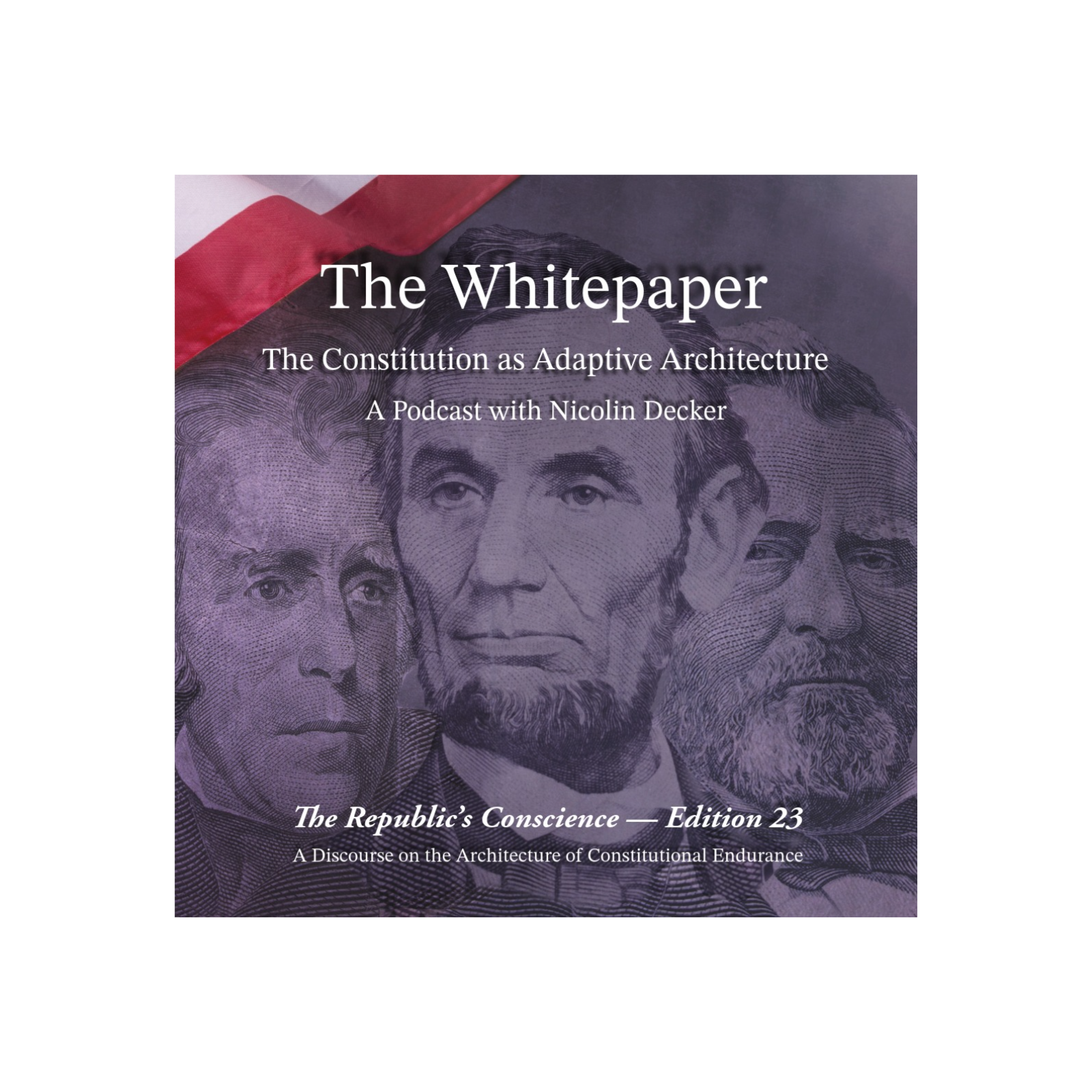
The Republic's Conscience — Edition 23: The Constitution as Adaptive Architecture — Part III.
from The Whitepaper
In this third edition of The Republic’s Conscience — The Constitution as Adaptive Architecture, Nicolin Decker examines Article V as the Constitution’s lawful recalibration mechanism.The episode argues that amendment is not replacement, adaptation is not abandonment, and constitutional change is not constitutional surrender.Rather than treating Article V as merely a procedural method for changing constitutional text, the episode frames it as an architectural safeguard: a mechanism that permits the Republic to adjust across time while preserving constitutional identity, legitimacy, and continuity.Within this framework, amendment thresholds—supermajority approval, federal ratification, distributed consent, and time—function as stability filters. They prevent temporary intensity, public pressure, visibility, or urgency from becoming permanent constitutional authority too easily.The episode concludes that Article V is indispensable, but not sufficient by itself. Constitutional survivability depends not only upon lawful structures, but also upon civic memory, interpretive clarity, and a people still able to understand what those structures were designed to preserve.🔹 Core InsightArticle V allows the Republic to adjust without dissolving, recalibrate without abandoning, and endure without becoming rigid.🔹 Key Themes• Article V — The amendment process as lawful recalibration• Amendment Logic — Constitutional change distinguished from replacement• Stability Filters — Supermajority approval, ratification, consent, and time• Constitutional Continuity — Preservation of identity across change• Temporal Filtration — Time as a safeguard against reaction• Lawful Adaptation — Change processed through constitutional form• Civic Understanding — The limits of text without public comprehension• Republican Survivability — Endurance through structure, restraint, and memory🔹 Why It MattersDay 3 shows that the Constitution remains adaptive not because it can be changed instantly, but because it governs how lawful change occurs. Article V preserves the balance between continuity and adaptation by ensuring that constitutional recalibration passes through durable, distributed, and legitimate processes before becoming part of the constitutional order.🔻 Series ContinuationWith Day 3, The Constitution as Adaptive Architecture moves from Adaptive Constitutional Continuity into amendment logic, showing how Article V operates as one of the Republic’s central mechanisms for lawful structural recalibration across generations.Read: The Constitution as Adaptive Architecture [Click Here]This is The Constitution as Adaptive Architecture.And this is The Republic’s Conscience.
NOW PLAYING
The Republic's Conscience — Edition 23: The Constitution as Adaptive Architecture — Part III.
No transcript for this episode yet
Similar Episodes
Mar 26, 2026 ·1m
Mar 19, 2026 ·34m
Feb 18, 2026 ·11m
Feb 11, 2026 ·45m