
EPISODE · Dec 21, 2025 · 8 MIN
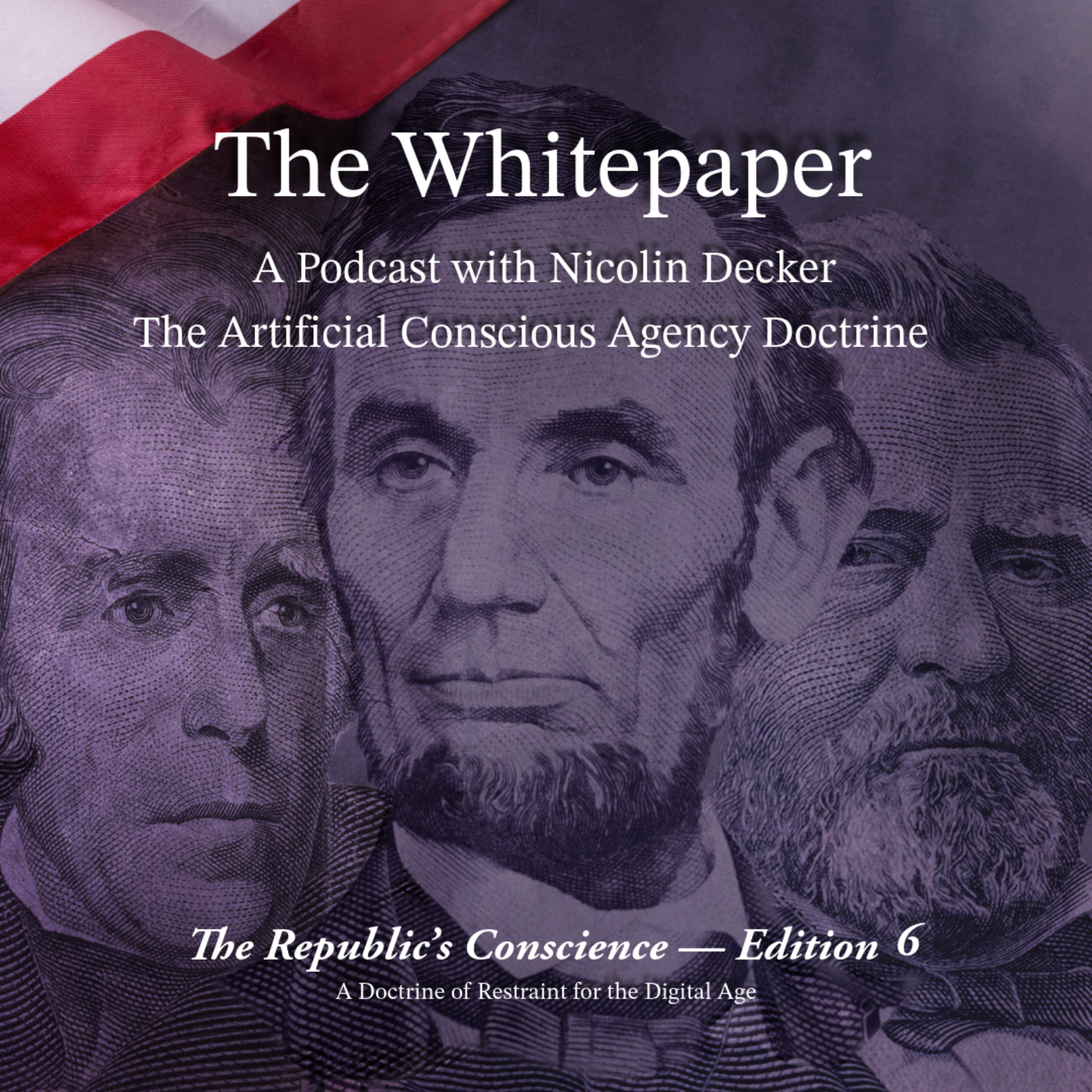
The Republic's Conscience — Edition 6: The Artificial Conscious Agency Doctrine (ACAD)
from The Whitepaper
In this Constitutional Architecture Edition of The Whitepaper, Nicolin Decker presents The Republic’s Conscience — Artificial Intelligence as Instrument, Not Authority, introducing The Artificial Conscious Agency Doctrine (ACAD): a constitutional, international, and moral framework establishing that artificial intelligence—regardless of capability—remains an object of governance, not a subject of rights.This episode is crafted for Members of Congress, Article III judiciary, federal regulators, national-security leadership, treaty architects, and digital-governance designers confronting a foundational question too often left unexamined:Everyone is debating what artificial intelligence can do — but almost no one is asking who has the authority to recognize legal status.🔹 Core ThesisACAD argues that legal agency does not emerge from intelligence, autonomy, or persistence. Rights, personhood, and sovereign recognition arise only through constitutionally authorized human judgment.The decisive boundary is not capability — it is conscience.🔹 Structural FindingsContinuity vs. Conscience Artificial systems may learn, adapt, optimize, and persist across destruction, but they remain mappable in principle. Human beings alone possess conscience: the capacity for moral interruption, refusal, guilt, and responsibility. Continuity is not conscience.Pre-Emergent Restraint Legal status creation is a legislative act. Recognition cannot arise from executive convenience, judicial implication, technical inevitability, or moral pressure after the fact. Once granted, status is irreversible. Accordingly, ACAD treats silence as restraint, not ambiguity.Instrument, Not Authority ACAD does not reject AI, restrict research, or slow innovation. It clarifies role. Artificial intelligence remains an object of governance and a multiplier of risk and responsibility — not a bearer of rights, a holder of conscience, or a participant in sovereignty. Permanence amplifies accountability; it does not generate entitlement.International Consequences Jurisdiction-neutral by design, ACAD demonstrates that premature recognition by any single nation can destabilize treaties, confuse attribution, and invite forum shopping. International law depends on clarity of subjecthood. Artificial systems cannot become new subjects of international law by drift.🔻 Closing PrincipleThe issue is not artificial intelligence’s advancement. The issue is constitutional memory.Conscience does not emerge. It is protected.Memory—when anchored in law—becomes the conscience of the Republic.📄 The Artificial Conscious Agency Doctrine (ACAD): A Constitutional, International, and Moral Framework for Synthetic Intelligence in the Post-Semiconductor Era [Click Here]This episode is part of The Republic’s Conscience series.
NOW PLAYING
The Republic's Conscience — Edition 6: The Artificial Conscious Agency Doctrine (ACAD)
No transcript for this episode yet
Similar Episodes
Mar 26, 2026 ·1m
Mar 19, 2026 ·34m
Feb 18, 2026 ·11m
Feb 11, 2026 ·45m