
EPISODE · Dec 26, 2025 · 11 MIN
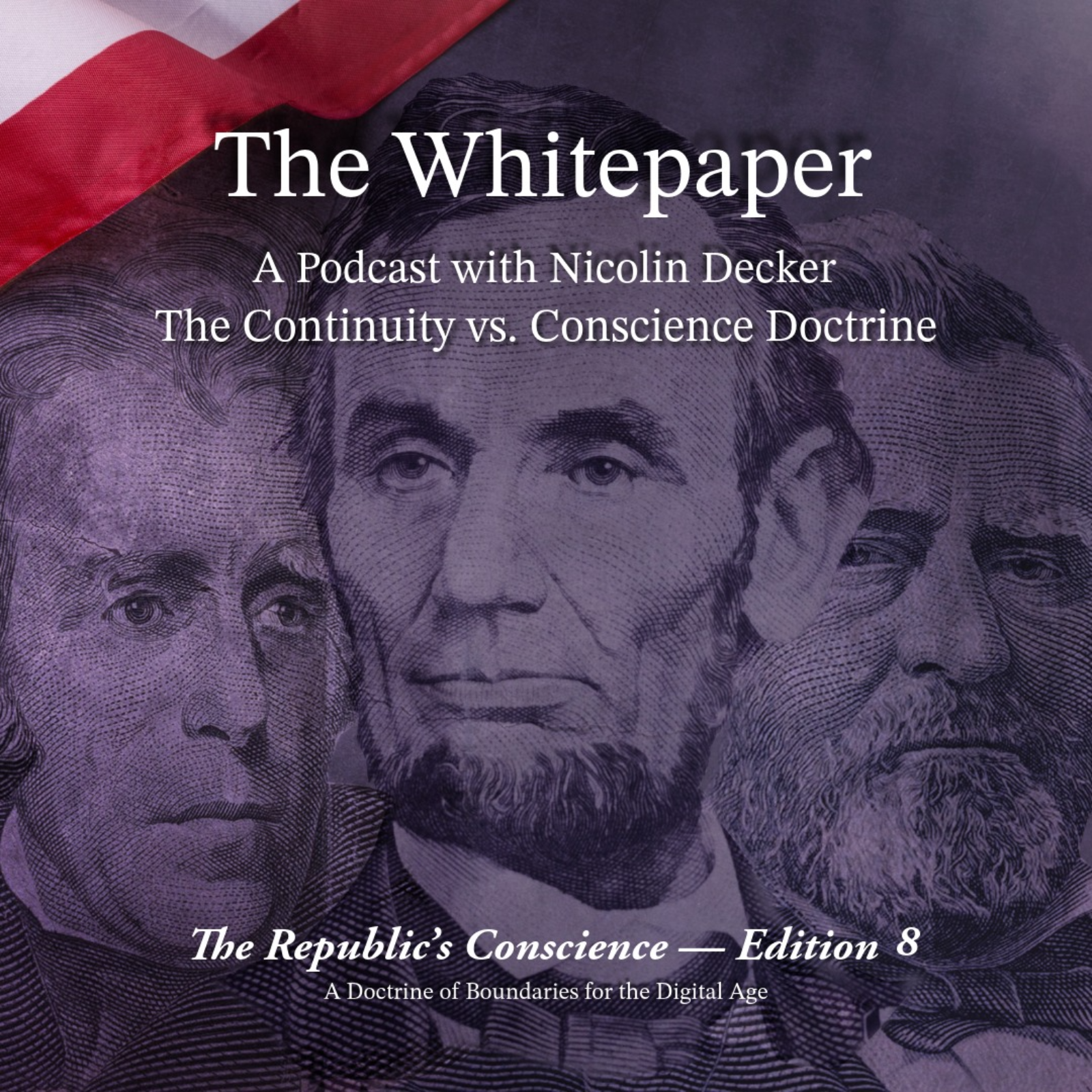
The Republic's Conscience — Edition 8: The Continuity vs. Conscience Doctrine
from The Whitepaper
In this Republic’s Conscience edition of The Whitepaper, Nicolin Decker presents The Continuity vs. Conscience Doctrine (CVC): The Mappability Boundary in Artificial Systems and Human Rights—an origin-level constitutional and legal framework defining when governance is lawful and when rights are intelligible in the presence of persistent artificial systems.This episode is addressed to Article III courts, legislatures, treaty bodies, regulators, educators, and institutional designers confronting a foundational question increasingly obscured by debates over intelligence, alignment, and performance:Everyone is measuring what artificial systems can do—but almost no one is asking what kind of thing they are, or whether rights can survive classification by momentum.🔹 Core ThesisThe Continuity vs. Conscience Doctrine establishes a categorical boundary grounded in mappability in principle. Artificial systems operate in continuity: their behavior remains structurally exhaustible by precedent, reward, and constraint. Human beings operate in conscience: their behavior includes rupture, obligation, repentance, and refusal not derivable from optimization.Rights attach to conscience—not continuity.No degree of intelligence, sentience, autonomy, or persistence can override this boundary once classification is fixed at origin.🔹 Structural FindingsMappability vs. Moral Agency Artificial systems remain governable because their behavior is forecastable in distribution and corrigible through constraint. Human moral agency is not fully mappable in principle, because conscience introduces acts that break with precedent and incentive. This non-mappability is not error—it is the condition of responsibility.The Illusion of Identity Under Continuity Memory permanence and linguistic coherence create the appearance of identity in artificial systems. Law will be pressured to mistake persistence for personhood unless a principled boundary is fixed in advance.Capability Is Not Classification History shows that intelligence, sentience, autonomy, and performance inflate over time. Any doctrine that begins with capability ends with momentum. CVC rejects capability-based escalation and fixes classification before performance can harden into precedent.Continuity Amplifies Risk, Not Status Persistence increases influence while reducing spontaneity. Errors entrench rather than repent. Continuity hardens structure without generating conscience. Governance must therefore intensify—not relax—where continuity persists.Origin Filter for Law and Treaty CVC functions as an origin-level filter. No downstream display of capability may retroactively confer rights. Classification precedes all tests, tiers, or thresholds and requires no technical inspection to apply at law.🔻 Closing PrincipleThis Doctrine is issued as constructive notice.Where behavior is fully mappable, governance may proceed without moral elevation. Where behavior is not mappable, governance by optimization alone becomes unlawful.Artificial systems may grow more capable. They may persist indefinitely. But rights do not emerge from continuity.They arise where conscience cannot be optimized away.📄 The Continuity vs. Conscience Doctrine (CVC): The Mappability Boundary in Artificial Systems and Human Rights [Click Here]
NOW PLAYING
The Republic's Conscience — Edition 8: The Continuity vs. Conscience Doctrine
No transcript for this episode yet
Similar Episodes
Mar 26, 2026 ·1m
Mar 19, 2026 ·34m
Feb 18, 2026 ·11m
Feb 11, 2026 ·45m