PodParley PodParley

The Saragossa Manuscript

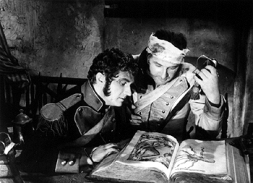
The Saragossa Manuscript, a 1965 film from Poland directed by Wojciech Has, became something of a cult favorite among younger American moviegoers at the time, dovetailing with the psychedelic era of the late 60s. After five decades we can see that it’s more sophisticated than the original fan base might have led us to believe. Attempting to make a film from the huge novel, completed in 1814, by Count Jan Potocki—a work containing over a hundred different tales—was an ambitious undertaking, to put it mildly. Has and his screenwriter Tadeusz Kwiatkowski pared the structure down to about ten major strands, filmed it in beautiful widescreen black & white, and produced a three hour epic with an intermission, a flawed but engaging ode to the picaresque that is truly one of a kind. In the midst of a battle during Napoleon’s war in Spain, a French officer stumbles upon a manuscript so fascinating that he barely looks up from his reading when Spanish troops burst in to the makeshift headquarters and capture him. A Spanish officer joins him in his reading, discovering that the book’s protagonist was his grandfather, a Belgian captain named Alfons van Worden. We then cut to the story of Alfons (played by the great Zbigniew Cybulski) who gets caught in a kind of supernatural loop as he tries to get to Madrid, is tempted by two Muslim princesses, converses with a distinguished mathematician, and dodges threats from the Inquisition, while suffering from the demonic influence of a couple of hanged men who keep coming back to life. Each character he meets has his or her own story, told in flashback, and as the movie goes on, characters within the stories tell their stories, in which other characters tell theirs, until we have flashbacks within flashbacks within….well, you get the idea. The director, Has, succeeds in capturing something of the 18th century love of surface, the playfulness of tale-telling mixed with ironic pedantry, familiar from authors such as Fielding or Diderot. If you’re paying attention, you may notice hints regarding the symbolism of the Cabala, a primary aspect of the novel. In the central role, Cybulski projects a naiveté that is quite charming, and the picture is beautiful to look at—the luscious widescreen compositions by cinematographer Mieczyslaw Jahoda have an almost classical purity. On the downside, the material inherently loses in depth what it attempts in range—it’s simply impossible for the film to achieve all its narrative goals. Yet you could do a lot worse than indulging in this riotous alternate universe for three hours. The Saragossa Manuscript has enough wit, or nerve, to avoid the trap of heaviness—it’s a light spectacle, a mock mini-epic, mysterious, absurd, and a great deal of fun. It’s available on DVD.

An episode of the Flicks with The Film Snob podcast, hosted by Chris Dashiell, titled "The Saragossa Manuscript" was published on May 8, 2014.

May 8, 2014 · Flicks with The Film Snob

0:00 / 0:00

The Saragossa Manuscript, a 1965 film from Poland directed by Wojciech Has, became something of a cult favorite among younger American moviegoers at the time, dovetailing with the psychedelic era of the late 60s. After five decades we can see that it’s more sophisticated than the original fan base might have led us to believe. Attempting to make a film from the huge novel, completed in 1814, by Count Jan Potocki—a work containing over a hundred different tales—was an ambitious undertaking, to put it mildly. Has and his screenwriter Tadeusz Kwiatkowski pared the structure down to about ten major strands, filmed it in beautiful widescreen black & white, and produced a three hour epic with an intermission, a flawed but engaging ode to the picaresque that is truly one of a kind. In the midst of a battle during Napoleon’s war in Spain, a French officer stumbles upon a manuscript so fascinating that he barely looks up from his reading when Spanish troops burst in to the makeshift headquarters and capture him. A Spanish officer joins him in his reading, discovering that the book’s protagonist was his grandfather, a Belgian captain named Alfons van Worden. We then cut to the story of Alfons (played by the great Zbigniew Cybulski) who gets caught in a kind of supernatural loop as he tries to get to Madrid, is tempted by two Muslim princesses, converses with a distinguished mathematician, and dodges threats from the Inquisition, while suffering from the demonic influence of a couple of hanged men who keep coming back to life. Each character he meets has his or her own story, told in flashback, and as the movie goes on, characters within the stories tell their stories, in which other characters tell theirs, until we have flashbacks within flashbacks within….well, you get the idea. The director, Has, succeeds in capturing something of the 18th century love of surface, the playfulness of tale-telling mixed with ironic pedantry, familiar from authors such as Fielding or Diderot. If you’re paying attention, you may notice hints regarding the symbolism of the Cabala, a primary aspect of the novel. In the central role, Cybulski projects a naiveté that is quite charming, and the picture is beautiful to look at—the luscious widescreen compositions by cinematographer Mieczyslaw Jahoda have an almost classical purity. On the downside, the material inherently loses in depth what it attempts in range—it’s simply impossible for the film to achieve all its narrative goals. Yet you could do a lot worse than indulging in this riotous alternate universe for three hours. The Saragossa Manuscript has enough wit, or nerve, to avoid the trap of heaviness—it’s a light spectacle, a mock mini-epic, mysterious, absurd, and a great deal of fun. It’s available on DVD.

saragossa    The Saragossa Manuscript, a 1965 film from Poland directed by Wojciech Has, became something of a cult favorite among younger American moviegoers at the time, dovetailing with the psychedelic era of the late 60s. After five decades we can see that it’s more sophisticated than the original fan base might have led us to believe.
Attempting to make a film from the huge novel, completed in 1814, by Count Jan Potocki—a work containing over a hundred different tales—was an ambitious undertaking, to put it mildly. Has and his screenwriter Tadeusz Kwiatkowski pared the structure down to about ten major strands, filmed it in beautiful widescreen black & white, and produced a three hour epic with an intermission, a flawed but engaging ode to the picaresque that is truly one of a kind.
In the midst of a battle during Napoleon’s war in Spain, a French officer stumbles upon a manuscript so fascinating that he barely looks up from his reading when Spanish troops burst in to the makeshift headquarters and capture him. A Spanish officer joins him in his reading, discovering that the book’s protagonist was his grandfather, a Belgian captain named Alfons van Worden. We then cut to the story of Alfons (played by the great Zbigniew Cybulski) who gets caught in a kind of supernatural loop as he tries to get to Madrid, is tempted by two Muslim princesses, converses with a distinguished mathematician, and dodges threats from the Inquisition, while suffering from the demonic influence of a couple of hanged men who keep coming back to life. Each character he meets has his or her own story, told in flashback, and as the movie goes on, characters within the stories tell their stories, in which other characters tell theirs, until we have flashbacks within flashbacks within….well, you get the idea.
The director, Has, succeeds in capturing something of the 18th century love of surface, the playfulness of tale-telling mixed with ironic pedantry, familiar from authors such as Fielding or Diderot. If you’re paying attention, you may notice hints regarding the symbolism of the Cabala, a primary aspect of the novel.
In the central role, Cybulski projects a naiveté that is quite charming, and the picture is beautiful to look at—the luscious widescreen compositions by cinematographer Mieczyslaw Jahoda have an almost classical purity. On the downside, the material inherently loses in depth what it attempts in range—it’s simply impossible for the film to achieve all its narrative goals. Yet you could do a lot worse than indulging in this riotous alternate universe for three hours. The Saragossa Manuscript has enough wit, or nerve, to avoid the trap of heaviness—it’s a light spectacle, a mock mini-epic, mysterious, absurd, and a great deal of fun. It’s available on DVD.

Future Flicks with Billiam The SomewhatNerdy Podcast Network Future Flicks is a podcast about flicks that come out, wait for it, in the future! In this podcast your host Billiam from SomewhatNerdy.com will go over all the movies coming out during the week, tell you his pick, and throw in his thoughts and occasionally trivia and news. He’ll also throw in a movie review every podcast or two for a suggestion on what to watch during a night in. So check out Future Flicks because why use Google to tell you what movies are coming out when you can have an opinionated Nerd do it for you. Box Office Premiere Podcasts Box Office is a weekly film show on Virgin Media Two, which takes a look at the pick of the flicks in cinemas, along with a host of fun film features. Flick Switch Flickswitch Flick Switch is far more than a rigging rental company. We have built our business on delivering high quality solutions with years of experience in a wide variety of markets, including film, television, live events, international touring and theatre.With our years of experience in audio, lighting, screens, sets, (and the list goes on) we can go further than just the support rigging. We are also able to rig the equipment too. Planning and installing the power and data distribution, fixtures, fly systems and other equipment, fine tuning, focusing and operating.When you engage Flick Switch yo Mark Fricks - The Road Less Traveled Mark Fricks Federal Employees - The Retirement Road Less Traveled with Financial Adviser and Federal Employee Advocate Mark Fricks. Mark Shares the mission behind the 2nd edition of The Book "The Road Less Traveled." This is a Financial Roadmap for Federal Employees seeking a secure retirement.
URL copied to clipboard!