
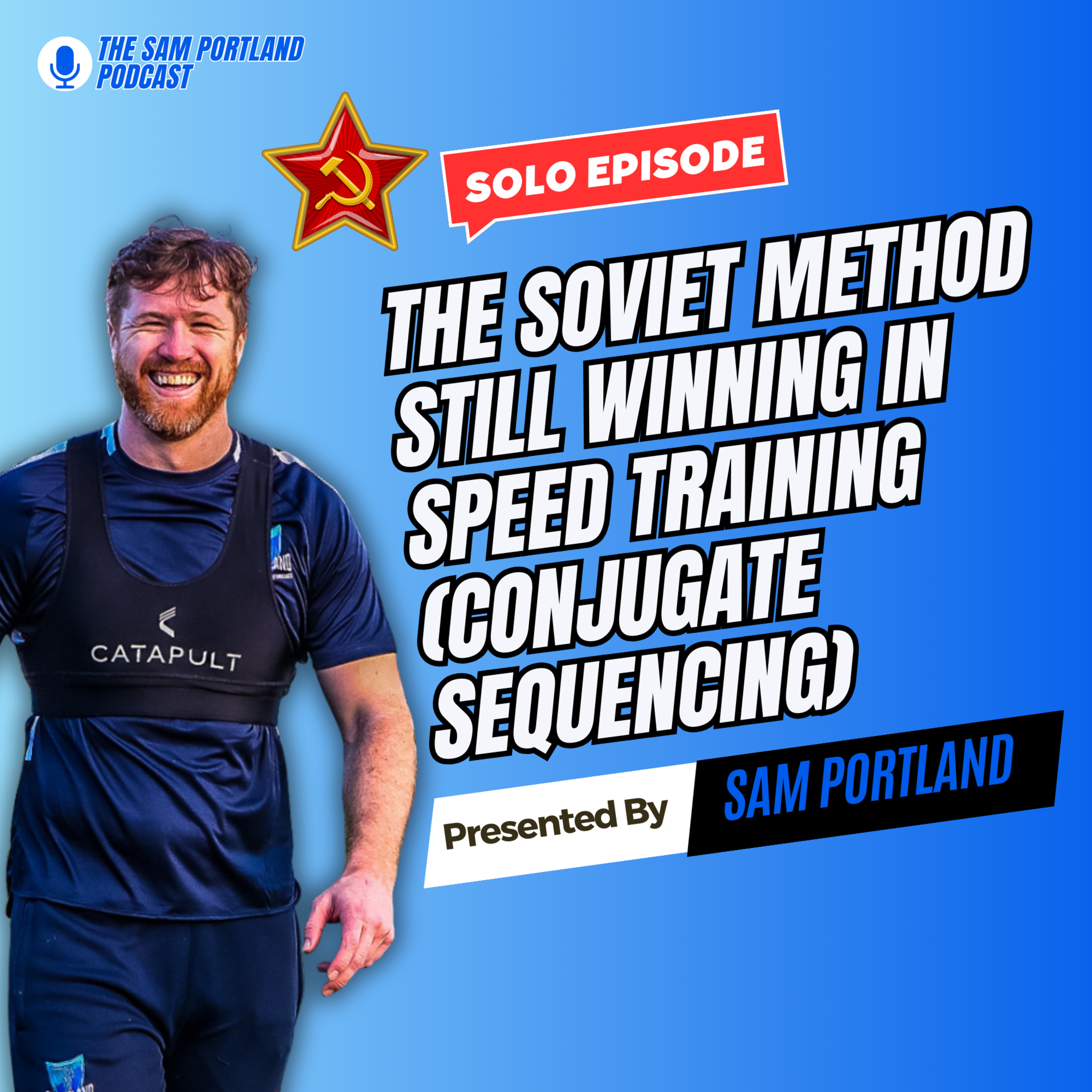
EPISODE · Dec 17, 2025 · 8 MIN
The Soviet Method Still Winning in Speed Training (Conjugate Sequencing)
from The Sam Portland Podcast · host Sam Portland
Welcome back to the Sam Portland Podcast, where we go beyond surface-level programming and break down how speed is actually developed.In this episode, we build on last week’s discussion around adaptation and intensity and introduce a critical (and often misunderstood) concept:Conjugate Sequencing.Most coaches struggle with one core problem:👉 How do you progress intensity without destroying athletes or stalling adaptation?This episode explains how to structure extensive and intensive training methods, layer different loading strategies, and apply former Soviet concepts (Verkhoshansky) to modern speed training.You’ll learn:• Why most training stays stuck in the “general” zone• How conjugate sequencing solves the intensity problem• Extensive vs intensive speed methods (clearly explained)• How to progress acceleration without killing max velocity• Why heavy resisted work must replace—not add to—earlier methods• How to structure 6–9 week speed blocks using the law of accommodation• Why speed itself is the metric that defines intensityIf you coach speed for team sports and want clarity, structure, and real transfer, this session will change how you plan training.⸻⏱️ Timestamps0:00 – Intro & lesson overview0:10 – Why intensity progression confuses most coaches0:32 – The danger of living in “general” training1:16 – Introducing conjugate sequencing1:33 – Soviet training origins and Verkhoshansky’s influence2:11 – Why gradual intensity steps are hard to create2:26 – Senior vs youth athlete intensity strategies3:03 – Extensive vs intensive training explained3:49 – Speed examples: tempo vs maximal work4:27 – Applying conjugate sequencing to acceleration4:53 – Learn, Load, Execute in practice5:13 – Law of accommodation and block sequencing5:36 – A simple 9-week speed progression example6:12 – Why heavy resisted work doesn’t equal max velocity6:39 – Extensive wall drills and early acceleration work7:02 – When to remove extensive work7:19 – Heavy resisted vs light resisted acceleration7:43 – Why speed defines intensity8:08 – Practical weekly programming task8:40 – Measuring progress through first-step explosiveness8:49 – What’s coming next week⸻🔗 Links📘 The Sports Speed Systemhttps://www.speedbysportland.com/sportsspeedsystembook⚡ Join the £9 Legacy Mastermindhttps://www.speedbysportland.com/legacy-mastermind-home
Embed this episode
Ready to play
The Soviet Method Still Winning in Speed Training (Conjugate Sequencing)
No transcript for this episode yet
Similar Episodes
No similar episodes found.
Similar Podcasts
No similar podcasts found.