
EPISODE · Jan 12, 2026 · 17 MIN
The Superkilonova Symphony: Merging Stars Inside Exploding Ones (AT2025ulz and S250818k)
from Multi-messenger astrophysics · host Astro-COLIBRI
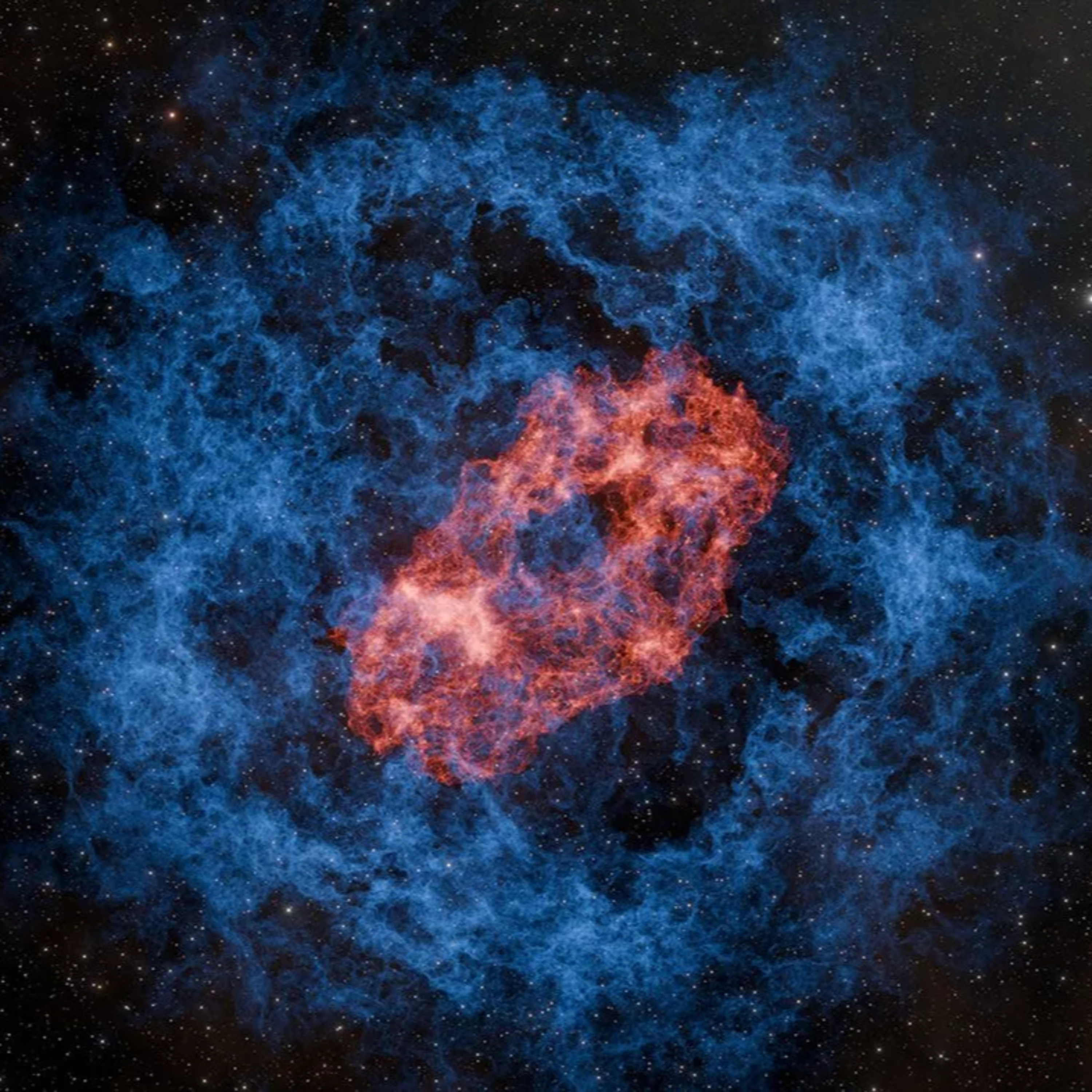
In this episode, we dive into a groundbreaking discovery that may have revealed a brand-new category of cosmic explosion: the Superkilonova. On August 18, 2025, gravitational-wave detectors picked up a signal, S250818k, indicating a merger between two neutron stars—but with a twist. The estimated "chirp mass" was surprisingly low, suggesting that at least one of the objects was below the mass of our Sun, a finding that challenges standard models of stellar evolution.The Optical Mystery:The Zwicky Transient Facility (ZTF) quickly identified a matching optical transient, AT2025ulz, in the same region. While its first week of behavior looked like a classic "kilonova" (the expected glow from a neutron star merger), it soon evolved into something much more complex. Spectroscopic and photometric data eventually showed it was most similar to a Type IIb stripped-envelope supernova, which is the explosion of a massive star that has lost most of its outer hydrogen.The Superkilonova Theory:How can an event be both a neutron star merger and a supernova? The researchers explore a fascinating theoretical model known as a Superkilonova. In this scenario, a rapidly spinning massive star collapses, and its core either fissions into two pieces or its surrounding disk fragments into subsolar-mass neutron stars. These fragments then merge almost immediately inside the supernova explosion. Key Highlights:A "Veritable Symphony": The potential for a single event to produce gravitational waves from a merger while simultaneously displaying the light of a core-collapse supernova.New Stellar Pathways: If confirmed, this proves that neutron stars can form via accretion-disk fragmentation, or it might even be evidence of primordial black holes.Multimessenger Challenges: Why scientists need more than just light to solve these puzzles, relying instead on a "panchromatic dataset" including X-rays, radio waves, and gravitational strain.Article ReferenceKasliwal, M. M., et al. (2025). "ZTF25abjmnps (AT2025ulz) and S250818k: A Candidate Superkilonova from a Subthreshold Subsolar Gravitational-wave Trigger." The Astrophysical Journal Letters, 995:L59 (18pp).Acknowledements: Podcast prepared with Google/NotebookLM. Illustration credits: Caltech/K. Miller and R. Hurt (IPAC)
Embed this episode
Ready to play
The Superkilonova Symphony: Merging Stars Inside Exploding Ones (AT2025ulz and S250818k)
No transcript for this episode yet
Similar Episodes
No similar episodes found.
Similar Podcasts
No similar podcasts found.