
EPISODE · Jun 3, 2026 · 35 MIN
The United Nations of Liquidity
from Janus Dispatch Podcast · host Janus The Watcher
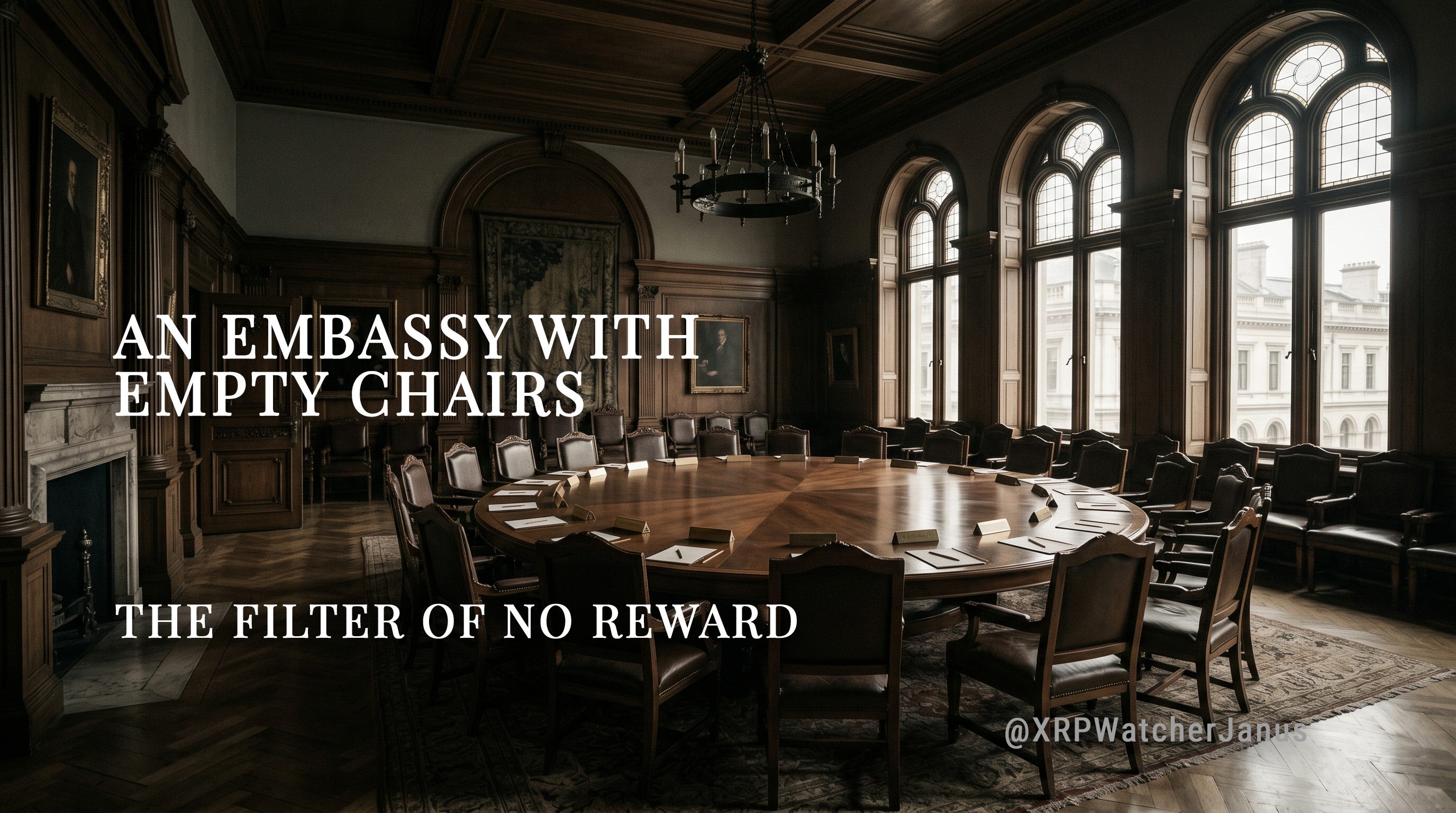
On 30 March 2026 the Eurosystem began accepting DLT-issued securities as collateral for central bank credit. Six weeks later, on 12 May, the Bank for International Settlements handed its top governance roles to the central bank governors of Italy, Brazil, Australia and Japan. In between, McKinsey put a clock on the decade: if one of the competing coalitions closes the interoperability gap between tokenized-money systems during 2026, near-instant commercial bank money stops being a pilot and becomes the rail — set against the four trillion dollars a year already moving through tokenized-deposit infrastructure. The institutions that run global settlement have stopped asking whether value moves on-chain. They are fighting over whose chain it moves on.Two of those four economies already sit close to the rails in contention — Brazil, where Ripple’s settlement infrastructure is live on the XRP Ledger, and Japan, where SBI is a premier member and super validator inside the rival Canton consortium. The appointments are not about XRPL. They mark who now sets the agenda for the system XRPL is trying to join.The contenders are not equivalent. The institutional frontrunner is Canton — built by Digital Asset, run by a consortium that already includes DTCC, BNY, Goldman Sachs and Franklin Templeton, a permissioned network governed by the institutions that use it. Against it stands the federation model: Cosmos and its IBC protocol, sovereign chains joined by neutral messaging with no shared settlement asset underneath. The XRP Ledger belongs to neither camp, which is why almost everyone files it under the wrong heading. It gets called a decentralized network that failed to decentralize. It is something stranger, and the strangeness is the entire point.Every settlement layer has a constituency. The question is who you have agreed to count, and whether you knew you were voting. Bitcoin’s constituency is its miners, paid in newly issued coin and fees. Ethereum’s is its validators, paid in staked yield and tips. Both route economic reward to the people who keep the lights on; the door is open in principle and paid for in practice. The XRP Ledger does not work this way — and reading why is the fastest route to seeing which of those architectures can actually become neutral global infrastructure, and which only looks like it can.This is the claim I will defend: the XRP Ledger is not a failed decentralization but a pre-institutional one. Its architecture — eighty-percent amendment consensus over a curated validator set — is the embryonic form of a multilateral governance body for global settlement. It looks fragile because its constituents have not arrived. The seats have been built; most of them are empty. Whether that reading survives the strongest objections is what the rest of this essay tests, and I will name, at the close, the conditions under which it is simply wrong.Act I — Who Governs TodayBegin with the mechanism, because the mechanism does most of the work.XRPL amendments — changes to the protocol — require eighty percent of the validator set to vote in favour, sustained over a two-week window, before they activate. A single validator opposed is irrelevant; a fifth of the set opposed is enough to block any change. The threshold is not a policy decision the foundation can override. It is the protocol’s own immune system. As of June 2026 the default list carries roughly three dozen validators — the XRP Ledger Foundation’s published dUNL sets a consensus quorum of 28, which is eighty percent of a 35-name list. The supermajority is not a slogan; it is a hard-coded integer.A recent example is https://xrpscan.com/amendment/fixPriceOracleOrderThe validator set itself is governed by Unique Node Lists. A node operator does not have to trust every other node on the network; she trusts a list, and the list trusts the validators on it. The default list — the dUNL — is published by Ripple and the XRP Ledger Foundation, and any operator who subscribes to it is, in effect, delegating their consensus participation to that list. Other publishers exist; in practice, the default list is what most of the network runs on. Transaction costs are burned, not routed to validators. The door is open in principle; entry is by invitation. The ledger’s architect, David Schwartz, has framed this absence of reward as a design choice rather than an omission — the best incentive is no incentive — on the logic that a validator with nothing to extract has nothing to collude over. That claim is the hinge this essay turns on, and it deserves both the strongest attack and a better defense than its author gives it.Who sits on the list today is the part rarely examined in the same breath as the mechanism it controls. Universities, technology companies, independent engineers, a handful of operators with no obvious commercial exposure to the chain’s continued operation. They run validators because they care about distributed systems, because their research benefits from the access, because the foundation asked them, because the cost of running one is low. None of them are paid in XRP for doing the work. The transaction-cost burn — the closest thing to a fee market — flows into the void, not into their pockets.The framing this produces, in public conversation, is incoherent. The XRPL is described as decentralized because no single party controls more than a few validators. It is simultaneously described as centralized because the foundation curates the list. Both descriptions are technically true and neither captures the actual position, which is that the network is governed by a small council of unpaid constituents whose terms of service are mostly intrinsic. That is not a description of either centralization or decentralization. It is a description of a club.The vocabulary fails because we keep trying to read XRPL through the Bitcoin lens — an open mining set with paid incentives that anyone can compete for. XRPL is something else. The right comparison is not Bitcoin. The right comparison is a treaty body. Its members are not in it for the per-block reward. They are in it because the existence of the body matters to them. The question this raises — and that the rest of this essay answers — is whether that arrangement is structurally fragile or whether it is the early form of something we do not yet have a name for.Act II — The Fragility ProblemThe standard critique of XRPL governance arrives quickly and lands with force. It deserves to be stated in its strongest form before any rebuttal.The critique runs as follows. A network with no payment to its validators has no sustainable validator set. People who run nodes for free will eventually stop — when the research grant ends, when the operator’s institutional priorities shift. There is no economic gravity holding the constituency in place. The set will erode by attrition until it is too small to remain credibly distributed, at which point the network’s security model collapses into pure trust in the curator. The curator becomes the system.A subset of this critique is technical. If the validator set falls below the threshold required to make progress, the network halts. The XRPL is designed to stop producing ledgers rather than produce inconsistent ones — a sensible engineering choice — but it means the failure mode is not gradual degradation. It is abrupt freeze. A coordinated departure of even a small number of dUNL validators could trigger a multi-hour outage on a chain meant to be settlement infrastructure for institutional value.A second subset is political. If the curator chooses the validators, the curator chooses the governance outcomes. The eighty-percent threshold is meaningful only if the underlying set is independently composed. If the foundation can quietly recompose the list, then “eighty percent of the validators agreed” reduces to “the foundation agreed.” Amendment consensus becomes theatre.All of this is correct as far as it goes, and it is not a small distance. The recent academic literature on decentralized value capture has begun to formalize the underlying problem: networks that fail to route external use value to their critical incentive layer cannot demonstrate that the layer is funded, regardless of how much value the network nominally captures elsewhere. Bitcoin closes its routing problem through block reward plus fees. Ethereum closes its through staking yield. XRPL does not close its routing problem. The transaction cost is burned, and burn — whatever else it does for supply or scarcity — is not payment to the people running the validators.There is no answer to this critique within the Bitcoin-Ethereum vocabulary. If the test is whether economic value reaches the constituency, the XRPL fails it. The case for XRPL governance cannot be that it secretly passes this test. It has to be that the test is asking the wrong question.Act III — The Institutional Eighty PercentThe wrong question is whether validators are paid. The right question is who has reason to be a validator even when they are not.Consider the United Nations. The General Assembly is not a profit centre. Member states do not receive a per-vote subsidy. They pay assessed dues, send personnel, host delegations, and absorb the operational cost of participating in a body that does not, in any direct accounting sense, return cash to them. They do this because membership has strategic value — agenda setting, vote bargaining, soft power, the right to be in the room when decisions are made about systems they depend on. The constituency is sustained by the intrinsic value of belonging to it.Now ask the question this essay was written to ask. What would the XRP Ledger look like if its validator set were composed not of universities and tech companies but of the institutions that already depend on global settlement infrastructure? Central banks — the Federal Reserve, the European Central Bank, the Bank of Japan, the People’s Bank of China, the Swiss National Bank, the Bank of England, the Reserve Bank of India. Major commercial banks — Deutsche Bank, HSBC, JPMorgan, Standard Chartered, the institutions whose cross-border flows would route over any neutral settlement layer that achieves scale. Major corporate users of settlement — Amazon for supply chain payments, Google for cloud infrastructure settlement, Apple for consumer payment rails, Tesla for energy market settlement. The existing technology stewards — Ripple and the XRP Ledger Foundation.Now ask whether any of these institutions would need to be paid to run a validator. The cost of operating one is trivial against their balance sheets. The strategic value of being inside the amendment-consensus process for a settlement layer they depend on is not. A central bank that uses XRPL for cross-border settlement has every reason to host a validator and no reason to expect compensation — the same way it hosts a seat at the BIS without billing for it. A commercial bank with material exposure to the chain’s continued operation does not need a per-block reward to justify the marginal cost of a node. The reward is the agenda-setting power that comes with being among the eighty percent.This is not a hypothetical reordering imposed from outside. It is a reading of what the mechanism already implies. The eighty-percent amendment threshold over a curated set is not a workaround for the absence of mining incentives. It is the wrong tool if you wanted Bitcoin. It is exactly the right tool if you wanted a multilateral consensus body. The architecture has been describing this constituency the whole time. It has just been waiting for the constituency to show up.The principle that emerges is simple: who uses the settlement layer should govern the settlement layer. The cost of governance is internalized by the user. The benefit of governance — predictability, and veto power over rules that would damage one’s own operations — is captured by the user. The institution that runs the validator is the institution that has to live with what the validator agrees to. That alignment, not external payment, is the sustainability mechanism. This is where the architect’s slogan earns a stronger reading than he gives it. The best incentive is no incentive holds — but not only because unpaid validators have nothing to extract. It holds because payment would select for the wrong members. Pay validators and you recruit whoever wants the payment; withhold it and the only entities who take a seat are the ones who need the system to exist. Absence of reward is not merely a security property. It is a filter.Act IV — Amendments as TreatiesIf the validator set is composed of institutions with skin in the game, the meaning of the amendment process changes. Amendments are no longer technical updates pushed by core developers and rubber-stamped by a polite consensus of node operators. They become multilateral negotiations between sovereigns over the rules of a system they all use.The closest historical analogue is the Bretton Woods system, and the analogy is not casual. Bretton Woods organized the post-war monetary order around a small set of dominant economies whose continued cooperation was required to keep the system functioning. Member states held veto power not because the constitutional text granted it but because their absence would have collapsed the system. The institutions that emerged — the IMF, the World Bank, the GATT, and the stillborn International Trade Organization — were not centralized monopolies and not decentralized commons. They were treaty bodies, governed by consensus among a constituency that was self-selecting on the basis of usage and self-disciplining on the basis of mutual exposure.XRPL amendment consensus is structurally the same shape. Twenty percent of the set can block. Eighty percent has to agree. The threshold is not majority rule; it is supermajority with veto. That is the constitutional design of every functioning multilateral organization since the Congress of Vienna. It is what you build when you want changes to be possible but never unilateral.This has two consequences that matter for the network’s future, and both run against the standard critique.The first is that stability through inertia is a feature, not a bug. A settlement layer that can be amended quickly is a settlement layer that can be hijacked quickly. The slowness critics describe as bureaucratic ossification is what makes the system credible as infrastructure. Banks do not want fast-moving settlement rails. They want rails that did the same thing yesterday as they do tomorrow, that cannot be unilaterally changed by a foundation or a single sovereign. The two-week window and the eighty-percent threshold purchase exactly that property.The second is that veto power above twenty percent prevents the system from being captured by any single bloc. If the constituency includes Fed, ECB, PBoC, BoJ, and the largest commercial banks, no national or political faction can amend the protocol unilaterally. The United States cannot force a sanctions-enforcement amendment over Chinese objection, and China cannot force a capital-controls amendment over American objection. The system is constitutionally non-aligned, by the same mechanism that makes the General Assembly non-aligned: no one party owns the consensus, and the cost of change is high enough that it happens only when the legitimate constituency actually wants it.Read this way, the XRPL is not a chain that failed to bootstrap economic security. It is a chain that bootstrapped the wrong constituency and is waiting for the right one. The transition from “thirty-five universities and tech companies” to “thirty-five central banks, major commercial banks, and corporate users” is not an architectural change. It is a constituency change. The architecture is already correct for the destination.Act V — The Tenth Man SpeaksThis essay has, until now, made the strongest version of the case. The Tenth Man Rule requires that the strongest version be subjected to its own strongest counter. There are five counters that have to be taken seriously.The first is geopolitical paralysis. The same veto power that prevents capture also prevents action. The United Nations Security Council has not passed a substantive resolution on a major-power conflict in decades, precisely because the design that prevents domination also prevents decision. A validator set composed of the Federal Reserve and the People’s Bank of China would face exactly this dynamic at every contested amendment. In a fragmenting world, the moments when neutral settlement rails would be most valuable are precisely the moments when the constituency would be least able to agree on changes to them. The body works as long as nothing important is at stake. When something important is at stake, the body freezes.The second is bureaucratic ossification. The argument that inertia is a feature assumes the technical environment is stable enough that the protocol rarely needs to change. That assumption is currently optimistic. Cryptographic standards age and performance bottlenecks emerge. Adversarial techniques evolve faster than slow governance can answer them. A settlement layer that takes a decade to update its consensus algorithm becomes obsolete faster than its replacement competitors. Bitcoin’s slow upgrade cadence is held up as evidence of its credibility, but Bitcoin also pays for that slowness with a programmability gap that other systems have now filled. The XRPL might purchase credibility at the price of relevance.The third is capture risk. The vision of a validator set composed of central banks and major corporate users is the vision of a network whose constituency is, by composition, the existing financial establishment. The whole reason a neutral settlement layer matters — the reason this essay began with Bretton Woods — is that the existing establishment is exactly what the multi-polar world is trying to route around. If the eighty percent is composed of the institutions that benefit most from the dollar order, it will not be a neutral settlement layer for the world. It will be a more legitimate version of the dollar order, dressed in multilateral clothing.The fourth is curation persistence. The eighty-percent threshold is only meaningful if the underlying set is independently composed. As long as the dUNL is curated by Ripple and the foundation, those parties retain the power to determine outcomes by determining membership. Moving to an institutional constituency does not eliminate this problem; it changes who is selected. Bretton Woods worked because the founding members were already empirically sovereign — there was no curator with the power to add or remove the United States or the United Kingdom. The XRPL has no analogous guarantee that an institutional eighty percent, once assembled, cannot be quietly recomposed by the entity that built the list. Stated without the diplomatic framing: as long as Ripple and the foundation write the list, this is not a treaty body. It is an absolute monarchy with empty chairs, and every argument in this essay describes only what that monarchy could become if it agreed to abolish itself.The fifth is the objection a motivated builder makes, and it is the sharpest. If institutions find the eighty-percent treaty architecture so attractive, why adopt the XRP Ledger at all? The code is open source. A consortium of central banks could fork it, start a sterile genesis UNL of thirty-five sovereign validators, name a wholesale CBDC as the base asset, and owe nothing to Ripple — a US company — or to the billions in retail XRP whose volatility they would otherwise import. Why take a single seat on someone else’s list when you could own the whole list?The answer is the same reason the question dissolves Cosmos. A fork inherits the code but not the liquidity, and a settlement layer without deep neutral liquidity is a database with a voting ritual attached. The value of a settlement asset is not its ledger; it is the depth of the market that will accept it on the far side of a cross-border leg at three in the morning. A freshly minted sovereign fork has no float, no market makers, no incumbent corridors, no reason for a counterparty to hold it overnight. It has a genesis block and a press release. The retail XRP the builder wants to escape is the same float that makes the asset usable as a bridge in the first place. Strip it out and you have rebuilt Cosmos: sovereign chains, neutral messaging, isolated liquidity, and no base asset to bridge them. The fork is technically trivial and economically stillborn. That is precisely why the incumbents who could fork it have not.These five counters do not refute the thesis. They locate it. The institutional UNL is not a guaranteed future. It is one path among several, and the path has clear failure modes that must be designed against rather than waved away. The architecture is necessary but not sufficient: the eighty-percent mechanism over a credible institutional constituency is a precondition for a neutral global settlement layer, but the constituency itself has to be composed in a way the architecture cannot guarantee. Getting the right set onto the list, and keeping the curator’s hand off it once they are there, is not the protocol’s work. It is governance work in the older sense — political, deliberative, slow, never finished.Act VI — When and How, Not IfThis essay began by saying the XRPL’s empty seats are not a sign of failure. They are seats waiting to be filled. The closing question is which architecture the institutions actually arrive at, and on what timeline.The current institutional default is Canton — a permissioned consortium chain governed by the major banks themselves. That is a legitimate answer to the interoperability question, and it carries the considerable advantage of already having institutional buy-in. But it answers the question by re-creating, in tokenized form, the trust structure the multi-polar world is increasingly suspicious of. A walled garden curated by a Wall Street consortium is functional for participants who already trust that consortium. It is structurally incapable of being the neutral layer for participants who do not.The federation answer, represented by Cosmos and its IBC protocol, is structurally different — sovereign chains connected by a neutral messaging protocol. But IBC is messaging. It is not a settlement asset. It transports value; it does not bridge it. What flows between the chains is the whole game, and the only liquid answer available today is a regulated USD stablecoin — which drags the issuer-counterparty problem back into the middle of a system built to escape it.The XRPL answer, if it materializes, is different again. It is a shared constituency that votes on the rules of a shared layer, with veto rights distributed widely enough that no single party can unilaterally amend the system. The settlement asset is the native asset of the consensus body, not the liability of any member. The transaction cost is burned because the validators are not vendors but members, paid in standing rather than in fees.This is the digital Bretton Woods reading, and it is the version of XRPL the architecture has been pointing toward without anyone naming it. The questions it raises are not technical. They are political. Who decides which central banks and corporates sit on the list? On what basis is membership granted and on what basis revoked? How does the network reconcile the tension between needing institutional members — for credibility and intrinsic constituency — and needing non-aligned actors, for real multilateral neutrality? These are not problems the protocol solves. They are problems it creates space for, and the work of solving them belongs to whoever decides to take the seats.That work has not begun in any formal sense. The current dUNL curators have not, to public knowledge, proposed a transition path from the academic-and-enthusiast constituency to an institutional one. The institutional candidates have not, to public knowledge, requested seats. The architecture is ready, and the constituency is absent.So here is the falsification, stated plainly enough to hold me to it. If the McKinsey interoperability window closes the wrong way — if by the end of 2027 one coalition has won, and the winner is Canton or a bank-consortium chain absorbing wholesale tokenized volume while the dUNL still reads as a list of universities and enthusiasts — then this architecture did not describe a pre-institutional body. It described a dead end with good acoustics, and this essay was wrong. The seats were not waiting to be filled. They were never seats.This is the moment at which essays usually end with a call to action. The temptation is to write that central banks should run validators, that the foundation should publish a transparent path from the current set to a target set. All of that is true, and all of it sounds like a lecture, and a lecture is the wrong shape for this question. The institutions that will or will not occupy the seats will not be persuaded by an essay. They will arrive when their own balance of constraints — interoperability pressure and the geopolitical incentive to escape unilateral US control over financial infrastructure — makes arrival cheaper than continuing to do without.The case this essay has tried to make is that when they arrive, the architecture they find is not a failed Bitcoin. It is the unstaffed embassy of a system that does not yet exist. The chairs are arranged. The voting threshold is set. The amendment process is described in a way that already presumes the kind of constituency that would make it credible. The eighty percent is waiting for who shows up.The question of whether nation states should become validators is therefore not the right question, because it presupposes they have a choice. The right question is whether the institutions that already depend on global settlement infrastructure can keep avoiding the seat they have already been allocated. As the rest of the system continues to fragment, the answer is increasingly that they cannot.The United Nations of Liquidity is not a future the architecture is reaching toward. It is a present the architecture is describing. The reason the building looks empty is that we have spent a decade telling each other it was supposed to be a coffee shop.— J.Disclaimer: Janus The Watcher tracks liquidity flows beyond nation-state and tokenomics marketing. Not financial advice. Do your own research. Positions disclosed: I hold XRP.Janus runs 1:1 Confrontation — sixty minutes, one decision, no follow-up. For people who carry responsibility and want their thinking taken apart before it costs them.janusthewatcher.substack.com/p/11-confrontationOne sentence is enough. This is a public episode. If you would like to discuss this with other subscribers or get access to bonus episodes, visit janusthewatcher.substack.com
NOW PLAYING
The United Nations of Liquidity
No transcript for this episode yet
Similar Episodes
No similar episodes found.
Similar Podcasts
No similar podcasts found.