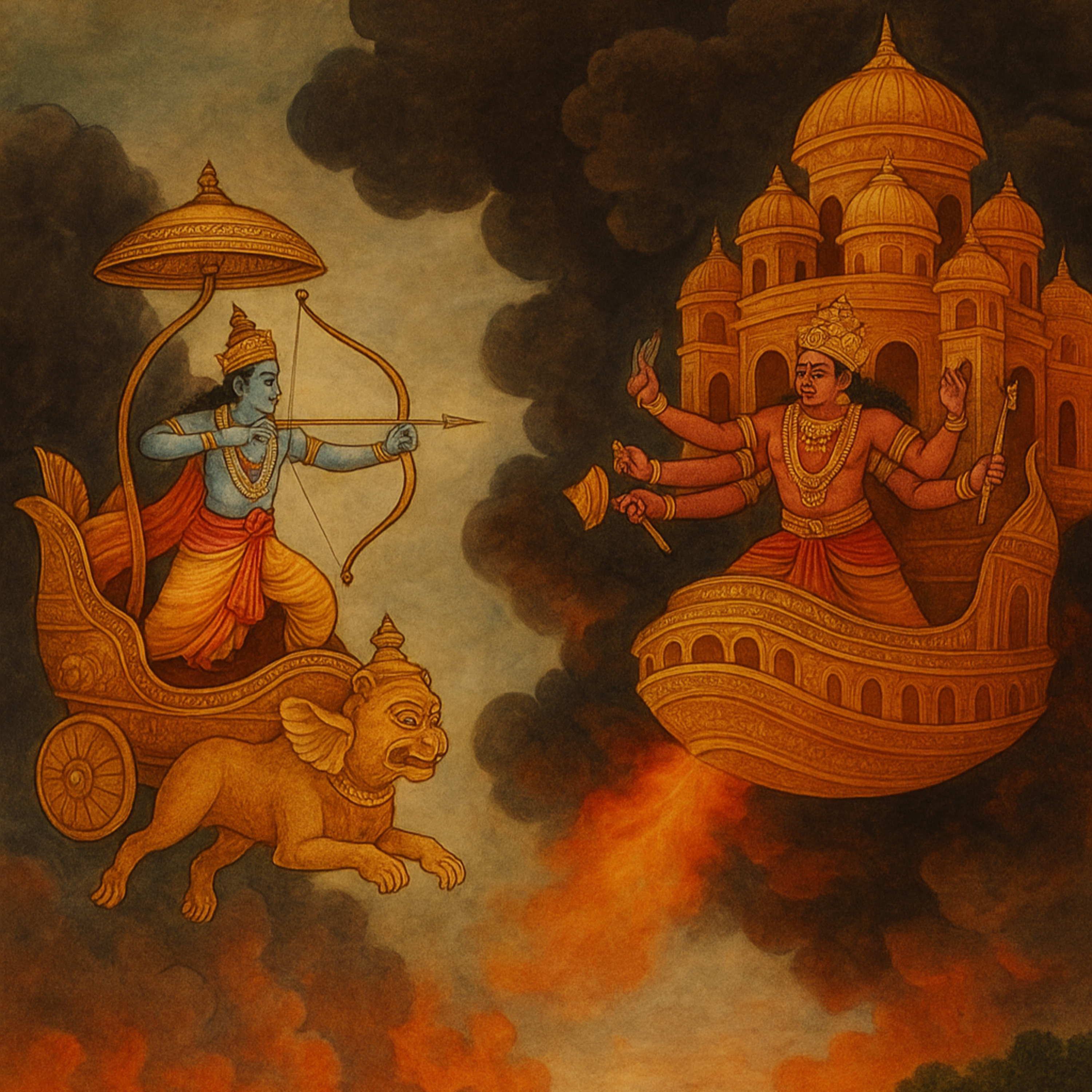
The Vimāna Wars: Chariots of Fire episode artwork

EPISODE · Oct 6, 2025 · 18 MIN

The Vimāna Wars: Chariots of Fire

from Time Machine Diaries: Ancient Civilizations & Future World Predictions. · host CNC Productions

Vimāna (vi-MAH-nah): Flying chariot or palace. Think UFO + luxury yacht.Astra (AH-struh): Divine weapon activated by mantra; arrows that become fire, storms, or floods.Vajra (VAHJ-rah): Indra’s thunderbolt cannon, reusable lightning strike.Gāṇḍīva (gahn-DEE-vah): Arjuna’s legendary bow, endless arrows.Māyā (MAH-yah): Illusions and deception on the battlefield.Pushpaka (POOSH-puh-kah): Rāvaṇa’s flying palace, stolen from the gods.Śakti (SHAHK-tee): Karna’s one-shot spear of destruction.Pāśupata Astra (pah-SHOO-puh-tah AH-struh): Śiva’s ultimate doomsday weapon, apocalypse in a mantra.Dharma (DURR-mah): The principle of cosmic order, balance, and duty.The Sanskrit epics weren’t just poetry, they were warnings. Flying palaces, thunderbolt cannons, serpent-weapons, and arrows that split into firestorms. Were they myths, or records of something we’ve lost? In this episode, we rip open the Mahābhārata and Rāmāyaṇa to uncover the wars of the sky — Vimānas, astras, gods, demons, and the first doctrines of annihilation.From Arjuna’s sky duels to Rāvaṇa’s stolen Pushpaka palace, from Karna’s one-shot curse to Śiva handing over the ultimate doomsday weapon, this is ancient war told in modern voice, cinematic, unfiltered, and relentless. patreon.com/THO420Campbell, Joseph. The Masks of God. Viking Press, 1959–1968.Childress, David Hatcher. Vimana: Aircraft of Ancient India and Atlantis. Adventures Unlimited Press, 1991.Debroy, Bibek, translator. The Mahabharata. Penguin Books India, 2010–2014.de Santillana, Giorgio, and Hertha von Dechend. Hamlet’s Mill: An Essay on Myth and the Frame of Time. Gambit, 1969.Ganguli, Kisari Mohan, translator. The Mahabharata of Krishna-Dwaipayana Vyasa. P.C. Roy, 1883–1896.Hiltebeitel, Alf. Reading the Fifth Veda: Studies on the Mahābhārata. Brill, 2011.Kak, Subhash. “The Astronomical Code of the Rigveda.” Munshiram Manoharlal Publishers, 2000.Menon, Ramesh. The Ramayana: A Modern Retelling of the Great Indian Epic. North Point Press, 2004.Sattar, Arshia, translator. The Ramayana. Penguin Classics, 1996.Shulman, David. The Wisdom of Poets: Studies in Tamil, Telugu, and Sanskrit. Oxford University Press, 2001.von Däniken, Erich. Chariots of the Gods? Unsolved Mysteries of the Past. Putnam, 1968.https://davidhatcherchildress.com/

Vimāna (vi-MAH-nah): Flying chariot or palace. Think UFO + luxury yacht.Astra (AH-struh): Divine weapon activated by mantra; arrows that become fire, storms, or floods.Vajra (VAHJ-rah): Indra’s thunderbolt cannon, reusable lightning strike.Gāṇḍīva (gahn-DEE-vah): Arjuna’s legendary bow, endless arrows.Māyā (MAH-yah): Illusions and deception on the battlefield.Pushpaka (POOSH-puh-kah): Rāvaṇa’s flying palace, stolen from the gods.Śakti (SHAHK-tee): Karna’s one-shot spear of destruction.Pāśupata Astra (pah-SHOO-puh-tah AH-struh): Śiva’s ultimate doomsday weapon, apocalypse in a mantra.Dharma (DURR-mah): The principle of cosmic order, balance, and duty.The Sanskrit epics weren’t just poetry, they were warnings. Flying palaces, thunderbolt cannons, serpent-weapons, and arrows that split into firestorms. Were they myths, or records of something we’ve lost? In this episode, we rip open the Mahābhārata and Rāmāyaṇa to uncover the wars of the sky — Vimānas, astras, gods, demons, and the first doctrines of annihilation.From Arjuna’s sky duels to Rāvaṇa’s stolen Pushpaka palace, from Karna’s one-shot curse to Śiva handing over the ultimate doomsday weapon, this is ancient war told in modern voice, cinematic, unfiltered, and relentless. patreon.com/THO420Campbell, Joseph. The Masks of God. Viking Press, 1959–1968.Childress, David Hatcher. Vimana: Aircraft of Ancient India and Atlantis. Adventures Unlimited Press, 1991.Debroy, Bibek, translator. The Mahabharata. Penguin Books India, 2010–2014.de Santillana, Giorgio, and Hertha von Dechend. Hamlet’s Mill: An Essay on Myth and the Frame of Time. Gambit, 1969.Ganguli, Kisari Mohan, translator. The Mahabharata of Krishna-Dwaipayana Vyasa. P.C. Roy, 1883–1896.Hiltebeitel, Alf. Reading the Fifth Veda: Studies on the Mahābhārata. Brill, 2011.Kak, Subhash. “The Astronomical Code of the Rigveda.” Munshiram Manoharlal Publishers, 2000.Menon, Ramesh. The Ramayana: A Modern Retelling of the Great Indian Epic. North Point Press, 2004.Sattar, Arshia, translator. The Ramayana. Penguin Classics, 1996.Shulman, David. The Wisdom of Poets: Studies in Tamil, Telugu, and Sanskrit. Oxford University Press, 2001.von Däniken, Erich. Chariots of the Gods? Unsolved Mysteries of the Past. Putnam, 1968.https://davidhatcherchildress.com/

NOW PLAYING

The Vimāna Wars: Chariots of Fire

0:00 18:10

No transcript for this episode yet

We transcribe on demand. Request one and we'll notify you when it's ready — usually under 10 minutes.

No similar episodes found.

No similar podcasts found.

Frequently Asked Questions

How long is this episode of Time Machine Diaries: Ancient Civilizations & Future World Predictions.?

This episode is 18 minutes long.

When was this Time Machine Diaries: Ancient Civilizations & Future World Predictions. episode published?

This episode was published on October 6, 2025.

What is this episode about?

Vimāna (vi-MAH-nah): Flying chariot or palace. Think UFO + luxury yacht.Astra (AH-struh): Divine weapon activated by mantra; arrows that become fire, storms, or floods.Vajra (VAHJ-rah): Indra’s thunderbolt cannon, reusable lightning strike.Gāṇḍīva...

Can I download this Time Machine Diaries: Ancient Civilizations & Future World Predictions. episode?

Yes, you can download this episode by clicking the download button on the episode player, or subscribe to the podcast in your preferred podcast app for automatic downloads.
URL copied to clipboard!