PodParley PodParley

There is no one thinking

. There is no one thinking. (when you say-‘I am thinking’, this itself is thinking and not the so...

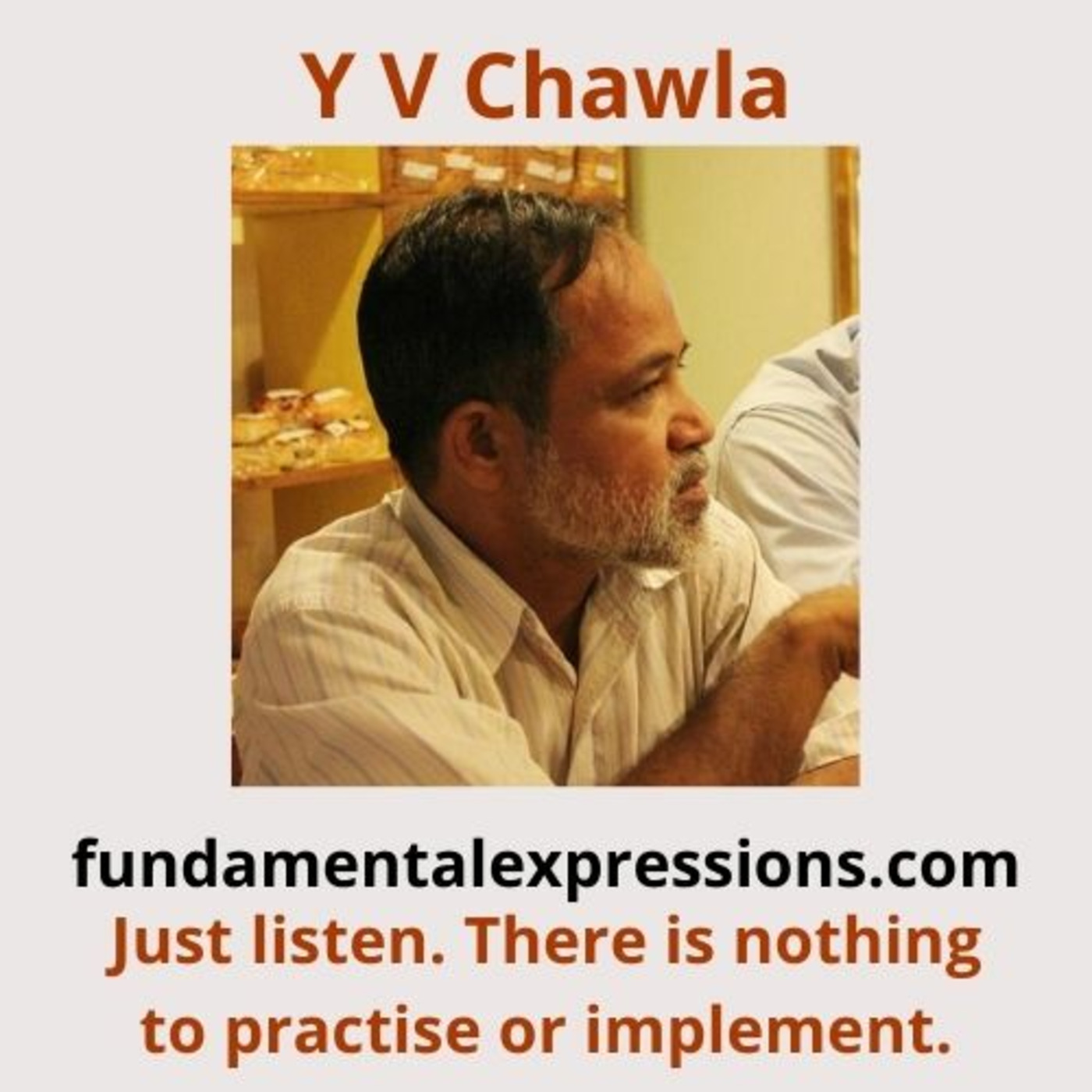
An episode of the Fundamental Expressions podcast, hosted by Y V Chawla, titled "There is no one thinking" was published on August 15, 2019 and runs 2 minutes.

August 15, 2019 ·2m · Fundamental Expressions

0:00 / 0:00

. There is no one thinking. (when you say-‘I am thinking’, this itself is thinking and not the source of thinking) If one sees this, the idea of controlling, moulding the thinking process drops. The Original ground takes over. Thought can refer to anything. It can name anything, describe anything. It can not know its own source. It can not know from where it is arising. Any reference about its source will be a thought. You are at the end of the mind. You can not go further. Thinking can not be used to arrive at-'why something happened which you do not like' or find irritating. Function of thinking is to describe, express. When you see this, you are on the magical ground. You are attuned to supreme relaxation. Any objective thing of the world including our body or DNA structure is not the sign of one’s being alive. The sign of being alive are ‘feeling’, and ‘naming’, thinking. The ‘feeling’ of friction-‘things are okay’, ‘things are not okay’-is the sign of being alive. Brain can not feel stably okay; an unending friction is in motion. Human being means-it can ‘feel’ the friction that things are ‘okay’, ‘things are not okay’. He is also Aware that he is feeling this friction, pain. This friction is the ground of unending evolution. Complaining, blaming, feeling guilty does not let one feel the friction. Awareness (supreme relaxation) and unending friction is a singular process, self-sustained process. The illusion escapes the friction by seeking stable relief, stable pleasure through possessions, relations, ideas-hence dullness, decay, death. Becoming aware of the illusion is to drop it-is to experience the wonder of automation of the whole process.

. There is no one thinking. (when you say-‘I am thinking’, this itself is thinking and not the source of thinking) If one sees this, the idea of controlling, moulding the thinking process drops. The Original ground takes over. Thought can refer to anything. It can name anything, describe anything. It can not know its own source. It can not know from where it is arising. Any reference about its source will be a thought. You are at the end of the mind. You can not go further. Thinking can not be used to arrive at-'why something happened which you do not like' or find irritating. Function of thinking is to describe, express. When you see this, you are on the magical ground. You are attuned to supreme relaxation. Any objective thing of the world including our body or DNA structure is not the sign of one’s being alive. The sign of being alive are ‘feeling’, and ‘naming’, thinking. The ‘feeling’ of friction-‘things are okay’, ‘things are not okay’-is the sign of being alive. Brain can not feel stably okay; an unending friction is in motion. Human being means-it can ‘feel’ the friction that things are ‘okay’, ‘things are not okay’. He is also Aware that he is feeling this friction, pain. This friction is the ground of unending evolution. Complaining, blaming, feeling guilty does not let one feel the friction. Awareness (supreme relaxation) and unending friction is a singular process, self-sustained process. The illusion escapes the friction by seeking stable relief, stable pleasure through possessions, relations, ideas-hence dullness, decay, death. Becoming aware of the illusion is to drop it-is to experience the wonder of automation of the whole process.
Self Taught Japanese: Grammar and more! J.D. Wisgo Learn about Japanese grammar from scratch with J.D. Wisgo, translator and creator of Self Taught Japanese. Targeted for beginning students (but also helpful for intermediate students), this podcast will teach you the fundamental building blocks to understand and speak Japanese. In addition to grammar, related topics such as vocabulary and expressions will also be taught. Deng U Reng Yeksani Welcome to ”Deng U Reng,” the podcast by Yeksani, dedicated to promoting sexual and reproductive health and rights (SRHR) while advocating for gender equality and the rights of individuals of diverse sexual orientations, gender identities, and expressions (SOGIESC). Join us as we delve into compelling conversations surrounding the intersections of SRHR, gender, and SOGIESC, emphasizing the importance of inclusivity and equal access to comprehensive healthcare and social services for all.Together, let’s challenge the status quo, debunk myths, and foster a more inclusive and affirming world for individuals of all genders and sexual orientations. Join us in our mission to advocate for the fundamental human rights of all individuals, regardless of their sexual orientation, gender identity, or expression. Listen in and be inspired to be part of the change for a more equitable and just society.Tune in to ”Deng U Reng” and be a part of the transformative journey towards a world where everyo RCI - Apprenons le Chinois Radio Chine Internationale Avec ce programme vous pourrez apprendre le chinois moderne fondamental, pouvoir communiquer en chinois, retenir en peu de temps le vocabulaire et les expressions de base de la langue chinoise, et améliorer efficacement sa compréhension. Apprenons le chinois avec RCI! Core Topics in University Mathematics The University of Nottingham This series of videos is aimed primarily at first-year undergraduate mathematics students. It covers some of the topics which students often find hard, but which are fundamental to success in university mathematics. One example of such a topic is curve sketching, which can reveal the qualitative behaviour of a function where perhaps the mathematical expression for the function is rather impenetrable. Proficiency with curve sketching comes with practice, and it is often hard to know where to begin. The videos in this series provide some useful tips. Another example of a core topic in university mathematics is the idea of proof. Rigorous proof allows us to establish the truth of mathematical statements. Videos in this series highlight two ways of proving mathematical statements: by induction and by contradiction. Further videos highlight the generalisation of a familiar pre-university mathematical concept (a vector) to a more abstract setting (vector spaces).
URL copied to clipboard!