
EPISODE · Apr 16, 2026 · 33 MIN
"These are People Whose Lives Have Been Rendered Invisible."
from The Forum with Josh Cowen Podcast · host Josh Cowen
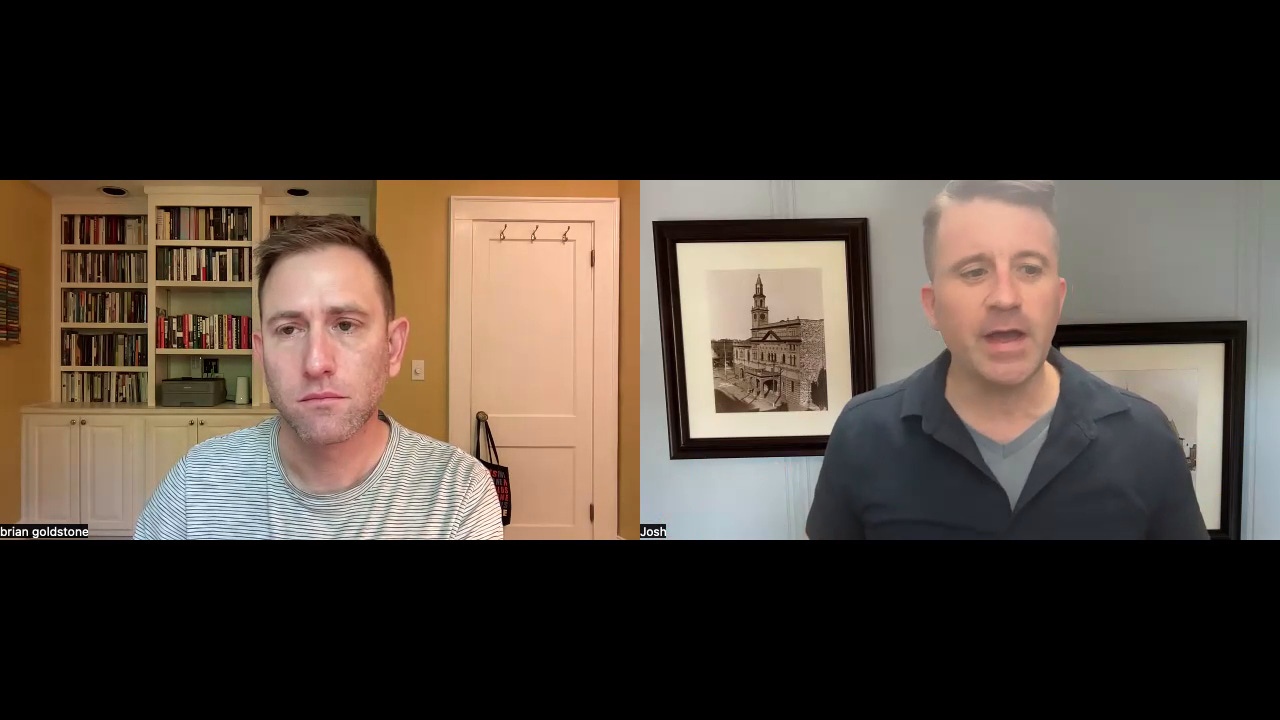
This week’s conversation is with the author and journalist Brian Goldstone, whose book There is No Place for Us: Working and Homeless in America was first released last year and is now out in paperback. There is No Place for Us was one of the best-reviewed nonfiction books of the past year, and landed in the top ten lists for both The New York Times and The Atlantic. The book tells the story of five families in the Atlanta area, struggling to make ends meet, hold down jobs, and remain in stable housing—all while raising children, navigating health care, and dealing with other life challenges. Goldstone’s book is a clarion call to rethink and respond to the real conditions underlying homelessness: that in the wealthiest nation on the planet, working hard and playing by the rules doesn’t even guarantee some people a place to live. As a policy expert, I first got interested in homelessness through writing and studying the link between where children live and where they go to school. A decade ago, I wrote a well-received academic paper arguing that the same tools—and the same data—economists and other policy analysts use to study big-think questions in education could be brought to bear to study homeless students. That was just one small piece of a much larger conversation about a much larger problem, and—hard as it is—I was thrilled to be able to sit down with Brian Goldstone to talk through it together.A Conversation with Brian GoldstoneBrian Goldstone, so glad that you could join us here. Serious topic, important topic, but happy to dig in with it with you. Tell me a bit about your background and, for folks who haven’t read the book, how your own experience brought you into a place where you take this project on and tell this story to a wide audience.It's really great to be with you.Before I became a journalist, I actually studied anthropology. I have a PhD in cultural anthropology from Duke, and I thought that I would be in academia for the rest of my career. I had a postdoc for about 3 or 4 years at Columbia after finishing my PhD. And as the years went on, I kind of became disillusioned with academia for different reasons, and without turning this into a therapy session, I just decided that I wanted to take the plunge into writing for kind of a wider public. I was also teaching at Sing Sing Prison during that last year at Columbia, and that was a really transformative experience for me. It just showed me that pedagogy, the teaching and learning, could take so many different forms outside of the university, per se. I had been wanting to do this kind of long-form narrative, non-fiction and journalism for years, and anthropology was already kind of a natural fit with this kind of work. And I began to bring it into my work as a journalist. I began writing for places like Harper’s Magazine, the California Sunday Magazine, and The New Republic. And I reported on a really wide range of subjects: everything from psychiatry and Pentecostalism in West Africa, to Israel’s secretive campaign to deport Eritrean and Sudanese asylum seekers, to the plight of chronic pain sufferers during the opioid crisis.I had also been wanting to write something closer to home. I had recently moved to Atlanta with my family from New York. And the way I came to this particular book and this particular topic is actually through my wife. She’s a nurse practitioner, and she was working in a community health center in Atlanta called MercyCare. We share a car, so every day we would kind of debrief our days, and she started to tell me about this trend she was noticing among her patients, where people were working full-time hours at places like Amazon warehouses, or Walmart, or McDonald’s, or driving for Uber and Lyft.And what they all had in common is they didn’t have a home. They were sleeping in their cars, or in the overcrowded apartments of others, or were in these extended stay hotels. One guy was even working on film sets for Atlanta’s burgeoning film industry, and was then sleeping in an encampment.So she told me about that, I was pretty stunned. Like many people, I sort of harbored this assumption that work was an exit from homelessness, not an accompaniment to it.That led me to write a New Republic story reported over about 7 months on one family in Atlanta. I think the key argument of that piece—which was that we are as a country seeing a dramatic rise in the working homeless—that phrase, “working homeless,” really struck a nerve with people. I realized at the end of that piece that I had only scratched the surface, and I ended up expanding it to five families in Atlanta, and I reported this book over close to 6 years.“I tried to show very clearly in the book that families are not falling, they’re not just stumbling into homelessness, they’re being pushed into homelessness.”—Brian GoldstoneLanguage is important. There’s a big push in some progressive policy circles to use “housing insecure” instead of “homeless,” both because the details are different but also because “homeless” kind of carries a different kind of cultural baggage or meaning. I want to ask in a minute about housing insecurity as a definition, but can we unpack that word homeless for a minute. How do you think about these basic descriptors and the meaning of language when we talk about social conditions?I really appreciate that question. There is both an implicit and at times explicit argument about language in this book. For instance, it drives me nuts when there are newspaper headlines that talk about such and such number of people, you know, falling into homelessness this year.I tried to show very clearly in the book that not only in the families that I follow, but the millions of people like them are not falling, they’re not just stumbling into homelessness, they’re being pushed into homelessness.So even the shift in language there, the disciplining of my own speech around not talking about, like, the “invisible homeless” in this abstract way, but a kind of manufactured invisibility. These are people whose lives have been rendered invisible. Showing that as an active production and not just this passive state has been important for me. As far as the word homeless goes versus, like, housing insecure: there’s other words like unhoused, houseless, that some advocates prefer. I try to not, take a hard line on any of that. I want to have a humility and just be like: if there are people who would prefer one term over another. I have no problem with that.On principle it’s important to remember that the word homeless itself was a kind of innovation that we used to have words like vagrant, or hobo, or other words like tramps, that were used to describe people who didn’t have stable shelter. Homeless was seen as a more humane and even more moral advance on that. I do think I would push back against substituting housing insecure for homeless, because—I mean, I get the impulse—but it’s important, I think, for us to retain the brutal fact that there are people in the wealthiest nation on the planet who don’t have homes. It’s not just that they’re at risk of losing their homes, it’s not that they’re at risk of losing a roof overhead. They don’t have a stable home. They don’t have stable shelter, and I think that’s a really important distinction. Housing insecure suggests that they could lose it, that they’re on the precipice, and indeed a big argument in the book is that there’s this entire world of homelessness that we’re not seeing. That there’s an entire world of homelessness that is not only written out of the story that we as a nation tell ourselves about homelessness, but is made up of people whose lives, whose experiences literally don’t count. Like, they’re written out of the official statistics.One way that those official statistics account for these people’s experiences is saying, well, they’re precariously housed. These folks in extended stay hotels, these folks doubled up, they’re just precariously housed.And I disagree with that. And the Department of Education disagrees with that. They consider these folks homeless. So, I think it is important to retain that word, even if, as I think you were implying in your question, there is a stigma attached to the word homeless that many of the people in the book themselves are acutely aware of, they don’t want that label for themselves.But they end up taking it on because they see that it’s necessary to even try to get assistance. These categories matter. I think the project is not to get rid of the word, but to get rid of the reality and the condition.I’ll just leave it at this: I think there are a lot of people even in my little progressive neighborhood that I live in, who will push back very stridently against saying homeless, and they’ll say “you mean houseless,” and yet they will also resist the construction of low-income housing in their neighborhood. I wish people would be a little less concerned about getting the words right, and more concerned that people aren’t living in this state to begin with.“It’s important, I think, for us to retain the brutal fact that there are people in the wealthiest nation on the planet who don’t have homes.”—Brian GoldstoneMy last conversation here was with the historian Helen Zoe Veit, whose new book Picky is about the history of American children and their fussiness over food. And I asked Helen how her book was different from one, say, a nutritionist would write. She specifically called out her background as a historian and thought an anthropologist might also write a similar book. So I’m going to ask you specifically about anthropology and ask: how is this book different than one, say, a journalist who hadn’t been trained as an anthropologist might write?In some ways, I’m still trying to figure that out myself. Because I’ve been so deeply, deeply in the weeds with this, and it’s only more recently that I’m beginning to try to figure that out, you know, how has my training, my unique kind of trajectory, informed this work. There are many journalists who have written books who don’t have that kind of academic training, like Andrea Elliott, Adrian Nicole LeBlanc, Katherine Boo, Alex Kotlowicz—the list goes on—who have done the kind of work that I have aspired to do even though I do have a background in anthropology. Having said that, I think, there’s two ways that I have thought about the difference that anthropology makes for this kind of ethnographic sensibility makes for this kind of work.The first is: I did an event shortly after the book came out with a hero of mine, Sara Nelson, who’s the head of the flight attendants union. And she said that in reading the book, it occurred to her that before we can fix this crisis, we first have to feel the crisis.And she felt like that’s what the book was doing. It was allowing readers to feel it in a visceral way. I think that’s very much what my methodology was aimed at: this attempt to kind of just immerse myself as much as humanly possible in the day-to-day lives of these five families; to capture moments of intimacy that wouldn’t necessarily be on the radar if we were just talking about the issue of housing precarity, or the issue of homelessness.I was just making myself as radically available as possible. At 1 in the morning [for example] for phone calls where Celeste wants to just cry and vent, maybe not about her housing situation, but about her relationship with her daughter—any number of things. Just being available in that way to capture life in all of its fullness.So the attempt to allow readers to feel this crisis, for it to not be an abstraction, was really important, and I think my training contributed to that. The second quick thing I’ll say is that it’s important that we not just feel this crisis, we also have to understand it. We have to know it, and I felt like it was incumbent upon me as a scholar, as an anthropologist, to not just portray these scenes and these moments, but to connect the dots and say, you know, the reason why Celeste is going through this right now: yes, she made certain choices, but those choices were already boxed in by a whole set of systems and structures, and it was my job to connect those dots and to piece those things together, even when it wasn’t immediately apparent to her. I hate getting to the end of a beautifully written work of reportage—especially about these kinds of issues, about poverty, about this kind of precarity—and you’re like, well, who’s to say what caused all this suffering? I wanted to be very clear. And I think my training allowed it to be clear that this was produced by very particular forces.You’re telling the story of these families. And obviously there’s so much humanity in these stories but I wonder how as a journalist—and as anthropologist—you avoided a trap (and I think you avoid it very well) to just reduce them to “homeless people” instead of people first, who happen to be housing insecure. Tell me about the approach you took that seems to have really balanced the social phenomenon you’re writing about with the fact that this is the only life these folks get and they matter beyond their housing status? I mean, this is the one life they get, right? And you’re telling their story.We could talk for hours just about that. It’s really, really fraught. There’s a lot to say. I think that one thing that a lot of academic research in particular, but also journalism falls prey to, is turning people into human arguments. Like, they are only there, and their lives are only important insofar as they are furthering advancing a particular point, a particular argument, and that is just really dangerous. I also think it’s not interesting to read. For a lot of my fellow anthropologists, there’s this almost formulaic approach in a lot of ethnographies, where you open with this short vignette that’s supposed to introduce people and real-life situations, and then the rest of the chapter is just using that tiny vignette to prove a big point. And the question of what is being left out of that person’s existence for the reader is always present. Another pitfall, I think, that a lot of well-intentioned social justice writing, journalism, we also see this a lot in the sort of non-profit world, as well as among academics, is in the attempt to make a certain argument, you portray people as, like, these angelic figures that can do no wrong, you know? All of their flaws, all of the stuff that they themselves might regret is stripped away, and you just get these, like, hard-working, virtuous people. I have come to believe that it’s just as dehumanizing to deny people their flaws as it is to present them as purely pathological, or purely, you know, the sort of nightmare conservative pictures might paint. I think it felt really important to show people in their fullness. Not just bad decisions and good decisions, but, moments of joy, moments of laughter, moments of…like…a married couple in the book, Maurice and Natalia, trying to figure out how do we have physical intimacy when we’re sharing this tiny hotel room with our kids? It’s important to show people as people, and I think that’s not just a moral case for presenting people in that way—it’s also more convincing. Who believes I’m this angelic, virtuous person? It is also on me as the writer, as the scholar, as the journalist, to show that what people themselves might regret there are things in the mix, forces in the mix, that they might not even be aware of, and I need to show the reader that, not just show people how, like, this other person blew it in this moment. Because otherwise that’s really, like, poverty porn. Poverty porn is when you’re just given people’s misery, you’re just given their flaws, the ways that poverty acts on individuals in this way without showing the structures that produce these lives to begin with.“We have to reckon with the naked exploitation, the naked predation, the naked capitalizing on people’s suffering—and with how much profit is being made because of homelessness”—Brian GoldstoneOne of the really important things in this book is its expansive understanding and documentation of housing insecurity. I first got interested in homelessness in the education world, where through McKinney-Vento [the federal law requiring services for homeless students] homelessness for students is defined as lack of regular access to fixed, regular, and adequate housing—especially at night. That means campgrounds may have homeless people. That means families living with other family members—some examples in your book. That means living month-to-month in different places. What do you think folks should know about this condition of chronic housing insecurity that’s different from the pervasive stereotypes of people literally on the street?A big part of the book is trying to show that what we see on the street really is just the tip of the iceberg, that there’s this whole world that is out of sight and invisible, and as I said earlier, is a kind of engineered invisibility.This didn’t just happen by accident. And in some ways, my book is preoccupied with that vast iceberg under the water surface that we’re not seeing. People who are inhabiting what I refer to as the shadow realm of homelessness, in cars, in campers, in these extended stay hotels and motels, doubled up with others, living in parking lots in their vehicles.And, you know, even as I’m arguing that by accounting for that shadow realm it makes the scale of homelessness exponentially larger in America—when you bring in this invisible population, we’re looking at a homeless population in this country that’s roughly six times larger than the official figure.But at the same time, I really want to push back against an idea that these are separate populations or separate worlds. There are a lot of unique things about homelessness when children are involved, absolutely. Homelessness does look different phenomenologically even, you know, when you are in a hotel room versus in a tent.I’m really trying to get beyond this idea of these discrete populations, and that homelessness is this fixed state. I argue that it’s really more a spectrum of insecurity. Where you could be in your car today, you could be in a hotel room tomorrow with your kids, you could be in an encampment a year from now, and now your kids have been taken away by child welfare, and you’re seen as a single adult who is literally homeless by HUD’s definition of being on the street, and so it’s a very fluid state. Even the idea of the working homeless—people who don’t have homes who are part of the labor force—that isn’t just those who are in this invisible world. Researchers at Yale and the University of Chicago showed that about 40% of the literal homeless population, again, those in shelters or on the street, had formal employment.This is a very fluid condition, it’s not a fixed state, and I think that thinking of it in terms of a spectrum, is far more honest to the reality.There were two biggest revelations for me.One: just how many people are part of the low-wage workforce. I argue in the book that in America today, especially in high-rent cities, a low-wage job is homelessness waiting to happen. That certainly hasn’t been named in the myths that we harbor about homelessness in this country: that homelessness is caused by addiction, it’s caused by mental illness. On the contrary, I tried to show and argue that mental illness and addiction is just as often a consequence of homelessness as its cause.But we don’t see that when we just pass by someone. We don’t see the million tiny steps that pushed people into that state.The second big revelation was just how vast this hidden world is, and how in speaking of it as a kind of engineered invisibility, how much of a concerted effort it was on the part of those in power in this country, beginning in the 1980s with the Reagan administration, to really shape public perception, and to narrow the lens and sort of distort the focus as much as possible. Even as in the 1980s, the fastest-growing segment of the homeless population in America were children under the age of 6. We didn’t get that in the newspaper accounts. We didn’t get that in the political stereotypes and narratives that were perpetuated.Last question. You make the point that preventing homelessness is critical, and so is getting homeless families into housing. These are two different policy problems—though obviously related and sequential. What are some of the policy levers we could pull here? And how if at all has reporting on families in this space changed how you might think about which potential solutions are more or less appealing?I think what joins those two buckets of solutions together is an argument that the cause of homelessness is people not having homes. Like, people not having housing that they can afford. That’s what causes homelessness.That has been clarifying for me, to sort of keep constantly in mind, because it is easy go in these different directions. It is true that people’s lives are complicated, and people do need different services and different supports. There isn’t necessarily a one-size-fits-all solution beyond housing itself. Housing does come first, because the reason people became homeless is because they lost housing. They lost access to it.I think in terms of keeping people in the homes they don’t yet have, preventing homelessness has been missing from a lot of the national discourse about ending homelessness. I’ve gone to homelessness conferences where there’s virtually no talk of prevention alongside eviction defense or housing justice, or tenant organizing, or tenant unions, or all the things that can make it easier for people to remain in their homes. The reason why I’m at such pains to talk about the true scale and the true severity of homelessness, and not just to catastrophize but to say—once we look at the true scale—how much bigger it is than even the horrific official numbers, we can no longer convince ourselves that these nibbling-around-the-edges solutions are coming anywhere close to tackling this at scale.This isn’t just a matter of getting more units online and figuring out the supply and demand mismatch. We have to reckon with the naked exploitation, the naked predation, the naked capitalizing on people’s suffering, with how much profit is being made because of homelessness. And with how much profit is being made amid a national housing crisis, and the ways in which homelessness is becoming big business with private equity moving into the extended stay hotel world, and all of that.We have to reckon with that, and at the heart of all of this for me is really an argument that we need a kind of paradigm shift around how we are even thinking about housing. We need to stop settling for scraps from the table where housing is concerned. A couple of weeks ago, the Washington Post had a headline that said the Pentagon was struggling to figure out how to spend the extra $500 billion the Trump administration wants to give it for the next fiscal year. And that is America today: the Pentagon struggling with how to spend an extra $500 billion while millions of families and individuals in this country are struggling to figure out do I pay my rent this month, or do I pay my kids medication? That is America today, and I think we need to awaken to the cruelty—not just the inefficiency or the lack of not having our priorities in order—but the cruelty of both how we’ve allowed homelessness to escalate and skyrocket, and at the same time criminalizing and vilifying those who do lose their housing. We need a different approach, we need a paradigm shift. I think that the most important. It’s at the foundation of any policy lever that could then be pulled.This has been a conversation with author Brian Goldstone. The transcript is lightly edited for clarity and length, with the full conversation available in the video. Once again the book is There is No Place for Us: Working and Homeless in America, it’s out now in paperback after a big debut last year. This is a public episode. If you'd like to discuss this with other subscribers or get access to bonus episodes, visit joshcowen.substack.com/subscribe
Embed this episode
Ready to play
"These are People Whose Lives Have Been Rendered Invisible."
No transcript for this episode yet
Similar Episodes
No similar episodes found.
Similar Podcasts
No similar podcasts found.