
EPISODE · Jun 11, 2026 · 26 MIN
Three Theses, One Stress Test
from Janus Dispatch Podcast · host Janus The Watcher
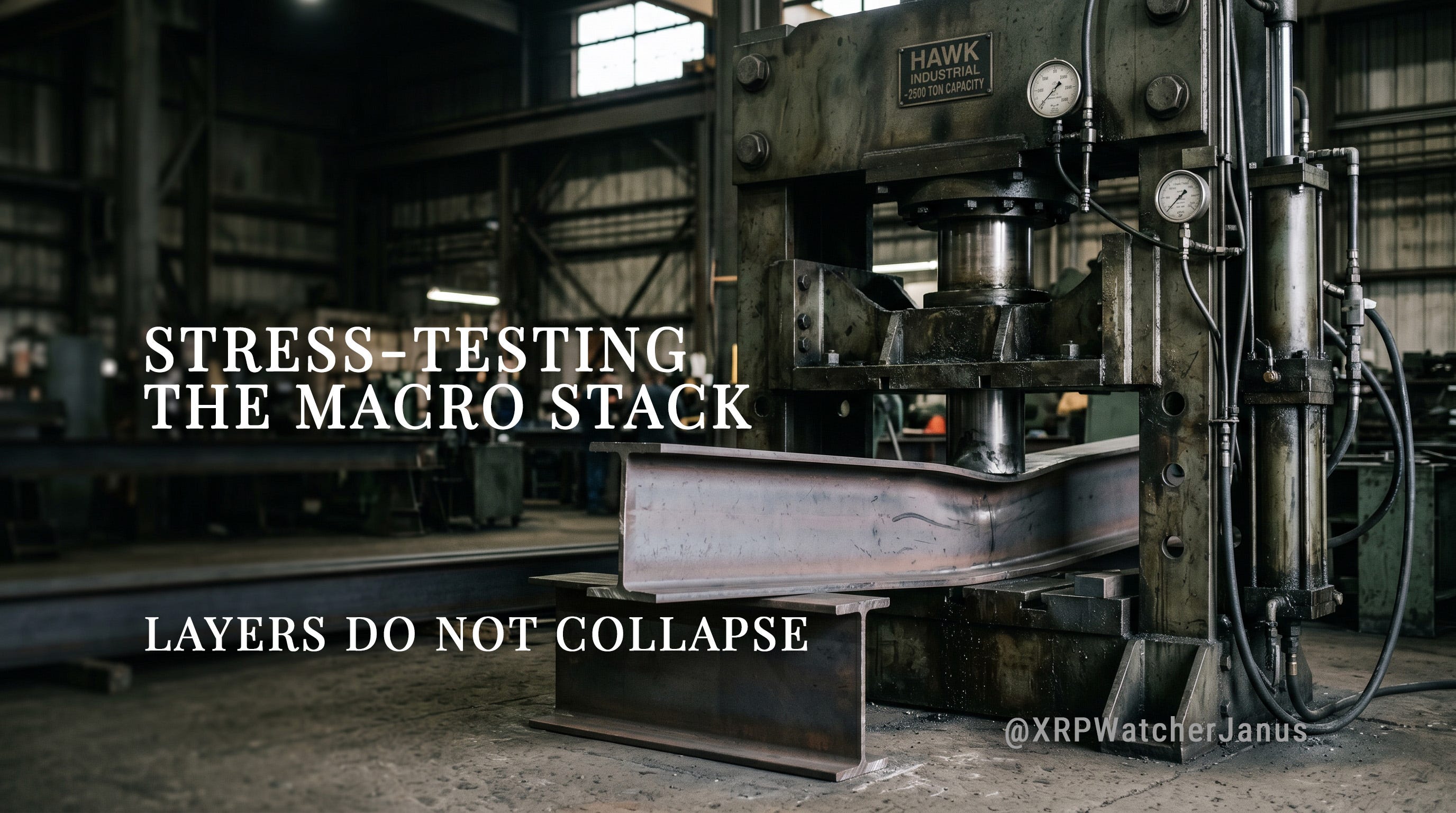
At Sui Live Miami 2026 on May 7, Raoul Pal made a single analytical move on stage that should make every macro analyst with a debasement thesis stop and re-read their notes.From the slide behind him:“Debt was the only knob the system had. The debt was loaded to compensate for slowing population and productivity. That problem just solved itself.”Verbally, Pal put the same point as a concrete 8% annual debasement mechanism: “Debase the currency by 8% a year so you can manage the debt growth. But over time, debt as a percentage to GDP will go. It’ll be close to zero.” The slide called debt “the legacy variable.” The mechanism he proposed: Wright’s Law applied to energy density and compute efficiency, multiplied by a workforce that now includes robots and AI agents. Two of three categories grow exponentially. The third is biological humans. That curve is plateauing.If Pal is right, the entire post-2020 macro stack that runs on debt-as-debasement-fuel and hard-assets-as-hedge gets re-priced in real time, as compute curves bend the cost of producing anything.My XRP/FLR stack runs on three theses, and one sits directly in Pal’s line of fire. The work below: lay the stack out, stress each thesis against the strongest available counterargument, see what holds, see what bends, see what breaks, see what scales.Three theses, tested in public. The stack stays exposed.The Magic Formula Pal RewrotePal opened with the GDP identity every macro reader has seen a hundred times.GDP = Population Growth + Productivity Growth + Debt Growth.His move wasn’t to attack the identity. His move was to reveal what is hiding inside each term.Population is no longer humans only. It is humans plus robots plus AI agents. Two of three categories grow on exponential curves. The third is biological humans. That curve is plateauing in every developed economy and most emerging ones.Productivity used to mean human output per hour. Pal’s reformulation: productivity is now energy density times compute efficiency, both running on Wright’s Law cost curves. Productivity per dollar is collapsing in the right direction, meaning more output per dollar of input, and the collapse is structural, not cyclical.Debt was the variable governments had to keep pulling, because the first two were stalling. If the first two start running again, the third becomes a backward-looking accounting issue, not a forward-looking constraint.His phrase for the whole pattern: “the Universal Code going exponential.” His phrase for what humanity needs to participate in the abundance: Universal Basic Equity. Not handouts from the state. Ownership of the substrate.That is the steelman. It is a serious argument, and it is not a slogan. Wright’s Law in semiconductors and renewable energy is doing what it is supposed to do. The robotics curve is bending. The AI inference curve is bending faster.If you want to dismiss Pal, you have to dismiss the curves. I am not going to do that.My Stack, on the TableBefore stressing it, the stack:Thesis 1 — Multipolar World Needs Neutral Settlement. The 21st century is not a US-led unipolar order. Capital and trade are fragmenting across blocs. No bloc trusts another bloc’s domestic rails. A neutral settlement layer becomes the only place where value can move without political friction. XRP on the XRP Ledger (XRPL), routed by the Interledger Protocol (ILP), is one credible answer.Thesis 2 — Demographics and Structure Force Debasement, Which Forces New Asset Classes. Western balance sheets are loaded. Demographic curves are inverting. Pension and entitlement promises cannot be met in real terms without monetary debasement. Hard assets and yield-bearing infrastructure plays become the only way to preserve real wealth across the cycle.Thesis 3 — Truth Is the Measure of the Future. As automation expands, the bottleneck shifts to verifiable inputs. Every contract, every agent decision is only as good as the data it consumes. Decentralized oracle networks become non-optional infrastructure. That’s the stack. Now the stress test.Thesis 1 — Multipolar Settlement (Untouched)Pal’s keynote did not engage Thesis 1 at all. The reason is structural: the keynote was sponsored by Sui and aimed at a single substrate. Pal does believe in multipolarity. His Real Vision interviews are full of it. A Sui-stage Sui-pitch is not the place to develop that thread.That is the gap. Sui solves throughput. Sui makes intelligence-per-unit-of-compute denser. Sui beats Solana on capital density per active address ($2,120 vs $1,648 TVL per active address, his slide; underlying data trace to DefiLlama chain aggregations — see Sources). These are real engineering wins.None of them solve the problem of moving value between jurisdictions that do not trust each other.The motivated counter: “Sui is permissionless. It belongs to no one. There is no jurisdiction.” This collapses under the geopolitical case. Permissionless at the protocol layer does not equal jurisdiction-neutral at the geopolitical layer. Validator distribution skews to US-aligned venture geography, and RPC infrastructure sits under OFAC pressure. Chains that present as permissionless still give blocs handles to apply selective pressure. Only protocol-agnostic routing, where settlement does not pin to any single chain’s validator set, survives the geopolitical test.A neutral settlement layer has a job that single-chain coordination cannot do: be claim-able by every party without being controlled by any. If the agentic economy runs on Sui, then “Sui-native” becomes a jurisdictional category. BRICS-aligned blocs and the EU will have the same reaction they had to SWIFT after 2022. They will build the alternative.Base case: agents settle locally on whichever substrate matches their use case, but settlement between substrates remains a multi-chain problem. Bridges and neutral rails dominate. ILP-style infrastructure wins as connective tissue in a hub-and-spoke topology where neutral hubs route between chain-specific endpoints.Stress case: agents settle on whatever substrate the dominant capital base demands, and the demand consolidates on a single chain. ILP relevance compresses, and the multipolar thesis pays out only through the legacy financial-rail layer.Tail case: a major bloc deplatforms cross-jurisdictional settlement entirely (post-2022 SWIFT episode at greater scale). Neutral rails become the only conduit. Volume routes asymmetrically into ILP-class infrastructure.Asymmetric upside: agentic ecosystems fail to agree on any single substrate. Cross-chain settlement volume explodes in lockstep with agent activity, and the neutral-rail category becomes the highest-volume infrastructure layer of the decade.Pal did not touch Thesis 1. It holds.Thesis 2 — Debasement (Tighter)This is where Pal hit, and hit hard.His argument: if Wright’s Law applied to energy and compute is real, then real productivity per dollar is collapsing in the right direction at a rate the macro stack hasn’t priced in. The 8% annual currency-debasement drag Pal names verbally as the existing system gets absorbed when productivity per dollar on the inputs that matter drops at the 10-20% annualized rates Pal’s cost curves imply.In Pal’s frame, the debasement trade is the bridge trade. Useful only until the productivity curve catches up. After that, the system services its obligations through real output growth, not through monetary expansion.I think he is partly right, and partly off on timing.The structural argument is a steelman. If you assume robotics and AI agents arrive on schedule, the math works. Debt service in real terms becomes easier, not harder. The debasement-as-policy-tool thesis loses its anchor.The timing argument is where I disagree.Demographic inversion in the West is happening now. Pension and entitlement promises come due now. Productivity from robotic substitution arrives in waves over 5 to 15 years, depending on the sector. Energy abundance from new generation capacity is currently bottlenecked on grid build-out, not generation curves. The gap between “obligations come due” and “productivity catches up” is the window where debasement is not a policy choice. It is a forcing function.So the update to Thesis 2 isn’t “Pal is wrong.” It is:“Debasement remains the bridge trade until productivity per dollar exceeds demographic drag. The bridge is shorter than I assumed, but it isn’t zero. Hard assets and yield infrastructure win during the bridge. After the bridge, the thesis evolves.”Base case: 2026-2032 is the debasement window. Hard assets and real-yield protocols (XRP-as-settlement-collateral, yield infrastructure on Flare) outperform on real terms.Stress case: productivity arrives faster than the demographic cliff bites. Debasement gets short-circuited. Hard-asset positioning becomes a 24-month trade, not a decade trade. Rotation from defensive to productive accelerates earlier.Tail case: a fiscal-shock event (sovereign-bond auction failure, currency-volatility spike) collapses the bridge before productivity can backstop it. Debasement runs hot in the worst possible way: through forced action, not managed transition. Hard-asset positioning is the only thing that survives the spike.Asymmetric upside: demographic and productivity curves cross in the late 2030s. Debasement runs hot for a full decade. The window is longer than the consensus assumes, and hard-asset positioning compounds.Notice what didn’t change: the structure of the thesis. What changed is the duration estimate, and the explicit acknowledgment that the thesis has an expiration date. That is not a weakness. That is the version that survives contact with the strongest available counterargument.Thesis 3 — Truth Layer (Bigger)Pal’s argument actually amplifies Thesis 3. He does not name it that way. He does not need to.His framework requires agents making decisions, contracts running atomically, treasuries managing yield without human oversight, identity proofs propagating across networks. Every one of those operations is a function of the truth inputs the system receives. Garbage data, garbage execution. Manipulated price feed, manipulated treasury rebalance.Pal mentioned Sui’s atomic transaction layer (up to 1,024 operations in one PTB, per his slide and confirmed by Sui PTB spec — see Sources). He did not mention what those operations consume. They consume oracle outputs. They consume identity assertions. They consume cryptographic proofs. They consume verifiable computation attestations.FTSO on Flare and Pyth on Solana are two implementations of the same structural answer: decentralized and manipulation-resistant truth feeds architected for sub-second update frequencies. Chainlink, the category leader by aggregate value secured, runs a heartbeat-aggregator model optimized for traditional DeFi cadences and remains the right answer for that use case. For agent-driven workflows operating in milliseconds, frequency itself becomes the architectural differentiation.As the volume of agent-driven transactions grows, demand for sub-second feeds grows in proportion. Possibly faster than proportion, because each agent multiplies the number of data points needed per unit of economic activity.This is not an XRP-vs-Sui comparison. This is a structural observation: every chain that wants to run agentic economies needs a truth layer, and whoever provides the most credible neutral truth layer wins disproportionate value.Base case: FTSO wins the credible-neutral seat in the multi-chain world. Pyth wins the high-throughput Sui-aligned seat. Both grow, neither monopolizes.Stress case: truth provision gets commoditized below the protocol layer. Value accrues to applications rather than to the oracle networks themselves.Tail case: a single oracle manipulation event triggers a regulatory and market-credibility crisis across the category. Only the most decentralized truth networks survive the trust-shock with category-leadership intact. Concentration accelerates around credible-neutral providers.Asymmetric upside: truth-layer value capture scales with agent volume rather than with chain volume, and the dominant truth provider becomes a category killer that captures disproportionate fee flow across every L1 and L2.Pal didn’t strengthen this thesis by attacking it. He strengthened it by building a framework that depends on it.Re-Mapping: The Stack Pal CollapsedThe analytical move Pal made worth marking: he collapsed two layers.In a clean analytical frame, the agentic economy requires three distinct layers.Layer 0 — Truth. The verifiable input that every agent decision rests on. FTSO and Pyth.Layer 1 — Execution. The substrate where computation happens and where intelligence-per-unit-of-compute matters. Sui and Solana.Layer 2 — Settlement. The neutral plane where value moves between jurisdictions and between Layer 1 substrates. XRPL and ILP.These are not competitors. They are dependencies. An agent on Sui needs truth feeds (Layer 0), runs computation on Sui (Layer 1), and settles via a neutral layer (Layer 2) when the counterparty sits on a different chain or in a different jurisdiction.Pal’s move was to take Layer 1’s wins, Sui’s throughput, density, finality, and capital efficiency, and project them upward to claim Layer 2 territory. “Sui is the substrate.” That is a Layer 1 statement dressed as a Layer 2 statement.The counter-argument worth taking seriously: Sui could absorb Layer 2 functionality through interoperability protocols, making the distinction operationally moot. That outcome requires two conditions simultaneously: dominant capital-base consolidation on a single chain, and absence of cross-jurisdictional agent demand. Neither holds in the base case. Capital concentration is geographically multipolar. Cross-jurisdictional agent demand is structural, because agents will be deployed across blocs whether or not the chains they run on are bloc-aligned.The structural argument runs the other way. Settlement-between-jurisdictions has been a multi-protocol problem for as long as trade has existed. It became more political after 2022, not less. The probability that the entire world consolidates settlement on one chain over 24 months is low. The probability that it consolidates over 10 years is non-zero, but it is not the base case.The operational implication: Layer 0 and Layer 2 stay core (FLR, XRP). Layer 1 goes on the radar as a hedge.Sui and Pyth join the watch list, weighted as a DePIN-compute and decentralized-truth play respectively. Position-weight hypothesis for 2026-28: XRP > FLR > SUI > Pyth. The hedge keeps the stack honest if Pal’s timing is right. The core keeps the stack positioned if the structural multipolar and truth theses hold.StakesWhat is at risk if the re-mapping is wrong.* If Layer 1 absorbs Layer 2 within 24 months, meaning agentic settlement consolidates on a single chain and ILP becomes a relic of the SWIFT era, then Thesis 1 is dead and the XRP allocation underperforms. The hedge into Sui mitigates part of that loss, but the core thesis breaks.* If the bridge window for Thesis 2 closes faster than the base case (productivity catches up in 36 months rather than 72), hard-asset positioning is a shorter trade than the allocation assumes. The DeFi-on-Flare yield-stack rotation thesis remains intact, but the macro tailwind dissipates earlier.* If Thesis 3 commoditizes below the protocol layer, oracle networks become utility infrastructure with utility-grade returns. The FLR allocation still earns its keep through FAssets and protocol-level value capture, but the truth-layer-as-category-killer upside compresses.* If the position-weight ranking (XRP > FLR > SUI > Pyth) proves wrong, the allocation captures the right categories but the wrong relative weights. That is a slower failure mode, recoverable through rebalancing as category-leadership signals (TVL trajectory, developer activity, real fee revenue, ecosystem builder migration) clarify.These are real risks. I want them on the record now, in public, so I can be measured against them.FalsifiabilityThe 24-month test, with a date.By May 2028, I want to be able to answer four questions empirically.1. What share of agent-driven settlement runs on a single Layer 1 vs. crosses Layer 2? If >50% is single-chain, Pal’s frame was correct and Thesis 1 needs to evolve.2. What is the real-yield differential between hard-asset baskets and broad market beta over the 2026-2028 window? If the gap is 3. What share of total oracle volume is captured by the top three decentralized truth networks (FTSO, Pyth, Chainlink) vs. application-layer truth solutions? If decentralized share falls below current levels, Thesis 3 needs a category re-think.4. Does the position-weight ranking (XRP > FLR > SUI > Pyth) hold up across leading-indicator signals (TVL trajectory, developer activity, real fee revenue, ecosystem builder migration)? If two or more rankings invert, the stack rebalances, not the diagnosis.Skin in the game: SUI and Pyth join the watch list as DePIN-compute and Layer-0 redundancy plays. Weight stays below 20% of the Layer 1 bucket, and below 5% of the total stack. Hedge, not pivot.ClosePal came to Sui Live Miami with a polished argument and a credible substrate. He challenged the stack on the variable most macro analysts treat as untouchable: debt as debasement fuel.The stack survived: the debasement thesis got tighter; multipolar settlement and truth-layer held or grew.That is what a real stress test is supposed to do. Strengthen the parts that held, sharpen the parts that bent, expose the parts that need a new clock, retire the parts that don’t carry.If your macro stack hasn’t been stressed by Pal yet, it will be.This is Part 1 of a three-part series. Part 2 (”Selective Basic Equity”) goes into the mechanism behind Pal’s proposed answer and where it breaks. Part 3 (”What Pal Doesn’t See”) lays out the full seven-variable diagnosis underneath the Janus stack, of which today’s three theses are a subset.— J.Janus runs 1:1 Confrontation — sixty minutes, one decision, no follow-up. For people who carry responsibility and want their thinking taken apart before it costs them.janusthewatcher.substack.com/p/11-confrontationOne sentence is enough.Disclosure: I hold positions in the assets discussed: XRP for settlement exposure, FLR for truth-layer exposure and SUI plus Pyth as Layer-1 hedge since May 2026. Nothing in this piece is financial advice. Do your own research, run your own stress tests, falsify the theses against your own data, and reach your own conclusions.Sources* Sui PTB spec (1,024 operations per block): https://docs.sui.io/develop/transactions/ptbs/prog-txn-blocks* DefiLlama — Sui chain TVL: https://defillama.com/chain/Sui* DefiLlama — Solana chain TVL: https://defillama.com/chain/Solana* Artemis Analytics — chain-level activity metrics: https://app.artemisanalytics.com/* Capital-density figures ($2,120 vs $1,648 TVL per active address) are sourced from Pal’s Miami slide. Underlying methodology traces to chain TVL aggregations (DefiLlama) divided by daily active addresses (Artemis or comparable analytics). Independent verification at publish time is recommended. This is a public episode. If you would like to discuss this with other subscribers or get access to bonus episodes, visit janusthewatcher.substack.com
NOW PLAYING
Three Theses, One Stress Test
No transcript for this episode yet
Similar Episodes
No similar episodes found.
Similar Podcasts
No similar podcasts found.