
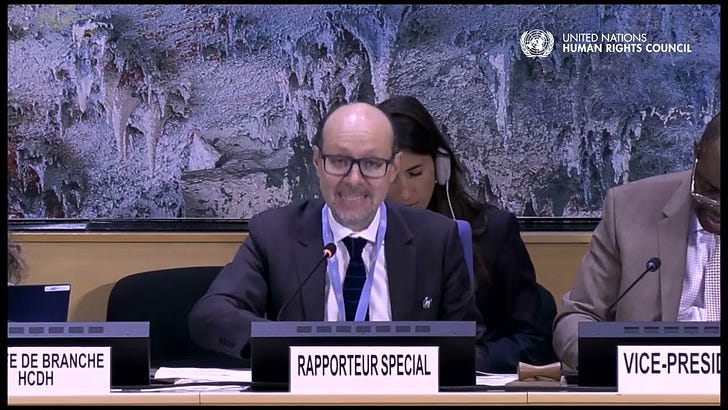
EPISODE · Dec 19, 2025 · 22 MIN
Toxic Substances Are Already a Human Rights Issue. The United States Is the Outlier
from Ne Bouge Pas! · host Tamara Dixon
Geneva, SwitzerlandI. Recognition already existsThere is a persistent misconception in public debate that toxic exposure occupies a legal gray zone, or that it has not yet been recognized as a human rights concern. That premise is incorrect. Within the United Nations system, toxic substances and hazardous exposures have been treated as a human rights issue for decades. The mandate of the Special Rapporteur on toxics and human rights is a standing part of the UN Special Procedures. It is not experimental. It is not provisional. It is not speculative.Under this mandate, States have obligations derived from core human rights, including the rights to life, health, bodily integrity, information, and a clean, healthy, and sustainable environment. These obligations include duties to prevent and minimize exposure to hazardous substances, to regulate and oversee non State actors, and to ensure access to justice and effective remedies when harm occurs. These are not policy preferences. They are framed as legal duties grounded in existing human rights law.This matters for one central reason. As a member of the United Nations, the United States is not conceptually outside this framework. It is bound by the same body of norms that it often invokes in other contexts. This framework is equally binding on European Union member states, where UN standards on hazardous substances and the right to a clean, healthy, and sustainable environment are increasingly reflected in European Union law and the jurisprudence of the European Court of Human Rights, even as implementation remains uneven. The question, then, is not whether toxic exposure qualifies as a human rights issue. That question has already been answered. The real question is whether victims can realistically invoke this framework in practice, particularly when exposure is invisible, intermittent, or deniable.II. What the toxics mandate actually coversThe UN mandate on toxics and human rights is broad by design. It covers the full life cycle of hazardous substances and wastes, from extraction and production to use, disposal, and long term environmental persistence. It addresses exposure through air, water, soil, food, workplaces, homes, and shared infrastructure. It applies to industrial chemicals, pesticides, waste streams, consumer products, and military or security related uses.Crucially, the mandate does not limit itself to acute poisoning or catastrophic events. It explicitly recognizes cumulative harm, low dose exposure, and chronic risk. The Special Rapporteur has repeatedly emphasized that harm does not require immediate injury or dramatic incidents. Long term exposure to low concentrations can violate human rights when it undermines health, shortens life expectancy, or interferes with bodily integrity over time. This framing is essential because it aligns human rights protection with how toxic harm actually operates in real environments, rather than with how harm is easiest to prove after the fact.The scope of responsibility is also explicit. States have a duty to protect people within their jurisdiction from toxic exposure, including exposure caused by private actors. Businesses have responsibilities to prevent harm. These duties extend beyond borders. The mandate recognizes that hazardous substances move across jurisdictions through trade, waste exports, environmental pathways, and supply chains. Protection does not end at national boundaries, and responsibility does not dissolve when harm is mediated through complex economic or infrastructural systems.A central concept within the mandate is the duty to prevent and minimize exposure. This duty operates ex ante. It is triggered by foreseeable risk, not by confirmed injury. Prevention in this context means identifying hazardous substances, regulating their use, controlling emissions, ensuring safe alternatives where possible, and intervening before exposure reaches levels that cause harm. Minimization requires continuous oversight and adjustment, particularly where exposure cannot be eliminated entirely. The mandate therefore places emphasis on precaution and due diligence rather than reactive enforcement.This preventive logic matters because it reframes how accountability is assessed. If prevention is a duty, then the absence of conclusive proof of harm does not excuse inaction. Instead, the failure to take reasonable steps to prevent foreseeable exposure can itself constitute a violation of human rights obligations. This approach is particularly important for substances whose effects are delayed, cumulative, or difficult to detect, where waiting for definitive evidence would guarantee harm before intervention.One of the most important features of the mandate appears in the principles on the protection of workers from exposure to toxic substances. These principles make clear that workers, representatives, whistleblowers, and human rights defenders must be protected from intimidation, threats, or reprisals linked to toxic exposure. They also state that workers and affected communities should not bear the full burden of proving causation in order to access remedies. This reflects a recognition that information asymmetry and evidentiary imbalance are structural features of toxics cases, not anomalies.Taken together, these elements show that the mandate is not merely descriptive. It is operational. It anticipates invisibility, cumulative harm, cross border exposure, and power asymmetries. It builds those realities into the allocation of duties and the design of remedies. The gap, therefore, is not in the scope or ambition of the law. It lies in how rarely these principles are translated into domestic procedures that victims can actually use.III. Why this recognition mattersThe existence of a recognized mandate has concrete consequences. It changes how harm is assessed, how responsibility is allocated, and how justice should function.First, it shifts the burden of proof. Because prevention and minimization of exposure are framed as duties, the question is not whether a victim can conclusively prove harm after the fact. The question is whether States and regulated actors took reasonable steps to prevent foreseeable risk. Failure to prevent exposure can itself constitute a violation, even before individual injury is established. When proof is treated as a precondition for protection rather than the outcome of precautionary response, invisibility functions as a gatekeeping mechanism that denies victims entry into the legal system altogether.Second, it means protection frameworks already exist. The UN system has developed guidance on protecting environmental and human rights defenders, including those exposed to toxic risks. These frameworks emphasize early intervention, access to information, and protection before harm becomes irreversible. They recognize that waiting for conclusive proof can itself entrench harm.Third, it reframes denial as a policy choice rather than a conceptual gap. Recent UN work, including the Guidelines on access to justice and effective remedies in the context of toxics, states plainly that there is already a strong basis in human rights law. The problem lies in the barriers that prevent victims from using it. These barriers include unreasonable or insurmountable burdens of proof, lack of specialized mechanisms, high costs, and weak enforcement. Together, they entrench impunity even where obligations are clear.IV. How this framework emergedThe recognition of toxic exposure as a human rights issue did not arise overnight. It emerged through decades of work on industrial pollution, occupational health, pesticide exposure, waste dumping, and environmental injustice. Communities living near industrial sites, workers exposed to hazardous substances, and populations affected by contaminated water or food supplies pushed these issues into the human rights domain long before they were formally codified.International attention to transboundary pollution, export of hazardous chemicals, and waste trafficking reinforced the need for a rights based approach. Environmental justice movements highlighted how toxic exposure disproportionately affects marginalized groups. Over time, these strands converged into a coherent framework linking hazardous substances to fundamental rights.What matters for present purposes is continuity. The concepts of cumulative harm, vulnerable populations, transboundary responsibility, and precaution have been part of this framework for years. The tools were built to address industrial and environmental harms that were often invisible to the public eye. That same logic applies to other contexts of exposure today.V. Invisibility, proof, and the justice gapUN human rights bodies explicitly recognize that many hazardous substances are invisible to human senses and that smell or immediate perception is not a reliable indicator of exposure or safety. Hazardous substances from human activity are present in air, water, food, and homes, and they can cause serious harm even where exposure cannot be readily perceived without scientific instruments. Ordinary sensory cues therefore cannot serve as the basis for protection or proof.It is important to distinguish between perceptibility, detectability, and legal recognizability. A substance may be imperceptible to human senses, detectable only through specialized monitoring, and still fail to register as legally actionable harm within existing procedures. This gap between physical reality and legal recognition is where many toxics cases collapse. The mandate acknowledges this gap and treats it as a structural problem rather than an evidentiary accident.The Special Rapporteur has further acknowledged that invisibility creates a structural barrier to justice. Scientific information on exposure, risks, and hazards may be non existent, preliminary, delayed, or inaccessible. Monitoring data may not exist at the relevant scale or time. Where it does exist, it is often controlled by States or corporations rather than affected individuals. In these conditions, proving exposure or causation becomes exceptionally difficult, even where health effects are real and ongoing.Cumulative and intermittent exposure compounds this problem. Harm accrues over time through repeated low level contact rather than through a single identifiable event. Traditional evidentiary models, which assume discrete incidents and linear causation, are poorly suited to this reality. As a result, victims are often asked to meet proof thresholds that were never designed for the kinds of harm they experience.The Guidelines on access to justice and effective remedies in the context of toxics describe this problem in stark terms. They identify the need for complex technical evidence, lack of specialized judges, financial barriers, and weak enforcement as factors that make the burden of proof unreasonable or insurmountable for victims. In practice, invisibility converts exposure into administrative non events, where routine checks produce no actionable finding and the absence of data is treated as the absence of harm.This dynamic is not accidental. It reflects a structural mismatch between the nature of toxic harm and the design of evidentiary systems. When harm is cumulative, intermittent, or invisible, traditional proof models fail by design. The UN has acknowledged this failure and proposed remedies, including dynamic allocation of burden of proof, precautionary approaches, expanded standing, and specialized mechanisms capable of addressing technical complexity.What remains underdeveloped is the victim facing infrastructure that would allow these remedies to operate in real time. This includes accessible monitoring, timely data, procedural rules adapted to invisibility, and early protection pathways that do not depend on definitive proof at the outset. Without this infrastructure, norms remain formally binding but practically unreachable for those most affected.VI. Jurisdictional asymmetry as governance failureThe gap between recognition and enforcement produces a form of jurisdictional asymmetry. At the UN level, toxic exposure is treated as a human rights issue with clear obligations and acknowledged barriers to justice. In the United States and, in different ways, in parts of the European Union, the same exposure patterns are fragmented across environmental permitting regimes focused on thresholds, tort systems demanding individualized causation, benefits frameworks that substitute compensation for accountability, or security based exclusions that remove certain exposures from ordinary scrutiny altogether.This fragmentation means that exposure travels very differently through governance systems. At the UN level, it is framed in terms of prevention, due diligence, and access to remedy. In European human rights jurisprudence, it may be recognized under rights to life or private and family life, particularly in pollution cases. Domestically, however, the same exposure is often treated as a technical compliance issue, a private injury claim, or a matter outside ordinary regulatory reach.The result is that the same exposure pattern that would trigger precaution, due diligence, and defender protection discussions in Geneva is domestically routed into tort claims, benefits determinations, or silence, leaving no human rights protection pathway at all. European systems face a parallel tension. There is strong recognition of the right to a non toxic environment at the UN and Council of Europe level, alongside delayed enforcement, weakened chemicals regulation, and persistent gaps in addressing cumulative and low dose exposure, with PFAS restrictions and uneven enforcement offering a visible example.This is not a legal vacuum. It is a governance failure produced by institutional design. Systems built around thresholds, individualized causation, or post hoc compensation are structurally incapable of responding to invisible, cumulative harm. The UN approach, by contrast, integrates prevention, protection, and remedy, and treats invisibility as a reason for precaution rather than denial.Without corresponding domestic infrastructure, commitments remain declaratory rather than operational. Victims are left navigating systems that cannot see their harm. Defenders face retaliation without adequate safeguards. Exposure persists not because the law is unclear, but because the pathways that would activate it have not been built.VII. Contribution of this workThis analysis does not argue for new rights. It takes existing UN norms at face value and examines where they fail to operate in practice. It brings together the toxics and hazardous substances mandate with environmental justice analysis and human rights defender protection, which are often treated separately, and does so in a way that is directly relevant to both United States and European Union governance debates on human rights and environmental due diligence.The contribution lies in showing how acknowledged barriers to justice in toxics cases intersect with contexts of invisible or deniable exposure. It demonstrates how invisibility functions as the mechanism through which legally recognized harms become practically unverifiable. By focusing on infrastructure rather than doctrine, the analysis shifts attention from recognition to implementation.VIII. Not lack of norms, but lack of infrastructureThe problem, then, is not whether toxic exposure qualifies as a human rights issue. It is whether victims can realistically invoke that framework when exposure is invisible, evidence is controlled by others, and the infrastructure needed to bridge that gap has not been built.UN documents are clear. States have duties to prevent and minimize exposure, ensure access to justice and effective remedies, and protect workers, communities, and defenders. Until the procedural, evidentiary, and protective infrastructure required to operationalize those duties is constructed, these commitments remain formally intact but operationally hollow. The gap between recognition and protection will continue to shield inaction, not because the law is unclear, but because its implementation has been deferred.Mandate and Geneva ecosystem* OHCHR. “Special Rapporteur on toxics and human rights – About the mandate.” Office of the High Commissioner for Human Rights.* OHCHR. “Special Rapporteur on toxics and human rights – Annual thematic reports.” Office of the High Commissioner for Human Rights.* Geneva Environment Network. “Human Rights, Hazardous Substances, and the Role of Geneva.” Geneva Environment Network, updated 3 December 2025.* Geneva Environment Network. “Geneva Addressing Hazardous Substances.” Geneva Environment Network, 29 September 2025.Core UN reports and principles* UN Special Rapporteur on toxics and human rights. A/HRC/42/41: Report of the Special Rapporteur on hazardous substances and wastes – Principles on human rights and the protection of workers from exposure to toxic substances. Human Rights Council, 2019.(Mandate page summary: https://www.ohchr.org/en/special-procedures/sr-toxics-and-human-rights/principles-protection-workers-exposure-toxic-substances)[6]aarhusclearinghouse.unece* UN Special Rapporteur on toxics and human rights. A/HRC/60/34: Guidelines on access to justice and effective remedies in the context of toxics. Human Rights Council, 2025.* UN Special Rapporteur on toxics and human rights. A/75/290: Report on twenty‑five years of the mandate on toxics.General Assembly, 2020.Access to justice and barriers* OHCHR. “Call for Input – Access to Justice and Effective Remedies in the Context of Toxics.” Office of the High Commissioner for Human Rights, 10 April 2025.* Geneva Environment Network. “Special Rapporteur on Toxics: Overcoming Barriers to Justice in Toxics Cases – HRC60 Side Event.” 15 September 2025.* UN Web TV / Human Rights Council. “Victims of toxic pollution are too often denied justice and remedies | #HRC60.” 16 September 2025.* youtubeHuman rights and environment* OHCHR. Human Rights and Hazardous Substances.* Geneva Academy of International Humanitarian Law and Human Rights. Human Rights and the Environment.Briefing No. 21, 2025.Regional and European references* European Parliament, Directorate‑General for External Policies. Environmental Human Rights Defenders: New Developments in the EU and Globally.* ChemSec. “EU leaders contaminated with PFAS ‘forever chemicals’.” ChemSec, 2025.* European Environmental Bureau. “PFAS pollution‑affected communities demand to be heard by Ursula von der Leyen.” EEB, 2025. This is a public episode. If you would like to discuss this with other subscribers or get access to bonus episodes, visit drtamaradixon.substack.com
Embed this episode
Ready to play
Toxic Substances Are Already a Human Rights Issue. The United States Is the Outlier
No transcript for this episode yet
Similar Episodes
No similar episodes found.
Similar Podcasts
No similar podcasts found.