
All of the wisdom tradition has some kind of like, that is not the territory, no false idol. The doubt that can be named is not, it's do not confuse this little thing for the whole. We must stay tethered to the whole. That is honestly what I understand Shabbat is for.
Six days focused on the part, one day zoom out to the whole, always stay tethered to the whole. So therefore, could AI help us in some way to change the very economic context in which AI is developed? I don't know, but that is part of the question that I would ask. Welcome to the fourth episode of Humans on the Loop.
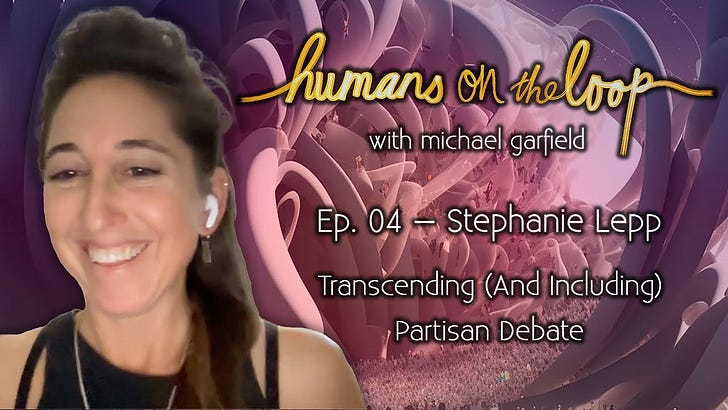
I'm your host, Michael Garfield. Thank you for joining me on an exploration into wisdom in the age of magical technologies. This week I speak with my friend Stephanie Lepp, two-time Webby award-winning producer and storyteller devoted to leaving no insight left behind with playful and provocative media experiments that challenge our limitations of perspective. Stephanie is the former executive director at the Institute for Cultural Evolution and former executive producer at the Center for Humane Technology.
Her work has been covered by NPR, the MIT Tech Review, supported by Mozilla Foundation and Sundance Institute, and featured on the Future Fossils podcast twice, first in episode 154 for her project, Deep Reckonings, and then in episode 205 with Greg Thomas on jazz leadership and antagonistic cooperation. She and I are members of what I think of as the integral diaspora, creative producers inspired in our youth by the integral philosophy of Ken Wilbur who are now committed to fostering multi and meta-perspectivalism in public discourse and applying it in practice for social impact without the jargon of adult developmental and transpersonal psychology. Her latest project, Faces of X, pits actors against themselves in scripted trial logs between the politically liberal and conservative positions on major social issues with a third role swooping in to observe what each side gets right and what they have in common. I support this work wholeheartedly.
In my endless efforts to distill the key themes of humans on the loop, one of them is surely how our increasing connectivity can, if used wisely, help each of us identify our blind spots, find new respect and compassion for others, and discover new things about our ever evolving selves at every scale from within the human body to the big we of the biosphere and beyond. Steph offers some of the most web-savvy, potentially viral, heartful, and humorous takes on this work I know, giving us a spoonful of sugar to help the medicine go down, as she reminds us that we are bigger than we think we are, and more capable of finding common ground. As we move into what will assuredly be a heavily politicized, deeply polarized year of pointless internecine conflict at precisely the moment we most need to find new ways to work together, I'm glad to weave her and her work into this project and include her DNA in the Senious Untapped Small Language Model that the show will blossom into one day. Before we start, I wanna call attention to a few things I just dropped or am about to.
One, my latest essay, Reflections on Technology and Eternity about how to see the future and stay humble is now up on sub-stack for my paid subscribers. Dig into that for comments on the failures of techno-apocalyptic thinking, how I've learned to differentiate between prophecy and prediction, and how to serve becoming without misinterpreting your visions. Two, this Friday, I will share co-evolving selfhood and curating transformational perspectives with large language models, my lightning talk from Santa Fe's El-Silan series on the potential of computing to encourage precisely the kind of wisdom Stephanie and I discuss in this episode. In this 15-minute blitz through media theory, the history of simulation, Eastern philosophy, and pro-social implementations of generative AI, I lay out the foundations of what I consider the most promising consequence of the digital revolution, namely, that it might provoke us to let go of the destructive ideologies of separation and embrace a more capacious sense of our place within the cosmos.
And three, I hope you'll join me this Saturday, January 18th at 2 p.m. Mountain Time for the first monthly online hangout of the year. No schedule, no agenda, simply me and patrons meeting up in circle to discuss what is alive for us right now and how we're making sense of it. I find these very nourishing and I hope you do too, and I can help you find a place to process.
I wanna thank my new donors and subscribers from the last couple of months, Jason Glickman, Alec Hanafell, Bill Sender, Megan Paeski, Jeff Garotti, Dan Palmeino, Roberta Vogeloyting, Fury Bean, Tom Murray, Kurt, Matt Bristol, Scott Rose, Rayanne Dien Sogg, Sage, and Sophie Wayland. Thank you and the hundreds of others contributing small pieces to what this show needs to stay afloat. If you would like to throw your weight into a wiser future, please subscribe at humansontheloop.com or make tax-deductible donations at every.org slash humansontheloop. Thank you and enjoy this conversation.
Thank you. Let's do this. Here we go. Stephanie Lepp, you're on the loop.
Thank you. Thank you. I'm grateful, I'm honored. At least I'm still on the loop.
Maybe we continue to be on the loop, right? Right. As opposed to in the loop. So just to clear about this, because you and I know each other well enough, let me do a little bit of context project framing here.
Outside that I would normally put in a preliminary call for people that I'm just meeting. I think you may have read this, the thing I sent you. There's three ways of thinking about autonomous weapons, right? There's in the loop, on the loop, out of the loop.
In the loop, as far as I'm concerned, presupposes a level of agency in human decision making that I find, frankly, fictional. You are never really completely in control. And then out of the loop, same story. You're never completely out of control.
Like on some level, you're- This is a very synthesis position on luteness, right? Right, right. The loop? Yeah.
Even if you're like blackout drunk, somehow you might still walk home. Some part of you is still making those choices, put in one foot in front of the other. So I think that the honest terrain for asking questions about our relationship to automation is what is going on between those two bounds? What is going on?
Like where do we have it? Simply even asking that question. Simply saying, well, I'm choosing to buy a large hazelnut latte today. Are you though?
Are you really sober if you're making that decision? Are you? Or are you intoxicated by your office activity, Edgar Gore? Right.
And we'll get into this later, but you know me well enough that yes, we don't turn black and white into gray. We want black, white and gray. Sometimes you really have hardly any control. Sometimes you really actually have a lot.
And sometimes you're somewhere in the middle. So yeah, under what circumstances do we, and do we want to to the extent that we can have a conscious decision about that? Right. The other piece I'll add just because both of us come from the School of Disenfranchised, Ken Wilbur, Diaspora, whatever.
I don't feel super-disciplined, does it? Yeah. You know what I mean? I'm not gonna get canceled talking about the fact that I learned so much from his work 20 years ago.
I feel good about it. I am grateful. I personally am grateful. Everything is cancelable now.
It's insane. Yeah. And we will get to that. My joking timeline is like something like least disliked by most people who cannot agree on anything else.
So that's what I'm going for. It's not canceled. It's just least disliked by most people who can't agree on anything else. It might only celebrities got canceled.
Everyone gets canceled now. That's something similar. This is all setting the stage. So the other thing, because I come from that, we're talking about multi-scale regulatory mechanisms, to the degree that you're not making decisions, it might be because you live in a society, but it might be because you're a particular species of organism that is only capable of seeing a certain band of the electromagnetic spectrum and therefore is unaware of all these other stuff going on that you might, you could decide to interact with.
There's all of these different ways historically that you look at where you are situated in the evolution of information across cosmic time. And you can say, where is the decision happening in this structure? That's a multi-scale selection thing that comes out of evolutionary biology where it's like, well, natural selection is not simply happening at the level of the gene. It's happening at the level of organism.
It's happening at the level of populations, of organisms, of ecosystems, et cetera. Plants, the great filter. So that is the decision-making matrix rudiments that I want to lead with through this conversation. But first, I want you to tell people who you are.
I want you to give us your story. I want you to address us in the matrix of decisions that created you and led to you making the decisions that resulted in you taking on the work that we're going to be talking about today. Yeah, honestly, these days, every time I start a sentence with I am, there's a little bit of me that just laughs. Am I anything other than a total and unbelievable mystery to myself?
What am I? But just like that is the preface to whatever I'm about to say. Yeah, just that's really, that's the, yeah. I actually have no, yeah, I'm just an unfolding mystery as we all are.
Without that, maybe I'll give us the address in the context of the story that very much does lead to one piece of work that we're going to talk about together. And that is the first real activism experience I ever had was completely alienating. I was a freshman in college and I went with the Redwood Action team at Stanford, Akron and Merath, to a city council meeting in Mendesino to protest the logging of the Northern California Redwood. And at the time an activist named Julia Butterfly Hill, some of you might remember her, was living in one of those red woods and we called her on speakerphone from a mobile phone to her tree from the protest and she gave us a patch talk from her tree.
Okay, so this is all very exciting, but I noticed something strange. I noticed that the people who we were protesting against, the loggers and their families, looked like really humble people, right? They looked mostly like migrant workers and I just remember thinking to myself, I don't really want to be on the opposite side from these people. I want to be on the same side of the tree and the people, right?
The way these lines are drawn just does not make sense to me. And that confusion ultimately marked the end of my involvement with rats and honestly, the end of my involvement with politics for a while until I could find a way to put people in trees on the same side. Until I used to call myself a promiscuous, pragmatic playerless until I discovered integral and I was like, I asked them much easier. One word, then three, so much less than a mouthful, but that really, that kind of did mark the beginning of my fascination with integrating different perspectives.
How do we redraw the lines to get more and less on the same side of things? And that ultimately led to the creation of Faces of X, which is a video series that we can talk about. Let's talk about it. Let's talk about it, should I just introduce it?
Please, yeah, I will just say, as a matter of journalistic integrity, I may or may not eventually have music in the bed of one of these videos at some point. You and I have been working in a scene list. Oh my gosh, totally. Yeah, I've seen these things in progress.
I've seen you working them out with other people and asking for input. And so I have a bias, I have a special, I cherish this project, not as merely an academic curiosity, but as something that I think has real legs that I want to succeed. Not just because I might get some sort of mention and pass. Yeah, thank you, I appreciate that, Michael.
And yes, you have been following along from the beginning. I feel like for this crew, listeners, I can go a little more behind the curtain a little bit. And just, I mean, this is very much in the canon of previous work, which is introducing integral thinking without actually saying the word integral, right? Is how do we teach people, how do we teach the internet?
In an internet friendly way, this a-perspectival machine, right? Has so many different perspectives that they're all seemingly in competition with each other. How do we teach them that perhaps those perspectives need not be in competition? Perhaps some of them in some ways are complimentary, such that they could give us a bigger picture of reality.
How do you do that, right? In that inside minute. So the face of action is a series of short videos that attempts to do that in five minutes or less. Basically, integrates different perspectives on divisive social issues, like gender, abortion, and race, keeping it late.
But the format is very simple. So I'm going with the Hegelian triad of thesis and synthesis synthesis, we're all played by the same person. So thesis and antithesis are having this debate, right, about abortion or gender or whatever it is. And steel manning, the different side.
And then synthesis walks in the door, again, the same person, and the tends to articulate an integrated perspective on that issue. So the format is very simple, but I hope the synthesis can offer something by way of not one side, not the other side, also not both sides of them, right? I like to say it's not likely that one side is entirely right. It's also not likely that both sides are equally right.
What's more likely is that most of us are partially right and some of us are more right than others, which doesn't make for a great tagline. But that's what's up when we're contending with the full complexity of reality. So yeah, ultimately, faces of action is not really about any of these issues individually. It's ultimately about cultivating our capacity to integrate different perspectives and see reality in a more multi-dimensional way.
So I appreciate that in your article about this and what is emerging, and just now a moment ago, you make an effort to distinguish this from both sidesism. I want to give what I think, based on what we were talking about earlier at the beginning, is a kind of a diagnosis of both sidesism. I think both sidesism is the other side of cancel culture in that both of them are an attempt to squeeze the breadth and complexity of the entire world into a situation with its own local constraints and considerations. So that cancel culture, it's well, this thing that works for me over here, within this sort of evolutionary moral light cone, this is bad, and over there, therefore, it must also be bad.
And both sidesism is saying, almost structurally the same kind of thing, but it works, which is- It's flattening totally. All of this exists, therefore, it must all be good all the time. And so that's why I felt like the need to introduce this issue of scale. It's a new dimension, right?
Yeah, I want to give a concrete example to people because I think that this has, to the degree that we're talking about this in light of what this means for technology, the way we think about technology, the way we think about a relationship to it, the way we're embedded within it, the way we relate to our markets as technologies and so on, what innovation means in this framing. I've been watching people lose their minds over, well, you see this in any given fandom now, because basically whatever people we're into back in the 80s, those people are all grown and they all have kids, and they all have different political positions, and their kids are at the age that their parents first interacted with this stuff. So let me give you the example of Disney Star Wars, right? Excellent example.
On the one hand- You have Andor, which is as Damien Walter has noted on the Science Fiction Podcast, Andor is clearly a version of Star Wars for like middle-aged men, basically, or like people who grew up with Star Wars and are now stuck in some sort of dehumanizing institutional infrastructure and are relating to it through the logic of what the rebellion must have been going through in terms of the class war and so on. And then you have stuff like the acolyte, which is Star Wars as packaged, basically, for teenage girls. And the people who loved Andor got all shitty over the fact that the acolyte exists, because they wanted more Andor. They can't interface with this particular branch of this enormous thing, which is all being served in the same streaming platform, and it's all served under the same franchise umbrella.
And there's something going on like this everywhere you look, where Star Trek is going through its own kind of thing, right? We're like people who like Stranger World's hate discovery, people who like Discovery don't like lower decks. But what's happening is the maximum entropy production algorithm of Capitalistic Extraction is seeking to find affordances on the attention of every possible version of someone who likes Star Wars, or someone who likes Star Trek. And so you're going to end up with something like a religious sectarianism, the way that many different scholars have noted that fandom is sort of a modern secular replacement for what religion is doing for people in a different kind of culture.
There's the critics that are hating on any one of these different spin-offs. And then there are the counter critics who are saying, everyone gets a piece. And yeah, I just felt like I need to inject that concrete example, because this issue of preference and localization, the way that people find themselves within a large sort of possibility space of identification and moral value and so on, this isn't just about what shows you stream, this is about what beliefs you cleave to, and that's where I will pass it back to you. Well, I can say that as a parent with young children, Disney is a great example if we're thinking about both ideas on them, or the evolution of culture, right?
Because Disney is evolving. We've watched the stories, evolve, we've watched the plots, evolve. It's not only male heroes and a love story between a man and, you know, we've not, the love story is between two sisters, or it's not about good versus evil at all. It's about the relationship with your family.
Moana, you got, the plots are getting a little thicker. Does that mean that I don't want my daughter watching the old Disney movies that are just about good versus evil? No, right? This, again, it's, I don't want to just collapse all black and white into gray, because then we've literally gone for two shades to one.
I want black white and gray. I want to know, I want more, because then my daughter and I, we get to have a conversation about the evolution of these stories. When she used to talk about bad guys, like I wouldn't, you know, I wasn't going to be like, well, her people hurt people. Like she can think that there are such things.
We start with black and white. And then recently, she actually asked me about Hitler's mom. Yeah. I was like, exactly.
So now we're starting to, like, how did they become a bad guy in the first, like, what's going, you know, so the plot is getting thicker. So I'm not going to just be like, you know what, jungle book, and like Cinderella, we've moved on. No, I want the evolution. I want bird to experience the evolution.
And I want to be able to talk about the evolution. So you said there's the critics who say, like, everyone gets to have their teeth, sure, everyone has their teeth, but the pieces are different. And let's acknowledge the difference between them. And there is one fundamental way in which your project touches on something that's not immediately obvious from that, which is when we're talking about everyone getting their own little corner of an expanding fandom.
The reason that this is so controversial for people is because we are treating matters of the individual allocation of attention and resources as the kind of scarcity in like cultural space to which we are accustomed in geographic space, when it's like, we're all worried that they're only going to fund one more Star Wars. And so the next one has to be this way. And so we're seeing this thing that's happening in massive parallel in more like a linear logic. Okay.
So William Irwin Thompson talks about noetic policies versus geographical policies. And we see this going on with, you know, like biology, there's the network state. We have this idea of network states that are like service providers, irrespective of your physical location, like an insurance company or something. And the question that we're tangling with as a society is, how does that kind of thinking superimpose in any kind of reasonable way on top of the fact that I still live in a particular place?
I don't live online. John Kerry Barlow's declaration for the independent subspace. That's nice. It didn't play out that way.
Like the internet didn't win in the sense that space and time have been remixed in weird ways, but we all still have bodies and live in some kind of shelter if we are so lucky and so on. We all have a location. And so that's the problem of politics into which the faces of X has dropped. There is a, there's an idea space in which we can train people to hold all of these things together.
And then there's a basically, in my opinion, an imperative that we must train people to hold seemingly contradictory ideas or to find the Hegelian synthesis between these different positions, or we end up treating the complex regulation of entire nation states as the arena in which matters of local concern must compete for global domination. That where the rubber really hits the road with the work that you're doing is that this is helping people come together and talk in a reasonable way about policy decisions, about a decision that has to be made, about a way that make the world one way and not another. I see it as honestly more like training wheels. Like for me, it's like success would be if these videos get boring.
I hope Sunday they're super boring because it's like, why would we ever leave an insight off the table because it came from someone that we didn't see? I, it's like, you just take the insights no matter where they do you or do you not want to be as tethered to reality as possible. Right. So yeah, the topic happens to be our most divisive political issues, but it could be anything.
Like I would love to make one about Michael Jackson. Obviously that is also instant political, but yeah, it's like spectacular entertainer, likely perpetrator, child sex abuse, victim of abuse. They don't cancel each other out. And not only do they not maybe they actually, maybe it's currently because he was the victim of that he became such an amazing entertainer and kind of a treat, like maybe these things actually go together.
So this just happens to be the stage that it's playing itself out on, but it's I'm like trying to cultivate a capacity that I think we already do in other domains of our life. Like my favorite examples, probably just Karen does. I love the shit out of you and go to sleep and those things coexist so deeply. I feel those both so that's part of what grows my heart and grows my mind.
So I think we do this in other domains, or maybe we forget it on our, on some of our most divisive issues and granted we have the card stack against us, but I see it as almost like training wheel in order to cultivate a capacity that yes, ultimately, I think is like a survival skill at the level of our species, the capacity to perceive reality more fully, which yeah, obviously has its implications and polarization, but it also has its bigger picture has its implications in just our capacity to even understand what the hell is going on. Right. As a way of working through this process for people, I want to do, let's cook on stage because for the purposes of this show, when we're asking questions like, if I can do anything, what should I be doing? But if technology allows me to do anything I want, supposedly there will always be inequity of some kind or another constraint of some kind, but we're getting very close to dream something and then wake up and it's in your 3D printer because of your brain reading headband.
So what do we dream about? And then the question becomes what I was saying a moment ago about how we have traditionally treated the world of ideas as non-arrivalous. I can have my ideas, you can have your ideas. But then we also act as ideologues.
We act like the world's not big enough for one idea or another. It is not big enough for the both of us. It's getting interesting right now in a way that the easier it becomes for someone to act on their desires and to make real what they want to see in the world, the more crucial it becomes for us to interrogate our ideologies. So there's this question, why do I want something?
Your toolkit here, I see as like a fundamental piece of how to teach people how to be wizards in the age of generative AI. Because if you can't sit there and ask yourself what you're doing with that power, you're going to end up doing horrible things. You are guaranteed to create consequences you weren't really thinking through. And frankly, none of us can think through all the consequences and we need each other.
And that's where being able to model other people and their perspectives and so on is just honest in the way that you're presenting it here. So what I want to talk about is innovation. You live in California. You've got these two things, right?
You've got, we'll just innovate our way out of it. Well, I think nothing. Yeah, but in order to innovate, in order to create, you must also destroy maybe the de-growth thing and the acceleration is thing. Oh, I can't wait to make spaces of artificial intelligence.
Let's do it. Yeah. This is where we can workshop that because I see a race to the stars on the one hand. And then on the other hand, I see the, well, we've overshot the carrying capacity of this planet and capitalism is the problem as the two things that desperately need a faces of X everywhere I look.
Well, capitalism. I did and I can share where that one lands. If that's helpful. And by the way, for everyone who is following along and would like to check these out, you can find them at facesofx.org.
Hopefully it's an ongoing series. And once you see one, you can imagine how the pipeline is potentially infinite. People with free speech, they have guns, faces of artificial intelligence. I think next up is probably going to be faces of feminism.
Are you going to create a generative interface for people to produce their own? I would love to do that. Right now it's very, right now it's very, it's me just saying, make your own. But yeah, I could definitely imagine that's not, that is one beauty of AI is once you have enough of the example, the series can continue more easily.
But yes, thank you for the invitation to Cook and Public. I can tell you where where my thoughts are as far as where faces of AI would land. Maybe it would be helpful to start with where faces of capitalism landed because that is very much related. So phase of capitalism, and it's a nice way of distinguishing between both sides of them and synthesis.
So both sides of them would be something like capitalism has its upsides and it has its downsides. It's so obvious to the point of not being particularly helpful, right? Where the synthesis lands is something more like capitalism's downsides have brought us to the potential point of civilizational self destruction. But its upsides are precisely what is enabling us to evolve the ended.
It is partially because of capitalism that we were even able to create such things as closed-loop production systems and platforms for decentralized coordination. So you have brought us to the brink of self destruction and enabled us to move beyond that point. That's our capitalism lands. Do you want to respond or should I just riff on what I'm thinking for AI?
All I will say as a bridge between the two is that if it's not as obvious to someone listening, what that bridge is, is I pretty much always bring up cosmoshelleses argument that AI is generalizable to the same thing that markets and bureaucracies and institutions are, and that there's a sense in which we can understand large language models as the child of, for instance, the limited liability corporation. I will say I don't. This is very like cooking in public. So maybe a couple of if we just first articulate and again, this is very simplified pieces and synthesis, granted that you could say there are insinity of perceptions about artificial intelligence and super simplifying and trying to just like cluster the main ones into general camps so that those camps can make love and we can have the beautiful baby.
So how would we articulate the two camps? Right? The two camps would probably be something and please jump in here too. Is I guess it's the acceleration camp and the deceleration camp.
It's artificial intelligence is the pinnacle of human progress versus artificial intelligence is the pinnacle of human hubris. OK. And actually maybe after we do this, the thinking that is going into this, like a lot of it is coming from a guest that I would totally recommend to you. So maybe we can talk about him after this.
But yeah, one main thing that the synthesis would do obviously is I don't know if obviously that is zoom out to the context in which this technology is being funded, developed and used. And have you talked about Moloch on this show? Not really. Take it away.
You had live in your series. So yeah, so live is holding the mantle of introducing the idea of Moloch in the public consciousness. So live where? Yeah.
But initially it was Alan Ginsburg who wrote about Moloch in a poem and then Scott Alexander wrote a beautiful essay called Meditations on Moloch and now live have been like bringing it to the internet with beautiful video essays and actually talked about Moloch on the TED stage bless her. Bless her. So Moloch is actually admittedly in the Bible, some kind of demon to whom we sacrifice our children basically to represent a sacrifice of long term collective well being for short term individual gain and has come to represent precisely that phenomenon where we sacrifice our long term well being in pursuit of short term gain and Moloch manifests itself off the route human civilization. Capitalism happens to be like a very powerful instantiation, let's say, but that doesn't mean that other economic systems and just human systems in general don't manifest Molochian multipolar traps.
So if we're going to do a synthesis on AI, the first thing to say yes is that AI is being developed within this like very Molochian context. So hence the race that we're seeing where it's like, how many nonprofits have started to pursue AI safety and then like somehow or other somehow or other have shifted to building AI as fast as they can. And the logic is, oh, well, we have to build it first because we're the good guys and if we don't build it, other people will build it and we're the ones that you really want us to build it because we're going to protect you from it, except for the fact that what everyone's doing is just racing to build it. Okay, but these organizations, these entities exist within this context, right?
We're playing just for Condits of Moloch. In the meantime, AI is also almost like this manifestation of Moloch in the sense of its frame is optimization, right? The frame is like optimizing one thing at the expense of, and that is exactly what Moloch is about. It is said that the root cause of the meta crisis is our inability to see holiness and say part of what I'm trying to do.
How the see a whole picture of what Moloch does is it's just, I only want to focus on process at the expense of everything else or you can make the same claim about socialism theoretically, socialism wants to focus on equality and the etc, but it's the focus on something at the expense of everything else that is in and of itself what we're up against. And so not only is AI being developed within an economic context that is prioritizing short term profit at the expense of everything else, but AI itself, and I don't know enough about how it's being designed and processing to be redesigned. But from what I understand, it is like amplifying that exact same dynamic of one thing at the expense of everything else. All of the wisdom tradition has some kind of like map is not the territory, no false idol, the doubt that can be named is not the, it's not confused.
This little thing for the whole, we must stay tethered to the whole. That is honestly what I understand Shabbat is for. Six days focus on the part one day zoom out to the whole, always stay tethered to the whole. So therefore, could AI help us in some way to change the very economic context in which AI is developed?
I don't know, but that is part of the question that I would ask. Maybe just caught fear. This is excellent because I'm sure we'll come as no surprise to you that I've been thinking a lot about this very thing. And in the context of AI specifically, which I may annoyingly to some people use interchangeably with technology generally as a leverage enhancing and world reducing instrument.
It's especially obvious in communication technology. In order to communicate across distances, information must be transmitted from context to context. And so something is shaved off along the way. Like you gave the example of socialism shaving off the issue of profit and capitalism shaving off the notion of fairness or whatever you want to call it.
There is this balance that we can ask, how can we strike this with our technologies? That has to do with finding the appropriate level of context. And again, I'm just going to point to the fact that whenever you hear someone in 2024 talking about a new technology, you are almost guaranteed to hear them talk about how it's going to scale in that frame. And when they say that typically what they mean is something like singularity university, like, how can we make this a product that impacts the lives of over a billion people?
And I guess what I would ask is something more like what I'm seeing in a countercurrent in the development of new AI tools, small language models, right? And like my buddy, Android Jones and his friend, Anson Fong and others, their friend group, they've been working on this project called Camara. And Android was the first of many planned artists to train a generative AI on only his own art. Oh, nice.
There's no issue here. Yeah, it doesn't have granted. And the like you're not getting, I used to work with Adam Boengel and Adam had this way of talking about it that I loved, which was when you are cooking dinner, you're not putting every ingredient in the world into that meal, nor the same amount of every ingredient. Right.
Some ingredients you have like a tiny venom, you know, it's like vanilla extract. Check yourself. Yeah. Yeah.
And so when people are using Shagep tea, the point Adam was making is they're asking for specific answers from an enormous billion dimensional galsy and curve that's going to give you the 000 coordinate at the center of all those distributions. You're getting the most mediocre possible recipe made from the conglomerate of all possible. Yeah. Too many cooks and they get too much ingredients in the face.
Yeah. Totally. And then that looks like both siding. That looks like yeah, totally sausage, just sausage.
I love sausage, but it's just like a little bit, everything. And then there's no difference between anything anymore. Not fun. We want different ingredients to play with.
So I'm really fascinated with this idea of technologies that don't scale. I love that. It's like one time we wanted to make everything as big as possible. But now that we know how to do that, ask yourself, what is the appropriate sign?
Okay. You hit the limit. You feed it. You won.
And now you can actually ask yourself, what is actually the thing that I want? That's your question. What do we actually want to dream? And I was just having a conversation with a friend.
I won't name the organization involved an immersive art experience. Corporation thing. And they went in there and they said, oh, we've had to reduce our hours because we had to just lay off a bunch of people because this thing grew really fast and then it had to right size itself as an organization. And it's I'm seeing this like when people talk about infinite growth versus collapse, I think that the system is actually doing what you are talking about here in some way that we're seeing the institutions work out their own sort of faces of ex calculus.
We're not having sex. And the right sizing is the like noxious corporate lingo version of finding the level at which this actually makes sense. The appropriate size for this corporation. It would be better not to overshoot it first.
I was it base camp. I can't remember which he and the founder he stopped growing. He was like, we're not. And that was it.
I think it was a base camp. But I can't really remember. But either way, you're familiar with panarchy. There's an element to which it's like when you're solving a problem that has not been solved.
You need resources and you're growing. You're figuring out once you solved it, you're coasting. You get to chill. You get to just be in maintenance mode.
You don't need to grow anymore. You want to find another problem to solve great. But other than that, like so much of what the world needs is literally just maintenance of like cleaning conditions, making our shoes, like changing a diver. It's not that sexy, but some of it's art so much is art.
It's already worth marveling at. Like a lot of it just requires just some maintenance. So yeah, while you're solving a problem, then you're on the whatever part of the adaptive cycle, but like at a certain point, you're coasting. I do have a guess I would love to suggest for you.
We talk about we. I will ask you at the very end of this. All of the guests that you want. If it comes up naturally in the course of conversation, by all means.
Yeah, I see like I want to talk about it because I have a theory about his theory that I would love to talk about with you. Maybe that'll feed your conversation with him. But yeah, but I was like one last thing on this basis of artificial intelligence. First, have I told you who I want to be the star and this?
Grines. Oh, perfect. She'd be perfect. OK, so that would be my dream.
And as just one last thing, I'm not there's something like in terms of a poetic, like one liner that's something like we know that we can't have the tower of gods without the love, prudence and wisdom of gods. But how can we develop the love of God? If we're under the trance of a demon. So there that little reset something there.
OK, so now, OK, so the guest and this is very relevant to what we were just talking about. So he is the author of my favorite piece of philosophy and technology. His name is Langdon Winter. He is a professor at the Rensler Polytechnic Institute in New York.
And he wrote a piece called do artifacts have politics. Can I actually just read the first like paragraphs of this article? OK, and then OK, so this article began in controversies about technology and society. There is no idea more provocative than the notion that technical things have political quality.
At issue is the claim that the machine structures and systems of modern material culture can be accurately judged not only for their contributions of efficiency and productivity, not merely for their positive and negative environmental side effect, but also for the ways in which they can embody specific forms of power and authority. Yeah. So do artifacts on politics is this beautiful piece of writing and still so pressing it, even though it was written in 1980. And it speaks to the fact that we are surrounded by claims that artifacts, the internet, artificial intelligence, Facebook inherently have politics.
Right. Facebook is destroying democracy. It's destroying our fan. It's destroying our mental and emotional well being.
So that is called technological determinism, right? The idea that just like technology causes the flip side, of course, is the notion that technology is in fact is entirely driven by the social system, then it inhabits. Right. Facebook is just this neutral tool that's being exploited by bad actors, whether that's venture capitalists or the Kremlin.
So that's social determinism. And what Langdon Winter is doing is inventing a sense that in most cases, neither technological determinism nor social determinism are really helpful for understanding how artifacts, how technologies have politics. And so that big question, how do we understand then the politics of Facebook and the internet and artificial intelligence? And he actually proposes this really nice framework in the article.
And that's what I'd love to talk about with you. But that is the genius of Langdon. So first of all, the next step of this project after interviewing someone is you and I pick guests and we host a live salon. If you're a game, sounds like you're a game.
Cool. But I want to, while it's still just the two of us and everyone in the future watching, I want to ask this question because there are domains or dimensions to this project that I think about as the kind of six consistent bins. And one of those bins is informed consent. And so like when you are talking about Langdon Winter saying do artifacts of politics or a moment ago when you were saying, you're asking that question about can we choose gods while under the influence of a demon?
There is this question about the nature of choice. And I think that your project gets to the heart of this in the way that the whole value of steel manning the other side of an argument is so that you actually understand your own position or that's one of the utilities of this. You can't know who you are unless you know the alternatives. When we talk about the way that this adult developmental psychology dimension of discovering that you live in a society and that the society is not just one culture, it's made out of multiple cultures and so on.
The issue that I have with the way that most of us make decisions most of the time, I think, it's like going back to what I said, there isn't really a pure platonic ideal of a human in the loop. There isn't really a pure platonic ideal of informed consent. Oh, we ever get a judge is good enough consent. Yeah.
And so you can get crazy. You can get cartesian Cartesian with it and be like, no matter how good this looks, it could be a demon. And that's where people want to go with this. That's where the AI as Shogoth has been erupting into the discourse, because as the system has become more and more layered, they become more and more opaque, something changes.
There's a qualitative shift in the nature of our decision making that happens between I am operating within a sensible cosmos to what you and I talked about with Red Thomas on Future Fossils Episode 205 about we move out of like orchestral performance from a score and into the realm of jazz leadership. Yeah. Turn it out. Yeah.
I'd love to hear you speak to this. And let's anchor it to faces of X. Like, how are we using this to help with this problem of transitioning from orchestrated jazz or to get us back on the page? I feel like that's what the project is.
It's like there are instances where we can actually get back into an orchestra together, stop feeling our way through non computable uncertainty. We can actually come to some sort of understanding about our values. I don't have an immediate response. I hope that cases of X can help with that.
I guess if we're used to content that is maybe just like one instrument by itself, playing scripted music and maybe when the spirit of training wheel, this is a little bit like scripted jazz, which I know is a little bit of an oxymoron, but it will go in happens and we eat ring our instruments at the table. And I do, I actually, I think there are things right now that I would think of as training wheels that maybe other people would think of as like permanent or something. Cause at the end of the day, like ultimately what do we need? We need, we need to all get skilled up on our own instrument.
We also need to learn how to listen to each other, but it really doesn't end there. Then we got to make something new together, then we got to make something, maybe even not like just completely surprises us. I mean, that's never been played, something that's never been heard. So yeah, faces of X actually is very much in the training wheel of one, the other side, one side, the other side.
Ultimately, I think we'll be able to give ourselves like a much longer leash thought to speak when we're all skilled, when we all know how to listen to each other and trust ourselves as a group who even knows what we're capable of. Let me come at this from a slightly different angle that I think might be easier for riffs. We're in an election year. Yeah.
I don't know when this will go live, but it's being recorded on August 16th, 2024. And voting is a technology that one might argue. Most people do not know how to actually operate because you can't vote for something if you don't understand the different choices. And in a way, like I see faces of X as a manual for learning how to vote.
For learning how to exercise agency as a citizen in society. Could be. Are you thinking literally? Or how would you see that playing out?
Because I would almost see it as manual for challenging their propositions that we are invited to vote on. Is this really the best proposition we could come up with? One about which we will be like almost equally divided on. Doesn't that mean it's almost as shitty of a proposition?
It's possible. So yeah. That's a good point. So there are like two places in the stream, right, where this could be interpolated.
One is lower in the hierarchy of legislation, where it's like, these are the choices you have. How can we think through? Because there is a synthesis. And I think you've always made this clearly, actually, in the way that we've spoken about this project.
It does more if it's upstream from that. It doesn't work if this is a tool for the people that are actually writing the bills. I would say both. But yeah, definitely, definitely.
Yes, it can do a lot at that level. And yeah, I think even like at just the conceptual level of just it's literally all this does is plant a seed that when I'm like arguing with someone or disagreeing with someone that maybe our views are not entirely clashing, but in some ways, complimentary or in some ways, like we're holding different pieces of that. That's also very kind of mystical icon from Judy of the phone. That's the notion of the shattering of the pieces and that part of our work is to put the pieces back together.
That said, it is also worth noting that this idea of synthesis can be weaponized, right? Like anything, some perspectives are inherently unintegratable, right? Abortion never and abortion always do not play well with other perspectives, right? Other perspectives are just morally not welcome.
There are some things about which there is no brain, like a meaningful synthesis on brain is not between anti-racism and racism. It's between the anti-racism proposed by Ibramak Kenbi and the color blindness proposed by Colmanis, at least that's how I trained it. But the point is we have to be discerning about which perspectives we're integrating trans-friend and include and how we're framing the side of the debate, because obviously anyone can come along and just frame it so that the thing that they want ends up being right in the synthesis. And how do we know we're doing that?
How do we prevent ourselves from doing that? Well, that's not so bad. It just goes back to the wisdom, should it stay connected to the whole? The man is not the chair.
There will be nothing I can even say. It's just like when it stops to be somewhat self-evident on some really gut level. That's when we're really in trouble. So yeah, just do Shabbat or just do whatever is your practice of staying tethered to the whole.
And hopefully that would keep your heart beating and your mind intact, such that you will discern when you're like weaponizing something that is like theoretically helping us stay tethered to the whole. So something you're saying here really excites me, which is if you think about legislation as code in society, then you have the coder and the end user. And there's this question, how do we get people from merely using technology to making technology? You have to be able to start thinking through the way that these different things are framed.
You have to have like a fourth wall rupture or something. You have to see that there's something left out. You have to see that you're not just taking a multiple choice test and then it's AB or some admixture. Like you have to be able to interrogate the frame as you were just saying a moment ago.
So I guess the last question about this for you that I have is how could this project grow into what you have might be like, I don't know, the undergraduate version. And then the graduate version is like teaching people how to basically teach people how to make weapons, right? Like teaching people how to structure the synthesis. But in order to achieve a pro-social, pro-topian, generative outcomes that are not merely teaching people how to hide the externalities in pitting one supposing, like a stream against another.
Right. Right. I think the 201 version or whatever, where we're headed is you can drop the like little like, putting the ingredients on the table in the beginning, right? But right now, part of the reason to do the thesis and to this is, it's to let everybody know you're being included, you know, it's, Hey, are you pro-life or pro-life?
Like, are you pro-choice? Like, your perspective is included here too. But eventually, when we don't need the training, we can just articulate. Because the different perspectives will be in there.
Like, we want you to be like, Hey, different side. I got you. Cause maybe the sides will no longer exist or be meaningful or they will have been re-spramed or something else. So it's probably something like that.
I do think some version that's in between this and there, something needs to be done with the end right now. It's just obviously it's just, and I think we've talked about this. It's so cat. It's one side, other side, one side, the other side.
So I've said this is, yeah. And then everybody's smiling. And it's just so creative and we unfatted. So I'm not sure it's not just like how to make it more entertaining.
It's honestly the question is how to make it more true, how to make it more real. Like what's actually going on. And in some of them, for example, the gender one, it's funny. I didn't plan this, but in the gender one, probably that if you were going to say, like which side had more of a partial truth in the synthesis, the gender critical side, like the synthesis says all transgender people deserve legal protections in medical care, but the right to make irreversible modmative modifications should probably be reserved at least until the age of consent, maybe accepted in rare or evidence-based circumstances.
So it's, but most of the time, not really. So it's really giving it. So, and at the very end of the video when the synthesis is done and the right and left are looking at each other, the left, I didn't plan this, like Buck Angel's gender inclusive side goes right on, dudes. And the gender critical side doesn't say anything.
And it is actually funny because the left was actually conceding. And that is what it's totally coincidental. That ended up being what it is in the video. But it is what I want.
Should the end be some kind of actual representation of which side? Who was the flower and who was the vanilla extract in that cake? Or I don't know. I'm not really sure how to end it in a way that is both creative and also true to the situation or maybe I'm overthinking it.
Well, again, I mean, the problem that you might be running up against is something we've talked about a lot in this, which is the audience is presumably what all English speakers, everyone in America, that these are issues. They're not issues in Homer, Alaska, where there is something that needs to be worked out at the regulatory layer of that particular community of people that is going to fine-grain in a way that the coarse-brain synthesis doesn't capture. And so that's another one of the basic or primordial dimensions of this project is, again, the question of multi-scale regulation and self-determination. And you and I talked to Jim Rutt a lot, Jim, the thing is that whole thing is working through this kind of thing.
Like, how do we allow enough self-determination in these different experimental contexts without it being a sort of anarcho libertarian fantasy land? That seems to be the axis where there might be an invitation to people to not just watch a thing and absorb a lesson, but to actually bring it to their council. Okay. And say, like, how do we titrate this?
How do we negotiate this kind of dialogue here where Jim's kid is trans and such and such and where there are people. It's not just because there are people attached to those issues. Yeah. Yeah.
Again, I think training wheels, but it's just the seed can be planted integrating perspectives in order to see a bigger picture of the sea. I will be happy to plant. I have one last question for you. And this may seem at first like a dog leg, but it's not.
And it has to do with you as a parent. Because in teaching people how to think through stuff like this, it's structurally very similar to teaching your own child how to make decisions about what is good for them. And as a way of ending this with a hurrah, I would love to hear you talk about how you think through and work through with your partner and your family. The issue of self determination with respect to technology and like how to use tools, how to decide which tools to use.
Are we going to let you have a phone like these kinds of things? No. I will hear your. My my like joking, not so joking idea that I actually may implement that I do want to do right now.
My kids are seven and almost four. So there is very little green technology in their life deliberately. That might be asked is to take them through the evolution of the technology. We'll start with Morse code.
We'll start with flares like eventually and like at some point, we'll install a headphone outside of the house, then maybe we'll have like a, you know, coconut, it'll be in the car, it'll be in the car, it'll be in the car, it'll be in the car, it'll be in the car. And then maybe when they're like on the way to college, they can have it. No. And then like, I'm like, I'm like, I'm not actually totally joking because there is something about we humanity had went through so much and had to learn and adapt at each step along the way.
And so, and maybe if I can just give that experience and fast motion so you can appreciate and recognize and have some perspective on is this better. What did I lose actually? So I would like to choreograph something like that. And then the joke is at the end, it's like surprise the whole time you were in an open world MMORPG, you were just unlocking new map terrain.
Very totally. And with every new point. Yeah. Awesome.
Thank you, Stephanie. And good luck with this project. It's important. Thank you.
I'll face the facts and not the evolution of caliphonic technology and both. Both. Okay. Thank you, Michael.
It's always such a pleasure, always such a pleasure to get to interact with your mind. Thanks again for listening. Humans on the Loop is made possible. Thanks to small grants from Cosmos Institute and O'Shaughnessy Ventures, gifts from imaginal seeds and BitTensor and paid subscriptions from hundreds of wonderful people who believe we can dream better together.
Subscribe at humansontheloop.com for more podcasts, writing, art, music and news, as well as our online community where you can meet new allies in the intersection of technology and wisdom. If you would like to partner with me or this project, I welcome you. Email humansontheloop at proton.me. Our next episode on January 22nd is going to be a banger of a conversation with science fiction author Robin Sloan on his amazing, genre-bending novel Moonbound, narrative-obsessed AI dragons, long-term thinking, monastic mathematics, interspecies and debates and being good ancestors.
Until then, take care, share the show if you're so inspired. And remember, attention is our greatest natural resource.