
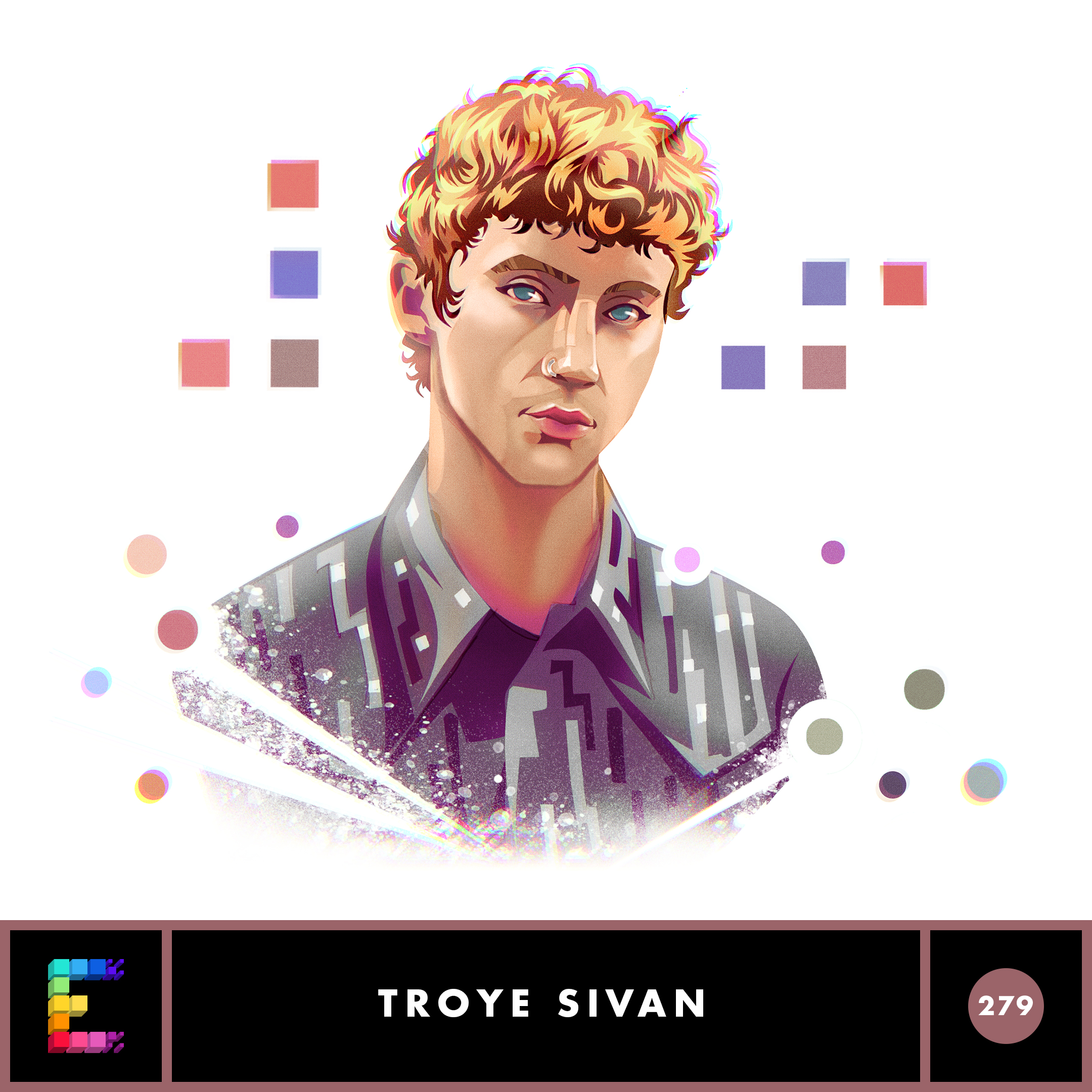
You're listening to song-exploder where musicians take apart their songs and piece by piece tell the story of how they were made. I'm Rishike Shirway. This episode contains explicit language. I think it's really, really difficult to write a song that's both funny and emotional.
It's a hard needle to thread. But I think that's what Troye Sivan did with the song that's in this episode. Troye Sivan is a singer and songwriter from Australia. He's been nominated for a Golden Globe, two Grammys, and he's won four of Australia's Aria Awards.
His song My My My was a number one hit on the Billboard Dance Chart and his third album, Something to Give Each Other, was one of Billboard's picks for the best albums of 2023. Troye's also an actor. He was in the HBO series The Idol, which figures into the story that he tells about this song. He came over to the studio and we talked about how he made one of his big hits, the song One of Your Girls.
For that song, he worked with two of his longtime collaborators, his frequent songwriting partner at Leeland and producer Oscar Goras. I'm Troye Sivan. The story of one of your girls begins with guys who I was talking to that were maybe flirting with me that had not been with guys prior. There are these boys.
I know plenty of them that are just like too cool to be straight. You know what I mean? They're supposed to be 100% straight and even if they are straight, they're never going to let you know that because it's kind of part of their mystique and appeal, I think, to be this, like, metrosexual it boy. That character, I just know him really well.
He's like tall and he's hot and he's fashionable. He takes film photos. The guy that specifically started the song, the guy that it's specifically about. He's very funny and he's like one of my friends, actually, and he told me he's like, I don't know.
Sometimes I just feel a little gay when I start drinking or whatever. You know, if I've had a couple drinks and maybe I want to explore that and he was very open about it and sweet about it. And so then I was like, okay, well, let me know if you're feeling gay on Saturday night because I'm free. You know, some of these guys, they just think it's kind of fun to get the attention and flight with a guy is kind of like a joke.
And then there's maybe someone who is, like, quite deeply closeted and who's actually not straight and, you know, exploring that. And I've had both of those experiences and experiences all along the spectrum and I would create that safe space for them. But then at the end of the day, you're still kind of, like, alone. There is this, like, deep longing and this deep sense of, like, melancholy, I think.
But what was really interesting to me was like, why do I keep putting myself in the situation? How does this keep happening? And that was the starting point of the song. At the time that this happened, I was in the studio with Leland and Oscar Gore as Swedish pop producer who I've worked with for years, something with Leland, Leland and I have been writing together for almost 10 years at this point.
And Oscar and I and Leland, we'd been writing for a couple of months and we were probably like in the middle of the album at this point. So we finished on a Friday. This was the weekend where I said to my friend, let me know if you're feeling gay on Saturday night, that weekend, unfortunately, Oscar went through some family stuff and he went into the studio on Saturday while kind of processing his family stuff that was going on back in Sweden. And he started with this melancholy loop that he made where he sings this like vocal oo and the drum groove, this bass line, and the arpeggiated synth.
So then when Leland and I come in on the Monday, Oscar starts telling his family he plays this loop and Leland and I are singing out into the room. And in the voice note, you can hear me go, ah, Oscar, I love it. There was just something so emotive and like hypnotic to me about this loop. And we've never made anything like this before.
Exactly. So good. And so we started writing the verse, I've just had this experience with this guy and I was explaining to Leland and Oscar this type of guy and I was like, let's write about him. Sometimes I'll think to myself, what would guy sing?
What would blah, blah, blah, sing on this? And so this loop and the space line got me thinking about like an Adele song. What would Adele do for a verse melody? And I sang.
Everybody loves you, baby. That feels like something that maybe she would sing. You should trademark your face. It's like imagining this line of like girls, boys, everybody wants to be with this guy.
And then Oscar had the acoustic guitar just in his lap and he started to strum that when we were writing. When he started playing that, I felt this longing. I think the thing when I'm songwriting that I'm really searching for, of course I'm trying to tell a story but I'm really trying to create a feeling. I'm just kind of like feeling so moved by this music and then I started to make these kind of like queer references like face card, no cash, no credit.
Face card, no cash, no credit. I'm just in queer culture, all room culture specifically. Someone's face card is their face and it's part of their sort of like currency. This person can shop to the front of any line at any restaurant or any club, any party.
They just show their face and they get let right in. Face card, no cash, no credit. I've never really done like a spoken part on the song. It's scary to me.
I think it takes a certain amount of confidence. You can very easily feel quite silly speaking in a low sexy tone into a microphone. It's a bit embarrassing. It's quite camp and I think sometimes the fear of embarrassment would have prevented me from doing that even if I thought it was really going to be cool on the song.
But Oscar and Linda do much, much more embarrassing things. And yes, guard, another queer culture ballroom saying, yes, guard, don't speak. You said it. So without saying a word, they've said all that they need to say, skip the application interview and then sweet like Marabou.
The pre-chorus finishes out with sweet like Marabou. I had sweet like and I was like, now that was so like expected here, you know, the place and the drink and just kind of like has been done a million times. But Oscar thought that I said, Marabou, I was like, no, what is that? It's like it's a Swedish chocolate.
And I was like, that's perfect. Sweden is a very special place to me. I've spent so much time writing with Swedes. I wrote my mind, Sweden.
I've had Oscar as such a special friend in my life and collaborator in my life and having had all these beautiful experiences in Sweden, sweet like Marabou. I had never tried the chocolate until very, very recently, but I was like, it's a Swedish chocolate. Let's do it. It was a little wink to the fact that Oscar was sitting next to me.
Look at you. Skip the application interview. Sweet like Marabou. Yeah.
This pre-chorus just feels so special to me. It's hot. It's sexy. It's longing.
It's sad. It's happy. It's like all of these things. It's like the gayest I've ever felt.
And then comes the chorus. They stuck. At this point as well, the pressure is heavily applied because this is my nightmare. I try and write chorus first because that's the part of the song that I'm intimidated by.
I don't like it when I start with a verse in pre-chorus because if I fall in love with them, now you've got to write the most important part of the song trying to live up to this verse and pre that you already are so in love with. And the chorus has this really cool, daft-punk feeling, arpeggiated synth that's moving all around and trying to find the melody in that felt really difficult. So then overnight, I'm thinking about it. And we're filming the idol at this time, the TV show with the weekend.
There is a song in the idol called One of the Girls that's like being talked about on set and stuff like that. It's part of the part of the show. I don't think about it. It's one of those things where it goes into the back of my mind and just sits in the back of my mind.
And Abel is like a film buff. Abel is the weekend. And he shows me this YouTube video and this robot is in the recording studio. And he's singing.
And he's like sad. His voice is like this vocoder voice. And I'm like, wow, this robot really, really wants to connect with humans. And he can't.
He's having a really hard time with it. And I'm like, I wonder if the chorus should be like that sad robot because of how disconnected I feel from the sky. And so then I'm in the chair and like, me, me, and I'm like making these like robot sounds and a melody comes. And then I said, I'll be like one of your girls or your homies in that like robot voice.
And I was like, I think I've cracked the chorus. My favorite thing in the chorus is the way that it flips because it starts with, give me a call if you get lonely and then it ends with, give me a call if you ever get desperate. Flip really reflected so accurately how I felt about myself in the situation, but it's not just about him. It's also kind of having an effect on me.
The chorus felt like it really captured all of that. But there was a weird be part, just sort of this like instrumental section in the middle of the chorus. And I knew that it wasn't right, but we couldn't solve it. We tried a million things, but nothing felt right.
And I knew that it could be my favorite song, but it wasn't yet. The most treacherous part of a pop song is the top of the second verse. I think that's where you're most likely to lose people because they've now heard the quote unquote best bit of the song and they've heard kind of like all of the parts except for the bridge and they can make their mind up whether or not they're interested in listening to the rest of the song. And so I often try to put something interesting and ear catching at the top of the second verse so that you don't want to stop listening.
And every single time I listen to this song and we get to that section, everybody wants you baby. I would sing everybody and I was imagining it as a sample, but we're like searching through samples and like nothing is hitting and then it hits me and I'm like, oh, this is like a Backstreet Boys thing. And I go into the booth and I lay all of these vocals and then ask for this like really sick automation plug in on it. And it is like one of my favorite moments in the song.
There's an element of humor in this song. There's a few moments of it. Number one. You shouldn't show that waist.
You shouldn't show that waist. And afterwards, there's this background vocal where it's like with the highest policy you can get. Funny lyric to me, we're just making ourselves laugh and it's got this sort of like under the sea island-y kind of feel, which leads to the chalala, which almost feels like a luau vibe. It's really just me and Oscar and Leland sprinkling in these little treats for ourselves.
Things that make us smile. I feel as though I've sort of gone to like the school of Swedish pop writing. I think I've sort of been raised by Swedish pop songwriters and Max Martin. He is like my idol.
He wrote Baby One More Time for Britney. He wrote like all those incredible Backstreet Boys songs all the way up to like 1989, the Ted Swift album. And when I first met with MXM, which is Max Martin's publishing company, which was many, many years ago now, they were like, okay, cool. We think that you would write really well with X and Y from our company coming in and trying to do some sessions.
And that's how I met Oscar. So now all these years later, Max Martin, I've never worked with him directly. But back in LA, it's his studio. So sometimes he comes in to hear what we're up to.
We play him a few songs and he's sitting on the couch and he's listening and then we play one of your girls and he stands up. And the energy in the room kind of like shifted and then he's like, he played again and he looks at me and he's like, is the lyric? And he says the chorus lyric to me. And I was like, yes.
And he's like, it's fucking brilliant or something like that. And I was like, wait, what is going on? And he walked over to the synth and he plays. I'm like, over the moon because I'm like, Max just played something on one of my songs.
And we saved the song. And I was like, this is almost something really, really, really special. But for some reason, the chorus is still not as strong as the rest of the parts. And that was really frustrating.
And so then I got to London to work with Oscar. And the studio that we booked, just because it was what was available, had this massive, massive live room that had like, timpani, Oscar is like an insanely talented, classically trained, multi-instrumentalist. And so put us in this massive room and he's like, wait, should we put a timpani role in one of your girls? Like, we've got the timpani.
There was a version where like, we were trying so hard to make the chorus really hit. So there was like, big drum fills. And then I was like, wait, Oscar, what if it's like the saddest, like worst drum fill you've ever heard? It's the sad robot.
He's in the studio and he's like, just depressed. That's what we ended up doing this sort of week, little, and then I re-record my chorus vocal. It needs to sound like me, but it needs to sound like this like, disconnected version of me. And so it's like, my falsetto is singing on top of the vocoder.
I love layering a high breathy falsetto on things. It was ultra important to add this element of silkiness and seductiveness and femininity to the song. But structurally, there's still this long B part in the middle where we don't know what to do. And I'm sitting in my hotel in London and I've got the chorus stuck in my head and I get to the part where it would be the B part.
But because there's nothing written there and it's just an instrumental part, I just skipped it. And the last two lines of the chorus. And I had this like, aha moment where I was like, oh, we just don't need it. We just need to cut the B part.
And immediately the song made total sense to me. I've always been fascinated by the fact that Oscar and I, we have this weekend where we each have these separate experiences that then on the Monday collide and you create something that none of you were expecting. And when it all was done, I mean, this sounds dramatic, but it felt like my manifesto. I was like, okay, this is very, very clearly to me, the centerpiece of this album.
I think it's such a queer song. I mean, like, the subject matter, the way that it feels, the cadence, the eternal longing, the dysphoria, the feeling of like throwing yourself at someone, the warmth, the humor, all of those things are like very, very queer to me. This is the most me that anything has ever felt, I think. And seeing the response to it, it is like everything that I ever hoped that it would be.
I don't know. I feel really seen from the song and like proud, yeah. So at this point, do you feel like you're done with these kinds of flirty may or may not be straight fashion voice? No, no, no.
No, when the song came out, it got worse because they all got the idea. They were like, oh, wait, I can like hit up Troy. Coming up, you'll hear how all this came together in the final song. And now, here's one of your girls by Troy Savon in its entirety.
Everybody loves you, baby. You should trademark your face, landing on the block to be around you. Maybe I'm first in place. Face card, no credit, yes card, the application of you.
Didn't show it that way, but nobody wants you. Visit songexploder.net to learn more. You'll find links to buy or stream one of your girls, and you can watch the music video. This episode was produced by Craig Ili, Theo Valcom, Kathleen Smith, Mary Dolan, and myself.
Our production assistant is Hagr Bissum. The episode artwork is by Carlos Larma, and I'm in the show's theme music and logo. SongExploder is a proud member of Radiotopia from PRX, and that work of independent, listener-supported, artist-owned podcasts. You can learn more at radiotopia.fm, and if you'd like to hear more from me, you can sign up for my newsletter.
You can find a link to it on the SongExploder website. You can also get a SongExploder t-shirt at songexploder.net slash shirt. I'm Richard K. Shareway.
Thanks for listening. Radiotopia.