
EPISODE · Dec 12, 2023 · 15 MIN
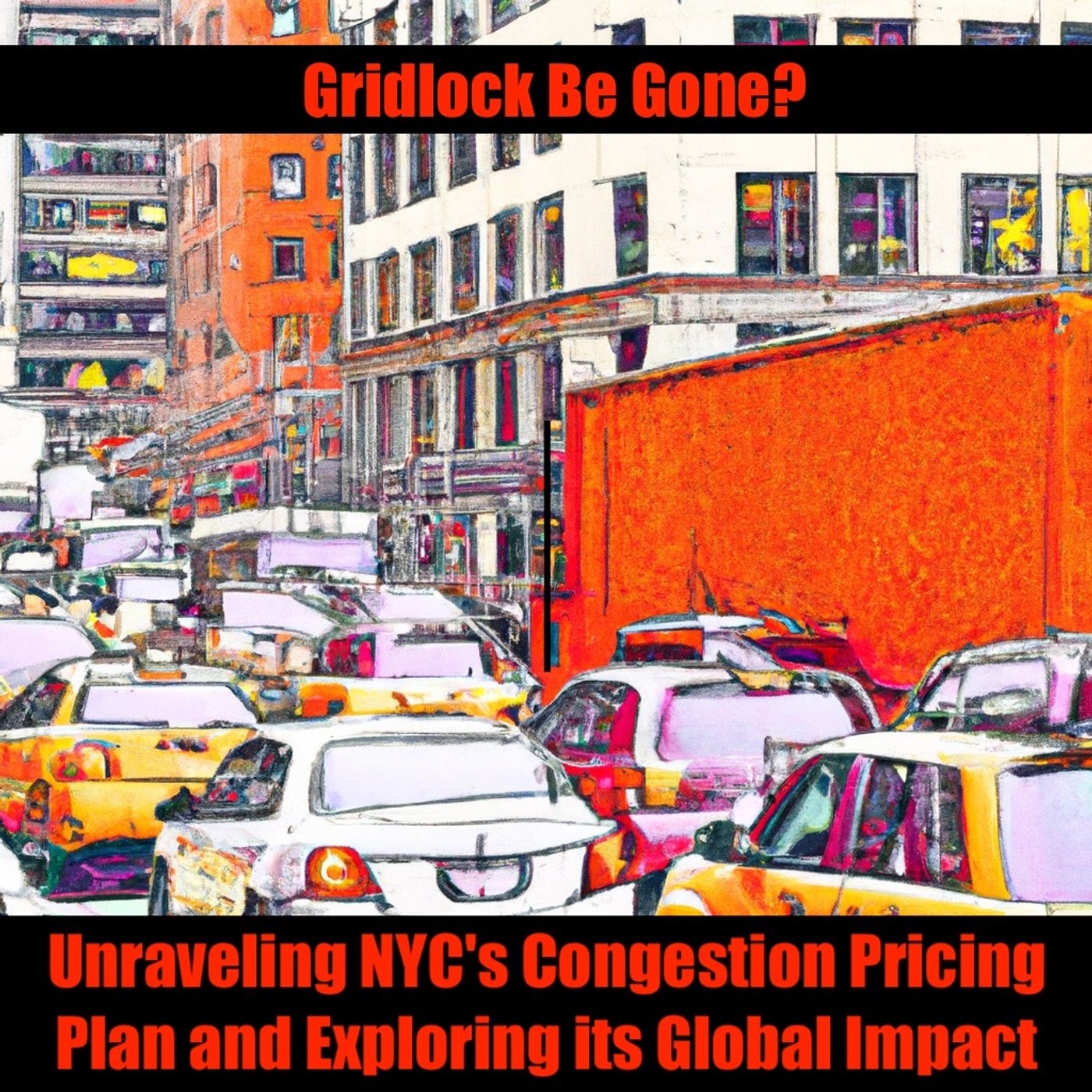
Unraveling NYC's Congestion Pricing Plan
from Congestion Pricing - Gridlock Be Gone? · host Inception Point Ai
In early 2024, an unprecedented new policy championed as a potential lifeline for New York City’s strangled streets will launch despite years of political clashes: congestion pricing tolls charging drivers to enter Manhattan’s central business district. Designed to cut traffic congestion while boosting struggling mass transit finances, the controversial move will test global assumptions about curbing car dependency in major metros. If the ambitious scheme succeeds, it could inspire an urban mobility revolution across America. But skeptics question whether the complex, cumbersome system can really slim chocking overcrowding without crippling commutes or deepening divides. As installations take shape across 60th Street checkpoints, the next chapter in NYC’s transportation history dawns. Will pricing finally ease gridlock by making drivers consider alternatives? Or will political infighting, technical glitches and pandemic uncertainty turn congestion pricing into a boondoggle crushing working-class motorists? With the world watching, New York again becomes an urban laboratory gambling on innovation. The city’s economic vitality and quality of life hangs in the balance. Why Congestion Pricing? Understanding the Historic Step The central premise of congestion pricing rests on leveraging basic supply vs demand principles. By placing a premium on entering high-traffic zones, a portion of drivers supposedly decide avoiding charges makes more sense than absorbing fees to haul vehicles downtown. Even relatively small reductions in daily cars then create outsize cumulative impacts easing congested corridors for all. Early evidence from cities pioneering various pricing models confirms charging works better than building new roads endlessly devoured by induced demand. In New York’s case, the acute crisis level traffic strangling economic productivity justifies unprecedented action. NYC ranks as America’s most congested metropolis, costing an estimated $20 billion per year in delays and pollution. Labyrinthine streets and aging infrastructure groan under 13,000 taxis, 80,000 rideshare vehicles including Uber and Lyft and a surging delivery truck presence thanks to Amazon and food delivery apps. Population and job growth further clog limited road capacity. And with the NYC region expecting 1 million additional residents by 2040, only bolder policies present hopes of avoiding total gridlock disaster. Meanwhile the city’s decaying, underfunded subway system creaks under record ridership, sparking calls for dramatic changes before chronic delays and failing signals cause economic catastrophe. Linking congestion fees to transit upgrades earned support from politicians and wonks. But skepticism brewed alongside support from the start. Roots of Modern Proposal In truth, charging drivers in some form to access America's largest business district has arisen periodically for 50 years. As far back as Mayor John Lindsay in the early 1970s, multiple city studies and panels have mused congestion pricing might alleviate intractable jams. But auto industry lobbying might and outer borough middle-class unease torpedoed those early conversations. By 2007 Mayor Michael Bloomberg’s administration formulated a congestion pricing framework to charge $8 for entering core Manhattan areas below 86th Street on weekdays while rebating bridge tolls and funding transit repairs with net revenues. Despite approval from the City Council and initial state legislature passage, political disputes doomed that bill amidst recession fears and resistance from suburban constituencies. Ever since, transit advocates pushed congestion pricing proposals during new mayoral administrations and Governor Cuomo’s terms before finally gaining serious momentum under current Mayor Eric Adams and Governor Kathy Hochul in 2021-2022. Key Details of Approved Plan Under language passed by the state legislature in Spring 2022, key components of NYC’s approved congestion pricing plan include: 1. Charging a daily variable toll for personal vehicles to enter Manhattan below 60th St 24 hours a day, 7 days a week, with exemptions after 9pm. 2. Trucks and taxis/rideshares are charged separate higher tolls on all days from 6 am-8 pm (12am on weekdays for taxis). 3. Exemptions for disabled drivers, emergency services, some low-income commuters, and others. 4. Oversight and yearly evaluations by a six-person Traffic Mobility Review Board. 6. Revenues funding $15 billion capital plan to modernize aging subways, buses, accessibility and expand transit access to underserved boroughs. Slated to launch by the end of 2023, the program suffered expected delays in installing hundreds of street sensors and tolling infrastructure across entry checkpoints along 60th Street. But charging infrastructure buildout nears completion to make a 2024 opening feasible. Fierce Opposition Drives Complex Final Plan Despite being passionately championed by transit activists for decades as a proven remedy to NYC’s traffic headaches, establishing congestion pricing demanded complex balancing of concerns raised by local drivers reliant on regional commutes far from robust public transport options. Affluent Manhattanites might easily absorb modest tolls to preserve quality of life and economic necessity of functional streets, subways and buses. But outer borough and suburban resistance cried foul over regressive impacts on working and middle class automobile commuters lacking alternate routes into city centers. Valid worries emerged over burdening small business deliveries or logistics companies with spiraling costs certain to raise consumer prices. If designed too broadly or bluntly, charges could seriously damage regional economic diversity and competitiveness against peer cities offering free flows of labor. As a result, final approved plans exempted key constituent groups to ease passage. Disability advocates secured pardons so disabled New Yorkers avoid exclusion from transit bottlenecks pricing might not solve alone. Manhattan lawmakers ensured extended evening and weekend grace periods for local entertainment industries fearing toll avoidance would cripple restaurants or theaters. Construction industry carve outs shielded trade workers getting to sites during early hours. Still, skepticism festered in neighborhoods where driving remains essential, like eastern Queens or southern Brooklyn. Another key concession establishing equity exemptions for specific lower income drivers helped congestion pricing pass its final political hurdles with support from skeptical social justice groups. Complicated verification processes allowing drivers from lower tax zip codes to petition skipping tolls during work hours eased concerns over regressive costs, even if applications may prove burdensome. Diverse coalitions backing discounted fares on transit options for low income neighborhoods also buffered pricing resistance. Together the finely tuned adjustments and eligibility clauses won over enough city and state representatives to pass congestion pricing while giving vulnerable commuters potential relief. But efforts to balance burdens and benefits during the long legislative journey demonstrate why no American city has attempted anything similar despite successes abroad. Uncertain Technical Outlook Beyond political clashes, delivering a smoothly functioning system able to charge hundreds of thousands of different vehicles across an invisible daily border poses dizzying logistical puzzles New York must still solve over coming months. Integration challenges between sensors, databases, payment processors and variable pricing algorithms leave observers nervous despite progress installing toll booth infrastructure and windshield tag registers. The scheme’s viability relies on effectively tracking cars entering or exiting the zone then seamlessly charging EZ-Pass account holders or mailing bills to license plates of vehicles lacking radio transponders. Plans promise toll amounts ability to flux in real-time based on traffic volumes or other data to properly balance road usage. But unforeseen issues plague even basic infrastructure elements so far. Open FOIL requests revealed installation delays thanks to sensor malfunctions misidentifying truck types during testing. Ongoing summer 2023 maintenance woes with MTA infrastructure like tunnel flooding or delayed signal repairs cast doubt on agency capacity to handle billions in promised upgrades tied to pricing revenue. Though most equipment should function adequately thanks to global expertise, concerns around sales estimates or revenue bonds missing targets leave next to zero margin for error. Any sizable shortfall or need for subsidy could unravel political and public support. The whole program’s survival likely requires nearly flawless activation. Potential Impacts: Traffic & Transit Changes If the maze of sensors, cameras and transponders shape an effective charging network once switched on, theory suggests traffic patterns could transform rapidly around Manhattan’s 60th Street delineation. But forecasting precise impacts across interwoven transport networks and traveler decisions contains uncertainty. Best case scenarios let NYC emulate famous traffic turnarounds in Singapore, London and Stockholm after implementing similar city center charges calibrated to local contexts. An oft cited 2020 report by city planners predicted 20-30% reductions in personally owned vehicles circulating Manhattan’s busiest blocks, easing gridlock significantly while curbing emissions. They expect majority transit migration alongside UberPool and carpooling incentives plus boosted commuter walking and biking. This tailwind of congThis content was created in partnership and with the help of Artificial Intelligence AIThis episode includes AI-generated content.
NOW PLAYING
Unraveling NYC's Congestion Pricing Plan
No transcript for this episode yet
Similar Episodes
Feb 4, 2026 ·18m
Apr 22, 2025 ·32m
Feb 27, 2025 ·0m
Sep 20, 2024 ·57m