
You're listening to song-exploder where musicians take apart their songs and piece by piece tell the story of how they were made. I'm Rishike Sherway. I remember watching the movie Dazed and Confused when I was a sophomore in high school and the song Low Rider by War came on and I had this strange moment of feeling like I was hearing the song for the first time but I'd also already known it my whole life. It's one of my favorite movie music memories and the song had been around my whole life.
To me it feels like it's part of the architecture of pop culture. The band War formed in 1969 in Long Beach, California. Low Rider is from their 1975 album Why Can't We Be Friends. The song was a hit as soon as it came out and went to number one on the Billboard R&B charts.
And it's just had tremendous lasting power ever since. Besides being in Dazed and Feued where I heard it, it's been sampled by Beastie Boys, it was covered by corn, and it was the theme song for all six seasons of the George Lopez show. For this episode I talked to War's band leader Lonnie Jordan and their producer Jerry Goldstein. The two of them told me how Low Rider was made in the studio through a combination of improvisation and meticulous editing.
My name is Lonnie Jordan. I am the band leader, music coordinator, and keyboard player of war. That's me. Along with my partner.
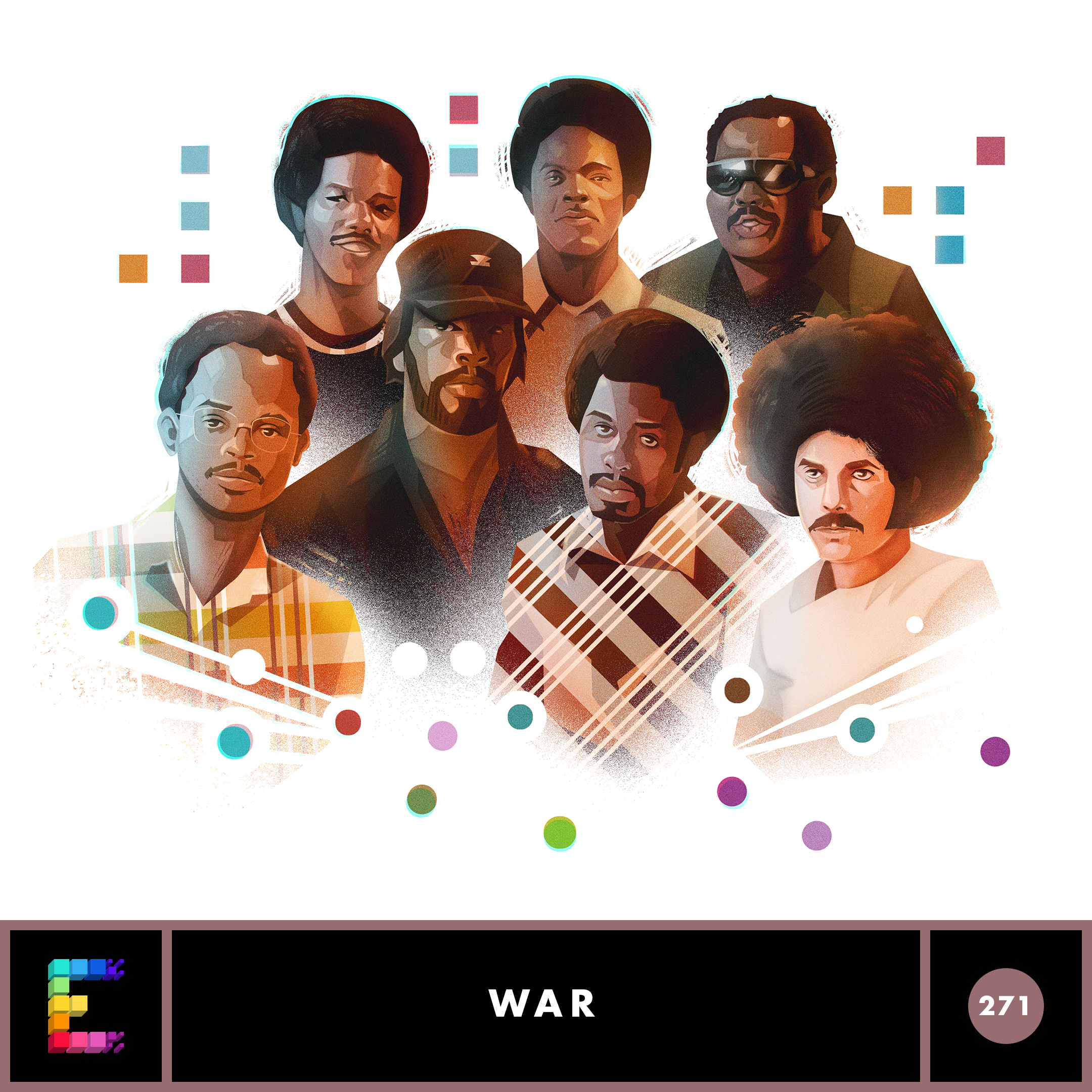
I'm a gold scene. I'm a war's producer from the beginning. There were seven people in the band, Charles Miller, saxophone, and vocal on Low Rider, Papa Diallen on Percussion, Harold Brown on drums, VB Dickerson bass, Howard Scott, guitar, the Oscar, harmonica. It all started on the West Coast of California in a studio called Crystal Studio, Crystal Studio on Von Street, and we went into the studio and we didn't have a song yet.
We weren't really writers. We didn't know nothing. And Jerry knew that. So he just took us in and said, okay, let's see what we can get.
They never been in the studio, so I try to make them as comfortable as possible. And we respected that, you know, because of his past, you know, with songs like, hang on, sloopie, sloopie, hang on, and my boyfriend is back and I'm going in the job. All that stuff. I would stand probably over his shoulder sometimes and watch how he was writing things, and you would just do it like it was nothing.
I guess I would come into my head and listen to the tracks jamming. So we did a 45-minute jam. It was just part of the creative process. We go in and we start recording, you know, and most of the time we just jamming.
It's going along and all of a sudden, eight-minute jam of something was a nice groove. This is cool. So I make a note, because it was only a small part of the jam that I had checked off as this part is interesting. We should work on this, you know.
Best editor in the world. Jerry Goldstein. And that was all part of it. It's kind of like between myself and the band and the engineer, we were like a nine-piece band.
And we all we needed at the same time together, you know, feeling it, creating it from scratch. That was our baby. Okay, check this out. The step-by-step.
We did this whole 45-minute jam. We haven't developed any form yet. I just found eight minutes of it that I like. That's it.
And I mixed the whole eight minutes and then edited it to figure out what the record is going to sound like and what's the order of everything. And it was like a process. I mean, scientific. It was crazy at times.
This is the way we wrote. We have tracks and ideas. And then we would just make records out of them and a lot of times they were written in the studio. It's like, I had to create the beginning.
There was no beginning because it was part of a jam. So I created the beginning by putting the cowbell by itself. Papadid did that beginning. That's when we started creating the form of the song.
When I used to play the timbales, I had my own style. I did know people like Tito Fuente and all these other percussionists was playing like, boom, boom, boom, boom, boom, boom, boom, boom, boom, boom, boom, boom, boom. And Jerry liked it. I didn't like it.
But he kept it because he knew it was different. Our style was so eclectic and he had his own way of playing him and they just found the pocket every time. And then that was the trademark. Harold Brown on the drums.
He's singing along with it in his own way, you know, whenever he's coming out of his head, he's singing in his head. That's what he did. But it happened on all the things he did. All the songs.
But even the leakage was in the groove. Ah, that's VV. Yeah. Great line.
VV was like a very innovative bass player. And I'm going to tell you right now, a lot of rock and roll bands back in the day after we did that song, a lot of rock and rollers simulated the bass line ahead of our time. Give me that bass. I never rerecorded any of this stuff.
I always made the original jam work, you know, which is more organic that way. And that's why it's so raw. And that's why it's war. So then we come back in and say, okay, let's put some real lyrics on.
And it just so happened that Charles Miller, a saxophone player at the time, walked in the studio and he had just parked his lowrider car outside. He just bought it. And we all went out to see it. 52 Chevy.
It was nice. And I said, you got that lowrider right there. Why don't we write a song about you, about lowriders? And he went out on the mic and we wrote down everything that we wanted to write about lowriders.
And the lowrider vibe and the lowrider culture. All my friends know the lowrider. Charles had his own real style of singing. He was kind of brilliant in his own way.
And he was a great saxophone. And he also had a unique vocal sound. The lowrider is a little higher. The lowrider culture, the beginning of it all was happening in Los Angeles, East L.A.
And we came out with a culture of people, Hispanics and Blacks, who shared the same dreams of fixing up a car and seeing who can have the best car, who can drop at the lowest. I mean, it was a crazy scene at the time. The lowrider drives a little slower. The lowrider is a real goer.
I was in the studio playing the piano while they were trying to work out. The lyrics. And then I came back in to hear what they had. And then he said, why don't we try to take a little trip?
Take a little trip, take a little trip, and see, take a little trip, take a little trip with me. And then acoustic on a song like that. Coward Scott. Coward Scott.
That piano sound. It's called an RMI. RMI piano. Only a few bands had those.
They didn't really like them. But I liked the attitude it had. And Jerry put it on tape and said, okay, let's put it on there without thinking about it. Because thinking for us was a disease.
That's right. Nobody thought we just did. Just do it. Yeah.
All of our music is sax and harmonica. That's the horn section. That's our horn section. Period.
And that's me on the little xylophones. People don't even know the xylophones in there. No, they don't. That's part of the sound.
You know, it's like that's what we did. We just did what we felt. And you know, there was a xylophone there that day. I didn't order it.
It was just from the previous section, I guess. And actually, Stevie Wonder worked in the afternoons. And we worked in the evenings. So I guess Stevie had it or something.
The line is the hook all by itself. If you ask someone, they said, yeah, I know that song you guys did that that that that when I tell people who are younger, you know, you maybe don't know lowrider and I sing the hook. Everybody knows that. And then they think.
Oh, right. That's it. I mean, I spent days editing this thing to get it right because I had to finish the album. And this was the last song I was doing on the album.
And it's six o'clock in the morning and I'm at Sound City and I've got five edited versions that I had done that day. And I took the shortest version because you never get enough in three minutes and don't overdo it. Just give them enough just what it needs. And that's it.
I had a friend on some local radio station. And before we actually released it, I had this radio station play it. And the phones, the guy was saying he's never had the phones light up like it did. The lowrider community and especially the Hispanic community.
I mean, they made us. We had a huge Mexican American following. And a huge Mexican following because we would play towns like El Paso and get more pesos in the box office than dollars. Lowrider has a life of itself.
It's been done so many different ways and so many different times. I didn't even know half of the rappers until they started sampling our music, you know, a piece of the boys, a lot of rappers come up on stage with us listening with the big clock playing the flake. Yeah, flake up on stage. I said, wow, I'm, yeah, it's kind of crazy.
I met these guys. I'd write the song. I'd arrange the song. I'd hire the musicians.
I'd tell them what to play. So I was in total control of all the sessions and then they came along and they were different from anything. I was totally different. And the one thing I always did is allow everybody to do, you know, whatever you are, you are, whatever you want to play, you want to play.
And it was completely opposite of what I had done before. I learned from them. We all learned from each other too. And we had a good time.
Coming up, you'll hear how all of these ideas and elements came together in the final song. And now here's Lowrider by War in its entirety. More, visit songexploder.net slash War. You'll find links to buy or stream Lowrider and you can watch the music video.
War will be on tour in the USA over the summer of 2024 and you can get tickets for that at War.com. This episode was produced by Craig Ealy, Theo Balcom, Kathleen Smith, Mary Dolan, and myself. The episode artwork is by Carlos Laramah and I made the show's theme music and logo. Song Exploder is a proud member of Radiotopia from PRX, a network of independent, listener supported, artistown podcasts.
You can learn more about all our shows at Radiotopia.fm. You can follow me on social media at Rishi Hairway and you can follow the show at Song Exploder. You can also get a Song Exploder t-shirt at songexploder.net slash shirt. I'm Rishi K.