
EPISODE · Mar 3, 2026 · 1H 5M
War With Iran? A Historian Warns of What Comes Next
from Julie Gammack's Iowa Potluck · host Julie Gammack
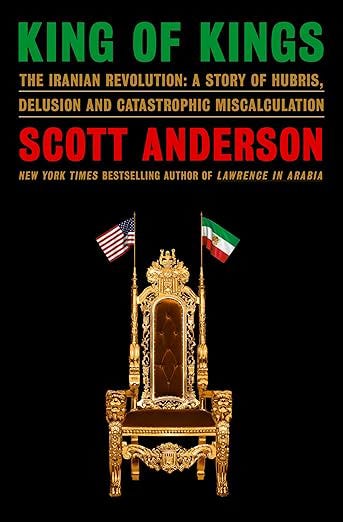
Scott Anderson is one of America’s most respected journalists and historians of the modern Middle East. A longtime contributing writer to The New York Times Magazine, he is the bestselling author of Lawrence in Arabia and The Quiet Americans. He was our featured guest Monday, and more than 60 readers joined the conversation.His new book, King of Kings: The Iranian Revolution — A Story of Hubris, Delusion and Catastrophic Miscalculation, tells the story of how Iran went from a close U.S. ally under the Shah to the Islamic Republic we know today — a rupture that still shapes global politics and conflict across the Middle East.Summary of the conversationScott Anderson has been in heavy demand since the U.S. president said the country is at war with Iran and began bombing strikes. Anderson grew up overseas in East Asia because his father worked for USAID as an agricultural advisor. He has lived in the New York area for about three decades.Anderson is ideally situated to help us understand what is happening in Iran — and why it matters — especially as Americans try to make sense of the latest escalation in the Middle East.The discussion quickly turned to who in Washington truly understands the region. Anderson’s blunt answer: “Nobody,”especially not in the current administration. He criticized the idea that targeted strikes or leadership decapitation will spark a successful popular uprising, warning that the regime’s security apparatus — particularly the Revolutionary Guard — is deeply motivated by power and money and will fight for survival. He predicted worsening internal violence and a significant risk of the conflict spreading regionally.Was it possible the war was launched as a distraction from the Epstein files? Plausible, Anderson said — but he also suggested there may be little coherent planning, more impulse and “knee-jerk” decision-making.On whether ordinary Iranians hate Americans, Anderson said not broadly. He noted long-standing cultural ties, past educational exchange, and reports from journalists that many Iranians react warmly to Americans — even if anger rises when U.S. actions kill Iranian leaders.He also talked about the collapse of student exchanges and the hollowing-out of USAID, arguing that isolation and sanctions often strengthen dictatorships and deprive the United States of reliable insight into what’s happening inside closed societies.Then the Q&A begins with Iowa Writers’ Collaborative participants and guests:* Rekha Basu asks what people inside Iran are feeling now and whether democracy is realistic. Anderson says it’s hard to read from outside, notes the opposition is fractured, and suggests that even symbolic rallying around the Shah’s son reflects desperation and the absence of viable internal leaders. He’s pessimistic about democracy emerging cleanly, citing how hopes of the Arab Spring largely collapsed.* James O'Shea opinion writer for the Eagle Intelilgence Report, a Europe-based online publication that circulates in several languages throughout the Middle East and Europe. I give them stories on news That’s my latest paying gig. Former Des Moines Register reporter, and managing editor of the Chicago Tribune. He shares an anecdote from Iran—during “death to America” chants, someone winked at him—supporting Anderson’s point that public slogans don’t always reflect private sentiment. * Daniel Henderson asks about Trump’s motivations and Netanyahu’s influence, including the role of Christian Zionist politics. Anderson agrees Israel is a major driver, questions the “imminent nuclear threat” framing, and argues Netanyahu has pushed this alarm for years.* Lyle Muller asks why U.S. leaders keep repeating the mistaken belief that bombing produces democratic transitions. Anderson says airstrikes don’t topple regimes and often harden resistance; he warns the security forces can still terrorize citizens regardless of conventional military damage.* Barry Piatt asks about timing and why regional actors support an attack now. Anderson says Iran has made many enemies through proxies and regional influence; Arab solidarity isn’t automatic here because Iran isn’t Arab, and many governments view Iran’s weakening as overdue.* Laura Belin asks about a conspiracy theory involving locator chips and Mossad. Anderson says Iranians love conspiracy theories; he believes Israel likely has deep intelligence networks inside Iran and notes the historically complex Iran–Israel relationship, including oil supply under the Shah.* Rekha Basu follows up on claims of “imminent threat” and war powers. Anderson rejects the imminent-threat claim and argues the administration uses “emergency” logic to act first and litigate later.* Richard Gilbert asks about Americans trapped in Iran. Anderson says there probably aren’t many, but warns Iran has a pattern of detaining Americans as bargaining chips.Scott attended the Iowa Writers’ Workshop in Iowa City for three years, so reader Mary McCarthy put in the chat that some of his old watering holes are still standing (Foxhead, Deadwood, and Joe’s).Thank to Jan Kaiser of Beaverdale Books for helping us invite the author to address this very important topic.Key themes that come through* Iran’s modern crisis is rooted in imperial history, 1953, and the 1979 revolution’s dual religious + anti-colonial character.* Anderson is deeply skeptical that bombing leads to democracy; he expects Revolutionary Guard dominance and internal bloodshed.* The administration’s “imminent threat” narrative is challenged repeatedly; participants connect it to war powers and a broader “emergency powers” pattern.* A persistent distinction between regime hostility and public sentiment, with multiple anecdotes supporting “Iranians don’t necessarily hate Americans.”If you value this kind of information and are able to chip in to help cover video production costs, please become a paid subscriber. Okoboji Writers’ and Songwriters’ RetreatHas there ever been a more important time to tell the stories only you can tell?Memoir. Opinion. Reported essays. Fiction rooted in truth.The world is shifting quickly. Voices matter. Yours matters.Join us for the Sixth Annual Okoboji Writers’ Retreat — three extraordinary days on the prairie along West Lake Okoboji, where accomplished columnists, novelists, filmmakers, and literary agents gather to share what they know about craft, courage, and building a writing practice that lasts.You’ll leave with tools. Renewed confidence. Real connections. And momentum.Every year, we sell out. All signs suggest this year will be no different.Reserve your place now. Dates: September 27-30, 2026.Don’t wait. Tell the story.. Learn moreThose who enroll now will be able to participate in the Okoboji Mastery Circle - an online course series featuring instructors from the retreat — at no additional cost. DATE: March 11, 2026TIME: 7:00 pmTITLE: Writing for ChangeHow to use your voice to illuminate injustice, human rights issues, global challenges, and more—and how to offer readers pathways to action.BIO: Rekha Basu is a syndicated columnist, author, and globally raised feminist journalist.Rekha will also be presenting at the 2026 Okoboji Writers’ and Songwriters’ Retreat. Click to learn more about Rekha.The Iowa Writers’ Collaborative Has a New Look!I am so doggone proud of what we have built over the past five years! Check out the amazing columns by award-winning journalists, and emerging writers, too. This is a public episode. If you'd like to discuss this with other subscribers or get access to bonus episodes, visit okobojiwriters.substack.com/subscribe
NOW PLAYING
War With Iran? A Historian Warns of What Comes Next
No transcript for this episode yet
Similar Episodes
May 8, 2026 ·12m