
EPISODE · May 7, 2026 · 20 MIN
"We should be very careful with what we share about our kids on the internet."
from The Forum with Josh Cowen Podcast · host Josh Cowen
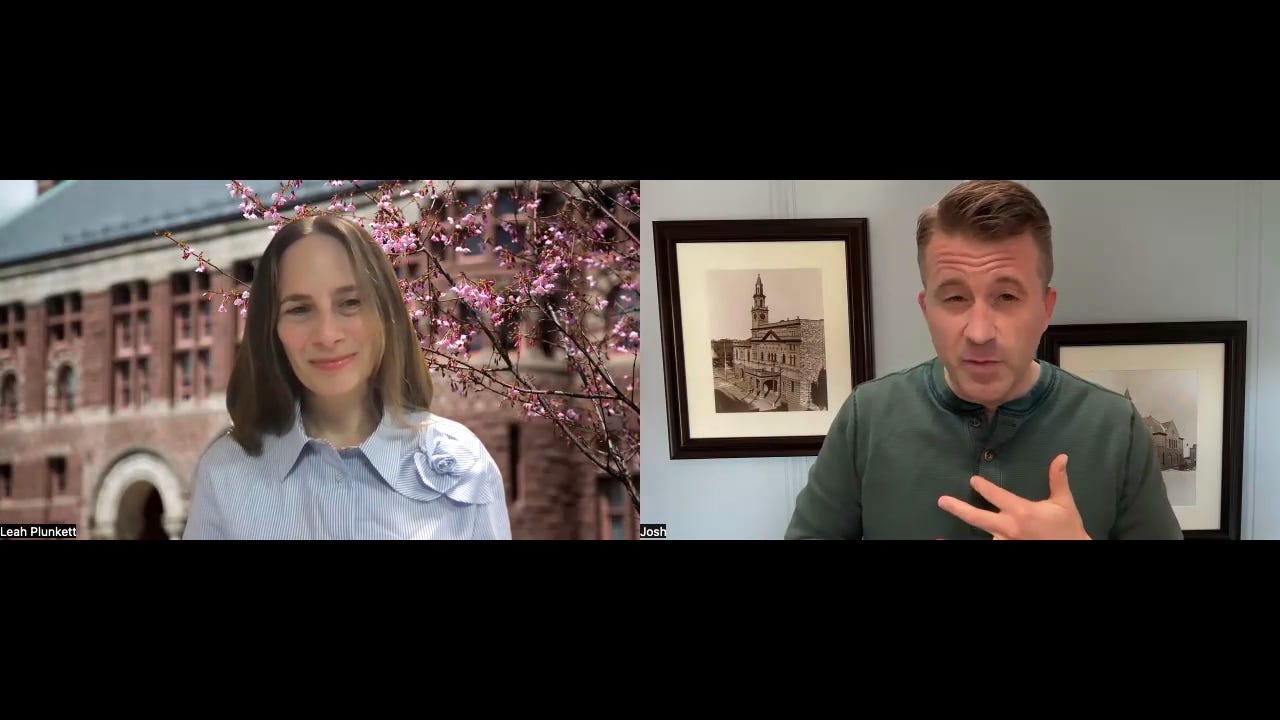
This week, my conversation is with author and Harvard law professor Leah Plunkett. She is also a faculty associate at Harvard’s Berkman Klein Center for Internet and Society. Leah’s book Sharenthood: Why We Should Think Before We Talk About Our Kids Online (MIT Press) was released a couple years ago, and since then she’s been one of the country’s leading experts on children and families when it comes to internet privacy, screen time, and the legal and policy questions involved in both. States across the country are setting limits on screen time in public schools. New reporting on the prevalence of YouTube and Chromebooks in the classroom has helped spur these changes, as have concerns that academic declines may be driven in part by over-reliance on digital devices. But Leah Plunkett’s concerns go further, wrapping parent choices into the larger discussion of digital and online behavior. She has worked on court cases involving kid influencers—including kids whose parents make substantial money on their child’s internet exposure—and her book Sharenthood outlines some of the downsides that we all have to be honest about in the way we talk about our kids and our families in the social media world.Leah’s got some good advice—both practical and philosophical—for how to make sense of all this, how much online exposure is too much exposure, and what’s coming next. This was a very, very timely conversation and I hope you’ll give it a read or a listen.Leah Plunkett thanks for being here. Tell us a little bit about your legal background, the types of work that you’re engaged in, and some of the big ideas or themes of that work.Thank you so much for having me, Josh. It’s such a pleasure and privilege to talk with you and your community of listeners.I am trained as a lawyer. I’m a graduate of Harvard Law School. I got my start in practice as a legal aid lawyer when I founded something called the Youth Law Project at New Hampshire Legal Assistance, where I represented kids and teens and sometimes parents in civil proceedings, mostly special education and school discipline. So that was kind of, like, one eagle arm in yoga, if I can do eagle arms in yoga, this early in the morning. Then when I became a consumer rights lawyer, and then when I became a legal academic, that sort of second arm in the eagle arms came together, and I became incredibly interested in how the everyday lives of kids and teens and families and their broader communities intersected with the internet in school, initially—that was my focus. I got started looking at educational technologies and student privacy. From there, Josh, I broadened out, and I now teach and research and write on kids, families, communities across the United States, and the way that our daily lives intersect or fail to intersect with the American justice system.You wrote this book Sharenthood, it’s a couple years old now but I think maybe getting more relevant by the day. What’s the overall message of the book?The overall message of this book is that parents, as well as grandparents, aunts, uncles, teachers, coaches, and other trusted adults should be very, very careful and very purposeful if and when we choose to share any information about any of the kiddos—I use kiddo here as a general term to mean minor, so really anyone kind of up through 18—before we transmit any of their information via the internet. And my reason for that—I’ve got a lot of reasons—but my biggest reason for that is a philosophical and kind of practical commitment to thinking that childhood, again, including adolescence, should be a protected space to play, to make mischief, make a few mistakes, and grow up better for having made them.And if we are raising our kids in a surveillance-type environment where we are chronicling all or most or even some of their experiences figuring out who they are and who they’re going to become, we are actually impeding that process of self-discovery and growth, and actually making it harder for them to figure out who they are and who they’re going to be.If we are raising our kids in a surveillance-type environment where we are chronicling all or most or even some of their experiences figuring out who they are and who they’re going to become, we are actually impeding that process of self-discovery and growth, and actually making it harder for them to figure out who they are and who they’re going to be.—Leah PlunkettJust playing devil’s advocate here. What’s wrong with just having a little fun? Everybody shares everything. Some would say it’s community—just digitalized. We’re all stressed about everything. What would you say to someone who doesn’t want to exclude themselves from what everyone else is doing and doesn’t want to take on a new worry about this kind of stuff? I would say first, I love fun, and I recognize that a lot of what I have to say about the internet may seem to run counter to that, but I promise it doesn’t for the following reasons. I would say to the person who’s like, but I want to have fun! I would say, absolutely.And you will ultimately have more fun if you are mindful and purposeful and thoughtful about the arenas in which you have fun whether the activities you’re engaging in in those arenas, especially online, are actually allowing you and your kids and your family and your community to have fun.And you’ll free up more brain space, emotional space, psychological space, and all the things if you are a little bit less reflexive about, oh, I’m really proud of the piano recital, I gotta put it in the Facebook mom group, or super excited, the kiddos look beautiful at prom. You know, it’s my next Instagram story! It may well be that for who you are and who your family is, a really deep-seeded, genuine part of having fun is sharing that with whoever might be following you online. If so, I respect it, I get it, and I’m old school about my belief in the First Amendment, free expression, and also individual freedom and liberty, especially parental liberty.But I think I will be the devil’s devil’s advocate and say: How much more fun is it really bringing into your experience of prom? If you’re like, oh my gosh, the kids look beautiful, it’s up on Insta, and all of a sudden, you’re like, ooh, who commented? Who liked it? How many views? And then the kids are getting into the limo for prom, and you’re like, oh my gosh, somebody DM’d me!Like chasing a dopamine hit or something?It is. And look, you know, I say this with a mug filled with coffee, and it’s like my third cup of the day. So, again, I get it, but the coffee in my cup is not actually creating a digital trail for my kids that strangers or potential bad actors, even within my network, could see and repurpose.So what are some of basic, practical guidelines for parents or grandparents who do want be proactive about what they put online, but also don’t want to isolate either?So a couple of guidelines. One is kind of an old school thought experiment. You and I are the tail end of Gen X, so we remember growing up without the internet, and we remember when news was shared in local newspapers or holiday cards or that type of thing.I would say to adults who either remember those analog days or who can sort of do a thought experiment about them: think about whether if you had to take out an ad in the local newspaper or write this up in a hard copy holiday card and send it to hundreds of people from your great aunt to your boss, would you still be sharing it, right? And if the answer is no, I’d feel a little icky [putting it online now].Or maybe even, like, think about your 13-year-old self, and sort of think, would I have felt weird if my parents had taken out an ad in the local newspaper to, like, talk about how my tryouts for softball went? Yes, we all would have. So then just maybe think, is there a way of sharing this that still creates community, still sparks fun, still sparks the dopamine hit, but isn’t quite as public? And there are ways of doing that, right? End-to-end encrypted messaging, group chats in those kinds of more secure messaging apps.People will often say, what about my social media settings if they’re set to private? To which I will say, I think it’s a little bit better, but truly, even social media settings set to private are kind of the equivalent of putting something on a billboard by the side of every highway everywhere in the world, now and forever.And so maybe just think a little bit about whether you want to do that.I don’t like what I’m seeing in terms of research or just common sense about how much time kids in primary and secondary schools in this country are spending on devices. I think we are setting up kids to have to master their own ability to pay attention in a way that is completely unreasonable for people who still have maturing brains.—Leah Plunkett It’s a bit outside your specific focus here but a big theme right now in education is reclaiming kids’ attention from screens. YouTube has taken over. Chromebooks in classes. iPhones, everything. How do you think about the specific problem of kids on screens and online—beyond what their parents put up online about those kids?This is actually going back to my original research with the Berkman Klein Center, starting back in 2013. I was part of a team that we had then called the Student Privacy Initiative.And we spent a lot of time looking at the privacy policies and practices and norms, as well as some of the adjacent spaces to privacy, so things like safety and well-being for kids in K-12 in public schools across the U.S. So this is a bit of a return to that research, as well as the class I teach every fall at the Harvard Law School, which is on youth privacy and digital citizenship.And definitely that digital citizenship part of it encompasses the choices that adults are making about whether, when, how, and why to give kids screens. So adults are involved, certainly, in the YouTube in schools phenomenon. Kids are not making the decisions about whether they’re using Chromebooks or, you know, pen and paper. But I certainly agree once you give a kiddo a device—particularly a kiddo, honestly, over, like, the age of 3 at this point—they’re exercising a fair amount of autonomy over what they’re doing on it, whether we adults like it or not. So when we started researching the real wave, maybe even onslaught of educational technologies in schools, really kind of going back—I would date this era to the early 2010s—we as researchers were much more focused on privacy, data gathering, data aggregation, whether kids were seeing advertising and marketing, whether they were being targeted with surveys.We were not using, at least at the Berkman Klein Center, as a focus, we were not using the word “attention” or “focus.” That was not something that was front and center of our minds, but we were very aware, even going back to that initial push that Google and other providers were making to have one-to-one device classrooms, right? That was the big thing back then—and still is. We were very aware that children’s time and their education could be disrupted. Again, we were thinking a lot about things like marketing and advertising. So how I think about devices in schools now is actually pretty much the same as how I think about them in homes and sports and houses of worship and all those other places is the following. First, of course, always looking for, is there a law, is there a binding regulation, etc? Okay.Once we’ve done that, why are we using the device? Who is using it? For what purposes? And quick gut check: could we accomplish more or less the same thing, or possibly even a better thing, if we didn’t use the technology?And I don’t like what I’m seeing in terms of research or anecdotic data, or just common sense about how much time kids in primary and secondary schools in this country are spending on devices. I think we are setting up kids to have to master their own ability to pay attention in a way that is completely unreasonable for people who still have maturing brains. Honestly, it can be hard enough as a full-grown adult to be like, oh, right, I really can’t just, you know, pop over to, you know, my New York Times or Wall Street Journal app and see what’s happening in the world when I’m supposed to be paying attention and such and such a thing.I think it is a Herculean task to ask kids to do that. I also think we’re setting up an incredibly unfortunate dynamic, and this now, Josh, goes back even before my Berkman Klein days to my legal aid lawyer days, where even in that 2007-2009 range, when I was a legal aid lawyer and I was representing kids in school discipline cases. The internet was coming up a lot. I still remember going into a client meeting, maybe 8th, 9th grade girl, getting in a lot of trouble at school, undiagnosed and not properly provided for what we call educational disability. Anyway, I walk in, vice principal comes in, puts a huge stack of papers on the conference room table, and it was a printout of a MySpace exchange—if anyone remembers MySpace—that my client had allegedly had with some classmates. Anyway, point being, we really are asking too much of our teachers, as well as other frontline administrators, because so many of them wind up essentially having to be the police of the internet. And it’s not okay for the hardworking men, women, and people who are trying to teach our kids what they need to know for the next standardized test to be a good member of a community, to get what they want to go in college or career to also be playing whack-a-mole with not just YouTube, but with other apps and programs that the kids are inevitably sneaking onto, even when the device is ostensibly locked down. We’re never gonna win that tech cat and mouse game.I would love to see a federal privacy law for all individuals with heightened protections for kids. I don’t think it’s going to happen soon. So I am looking to the states. To school boards at the district or local level. To communities coming together to say there are common sense, everyday norms that we should be able to agree on.—Leah PlunkettLast question. Bring the law and the digital, online concerns together. What are going to be some of the big legal and policy fights over the next five years? Ten years? Where are we going for all this—feel free to tell us we have to wait till your next book!So my crystal ball is the following. With all due respect to our federal government—and I’m agnostic on administrations when I say this—the federal government has not done, on the legislative side the kind of leadership work we need it to do on privacy and online safety law reform for any of us in this country, particularly our kids. I would love to see Congress and the U.S. Senate pass and have the president of any administration sign an ethical, practical, of course, constitutional federal privacy law for all individuals with heightened protections for kids. Or I would settle for a comprehensive federal law just for kids. I don’t think it’s going to happen in the next 5 or 10 years. So, brings me to my next point. I am looking to the states. I’m looking to state legislatures, I’m looking to state agencies, I’m looking to state attorneys general, I’m looking to state boards of education, school boards at the district or local level. I’m looking to leadership in individual schools, as well as broader communities in which schools are embedded, so unions, athletic associations, and all of that, to continue the trend that I’m seeing of blue, purple, and red states and communities coming together in this kind of center of the Venn diagram to say, there are common sense, everyday norms that we should be able to agree on. Those include that kids in schools should be learning not watching goodness knows what on YouTube. Those also include, Josh, an area that’s very near and dear to my heart that I’ve been working hard on, so I’ll plug this now, which is state law reform for protections for kids and teens who go to work as child and teen influencers. I’m very involved with work that the Uniform Law Commission is doing. It’s available online, Child Digital Entertainer Act is what it’s called. We are in the process of drafting a potential model law.Uniform Law Commission has not made a decision on whether or not to adopt it, so I don’t want to put the cart before the horse, but there are a number of states, including California, Utah, Minnesota—so again, we have states kind of all over the map—that actually have already passed basic financial protections, and in some instances, privacy protections for kids whose parents or other adults are making money off of having those kids perform on social media platforms. That’s an area I’m watching a lot. Another area I’m watching a lot is what will happen with AI, particularly character-based AI. There’s a lot of litigation that’s already started. There’s more to come, and you cannot have AI bots or whatever other AI is coming our way that will tell a minor things like, go ahead and murder your parents for taking away or limiting your internet time. I should say that’s still an allegation. But that is a paraphrase of an allegation that is playing out right now in a court in Texas. So the AI companies either need to figure out yesterday how to, with a high degree of certainty, keep their bots and other AI tools from saying things to kids that are dangerous, if not illegal or criminal, or please, ideally federal government—but again, not holding my breath—states figure out whether it’s a matter of legislation, lawsuits, private plaintiffs lawsuits, or some combination, how to keep our kids safe from the real dangers that that kind of AI poses. I should say by that kind of AI, I mean character AI that really kind of gets to know you. Last, but certainly not least, we are seeing a lot happening with outright device bans in schools here in the great state of New Hampshire, where I live with my family. We have a state law that bans kids from having their personal devices out during the day. I am in favor of it.I think that I’d like to see New Hampshire and all other states go further, and from a top-down level at the state level, I don’t think this is a federal government purview, but at the state level, actually come up with top-down, common sense constitutional guidance, and in some instances, binding rules that takes these whack-a-mole decisions out of the hands of principals, vice principals, teachers, individual kids, and says: from the time you say the Pledge of Allegiance to the final bell you’re here to learn. If there’s an emergency, go to the office and call your mom.Once again, Leah Plunkett is a law professor and faculty associate at the Berkman Klein Center for Internet and Society at Harvard, and the author of Sharenthood: Why We Should Think Before We Talk About Our Kids OnlineI also want to give a special shout-out to Brian Goldstone, who in April joined me here in this space for conversation about his book There Is No Place For Us: Working and Homeless in America. On Monday, May 4th, Brian won the Pulitzer for this work—a tremendous achievement for a remarkable piece of journalism. This is a public episode. If you'd like to discuss this with other subscribers or get access to bonus episodes, visit joshcowen.substack.com/subscribe
Embed this episode
Ready to play
"We should be very careful with what we share about our kids on the internet."
No transcript for this episode yet
Similar Episodes
No similar episodes found.
Similar Podcasts
No similar podcasts found.