
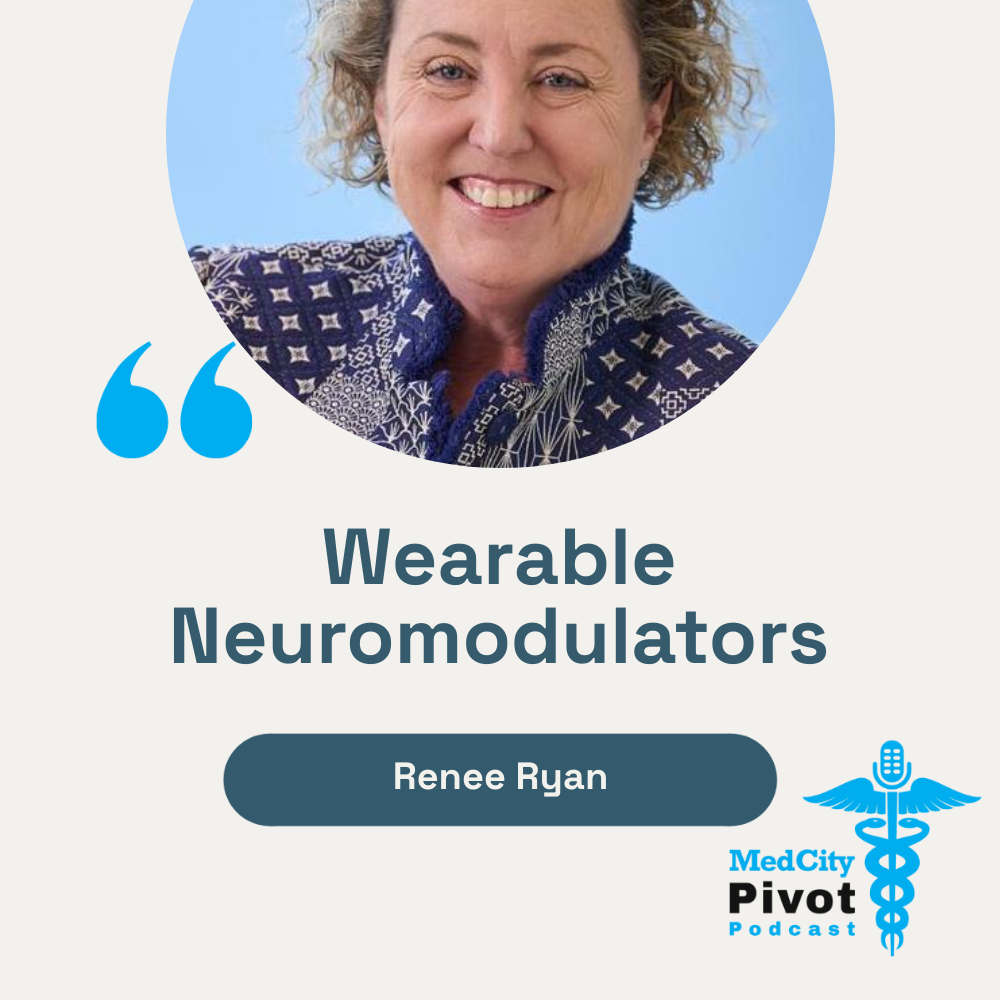
I was the first money into the company and I met Tate at a event at Stanford Bio Design and I said, Kate, we're going to go start a company. And she told me all the reasons why we couldn't do that. And six weeks later, Calla was born. Hello and welcome to Med Cities, Pivot Podcast.
I am Orland Dutti Barmar, Editor-in-Chief of Med Cities News. The voice that you heard was of Renee Ryan, a VC turned CEO leading a wearable neuromodulation company called Calla Health. In this episode, we talked about Calla's therapy, goals that the company has, and the edge that Renee has with raising money for her startup. Hello, Renee.
Welcome to Med Cities, Pivot Podcast. Renee, thanks for having me. So, you know, I used to be a Med Tech reporter back in the day and I've always have found Calla Health to be very intriguing. For those who don't know the company and how you leverage neuromodulation, can you describe the device and the therapy?
Sure, I'm happy to. So, Calla has developed a wearable neuromodulation therapy. We use nerves at the wrist to deliver electrical signals to the brain to treat a condition called essential tremor. And so the device itself is like a watch.
It has a proprietary waveformer that the simulator generates and we deliver electrical signal through drawing electric materials that are embedded in the watch band. That's very interesting. Now, I think you have said previously that this is not a curative device. It is to reduce symptoms so that people can leave as normal life as possible.
Can you expand a little bit on that? Sure, happy to. So, in all of our early work, we identified that we could reduce the burden of tremor by at least about 50% in most of our patients. And so today, now that we have commercial users that are consistently using the device out now well over 18 months, 24 months, we're seeing that tremor burden reduction increase.
So, now we're seeing 60% of a tremor burden reduction in some of our real-world relevance. That's very interesting. Tell me about why the device is called Calitraio. It's called the Calitraio largely because we originally developed code names in terms of the company that were related to copies of things like Grande and Bentay.
But when we had our FDA approval, the first approval we received was on the Cali One device. OK. So you could imagine we didn't get very creative as we then further studied the Cali. Two.
And so, hence, we have three electrodes in our band. OK, we got fancy with the name Treto. Now, there is another device on the market. I briefly looked at the company's website.
It's called Tramello device from five microns. Your device looks far more attractive physically. And of course, the therapy modulation is much different. But theirs doesn't appear to need a prescription.
I think you're accurate. I know it's a weighted glove. We've actually worn their device previously. It's a much more prominent looking device.
It has weight that comes off of their glove. But the honest I've heard is that it's 18 patients need solutions. And so if you can use whatever device to restore your functionality, restore your ability to do your activities of daily living, you know, we think it's it benefits these tremendous number of patients that have essential tremors. But is there I mean, are you do you see yourself as a direct competitor?
Because yours is a prescription there and there's isn't, but they're also attacking essential trauma. How do you view them? I view them as another assistive device to help these patients. You know, if you think about how these patients have managed their condition up to now, it's really been generic drugs on one end and then highly invasive surgical options on the other end.
Right. So since you mentioned the highly invasive therapies, those are deep brain stimulation. And of course, you have companies like Medtronic develop devices. Do you see yourself as an alternative to those or you are helping patients or you're on in their symptoms and eventually they will progress to where they will need more invasive surgery.
Yeah. Aren't I? It's a great question. We see there's two major surgical options for these patients.
One is DBS. The other is focus ultrasound or ablative thalomatamines. And patients who have essential tremor are struggling with their tremors. But the invasiveness and the riskiness of these surgeries are really unattractive to the patients.
So we see ourselves fitting the full spectrum. We have clinical guidelines that place us closer up to the top end of the following meeting, a compliment to personal drugs. When we like that positioning. Okay.
So again, since you mentioned drugs, you know, a few years ago, I spoke with a physician who happened to be a Medtang VC. And he talked about how neuromodulation was this magical, almost magical therapy modality that would once, you know, create options for patients, but also ultimately chip away at the drug market share for some of these neurological diseases and other diseases. So do you see neuromodulation as sort of achieving its potential in sort of chipping away at some of the hegemony for lack of a better word of the drug makers? You know, I think the opportunity for neuromodulation is tremendous.
Right. And so our belief is that it's going to get, we're broadly adopted. If you can develop much more patient friendly solutions like the callowarable solutions. But you don't see it as fundamentally giving the pharma world a run for its money.
No. No. And why is that? Well, because drugs are so easy to prescribe and so easy to take generally.
Right. I think some of the higher end biologic type compounds are not meeting those speeds, but those are big markets and big drugs. Thank you, Vera. We have five pharmaceutical companies that have invested in calla.
And so I think they look at us as a compliment to their drug franchises. But what about side effects? I mean, medical devices and neuromodulation don't nearly have the same type of side effects that drugs in general do. Absolutely.
You're correct. So there, I mean, I guess in the US, we're so dependent on drugs that it's harder to move away from that paradigm, I guess. Yeah. And so what we've done in all of our clinical work is we had our patients stay off or maintain their dose of gender medications, add on the calla therapy.
And then once they've been using the device for a number of months and they've seen a success they can have, we often have anecdotal evidence that patients are stopped using their various drugs. Yeah. Very important promoting it. But we do see it in our data.
Why not? Why aren't you promoting it? Because it'd be a very long and costly study by how you can take patients off their drugs and plus your investors. We do have to do that.
So let's talk a little about some of the other things that you're planning down the road. So you're tackling essential tremor. What other conditions could benefit from the same type of therapy? Yeah.
Our early commercial success in essential tremor is really important to us and treating those patients, delivering on our promise to them. We are working in Parkinson's, we're submitting our FDA data later this year. And so what does stay very focused on this movement as sort of space for the foreseeable future? We do have pipeline work going on with folk like Einstein and MGH with a vagal nerve stimulation platform, primarily looking at inflammation in terms of conditions such as Crohn's disease and IBD and those types of conditions.
We have some work going on at the risk with our risk platform in cardiovascular indications and other neurologic indications as well. What about hypertension? I feel that neuroagulation has had a spot in history when it comes to hypertension, specifically people that have resistant hypertension. Yeah, it has.
We're not going to start in hypertension. But I do think there is a case to be made and there's history around how certain nerves are influencing hypertension. It is a complicated disease because you get the white coat hypertension. It's a part of study at this physician's office.
Right, makes sense. Let's talk a little bit about the macro of climate. I'm just wondering how the pandemic altered either your operations or business trajectory. I mean, you're not like a telemedicine company that saw huge adoption.
How did the pandemic affect Cali help? We had a little bit of a slowdown for about six weeks, March and April of 2020. But we started growing pretty readily again in May. Okay.
In fact, we only sheltered in place for about six weeks. We had people back in the office, manufacturing products, shipping products, infecting products, starting May of 2020. Wow. How many devices have you shipped?
Are you able to share that number? We currently have about 1400 patients actively using our devices these days. And this is all in the US. It is all in the US.
Yeah. Okay. And do you plan to expand in other places? Once we get our next generation technology out into the marketplace, then we're going to evaluate US markets.
Now, I've not looked at your devices in person. I've only seen videos. It looks as if you love consumer devices. And I'm wondering whether this is one of the reasons that you choose to manufacture and deliver yourself instead of using third parties, you want to maintain that consumer connection.
Well, we do. And actually earlier in the month of June, we launched our portal for patients to be able to see their data. So that's really why we wanted that direct relationship so that we could begin to empower our patients with help their tremors, improving, how they're using their technology and being successful with it. So I want to talk to you about the future of digital medicine.
I mean, it's had a few ups and downs. I mean, I think of pharma companies trying to tie up with digital health companies, those haven't gone well. Proteous digital health was much value to it. Very interesting company, but had a real fall from grace.
What is the future of digital medicines? I think it's a great future personally. I mean, we are not a pure digital solution. Sure.
Have a part of our component that the amount of patients risk. Right. But the power of what we can do in terms of doing over the Earth's software updates to continue to optimize the therapy for each patient is really powerful. What are your goals in the next six months or so?
Right now we're in a discussion with CMS about pricing for technologies. Okay. No, we were fortunate within our first year on market, we received two unique codes. Oh, well, from CMS.
We then came through a process over the last probably six months where they deemed us to be a DME or dirty equipment. Yeah. And they unfortunately went back to their original decision and gave us a pricing that was similar to tens. And clearly we have unique codes and unique way of operating huge amounts of IP, such that we've now appealed that decision about the pricing and are waiting their pricing decision in September.
So right now, do consumers have to pay quite a bit out of pocket if they are prescribed this device? They do. We have a cash pay available. We are able to file some commercial insurance claim and then we have a very nice relationship with the VA.
Okay. So I guess the question is, you know, a lot of new and novel devices are really stymied by reimbursement issues. How much are they difficult? Do you see that?
And do you think that since you've appealed this decision, you know, you expect a different result? Well, that's, that's what we're saying. Very expensive lawyers. But I'll say this.
When I talk about the pipeline of indications, we have prioritized those based on where we think we would have the opportunity to meet Medicare rules, regulations, with regard to being a reimbursed technology. So there's almost a topic to keep for us. And so I'm like, do we have a lead that the science will work or taps away for it will have impact on that clinical condition? And then number two, can we get reimbursement?
Yeah, everything that is dependent on reimbursements these days, I feel. Do you think even commercial pairs, you know, are hesitant to reimburse because CMS hasn't taken the lead or do you think there are more progressive for lack of a better term payers that you've interacted with? Yeah. You know, we've been in front of these commercial payers now for the last year because our codes went into effect April of 2021.
And only now are we beginning to have the contract conversations. I see. I see. So the commercial payers are very slow.
Yeah. I'm not surprised. Oh, good luck with that. I want to ask you about your decision in your career to move away from, you know, funding novel startups to leading one, you know, you've been on the investment banking side.
I met at VC as part of Johnson and Johnson. What made you want to take the leap to lead a startup? I don't think it was a desire to go be a CEO. In fact, I know it wasn't.
It really was the opportunity at Kala. I was the first money into the company. I met Kate at a event at Stanford Bio Design and I said, Kate, we're going to go start a company. And she told me all the reasons why we couldn't do that.
And six weeks later, Kala was born in him. So I went out battle and then we were on this journey to find a commercial stage CEO, the company had received her by 10th or 25th and K did a large clinical study. And now we're ready to commercialize. But the challenge we found is that most of the people who understood their modulation were surgical people, people who, you know, had to have to be in the procedure room with a physician, helping with programming advice.
And that was very different than what Kala was doing. Right. And so for me, it was the opportunity to raise my hand and maybe do something a little risky and allow the board to give me the opportunity to commercialize our technology. And so we stayed very much in a beta mode for the first two and a half years.
And only earlier this year, did we start adding to our sales reps. So we only had three reps in the field all the way through the end of 2021. And do you think your experience as a VC helps you when you're raising capital, assuming you've done something in the internal period since you took over? Yeah, we did.
We raised 77 million last fall. We announced it. It was led by Ascension Health Systems. And so they ran us through all of their departments of neurology and their buying groups and their own in-house insurance company.
And so we had a pretty extensive deal, which is by them. And so we felt very good in coming through that and being able to attract that much capital. But what edge do you think you have as a CEO raising money, having been on the VC side? Probably never won a network.
I had a lot of people like a call because I knew a lot of people. And then also the ability to not be afraid to say, why are you saying no? What can I learn from a no? Right.
And so that was really helpful. Be able to say it's some of these growth stage guys would say, listen, I want to see 10 million of revenue as the threshold as to when I would come and actually invest. And we were well below that. Today we're sort of at that run rate.
Right. So we have the ability to go back and open those doors. That's great. That's great.
How many people work at Calum now? 113. Oh, wow. So you were fine in 2014, right?
And paperwork. Yeah, we finalized paperwork in 2014. We really started activity in early 2016. OK, so you've been around seven, eight years.
What sort of them end goal you think I would love to play out our pipeline. OK. And so in order to do that, likely need to be able to control our destiny with future funding. Meaning IPO.
Right. We obviously have a lot of strategic investors and strategic interest. But I really want to be able to prove that wearable der modulation has a place in treating these conditions, these chronic diseases for patients. So if I'm reading between the lines correctly, you're performing an IPO to an M&A.
But the market is terrible right now. It is terrible. We have a patient woman right? Renee.
Yeah, we've been raised a lot of money last year. We have a lot of new fresh talent. We've been able to get amazing people to join us on this journey. And we're committed to playing this out.
All right, great. It was wonderful chatting with you, Renee. And hopefully you'll keep us posted on news coming out of Calhelp. I'd be happy to.
I'm Dottie. Thanks. You.