
EPISODE · Feb 16, 2024 · 6 MIN
“What are the 6 Subtypes of Conventional (Solid or Multicystic) Ameloblastoma?”
from Dr. Gallagher's Podcast · host Brendan Gallagher, DDS
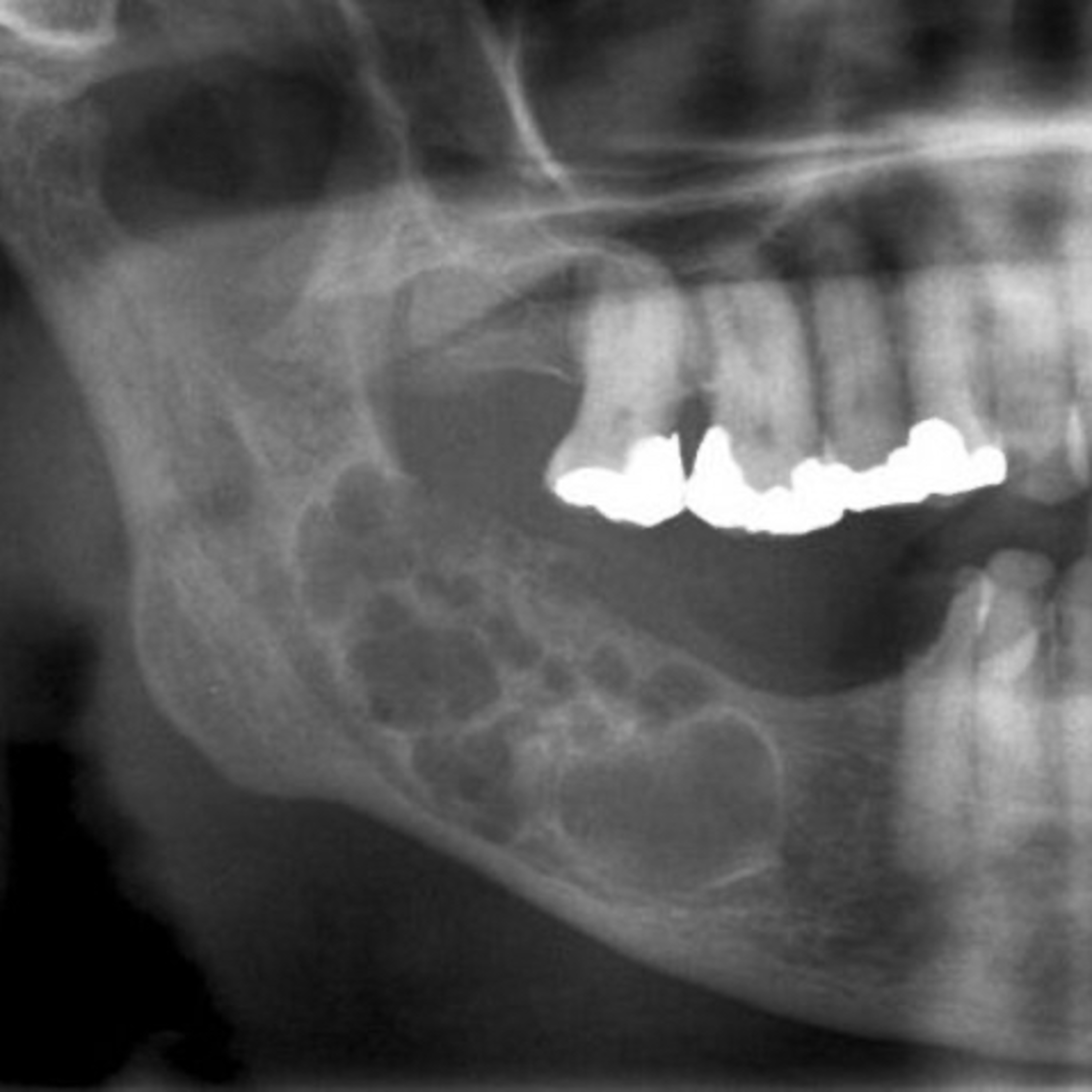
2.16.24 Quick Review #109 - #pathology #oralpathology #doctorgallagher #oralsurgery #oralsurgeon #dentist #dentistry #dental Ameloblastoma, a benign but locally aggressive odontogenic tumor, exhibits 6 subtypes within its most common form, the Conventional (solid or multicystic) Ameloblastoma: 1. Follicular Ameloblastoma: - *Most Common Subtype* - Clinical: Often presents in the posterior mandible as a painless swelling. - Radiographic: Shows well-demarcated, unilocular or multilocular radiolucencies often described as "soap bubble" or "honeycomb" appearances. - Histological: Follicles or islands of odontogenic epithelium surrounded by a fibrous stroma. Central stellate reticulum-like cells with peripheral columnar or cuboidal ameloblast-like cells. 2. Plexiform Ameloblastoma: - Clinical: Similar to the follicular subtype, with a preference for the mandible. - Radiographic: Radiolucent, often multilocular lesions, but the internal structure may appear more "net-like" due to the plexiform pattern. - Histological: Anastomosing strands or cords of odontogenic epithelium within the stroma, resembling a plexus. 3. Acanthomatous Ameloblastoma: - Clinical: Slightly more aggressive behavior and may cause more bone destruction. - Radiographic: Radiolucent areas, similar to other subtypes. - Histological: Notable for squamous metaplasia and keratin formation within the epithelial islands, resembling squamous epithelium. 4. Granular Cell Ameloblastoma: - Clinical: Tends to occur in a slightly older age group, with a slow-growing mass in the jaw. - Radiographic: Radiolucent areas, similar to other subtypes. - Histological: Granular eosinophilic cytoplasm of the stellate reticulum-like cells, giving a granular appearance. 5. Desmoplastic Ameloblastoma: - Clinical: Often involves the anterior maxilla; less common for other subtypes. - Radiographic: Distinct for its mixed radiolucent-radiopaque "honeycomb" or "soap bubble" appearance, often mistaken for fibro-osseous lesions. - Histological: Extensive stromal collagenization (desmoplasia) with small, compressed islands of odontogenic epithelium. 6. Basal Cell Ameloblastoma: - *Least Common Subtype* - Clinical: Rare and may present similarly to other ameloblastomas; can have a more aggressive course. - Radiographic: Radiolucent areas, similar to other subtypes. - Histological: Uniform, small, basaloid cells with less cytoplasm, arranged in compact islands with peripheral palisading. References: 1. Reichart, P. A., Philipsen, H. P., & Sonner, S. (2000). Ameloblastoma: biological profile of 3677 cases. European Journal of Cancer Part B: Oral Oncology, 36(1), 46-50. https://lnkd.in/dg6m2eiq 2. Neville, B. W., Damm, D. D., Allen, C. M., & Chi, A. C. (2015). Oral and Maxillofacial Pathology (4th ed.). Saunders. 3. Abubaker, A.O., Lam, D., & Benson, K. (2016). OMFS Secrets (3rd ed.). Elsevier. 4. ChatGPT. 2024.
What this episode covers
2.16.24 Quick Review #109 - #pathology #oralpathology #doctorgallagher #oralsurgery #oralsurgeon #dentist #dentistry #dental Ameloblastoma, a benign but locally aggressive odontogenic tumor, exhibits 6 subtypes within its most common form, the Conventional (solid or multicystic) Ameloblastoma: 1. Follicular Ameloblastoma: - *Most Common Subtype* - Clinical: Often presents in the posterior mandible as a painless swelling. - Radiographic: Shows well-demarcated, unilocular or multilocular radiolucencies often described as "soap bubble" or "honeycomb" appearances. - Histological: Follicles or islands of odontogenic epithelium surrounded by a fibrous stroma. Central stellate reticulum-like cells with peripheral columnar or cuboidal ameloblast-like cells. 2. Plexiform Ameloblastoma: - Clinical: Similar to the follicular subtype, with a preference for the mandible. - Radiographic: Radiolucent, often multilocular lesions, but the internal structure may appear more "net-like" due to the plexiform pattern. - Histological: Anastomosing strands or cords of odontogenic epithelium within the stroma, resembling a plexus. 3. Acanthomatous Ameloblastoma: - Clinical: Slightly more aggressive behavior and may cause more bone destruction. - Radiographic: Radiolucent areas, similar to other subtypes. - Histological: Notable for squamous metaplasia and keratin formation within the epithelial islands, resembling squamous epithelium. 4. Granular Cell Ameloblastoma: - Clinical: Tends to occur in a slightly older age group, with a slow-growing mass in the jaw. - Radiographic: Radiolucent areas, similar to other subtypes. - Histological: Granular eosinophilic cytoplasm of the stellate reticulum-like cells, giving a granular appearance. 5. Desmoplastic Ameloblastoma: - Clinical: Often involves the anterior maxilla; less common for other subtypes. - Radiographic: Distinct for its mixed radiolucent-radiopaque "honeycomb" or "soap bubble" appearance, often mistaken for fibro-osseous lesions. - Histological: Extensive stromal collagenization (desmoplasia) with small, compressed islands of odontogenic epithelium. 6. Basal Cell Ameloblastoma: - *Least Common Subtype* - Clinical: Rare and may present similarly to other ameloblastomas; can have a more aggressive course. - Radiographic: Radiolucent areas, similar to other subtypes. - Histological: Uniform, small, basaloid cells with less cytoplasm, arranged in compact islands with peripheral palisading. References: 1. Reichart, P. A., Philipsen, H. P., & Sonner, S. (2000). Ameloblastoma: biological profile of 3677 cases. European Journal of Cancer Part B: Oral Oncology, 36(1), 46-50. https://lnkd.in/dg6m2eiq 2. Neville, B. W., Damm, D. D., Allen, C. M., & Chi, A. C. (2015). Oral and Maxillofacial Pathology (4th ed.). Saunders. 3. Abubaker, A.O., Lam, D., & Benson, K. (2016). OMFS Secrets (3rd ed.). Elsevier. 4. ChatGPT. 2024.
NOW PLAYING
“What are the 6 Subtypes of Conventional (Solid or Multicystic) Ameloblastoma?”
No transcript for this episode yet
Similar Episodes
Dec 5, 2025 ·50m
Oct 9, 2025 ·33m
Oct 3, 2025 ·40m
Sep 11, 2025 ·31m
Aug 27, 2025 ·39m
Aug 18, 2025 ·54m