
EPISODE · Jun 26, 2026 · 16 MIN
"What I know to be true is that we are significantly underfunding our kids."
from The Forum with Josh Cowen Podcast · host Josh Cowen
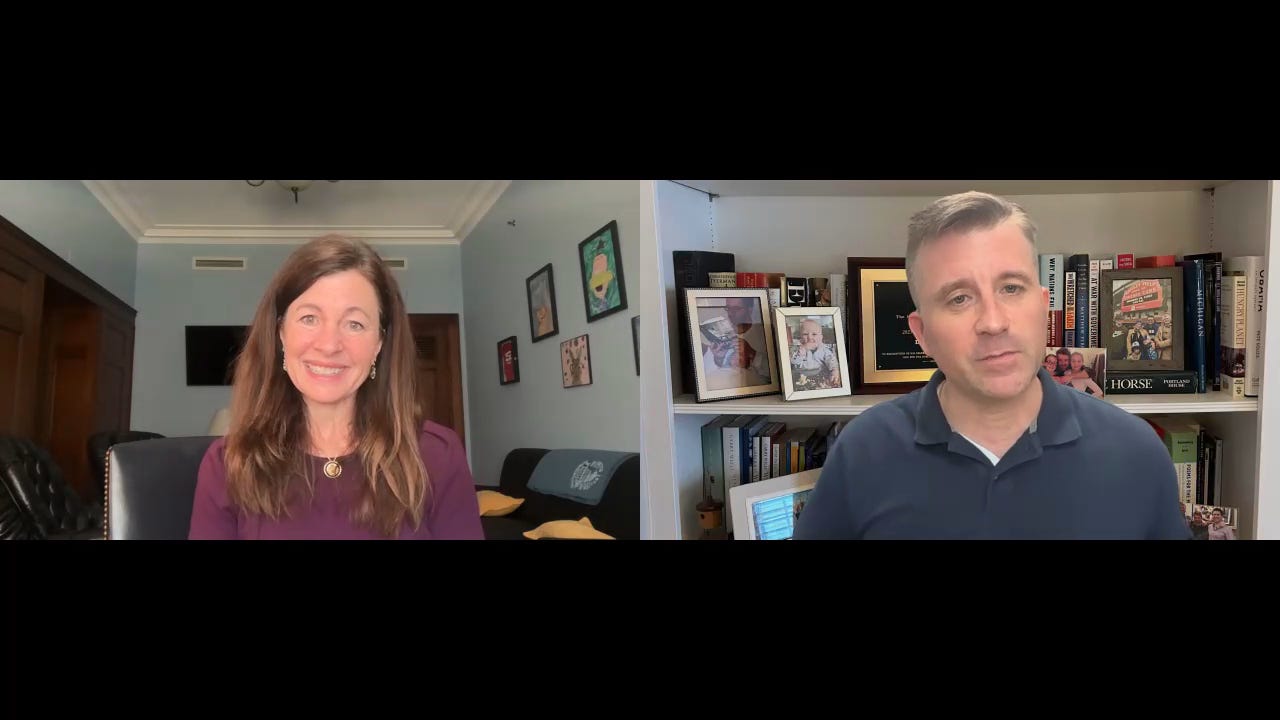
We’re capping off a half-year of conversations with members of elected officials and candidates about the politics and policy of serving kids and families. There will be more over the next few months, and look for a special recap next week. Today’s guest is an especially important leader in all things child and family policy: early education, child care, K-12 schooling, and access to higher education. I’m talking with Congresswoman Kristen McDonald Rivet, representing Michigan’s 8th District. Congresswoman Rivet is finishing up her first term in Washington, after serving in Michigan’s state senate. Both her state and national legislative districts are about as swing as they come: voters routinely back both political parties not only in different election cycles but even on the same ballot. So she knows how win tough elections. In both the legislature and in Congress, Kristen McDonald Rivet has been a leader on child care, access to early education, and improving K-12 schools—while fighting for public investment in all of those areas as well. Before elected office, the congresswoman served in a variety of roles inside and outside government. She was the executive director of Michigan Head Start, chief of staff at the Michigan Department of Education, and on staff at the Department of Health and Human Services.So basically, if you’re into public policy, and you’re especially interested in the idea that public policy professionals can and serve in some of the most consequential elected offices in your state and in Congress, Kristen McDonald Rivet is for you.Give this a read or a listen.A Conversation with Congresswoman Kristen McDonald RivetWelcome and thanks for joining me here. Just to get started, tell us a bit about your background, how you got involved in electoral politics and about the Michigan 8th Congressional District you represent.Let me try to sum that all up really quickly. Fifty-six years of my life, right, in this little section. I actually spent most of my career working in this public policy space around kids and families. Started that career running the Michigan Head Start Association.The thing that I want to tell you about that, that was so life-changing for me, is that in Head Start programs, as well as the Head Start Association, half of the board of directors are parents. And when you’re trying to put together a policy agenda for small children, and you’re doing it alongside a mom or a dad who lives at the federal poverty level and is actively parenting a toddler: your lens changes just fundamentally changes. And so that became for me, it was a really good instruction for how this work should be done, how we should be relating to people, how we, you know, things when we determine who whose voice has value in a room and it’s all fraught with those decisions.So in that time I started, you know, having my own children. My husband and I have raised six kids. What I know to be true is that we are significantly underfunding our kids. We are not supporting families in their attempts to, you know, raise their kids and just really have a stable, thriving household. And I saw that when I was the chief of staff at the Michigan Department of Education, and was a senior advisor to Governor Granholm, and all of these, all of these pieces, even when I was working on the ground in Detroit for the Skillman Foundation.Across demographics, across rural, urban. It’s harder and harder to raise a child, and there are big things that have to change if we are going to change that trajectory.I ended up getting into electoral politics for the first time in 2022, when I ran for the Michigan State Senate. And, I said no, quite honestly, the first couple times they asked me, because it just felt like, politics has gotten ugly and unproductive, and I really thought…You know what? We need to change our child care system. We need to change our education system. We need to change the way we talk to parents and community members. We need to change how programs are run and how we talk to people.It felt to me like being in the State Senate was a good place to do that. So, I ran for the Senate, flipped a Republican seat, and a year later, uh, was recruited to run for Congress. And here I am.We need to change our child care system. We need to change our education system. We need to change the way we talk to parents and community members. We need to change how programs are run and how we talk to people.—Congresswoman Kristen McDonald RivetBefore we get into some policy details, let’s talk a bit about the job. You’re in Congress, you’ve been in the state legislature. You’ve worked in leadership roles at state agencies. What are you finding that’s different about Congress, specifically? Anything your past leadership roles have helped prepare you for in DC now?It’s been an interesting 18 months. First about my district. I represent Genesee County, where the city of Flint is. Saginaw County, Bay County, half of Midland County. What’s really interesting about the 8th Congressional is, it’s a microcosm for the whole Midwest. We have farmers, we have manufacturing, we have abandoned industrial. We’ve got the home to Dow chemical semi conductor. All of these things that are when you look to Pennsylvania, Ohio, Indiana.This is what the Midwest looks like.But 70% of the jobs in my district pay less than $60,000 a year. So you think about what take-home pay looks like on 60 grand a year, and then start to think about the cost of groceries, and keeping your heat on in the winter, and childcare, which is around $450 a week for an infant.People can’t make it. People can’t make it.So, that is what I get up every day and think about, and get up every day and try to make a difference. And so, when I got to Congress, this is a wild, unruly place. A lot of people are very cynical about it, and there’s reason for that.But where I’ve been able to actually find success is going into that common ground and finding other people, I don’t care what side of the aisle they’re on, who are also getting up every day and thinking about that, because it’s not just the Michigan 8th, right?It’s the same thing in congressional districts in Pennsylvania, in Iowa, in places where people are hearing it from their constituents. And that’s where we’ve been able to partner, and I’ve partnered with other Democrats and Republicans, and been able to actually get some real stuff done.Even though people think that’s not possible in Washington anymore.Let’s turn to schools, kids, and families. You’ve been a leader in the early education and education reform spaces. Tell me a bit about what you’re working on these days.I just recently introduced a major tax cut for working families. And it’s part of building on the working families tax cut that I authored in the state senate that we were able to pass in the first six months of the trifecta that has been so meaningful and actually brought thousands of kids out of poverty in Michigan.But it’s also rooted in my own experience of having — there’s a moment in time where as a single mom with two kids, I knew exactly what it feels like to run out of milk on a Wednesday, and no, you’re not getting paid until Friday. The secret to that is you add a little water to the milk to make it go farther. But we shouldn’t really have to be doing that, and if you look at who’s paying what in our tax system, it’s an important question. So, what we’ve proposed is a large tax cut for families making less than $100,000 a year, and who have children under the age of three. So, what this would be is a $5,500 refundable tax credit for every child under the age of three. So it’s building on that work that we did in the state senate. But mostly what this does is put more cash in people’s hands, more money in your pocket to be able to buy formula and diapers and help pay for childcare, trusting parents with these dollars to make those decisions that we know we’ve got 40 years of research that says that that makes an enormous amount of difference.On K-12: we have to call the question on these things that we just defend with such rigidity when we have overwhelming evidence that we’re failing our kids and our teachers on pretty fundamental levels.—Congresswoman Kristen McDonald RivetI worry a bit that Democrats have kind of lost the plot a bit when it comes to K-12—and polling is starting to pick this up. We’ve seemingly got a clear plan on early childhood, and momentum around what it means to set students up for success in higher education, but there’s still some work to be done to come together on K-12. You’ve been working on all this for so long and wearing so many different hats, how do you make sense of what’s needed right now in K-12 relative to the other policy spaces?So let’s just level set about where we’ve made success. So we are in Michigan right now. Most four-year-olds are in preschool. So we’ve really gotten very close to achieving universal preschool, and it’s wildly successful. We can see it in all kinds of different ways.We’ve been able to help shore up our sort of birth-through-three space, lot of support for that, and, we’re almost at free community college for everyone, which is great. And the way we’ve been able to do that is just by putting a lot of choice out there, and a lot of roads, and a lot of access.But when it comes to K-12: we get into these very prescriptive, very nuanced, this is how you have to do it, this is what it has to look like, this is the test to see whether or not you’re doing it well, and this is the morass of bureaucracy and red tape that you have to wade through in order to reach goals that you were not a part of setting. And I think that that actually is a big part of the problem. Now, I’m not a pro-voucher person. I think that vouchers are dangerous from a funding point for our public schools. And also it’s embedded in Michigan’s constitution, so they’re not even legal in Michigan. But let’s just sort of define what the problem is. We’re, what, 30 years from No Child Left Behind, where we put in this accountability system and these mandated testing of one specific test that was mandated, and that test does not inform the practice of teaching in any way, shape, or form. The schools have no voice in when it’s administered and what test it is, and the consequences are very draconian. And parents don’t understand what any of that means. So in that time, what we have seen is our educational outcomes drop, teacher salaries basically stagnate, and everybody is very concerned with the state of our education system. So I think what we have to think about is what do we do going forward? Because the problem here is that our teachers are demoralized and struggling financially. Our kids, what we’re watching is that the access to things outside of those core things that are tested is almost non-existent unless you are from a wealthy family or in a wealthy community. And when I was coming up, granted, I’m an old person now, right? But I took driver’s training at school. Sports were free. There were all kinds of things that helped me become who I am that were beyond my math skills. And that, I think, is where not just Democrats, but everybody should be focusing. They would have to call the question on these things that we just defend with such rigidity when we have overwhelming evidence that we’re failing our kids and our teachers on pretty fundamental levels.We have to stop being in a place where we’re looking at states that are getting to a 60% reading proficiency and a 20% math proficiency in high school, and calling that a miracle.—Congresswoman Kristen McDonald RivetLast question. It’s pretty clear that the federal role in education is changing—funding, oversight, governance, all of it. You have an Administration that is doing everything it can to dismantle the Department of Education. As someone who’s sat in local, state, and now national leadership positions, what do you see when you look ahead? Where do we go from here and what are some of the big priorities we need to focus on together?I’m just going to give it a little bit of an optimistic twist, which I know is unusual in these times. But let me say this. The president can’t eliminate the Department of Education. He’s got to go to Congress with that, and there aren’t the votes.He’s farming out all of the different pieces of it to make it basically a shallow shell. But I think we can all agree that the Federal Department of Education needed a massive overhaul.And so, now we’re in a place where we are going to have to rebuild. So for me, it’s not a question of we’ll see what it looks like when it’s rebuilt. I wanna be a part of rebuilding it. And what we actually need to do is to think about, so the one I’m most worried about in the right now is our kids that need special education services.Because that is highly alarming to have that entire program put under Health and Human Services in a department that is completely rejecting all science of all kinds, and there’s just so many concerns there.We also — what if we could build a Department of Education that said, listen: we need every single kid who graduates from our public school system to be proficient in reading and functional in math.And when I say every single kid, we have to stop being in a place where we’re looking at states that are getting to a 60% reading proficiency and a 20% math proficiency in high school, and calling that a miracle.That is bananas! So, if the Federal Department of Education suddenly became a place that was trying new things, an education R&D, where we are looking at places where we can get to 90%, not 60%, that is something worth investing in, and I think that we all need to commit to being a part of the rebuild of the Department of Ed, and make it really work towards this goal of every kid and not just the rich kids and then some small other part of the country.Congresswoman Rivet is also running for re-election in the competitive 8th District—a seat that Democrats have to hold to retake the majority in Congress. You can learn more about her campaign here. This is a public episode. If you'd like to discuss this with other subscribers or get access to bonus episodes, visit joshcowen.substack.com/subscribe
Embed this episode
Ready to play
"What I know to be true is that we are significantly underfunding our kids."
No transcript for this episode yet
Similar Episodes
No similar episodes found.
Similar Podcasts
No similar podcasts found.