
EPISODE · Feb 11, 2025 · 5 MIN
What It's Like to Ride a Waymo in San Francisco. (And, Drive Tesla FSD to Get Home.)
from Deep Learning With The Wolf · host Diana Wolf Torres
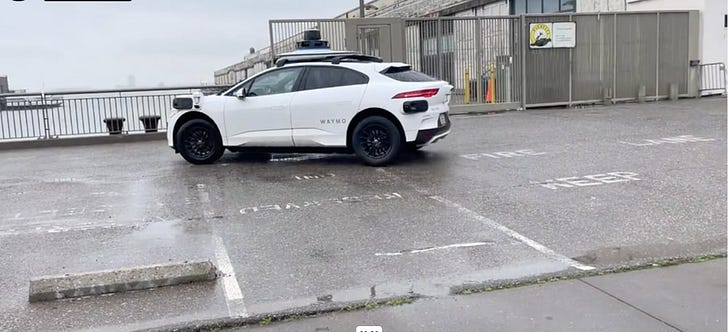
The podcast is read by an AI from ElevenLabs.[The background image for the podcast shows the blurry, obscured view of one of the TeslaVision cameras on a rainy day. ]On a particularly stormy Thursday in San Francisco, I found myself in a unique position to experience two distinct approaches to autonomous driving technology. The weather conditions were challenging – heavy rain reduced visibility, roads were slick with large puddles, and traffic moved at a crawl. These less-than-ideal conditions provided the perfect testing ground to compare Tesla's Autopilot and Waymo's autonomous driving system.It was a day of planes, trains and automobiles. I had a meeting in San Francisco, but also needed to pick up someone from the airport. So, I drove my Tesla to the airport in a heavy downpour, (more on this later), squeezed it into a much too tight parking spot at the airport and “caught the BART” up to the city.Riding BART is not as old-school as the New York City subway system, but not nearly as modern as the Metro in Washington, DC. The interiors of the cars have been modernized, but the ride itself is so loud you’d be hard-pressed to have a conversation while riding in one. It still beats driving and trying to find parking, though.I had a great meeting learning about some new robotics technology and then had a short period of time to make it to the CalTrain station. (Yes, a different type of train this time.) Due to the distance and short-time before the train was leaving, it seemed the perfect opportunity to try a real San Francisco treat…. yes, the Waymo.I was traveling with my research assistant, (which is handy, otherwise I would have been in the Waymo talking to myself as I recorded these videos.)We “summoned” the Waymo while walking away from our rainy, but very scenic, meeting site on Pier 17.The software is very intuitive to use and reminiscent of summoning an Uber. Yet, someone, the process felt less complicated than dealing with human drivers and the Waymo arrived VERY quickly. Within two minutes, our ride had arrived- a sleek looking Jaguar-equipped Waymo.After greeting you by name, the Waymo takes you through a safety briefing that sounds reminiscent of an airplane briefing.The Multi-Sensor Approach: Waymo's Autonomous SystemThe Waymo approach to autonomous driving is strikingly different from my Tesla with its AutoPilot and Full-Self Driving system.As a Level 4 autonomous system, Waymo combines lidar, radar, cameras, and detailed mapping to create a comprehensive understanding of its environment. The difference was immediately noticeable in the smoothness of the ride and the system's confidence in handling the poor weather conditions.None of this reassured my fellow passenger who initially described himself as “terrified” by the experience.My experience was very different. I was thrilled from the onset and felt completely safe for the entire ride. Perhaps it is because I have spent so much time research autonomous car technology. I know WHY a Waymo is so much safer than a Tesla as it drives itself around. The knowledge of all the technology making the car work was very reassuring, and I didn’t feel I had to continually monitor the car for “interventions,” (as is required in a Level 2 self-driving car like a Tesla.) Continual monitoring is NOT relaxing.One particularly memorable moment came when the Waymo vehicle navigated a tight right turn around a yellow cab. While the maneuver brought us closer to the taxi than most human drivers would attempt, the system had precisely calculated the available space using its lidar sensors. This illustrated how Waymo's approach combines multiple data sources to make decisions with mathematical precision, even in challenging conditions.My final thoughts on my Waymo ride are this…. if you are ever in San Francisco (or Los Angeles, or Phoenix), add “riding in a Waymo” to your list of things to do. It is an absolute treat. It is also an incredible way to see the city! Look at the lovely tour I received just as we headed to the train station.The Vision-Based Approach: Tesla's AutopilotMy research-assistant successfully made his train and I “caught the BART”to the airport, (to pick up my husband.)After a day of heavy rain, we began a slow, two-hour slog through peak, rush-hour traffic. Slow traffic is an excellent time to engage Tesla’s Autopilot. The system relies primarily on cameras and neural networks to understand its environment, much like how humans process visual information. This vision-based approach has allowed Tesla to deploy their technology widely without requiring expensive hardware like lidar sensors.However, the limitations of this approach became apparent as we encountered deep puddles concealing rough road surfaces. The cameras, while sophisticated, couldn't determine the depth of water or detect the condition of the pavement beneath. Like a human driver struggling to judge puddle depth, the system lacked the sophisticated depth perception that more advanced sensor systems provide.It made for a very rough ride as it felt like the car was “diving into” the puddles. In reality, as a Level 2 system it was simply not sophisticated enough to take “passenger comfort” into consideration. A Level 4 system like Waymo is better at charting a smooth path, (although not perfect, in the same way, we all inevitably hit rough patches of road at times.)At the end of the clip when my husband says “Stop!”, he is talking to the car. Who is going to tell the man the car is not K.I.T.T. and cannot respond to such things?We found ourselves regularly disengaging the system when approaching these hazards, demonstrating why Tesla's Autopilot remains a driver assistance system rather than a fully autonomous solution. While it helped reduce the cognitive load during a stressful drive, it required constant supervision and regular interventions.But, at least we kept our sense of humor about our car’s propensity to dive into mud puddles like Pig-Pen.Looking to the FutureThese contrasting experiences highlight the two main paths toward autonomous driving. Tesla's vision-based approach mirrors human learning and perception, potentially offering broader adaptability but requiring significant advances in AI to achieve full autonomy. Waymo's multi-sensor approach provides greater precision and reliability within mapped areas, though it requires more extensive infrastructure and preparation.The future of autonomous driving may ultimately combine elements of both approaches, but for now, these distinct strategies offer different tradeoffs between deployment scale and operational capability.FAQ:What's the difference between Level 2 and Level 4 autonomy? Level 2 systems, like Tesla's Autopilot, assist drivers but require constant supervision. Level 4 systems, like Waymo, can operate fully autonomously within specific areas and conditions.Why doesn't Tesla use lidar sensors? Tesla believes that vision-based systems using cameras and AI can achieve human-level driving capabilities at a lower cost than lidar-based systems.Can these systems drive in any weather condition? Weather conditions affect both systems, but multi-sensor approaches like Waymo's tend to handle poor weather more reliably due to their redundant sensing capabilities.#AutonomousVehicles #SelfDrivingCars #Tesla #Waymo #TechInnovation #ArtificialIntelligence #FutureOfTransportation #AutonomousDriving #MobilityTech #TransportationTechnology #TeslaAutopilot #WaymoDrive This is a public episode. If you would like to discuss this with other subscribers or get access to bonus episodes, visit dianawolftorres.substack.com
Embed this episode
NOW PLAYING
What It's Like to Ride a Waymo in San Francisco. (And, Drive Tesla FSD to Get Home.)
No transcript for this episode yet
Similar Episodes
No similar episodes found.
Similar Podcasts
No similar podcasts found.