
EPISODE · Jun 8, 2025 · 6 MIN
When Oligarchs Fall Out
from Carl's Mind Chimes Magazine Podcasts · host Carl Cimini
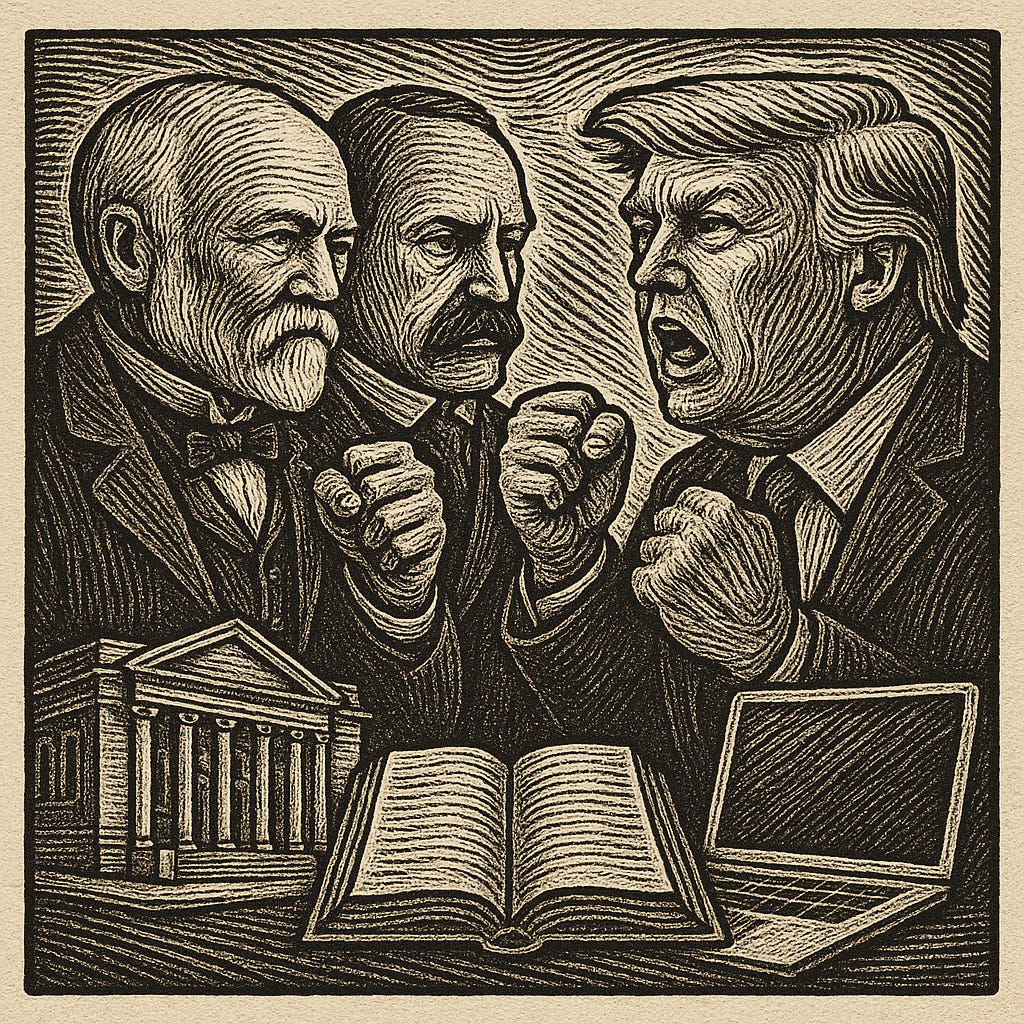
When Titans Fall OutWe have seen it before! From Carnegie and Frick to Trump and Musk, power feuds shape more than headlines—they shape legacies, institutions, and the architecture of American greed.By Carl CiminiIn the smoke-choked steel towns of 19th-century Pennsylvania, two men once stood shoulder to shoulder atop the roaring furnace of American industrialism: Andrew Carnegie, the philosopher-capitalist, and Henry Clay Frick, the iron-fisted enforcer of labor discipline. Willing to kill for profit. Together, they helped build the modern United States—literally. Their steel ran through the veins of bridges, railways, and skyscrapers. But like all stories of power shared by men of ego, ambition, and unshared values, their alliance dissolved into enmity.Carnegie envisioned himself as a moral industrialist—an enlightened giver who believed in capital as a means to uplift the poor. Frick, by contrast, was a Darwinian in a waistcoat: no-nonsense, brutal, and unrepentant in his belief that order was maintained through force. Their fissure came during the infamous Homestead Strike of 1892, when Frick called in Pinkerton mercenaries to crush striking workers while Carnegie vacationed in Scotland, conveniently out of reach.The bloodletting at Homestead cracked their alliance. Frick considered Carnegie cowardly and duplicitous. Carnegie found Frick’s ruthlessness an inconvenient stain on his legacy. Their business partnership endured for a while longer, but the friendship was ash. They would eventually sue each other, disparage each other in private letters, and race one another to philanthropic sainthood—Frick with his art collection, Carnegie with his libraries. Both tried to write their epitaphs with endowments. Both succeeded—though not equally.Today, we tell a version of this story every time we step into a Carnegie library or gaze at a Frick painting. Their rupture did not just end a friendship; it changed the moral shape of modern American capitalism.A 21st-Century RefrainToday’s wealth gap is now greater than it was during the Gilded Age. See the exposé new book called “The Haves and Have Yachts”The political and technological spheres of today offer a strikingly parallel rupture: Donald J. Trump and Elon Musk. Two men of vast influence, bottomless ego, and fleeting mutual admiration. Each, in his way, is a conjurer—one of populist rage, the other of techno-futurist myth.Trump and Musk once circled each other like heavyweight contenders trapped in the same ring. Musk offered quiet support during Trump’s presidency—grumbling about COVID mandates, echoing libertarian bromides, and posturing as a renegade visionary. Trump, in turn, hailed Musk as a “genius,” delighting in the myth of American exceptionalism reborn through SpaceX rockets and crypto-fueled rebellion.But their alliance was built on convenience, not conviction. It began to fray when Musk took jabs at Trump’s election lies, calling for “less drama” in American politics. Trump responded in kind, labeling Musk a “b******t artist.” The bond was broken.Their falling out is less about ideology than ego. Both men demand oxygen. Neither will concede center stage. Trump wields grievance like a cudgel; Musk wields disruption like a religion. Each imagines himself as the indispensable man of his age. And so, as with Carnegie and Frick, only one could remain.Legacy GamesYet what happens after titans fall is often more consequential than the fall itself. Carnegie and Frick, for all their brutality, ultimately sought to give back. Their feuding lives ended in institutions—universities, foundations, public treasures. The structures they left were tangible, democratic, imperfect, and real.Trump and Musk’s legacies are far murkier. Trump’s family foundation was shut down for self-dealing and fraud. His social media platform, Truth Social, is less an information commons than a feedback loop for his own grievances. Musk, for all his ambition, presides over a fraying empire of platforms and promises—from the rebranded X (formerly Twitter), to the still-unrealized ambitions of Mars colonization and self-driving utopias. His foundation, notably, is virtually invisible.These men are not building libraries; they are building ecosystems of attention. Less marble, more meme. Their philanthropic instinct seems not to uplift, but to dominate the discourse. Legacy, for them, is not what endures—but what trends.The Vacuum on the RightTheir personal rupture has left more than bruised egos—it has created a vacuum in the American Right. The uneasy marriage of tech-libertarianism and populist nationalism that briefly animated the Trump–Musk relationship has dissolved. In its place is confusion. Who, now, speaks for the future of the Republican Party?Trump remains the tribal chieftain of grievance politics, but increasingly appeals to an aging, economically precarious base. Musk, whose cultural cachet once suggested a possible bridge to the post-Trump generation, now finds himself politically adrift—praised by centrists one week, pilloried by all sides the next.Into this void tumble lesser figures. Ron DeSantis, Vivek Ramaswamy, and Peter Thiel attempt to synthesize the spectacle of Trump with the futurism of Musk—but lack the charisma or cultural ubiquity to do so. What emerges is a fractured coalition: one half nostalgic for the past, the other obsessed with a digital future that never seems to arrive.It’s not just a political vacuum; it’s an epistemic one. The Right no longer knows what it believes. Is it faith or code? Truck rallies or quantum computing? Its great voices have turned inward, canceling each other out.What Falls Away, and What RemainsCarnegie and Frick were ruthless, but they believed—however paternalistically—that capital had a moral duty. Their institutions still serve the public. Trump and Musk, by contrast, are the children of a culture that has traded public virtue for private branding.The question is not just who they are, but what they will leave behind. In an age where billionaires shape the narrative in real time, we must ask what kind of country will inherit their ruins—or their tools.One era gave us libraries, concert halls, and museums.The other gives us livestreams, hashtags, and litigation.We have always been a nation built by titans. But when titans fall out, we learn what they were really building.Carl’s Mind Chimes Magazine is a reader-supported publication. To receive new posts and support my work, consider becoming a free or paid subscriber. This is a public episode. If you'd like to discuss this with other subscribers or get access to bonus episodes, visit mindchimesmagazine.substack.com/subscribe
NOW PLAYING
When Oligarchs Fall Out
No transcript for this episode yet
Similar Episodes
Sep 29, 2023 ·76m
Sep 29, 2023 ·73m
Sep 29, 2023 ·72m
Sep 29, 2023 ·75m
Sep 29, 2023 ·75m
Sep 29, 2023 ·73m