
EPISODE · Nov 4, 2025 · 10 MIN
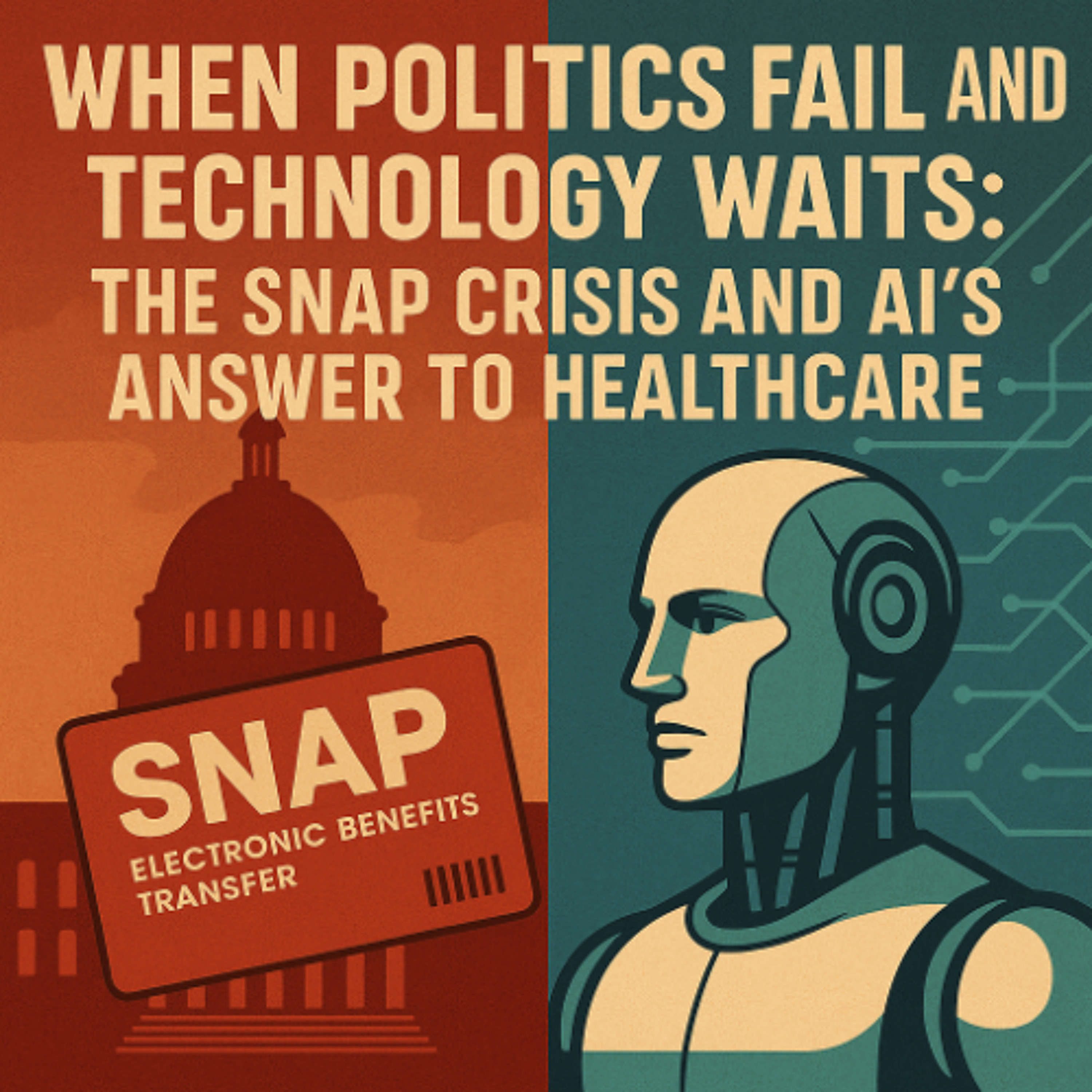
When Politics Fail and Technology Waits: The SNAP Crisis and AI’s Answer to Healthcare
from The Rock of Talk · host Eddy Aragon
Eddy Aragon’s “Rock of Talk” commentary intertwines sharp political analysis with a forward-looking argument about healthcare innovation, focusing on the intersection of the ongoing government shutdown, the SNAP benefits crisis, and the potential of artificial intelligence (AI) to reshape public policy and healthcare delivery. His analysis frames the Republican Party’s handling of the shutdown as a major political misstep, one that simultaneously exposes weakness in strategy and a failure to address the underlying economic and healthcare issues driving public frustration. At the political level, Aragon predicts an Albuquerque mayoral runoff between incumbent Tim Keller and challenger Darren White, projecting Keller at 42% and White at 30%. He uses this local race to illustrate broader national trends: Democrats appear poised to benefit from Republican disarray, particularly over the administration’s management of the Supplemental Nutrition Assistance Program (SNAP) during the shutdown. Aragon criticizes the Trump administration for mishandling the issue and enabling Democrats to claim the moral and political high ground. He points to specific missteps, including President Trump’s refusal to back Republican Curtis Sliwa in the New York City race while engaging with Democratic Governor Andrew Cuomo. Aragon accuses the administration of inconsistent leadership—“giving away the farm in China”—and questions the GOP’s reliance on Fox News and its inaction on securing election systems, implying a pattern of political complacency and poor communication strategy. The SNAP funding crisis serves as the central policy battleground in Aragon’s critique. The courts, led by Judge Tawani, are expected to compel the administration to use emergency funds to maintain benefits for 42 million Americans, preventing massive disruptions in food assistance. With SNAP costs approaching $9 billion per month and only a $5.3 billion contingency fund available, the administration’s indecision has led to halted payments and confusion across states. Blue state governors, including New Mexico’s Michelle Lujan Grisham, have stepped in with state-level allocations to bridge the funding gap. Aragon argues that the episode symbolizes a deeper political failure: Republicans, despite controlling the presidency and both chambers of Congress, are losing the public narrative and allowing Democrats to frame themselves as protectors of working families. Beyond politics, Aragon pivots toward a constructive vision for reform through artificial intelligence. He argues that healthcare—not partisan gamesmanship—is the true driver of the shutdown, and that AI offers the most promising path to reducing costs and improving outcomes. He outlines multiple applications of AI in healthcare, including early disease detection via wearable technology, personalized medicine tailored to genetics and lifestyle, automation of administrative tasks, and predictive modeling for public health management. These tools, he insists, could revolutionize care delivery while easing the economic strain on both households and government budgets. Ultimately, Aragon calls for a “new conversation” within the Republican Party—one that embraces technological innovation rather than political paralysis. He warns that both parties share blame for neglecting practical solutions, but places particular responsibility on Republicans for failing to lead. His closing message is clear: political power without policy innovation is meaningless, and until technology is integrated into America’s healthcare and economic framework, the nation will continue to stumble from crisis to crisis.
Embed this episode
NOW PLAYING
When Politics Fail and Technology Waits: The SNAP Crisis and AI’s Answer to Healthcare
No transcript for this episode yet
Similar Episodes
No similar episodes found.
Similar Podcasts
No similar podcasts found.