
EPISODE · Apr 20, 2026 · 57 MIN
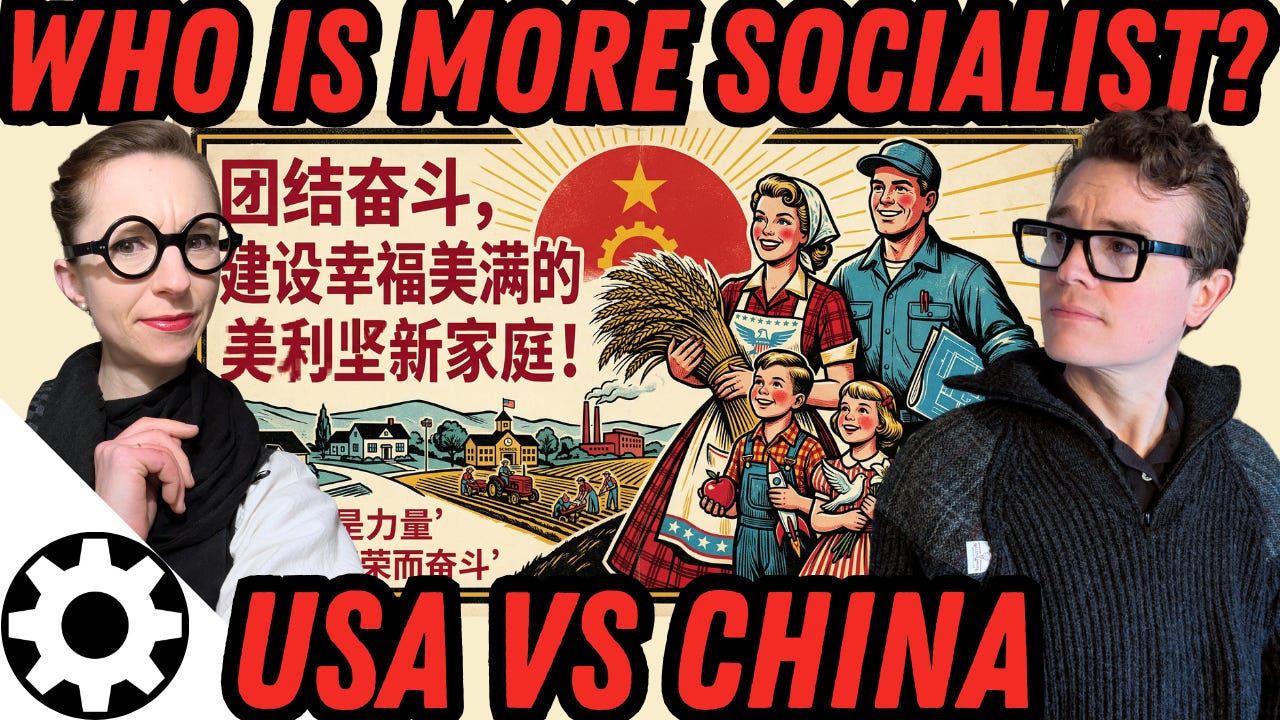
Who is REALLY More Socialist: The US or China (2026)?
from Based Camp | Simone & Malcolm Collins · host Simone Collins
Having been given the impression as young Americans that China was “socialist,” providing abundant services and safety nets for its citizens, while the US was “capitalist,” leaving its citizens to fend for themselves, we were in for a surprise when we discovered that, relatively speaking, the United States is a socialist utopia.Today on Based Camp, we explore the United States’ (admittedly unsustainable) socialist utopia Americans enjoy and the (put diplomatically) bare bones support provided to citizens—especially rural citizens—by the CCP.If you’re a parent in the US looking to avail themselves of more of the United States generous services oriented around families, please refer to Pronatalist.org’s summaries of and links to State resources for parents.Show NotesI grew up thinking the USA was a land of pure capitalism, where people are on the hook for everything. Turns out that’s only the case if you’re middle class.If you’re poor in the USA, you’re arguably living in the best communist world imaginable, because you’re enjoying socialist-style support (for food, childcare, healthcare, etc.) but getting capitalism-style goods and services (e.g. going to the same private hospitals that rich people go to; going to the same grocery stores that rich people go to, etc.)Case in point: State resources for parents (We created detailed guides for Pronatalist.org)* See Minnesota as an exampleIf “communism” means “this country has a significant social safety net”, then the USA is more communist than China.Even China has disparities in its benefits: urban formal workers receive significantly better protection than migrants and rural residents.Old-Age Income* USA: Social security* Going to stop working* Based on what you contribute as a worker… sort of* For a typical retiree claiming at full retirement age, Social Security is designed to replace around 40 percent of pre‑retirement earnings, with replacement rates higher for low earners (roughly 60–80 percent) and lower for high earners.* The Social Security Administration indexes each year of your past earnings to national wage growth and takes your 35 highest‑earning years to compute your Average Indexed Monthly Earnings (AIME)* For people first eligible in 2025, the formula replaces 90 percent of the first slice of AIME, 32 percent of the middle slice, and 15 percent of the top slice (with “bend points” around 1,226 and 7,391 dollars of AIME), so lower earners get a higher share of their prior income replaced* The USA covers most seniors and low‑income households through Social Security, Medicare, and Medicaid, but non‑elderly adults without stable jobs or employer plans can still fall through gaps, especially as enhanced ACA subsidies expire.* China:* China now has a “three‑pillar” setup: a basic public pension (still the main source), employer/occupational plans, and voluntary private pensions with tax incentives.* Resident pensions are low; national minimums have risen from 55 yuan per month at the program’s launch to around 143 yuan in 2025, with local governments often topping this up, but even average rural pensions of about 246 yuan per month in 2024 are only a modest supplement to other family or work income. Beijing, for example, set basic resident pensions for new claimants around 998 yuan per month in 2025, much higher than the national floor but still far below urban wages.Medical Care* USA* Medicaid (for poor and disabled people)* For full‑benefit Medicaid (the typical situation for very low‑income adults, children, pregnant people, and many disabled people), there is generally no monthly premium charged to the enrollee; the program is funded by federal and state governments.* Some states can charge small premiums or use “share of cost” rules for certain groups with higher incomes (e.g., medically needy programs), but that is the exception, not the norm for the poorest enrollees.* Medicare (for old people)* Part A: $0/month for most people who worked and paid Medicare taxes at least 10 years* Part B: Premium: $202.90/month for most beneficiaries, higher for high‑income enrollees.* Access to top-drawer private medical care if you’re poor or old (due to Medicare and Medicaid)* Functionally, this is paid for by not just the government, but by private citizens and corporations (paying for super high health insurance premiums)* China* China: Public “basic medical insurance” covers about 95% of the population via two main schemes (urban employee and urban–rural resident), but works as insurance with deductibles, coinsurance, and annual ceilings, plus optional commercial top‑ups.* Even poor people in China usually have to pay something when they get medical care; public insurance and extra subsidies then reimburse part of the cost, often in several layers* PEOPLE FEEL THE NEED TO BRIBE THEIR DOCTORS* The most significant gap between China’s formal coverage promises and lived reality is the persistence of informal payments. Academic analysis of bribery in Chinese hospitals describes the normalization of “red packet” (hongbao) payments — cash given directly to physicians by patients seeking faster or better treatment. A peer-reviewed mixed-methods study using data from 3,546 judicial cases found bribery was the dominant form of medical corruption, with roughly 80% of bribe-takers being healthcare providers. More telling, an earlier survey found that one-third of 500 randomly sampled residents in China reported that they or family members had given red envelopes to doctors, rising to 50% when surgeries were involved* The structural driver is well understood: China’s public hospitals were effectively defunded by the market reforms of the 1980s and have since been run on a quasi-commercial model, expected to generate much of their own revenue. Basic doctor salaries remain very low — sometimes as little as 800–3,000 RMB per month in smaller cities — creating systematic pressure to supplement income through pharmaceutical kickbacks and informal patient payments. Xi Jinping’s high-profile anti-corruption campaign launched around 2023 swept hospital directors across the country and publicly targeted this behavior, but structural underpayment remains the root cause.* Universal basic medical insurance* Nationally, basic insurance typically covers primary and specialist visits, inpatient hospital care, emergency care, prescription drugs, some mental health services, physical therapy, and traditional Chinese medicine, subject to local catalogs and reimbursement rules* Patients face deductibles, copayments, and annual reimbursement caps; local governments define detailed benefit packages, and there is no national cap on out‑of‑pocket spending* Even with coverage, serious illness can still cause heavy financial strain, particularly for rural, low‑income, and resident‑scheme enrollees, who are more exposed to catastrophic health expenditures* There is real and acknowledged urban-rural healthcare disparity* China’s approximately 300 million rural-to-urban migrant workers occupy a particularly precarious position. Although more than 90% of Chinese residents are nominally enrolled in basic health insurance, migrant workers face fragmented, non-portable coverage: insurance purchased under a rural scheme is often not reimbursable in the city where the worker lives and is treated, and employer compliance with providing urban employee coverage is widely evaded. Research has characterized this as a “covered but unprotected” dilemma — workers are technically enrolled but the insurance provides no effective financial safety net.Aside: NHS Care in the UKThe UK has more socialized healthcare than China: In the UK, most medically necessary NHS care is free at the point of use, but there are defined areas where patients routinely pay charges (or go fully private), mainly prescriptions in England, dentistry, eye care, and some “lifestyle” or non‑essential services.FULLY (or mostly) COVEREDThese are generally free at the point of use for eligible residents (England-specific where noted):* GP services and community care: GP consultations, practice nurse appointments, most community nursing and midwifery, and NHS 111/telehealth are free.* Emergency and urgent care: 999 ambulance, A&E, emergency surgery, and emergency inpatient stays are not billed to patients.* Medically necessary hospital care: Consultant appointments, diagnostic tests, elective and emergency surgery, inpatient and outpatient treatment for physical and mental health if clinically needed.* Maternity and neonatal care: Antenatal and postnatal care, labour and delivery in hospital or at home, and neonatal intensive care when needed.* Many vaccinations and screening programmes: Routine childhood immunisations, seasonal flu for eligible groups, cervical, breast, and bowel cancer screening, diabetic eye screening, AAA screening, newborn blood spot/hearing/physical exam, and pregnancy/fetal anomaly screening.* Most mental health care: Community mental health teams, inpatient psychiatric care, talking therapies and crisis services when referred via NHS pathways, though access and intensity can vary by area.* Palliative and end‑of‑life care: NHS hospice and specialist palliative services are provided free, though many hospices also rely on charity funding.In Scotland, Wales, and Northern Ireland, prescription charges have been abolished, so clinically indicated NHS care is even closer to fully free at point of use.HOWEVER care is very spotty* Investigative reporting found that treatment approval rates for individual funding requests varied from as low as 2% (Shropshire ICB) to 69% (Gloucestershire ICB) for identical categories of treatment within England’s NHS.* Per NHS’s 2025 data, London practices face over 500 more patients per GP than the south-west of England. Rural patients face particular disadvantages: GP waiting times in rural areas are substantially longer than in urban areas, and by 2019 only 80.9% of people in rural areas had a GP within half an hour’s travel by public transport and walking, compared to 99.8% in urban areas.* Variation is really stark for specialist and cancer care:* NHS commissioning data revealed that fewer than one patient per 100,000 population in one area was referred for CT colonoscopy compared to 59 per 100,000 in a neighboring area — a 59-fold difference in access to the same diagnostic test within the same nominal healthcare system.* Stroke unit admission within the recommended four hours varied from 80% in one area to 20% in another.Commonly not covered or tightly restrictedThese are typically not available on the NHS at all, or only under strict criteria, so patients often pay fully out of pocket or via private insurance.* Purely cosmetic procedures: Surgery or treatments done solely to change appearance (e.g., cosmetic rhinoplasty, breast enlargement without medical reason, most cosmetic dermatology) are usually excluded; surgery may be covered only when there is clear functional or severe psychological/medical need.* Many travel vaccinations: Routine NHS vaccination schedule is free, but several travel vaccines (e.g., for certain destinations/conditions) are often private and must be paid for directly.* Some fertility treatments: Basic infertility investigation may be covered, but IVF and related assisted reproduction are very tightly rationed, with local criteria on age, BMI, previous children, prior treatment, etc.; many couples pay privately when they do not meet criteria or have exhausted local NHS entitlement.* Non‑essential secondary care with limited benefit: Procedures considered low‑value or “procedures of limited clinical effectiveness” (certain minor skin lesion removals, cosmetic eyelid surgery, etc.) are often no longer routinely commissioned, so patients either do not get them or must self‑fund privately.* Most private amenities: Single rooms, hotel‑style facilities, extra non‑clinical services, and choosing a specific consultant outside normal NHS arrangements are private and paid for if desired.Unemployment* USA* State unemployment insurance with limited duration; means‑tested programs (SNAP, Medicaid) partially cushion job loss; access depends on work history and state rules* China* Unemployment insurance as one of the five insurances, plus dibao and other local assistance; coverage stronger for formal urban workers, weaker for informal migrants and rural residents.* Dibao is China’s main means‑tested cash welfare program, formally called the “Minimum Livelihood Guarantee,” intended to ensure very poor households can reach a locally defined minimum income lev* The benefit is gap‑filling: if the dibao line is 900 yuan per month and an individual has 700 yuan of counted income, they should receive 200 yuan, bringing them to 900 ($131 USD).* In some areas, applicant names are posted publicly for neighbors to comment on “deservingness,” creating social stigma and sometimes deterring eligible people from applyingPoverty Relief* USA* SNAP, housing assistance, TANF (cash welfare), EITC and other tax credits, plus state/local programs; many eligible people do not participate.* China* Dibao minimum living allowance and targeted poverty alleviation; absolute poverty officially eradicated but benefit levels are low and local enforcement varies.Housing* USA* Housing vouchers, public housing, tax subsidies to homeownership, but limited reach and long waitlists in many cities.* China* Mandatory housing provident fund for many urban employees to support home purchase or mortgage payments; rural and migrant workers less covered.Episode TranscriptMalcolm Collins: [00:00:00] Hello Simone. I’m excited to be here with you today.Today we’re gonna be discussing a very spicy topic, which is buy the numbers. And by the social support systems offered, which country is more communist today? Mm-hmm. The United States. Or the CCP China. And the answer is like, because you see somebody like Hassan go to China, right? And he is glazing China talking about how great it is and how weird this totalitarian dictatorship in the United States.It’s capitalist and horrible, and China is this amazing communist country. And it’s like, well, so, just for some, some beginning numbers here before we go into detail. Aid even when you adjust the value of the dollar versus the value of the one. Right? America provides three x the amount of social safety net that China provides and it [00:01:00] provides it at almost every layer that a social safety net could be applied.Where China does not.Simone Collins: Yeah. Yeah, I, I also, I came into this expecting China to at least offer like the same level or more of what, say the UK offers, you know, in terms of like universal healthcare and, and was shocked. Shocked. The, no, no, no, no, no. They have near universal health insurance.Malcolm Collins: YouSimone Collins: know, like deductibles and copaysMalcolm Collins: inSimone Collins: many places, by the way, huge disparities in, in actual like coverage too.So,Malcolm Collins: so in, in China in many places you have to pay up front for hospital visits.Simone Collins: Well, no, that, that, that’s what a deductible is. So, so the way that health insurance works, for those who are fortunate enough to live somewhere where there actually is government provided healthcare, not China. What you do when you have insurance is [00:02:00] you basically.Have to pay for your healthcare up until you reach a cer your deductible, which is like a sort of minimum threshold. And then after that, they will cover you. So it’s like kinda like someone being like, oh, well, you know, you’re, you’re on the hook for the first, you know, $5,000. And then after that.We’ll cover you. For example, our health insurance, our deductible as a family is $16,000. So, you know, do we feel like we’re covered? Not so much. And that’s, that’s how it is with most health insurance isn’t in China. It’s no different. So there is that, and then there are also limits in China on what they will actually.Cover it all, of course. So they might not cover anything even after your deductible met is met. And even after your deductible is met, or even if something is supposed to be covered right away, you still pay what are called copays. Where they might say like, okay, well your deductible is met, but you still have to pay for half of it.You know, we’re not gonna pay the whole amount. So really what the, the Chinese health insurance program is, and this makes decent sense if you [00:03:00] have private healthcare businesses, is hey, we’re gonna try to reduce the catastrophic downside of health problems people may face. You know, like we wanna reduce the catastrophic financial hit people take when they have health scares, but we’re not gonna like.We’re not gonna take care of you.That would be crazy.Whereas I think the NHS is, is an example of what it looks like when you have government provided healthcare, which is like, okay, we’ll cover your healthcare, but it’s gonna be, you know, a a a state run business, which, you know, is, is the NHK, sorry.NHK NHS in the United Kingdom. And it’s gonna be like going to the DMV, you know, like, it’s not gonna be pleasant. You’re not gonna like it, but like. You’ll, you’ll probably, you’ll probably survive that kind of thing.Speaker: By the way, if you’re excited about the NHS style socialist, , healthcare system, be aware that it actually has worse healthcare outcomes than the US system, even if you’re just looking at like the [00:04:00] outcome at the general population level when it comes to severe illnesses. , And if you look at something like Canada that everyone thinks is so great., Well over a thousand Canadians per year come to the United States for life-saving treatment because they just can’t get it in Canada. , The United States healthcare system is at least, , in terms of effective socialization, more socialized than Canada or the NIH.Speaker 2: I mean, just so you get an idea of how much better the US is than the uk, if we’re looking at cancer survival rates in the US at 65% in the uk, it’s only 56%. If you look at breast cancer in the US, it’s 90.2%. In the UK it’s 80% if you look at., Lung cancer, the five year survival rate in the United States is 18%, and in the UK it is 12%. , So just across the board, what you see is that the NHS is less good at helping the average citizen than the United States system.Malcolm Collins: Yeah. Okay. So do you wanna go through, how do you, how do you wanna structure this?Do you wanna go through the various [00:05:00] parts of the system? Do you wanna go into absolute numbers? I guess I could just start with absolute numbers. Yeah. So, public spending is roughly 19 to 21% of the American GDP. Mm-hmm. If, if, if you look at. China it is around 9% of the GDP. Mm-hmm. So if you’re talking about global GDP, the United States is more than double China where Dabo, the main cash assistance thing in China mm-hmm. Is relevant to only 0.1%. And OCD data put total spending of the United States, oh, potentially even higher. 30 to 33% of total GDP. The 19 to 21% was maybe an understatement, which would make us over three times China.Simone Collins: Yeah. So just for more color, Dabo is China’s main means tested cash welfare program.So it’s, I guess kind of like, kind of like unemployment here, so some other things, but it’s basically like a minimum, minimum livelihood [00:06:00] guarantee. And the idea is that the very poor in China can sort of have a like minimum. Income, but it’s, it is one, even in China, it’s not meant to like be a universal basic income.It’s not gonna take care of you. It is gap filling. It is only intended to like fill a gap and like,Malcolm Collins: well, and they don’t have permanent homeless shelters in China. There is no infrastructure that assumes. Permanent homelessness even exists in China. If you’re like, well, what do homeless people do if there’s no infrastructure, assuming per they either dieSimone Collins: mm-hmm.Malcolm Collins: Or they go to live with extended family networks.Simone Collins: Yeah. And so also when you receive kind some kind of like, assistance in, in most countries, right? It’s, you know, you have to apply for it. Sometimes it’s a bit of a hassle. It, it might be a little bit embarrassing, you know, it No, no one, okay. A lot of people don’t like.Being a leach, but in China also utilizing this benefit is in some regions actively shamed. [00:07:00] So in, in some areas they actually, and this, this isn’t even if you’re on the assistance applicant names are posted publicly so that neighbors can comment on the deservingness so that you not only like, could, maybe not ultimately qualify if your neighbors are like, know they’re pizza.Trash, no ccp, but there’s also just that really creates extra social stigma and can deter otherwise eligible people from applying. Now it’s, it’s clear that of course across the board, across countries there are many social services. And this is also an issue in the United, in the United States, where people who technically.Would qualify for, for various assistance programs don’t apply for them. That, you know, they don’t want the stigma. I, I don’t think that’s a bad thing, you know, I think that’s a good thing.Malcolm Collins: Well, and I, I think that people are unaware of like, let’s look at the healthcare system in the United States.Mm-hmm. How accessible healthcare is to you if you’re poor in the United States.Simone Collins: Oh my God. Oh my God. No, that’s, that’s the thing. And I think one of the biggest things that I want to just highlight here is that. In [00:08:00] other countries, you, for example, oh, I wish, you know, we had free healthcare. Oh, it would be so wonderful in the United States functionally.If you are very poor or if you are old, you basically have free healthcare. But it’s very different from free healthcare in say even like a nice country, like, I mean the, the one you don’t have free healthcare in China, but even the healthcare you can get, it’s like, ugh, I don’t know if I’d really like that.Now I’ve been to. Like in the uk and I’m sure you have too, like,Malcolm Collins: oh, I have too. It’s, it’s, it’s horrible. It’s worse than nothing. I think.Simone Collins: Yeah, I, I was okay. I mean, I wasn’t impressed with it, but it’s, but it’s like, it’s the DMV of healthcare, right? It’s not nice. Whereas if you are poor in the United States, you’re not going to the DMV of healthcare.You’re going to a private hospital. You’re, you’re going to the kind of thing that someone in the UK who’s in the upper class would actively have to pay, you know, it’s like a gated system, but no, you’re just strolling on in if you’re in the United States. And if you’re on [00:09:00] Medicaid, which is for poor and disabled people in the us basically for full benefit Medicaid, that which is the typical situation for.Many low income adults or well, very, all very low income adults in the US and children and pregnant people, and many disabled people. There’s no monthly premium charge to the enrollee, and the program is funded by federal and state governments. And while some states charge very small premiums or have rules for certain groups with higher incomes like their very medic, medically needy programs, that is a big exception.Most enrollees in Medicaid. Pay nothing. Right. So, and actually we, we’ve encountered this. There are lots of families that have like, kids who, who qualify because they’re disabled and it’s just insane the amount of coverage they get and the access to, again, this is private, top of the line medical care when I, whenever I deliver a baby at, at this really fancy hospital, Malcolm, you’ve been in there?Yeah. It is, these are hotel stem rooms. We, we, we actually did an episode where we showed [00:10:00] pictures of like the, the kind of hospital where like, you delivered and, and, and Kate Middleton delivered like the most expensive top of the line delivery rooms. Yeah. Are like postpartum rooms in the United Kingdom.And then my hospital room. And mine is just the same. It looks just a few better. Well, yours was,Malcolm Collins: yours was significantly nicer.Simone Collins: Yeah, my views, my view is better. And, and they’re across, you know, across the hallway from me next door to me are clearly probably illegal immigrant women. ‘cause they also speak absolutely zero English.And I, they’re not paying, they’re not paying anything. Medicaid is paying for them. So I again, just wanna make it clear that, like even in aMalcolm Collins: system, I wanna understand, I want people to understand like there are homeless people in the US who use. Hospital ambulances like taxis. Yeah. Because they know that they can get away with it.And that’s the way our system is set up.Simone Collins: Yeah. Yeah. There, there’s, yeah, there, there’s a law that, and this, this also kind of existed in many countries, including in China, where like, private medical companies are, are. Required by law to provide stabilizing care. KindaMalcolm Collins: [00:11:00] like, a great example of just how much this is the case is.Now, obviously this isn’t true. If you have an ongoing medical condition, you’re not gonna be able to get easily something like ongoing diabetes medication or something like that if you’re very poor in the United States.Simone Collins: No. Can’t get the medication. But you also can’t get that in China either.Malcolm Collins: Yeah, but, but if you’re like.The story that he tells to just understand what it’s like to be a homeless person in the United States and you as a hospital is he talks about when one time he went to a hospital and an emergency room got up and they were just gonna let him leave without paying. And he needed to explain to them that he wasn’t homeless because yeah,Simone Collins: they just thought he was a homeless man.So they’re like, you can go. It’s fine. ‘cause because yeah, again, by law. Emergency rooms are required to provide stabilizing careMalcolm Collins: regardless, and this is partially why healthcare costs as much as it does in the United States for the middle class. This is why healthcare can so easily destroy a middle class family in the United States.Yeah. With this and the insurance companies both of which I think any sane conservative movement would ban yeah. Right. Like, these, these things should not exist.Simone Collins: Yeah. Well, and this is another [00:12:00] really interesting thing about the United States is again, all this is, it’s so magical and amazing and it’s, it’s very unsustainable.We’ve talked about it on another podcast, maybe we’ll talk about it here too. But it is unbelievable the level of luxury that, that people have who are at the, at or below the poverty level in the United States. But the middle class they’re the ones who are paying for all of it. And I, I point to the middle class because they’re the ones who, you know, are paying very, very high health insurance rates.They’re paying out of pocket a lot at, at at, for health insur, for healthcare. And like I was, I just mentioned, our deductible, $16,000. You know, it’s, it’s a ton and it’s really painful. And, and then we’re, of course, our tax rate is really high too, as, as, as middle income Americans. Once you become a really wealthy American, you’re not paying taxes.Because you one, have really great accountants who are able to hide everything. And two, you, you kind of typically you shift away from having a [00:13:00] salary, which is what’s taxed. And then instead you just sort of make money from your investments and you’re able to like use debt. Shift around your investments and use tax loopholes in a way where actually you’re probably never really taxed on your capital gains.‘cause you just, like, you harvest loss from this one thing to like, you know, put toward this other thing and then you reinvest as soon as you get something. And like, basically you just leverage debt to pay for everything. And then just never cash out your investments and just keep reinvesting and so you’re never really paying taxes.So it, it’s just, it’s one of these really frustrating systems in the United States, but nevertheless. The luxury with which people at the, at below the poverty line live with is insane. And I mean it, another thing just about medic. Well, okay, look, I wanna talk about, let’s switch to, since we’re on medical care though, in China, it’s not just that you have to, you, you, you basically have to pay for everything.You don’t, there are no like state provided,mm-hmm.Like [00:14:00] NNHS style systems. Did you know that also, even just like people who have plenty of ability to pay just Bri, they bribe their doctors all the time.Malcolm Collins: What to not pay.Simone Collins: Yeah. So,Malcolm Collins: well, how does this work?Simone Collins: Yeah. The, the, the most significant gap between China’s formal coverage promises, you know, of like, oh, well your health insurance will cover this.And the lived reality is the persistence of informal payments. And so some academics did an analysis of bribery in Chinese hospitals, and they described the normalization of. Red packet or hung bowel payments. Cash given directly to physicians by patients seeking faster or better treatment. A peer review mixed method study using data from 3,546 judicial case.Bribery was the dominant form of medical corruption with roughly 80% of bribe takers being healthcare providers. More telling. An earlier survey found that one third of 500 randomly sampled residents in China had reported they or family members had given red envelopes to doctors [00:15:00] rising to 50% when surgeries were involved.And there, there is a reason why this is the case. Basically, China’s public hospitals. Were effectively defunded by the market reforms of the 1980s. Yeah. And then they’ve since been run on a quasi commercial model. Like I said, that this is not like the NHS where it’s government run, and so they’re expected to generate their own revenue and, and also doctor salaries are extremely low.They’re sometimes between 800 to 3000 r and b per month in smaller cities. And so there’s this systemic pressure to supplement income through pharmaceutical kickbacks. So they’re also like, by the way, you should take this. And also to just accept informal payment. So like actually bribing a doctor. Is gonna make a difference.Like, ‘cause they need the money. So like they actually will prioritize you. Yeah. And, and Xi Jinping’s high profile anti-corruption campaign launched around 2023 swept hospital directors across the country and publicly targeted the behavior. But the structural underpayment remains the root cause of this.And [00:16:00] I mean, if I were going in for surgery in China, you know, I’d be bribing them. When I go in for my C-sections, I come in with a giant basket full of like eggs and baked good. I’m doing it and I know that they’re, I mean, I, I, I feel like they could be paid more. The, the, the medical professionals in, in every country I think are amazing and, and wonderful, and they deserve everything.But like when you’re like literally just bringing an envelope of cash and being like, I. Please, please, please. That, like, that, that is a really big deal. Another big issue with with China’s medical coverage is that there they basically, you have like medical insurance based on either your rural, rural or urban like plan.Mm-hmm. And there’s, there’s big discrepancies with a lot of social services. There’s like these weird housing discrepancies, and I still don’t fully wrap my head around it the way it works in China. But a problem is if, let’s say you’re a rural Chinese person. And then you, that means that you have the like rural Chinese person health insurance, but you go to work in Shanghai or [00:17:00] Beijing.Do you have coverage when you go to see a doctor in Beijing? No. No,Malcolm Collins: youSimone Collins: don’t. You don’t. They’re not in your insurance plan. And so it’s almost as if like you, you, you have like a local employer in the United States and they have like their insurance, but. You, you live in Portugal, what do, like, what good does that do for you?No good. And so there’s also just a ton of migrant workers in China who are just functionally uninsured and just totally like on,Malcolm Collins: completely outta the system.Simone Collins: Yeah, and I mean, even in places, and again, I think if you’re gonna provide government healthcare, you should. Own the healthcare system, right?It should just be the DMV of healthcare. And then if people wanna get like actually good services, it need to pay for it privately. I think that what the NHS does is good, but even with the NHS, their care is extremely spotty. So investigative reporting found that treatment approval rates for individual funding requests really varied actually.So, it, it was as low as 2% in rupture to [00:18:00] 69% in Gloucester share. For just identical categories of treatment. So depending on where you live in the UK, you could have like pretty decent government provided healthcare, or you can have like really bad. Also just, you know, it’s, I think this is more discussed in Canada and why MAID is such a problem.But also in the uk, like London practices face over 500 or more patients per general practitioner, 500 or more patients. Like, do you?Malcolm Collins: Wow. Yeah. Isn’t this is what, in the UK or in China?Simone Collins: In London. I’m, I’m just talking about a system where it’s actually kind of nice. Getting comparison to China.Malcolm Collins: It’s not bad.People’s Republic, China healthcare system is a, i I really had my life threatened there a number of times because of the inefficiencies of the system.Simone Collins: Oh really? Did you get really sick when you were there?Malcolm Collins: I was having a really bad reaction to a medication that could’veSimone Collins: Well, was it the same one that you were taking when we first met that I was like, you need toMalcolm Collins: get off.Yeah. And they were like. Come see us tomorrow. And I’m like, if this reaction continues, ISimone Collins: thinkMalcolm Collins: I’m gonna [00:19:00] die. I be dead tomorrow. And they’re like, well, I’m sorry. We don’t have any other way to see you. Right. Like, this is the, this is the way things workSimone Collins: here. No. See, I think that’s government healthcare done right?It’s like just letting people, we’re here, we’re not really here, but like, it’s, it’s. Only the strong will survive in our country. Okay. Sorry, Malcolm Y You were too weak. I had similar experience like, ‘cause I mean, I also went to it when I was in school and like, it was kind of like, sweetie, you’re on your own.But yeah. Well, and like, I mean, like, you’re not gonna get aside from like this really spotty differences in care. And this also, like, there’s really weird discrepancies in like, referrals for really basic stuff like colonoscopies for diagnostics and stuff. Like, it, it’s really weird. Like again, you can have it, it is just scary, especially if you have like cancer or something serious in China, like, or sorry, in in the uk, you’re gonna wanna.Go private anyway. But eh you’re, you’re not, you’re never gonna get a private hospital room, for [00:20:00] example.Malcolm Collins: Yeah, yeah, yeah.Simone Collins: You know, I’m like,Malcolm Collins: well, so another thing to note was China, right? Mm-hmm. If you’re like, well, didn’t she say that he eliminated poverty in the country? Right. Because this is a, a big claim by the ccp.Simone Collins: I didn’t, I didn’t know that was a claim they made.Malcolm Collins: Oh, yeah. He says there’s no poor people in China.Simone Collins: Oh. So,Malcolm Collins: so,Simone Collins: because that’s a mindset, Malcolm. Poverty’s mindset.Malcolm Collins: The the, the threshold that was set to determine this which a huge chunk of China still lives on is 60 cents a day to a dollar 90 a day.There are many people in China who live on 60 cents to a dollar 90 a day.Simone Collins: I mean.Malcolm Collins: A lot of them, they, they did not actually sell. So if, if you look at by US standardsSimone Collins: mm-hmm.Malcolm Collins: 17% of China’s population would be below the poverty line,which is a ton.Simone Collins: It’s a lot of people,Malcolm Collins: By the way, if [00:21:00] you’re, if you’re wondering about relative different, like what’s, what’s the oh, what’s it called again? I want say the Genie Score or something.Simone Collins: Genie Coefficient.Malcolm Collins: Yeah, yeah, yeah. Between China and the United States.Simone Collins: Yeah.Malcolm Collins: In the United States it’s 0.74 to 0.83, and in China it’s 0.62 to 0.70.So, it’s actually slightly better in China. The core reason being that there are not as many super wealthy people in China and the super wealthy are not as super wealthy as they are in the United States.Simone Collins: Yeah.Malcolm Collins: But. Yeah, it’s, it’s only marginally different. Like, it’s not like a, for a communist country, there’s a really high genie coefficient.Simone Collins: Yeah. Yeah. So let’s also, we can talk about their pension plans. Again, like I, I, I thought China had a better system.Malcolm Collins: Yeah,Simone Collins: let’s talk, I mean, in other, in other countries that aren’t like, oh, like leading top country, like in Peru, I think their, their retirement system’s super, super decent. Like you have your account, you can log into it online, you can see it, your employer is [00:22:00] required, I think, to put a month’s worth of salary into it twice a year.Malcolm Collins: Yeah,Simone Collins: no, that’s different. But there are, there are like, there’s, there’s significant contributions. I’m thinking there are different things. So four times a year you as an employer have to like pay double your employee’s salary. And twice a year. That’s just to give them like extra money,Malcolm Collins: a windfall to buy types of things.You needSimone Collins: a windfall to buy, to get to like fix something in your house or like, yeah, pay a hospital bill. And then, although they do have government provided healthcare, so fix something in your house. And then the other, the other one is to, to contribute toward your unemployment account, which is a separate bank account that just fills up.And then when you, or when you get fired or when you leave that job, that account is just yours. It’s great. We’ve even had employees be like, Hey, please fire me. I wanna like cash that out. And we’re like, no, we’re not doing that. That’s like super illegal. But that, there’s that. And then you also see your retirement account.So I’m like, okay, China’s gotta have something like that. But they don’t have something like that. They have this three pillar. [00:23:00] Set up, which is like, there’s a basic public pension, which is still the main source. And then there are employer or occupational plans. That’s like having a 401k. We don’t have a 401k.Like even we as an employer aren’t big enough to be able to afford to offer a 401k. Yeah. So that’s not even a thing that for even America. And then there’s also like voluntary private pensions with tax in tax incentives. Kind of like a Roth IRA or an IRA in the United States. But the Chinese version of it.Like, basically you’re on your own. Like if you can save your own money, if you’re wealthy enough for that. But these pensions, resident pensions, they’re super low. So while the national minimums have risen from 55 Yuan per month at the programs launched to around 143 Yuan in 2025. And then local governments may top it up.Even average rural pensions are like around 246 want per month. It’s, it’s, it’s just super low. Like this is it, it is a trivial amount of money that is not going to cover your actual expenses. Yeah. And then in contrast in the United States [00:24:00] social Security, that was going to start faltering in like five years.‘cause yeah. We messed it up. Okay. Demographic collapse, blah, blah, blah. We’ve talked about this a lot. Yeah. So it’s not ai it’s not gonna keep working like this, but yeah, maybe AI will fix it. For a typical retirement.Malcolm Collins: No, I think AI might exacerbate the problem.Simone Collins: Oh, well, yeah, sure. No. Yeah, yeah, yeah. No, actually you’re, you’re totally right.It will because right now. The way that social security in the United States is going to falter is that it, is it, the program is being funded by the social security payments of the current working generation. They didn’t do the whole thing where like,Malcolm Collins: and I mean, as AI takes people’s jobs, it’s money’s going in a way that’s not going to, you know, make it easy to filter into the tax system.Simone Collins: Yeah. And so how it’s gonna work is now the, those who remain working, like it’s currently expected that like in 20. 30 something like 76% of like, you’re, instead of getting, like, let’s say [00:25:00] you were owed a thousand dollars a month, now you’re gonna get seven thou $760 a month and you’re gonna be really resentful.Meanwhile, some like beleaguered working person is like, great, well I’m never gonna get social security. And here you are resenting the money that I’m sending you every month. Great. But. Yeah, that’s, let’s not, so let’s pretend it’s working the way it was supposed to. Okay.Malcolm Collins: There. No, I mean, I think this is, this is one of those things that people need to come to gris with.Old people are going to die in mass within our lives.Simone Collins: Yeah. Because all, I mean, as much as they’re gonna resent receiving their $750 instead of a thousand dollars a month. Their entire life was built over depending on that fixed income. Like where are they gonna get more money? Are they gonna get a job again, like they’ve already retired.It’s gonna be hard for them to get rehired in the AI age when no one can get rehired.Malcolm Collins: Yeah. This is where I, the people who are against, like maid and stuff like that, like it’s got its problems, but like, I just don’t see other realistic solutions.Simone Collins: Yeah.Malcolm Collins: In, in the United States given. I [00:26:00] mean, obviously if we can milk the AI companies, but that only works for us.What, what, what then do the Latin American countries, do you know what then does Europe do, right?Simone Collins: Yeah.Malcolm Collins: So it’s, it’s gonna be badSimone Collins: anyway. China’s, China’s pension plan as it is meant to function. And keep in mind with all these plans, as I’ve pointed out with the other examples, like medical examples, they don’t necessarily play out the way they’ve been promised to play out.Okay? But. The, the Chinese one, it’s like, well, you get like, sort of the equivalent of maybe like $200 a month or something. Like maybe it’ll help you with a little bit of food, but it’s not gonna support your life the way that social security is designed to work in practice. In theory, you know, until we screwed it up.Is it, was it going to replace around 40% of your pre-retirement earnings? With replacement rates being higher for low earners. So if you didn’t really have a high income during your working years, you’d be making roughly 60 to 80% of your monthly paycheck. And if you were a high [00:27:00] earner, you’d be making less.So basically the Social Security Administration indexes each year of your past earnings to the national wage growth, and then it takes your 35 highest earning years to compute your average index to monthly earnings. And for people first eligible in 2025, the formula replaces. 90% of the first A-A-I-M-E your, your average earnings.So like if you’re, if you’re in the lowest belt, you get 90% of your former earnings and then you get 32% in the middle and then 15% in the top slice, which makes sense. ‘cause you know, after you’re making like, I don’t what, $200,000 a year? Like you didn’t actually need all that. You probably do if you’re living like some crazy dink style American, but you know what I mean?Right. But that’s very generous. That’s just not what you get in China. So again, like I feel like the United States is more socialist, more communist ish, you know, in terms of like we’re providing these abundant benefits than, than China is by far. ThatMalcolm Collins: is [00:28:00] wild.Simone Collins: Yeah.Malcolm Collins: But it’s, it is like an every single layer of the economy.And I almost wanna zoom out to the meta level of this. Why, if this is the case, why have the United States just so socialist compared to China? Why? Do leftist laed China. Right?Simone Collins: Seriously. Seriously.Malcolm Collins: Why does Hassan Piker Laed China and hate America when America is much closer to the economic system that he claims that he wants?Simone Collins: Mm-hmm.Malcolm Collins: And it’s not just him. You see a lot of leftists online doing this. And then I think the, the answer is obvious. It is that these people simply hate America. They hate American values. Oh, really? And they hate what they see America as representing. They don’t care that China has, you know, is, is genocide at the moment.They are doing a genocide right now, right. Against one of the protected populations.Simone Collins: And no one talks about that.Malcolm Collins: Well, it’s a bummer. No [00:29:00] one cares anymore. TheSimone Collins: right he hasan’s uncle’s name is literally what is it? Jank? Uighur. You’d think he’d anyway little weird.Malcolm Collins: I mean, the answer is they hate us.They want us dead, and they want us gone. That’s just the full of it right there. There is, there is nothing else. There is a group of people out there that wants to create a future.Simone Collins: Yeah.Malcolm Collins: There’s a group of people out there that wants to eradicate the one civilization, as we call it, from the map. Right.And they see China as a tool for them achieving that. Yeah. And you know, I, I think it’s important one that we remember that this fight is. Existential, and that is why we cannot turn away potential allies just because they don’t fit your purity test. Yeah. Because then we will have coalitions that can’t win elections.And the people working against us are willing to [00:30:00] pull in allies from groups as diverse as Islamists and LGBT activists, right?Simone Collins: Mm-hmm.Malcolm Collins: Environmental activists who actually care about the future eeg, pro-nuclear environmental activists and anti-nuclear environmental activists who just wanna shut everything down and destroy civilization.But but they, these groups work together and they still vote Democrat together. Right. And they, but they know how stupid this is. Right?Simone Collins: I don’t, I don’t know if they do. Because I mean, for example, you know, we, we engage in a lot of prenatal list activism, right? And, and one of the constant rallying cries that we’ll get from people in this group is like, well then if, if you think people should have more kids, then you need to pay people to have more kids.And I just wanna, like we, through prenatal list.org one year just sat down and hired a bunch of people who specialized in their own respective states in helping families navigate. The state’s benefit systems, you know, just what, what does our socialist, communist country [00:31:00] provide to families in need?And it is, anyone I, I’ll link to this in the show notes, what you can find on Substack and Patreon the, the, the sheer amount. Of resources that we offer to families in the United States. Mm-hmm. If you’re out or near the poverty line, mind you again, if you’re, if you’re middle class, you get to bankroll it all and not get any of it.But it, let me just go through, for example, Minnesota. ‘Cause you know, everyone’s talking about Minnesota’s benefits, which are being also like not even provided to the people who think that they’re getting that because instead they’re being. Fraud. Fraud is, fraud is happening. But you get obviously medical assistance if you’re low income.And this is just like full coverage at private hospitals. Great medical care. They have this thing called Minnesota Care in addition to just like Medicaid. It’s a healthcare plan offered to low income individuals. There are no premiums for children. Adults may have some monthly costs, but it is if you’re a [00:32:00] Minnesota resident.Or US citizen, or you’re lawfully president present in the US and you meet their income guidelines and you’re not in jail. You and you don’t have access to Medicare already through some other means, then you get Minnesota Care. So they, they have backups to Medicare. Okay. Then there’s also msu which is Minnesota’s Health Insurance Marketplace.So you have, you know, additional access to that if you can’t, for whatever reason, access Medicaid or Minnesota Care. And that, that also helps that I think that’s closer to like what Chin China offers. Yeah, you know, that, that we’ve, we finally made it to, to the CCP level which is something then there’s also, and this is not income gated, so I appreciate this is Minnesota Vaccines for Children which ensures that all children have access to timely vaccinations regardless of household income level and all participating hospital hospitals and clinics will offer it.So you, you, you just. If, if basically if you feel like you [00:33:00] can’t pay for your child’s vaccination, you just ask your medical pro provider about the program and they’re like, great, we can get coverage for this. You’re good. Then we move on to Snap, which was I think discussed a lot online. Even if you’re not in the US you’re probably familiar with the program because it was.Like payment to it was kind of suspended for a little bit last autumn. AndMalcolm Collins: people were like, I’m just gonna rob stores if the government doesn’t support my lifestyle for free.Simone Collins: Yeah.Malcolm Collins: Like, what else am I supposed to do? Get a job?Simone Collins: So based on your income and assets and family size and participation in other government programs like childcare assistance and, and SSI, you, you could basically, it’s like a debit card and you just go to a store and you buy food.And of course people are like famously buying, I think they’re, the Trump administration is trying to put limits on this. But just cookies, candy, branded products, like it’s, it, it’s not like other programs. That exist in some states where like you have to buy, like you can only buy eggs and milk and whole grain bread [00:34:00] and like healthy food likeMalcolm Collins: that.Simone Collins: Yeah. And, and so it’s, it’s different then. Then there’s the one that I was talking about, which is that there’s so many, do you see how many programs there are? There’s this program called wic, which is Women, infants and Children, and this is the one where they’re, they’re health food Nazis and you, you, you also get a debit card, but you can only use it.On designated and approved foods. And it’s, it’s for pregnant mothers and nursing mothers and children under five. And it’s not based only on income. If you have a disabled child, they might also qualify for it. Again, if you are a parent and you want to see if you qualify for any of these things. Go to the link in our show notes to our state-based resource guides.Click on your state. And anything that’s highlighted in green is something that isn’t necessarily like only gated to people who are at or near the poverty line. We tried to make this really easy to navigate, but there’s school meals and this is something that came up in, during the pandemic.Mm-hmm.When schools were shutting down like. Were people [00:35:00] really that worried about their kid not being educated, not so much. Right. But I mean, they got worried when they saw, like when the lessons restarted and they saw how, how their kids were actually being taught, but most parents were like, oh my God.Who’s gonna watch my kid, but also like, where’s my kid gonna get food? Because a lot of kids primarily get their food through US schools. So in Minnesota, for example, most school aged Minnesota students receive free breakfasts and lunches each school base, each school day. And the benefit is offered through schools that participate in the National School Lunch program or the school breakfast program, or the USDA’s school lunch program.Three different programs. And we, we experience like when our, when our son Octavian went to public school. Yeah. He, he did get even though we, we asked not for it ‘cause we, we fed him breakfast and we also packed his lunches. He would just get food. But also it was healthy food. He was like. I remember one point he told me, he was like, I maybe I wanna go back to school.And I’m like, why? And he’s like, well, they have donuts there. And I’m like, what do you [00:36:00] mean they have donuts there? But like, I think they gave them like donuts for breakfast a lot of the time. And I’m like, dude, we can have donuts here. And he is like, oh. Okay, nevermind.Malcolm Collins: Nevermind. I wanna go back to school because, because they have donuts.Simone Collins: But like, that’s, that’s, that’s actually a thing. So, okay. We’ve covered, we’ve covered medical care, we’ve covered food assistance. Then there’s the childcare and early childhood education benefits. And of course, everyone knows about Minnesota’s childcare, but Yeah. They, they, they provide free.Malcolm Collins: AnotherSimone Collins: thing,Malcolm Collins: by the way, speaking of, of, of childcare and all of that.Simone Collins: Yeah.Malcolm Collins: The United States also offers. Unlike China Free College, a lot of people are unaware of this because they stupidly go to the non-free options.Simone Collins: Mm-hmm.Malcolm Collins: But if you go to something like West Point that’s government funded and free.Simone Collins: Yeah.Malcolm Collins: Right.Simone Collins: Well then in general, if you join the military, a lot of your education is paid for.Like there’s that famous guy from like financial audit who was at. I think in Naval [00:37:00] Academy for education. So he wasn’t actually like actively serving in the military yet, and then he got depressed and like dropped out and then was living on veteran benefits, like I think $2,000 a month. It’s so bad.Ah, oh. Speaking of being disabled in Minnesota, there are a bunch of disability and special education benefits. I didn’t find in, in my research any really strong disability programs in China. Like it’s not like you get a free ride if your kid turns out to be disabled. So in in Minnesota there’s Disability Hub Minnesota, which is a.Free online resource center that helps parents of special needs children’s plan the life they want with their child. There’s help me grow, which connects families with evaluations and referrals and interventions related to early childhood development. And these services range from testing to home visits and therapy appointments.We experienced something similar in Pennsylvania when we had our first kid. We stopped using these programs ‘cause we didn’t really feel like they were making a difference. [00:38:00]Malcolm Collins: Yeah.ButSimone Collins: they would. They would, we give like active sessions with our children to go over things like speech therapy and other things.‘cause we, we had some delayed speakers. And they still, even with every time I give birth, if there’s some like kind of complication, they’re like, you’re eligible for this. Like, you should probably reach out to them about this. Then there’s also this thing called a follow along program, which assigns a nurse or another developmental professional to touch base with your family occasionally while your child grows.There are other parents support outreach programs. They also provide transportation assistance. They provide cash and career benefits. I probably, I should stop energy assistance. I’m, I’m just telling you like,Malcolm Collins: you’re just like, it’s insane. It’s insane. And this is not the case in theSimone Collins: dream of communism is alive in the us.Today, the dream ofMalcolm Collins: communism is alive and well in Minnesota for Somalians, not for white people, of course, forSimone Collins: Somalians.Oh, I mean, there’s similar issues in in California. Again, like it, it’s,Malcolm Collins: right,Simone Collins: because I did mention Medicaid. There’s alsoMalcolm Collins: California and seceding. I, I [00:39:00] really think that that should be the next big Republican cause is to get one of these Democratic states that wants to secede.To secede.Simone Collins: Oh my God. Yeah. Drop California. Take Alberta. All right. Let’s just one for one. You know, one forMalcolm Collins: one. Trade, right? Yeah. Because you know, e eventually you and people are like, but California the net exporter of taxes for the federal government. And I’m like, well, for now, right? But if you drop a couple years, that billionaire tax.Or California laws, it will not be for long. All those companies are gonna disappear. A lickity split split which we’re already seeing in California is a mass exodus of, of corporations and it’s been happening for a while. AndSimone Collins: yeah,Malcolm Collins: It seems to be speeding up. I mean, especially in Hollywood.Hollywood is whoof. We could do a whole episode. On Hollywood is literally, literally burning down. Literally burning down. It is a trash fire, a literal trash fire. If you’ve been to la. But yeah, I appreciate you doing this episode. I think it’s [00:40:00] very enlightening. I think that it really reframes the way I think a lot of people think about America and the privilege of being an American citizen.And one, how crazy it is that we give away that privilege for free.Simone Collins: Well, it’s also, it’s, it’s so unsustainable though.Malcolm Collins: Oh, totally unsustainable.Simone Collins: Like the NHS is, is sustainable. And, and like I, I get nationalized healthcare, single, single payer healthcare. Again, DMV of healthcare. Like, it’s not gonna be good.You might die, but like it’s there. I, and I get what China’s doing, which is like, sure we have catastrophic health insurance. But you’re gonna pay and it’s gonna suck. And like the hospitals aren’t great, but like whatever. I’m sure if you’re really rich, you’ll figure it out. And if not, expect your family to take care of you.Like that also works. What we’re doing is wildly luxurious, but also wildly unsustainable. The middle class is, is, is, is, is, is really just Crip. Crumbling under the pressure.Malcolm Collins: Oh, absolutely. Yeah. It, ‘Simone Collins: cause we’re paying through it, through, through [00:41:00] two ends we’re, they’re, they’re functionally paying when you put together, and I think for most, like middle class families, when you put together all the state, county, local earned income taxes with federal income tax, they’re functionally paying 40% in taxes.And then on top of that, they’re paying. Extremely high rates for childcare and for healthcare. And one of the reasons why they pay such high rates for childcare in healthcare is that they are subsidizing the free childcare and free healthcare being offered to people who are not paying it all.Yeah. And, and it’s not just that those people aren’t paying it all, it’s that the government is paying for them, but the government is often paying. Very low amounts, or not paying it all, or even just stiffing the private organizations,Malcolm Collins: institutions take them. But it, I mean, so bad.Simone Collins: Well, there’s also the, the issues with care.And that like we, we discovered that, for example, our daycare would, when we had our kids [00:42:00] in daycare, we. Completely declared bankruptcy on that one. One ‘cause we couldn’t afford it, but two, because it was not great for our kids.Malcolm Collins: Well, but in, in daycare in the United States, the kids who get paid by the government, the, the quote unquote free daycare generally get much better service than the kids who are paying and subsidizing them.Simone Collins: Yeah. Our kids show up with a runny nose. Or like they have like a mosquito bite and the daycare calls and it’s like they have a mosquito bite, they need to come home right now. They would like any excuse, they would try to get that kid sent home and off their hands. Or like,Malcolm Collins: but they don’t, they don’t do that for the government kids.And the reason is, is because they get paid by day by the government kids.Simone Collins: Yeah, yeah, yeah. So, yeah, again, like there’s just like from a, a qualitative, from a financial standpoint it, it’s, it’s a very. Honestly, it, it, but again, isn’t that kind of Hassan’s dream? Doesn’t he want like to eat the rich and then, you know, have everything go to like the, the deserving disenfranchised poor?I, I mean the only part that’s missing from Hassan’s equation is that the. [00:43:00] We’ll say like the, the ultra wealthy class that doesn’t even have an income that just lives off their invested income and debt.Malcolm Collins: Well, that’s his class and he expects them to continue to have wealth forever.Simone Collins: Right? Like he’s, yeah, I guess they’re, they are, they are the gods.Floating and watching from Olympus as, as the middle class.Malcolm Collins: Yes. No, ISimone Collins: mean, course should eat the middle class. WhatMalcolm Collins: he’s fighting for is a system we already have. Largely speaking. JustSimone Collins: make it No, like literally though, like why aren’t you happy, Hassan, you got it. This is happening. It’s happening. The bushwa is being eaten.Malcolm Collins: I doesn’t understand why people see him being extremely wealthy and extravagant with his wealth as being hypocritical. And if you are a leftist and it is confusing to you why it’s hypocritical, it’s because if he really believed that WELS should be redistributed. He could redistribute his wealth.Yeah. Very easily. He could give to charity at least some instead of wasting on extremely expensive glasses and outfits and everything like that.Simone Collins: Malcolm we’re wearing extremely expensive glasses. [00:44:00] We got them on eBay, but like still.Malcolm Collins: Yeah. No, but I, we, we, but we don’t espouse that the government should be redistributing people’s wealth.And he does, right? So why can’t he redistribute his own wealths? Why doesn’t this morality apply to his lifestyle? And the answer is very, obviously, it’s because. He doesn’t really believe it. He is milking girls, as you said. We had asked in another episode like, why do people actually watch this? And a, a fan reached out and they’re like, oh, the reason women watch Hassan, ‘cause I’ve seen the women in my office talk about watching and liking Hassan is because he frequently negs and talks down to his audience and yet takes on a masculine persona.And he’s really the only streamer that does that. That’s allowed,Simone Collins: well, who says all the right things? So he says all the correct leftist things, but he’s not a soy boy. He also negs them allowing them to, to exercise their submission fetish without feeling sex negative. Because they’re just listening to, you know, a, a correct ideological masculine man.Tell them how bad they are. Hmm. [00:45:00] I, I still don’t, he’s, I, I, I, again, I have a type. You’re my type. So I guess you could understand why I don’t understand what women see in Hassan. ‘cause they only have eyes for you. I, I didn’t, I don’t see it. You were the first person to be like, women find him attractive.And I’m like, no, they don’t. And, but now I’ve, I’ve received confirmation from one other person who I love.Malcolm Collins: It’s like, has understanding Hassan. It’s a weird sex thing.Simone Collins: It’s aMalcolm Collins: yesSimone Collins: weird sex thing. That note like, now I finally freaking get it. Because I just, I couldn’t understand. He was so abrasive. He doesn’t seem happy, like he seems irritable.He seems like he hates his viewers, but he also hates the right hates his fricking dog. Like he just seems so, I don’t wanna watch someone that unhappy, but if you like, need someone to tell you how terrible you are, who dumb you are,Malcolm Collins: you’reSimone Collins: dumb. Go to Jim. Yeah, like they, they can’t listen to Andrew Tate, but they can listen to him because he, he, he.He stands in Palestine and this,Malcolm Collins: this, oh my God. Who’s that, that streamer that we were talking [00:46:00] about. Eric whatever, who used to, used to be old, old famous streamer went off,I was thinking of Id dubs here. I.Malcolm Collins: his girlfriend, went crazy and tried to turn him into like a Hassan guy. Right. But she’s still like thirsting after Hassan all the time that he’s, she’s thirsting after him because her husband doesn’t put her down and treats her well, while Hassan constantly does.Simone Collins: Yeah. No, yeah, yeah. Basically he’s the, yeah, he’s the Andrew Tate. For the left. He, but, and, and for left, left is women. Yeah.Malcolm Collins: People are like, oh, women are like that. And it’s like, no, I mean, like, clearly not, right.Simone Collins: Mm-hmm. Mm-hmm. Mm-hmm.No,Malcolm Collins: there is a, just don’t marry one who’s like that. Okay.Simone Collins: Well, yeah.As we’ve discussed this, this concept of like maintaining frame. For that long,Malcolm Collins: for your entire life. Ugh.Simone Collins: It’s like constantly clenching, holding a fart. Like, do you really wanna do that? It seems horrible.Malcolm Collins: I get it.Simone Collins: I mean, I, I get, I get that like there’s some people who are [00:47:00] just like naturally dominant, like you are naturally dominant.But you, you don’t, you don’t manifest it in this performative, like male way.Malcolm Collins: You’re constant flexing it. Yeah.Simone Collins: Yeah. Well, yeah, or, well, I, I think a lot of people think that maintaining frame is saying insulting things towards women and being irritable. Which to me sounds just like that. Okay. That, okay.It’s Hassan. And it’s entertained. They just seem irritable. I’m like, and mad. I’m like, what’s wrong? Are you hungry? Like what a sandwich.Malcolm Collins: A redSimone Collins: pill. Why they keep asking women to make them a sandwich. They’re hangry. That’s the problem. But like real dominance is, is just confidence. It’s being based, you know, it’s being unapologetic.It itMalcolm Collins: to you, I mean, obviously some women do like the Hassan style. He’s, yeah. ISimone Collins: wanna make someone a sandwich. Okay? We just wanna help but see you, let me make you sandwiches.Malcolm Collins: I let you make me sandwiches.Simone Collins: You move the masculinity. AskMalcolm Collins: what you, what are you making me for dinner tonight? Woman?Simone Collins: Bullock.Malcolm Collins: [00:48:00] Bullock.Simone Collins: Extra spicy with the what? Those weird gross mushrooms.Malcolm Collins: I love those Korean mushrooms.Simone Collins: Wow. Heat mushrooms.Malcolm Collins: You can’tSimone Collins: see that. I’m just so glad you you’ve stopped like forest harvesting Chicken of the woods, trying to cook it in our house. I will never forget that. Unique level. Nausea,Malcolm Collins: such a fit.Simone Collins: Oh, I was pregnant in my first trimester.Even like the smell of bananas made me wanna vomit. And then you take out chicken of the woods and you’re like, let’s do this. Let’s gas the house. Let’s saute this. We, we don’t have a vent in our house. We live in a fricking 1790s farmhouse. There’s no ventilation in here. Ventilation is, it goes through the floorboards into every room of our house.Ah.So thank you, thank you, thank you.Malcolm Collins: But you see, she still tolerates me even when I go on my little foresting pictures.Simone Collins: It’s great. It, I mean, it, it was oh, did we [00:49:00] miss ramps season? Let’s walk tomorrow. It’sMalcolm Collins: right now.Simone Collins: Let’s go. It’s right now. Wait, do you have a knife? Do I need to find it?Malcolm Collins: We gotta find it.I think it’s up there. We put it in the supply.Simone Collins: Leave toasty in your room for like 30 seconds and he’ll find whatever the sharp object is. This morning I was like changing indie’s diaper and he comes up behind me with a giant, food processor knife, like the dual blades. And I’m like, oh, like jump scare.And he is like, mommy, this is on the floor. I don’t know how it fell down. Like one of the kids must have like knocked it over when I was putting it away from the dishwasher. It fell under the cabinet. And he’s like, this was under your cabinet. And he’s like walked all the way up the stairs with this dual blade food processor blade.That kid will find any if it’s deadly. Remember, I like, I, I, I dropped something glass in the basement yesterday and toasty is like immediately likeMalcolm Collins: running towards it. Yeah.Simone Collins: So just, yeah, he’s like a magnet. Put ‘em in your room. 30 seconds, you’ll have the knife you need for ramps and then we’ll go picking ramps tomorrow.Okay.Malcolm Collins: That’s a fun idea. Yeah, [00:50:00]Simone Collins: it’s fun.Malcolm Collins: They take, you can get them at Wegmans, just buy ramps, you know, it’sSimone Collins: like we buy things anymore. We’ve given up on that.Malcolm Collins: We did Miss Fern season though.Simone Collins: Oh. But yeah. Bit of fiddle, ferns or whatever.Malcolm Collins: Fiddle. Ferns. Yeah, fiddle. We’ve never ended up actually trying to cook those.Simone Collins: I know, I know, I know. And there was some other thing that you bought. Oh yeah. You tried to harvest the Japanese knot weed and then you just like left it loose in our freezer, covered in dirt. That was a nightmare to clean out. And it stinks. No, I’m okay with ramps. Ramps are very like very bougie. Veryverybougie.Talk. Very, yeah. Like I’m okay with it because like. The, the, the filler face thought moms of my Instagram would approve it. I told youMalcolm Collins: it. Okay.Simone Collins: Yes. And I, I care about what they say. Okay. So I’m excited for tomorrow morning then. Hope it’ll warm up. I love you.Malcolm Collins: Alright. Love you too. ByeSimone Collins: bye. God bless America.Malcolm Collins: By the way, tomorrow’s episode I’m thinking of putting.Simone Collins: [00:51:00] Exciting. I’m slippery. I’mMalcolm Collins: trying to think. Other than the spicy sauce, what’s something that could spice up Bullock?Simone Collins: Just that, that black Korean spicy sauce. You gotta be true to the. Come on, man.Malcolm Collins: Okay. I use more cheddar next time, by the way. Okay.Simone Collins: Yeah, I can absolutely do that. Plenty.Malcolm Collins: It really added to the flavor is quite good.Simone Collins: Good.Malcolm Collins: Or if you want to go weird, you could grind up my, my hard cheese that I have in the fridge. That’s a unique one.Simone Collins: No, not the tescano. I don’t think so. Let’s notMalcolm Collins: discover. Tastes surprisingly good. Ground up in, in.Simone Collins: And melted. I don’t think it melts well. It’s meant to be like a hard cheese. Enjoyed with crackers and other crunchy bits, you know?Malcolm Collins: Okay.Simone Collins: Yes,Malcolm Collins: I hear you. My beautiful one.Simone Collins: Could be wrong, butMalcolm Collins: Well, I mean, you know what’s up, you know what’s up.Simone Collins: I like cheeses, so [00:52:00] there’s that.Malcolm Collins: How did Octavian do today pretending to be dad?Simone Collins: I mean, so far he’s just churning away and I keep. Sneaking in to see if he’s actually moving forward with his lessons and he seems to be actually, so I don’t know.Malcolm Collins: We woke up this morning, goes downstairs, and I had left one of the iPads in the room accidentally. And so Octavian had set it up attached to his computer like I do when I’m watching AMVs on my computer. And he’s working on his lessons of his own Vion. First time.Simone Collins: Yeah.Malcolm Collins: Just got out his computer started working and he is like, oh mom, the alarm didn’t wake me up again.I set the alarm but it didn’t wake me up, which is something I often complain about in the morning. So it’s clear that because I also work from bed. He was trying to emulate what he sees dad doing every day. SoSimone Collins: he was even explicit with me about that letter. He’s like, yeah, see, I’m working just like daddy.Little, like second screen set up. Oh my god. Daddy’s little boy. [00:53:00] He’s doingit. He’s doingMalcolm Collins: it. He wants it. The song, by the way good song about this if, if you are interested is I wanna be Like You. Good country song.Simone Collins: Yeah.Malcolm Collins: Country songs have awesome messages too. I really like country song culture.Simone Collins: Yes, yes.Malcolm Collins: Like it’s, it’s, it’s clear why redneck culture consistently has been able to one, rebut the urban monoculture while still, you know, economically outcompeting other cultural groups in the United States, which are similar, like black culture because you look at their music and you don’t see the, those types of values reflected at the same rate.So we have another episode on this where weSimone Collins: Yeah, yeah. That there’s so much cultural similarity in terms of like food and other practices, but like.Malcolm Collins: They, they didn’t get the memo. Music is different about you know, wealth displays for the sake of wealth displays ending up with total cultural corruption over time.But they were also isolated and targeted by the Wokes cr Ification of Black Culture episode, if you have, and it’s a, it’s a great [00:54:00] one. AndSimone Collins: blow my mind. Yeah,Malcolm Collins: you had the, the obviously the huge astroturfing of I love it when people are like, oh, like the Jews made society woke, and I’m like. Bro, like we can look at the specific economic influences that related society to be grow woke.And if you’re looking at something like bbl m you haven’t seen the episode on this, like we bring lots of receipts. BLM was funded by Russia. Like overwhelmingly it was a Russian psyop campaign in terms of the money that they put to trying to get Trump elected versus BLM. It was a nine to one about, in some of the reports like.It is, it is groups like Russia that, that, that made society woke. So do not fi for them. Okay. Well, Russia and white women being the other core problem which is not that there aren’t some Jews that are doing this, but it’s, there’re a minority force in the, in the cultural melu that we are walking through.TheSimone Collins: Melu cultural MeluMalcolm Collins: Melu, that, that annoying me in one [00:55:00] of the recent comments when they’re like, it’s about being pro-white. And I go, well, the, the anti-white message is coming from white women mostly. Yeah.Simone Collins: Yeah.Malcolm Collins: So we gotta figure out how to you know, neutralize that while still having children, it’s a difficult, it’s a difficult needle to thread.Simone Collins: Yeah. God, who was I listening to this morning? Someone just being like, but you see white women have white babies and so. You know what? That that is like this really? Yeah. Like if you want white babies, you have to get with a white woman. But like a lot of the people who you would think are the most racist are not marrying white women, because honestly, they just, they can’t, they just can’t.Malcolm Collins: Oh. Everyone knows that if, if Nick Fuentes gets married ever, it’ll be to a Hispanic woman. Obviously I mean, that’s a huge pool of Catholic fans, right? You know, that’s where he is gonna find one. But anyway that’s, that’s, that’s the way it is. And by the way, if you’re wondering how, how actually do you solve this problem?Like, you know, white women are you, you just [00:56:00] get them out of the crowd and you talk with them. A lot of them aren’t actually that brainwashed. They, they just have never heard that they’re allowed to have alternate perspectives in a safe environment when you’re not starting them with like, Hey, you should support Trump, but more like, Hey, what do you value?Like, let’s walk through how to achieve that, right? Mm-hmm. What I did with Simone, like the most feminist, you, you were an extreme feminist when I met You. Wanted me to change my last name when we got married, you know, come on. All right we’ll get started here.Speaker 3: Okay. What are you doing? I got, you’re going to bed and you have a little house here? Yes. Is it cozy? Yes. Who built it for you? Um, dad.Speaker 4: Um, I, I put a pillow here. Go[00:57:00]Speaker 3: Tors. What are you working on? I just, I just, here’s and goes have a D tower. Oh, that’s a beautiful tower. Yeah. Just gonna be pretty on with the. This is a public episode. If you'd like to discuss this with other subscribers or get access to bonus episodes, visit basedcamppodcast.substack.com/subscribe
Embed this episode
NOW PLAYING
Who is REALLY More Socialist: The US or China (2026)?
No transcript for this episode yet
Similar Episodes
No similar episodes found.