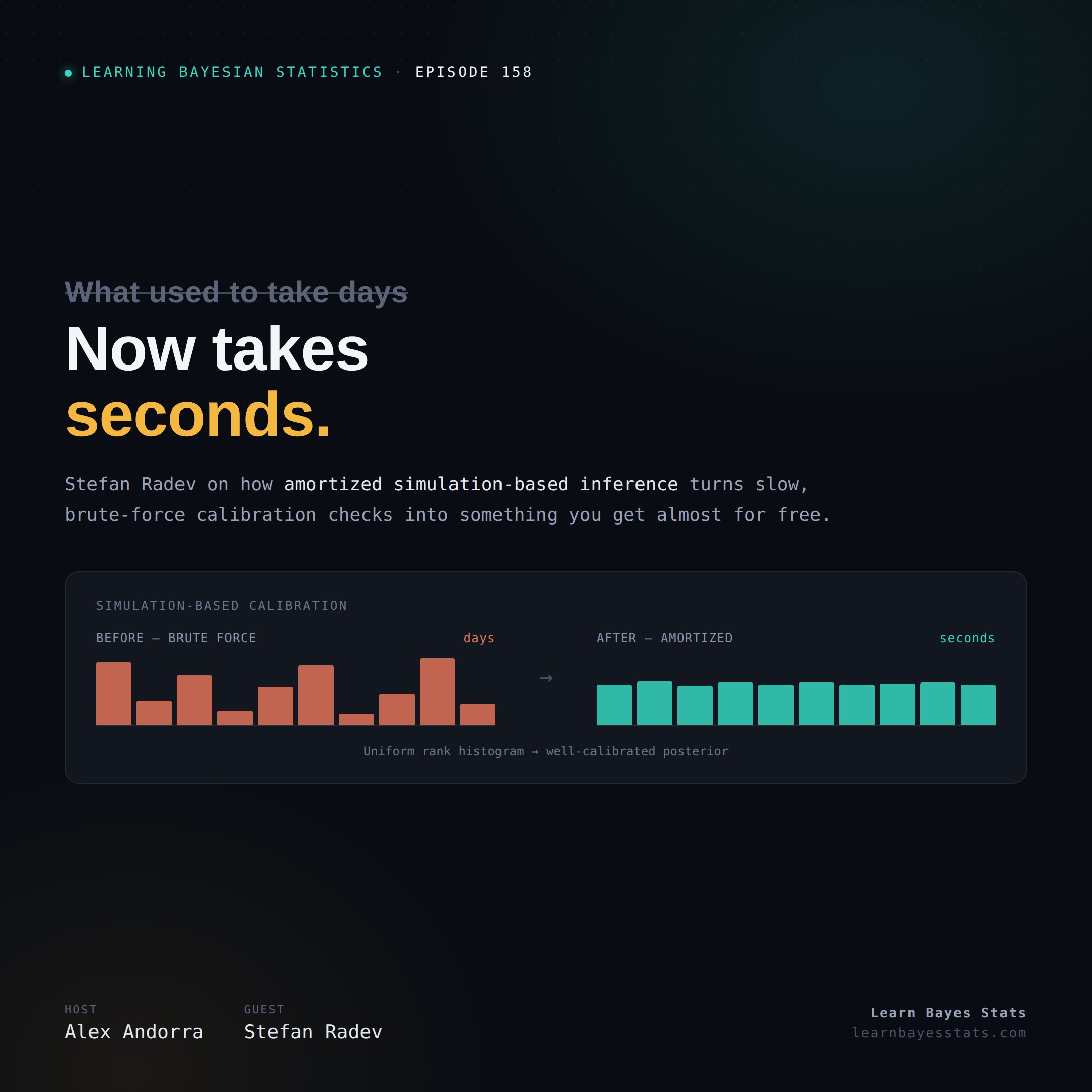
Why Bayesian Statistics Is More Computational Than Ever episode artwork

EPISODE · Jun 19, 2026 · 4 MIN

Why Bayesian Statistics Is More Computational Than Ever

from Learning Bayesian Statistics · host Alexandre Andorra

Today's clip is from Episode 158 featuring Stefan Radev. In this conversation, Alex Andorra and Stefan break down a core argument from their paper: Bayesian statistics has never been more computational than it is now, and simulation is the thread that ties the whole workflow together.Stefan parcellates the Bayesian workflow into four stages, and this clip covers the first two. Stage one is model specification, where the workflow community has long recommended prior predictive checks. You can do this informally, just running simulations from your model and eyeballing whether the output meets your expectations, or formally, à la Michael Betancourt, by pushing your model's high-dimensional output through a transformation into a low-dimensional, interpretable space and checking it against reality. The punchline: a surprising number of models can be discarded before you've even seen real data, yet Stefan notes these checks remain underused in practice.Stage two is model verification, where the question shifts to whether your inferences are well calibrated. This is the territory of simulation-based calibration and parameter recovery studies, classic tools that have always carried a steep computational price. You simulate thousands of synthetic datasets and run inference on every single one, which is exactly why these checks are so often skipped in papers, even though doing one well can be a contribution in its own right.Here's where amortized simulation-based inference changes the math entirely. Checks that used to take days now take seconds, and instead of laboriously running inference dataset by dataset, you get millions of posterior samples essentially for free. The calibration checks that the field has always known it should be doing finally become cheap enough to actually do.Get the full discussion hereSupport & Resources→ Support the show on Patreon→ Bayesian Modeling Course (first 2 lessons free)Our theme music is « Good Bayesian », by Baba Brinkman (feat MC Lars and Mega Ran). Check out his awesome work

Today's clip is from Episode 158 featuring Stefan Radev. In this conversation, Alex Andorra and Stefan break down a core argument from their paper: Bayesian statistics has never been more computational than it is now, and simulation is the thread that ties the whole workflow together.Stefan parcellates the Bayesian workflow into four stages, and this clip covers the first two. Stage one is model specification, where the workflow community has long recommended prior predictive checks. You can do this informally, just running simulations from your model and eyeballing whether the output meets your expectations, or formally, à la Michael Betancourt, by pushing your model's high-dimensional output through a transformation into a low-dimensional, interpretable space and checking it against reality. The punchline: a surprising number of models can be discarded before you've even seen real data, yet Stefan notes these checks remain underused in practice.Stage two is model verification, where the question shifts to whether your inferences are well calibrated. This is the territory of simulation-based calibration and parameter recovery studies, classic tools that have always carried a steep computational price. You simulate thousands of synthetic datasets and run inference on every single one, which is exactly why these checks are so often skipped in papers, even though doing one well can be a contribution in its own right.Here's where amortized simulation-based inference changes the math entirely. Checks that used to take days now take seconds, and instead of laboriously running inference dataset by dataset, you get millions of posterior samples essentially for free. The calibration checks that the field has always known it should be doing finally become cheap enough to actually do.Get the full discussion hereSupport & Resources→ Support the show on Patreon→ Bayesian Modeling Course (first 2 lessons free)Our theme music is « Good Bayesian », by Baba Brinkman (feat MC Lars and Mega Ran). Check out his awesome work

NOW PLAYING

Why Bayesian Statistics Is More Computational Than Ever

0:00 4:46

No transcript for this episode yet

We transcribe on demand. Request one and we'll notify you when it's ready — usually under 10 minutes.

French Your Way Jessica: Native French teacher founder of French Your Way Boost your French listening skills and test your comprehension with this one of a kind series of podcasts. Get the chance to listen to a real conversation between native speakers talking at normal speed AND customise your learning experience through carefully designed sets of questions (2 levels of difficulty) available for download at www.frenchvoicespodcast.com. All interviews also come with the transcript. French teacher Jessica interviews native speakers of French from around the world who share a bit of their life and passion. Where else would you meet in one same place a French yoga teacher based in Melbourne, a soap manufacturer from Provence, or a couple cycling around the world? Kaizen Blueprint Aldo Chandra "Kaizen" is a Japanese term for continuous improvement. This podcast provides a blueprint to learn about health, wealth, relationships and everything else in between. Through our podcast, we strive to inspire, educate, and motivate our audience to cultivate a mindset of lifelong learning, productivity, and personal development. By sharing insights, strategies, and practical tips, we aim to guide listeners on their journey towards realizing their fullest potential, fostering success, and creating lasting positive change. Tips, News and Stories for Older Adults Esther C Kane CAPS, C.D.S. "Tips, News, and Stories for Older Adults" delivers weekly insights tailored for seniors. We bring you summaries of curated news, practical advice, and inspiring stories that matter to the 55+ community. From health and finance to technology and lifestyle, our content keeps you informed and engaged. Sourced from trusted outlets, each episode offers valuable information for navigating your golden years. Join us as we explore aging with positivity, wisdom, and engaging stories. Your perfect companion for staying active, learning, and embracing life's later chapters. CISO Perspectives (public) N2K Networks This season on CISO Perspectives, host Kim Jones explores some of the challenges of leading through uncertainty. We explore the complexity of the changing nature of regulation and working with the federal government, the evolution of privacy and fraud, and how emerging technologies like AI and quantum computing are changing cyber. When you don’t know what questions to ask, you’re afraid to ask, or don’t know who to ask, CISO Perspectives provides the foundation for learning in this brave new world.

Frequently Asked Questions

How long is this episode of Learning Bayesian Statistics?

This episode is 4 minutes long.

When was this Learning Bayesian Statistics episode published?

This episode was published on June 19, 2026.

What is this episode about?

Today's clip is from Episode 158 featuring Stefan Radev. In this conversation, Alex Andorra and Stefan break down a core argument from their paper: Bayesian statistics has never been more computational than it is now, and simulation is the thread...

Can I download this Learning Bayesian Statistics episode?

Yes, you can download this episode by clicking the download button on the episode player, or subscribe to the podcast in your preferred podcast app for automatic downloads.
URL copied to clipboard!