
EPISODE · May 24, 2026 · 25 MIN
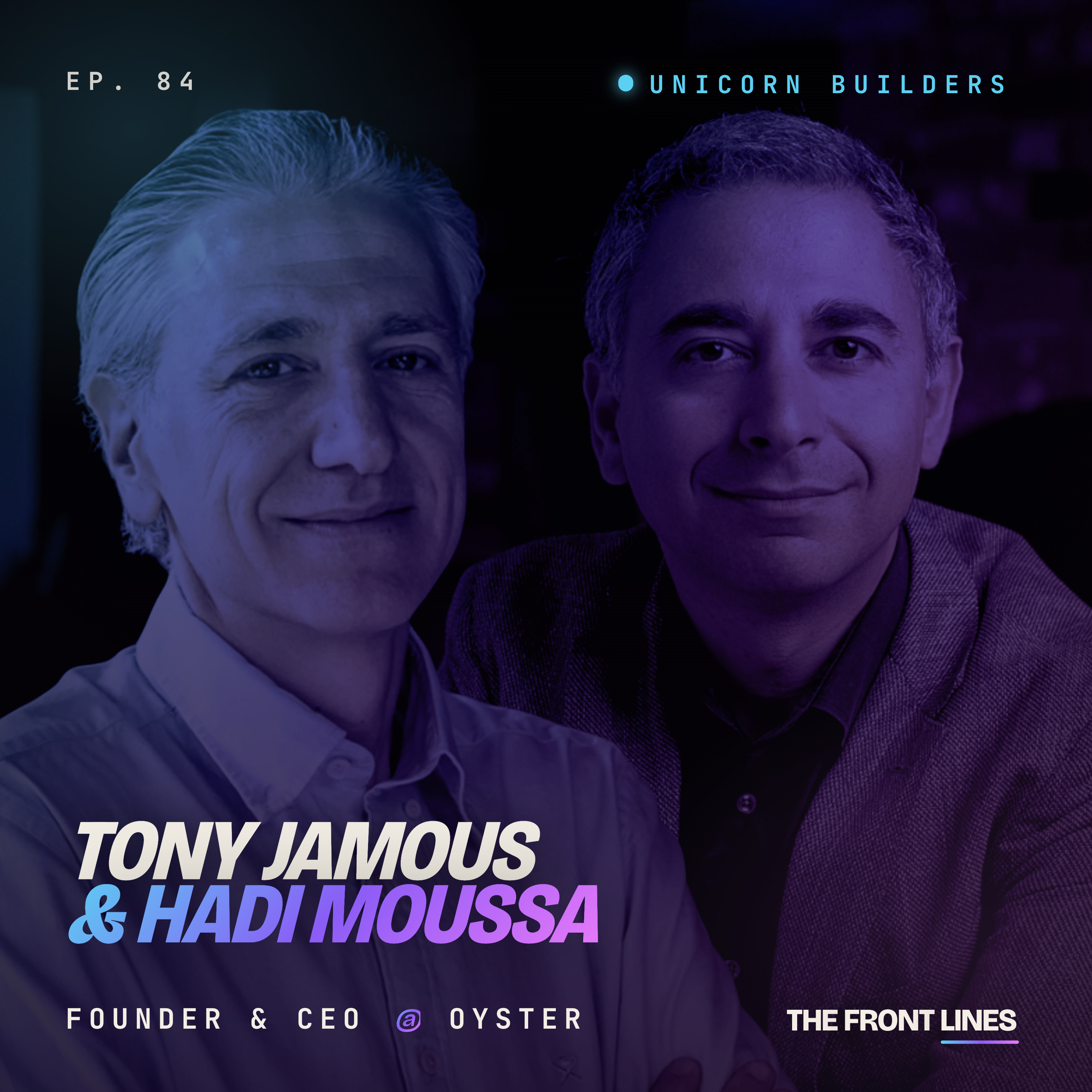
Why Oyster's founder initiated his own CEO replacement | Tony Jamous & Hadi Moussa
from Unicorn Builders · host The Front Lines
Oyster is a global employment platform built on one core premise: make hiring across borders as easy as hiring locally. Rather than racing competitors toward all-in-one HR stacks, Oyster stayed deliberately narrow — owning the cross-border employment use case in a $30 billion market. In this episode of Unicorn Builders, founder Tony Jamous and newly appointed CEO Hadi Moussa walk through one of the most intentional leadership transitions we've seen in B2B tech — why Tony initiated it, how they executed it, and what Oyster's next chapter looks like from a strategy and GTM standpoint.Topics Discussed:Why Tony proactively surfaced himself as the bottleneck — and how he structured the board conversationWhat an 8-month, 50-candidate global CEO search actually looks like from the insideHow Hadi structured his first 30-60-90 days: what he prioritized, what he deferred, and whyOyster's three strategic bets: EOR depth, mid-market expansion, and AI talent demandThe operational systems behind Oyster's mission authenticity — beyond the website copyWhy remote work was just the catalyst, and what's actually sustaining global employment demandGTM Lessons For B2B Founders:Founder-as-bottleneck is a GTM problem, not just a leadership one. Tony didn't wait for board pressure. He solicited 360 feedback, concluded he was limiting the company's trajectory, and brought the transition idea to the board himself. The framing matters: he positioned it not as stepping down, but as identifying what the company needed to grow beyond what he could deliver. For founders, this is a GTM unlock — the wrong leader at the helm caps your sales motion, your hiring, and your market credibility at exactly the wrong time.Your first 30 days as an incoming CEO is a customer discovery sprint. Hadi's first month was structured entirely around listening — with the team, with customers, and with the existing plan. He specifically prioritized customer conversations to map pain points and identify where Oyster was creating friction. The output wasn't a vision deck. It was the foundation for a three-year strategy grounded in real customer problems Oyster could solve in a differentiated way. Incoming operators: resist the pressure to announce strategy early. The diagnosis has to come first.Over-invest in the transition communication plan. Tony and Hadi spent roughly two months planning the transition before it was announced. The core insight: your company is as attached to you as you are to it. People joined because of your story. A rushed or ambiguous handoff creates fear, not confidence. The communication plan needs to answer one question clearly — why now, and why is this good for them. That requires intentional design, not a last-minute all-hands.Execute the handoff fast once it starts. Tony left his team Slack channels within one week of Hadi joining. His words: it was painful, but necessary. Slow transitions create ambiguity around decision authority, which stalls execution at every level of the org. Once the decision is public, speed matters more than comfort. Dragging out the overlap is almost always worse than a clean break.// Sponsors: Front Lines — We help B2B tech companies launch, manage, and grow podcasts that drive demand, awareness, and thought leadership. www.FrontLines.ioThe Global Talent Co. — We help tech startups find, vet, hire, pay, and retain amazing marketing talent that costs 50-70% less than the US & Europe. www.GlobalTalent.co//Don't Miss: New Podcast Series — How I Hire Senior GTM leaders share the tactical hiring frameworks they use to build winning revenue teams. Hosted by Andy Mowat, who scaled 4 unicorns from $10M to $100M+ ARR and launched Whispered to help executives find their next role. Subscribe here: https://open.spotify.com/show/53yCHlPfLSMFimtv0riPyM
What this episode covers
Oyster is a global employment platform built on one core premise: make hiring across borders as easy as hiring locally. Rather than racing competitors toward all-in-one HR stacks, Oyster stayed deliberately narrow — owning the cross-border employment use case in a $30 billion market. In this episode of Unicorn Builders, founder Tony Jamous and newly appointed CEO Hadi Moussa walk through one of the most intentional leadership transitions we've seen in B2B tech — why Tony initiated it, how they executed it, and what Oyster's next chapter looks like from a strategy and GTM standpoint.Topics Discussed:Why Tony proactively surfaced himself as the bottleneck — and how he structured the board conversationWhat an 8-month, 50-candidate global CEO search actually looks like from the insideHow Hadi structured his first 30-60-90 days: what he prioritized, what he deferred, and whyOyster's three strategic bets: EOR depth, mid-market expansion, and AI talent demandThe operational systems behind Oyster's mission authenticity — beyond the website copyWhy remote work was just the catalyst, and what's actually sustaining global employment demandGTM Lessons For B2B Founders:Founder-as-bottleneck is a GTM problem, not just a leadership one. Tony didn't wait for board pressure. He solicited 360 feedback, concluded he was limiting the company's trajectory, and brought the transition idea to the board himself. The framing matters: he positioned it not as stepping down, but as identifying what the company needed to grow beyond what he could deliver. For founders, this is a GTM unlock — the wrong leader at the helm caps your sales motion, your hiring, and your market credibility at exactly the wrong time.Your first 30 days as an incoming CEO is a customer discovery sprint. Hadi's first month was structured entirely around listening — with the team, with customers, and with the existing plan. He specifically prioritized customer conversations to map pain points and identify where Oyster was creating friction. The output wasn't a vision deck. It was the foundation for a three-year strategy grounded in real customer problems Oyster could solve in a differentiated way. Incoming operators: resist the pressure to announce strategy early. The diagnosis has to come first.Over-invest in the transition communication plan. Tony and Hadi spent roughly two months planning the transition before it was announced. The core insight: your company is as attached to you as you are to it. People joined because of your story. A rushed or ambiguous handoff creates fear, not confidence. The communication plan needs to answer one question clearly — why now, and why is this good for them. That requires intentional design, not a last-minute all-hands.Execute the handoff fast once it starts. Tony left his team Slack channels within one week of Hadi joining. His words: it was painful, but necessary. Slow transitions create ambiguity around decision authority, which stalls execution at every level of the org. Once the decision is public, speed matters more than comfort. Dragging out the overlap is almost always worse than a clean break.// Sponsors: Front Lines — We help B2B tech companies launch, manage, and grow podcasts that drive demand, awareness, and thought leadership. www.FrontLines.ioThe Global Talent Co. — We help tech startups find, vet, hire, pay, and retain amazing marketing talent that costs 50-70% less than the US & Europe. www.GlobalTalent.co//Don't Miss: New Podcast Series — How I Hire Senior GTM leaders share the tactical hiring frameworks they use to build winning revenue teams. Hosted by Andy Mowat, who scaled 4 unicorns from $10M to $100M+ ARR and launched Whispered to help executives find their next role. Subscribe here: https://open.spotify.com/show/53yCHlPfLSMFimtv0riPyM
NOW PLAYING
Why Oyster's founder initiated his own CEO replacement | Tony Jamous & Hadi Moussa
No transcript for this episode yet
Similar Episodes
Jan 4, 2026 ·3m