
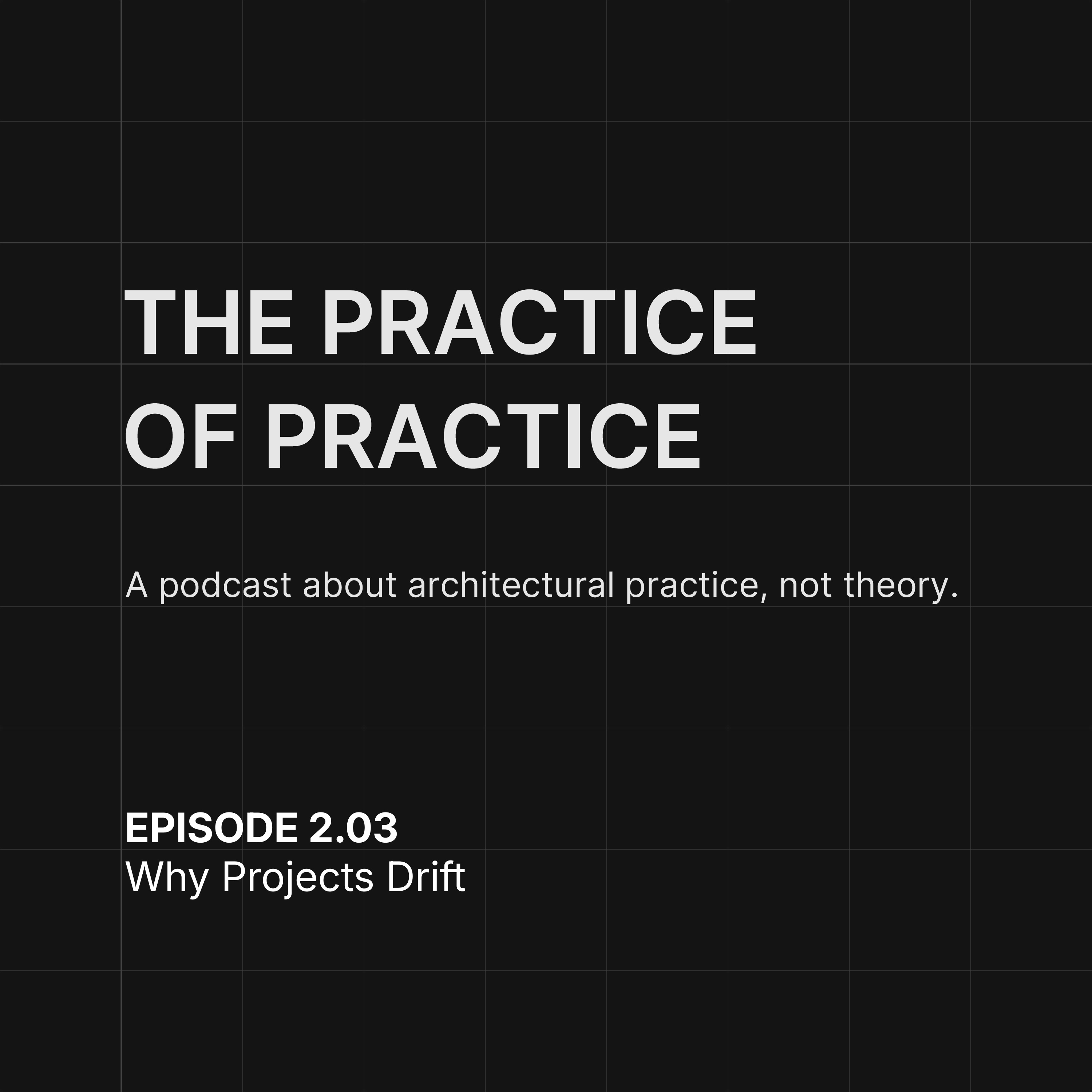
EPISODE · May 15, 2026 · 22 MIN
Why Projects Drift
from The Practice of Practice · host Taylor Woolf, AIA NCARB
There’s a point in every project where things start to feel slightly off. Not broken. Not failing. Just… misaligned.This episode names that pattern for what it actually is.Drift.Projects don’t fall apart because of one bad decision. They drift because decisions aren’t actively reinforced over time. What was aligned last week shows up differently this week. What was decided in a meeting slowly changes in drawings, emails, and coordination.No one is wrong. No one is careless.No one is holding the line.We break down how drift actually forms:Decisions are made once, but not reinforcedResponsibility is assumed, not ownedProgress replaces verificationAnd we introduce the role nobody explains clearly in practice: holding the line.Not authority. Not control. Not ego.Stewardship of direction.This episode reframes coordination issues as something deeper. Most problems aren’t technical. They’re the result of decisions that weren’t protected as the project moved forward.If a project feels heavier than it should, this is usually why.In the next episode: we go deeper into coordination and unpack why most coordination problems are not about drawings, but about timing, assumptions, and expectations between people.KEY TAKEAWAYSProjects don’t fail suddenly. They drift. Misalignment builds slowly through small, unreinforced decisions.Decisions don’t stick on their own. They require active reinforcement as the project evolves.Drift is not a communication problem. It’s a reinforcement problem. Teams are talking. They’re just not holding direction in place.Responsibility is often assumed, not assigned. When everyone assumes someone else is holding the line, no one is.Progress can mask misalignment. Work can be moving while direction is quietly slipping.Rework is often a symptom of drift, not incompetence. The system moved. The decisions didn’t hold.Holding the line is a learned behavior, not a title. It shows up in small moments long before it’s formally expected.
What this episode covers
There’s a point in every project where things start to feel slightly off. Not broken. Not failing. Just… misaligned.This episode names that pattern for what it actually is.Drift.Projects don’t fall apart because of one bad decision. They drift because decisions aren’t actively reinforced over time. What was aligned last week shows up differently this week. What was decided in a meeting slowly changes in drawings, emails, and coordination.No one is wrong. No one is careless.No one is holding the line.We break down how drift actually forms:Decisions are made once, but not reinforcedResponsibility is assumed, not ownedProgress replaces verificationAnd we introduce the role nobody explains clearly in practice: holding the line.Not authority. Not control. Not ego.Stewardship of direction.This episode reframes coordination issues as something deeper. Most problems aren’t technical. They’re the result of decisions that weren’t protected as the project moved forward.If a project feels heavier than it should, this is usually why.In the next episode: we go deeper into coordination and unpack why most coordination problems are not about drawings, but about timing, assumptions, and expectations between people.KEY TAKEAWAYSProjects don’t fail suddenly. They drift. Misalignment builds slowly through small, unreinforced decisions.Decisions don’t stick on their own. They require active reinforcement as the project evolves.Drift is not a communication problem. It’s a reinforcement problem. Teams are talking. They’re just not holding direction in place.Responsibility is often assumed, not assigned. When everyone assumes someone else is holding the line, no one is.Progress can mask misalignment. Work can be moving while direction is quietly slipping.Rework is often a symptom of drift, not incompetence. The system moved. The decisions didn’t hold.Holding the line is a learned behavior, not a title. It shows up in small moments long before it’s formally expected.
NOW PLAYING
Why Projects Drift
No transcript for this episode yet
Similar Episodes
Mar 26, 2026 ·1m
Mar 19, 2026 ·34m
Feb 18, 2026 ·11m
Feb 11, 2026 ·45m