
EPISODE · May 28, 2026 · 9 MIN
Why Reparations in Black Churches Are Sparking a Revolution
from African Elements Daily · host African Elements
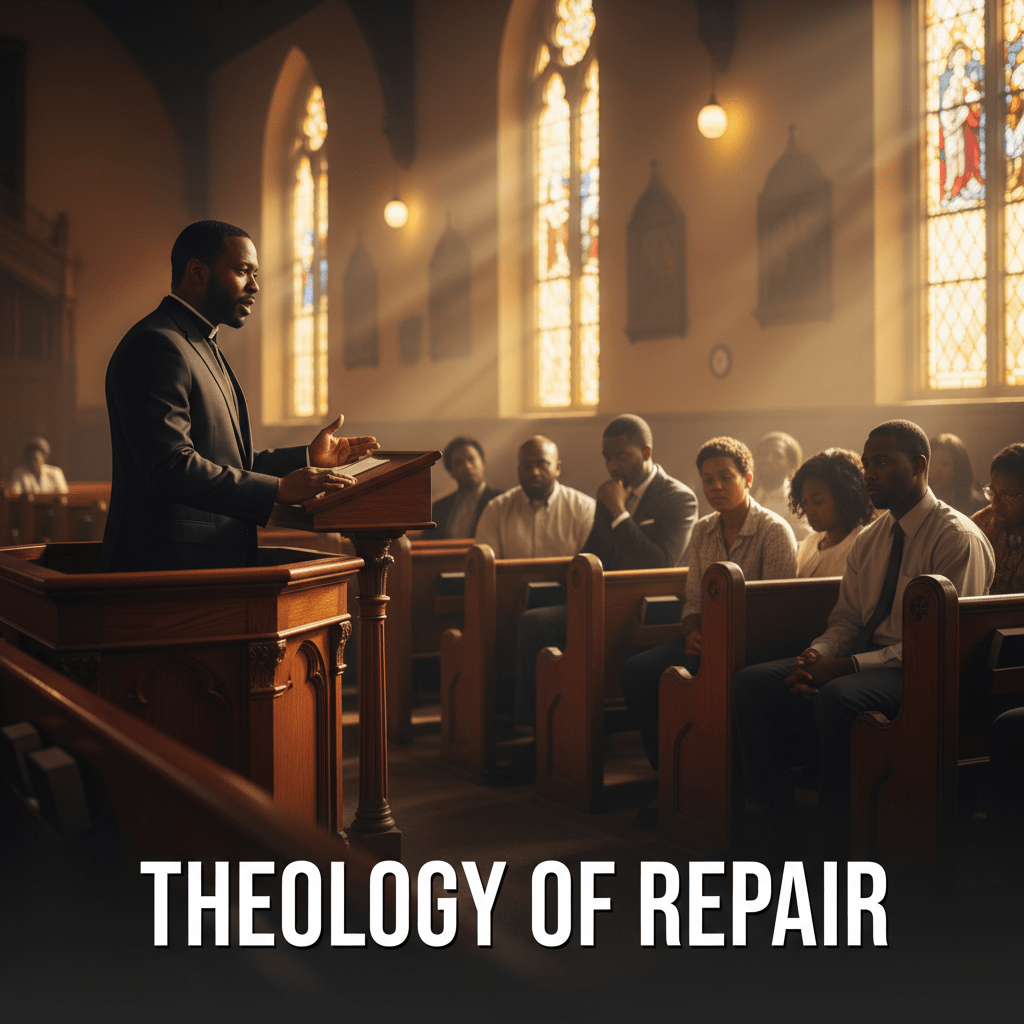
While Washington stalls, Black churches are leading a grassroots movement for economic reparations, turning the pulpit into a platform for racial justice. Why Reparations in Black Churches Are Sparking a Revolution By Darius Spearman (africanelements) Support African Elements at patreon.com/africanelements and hear recent news in a single playlist. Additionally, you can gain early access to ad-free video content. A quiet but powerful movement is sweeping through spiritual sanctuaries across the United States. During Memorial Day weekend, Black churches nationwide came together for a unique moment of action (washingtoninformer.com). Under the banner of "Reparations Sunday," hundreds of congregations raised their voices to reframe a long-standing national debate (washingtoninformer.com). They did not merely discuss policy. Instead, they used sermons, educational forums, and liturgy to present economic repair as a deep moral and biblical obligation (richmondhillva.org). While the federal government stalls on the issue, spiritual communities are moving forward. They are refusing to wait for Washington to act. By turning their pulpits into platforms, Black churches are organizing at the grassroots level (washingtoninformer.com, afro.com). They are modeling what a theology of repair looks like in daily life (richmondhillva.org). To understand this momentum, one must look at the history of faith, protest, and economic struggle (tennesseeencyclopedia.net, tennesseeencyclopedia.net). The Spark of 1969: James Forman and the Black Manifesto The current movement inside Black churches has a clear starting point. On Sunday, May 4, 1969, a major civil rights leader stepped into the spotlight (trcnyc.org). James Forman, the former executive secretary of the Student Nonviolent Coordinating Committee, walked into Riverside Church in New York (trcnyc.org, stanford.edu). He disrupted the morning service to make a bold statement (trcnyc.org). Forman marched down the center aisle and took the chancel (trcnyc.org). He read the "Black Manifesto," a radical document developed in Detroit (trcnyc.org, wikipedia.org). This document accused American religious institutions of exploiting Black labor (trcnyc.org). It demanded $500 million in reparations from white churches and synagogues to fund Black economic projects (trcnyc.org). The reaction was highly polarized. The church organist tried to drown out Forman by playing music (trcnyc.org). The minister led a silent walkout of the congregation (trcnyc.org). Even though many white leaders denounced the protest, it changed the conversation forever (washingtoninformer.com, trcnyc.org). It forced religious groups to look at their own historical debts (richmondhillva.org, trcnyc.org). As a major civil rights organization formed in 1960, the Student Nonviolent Coordinating Committee spearheaded nonviolent direct actions like voter registration drives (snccdigital.org, stanford.edu). As the executive secretary from 1961 to 1966, Forman provided the administrative skills that turned the student-led group into a national force (stanford.edu). His later move toward systemic economic justice directly shaped his demands at Riverside Church (trcnyc.org, stanford.edu). The Black Manifesto Demands: Then vs. Now Comparing the original 1969 demand to its modern inflation-adjusted value. 1969 Demand $500 Million Modern Value (Inflation Adjusted) $3.2+ Billion Forgotten Pioneers: Belinda Royall and Callie House The pursuit of economic repair is older than the modern civil rights movement. In 1783, Belinda Royall filed the earliest recorded petition for reparations in Massachusetts (royallhouse.org). She was a formerly enslaved woman who successfully petitioned the legislature for an annual pension from her former owner's estate (royallhouse.org). Although she won her legal battle, she struggled to receive the funds (royallhouse.org). She had to file five more petitions over a decade to collect what she was legally owed (royallhouse.org). A century later, another heroic woman took up the cause. Callie House, a widowed washerwoman, became the mother of the national pension movement (wikipedia.org, tennesseeencyclopedia.net). In 1894, she co-founded the National Ex-Slave Mutual Relief, Bounty, and Pension Association (tennesseeencyclopedia.net). This group organized hundreds of thousands of formerly enslaved people to petition the federal government for pensions (wikipedia.org, tennesseeencyclopedia.net). Their organizing was deeply grassroots and relied heavily on local church networks (tennesseeencyclopedia.net). Unfortunately, federal agencies feared her growing influence (tennesseeencyclopedia.net). They used postal laws to cut off her communication and dues (tennesseeencyclopedia.net). In 1917, she was unjustly convicted of mail fraud on weak evidence (tennesseeencyclopedia.net). After serving a year in prison, her national movement dissolved, but the spiritual foundation remained (tennesseeencyclopedia.net). Her efforts showed the power of Black communal organizing during the tough struggles after emancipation (tennesseeencyclopedia.net, tennesseeencyclopedia.net). The Biblical Foundation: Theology of Repair The modern church reparations movement is built on a solid theological foundation. It is more than a simple matter of charity or tithing. Instead, clergy argue that the theology of repair is a mandatory moral requirement (richmondhillva.org, faithward.org). Standard charity often acts as a voluntary gift, which can maintain paternalistic structures (faithandleadership.com, salthousechurch.org). In contrast, the theology of repair focuses on paying an outstanding debt and returning stolen wealth (richmondhillva.org, faithandleadership.com). This framework draws heavily from both the Old and New Testaments. Activists frequently point to Isaiah 58:12, which calls on believers to be "Repairers of the Breach" (richmondhillva.org, nationalcouncilofchurches.us). They also look to the story of Zacchaeus, who offered fourfold financial restitution to those he had defrauded (richmondhillva.org, thegospelcoalition.org). For these churches, spiritual healing is impossible without material restitution (richmondhillva.org, faithandleadership.com). Predominantly white denominations have begun to engage with this theology. They are researching their historical ties to slavery and segregation (richmondhillva.org, faithandleadership.com). For example, the United Church of Christ published guides to codify this biblical duty (nationalcouncilofchurches.us). They are shifting the focus from simple racial reconciliation to real economic justice (richmondhillva.org, faithandleadership.com). The Stagnant Wealth Gap (Median Net Worth) Black families hold roughly 15 cents of wealth for every dollar held by white families. White Households: $284,310 100% Black Households: $44,100 15.5% Sobering Numbers: The Stagnant Wealth Gap The passion behind "Reparations Sunday" is fueled by modern economic realities. According to research from the National Community Reinvestment Coalition and the Urban Institute, the racial wealth gap has not improved for generations (ncrc.org, urban.org). Today, the median wealth of a white household is $284,310, while the median wealth of a Black household is $44,100 (ncrc.org, urban.org). This means Black families hold only 13 to 15 cents of wealth for every dollar held by white families (ncrc.org, urban.org). This massive disparity did not happen by accident. Economist Ellora Derenoncourt has shown that the wealth gap closed quickly after the Civil War (nber.org). However, that progress completely stalled in the 1950s (nber.org). Since then, the gap has remained frozen due to systemic barriers (nber.org, minneapolisfed.org). Post-war policies actively locked Black families out of wealth-building tools (minneapolisfed.org). Federal housing programs used redlining to deny mortgages to Black buyers (localhousingsolutions.org, huduser.gov). Additionally, Black veterans were widely excluded from the benefits of the 1944 GI Bill (iava.org). Because wealth has shifted to stock equity while Black families hold most of their wealth in housing, the divide has only widened (urban.org, minneapolisfed.org). Faith communities recognize that public policy has failed to solve this issue (washingtoninformer.com, afro.com). Local Pulpits and Tangible Repair Rather than waiting for the federal government, local congregations are taking action. The Grassroots Reparations Campaign and the National African American Reparations Commission are helping churches build localized funds (thetruthtellingproject.org, reparationscomm.org). These efforts are designed to avoid paternalistic structures by transferring power to Black leaders (faithandleadership.com, salthousechurch.org). For example, Salt House Church in Washington dedicates one percent of its annual budget to a reparations program (salthousechurch.org, salthousechurch.org). To ensure fair distribution, they manage the funds through an independent board that is at least half BIPOC (salthousechurch.org). They also use a lottery pool to distribute grants, giving recipients absolute autonomy over how they use the money (salthousechurch.org). Similarly, Memorial Episcopal Church in Baltimore voted to allocate $500,000 from its endowment over five years (faithandleadership.com). They distribute these funds directly to Black-led non-profit organizations instead of managing projects themselves (faithandleadership.com). Meanwhile, the Episcopal Diocese of New Jersey holds special services to reflect on historical segregation while supporting systemic state-level legislation (washingtoninformer.com, afro.com). Modern Local Church Reparations Programs Examples of congregations implementing financial and structural repair. Salt House Church (Kirkland, WA) Allocates 1% of the annual operating budget to direct cash grants. Distributed via a lottery system to Black applicants, governed by a minimum 50% BIPOC board. Memorial Episcopal Church (Baltimore, MD) Committed $500,000 from its endowment over a five-year period. Funds go directly to Black-led non-profits working in housing, education, and employment. The Political Fight and H.R. 40 While local churches act, the political struggle for federal reparations continues. The center of this legislative effort is H.R. 40, a bill to study and develop reparation proposals (washingtoninformer.com, hrw.org). First introduced in 1989 by the late Representative John Conyers Jr., the bill has faced decades of resistance (washingtoninformer.com, newsweek.com). Conyers introduced the bill in every session for nearly thirty years until his retirement (newsweek.com). The bill proposed a thirteen-member commission to research the legacy of slavery and subsequent policies like redlining (hrw.org). The number forty in the bill is a direct reference to the unfulfilled Civil War-era promise of forty acres and a mule (zinnedproject.org, archives.gov). Following Conyers, Representative Sheila Jackson Lee sponsored the bill until her passing in 2024 (washingtoninformer.com). Today, Representative Ayanna Pressley sponsors its reintroduction in the 119th Congress (washingtoninformer.com). Because progress at the federal level is slow, state-level initiatives have started to emerge. Some advocates are turning their attention to local reparations task force models to bypass the gridlock in Washington (washingtoninformer.com, afro.com). The work of spiritual communities acts as a powerful moral bridge between these political efforts and local communities (washingtoninformer.com, richmondhillva.org). Educating the Future and Supporting HBCUs A critical part of the reparative movement involves supporting educational institutions. Historically Black Colleges and Universities, or HBCUs, have played a massive role in building the Black middle class (uncficb.org, pnpi.org). Formally defined under the Higher Education Act of 1965, these institutions were established before 1964 with the primary mission of educating Black Americans (ed.gov, pnpi.org). Protestant religious organizations founded most HBCUs during the Reconstruction era because Black students were barred from other colleges (bryanuniversity.edu, pnpi.org). Later, the Second Morrill Land-Grant Act of 1890 required segregated Southern states to fund Black land-grant institutions (wikipedia.org, hunt-institute.org). Despite historically receiving smaller budgets, HBCUs have been highly successful at creating economic opportunity (uncficb.org, pnpi.org). Many churches participating in "Reparations Sunday" direct their offerings to support these institutions (washingtoninformer.com). They recognize that investing in Black education is a direct way to fight systemic wealth disparities (washingtoninformer.com, richmondhillva.org). By connecting historical memory to direct financial investment, faith communities are helping to pave a pathway toward true equity (richmondhillva.org, faithandleadership.com). About the Author Darius Spearman is a professor of Black Studies at San Diego City College, where he has been teaching for over 20 years. He is the founder of African Elements, a media platform dedicated to providing educational resources on the history and culture of the African diaspora. Through his work, Spearman aims to empower and educate by bringing historical context to contemporary issues affecting the Black community.
NOW PLAYING
Why Reparations in Black Churches Are Sparking a Revolution
No transcript for this episode yet
Similar Episodes
No similar episodes found.