
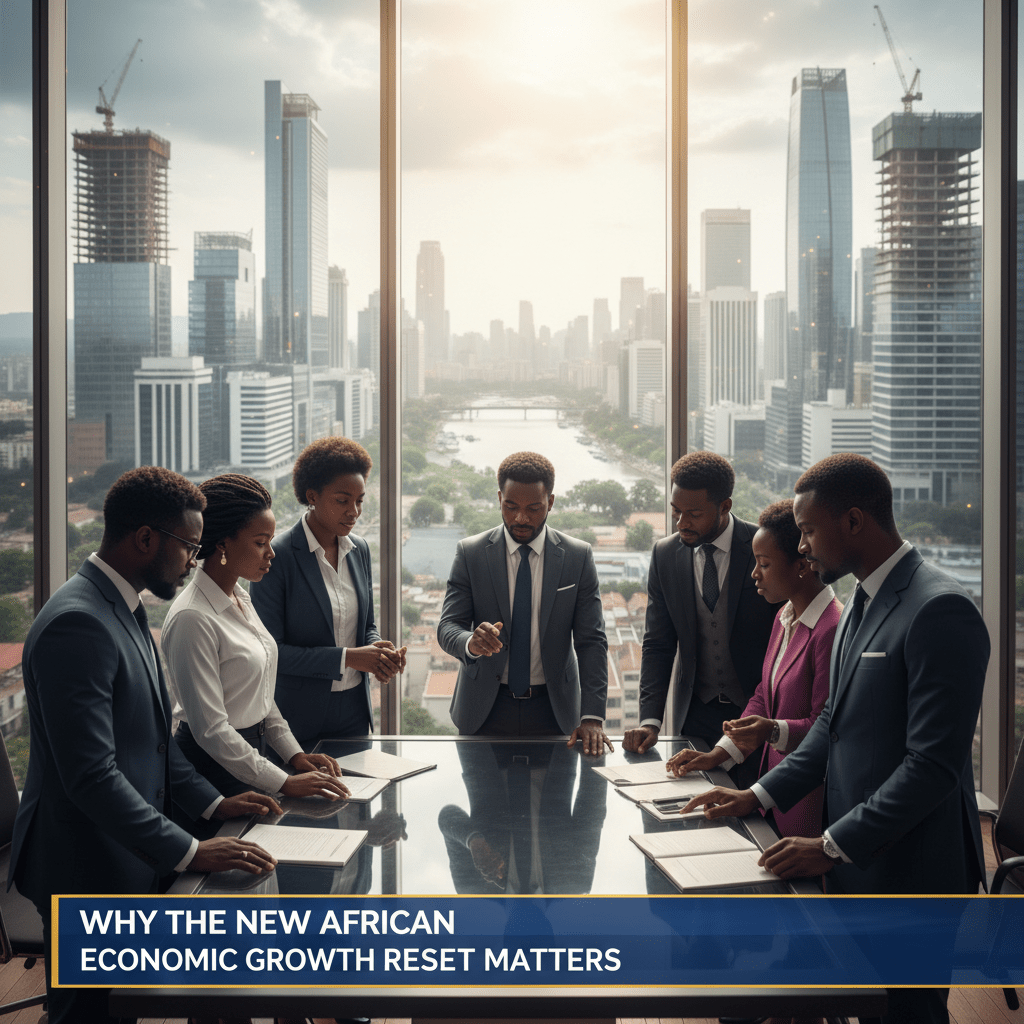
EPISODE · May 21, 2026 · 11 MIN
Why the New African Economic Growth Reset Matters
from African Elements Daily · host African Elements
The IMF calls for a shift to private sector-led growth in Sub-Saharan Africa. Learn how historical debt and digital reforms are shaping a new economic future. Why the New African Economic Growth Reset Matters By Darius Spearman (africanelements) Support African Elements at patreon.com/africanelements and hear recent news in a single playlist. Additionally, you can gain early access to ad-free video content. The Urgent Call for an Economic Reset The International Monetary Fund recently issued a critical report on Sub-Saharan Africa. The organization is calling for a massive shift in economic policy (imf.org, imf.org). For decades, many African nations relied heavily on state-led economic models (rsisinternational.org). Now, the global lender urges a transition toward private investment-driven growth (imf.org, imf.org). This recommendation comes at a time of extreme fiscal pressure. Leaders must navigate a severe funding squeeze that threatens recent progress (imf.org). This shift represents a major departure from previous development strategies. Many countries are struggling under the weight of heavy debt. Rising global interest rates make borrowing very expensive (imf.org). Consequently, the old ways of funding development are no longer viable (imf.org). The new blueprint emphasizes business-friendly structural reforms across the region (imf.org). This approach aims to unlock private capital to replace vanishing international aid (imf.org). Economic data reveals a widening gap between this region and other developing areas. Over the last three years, regional growth per capita averaged only 1.4 percent annually (imf.org). Meanwhile, other emerging markets grew at a faster rate of 3.4 percent (imf.org). This divergence highlights the urgent need for a new economic strategy (imf.org). For the global Black community, these developments carry deep meaning. Economic stability on the continent directly impacts the African diaspora (africandiasporanetwork.org). Stable African economies foster stronger global partnerships. These connections can help in decolonizing education systems and other institutions worldwide. Understanding this current policy shift requires examining its deep historical roots. The Post-Independence Dream of State-Led Growth Following the dawn of independence in the 1960s, optimism ran high across Africa. New national leaders sought to rebuild their societies after decades of colonial exploitation (umich.edu). Figures like Kwame Nkrumah in Ghana championed rapid state-led modernization (umich.edu). Many governments adopted Import Substitution Industrialization to reduce reliance on foreign goods (umich.edu). Under this model, the state became the primary driver of economic activity. Governments established large state-owned enterprises to manage key resources (researchgate.net). In the initial years, this model achieved notable success. Sub-Saharan Africa experienced steady growth, averaging about four percent annually between 1960 and 1975 (rsisinternational.org). This progress, however, rested on fragile foundations. The system relied heavily on high global commodity prices. It also depended on easy access to cheap foreign credit. When global economic conditions changed, the entire structure began to crack. The oil shocks of 1973 and 1979 dealt a devastating blow to non-oil producing nations (researchgate.net, ijeais.org). At the same time, global interest rates began to climb rapidly. This combination plunged many African countries into a deep debt crisis (ijeais.org). The state-led engine, once a symbol of self-reliance, could no longer sustain itself. These historical challenges created a need for external assistance, which came with heavy costs. Comparing African Growth Eras Post-Independence Era (1960-1975) +4.0% Growth Lost Decades (1980s SAPs) -0.7% Per Capita GDP Africa Rising (2000-2010) Doubled Real GDP The Painful Era of Structural Adjustment As debt levels became unsustainable, international financial institutions stepped in. During the 1980s and 1990s, the IMF and World Bank introduced Structural Adjustment Programs (SAPs) (democracyinafrica.org). These programs enforced a set of policies known as the Washington Consensus (democracyinafrica.org). To receive loans, governments had to implement severe market reforms. These measures included privatizing state-owned companies and cutting public spending (democracyinafrica.org). Governments also had to devalue their domestic currencies (democracyinafrica.org). This period became known as Africa's lost decades. The social costs of these reforms were extraordinarily high (thetricontinental.org, ids.ac.uk). Annual GDP per capita actually declined by 0.7 percent during the 1980s (researchgate.net). The rapid dismantling of public services crippled healthcare and education systems (researchgate.net). Families struggled as basic safety nets disappeared. This economic pressure weakened communities, testing the strength of resilient family networks both at home and abroad. The sudden elimination of food and fuel subsidies sparked widespread public anger. Citizens took to the streets in what became known as IMF riots (sackett.net). These protests highlighted the deep disconnect between economic theory and human survival. Critics argued that the reforms prioritized debt repayment over human development (thetricontinental.org). The negative legacy of these programs still shapes how citizens view international financial institutions today. The Commodity Boom and the Modern Funding Squeeze At the turn of the millennium, the economic tide began to turn again. A massive global commodity boom, driven by China's industrialization, fueled rapid growth (africandiasporanetwork.org). Between 2000 and 2010, the real gross domestic product of Sub-Saharan Africa doubled (rsisinternational.org). This period gave birth to the optimistic Africa Rising narrative. International initiatives also provided critical debt relief to many nations (democracyinafrica.org). This relief wiped out billions of dollars in old debts (democracyinafrica.org). However, the underlying structure of these economies remained highly vulnerable. Most growth still depended on exporting raw materials rather than manufacturing. After 2020, a series of global crises disrupted this progress. The COVID-19 pandemic, geopolitical conflicts, and inflation created a severe economic shock (imf.org). This combination triggered a modern funding squeeze across the region (imf.org). By 2024, total external debt for the continent reached 1.15 trillion dollars (afdb.org). The cost of servicing this debt has tripled for several nations (imf.org). Cheap foreign loans have dried up completely. This fiscal reality has forced governments to reconsider their economic strategies (imf.org). In response, many leaders are looking for alternative pathways to achieve sustainable growth. The New Blueprint for Private Sector-Led Growth The IMF now argues that the state-heavy economic model has reached its absolute limit (imf.org). Public debt-to-GDP ratios across the region stabilized at roughly 60 percent in 2024 (imf.org). However, high interest payments consume an increasingly large share of domestic revenues. The new IMF strategy focuses on unlocking the potential of the private sector (imf.org, imf.org). The goal is to transition from public investment to private productivity (imf.org). This shift requires comprehensive structural reforms to attract investors. Business regulation, trade openness, and governance require major improvements (imf.org). The IMF projects that a coordinated reform package could yield massive benefits. It could lift the region's economic output by 20 percent over the next decade (imf.org). This growth is crucial for creating jobs for a rapidly growing youth population. To achieve these goals, African nations must build stable business environments. This effort aligns with historic fights for economic justice across the diaspora. Transparent legal systems and reliable infrastructure are essential for attracting long-term business partners. Governments must work closely with local enterprises to foster innovation. Projected Output Boost from Reform Package +20% Expected increase in economic output over the next 5 to 10 years with robust governance and market reforms. Digital Governance in Rwanda and Benin To illustrate this new economic path, the IMF highlights specific success stories. Both Rwanda and Benin serve as modern models for digital reform (imf.org). These nations are using innovative digital tools to improve governance and reduce red tape (imf.org). By modernizing tax collection, they are increasing domestic revenues without raising tax rates (africandiasporanetwork.org). Rwanda has implemented Electronic Billing Machines for local businesses (africandiasporanetwork.org). These devices digitize transactions and send billing data directly to tax authorities (africandiasporanetwork.org). This system has dramatically reduced tax evasion and streamlined business operations. Additionally, Rwanda uses advanced software to automate taxpayer data management (africandiasporanetwork.org). This automation reduces the opportunities for bribery and increases administrative transparency. Benin has made similar strides by launching an online portal for tax filing (africandiasporanetwork.org). Large and medium businesses can now declare and pay taxes online easily. This digital platform protected revenue collection even during global economic shutdowns. Furthermore, Benin is implementing artificial intelligence to improve public services (africandiasporanetwork.org). These technological shifts demonstrate how modern tools can build state capacity. They offer a practical guide for other nations seeking economic stability. Social Justice and Diaspora Connections The transition to a private-led model raises important questions about social justice. Critics worry that rapid privatization might harm the most vulnerable citizens. If essential services become commodities, poor families may lose access to them (africandiasporanetwork.org). Currently, about 40 percent of the population in the region lives below the poverty line (africandiasporanetwork.org). Therefore, governments must balance market efficiency with strong social safety nets (imf.org). However, private innovation has also shown a remarkable ability to reduce poverty. In Kenya, mobile money services have increased financial inclusion dramatically (africandiasporanetwork.org). This technology has empowered female-headed households by allowing them to save and transfer money safely (africandiasporanetwork.org). In Rwanda and Ghana, private drone services deliver medical supplies to remote areas (africandiasporanetwork.org). These partnerships bypass weak public infrastructure to save lives. Economic instability in Sub-Saharan Africa directly affects global Black communities. The African diaspora sent over 95 billion dollars in remittances to the continent in 2021 (africandiasporanetwork.org). These funds are vital for supporting families and local businesses. High transaction costs, however, often reduce the impact of these transfers (africandiasporanetwork.org). Resolving economic instability can help secure these vital financial lifelines. This stability also encourages a balanced exchange of skills between Africa and the diaspora. Many skilled professionals leave the continent due to limited local opportunities. This trend is often called the brain drain (africandiasporanetwork.org). A stable economy can transform this loss into a productive exchange of talent. Diaspora networks play a key role in funding new enterprises back home. Diaspora Remittances Outpace Foreign Aid Foreign Aid Annual average flows Remittances $95 Billion (2021) A Departure from the Policies of the Past The current growth reset differs from the harsh austerity of the 1980s. IMF officials state that they have learned from past mistakes. The new framework emphasizes preserving state capacity and social contracts (imf.org). Rather than forcing sudden budget cuts, the focus is on domestic revenue mobilization (imf.org). This means widening the tax base and removing unfair exemptions for wealthy corporations. Furthermore, modern financing options provide more flexible support. Rapid Financing Instruments offer immediate assistance with fewer policy conditions (imf.org). This approach helps countries manage temporary crises without triggering domestic instability. The goal is to build long-term economic resilience. Global changes are also shifting how nations handle international debts. Some analysts point to Chinese lending practices as project-focused alternatives (africandiasporanetwork.org). However, Western private creditors still hold the largest share of African debt (africandiasporanetwork.org). This complex debt landscape requires careful negotiation by African leaders. Ultimately, the growth reset represents a historic pivot for Sub-Saharan Africa. The era of easy credit and volatile commodity booms is ending. By building strong local businesses and transparent institutions, the region can chart a sustainable path. This economic evolution will strengthen both the continent and its global diaspora. It marks the beginning of a self-determined economic future. About the Author Darius Spearman is a professor of Black Studies at San Diego City College, where he has been teaching for over 20 years. He is the founder of African Elements, a media platform dedicated to providing educational resources on the history and culture of the African diaspora. Through his work, Spearman aims to empower and educate by bringing historical context to contemporary issues affecting the Black community.
NOW PLAYING
Why the New African Economic Growth Reset Matters
No transcript for this episode yet
Similar Episodes
No similar episodes found.