
EPISODE · May 28, 2026 · 11 MIN
Why US Deportees Are Trapped in a Dictator’s Private Hotel
from African Elements Daily · host African Elements
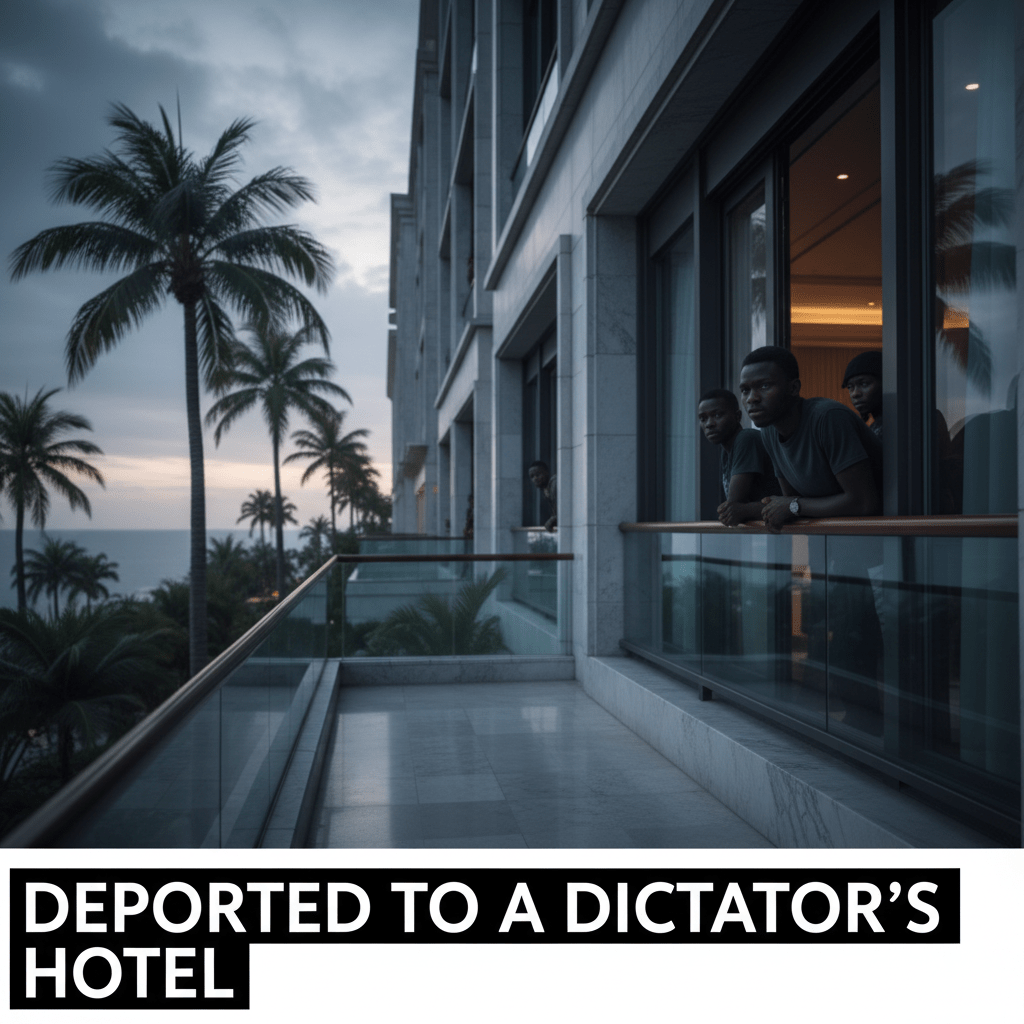
An investigation reveals a secret $7.5M US deal sending deported asylum seekers to a private hotel owned by Equatorial Guinea's corrupt ruling family. Why US Deportees Are Trapped in a Dictator's Private Hotel By Darius Spearman (africanelements) Support African Elements at patreon.com/africanelements and hear recent news in a single playlist. Additionally, you can gain early access to ad-free video content. In May 2026, investigative journalists uncovered a shocking diplomatic operation between the United States and Equatorial Guinea. The United States government established a secret $7.5 million agreement to send deported asylum seekers to Central Africa (thirdcountrydeportationwatch.org). These deportees, who originally sought safety in America, now find themselves confined inside the Bamy Hotel in Malabo (thirdcountrydeportationwatch.org). The luxury property belongs directly to the family of the authoritarian president of Equatorial Guinea (thirdcountrydeportationwatch.org). This shocking situation highlights a deep history of immigration policy, foreign aid diversion, and global corruption. This article will explore how U.S. taxpayers are funding a private prison for vulnerable refugees in one of the most repressive regimes in the world. By examining the history behind these headlines, observers can understand how modern border control exploits international loopholes. The Rise of the Obiang Dynasty and the Petrostate To understand the crisis, one must analyze the history of the ruling dynasty in Equatorial Guinea. The nation gained independence from Spain in 1968, but quickly fell under the brutal rule of Francisco Macías Nguema (wikipedia.org). In 1979, his nephew, Teodoro Obiang Nguema Mbasogo, overthrew him in a violent coup (wikipedia.org). President Obiang has ruled the country ever since, making him the longest-serving non-royal leader in the world (hrw.org). In the mid-1990s, workers discovered massive offshore oil reserves, turning the nation into a wealthy petrostate (fpri.org). However, the Obiang family systematically diverted this immense wealth into their own private accounts (icij.org). While the majority of citizens live in extreme poverty, the ruling family enjoys an incredibly lavish lifestyle (hrw.org). This systemic corruption has turned the nation into a classic kleptocracy (justiceinitiative.org). The president's eldest son, Vice President Teodoro "Teodorín" Nguema Obiang Mangue, is famous for his global spending sprees. In 2014, the United States Department of Justice forced Teodorín to settle a civil forfeiture case worth over $30 million (justice.gov, justice.gov). French courts also seized over €150 million of his stolen assets in 2021 (icij.org, theguardian.com). Today, this same corrupt family owns the Bamy Hotel, where the United States is sending protected refugees (thirdcountrydeportationwatch.org). US Funding for Third-Country Deportation Deals Total Global Third-Country Budget $40,000,000 Equatorial Guinea Opaque Deal $7,500,000 Eswatini Transit Deal $5,100,000 The Legal Blueprint of Refugee Externalization The practice of sending deportees to intermediate third countries is a calculated legal strategy. It represents a process known as refugee externalization, where wealthy nations push their borders outward (humanrightsfirst.org). Historically, international law allowed countries to return asylum seekers to a safe third country (migrationpolicy.org). However, the receiving nation must guarantee full legal procedures and ensure the refugee's safety (migrationpolicy.org). In 2019, the first Trump administration developed Asylum Cooperative Agreements with several Central American nations (migrationpolicy.org, migrationpolicy.org). These agreements allowed the United States to bypass processing claims by flying migrants to countries that lacked proper protective infrastructure (migrationpolicy.org). Although suspended in 2021, these programs laid the legal framework for utilizing third-party nations to bypass domestic asylum hearings (migrationpolicy.org, migrationpolicy.org). Under the second Trump administration, these strategies transformed into a mass deportation blueprint (lawfaremedia.org). This policy exploits a major legal loophole. Many deportees previously won legal protections, such as withholding of removal or protection under the Convention Against Torture (humanrightsfirst.org). These judicial orders legally prohibit the United States from returning them to their dangerous home countries (myattorneyusa.com). By sending them to Equatorial Guinea, the government technically satisfies the court orders while exposing them to extreme danger (thirdcountrydeportationwatch.org). Diverting Humanitarian Funds for Border Enforcement The funding mechanism used to execute the $7.5 million deal represents a historic departure from original legislative intent. Signed into law by President John F. Kennedy in 1962, the Migration and Refugee Assistance Act was created to assist people fleeing persecution (senate.gov, senate.gov). For over sixty years, Congress strictly utilized these funds to support international humanitarian aid and refugee resettlement (state.gov). In late 2025, Congressional Democrats revealed that the U.S. State Department had transferred $7.5 million from this humanitarian account to Equatorial Guinea (senate.gov, senate.gov). Lawmakers pointed out that this was the first government-to-government transfer from the account used to fund deportations to a foreign dictatorship (senate.gov). Using refugee aid to fund a repressive regime represents a major shift in state versus national power and executive authority. This financial strategy directly supports a government notorious for human rights violations. Instead of helping refugees escape oppression, the United States is paying an authoritarian dynasty to jail them. This misuse of historical humanitarian legislation has created deep outrage among legal experts and human rights advocates (humanrightsfirst.org, thirdcountrydeportationwatch.org). Fate of Bamy Hotel Detainees (Since Nov 2025) 32 Total Detainees 25 Returned (Refoulement) Approximately 78% of deported asylum seekers held in the Bamy Hotel have already been forced back to their dangerous home nations. The Reality Inside the Bamy Hotel Because Equatorial Guinea is a tightly controlled police state, foreign journalists struggle to access the country. However, in April 2026, Pope Leo XIV conducted a historic papal visit to the island of Bioko (apnews.com). An Associated Press correspondent joined the papal press delegation, using the security credentials to bypass state blocks (apnews.com). This allowed the journalist to investigate the Bamy Hotel in Malabo directly (apnews.com). The investigation confirmed that the luxury hotel functions as a secret detention center (apnews.com, thirdcountrydeportationwatch.org). Since November 2025, security forces have held at least thirty-two U.S. deportees there under guard (thirdcountrydeportationwatch.org, thirdcountrydeportationwatch.org). These individuals had no criminal records in the country and possessed valid legal protections from United States judges (thirdcountrydeportationwatch.org). Detainees described intense psychological pressure from Equatoguinean security forces inside the hotel (thirdcountrydeportationwatch.org). Officials routinely confiscated their passports and told them they had no right to seek asylum (thirdcountrydeportationwatch.org). Under this immense pressure, twenty-five of the thirty-two detainees agreed to return to their dangerous home countries (thirdcountrydeportationwatch.org, thirdcountrydeportationwatch.org). This forced return constitutes a direct violation of international human rights treaties (ohchr.org). The Target on Black and African Migrants Advocates argue that these secret agreements systematically target Black and African migrants (refugees.org, refugees.org). The United States has aggressively secured deportation pipelines with over thirty countries, focusing heavily on developing nations in Africa (thirdcountrydeportationwatch.org, thirdcountrydeportationwatch.org). These agreements are often implemented as a political strategy decisions to deter migration through intimidation. Records show that Black and African asylum seekers who won legal protection in U.S. courts are systematically selected for these flights (americanimmigrationcouncil.org). Once sent to third countries like Ghana or Equatorial Guinea, they face immediate deportation to their dangerous home states (thirdcountrydeportationwatch.org). The administration has even used the threat of these transfers to force detainees to abandon their asylum claims (americanimmigrationcouncil.org). Specific demographic profiles highlight the human cost of these flights. On November 24, 2025, the first flight carried nine men from Georgia, Mauritania, Angola, Ghana, and Eritrea (thirdcountrydeportationwatch.org). The second flight on January 22, 2026, carried fourteen men and six women from East and Central Africa (thirdcountrydeportationwatch.org). A third flight on April 29, 2026, transferred two Cameroonian women and an Egyptian man to the hotel (thirdcountrydeportationwatch.org). This systematic targeting reveals deep racial disparities within the modern deportation apparatus, compounding a long history of systemic economic injustice and human exploitation. Global Reach of Third-Country Deportation Deals 47 Agreements Global pipelines active, signed, or in negotiation. $40 Million+ Invested to secure third-party returns. 300 Migrants Deported under third-country arrangements. 7 African States Targets including Eswatini, Cameroon, and Ghana. Withholding of Removal and CAT Legal Battles The legal battles surrounding these deportations focus on two key legal protections. The first is withholding of removal, a mandatory protection granted by U.S. immigration judges (americanimmigrationcouncil.org). It prevents the government from deporting a noncitizen to a specific country where they face severe persecution (myattorneyusa.com). The second is protection under the United Nations Convention Against Torture, which prohibits returning anyone to a place where they will face torture (myattorneyusa.com). However, the Department of Homeland Security exploits a loophole by treating these protections as country-specific (americanimmigrationcouncil.org, myattorneyusa.com). Under federal regulations, withholding of removal does not prevent the government from deporting an individual to a willing third country (americanimmigrationcouncil.org, myattorneyusa.com). In early 2025, immigration authorities directed agents to re-detain these individuals and assess them for third-country removals (humanrightsfirst.org). Advocates quickly fought back in federal courts. In February 2026, a federal judge in Massachusetts ruled in D.V.D. v. DHS that removing individuals to third countries without prior notice is unlawful (courthousenews.com). However, the United States Supreme Court temporarily stayed this injunction in June 2025, allowing the government to continue removals during litigation (courthousenews.com). To bypass legal challenges, the government relies on "blanket assurances" from third countries, claiming deportees will not be harmed (humanrightsfirst.org). The Global Pipeline of Third-Country Deportation Deals The $7.5 million agreement with Equatorial Guinea is part of a larger, highly coordinated global network. Internal documents show that the United States government has spent at least $40 million on third-country deportation deals (thirdcountrydeportationwatch.org, thirdcountrydeportationwatch.org). Under these programs, immigration authorities have deported approximately three hundred migrants to various nations (thirdcountrydeportationwatch.org, thirdcountrydeportationwatch.org). The network includes several African countries with severe governance and human rights issues. For example, the United States paid $5.1 million to Eswatini to accept deportees for transit stays of up to one year (thirdcountrydeportationwatch.org, thirdcountrydeportationwatch.org). Cameroon also signed a secretive agreement, where some deportees have already been forced back to hostile home environments (thirdcountrydeportationwatch.org, thirdcountrydeportationwatch.org). Other countries involved in this expanding network include South Sudan, Rwanda, Uganda, and Ghana (thirdcountrydeportationwatch.org, thirdcountrydeportationwatch.org). The United States has secured or negotiated up to forty-seven bilateral agreements worldwide (thirdcountrydeportationwatch.org, thirdcountrydeportationwatch.org). This vast pipeline demonstrates that refugee externalization is no longer an isolated experiment, but a primary mechanism of modern border policy. Resistance from Advocates and International Observers National and international groups are actively fighting to stop this deportation pipeline. The primary watchdog coalition, known as the Third Country Deportation Watch, tracks the scale and secrecy of these agreements (thirdcountrydeportationwatch.org). This coalition includes Human Rights First, Refugees International, and technical contributors from the UC Berkeley Human Rights Center (thirdcountrydeportationwatch.org, thirdcountrydeportationwatch.org). Other human rights groups, including EG Justice and the American Civil Liberties Union, have also launched major campaigns (humanrightsfirst.org, thirdcountrydeportationwatch.org). Activist Tutu Alicante of EG Justice has been particularly vocal in exposing how the deal enriches the corrupt Obiang dynasty (thirdcountrydeportationwatch.org). These advocates are working with Congressional Democrats to demand complete transparency regarding the diverted taxpayer funds (senate.gov, senate.gov). On May 13, 2026, UN human rights experts issued an urgent public appeal to the government of Equatorial Guinea (ohchr.org, ohchr.org). Co-signed by the African Commission on Human and Peoples' Rights, the appeal urged the regime to halt all imminent expulsions of U.S. deportees (ohchr.org). They warned that sending these individuals back to their home countries directly violates international treaties against refoulement (ohchr.org, ohchr.org). Conclusion: A Dangerous Legal Precedent The revelations of May 2026 expose a deep crisis in international human rights and legal protections (thirdcountrydeportationwatch.org, ohchr.org). By routing protected refugees through authoritarian nations, the United States has successfully externalized its border enforcement (humanrightsfirst.org, thirdcountrydeportationwatch.org). This process has created a highly dangerous legal precedent that threatens to erode asylum standards worldwide (humanrightsfirst.org, ohchr.org). The historical ironies of this situation are incredibly stark. A U.S. humanitarian fund created by President Kennedy to assist refugees has been redirected to a corrupt dictatorship (senate.gov, senate.gov). Meanwhile, a notorious family convicted of global money laundering is profiting from holding protected asylum seekers in their private luxury hotel (icij.org, thirdcountrydeportationwatch.org). Without immediate legal intervention, this opaque system of indirect refoulement will continue to put vulnerable lives at extreme risk. About the Author Darius Spearman is a professor of Black Studies at San Diego City College, where he has been teaching for over 20 years. He is the founder of African Elements, a media platform dedicated to providing educational resources on the history and culture of the African diaspora. Through his work, Spearman aims to empower and educate by bringing historical context to contemporary issues affecting the Black community.
NOW PLAYING
Why US Deportees Are Trapped in a Dictator’s Private Hotel
No transcript for this episode yet
Similar Episodes
No similar episodes found.