
EPISODE · Feb 16, 2024 · 32 MIN
Willow Bar Beach Soundwalk
from Soundwalk · host Chad Crouch
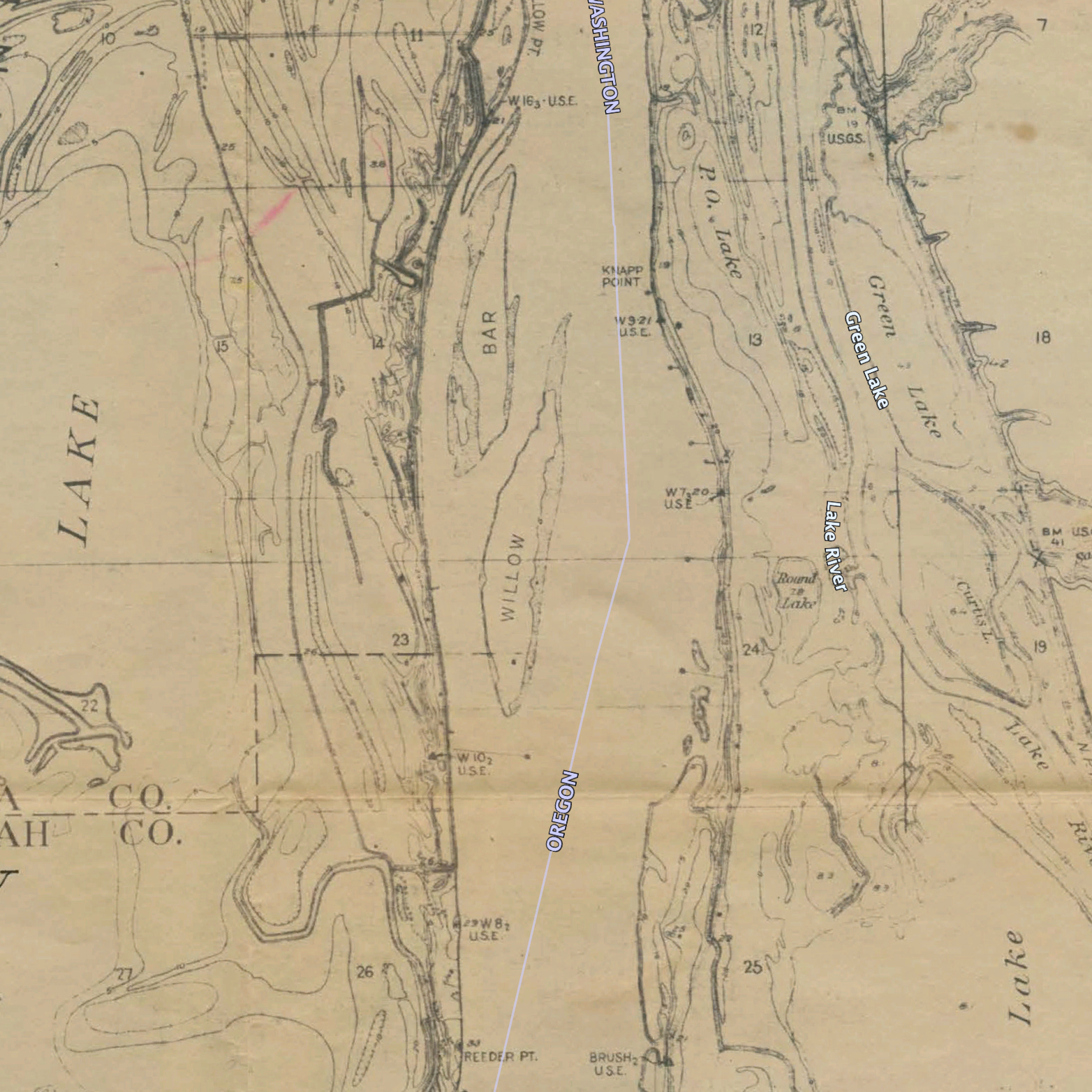
Our five-part experience on the Columbia resumes on the shoreline. We are still on Sauvie Island, walking along the beach of a wooded peninsula called Willow Bar Beach. It’s a cool late October morning. The wave action is the wake of small, medium and large ocean-going ships, their lumbering mechanical sounds out of earshot on the far side of the river where the channel runs deep. The wildlife is distant so there is more room for my musical score. Consequently, almost the whole way through there are synthesizer drones that just kind of glow and oscillate slowly like embers in a fire, like the rising and falling of the water, the breaking and ebbing waves. The soundscape in our soundwalk is edited to effect a pre-industrial, quieter time. I’m very curious about that long-gone history, those old ways.A Culture Nearly Washed AwayLast time I wrote about how Sauvie Island was once a cradle of indiginous civilization, perhaps more densely populated than any other Native American site on the continent. Archeologists speculate that the Portland Basin could have once been the home of 30-40,000 Native Americans in the 1700’s. When Lewis and Clark came back up the river in 1806 they estimated the Sauvie Island population of some 2400 persons and described Multnomah as the “remains of a large nation”. This was over decade after the introduction of small pox to the region from the first white traders on the west coast. Within 30 years the island was almost entirely depopulated following waves of malaria. Nevertheless the Chinookan culture survived, and though their tribe is not federally recognized, the diaspora are alive and well with tribe members living in Bay Center, Chinook and Ilwaco in Washington state, and Astoria and Grande Ronde in Oregon, among other places.Willow Bar has only recently joined the mass of Sauvie Island. It was an island group in in the early 1900’s Clan-nah-quah was the name given to a village on the south end of the channel separating Willow Bar, about a mile north of Multnomah (máɬnumax̣), the largest village on Sauvie Island.In their “Estimate of the Western Indians”, Lewis and Clark observed: “Mult-no-mah Tribe reside on Wap-pa-tow Island [Sauvie Island] in the mouth of the Multnomah [Willamette River], the remains of a large nation, 6 houses, probable number of souls, 800. Clan-nah-quah’s tribe of Multnomah’s on Wappato Island below the Multnomars, 4 houses, probable number of souls, 130.” The Clan-nah-quah site is now nearly all washed away, only a bank of broken camp rock on the river shore marks the place. Stone Age of The Columbia (1959)Camp rock, AKA fire-cracked rock, FCR, fire-affected rock, or FAR, is not conspicuous to most folks. It looks like ordinary rock to me. Archeologists spot it on many a Columbia River shoreline as a vestigial reminder of native peoples’ inhabitation. These cracked stones and fragments are the result of years of being heated in a fire by humans for cooking and providing a longer lasting heat source. Maps seem to suggest accretion along the shoreline, not erosion, The lumpy sandy landscape near Willow Bar suggests the channel was plugged with dredge spoils sometime in the last 50 years. [Around 1960, actually.] I’m no archeologist but I’m curious to know more. I read a 2021 doctoral student’s 300 page thesis project regarding Sauvie Islands’ western shore, wherein the author discovered 8 unrecorded archeological sites, 3 of which were determined to have “high archeological value”. I think it’s probably important to clarify here that high archeological value means in a nutshell is that the site may contain a multi-decade, or even multi-century refuse pile called a midden. When excavated carefully, a midden can tell a layer-by-layer story of the human habitation. It does not in all likelihood mean that there is a beautiful stone sculpture slumbering away in the soil. Still, Sauvie’s Island has a record of artifact discovery that conjures the imagination. The Portland Art Museum mounted a show in 1952 entitled Prehistoric Stone Sculpture of the Pacific Northwest. More recently, in 2005, an even bigger collection was assembled for the People of The River exhibition. (The show produced a sizable book.) It’s more or less a once in a generation event to see these sculptures in one room. Hence, the story of the Native American artists of Sauvie Island, and more generally the Chinookan tribes of the Lower Columbia is not well known.Of course, in piecing together the story, it doesn’t help that early settlers and relic hunters plundered sites, hoarding and selling artifacts to private collectors before laws prohibited such activity on public lands. Assembling enough pieces from institutional and private collections to mount an exhibition is a daunting task.An interesting story, which reads like lore, comes from amateur archeologist Emory Strong:There is an interesting and well authenticated story about one of the collections made on Sauvies Island. One of the early settlers built his home on the deserted site of one of the larger villages. In clearing the land numerous artifacts were found, and the wash from passing steam-boats and the yearly flood eroded more from the banks.This man picked up and saved the best of them and eventually accumulated a large collection of exceptionally fine stone and bone carvings and chipped pieces. Growing old and not wanting his collection to become dispersed, and as there was then no local museum to donate it to, he buried it in one of his fields. There it yet lies, the best single private collection of Indian work in the west. Some day it may again erode from the bank. Stone Age of The Columbia (1959)Hmm. Not sure how much stock to put into that. On a somewhat related note, though, just a couple days ago I saw this stone bowl on display at the Grande Ronde Chachalu Museum and Cultural Center:There were several very old baskets and woven pieces, three small possibly pre-contact carvings on display, but this was the only larger stone sculpture piece on display. I asked the woman at the front desk about it. She said it was found at a dump. Huh? She didn’t have any other details to offer. But as I thought more about it, there was a village site on the Columbia Slough near the old St. Johns Landfill in north Portland (now capped with a prairie habitat). Could that be the dump in this story? Or perhaps it was a variation on the old an it fell off the back of a truck line accompanying repatriation of an illegally collected relic? A mystery… This is a public episode. If you'd like to discuss this with other subscribers or get access to bonus episodes, visit chadcrouch.substack.com/subscribe
NOW PLAYING
Willow Bar Beach Soundwalk
No transcript for this episode yet
Similar Episodes
Mar 27, 2026 ·46m
Nov 28, 2025 ·25m
Nov 28, 2025 ·20m
Nov 28, 2025 ·23m
Nov 28, 2025 ·22m
Sep 9, 2025 ·28m