
EPISODE · May 28, 2026 · 38 MIN
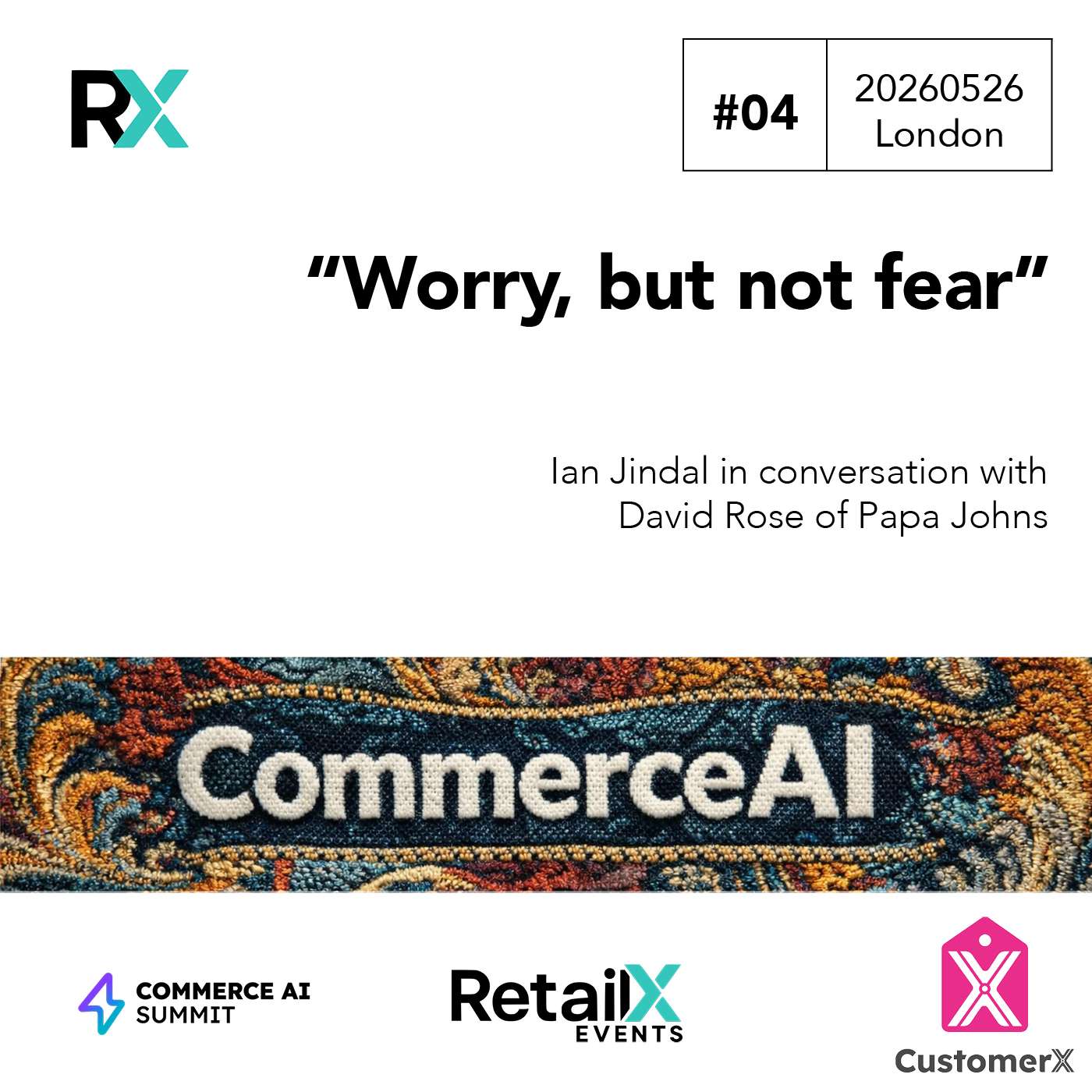
"Worry, but not fear": in conversation with David Rose, Papa Johns
from CommerceAI · host Ian Jindal
For commercial and technology leaders trying to move fast with AI without breaking things that cannot be broken, this episode offers a tested playbook rather than aspirations. David Rose arrived at Papa Johns from a marketing career spanning Virgin Atlantic, Starbucks and the NHS, retrained himself on AI through deliberate study, and now leads both international technology and the company's group-wide AI programme across 6,000 stores in 50 markets. The conversation covers governance design, building internal AI capability from existing talent, and why AI literacy is not just an HR box but a social obligation -- all grounded in what actually happened over two years of experimentation, failure and recovery.Key themesThe challenger brand advantage. Papa Johns is large enough to have genuine enterprise constraints but not so large that it cannot move. David argues challenger brands earn a little more licence from customers and boards to take risks and iterate, which creates a structural opening for AI adoption that market leaders often lack.Poacher turned gamekeeper. David's first two years at Papa Johns involved launching pilots without adequate governance, creating problems his CTO then asked him to fix. The resulting four stage-gate process -- intake, pilot approval, pilot evaluation, production sign-off -- sits upstream of standard processes and was deliberately built fast and light so it enables rather than obstructs innovation.Three pillars, in order. David's framework for AI transformation in any enterprise: governance first, then a structured innovation programme aligned to actual strategy (not just interesting pilots), then AI literacy for the whole organisation. He is candid that early pilots pulled the best talent off-strategy and frustrated executives.AI literacy as a social imperative. Beyond internal training, David frames AI literacy as a genuine social responsibility for businesses. He distinguishes worry from fear: worry prompts planning, fear prompts paralysis. He believes boards and investors now expect companies to prepare their workforces, and that this obligation extends to both current employees and new entrants.Surfacing hidden talent. PJX, Papa Johns informal internal AI community, exists to give permission to people who are already experimenting on the side but feel exposed doing so openly. The cultural insight: talent is there, it just needs a safe space and a signal from leadership that curiosity is valued.Nobody has done this before. David's consistent refrain is that AI is the first technology shift where no one has a twenty-year head start. That democratises learning and creates the unusual situation where a diligent self-taught practitioner can genuinely be at the front line alongside specialists.⠀What you'll learnHow to construct a lightweight four stage-gate AI governance process that enables rather than blocks experimentation.Why aligning pilots to existing strategy before chasing interesting technology is the difference between progress and wasted executive goodwill.How to surface the AI talent already inside your organisation before hiring externally.What a two-year arc from early chaos to structured internal capability actually looks like in a large QSR business.Why the worry/fear distinction matters when communicating about AI disruption to boards, teams, and new workforce entrants.How a commercial and marketing background -- with no deep technical formation -- can be a genuine asset in leading AI transformation at scale.⠀Chapter structure~00:00 Introductions: David Rose and Papa Johns -- 6,000 stores, 50 markets, Kentucky origins~02:00 Menu consistency vs local innovation: croissant pizza, sourdough, deep-fried prawn~04:00 Consistency and innovation as parallel disciplines, not opposites~07:00 Papa Johns as an e-commerce brand: 80% of revenue through digital channels~08:00 Career arc: British Army, Virgin Atlantic, Starbucks AMEA, NHS blood donation, Papa Johns~12:00 The cartilage between the customer and the infrastructure -- David's self-described superpower~14:00 From marketing to technology: product thinking as the bridge; the Oxford AI course~17:00 "Nobody's done this before" -- the democratisation of AI learning~19:00 Balancing pace and governance: the classic enterprise tension~21:00 The three pillars: governance, structured innovation, AI literacy~24:00 The poacher-to-gamekeeper story: early fires, CTO intervention, AI committee~27:00 Pilot design: customer-facing, internal operations, personal tools~29:00 Building internal AI capability: data science roots, PJX community, external vendors as primers~32:00 Voice AI ordering product launched in the US via Google Cloud~33:00 Junior talent, the social worry, and the case for AI academies~37:00 Closing: worry encourages planning; fear does not⠀About the guestDavid Rose is VP of International Technology at Papa Johns, overseeing technology across approximately 2,500 stores in 50 international markets, and programme director for the company's group-wide AI initiatives. His background is in B2C commercial and marketing leadership -- a decade at Virgin Atlantic, regional roles at Starbucks, and a period leading digital transformation at NHS Blood and Transplant -- before pivoting deliberately into technology and AI. He retrained through an executive AI programme at Oxford Saïd Business School and now leads Papa Johns applied AI team, governance framework, and internal AI literacy programme.Quotes"My superpower is being able to influence change at scale.""Nobody's done this before. I have no mentor to learn from. That's a fantastic place to be if you're looking to advance your career." "I turned poacher to gamekeeper. I'd created more problems than I solved, and my CTO asked me to build something that controlled this a little better." "Worry is good. Worry encourages planning, encourages thinking. Fear does not." "Often people are reticent to be the AI guy or girl. PJX just gives them a safe space to raise their hand."
Embed this episode
NOW PLAYING
"Worry, but not fear": in conversation with David Rose, Papa Johns
No transcript for this episode yet
Similar Episodes
No similar episodes found.
Similar Podcasts
No similar podcasts found.