
EPISODE · Jun 16, 2026 · 14 MIN
XRPL — The Separation of State and Compute
from Janus Dispatch Podcast · host Janus The Watcher
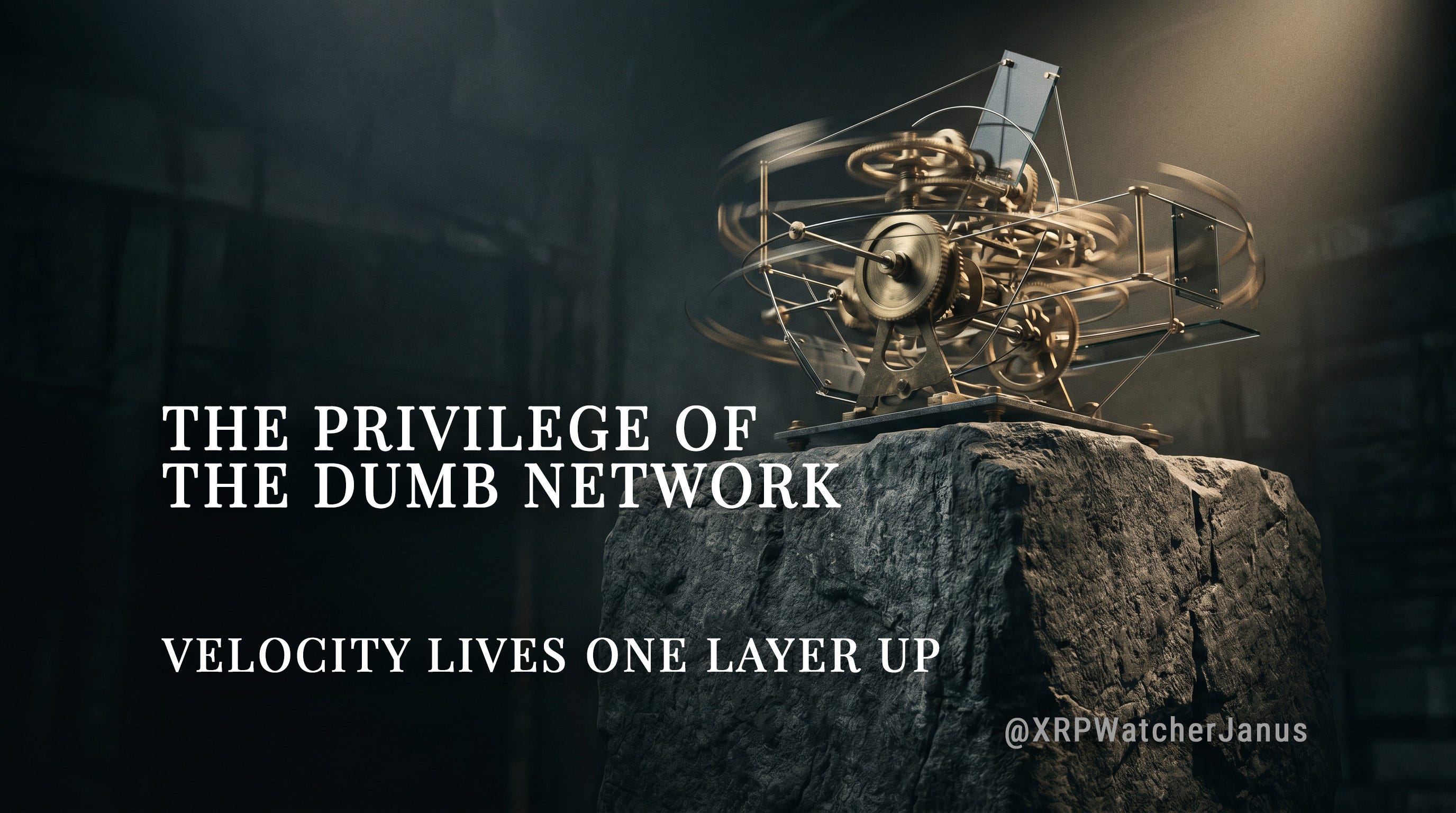
The charge arrives on schedule. Publish anything arguing that the XRP Ledger matters, and within hours a reply lands: it is a ghost chain, ossified and frozen, therefore dead. The critique reads rigidity as a verdict. It is the most misread property in the asset class.Here is what the verdict steps over. On 30 June 2025 the XRPL EVM Sidechain went live on mainnet, bridged to the main ledger through Axelar, running Ethereum smart contracts with XRP as its gas token. Programmability did not land on the base layer. It landed next to it, by design. The people who call the ledger frozen are describing the foundation and ignoring the building that already sits on top of it.That gap between what the base does and what the layers above it do is not an accident of an old chain that forgot to upgrade. It is an architecture. Once you see it, the ossification attack inverts: the thing they call a tombstone is the load-bearing wall.The Dumb NetworkStart with the assumption the attack smuggles in. Ethereum and Solana fuse two functions on a single layer: settlement, which is the transfer of ownership, and computation, which is the logic that decides what happens next. One ledger does both. The appeal is obvious. The cost is structural. Make a base layer fast and expressive enough to run arbitrary logic, and you have made it complex enough to attack and volatile enough to fork.A settlement layer has the opposite job. It is the place where a transfer becomes final and where finality has to survive contact with adversaries who would profit from reversing it. For that role, two properties that sound like insults are actually the specification. The base must be dumb, so its surface offers nothing to exploit. It must be slow to change, so that what cleared today still means the same thing in a decade. Precisely because of those two, it can be strong.This is where the XRPL’s amendment process stops looking like paralysis. A rule change needs more than 80% validator support sustained for two weeks before it becomes permanent. That threshold is not a bug report waiting to be fixed. It is a guarantee that the foundation has the same shape tomorrow as it does today, which is the precondition a central bank requires before it will build anything on a rail it does not own.The corrective to the attack is therefore not to deny the ledger is rigid. It is to refuse the premise that rigidity is a defect. Speed at the settlement layer is a bug. Turing-complete programmability at the base is an attack vector. The distinction the critics miss is between bounded and unbounded computation. The XRPL permits only hard-bounded native primitives that can never stall consensus or run forever: the on-chain DEX, the AMM, escrow, issued tokens, and the deliberately constrained Hooks model. What it refuses on Layer 1 is the unbounded, arbitrary computation that defines the EVM and Solana. That heavier logic is pushed to a separate layer entirely. Saying the ledger „has no smart contracts“ is simply wrong; the accurate and stronger reading is that unbounded compute is held off the consensus base on purpose.Asymmetric VelocityThe base can afford its inertia only because it does not have to be agile. It exports agility to a layer that runs on a different clock. Two clocks, one system.On the slow clock sits final clearing: settled ownership and sovereign state, moving in years. On the fast clock sits conditional logic: smart contracts, oracle feeds, execution and liquidity, moving in milliseconds. The mistake the monolith makes is forcing both onto the same clock and then wondering why the thing is either too slow to be expressive or too expressive to be safe.None of this is exotic. It is the shape of the existing monetary system. Central-bank money is final and deliberately unintelligent; the commercial-bank and payment layer stacked on top of it is fast and disposable. Nobody runs retail card authorizations through the central bank’s settlement core, and nobody clears interbank finality on a payment app. The crypto version is the same division of labor: settlement underneath, execution above. The argument is settlement versus execution, not chain A versus chain B.Which is why unbounded compute here is a category, not a brand. The orthogonal layer can be native to the ecosystem, like the XRPL’s own EVM sidechain reached through Axelar, or fully external, like a separate cross-chain network such as Flare, whose FAssets system mints FXRP, a one-to-one representation of XRP usable in EVM DeFi while, in Flare’s own documentation, treating „XRPL as the native asset and settlement layer.“ Flare is one worked example of the category. It is not the point. The point is that the category exists by design, and the base stays dumb so the category can stay fast.Skin in the Game, at the Protocol LevelThe parent essay argued that the XRPL pays its validators nothing on purpose, and that the absence of reward is a filter rather than a flaw: it screens out actors who want to be paid and selects for actors who need the ledger to keep working. That filter was applied to institutions. Apply it now to protocols.Ask the question directly. Why would a compute layer pay the real cost of running an XRPL validator when there is no block reward on the other side? There is exactly one thing on offer that money cannot buy elsewhere: a share of the 20% that can block an amendment. Nothing else.Consider what is at stake for such a layer. Flare’s FXRP rests, per Flare’s documentation, on the XRPL as native asset and settlement layer, and the Flare Data Connector exists to verify XRPL events for Flare’s own state. An amendment that altered cryptographic primitives or transaction and message formats could strand that observation and break the bridges that depend on it. A layer in that position does not run a validator for diplomatic prestige. It runs one so it can stand inside the 20% and stop precisely the change that would cut its own legs out. The veto is insurance on its own infrastructure.That is the filter doing its work. No reward means no speculators bother. What remains are actors whose own systems collapse if the base moves wrong, which is exactly who you want holding a blocking stake. Skin in the game is not a slogan here. It is the entry condition.The Ticket Is Not the Balance SheetThere is an obvious wrong answer, and it has to be killed before it spreads. The wrong answer says: show your XRP reserve, and your stake buys you a vote. That is proof-of-stake wearing a different hat, and it dies twice over.It dies once as plutocracy. If the veto is priced in tokens, the veto is for sale, and a single large holder buys five seats and then the room. It dies again as a sovereignty conflict. No Western central bank is going to park billions of dollars of volatile retail XRP on its balance sheet in order to earn standing on a ledger; it will walk to a permissioned venue like Canton instead. The architectural achievement of the XRPL is that it decouples capital from governance. Re-coupling them through a stake requirement throws that achievement away.The right filter measures something money cannot fake: verifiable operational exposure, or systemic fall-height. The question is not how much you hold. It is how much of your own infrastructure collapses if this system breaks. The closest institutional analogue is the Security Council. The permanent five did not purchase their veto. They received it because the postwar order could not have held without their mass, and a veto that ignored them would have been ignored in turn. Standing followed exposure, not the other way around.This is also where the most popular adoption story quietly fails. An exchange-traded fund that only holds XRP carries zero fall-height. The risk sits with the buyer, ring-fenced in the fund. The issuer is a supermarket collecting a management fee, and the vehicle is pure passthrough: nothing of the network depends on its survival. Holding is not adoption, and adoption is not a seat. The real measure of institutional commitment is not assets parked in a wrapper. It is the count of institutions willing to run a validator, which today is close to zero. That number, not the ETF approval, is the seating chart.The Tenth Man, and the Kill SwitchRun the design forward and an uncomfortable failure mode appears. Suppose the roughly 35 seats on the default list were ranked purely by absolute dollar fall-height. Within five years the list converges on the largest balance sheets on earth: a wall of American banks and American tech, with the rest of the world priced out. That is not a neutral settlement layer. That is Canton with extra steps. A challenger cannot simply fork its way out, because a fork inherits the code but not the liquidity. What it can do is worse: the moment the PBoC or the EU concludes the room is captured, they exit, and the dream of a single neutral settlement layer shatters back into fragmented, regional walled gardens.There is a fix for that, built on exposure measured within categories rather than across them, plus geopolitical balance. It is real, and it does not belong in this essay. Spelling out how the list should be curated turns a diagnostician into a charter author and invites the only question that ends the project: who are you to design the United Nations? The discipline here is to name the failure mode and stop at the edge of prescription.State the conditions under which this whole argument is wrong, with dates attached. If a single monolithic, programmable, fast-settlement chain captures sovereign wholesale settlement at scale, central-bank money clearing on the monolith itself without a separate slow base underneath it, then the claim that settlement and compute must be separated is falsified. Retail volume routed through a fast chain does not count; that is the execution layer doing its job. And if, by the end of 2028, not one compute layer with deep operational exposure has taken a seat on the default list, then the mechanism this essay rests on — that exposure pulls you to the table — has failed in practice, whatever the theory says.Until one of those happens, the ossification verdict has the architecture backwards. The base is not dead because it cannot change. It is trusted because it will not. Velocity was never supposed to live there. It lives one layer up, on compute that earns its seat at the base by having the most to lose if the base ever moves.— J.Disclaimer: Janus The Watcher tracks liquidity flows beyond nation-state and tokenomics marketing. Not financial advice. Do your own research. Positions disclosed: I hold XRP & FLR.Janus runs 1:1 Confrontation — sixty minutes, one decision, no follow-up. For people who carry responsibility and want their thinking taken apart before it costs them.janusthewatcher.substack.com/p/11-confrontationOne sentence is enough. This is a public episode. If you would like to discuss this with other subscribers or get access to bonus episodes, visit janusthewatcher.substack.com
NOW PLAYING
XRPL — The Separation of State and Compute
No transcript for this episode yet
Similar Episodes
No similar episodes found.
Similar Podcasts
No similar podcasts found.