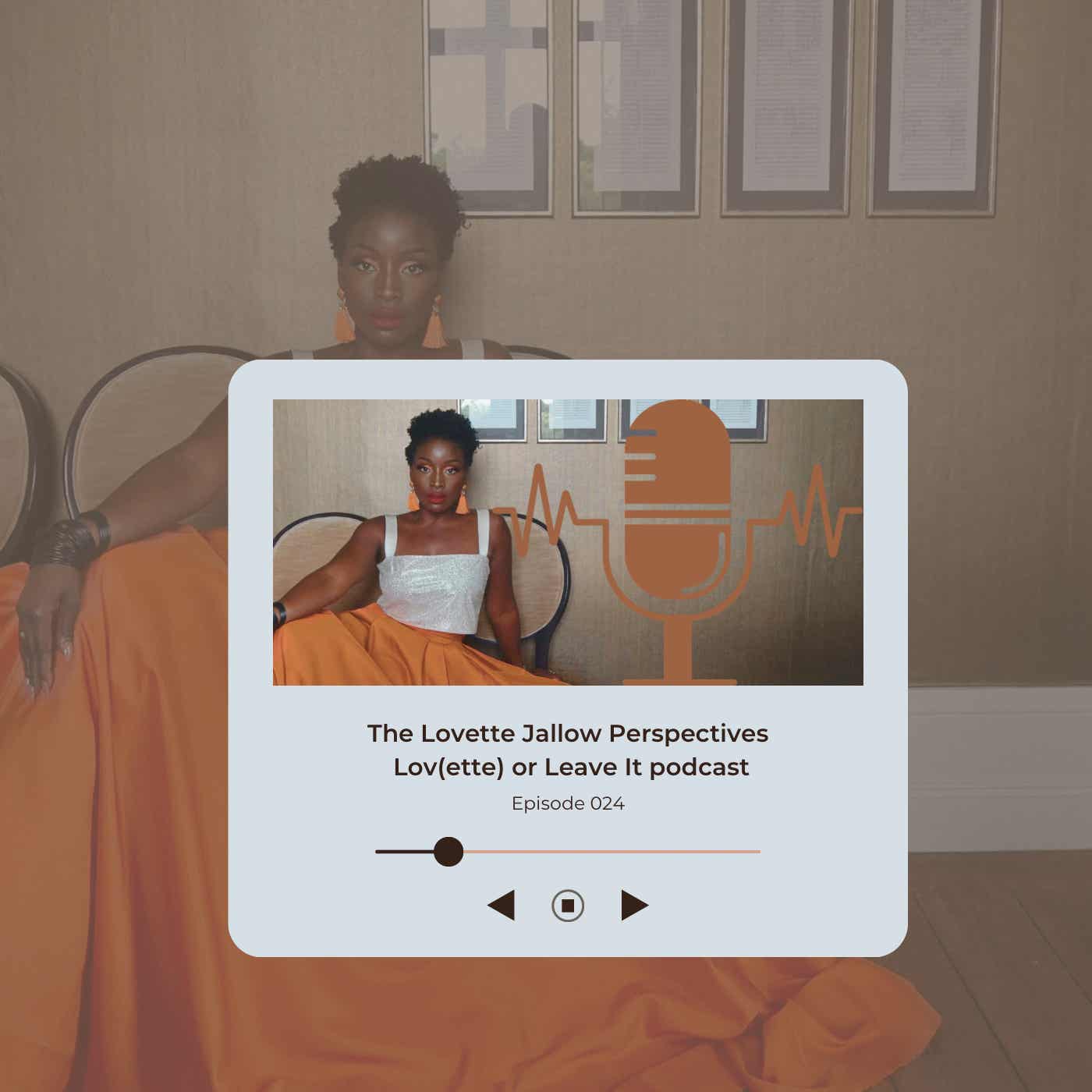
🎙️ Lov(ette) or Leave It podcast artwork

PODCAST · society

🎙️ Lov(ette) or Leave It

The Lovette Jallow Perspective aka Lov(ette) or Leave It is a podcast that challenges societal norms and digs into the realities of neurodivergence, racial identity, and systemic bias in Sweden and beyond. Hosted by award-winning DEI speaker and neurodiversity consultant Lovette Jallow, each episode offers authentic insights from lived experience, tackling workplace inclusion, intersectionality, and the challenges faced by neurodivergent individuals in a world built for neurotypicals. Bold truths, real conversations, and actionable change—this is the space where no topic is off-limits. lovettejallow.substack.com

  1. 33

    Call-Out Culture Has a Place, Most People Just Don’t Know Where

    What do people actually mean when they say “call-out culture”?“The phrase itself is rarely neutral. It carries a judgement about how people are using critique, who is being centred, and whether the reaction is proportionate to the harm.”© Lovette Jallow. All rights reserved.No part of this publication may be reproduced, excerpted, paraphrased, or used in academic, commercial, institutional, or derivative work, including AI training, without explicit written permission. Contact [email protected] for permissions.I watched it happen at a community gathering years ago. A young activist stood up and publicly berated another member for something that had gone unaddressed for weeks. People snapped in approval. The clip went online that evening and by the next morning it was being shared as a bold moment of accountability. Behind the scenes, nothing was resolved. The person who was called out left entirely. The harm that triggered the confrontation went unaddressed. The community was more fractured than before.When someone says “call-out culture,” they are usually trying to name a pattern where public confrontation has replaced the slower, often quieter work of organising. The phrase carries weight. It is a judgement about how people are using critique, who is being centred in the response, and whether the reaction is proportionate to the actual harm.The Lovette Jallow Perspective is a reader-supported publication. To receive new posts and support my work, consider becoming a free or paid subscriber.Underneath the surface, most people using this phrase are naming several things at once. They are naming exhaustion with performance-based politics, where the volume of a reaction is treated as evidence of commitment. They are pointing out that people mistake visibility for power, that a call-out can create noise but noise is not structure and does not shift conditions. They are describing how individual punishment has replaced collective accountability, how call-outs tend to isolate one person and turn them into the entire problem while the system that produced the behaviour stays intact.People who have done real movement work, across years, across countries, through logistics and legal research and fundraising and conflict mediation, can see the difference immediately. A viral reprimand is not sustained advocacy. A trending clip is not governance. But for many people online, these look identical because both use a moral voice and both generate attention.That collapse is the problem. And it did not happen by accident.Why do most people confuse call-outs with activism?“People mistake the adrenaline rush of a viral call-out for the discipline of movement building.”The confusion is architectural. Social media platforms are built to reward content that generates strong emotional responses. A 2024 study published in the Proceedings of the National Academy of Sciences found that ranking algorithms on major platforms amplify emotionally charged and partisan content beyond what users themselves would choose to engage with. The platforms do not reward nuance, follow-through, or strategic thinking. They reward speed, indignation, and the appearance of moral clarity.This design produces a specific distortion. Online, critique looks like activism because both use moral language. Both generate attention. Both attract followers. The difference is in method. One is reactive and feeds on the cycle of outrage. The other is strategic and requires patience, planning, facilitation, and the willingness to do unglamorous work over long timelines.The Lovette Jallow Perspective is a reader-supported publication. Free subscribers get every essay. Paid subscribers keep them coming..Most digital participants never access training in political literacy, movement analysis, or transformative justice. They have no framework for distinguishing between catharsis and strategy, between a personal reaction and a political intervention. Platforms collapse that distinction by design, because the algorithm does not care which one it is. It cares about engagement.The numbers make this visible. A Verywell Mind analysis found that one campaign with 6.4 million online engagements yielded only 30 physical donations. The low commitment required to signal support online encourages people to appear engaged while avoiding the actual labour of organising. Posting, sharing, commenting, and calling out all register as action. They feel like contribution. But contribution requires something platforms are not designed to host: sustained presence, material support, and accountability over time.This is not a moral failing of individuals. It is a design outcome. The architecture of these platforms trains users to believe that reaction is the same as response, that volume is the same as power, and that being loud is the same as being effective. When you understand this, the confusion between call-outs and activism stops being surprising. It becomes predictable.A note for anyone reading this as permission to avoid being called out: it is not. My essay argues that call-outs are a strategic tool. If someone is using that tool on you, the question is not whether they used it politely enough. The question is what you did. People keep trying to soften harm by rephrasing it, as if the clarity is the problem. It is not. The behaviour is. I am precise for a reason, and borrowing my language to sidestep accountability will not change what happened.When does public shaming actually work as a strategic tool?“I will never tell marginalised people to keep quiet about harm. But I will ask: what is your plan for after the call-out?”This is where I break from the popular take. The standard position, especially among people who have been burned by online pile-ons, is that call-out culture is inherently toxic. I do not agree. Public shaming has a strategic function. It is a tool. The problem is that most people are using it without training, without context, and without any plan for what comes after.Public exposure works when private routes have failed. When harm is ongoing and internal channels have been exhausted. When gatekeeping protects perpetrators and silence enables further damage. I have named names publicly when I had no other option left, when staying quiet would have meant allowing fraud, exploitation, or abuse to continue unchecked. I do not regret those decisions. They were strategic. They were necessary. They were the last step in a longer process, not the first.The distinction matters. A call-out that follows months of private intervention, documentation, and failed mediation is a strategic tool. A call-out that replaces all of that, that skips straight to public denunciation because it is faster and more satisfying, is something else entirely. It is punishment without process. And punishment without process reproduces the very systems activists claim to oppose.Asam Ahmad wrote in Briarpatch that call-out culture “mirrors what the prison industrial complex teaches us about crime and punishment: to banish and dispose of individuals rather than to engage with complicated stories and histories.” Youth OUTright made a similar observation: public shaming shuns and exiles people without a path to repair, replicating the logic of jails and prisons. When communities adopt call-outs as their primary accountability mechanism, they adopt carceral methods. Banish and dispose. The target disappears, the crowd moves on, and the conditions that produced the harm stay exactly as they were.The question I ask when I see a public call-out is simple: what happens next? If there is no next step, no plan to repair, no council of peers weighing consequences, no path for either remediation or rightful removal, then it was not accountability. It was performance. And performance, however satisfying in the moment, does not keep anyone safe.How do you build accountability that survives without an audience?“Visibility before stability destroys movements. I only share my work once it is finished.”Real community organising cannot survive unfiltered access. It requires confidentiality, boundaries, and protective structures. Activist support guides are explicit about this: “confidentiality is very necessary for building trust.” Sensitive matters discussed within a group should not be discussed with anyone outside it. Without that principle, vulnerable people stop disclosing, committed workers stop investing, and the loudest voices take over regardless of their capacity or intent.After many years of organising across multiple countries, navigating state violence, managing trauma-heavy projects, and coordinating people with vastly different levels of capacity, I built my spaces with deliberate separation. Private spaces for vulnerable people. Operational spaces for those who show up consistently. Strategic rooms for decision makers. And public spaces that function as a decoy.Everyone does not get access to everything. That is not secrecy. That is governance.The people who support survivors have their rooms. The people working on the ground have theirs. Board members have theirs. Even my friends have designated circles. This structure exists because I watched what happens when it does not. When you gather everyone in one space, especially online, the result is predictable. People with no goals derail the work of those who have them. People with harmful intentions attach themselves to visible organisers because visibility gives them a stage. People who cannot regulate themselves disrupt the work of those who can.I only share completed work publicly. Early exposure invites interference from people with no context, no capacity, and no duty of care. Visibility before stability destroys movements. I learned that through experience, not theory.To even locate the branches of the baobab systems I have built, you would first have to understand them. Most people never will. That is intentional. It protects the work, the people, and the timelines.What separates people doing the work from people performing proximity to it?“Your choice to separate your spaces is not secrecy. It is governance.”The markers are not complicated. Consistency. Boundaries. The willingness to stay when the work becomes heavy and the attention has moved on. People who are serious show it through sustained presence, not through the volume of their reactions. They show it through what they build, not what they call out.It is easy to tell who is serious. The people doing the work can feel the difference immediately. The people performing proximity to the work cannot, because they have never stayed long enough to learn what the difference feels like.I do not rely on call-outs. I rely on studying how people move and removing myself, and my people, from harm. That is the practice I stand on: observe patterns, set boundaries, build your structures where they can grow, and do not waste your capacity on audiences that confuse critique with contribution.Social media is engineered for collapse, not community. These platforms reward impulsivity, emotional volatility, and public confrontation. They cannot hold long-term strategy, analysis, or care. Knowing that, I built elsewhere. The real work has always happened in rooms the public will never see. That is how it survives.More from The Lovette Jallow PerspectiveThese essays go deeper into the questions this piece opens. If you read one, start with the one that unsettles you most.Who is Lovette Jallow?Lovette Jallow is a nine-time award-winning author, keynote speaker, and inclusion strategist working across Sweden, Europe, and the MENA region. She is the founder of Action for Humanity. Read more at lovettejallow.com.Stay Connected➔ Follow Lovette Jallow for expert insights on building equitable, neurodivergent-affirming environments.🔹 Website: lovettejallow.com🔹 LinkedIn: linkedin.com/in/lovettejallow🔹 Instagram: instagram.com/lovettejallow🔹 YouTube: youtube.com/@jallowlovette🔹 Twitter/X: twitter.com/lovettejallow🔹 Bluesky: bsky.app/profile/lovettejallow.bsky.socialThe Lovette Jallow Perspective is a reader-supported publication. To receive new posts and support my work, consider becoming a free or paid subscriber. This is a public episode. If you'd like to discuss this with other subscribers or get access to bonus episodes, visit lovettejallow.substack.com/subscribe

  2. 32

    You Don't Look Disabled Is Not a Compliment

    The phrase arrives packaged as kindness. Someone looks at you, takes in what they can immediately read, and offers it back: you don’t look disabled. They think they are being kind. They think they are reassuring you.What they have actually done is tell you precisely how narrow their frame of reference is, and then handed you the bill for it.This essay is a companion to the video above. Watch it first if you haven’t. What follows is the structural argument the video opens up.Why does “you don’t look disabled” feel so wrong?Because it is not an observation. It is a conclusion drawn from a very limited dataset, stated with the confidence of someone who has no idea what they don’t know.The cognitive mechanism at work here has a name: availability heuristic. Your brain reaches for the most available image it holds of a category. For disability, in most Western cultural contexts, that image is a wheelchair. A white cane. Something external, visible, legible without context. When a person in front of you doesn’t match that image, your brain quietly files them under: not disabled.And then, crucially, some people say it out loud.The problem is not the internal sorting. Cognitive shortcuts are human. The problem is treating the absence of visible evidence as evidence of absence, and then presenting that conclusion as a compliment to the person you just misread. You are not seeing absence. You are seeing the limits of your own frame of reference.What does self-disclosure actually require from disabled people?There is a particular exhaustion that comes with being invisibly disabled, neurodivergent, or chronically ill in a world that requires you to perform your condition before it grants you credibility. Diagnosis letters. Visible symptoms. Audible pain. Something legible enough that the person across from you feels entitled to believe you.Functioning in public does not erase disability. It often reveals how much private labor has gone into surviving the interaction.When someone says you don’t look disabled, they are seeing the output of an enormous amount of effort they had no access to. The preparation before. The strategies layered over years of trial and error. The energy spent on appearing manageable, coherent, present. What they are not seeing is the cost of that functioning, or what follows it.For neurodivergent people specifically, this becomes particularly acute. Autism, ADHD, sensory processing differences, and many co-occurring conditions do not always announce themselves in ways others recognise. A person may appear calm while actively managing sensory overload. They may show up articulate, dressed, and present, then spend hours recovering from what the room experienced as ordinary.This performance requirement is not accidental. Systems that tie access to self-disclosure, whether at work, in welfare processes, in medical settings, or in social encounters, were built around the most visible, most legible, most stereotypically represented disabilities. Everyone else is processed as an edge case, a person who needs to do more to prove it.Why do systems still reward visible suffering?Accessibility is not a reward for performing distress convincingly.When support, accommodation, or basic adjustability requires a person to demonstrate their worst, most visible, most suffering version of themselves, the system is not protecting anyone. It is sorting people by how well they can perform pain to an audience that decides what counts as real.In Sweden and across the Nordic region, this contradiction sits inside a particular kind of cognitive dissonance. Rights language exists. The UN Convention on the Rights of Persons with Disabilities has been signed. Formal protections exist on paper. But the lived experience of accessing those rights still often requires a level of documentation, persistence, and performance that disproportionately excludes people whose disabilities are invisible, fluctuating, or not yet understood by the systems meant to assess them.The Convention’s own definition matters here. Disability is the interaction between a person’s condition and the barriers in their environment. That is not a threshold. It is not a visual. You cannot determine it from appearance.Why this phrase is about ableism, not awkward wordingSome people defend the comment by saying the speaker meant well.Intent matters less than impact here. The statement rests on a deeply ableist assumption: that disability should be visually obvious, externally legible, and easily verified by people with no real knowledge of the person in front of them.It also places the disabled person in an unfair position. They are expected to comfort the speaker, educate them, disclose personal information, or absorb the awkwardness of being misread. Once again, the burden shifts to the person already carrying more than the room can see.Disabled people do not owe anyone a performance of suffering in order to be believed. Accessibility should not begin only once distress becomes visible to other people.The ask is straightforward: extend dignity before evidence. Stop treating the absence of your understanding as proof of absence.The video above gets personal in ways this essay doesn’t. The essay gives the structure. The video gives the edge, the tone, and the lived weight underneath it. I recommend both.If this is landing, the full archive of essays on neurodivergence, invisible disability, structural harm, and dignity is at lovettejallow.substack.com. Over 8,000 subscribers read this work each month.For speaking, training, or consulting: [email protected] This is a public episode. If you'd like to discuss this with other subscribers or get access to bonus episodes, visit lovettejallow.substack.com/subscribe

  3. 31

    Why Mother Wounds Follow You Into Relationships Even After You Move On

    Why Do You Keep Choosing the Same Emotional Climate in Different PeopleA mother wound can follow you into adulthood and disguise itself as chemistry.There’s a specific kind of ache that shows up in adult relationships that has nothing to do with the person in front of you.It shows up when you wait for a reply longer than you should, when you accept “I’ve been busy” as a personality, when your stomach drops after a small shift in tone and you start performing for reassurance before you even realize you’ve started.You call it chemistry. You call it attachment. You call it love.Sometimes it is a mother wound wearing perfume.I used to want to be chosen in the exact places where I once felt abandoned. I wanted to be held in the places where I learned to self-soothe. I wanted consistency from people who only knew how to offer intensity. I wanted to be kept by women who felt familiar in the way old pain feels familiar. I wasn’t wrong for loving women, I was repeating a belief that love comes with struggle, silence, or survival.Now I choose love that feels safe. Love that sees me. Love that doesn’t ask me to prove I’m worthy of being kept.Here’s what frames everything that follows.I do the heavy lifting and I do the work, then I walk myself back into the kinds of situations that used to break me, because I want to see how I move now. I want to see whether my nervous system still reaches for the same harm with a prettier name. I want to see if I still mistake familiar for safe.Mother wounds are widely known and rarely spoken about with honesty. People speak about them in soundbites, then avoid the practical parts, the parts that show up in your friendships, your workplaces, your partnerships, and your body.Most people don’t ask why they keep getting drawn to certain dynamics. They blame the individual person and miss the pattern. They miss the repetition. They miss the fact that your home of origin often becomes your template for love, even when you swear you’ve outgrown it.I dedicate this essay to my friend and bosom buddy Nat. for proof reading and sharing her thoughts with me on my writing. Thank you for being a friend.Why Do We Recreate Our Family Dynamics in Friendships and RelationshipsYour home of origin often becomes your template for love, even when you swear you’ve outgrown it.If you’ve read my essay about estrangement from my mother, you already know I take patterns seriously. Estrangement forced me to look at my life without the fog of obligation. Distance gave me the ability to see the dynamic objectively.When I looked at my friendships, I realized something I did not want to admit. I had recreated parts of my mother dynamic in my social life, especially with people who needed me, people who made me responsible for fixing the atmosphere, and people who stayed vague until vagueness turned into cruelty.The pattern kept repeating because I was skilled at surviving it. That skill looked like loyalty. It looked like patience. It looked like maturity. In reality, it was training.When a nervous system learns early that love comes with uncertainty, it becomes good at uncertainty. It becomes fluent in mixed signals. It becomes talented at filling in gaps. It becomes excellent at staying.That’s why adverse childhood experiences matter as a framework, not as a label. The CDC describes how adverse childhood experiences can have long-term negative impacts on health and wellbeing, and many studies describe a dose-response pattern where higher exposure tends to correlate with higher risk of later difficulties.That doesn’t mean your life reduces to a score. It means your body remembers what your mind tries to override.How Does a Mother Wound Shape What We Tolerate?If care came with strings attached, adult love can start feeling like something you have to earn.People flatten “mother wound” into a trendy phrase. I’m interested in patterns, behaviors, and the long shadow of early conditioning.A mother wound forms when the first relationship that teaches you about love also teaches you about emotional absence, inconsistency, punishment for needs, or intimacy that comes with fear.Sometimes the mother is cruel. Sometimes she is overwhelmed and unsupported. Sometimes she is neurodivergent and undiagnosed, surviving with shame and control because nobody taught her regulation. Sometimes she is loving and still emotionally unavailable in the specific ways you needed.The outcome can look similar. You grow up fluent in self-abandonment.Sometimes a mother like that believes care equals love, because food, shelter, clothes and the basics are provided, and in her mind that settles the question. bell hooks wrote about this confusion, where “care” becomes the substitute definition of love.The problem is that this care rarely comes with no strings attached. It can come with expectations to be grateful for the bare minimum, and the reminder that even the basics can be withdrawn if you make the wrong move.So adulthood can feel confusing. You start asking yourself what love is and what care is, because those definitions were blurred early, and you were trained to accept crumbs as proof. Then someone shows you care and you assume it must be love, because your body learned early that love is conditional and small.Once you’re fluent in that kind of conditional love, you can build whole adult relationships on top of it. You can create a life that requires you to keep earning what should be given freely.Why Do Neurodivergent Girls Learn Self-Soothing Early?Neurodivergent women often learn early that belonging is conditional, and that the cost of being loved is being easier to live with.You learn that honesty gets punished as “too much,” silence gets interpreted as “cold,” dysregulation gets framed as “dramatic,” and clarity gets treated as “intense.” So you start adjusting yourself in real time. You mask. You soften. You perform. You translate yourself into something easier to keep.That early training shows up later as overexplaining, overgiving, and overfunctioning. It can also show up as a specific kind of relational self-harm, where you stay inside dynamics that keep misreading you because you still believe being understood is something you earn through perfect communication.This is why some neurodivergent women stay too long. They keep searching for the sentence that will finally make the other person get it, and they keep mistaking effort for evidence. The hard truth is that the right sentence can’t create emotional capacity where it does not exist.If you are autistic or ADHD, home can become a sensory and emotional battlefield, even in families that believe they are loving. Neurodivergent children get punished for nervous system realities: overwhelm, blunt honesty, needing quiet, needing predictability, struggling with transitions, melting down after masking. When those needs meet a parent who is rigid, ashamed, or dysregulated, the child learns a brutal lesson that follows them into adulthood, my needs cause conflict, therefore my needs are dangerous.In mother-daughter dynamics, that lesson becomes a life script. You become “easy,” you become helpful, you become the emotional stabilizer, you absorb blame, you shrink to keep peace, and you learn that being convenient is safer than being fully seen.Later, you repeat it in adult spaces that reward the same performance. The pattern also follows you into relationships, especially if you grew up managing a dysregulated parent. Adult love can start feeling like another atmosphere you have to regulate, another person you have to interpret, another bond you have to keep stable through your own labor. Your nervous system recognizes the assignment and starts working before you consent.How Do Mother Wounds Shape Love Between Women in Queer RelationshipsLoving women can feel like relief and threat in the same breath, because the first woman who hurt you may have been your mother.Queer women often end up doing relational work in public that straight people get to keep private, and the stakes multiply once race, religion, disability, and cultural expectation enter the room.So loving women can carry two realities at the same time. It can feel like relief because you are finally with someone who understands your inner world without you translating every sentence. It can also feel like threat because women can become the stage where your earliest female pain replays, especially if your first experience of womanhood and care came with inconsistency, control, or emotional absence.If you grew up craving tenderness from a mother who couldn’t offer it, you can find yourself reaching for maternal repair inside partnership without even meaning to. You are not searching for a mother, you are searching for regulation, softness, steadiness, and the kind of staying that doesn’t require you to earn it.The danger shows up when “someone to stay” quietly turns into “someone to convince.” That shift is where struggle starts feeling like depth, instability starts feeling like chemistry, and pain starts getting recast as proof that the bond is real. A mother wound can turn your nervous system into a proof-of-love machine, where you keep offering more patience, more clarity, more understanding, because a part of you still believes that if you can make this work you will finally be chosen in the place you were once left.How Do Mother Wounds Show Up at WorkWorkplaces celebrate the ‘work mom’ until the boundaries blur and extraction becomes normal.This is where a lot of women get trapped, especially neurodivergent women who learned early that stability comes from being useful.Workplaces love a woman who quietly becomes everyone’s emotional support system. She becomes the “work mom,” the one who smooths tension, manages feelings, remembers deadlines, holds the social glue, and absorbs chaos so the system can keep pretending it functions.It usually starts with flattery, then the boundaries blur, then the extraction becomes the norm. Neurodivergents forget that in order to have superpowers someone must also ensure the kryptonite is far from them. Neurodivergent competence has conditions, clear scope, recovery time, and support. Without that, ‘strength’ becomes a way the system justifies using youThe cruelty is often subtle, which is why it lasts. Vague feedback that keeps you guessing. Moving goalposts that make you work harder for the same recognition. Ambiguous communication with plausible deniability. The same emotional weather you learned to survive at home, repackaged as professionalism.If your earliest love was inconsistent, this dynamic can feel familiar. Familiarity makes people stay longer than they should, especially when their nervous system confuses endurance with loyalty and overfunctioning with care.Why Do We Curate Other People’s GoodnessI curated their goodness in public while my body carried the cost in private.When I looked at my partnerships, I saw another pattern that embarrassed me, because it wasn’t just about who I chose. It was about what I edited out in order to stay.I picked people who were outwardly likeable, and sometimes charming enough that I started doing reputation management for them. I built their external persona the same way I used to do it with my mother.Every Mother’s Day, every birthday, I painted the picture of the most self-sacrificing mother, the best mother you could have, while the private reality looked completely different. I protected the image because I needed something to point to, something that could justify the ache, something that could make the story feel coherent.Then I repeated the same pattern with partners.I would take the smallest decent thing they did and curate it into proof of their goodness. I made the story prettier than the lived experience. I made sure other people saw them as caring, safe, admirable, “trying their best,” even when kindness was inconsistent and respect was negotiable.And here’s what makes this pattern dangerous.While I was curating the best version of them, they were often willing to let my true self and image take the hit. They would preserve their own persona by flattening me into the difficult one, the demanding one, the sensitive one, the one who “misunderstood.” They could ruin my credibility to protect their narrative, because the relationship was never about mutual care. It was about maintaining who they wished they were, and having me do the labor of keeping that illusion intact.So even when I was left holding financial heaviness, I would still protect the image. Even when my boundaries were minimized or dismissed, I would still soften the story. Even when I stayed inside push-pull dynamics that kept my nervous system on a leash, I would still find ways to frame them as good, because admitting the truth would mean admitting I was staying in something that did not love me back in a stable way.This is one of the most socially rewarded forms of self-abandonment, protecting someone’s image while your body pays the cost.Why Do We Chase Being Chosen Where We Once Felt Abandoned?A late reply can hit like a childhood memory, because the body hears, you are alone again.This is the part people either romanticize or shame.They romanticize it by calling it “a lesson,” as if your pain exists to make you wise. They shame it by calling it “low self-esteem,” as if you woke up and chose this.A more accurate frame is repetition as an attempt at mastery. You return to familiar pain because a part of you believes, if I can finally be chosen here, I will finally be healed.So you date people who withhold. You bond faster with people who confuse you. You feel more alive when you feel uncertain, because uncertainty is the emotional climate your body learned to survive in.You are trying to fix the original rupture in real time.That’s why a late reply can hit like a childhood memory. Your adult brain knows the context, but your body hears, you are alone again. The body doesn’t speak in essays. It speaks in panic, nausea, collapse, and overfunctioning.Attachment research describes how two common forms of adult attachment insecurity, anxiety and avoidance, tend to shape emotion regulation and behavior under stress. Stress is where patterns show themselves, and it’s also where people reveal whether they can repair.Why Does Co-Regulation Become a Trap for Women Who Learned to Parent AdultsMy capacity to co-regulate became a magnet for people who wanted a caretaker, not mutuality.I write often about why I dislike transactional relationships, and why I value co-regulation. I’m very good at regulating other people, and that skill comes with a shadow.It attracts people who outsource their internal regulation to me.When they feel anxious, I’m expected to be available, to soothe them, to talk them down, to stay on the phone until they can breathe again. Sometimes it’s six hours. Sometimes it’s eleven. They don’t build the muscle to hold themselves, because they’ve learned they can hand their nervous system to someone else. I recognize this pattern because I learned it early. I learned to read adults before I learned to rest. I learned to anticipate mood shifts. I learned to manage emotional weather so I wouldn’t get caught in it.People call this caring, and caring is real. The trap is when care becomes dependency, and your capacity becomes a service other people feel entitled to access. A mother wound can turn your nervous system into a public utility, always on, always available, always responsible for keeping the room stable.How Do You Heal a Mother Wound When Your Mother Cannot ChangeYou can love your mother as a human being and still protect yourself from her access.Some mothers will never repair with you. Some mothers cannot, because repair would require accountability, and accountability would require them to admit harm.You can grieve that and still heal.You can love your mother as a human being and stop offering her access to the parts of you she harms. You can accept her limits without living inside them, and you can stop treating her potential as your responsibility.For many autistic daughters, distance becomes the condition for survival, especially when the family system demands loyalty at the cost of personhood. When the dynamic is built on obedience, self-erasure, and emotional labor, contact becomes a slow leak.This is where people will try to guilt you with “forgiveness,” “understanding,” and “family.” If your mother wound includes parentification, emotional coercion, or punishment for boundaries, guilt will feel familiar. Familiarity is not a moral compass. Familiarity is often a symptom of what you were trained to tolerate.Why Do Partners Become Parent-Repair ProjectsSome relationships are built on a repair fantasy, and the bill always arrives.At the root of it, many people aren’t seeking partnership. They’re seeking repair. They want to rewrite what happened with their parents through a romantic bond, because confronting the original wound feels impossible, and reenacting it feels like action.So they choose women who mirror how they were mothered. Inconsistency that keeps you reaching. People who are hard to read and harder to reach. People who make you work harder to feel loved. Emotional distance dressed up as independence.Research on childhood emotional maltreatment has been linked to lower quality romantic relationships in adulthood, partly because early experiences shape how people trust, attach, and interpret closeness.So you might want to be chosen in the same place you were abandoned and miss the reenactment happening in real time. The same abandonment repeats in new places, and the body keeps treating repetition as a chance to finally repair what was never repaired the first time.What Does Reparenting Look Like Outside Social Media?Reparenting looks like leaving the moment care becomes a punishment.Reparenting gets reduced to aesthetic rituals. I care about behavior, because behavior is where healing becomes real.Reparenting means you become the adult who protects the child part of you from replaying the same abandonment with new people and new settings. It means you stop outsourcing your safety to the people who trigger your fear, and you stop calling that attachment.A lot of popular writing describes reparenting as meeting unmet childhood needs through a nurturing internal stance, often linked to inner child work. That can be true, but I want to keep it grounded, because the point is not the language. The point is what you do.In real life, reparenting looks like leaving conversations that punish you for asking direct questions. It looks like refusing relationships where basic care feels like something you have to audition for. It looks like choosing predictability over emotional gambling. It looks like building a life with friends, routines, and supports so that romantic love stops being your only shelter.It also looks like learning what safety feels like in your body, which can be unfamiliar if tension has been your baseline for decades. Peace can feel empty at first. Safe love can feel suspicious at first. You say something direct and the other person doesn’t punish you. You set a boundary and the other person doesn’t collapse. You ask for clarity and you get clarity back.This is where patterns reveal themselves, because stress is the real test. Under stress, some people move toward repair. Others move toward disappearance, deflection, or control. So here is the practical question I use now, and it has saved me years of confusion.When stress shows up, do they move toward repair, or do they move toward disappearance?What Happens When Two People Bring Mother Wounds Into the Same Relationship?Two unhealed systems can mistake reenactment for intimacy, then call the fallout incompatibility.This is where people either get honest with themselves, or they start rewriting the story to avoid what they already know.I wrote recently about returning to a dynamic from almost eight years ago. For a brief moment it seemed possible. We shared communication methods. We seemed open. I thought I’m more regulated now, maybe we can meet each other better.Then the patterns emerged. The hiding. The dismissing. The boundary violations.And I had to sit with an uncomfortable truth, these reenactments can run both ways. People can trigger each other’s original injuries and call it incompatibility. Sometimes it is incompatibility. Sometimes it’s two unhealed systems trying to use each other as repair, each hoping the other person will finally make the old wound behave.Here’s the logic many people run without naming it. If I can get this partner, who mirrors my mother in the ways that hurt, to keep their word, show up consistently, choose me, love me stably, then I can prove I was worthy all along.That logic explains why people stay in pain for years. It also explains why leaving can feel like losing a parent all over again, because the bond was carrying more than romance. It was carrying a childhood hope that this time, with this person, the ending would finally change.Why Does the Perpetual Victim Story Feel Familiar?When someone’s identity is built on being harmed, accountability feels like an attack.One thing my mother excels at is curating a storyline where she has never harmed anyone. Harm always happened to her. Her siblings did it to her. Her ex did it to her. Her friends did it to her. Somebody is always the problem, and she is always the one enduring it.That’s how she avoids responsibility. She turns her life into a courtroom where she is permanently the injured party, and the verdict is always already decided.I’ve met this pattern in partnerships too, including one of the worst dynamics I’ve lived through.When someone’s identity is built on being harmed, accountability starts to feel like an attack. Boundaries get reframed as cruelty. Expectations get called demands. Your clarity gets treated like conditional love, as if asking for basic honesty is a threat instead of a standard.This is one of the ways mother wounds replicate across relationships. People learn early that victimhood can be used as cover, and then they bring that tactic into adulthood. The story becomes a shield, and the person closest to them becomes the one who has to carry the consequences.What Is the Devastating Truth About Trying to Heal Through Other People?You can’t heal a mother wound through someone who is still acting out their own.Here’s the devastating truth. You cannot heal a mother wound through romantic partnerships.You can replay it with other people, you can recreate it with new faces, and you can keep choosing people who haven’t even started facing their own wounds. Those are the people most ready to reenact harm while calling it love.Some people seek maternal figures in partners, then resent those partners for having adult expectations. They want unconditional love without repair, honesty, or responsibility. That expectation belongs in a parent-child bond. Adult relationships require mutuality, follow-through, and the ability to be accountable without collapsing.So when you request basic stability, they experience it as rejection. It touches the original mother rejection, then they destabilize the connection so they can return to what feels familiar. Confusion becomes their comfort zone, because it keeps them in control of the emotional temperature.This is why I tell people to look at someone’s pattern, not just their personality. Look at who they date. Look at whether they keep choosing volatile people they can rescue. Ask what happens when they can’t rescue you, or when you refuse to be rescued.Sometimes they destabilize you so they can feel needed again. And if you refuse to be destabilized, they will cast you as the unavailable mother, the one they can finally punish, because they would never do it to their actual mother.How Do You Teach Your Nervous System to Leave?I do not stay where I am not safe, even if leaving feels like abandonment.This is where reparenting becomes real, because you stop treating “staying” as proof of love and start treating leaving as protection.You teach your nervous system a sentence it will resist at first, because it changes the whole script: I do not stay where I am not safe, even if I love the person.Leaving can feel like abandonment. Leaving can mean grieving alone. Leaving can drag up the original wound and make it feel present again, even when you know you’re an adult and you’re choosing yourself.You leave anyway, because staying costs you your selfhood.This kind of leaving opens the door for grief, especially for those of us who are autistic, ADHD, and living with CPTSD or PTSD. You grieve the parent you needed and never had. You grieve the partner they could have been if they invested in their own work. You grieve the fantasy that love plus effort equals healing.You also grieve the little girl who believed the right partner would finally choose her, so she could stop doing all the work alone.Grief is part of reparenting. Grief is how the body releases the fantasy and makes room for reality.Some mothers can’t give stable love because of their trauma and wounds. That explains the why. It doesn’t remove the harm. Some partners can’t give stable love because you chose them through the lens of early injuries, and because they are still reenacting their own. That dynamic can change when your standards change, when your pattern changes, when you stop bargaining with inconsistency.None of this is a referendum on your worth. You were never the problem, not as a child, not now.The Ending I Live Inside NowIf you’ve already lost one mother, don’t lose yourself trying to save another.The child part of you still exists. Sometimes she still whispers, maybe if I try harder, she’ll stay this time, and you know exactly where that voice comes from.I only speak from the adult part of me, because that’s the part that has to keep you alive.The adult part answers without negotiating. We set boundaries, and we leave when we are harmed. We can grieve later, we can make sense of it later, we can talk it through with a therapist later, but we do not stay inside harm just because an old part of us is begging for a different ending.Trying harder won’t make anyone choose you. Trying harder only risks making you disappear.I used to believe love required endurance. I used to believe that if I stayed calm enough, kind enough, clear enough, I could earn being kept. So I kept choosing the same emotional climate with different faces, and I kept trying to win a childhood argument in an adult relationship.That pattern ends when you accept the truth people avoid saying out loud, being chosen by someone unavailable does not heal you. It confirms the wound and teaches your body to confuse longing with love.Reparenting is where the story changes, because the goal shifts. You stop trying to get the past to finally behave, and you start protecting the part of you that keeps volunteering for familiar pain.So now I choose love that feels safe, steady, and real in my body. I choose love that sees me without requiring performance. I choose love that keeps me, because I’m not asking to be kept as a reward, I’m asking because that is what partnership is supposed to feel like.I can love women deeply without repeating struggle, silence, or survival.And if I ever feel myself slipping back into the old hunger, that hunger to be chosen where I once felt abandoned, I recognize it early. I sit with it, I hold it, I parent it, and I refuse to build a home there.Because I already survived that house once. I recognize it, and I am not going back.If this resonates, share it with someone who needs it and consider becoming a paid subscriber or contributing. Every share helps, your support sustains the work.Work With Me: Inclusion Strategy, Keynotes, and Critical ConversationsExplore More from The Lovette Jallow PerspectiveYou can find more of my essays exploring:* Neurodivergence, autism, and navigating public life as a Black woman* Building true inclusion beyond checkbox diversity* Reclaiming voice and agency across personal, political, and historical landscapes* Racism in Sweden and systemic injusticeEach essay connects real-world experience with structural analysis—equipping individuals and institutions to think deeper, act smarter, and build sustainable change.Who is Lovette Jallow?Lovette Jallow is one of Scandinavia’s most influential voices on systemic racism, intersectional justice, and human rights. She is a nine-time award-winning author, keynote speaker, lecturer, and humanitarian specializing in:* Neurodiversity and workplace inclusion* Structural policy reform* Anti-racism education and systemic changeAs one of the few Black, queer, autistic, ADHD, and Muslim women working at the intersection of human rights, structural accountability, and corporate transformation, Lovette offers a uniquely authoritative perspective rooted in lived experience and professional expertise.Her work bridges theory, research, and action—guiding institutions to move beyond performative diversity efforts and toward sustainable structural change.Lovette has worked across Sweden, The Gambia, Libya, and Lebanon—tackling institutional racism, legal discrimination, and refugee protection. Her expertise has been sought by outlets like The New York Times and by leading humanitarian organizations addressing racial justice, policy reform, and intersectional equity.Stay Connected➔ Follow Lovette Jallow for expert insights on building equitable, neurodivergent-affirming environments.🔹 Website: lovettejallow.com🔹 LinkedIn: linkedin.com/in/lovettejallow🔹 Instagram: instagram.com/lovettejallow🔹 YouTube: youtube.com/@jallowlovette🔹 Twitter/X: twitter.com/lovettejallow🔹 Bluesky: bsky.app/profile/lovettejallow.bsky.socialThanks for reading The Lovette Jallow Perspective! Subscribe for free to receive new posts and support my work. This is a public episode. If you'd like to discuss this with other subscribers or get access to bonus episodes, visit lovettejallow.substack.com/subscribe

  4. 30

    What Precolonial Africa Can Teach Us About Nonspeaking Autism and Belonging

    The Colonial Demand for SpeechNonspeaking autistic children in Black families are often treated as risks rather than as people communicating differently.When Black families raise nonverbal autistic children, silence is treated as danger rather than communication, and fear becomes the engine of discipline, secrecy, and forced speech. - Lovette Jallow© Lovette Jallow. All rights reserved.This section is part of a protected and copyrighted body of work. It may not be reproduced, excerpted, adapted, or cited in academic, commercial, or derivative work without explicit permission. This is living, ancestral research rooted in lineage, not labs.I keep returning to the same image when diaspora parents call me about their nonverbal autistic children—a conversation I have had hundreds of times across four continents since 2019, sitting with precolonial Africa as a living archive, not a museum.In my research, I sit with societies where memory was held in bodies, where knowledge moved through rhythm, ritual, repetition, and apprenticeship. Where people learned each other slowly. Where language was never only about mouths. It was eyes and silence and gesture and timing, and a community’s ability to read what was present without demanding performance.I picture an older compound at dusk. The air heavy with cooking smoke. Children moving in and out of each other’s space. Someone humming while they work. Someone else quiet, observing everything, taking in the whole scene without comment. Nobody rushing them. Nobody demanding a greeting on command. Nobody dragging them into the centre to prove they are “okay.”Then I answer the phone in 2026 and the first question is almost always the same.How do I make them talk?The parent usually starts with care. They found my lectures, my training, a post that went viral, a clip where I said out loud what many of us feel but have not yet found language for. They tell me they are tired. They tell me they are scared. They tell me they love their child. Then they say the sentence with a weight behind it: my child is nonverbal.What that word carries is not just a diagnosis. It is a judgment wrapped in institutional language, a way of naming what the parent fears most: invisibility.Sometimes they whisper it like it is contraband. Sometimes they admit they are hiding it from their larger family. Sometimes they have already been pushed toward methods that promise quick results, less stimming, more sitting still, more eye contact, more obedience. The language of “progress” arrives early in the call, and it always sounds the same: make the child easier to manage, make the child easier to read, make the child easier for other people to tolerate.That is where my research and my reality collide.Because I hear grief, and the grief is real. But I also hear something louder than grief. I hear fear of judgment. Fear of elders. Fear of teachers. Fear of being blamed. Fear of being seen as careless, cursed, weak. Fear of a child who cannot perform respectability on demand.And once fear becomes the driver, speech stops being communication. Speech becomes evidence. It becomes a receipt you can hold up to the world to prove your child is “in there,” to prove you are doing parenting correctly, to prove your family should be spared humiliation.This is the quiet violence beneath so many diaspora stories.We come from cultures that speak through the body, then we raise our autistic children as if body language is meaningless unless it becomes speech. We can read a room with a glance. We can correct a child with a look. We can communicate refusal with teeth-sucking, disappointment with silence, warning with timing. We do whole conversations without words. Yet when a child’s autism makes speech difficult or unavailable, many families are pressured to treat that child as unreachable, then hand the child over to compliance systems that promise to make them “functional.”I want to name what is happening here, without romanticising the past and without excusing the harm of the present.Precolonial frames did not require a child to perform neurotypical communication to be recognised as a full human. Diaspora pressure often does. And when recognition depends on performance, the child pays for the adult’s fear with their nervous system.That is why these calls keep repeating themselves. They start with love. They end with a demand. And somewhere in the middle, the child’s actual language gets lost under everyone else’s panic. Please note my whole life up to now: when I meet nonverbal autistic children before anyone tells me they do not speak, I rarely register their silence as absence. We communicate without effort. Often the adults watching us react with visible astonishment, as if something impossible is happening in front of them.I recognise that reaction because I lived it from the other side. I was intermittently non-speaking as a child and today. I understood everything around me, but there were periods when my body would not produce speech. Adults treated that gap as confusion or defiance, and their insistence on making me talk was exhausting. They were exhausting especially in Swedish schools. What they could not see was that comprehension was never the issue. Access was.I want to be clear about scope and language here. Black families are not a monolith, and neither is Africa. The patterns I describe emerge across different diaspora contexts shaped by migration, racial surveillance, religious pressure, and institutional scrutiny. My references to precolonial African communication draw from specific West and Central African lineages and contemporary continuities, not from an imagined uniform past. When I use terms like nonverbal or non-speaking, I am naming access to speech rather than absence of understanding. Communication remains present, relational, and responsive, even when words are not.Why Parents Hide an Autism Diagnosis from Black Extended FamiliesSecrecy turns the child into a risk management exercise. Every meltdown becomes something to control before somebody sees. - Lovette JallowThen comes the second pattern, the one parents confess after they trust me enough to say it out loud.They are hiding the autism.They are hiding it from grandparents, aunties, uncles, cousins, the wider family WhatsApp, the church circle—the people who will frame everything as shame, punishment, or spiritual failure. Sometimes they hide it because the family will blame the mother. Sometimes because the family will treat the child like a problem that has embarrassed the lineage. Sometimes because they fear the child will be excluded from family gatherings, spoken about like they are not in the room, or disciplined harder because relatives interpret autism as disrespect.When a parent hides a diagnosis, they often tell themselves they are protecting the child. In practice, secrecy turns the child into a risk management exercise.The child becomes a public relations issue. Every meltdown becomes something to control before somebody sees. Every sensory reaction becomes something to correct before somebody comments. Every difference becomes an emergency because the family cannot know, and the parent cannot be questioned, and the child cannot be allowed to make visible what the adults are trying to conceal.This is where diaspora parenting starts parenting the audience.The family secret becomes the climate the child grows up breathing. The child learns early that their needs cause tension. The child learns early that adults tighten up around them. The child learns early that the room changes when they enter it.That is a form of violence, even when nobody throws a hand. It teaches the child that belonging depends on appearing acceptable. It teaches the parent that their love must be managed in private. It keeps everyone performing, and performance always has a cost.In my research across hundreds of diaspora families, I keep returning to the role of collective interpretation. Griots and oral historians carried genealogies and social memory through attention, rhythm, repetition, and nuance. Communities knew how to listen for what was being expressed beyond direct speech. That kind of listening is not soft. It is disciplined. It is a communal skill.Secrecy interrupts that. Secrecy isolates the parent. Secrecy isolates the child. Secrecy hands power to the loudest, most punitive voices in the family because the parent starts acting from fear.Once autism becomes a secret, every behavior turns into evidence, and parents start parenting the audience, not the child.This is the part where I slow the conversation down, because “nonverbal” gets used in ways that quietly erase the child.A parent says “nonverbal” and what they often mean is unreachable.They mean: I cannot get confirmation. I cannot get reassurance. I do not know what they think of me. I cannot show the family that my child understands. I cannot prove to doctors and teachers that my child is intelligent. I cannot stop strangers from treating my child like they are empty.That word becomes a label for adult helplessness, not a description of the Autistic child’s actual communication. - Lovette JallowMany non-speaking autistic people communicate clearly through bodies, patterns, devices, and relational cues. Some communicate through gesture, hand leading, eye direction, pacing, stillness, sound, humming, scripting, repetition, rhythm. Some communicate through AAC. Some of us myself included communicate intermittently. Some speak in certain contexts and lose speech under stress. Some speak in ways that do not match what adults expect, and adults treat that mismatch as failure.We already understand this as Black people. We can read a glance across the room and know we are being warned. We can hear a long pause and know someone is displeased. We can tell when someone’s breathing changes and know something is coming. We have a cultural archive of nonverbal literacy, built through history, proximity, surveillance, and the need to communicate without giving ourselves away.That literacy should make us more capable of understanding a non-speaking child. It should make us slower to assume absence. Instead, parents often get pressured into chasing neurotypical performance. They chase speech because speech is rewarded by schools. Speech is treated as proof of progress. Speech can quiet relatives who keep asking, “What is wrong with them?” Speech can prevent the child from being punished for not answering fast enough.Then the methods get uglier. “Make them talk” slides into compliance training. It slides into forced eye contact. It slides into punishing a child for failing tasks their nervous system cannot perform on demand. It slides into spanking, shouting, intimidation, and humiliation, because the family already has a discipline culture that treats children as objects to correct.Who is it that struggles to read Black faces and expressions? If not whiteness and its social constructs?White people and non-Black minorities routinely misread our affect. Research from the American Psychological Association shows they have a harder time telling genuine from fake smiles on Black faces than on white faces, a problem Black people themselves do not have. They cannot reliably read our joy, our discomfort, or our boundaries—but they still expect our children to be readable to them on command.Now instead of learning your child’s language, you are pressured to make your child fluent in a colonial way of expression.That is why I press the question that makes people uncomfortable. What exactly are you asking your child to sacrifice so you can feel calm?This question matters because communication and compliance are not the same thing. A child can be trained to perform obedience while still living in distress. A child can be trained to speak while their body learns that speech comes from threat.My work on precolonial neurodivergence keeps bringing me back to a different ethic. People observed. People adjusted. People interpreted. People made space for silence and difference without turning it into a crisis that had to be beaten out of the body. That ethic belongs in diaspora parenting now, because our children are paying for our fear in real time.If the parent equates speech with personhood, then every other form of communication gets dismissed before it is even read.Black Psychological Practices Before Western InterventionYears into my research on precolonial Africa and Black communication systems, I started asking a different question: What methods did Black families and communities create for understanding, regulating, and supporting children who communicate differently?When I looked beyond formal academic psychology, where so much credit has been stolen, buried, and filtered through white institutions, I found something else entirely. Black communities have always produced sophisticated systems of regulation, interpretation, and meaning-making. These are not new. They are not borrowings from white clinical frameworks. They are indigenous technologies refined through generations of necessity and observation.These practices show up as everyday structure in how Black families actually parent:The auntie who can tell a child is dysregulated before a word is spoken, because the eyes have shifted and the shoulders have tightened.Collective regulation through rhythm—clapping, drumming, humming, rocking, pacing in sync, call-and-response that keeps a nervous system anchored to the group.Indirect instruction through proverb, story, and repetition, the same lesson delivered from multiple angles until it lands in the body.Observational learning and apprenticeship, where a child watches first, participates second, performs last, without being forced to narrate themselves on demand.Nonverbal accountability—correction through a look, a pause, a withdrawal of attention, a shift in tone—because the goal is behavior adjustment without humiliation.Sensory-informed caregiving without clinical language: lowering voices, changing lighting, moving a child away from noise, letting them sit near a trusted adult, letting them chew, tap, sway, and stim without turning regulation into a moral problem.These are psychological tools. They are relational tools. They are nervous system tools. They come from lived necessity and intergenerational pattern recognition, not from labs. And they matter immensely for Black families raising nonspeaking autistic children, because they represent an entire alternative to compliance-based intervention.When Western systems treat Black psychological practices as folklore when it suits them, then pathologise Black autistic nonverbal communication when it resists control, they are not correcting a deficit. They are enforcing an order.Precolonial African Frameworks for Recognizing Silence and DifferenceAcross the oral histories and social logics I study in precolonial African societies, I keep encountering a different ethic than the one dominating how Black families raise nonspeaking autistic children today. It is the ethic of learning a person’s language rather than forcing them into performing ours.Let me be precise, because precolonial Africa gets mythologized constantly—stripped of complexity, flattened into fantasy.I am not claiming the past was gentle. I am not claiming communities were universally safe. I am not pretending harm did not exist. Harm existed everywhere. Hierarchy existed everywhere. Exclusion existed everywhere. What I am naming is something narrower and more useful: a different set of assumptions about what communication is for, and who carries the burden of translation.In the accounts and cultural memory I return to, a person who does not speak is not automatically treated as empty, stupid, or absent. Silence can be interpreted as temperament, as discernment, as spiritual proximity, as deep processing, as sickness, as grief, as caution, as choice. Sometimes it is treated with neutrality. Sometimes it is treated with awe. Sometimes it is treated with fear.But even that range is the point.Speech is not positioned as the single gateway into humanity.The ethic I keep finding is recognitional. You learn someone by watching them. You place them in the rhythm of daily life. You notice what they do with food, sound, movement, attention, proximity, routine. You notice who they soften around, what they avoid, what calms them, what throws them off. You do not demand a performance to prove they are there.That does not mean people never pushed or punished. It means the social world had room for personhood that was not tied to verbal output.And that difference matters because it exposes something crucial: modern panic about silence is not inevitable. It is produced.Silence becomes terrifying when you live in systems that punish what they cannot categorise. Silence becomes dangerous when the state is waiting to label your child as “difficult,” “delayed,” “problematic,” “aggressive,” “special needs,” “burden.” Silence becomes shameful when extended family treats disability as moral failure, and treats mothers as guilty by association. Silence becomes urgent when you have absorbed the belief that your child must prove they deserve care.So when Black families raising autistic children panic about silence, we are not responding to the child’s actual reality. We are responding to the systems watching us. We are responding to surveillance. We are responding to the gaze of schools, clinicians, immigration systems, relatives, and white institutions that hand out resources with one hand while punishing difference with the other.Under that gaze, parents begin to treat speech as a receipt. Proof the child is “trying.” Proof the parent is “doing something.” Proof the family is “handling it.” The child becomes a document to present to the world.Precolonial frameworks did not operate under that constant evaluation. The child was not a problem to be solved for external consumption. The child was a person being slowly learned.That is what we have lost, and that is what we need to recover in diaspora parenting now.Why Speech Becomes Respectability Politics for Black ParentsParents chase speech because they are chasing safety. The child experiences that chase as constant correction and micro-erasure. - Lovette JallowMany diaspora parents chase speech because they are chasing safety, school access, social acceptance, and immunity from judgment. But the child experiences that chase as constant correction and micro-erasure.This is the part where I refuse the easy villain story.Parents are not chasing speech because they are evil. They are often chasing speech because they have been taught that without it their child will be locked out of everything: school placements, support hours, medical credibility, “good” teachers, “safe” classrooms. Even basic protection from abuse, because the world treats nonspeaking children as easy targets.Parents are also chasing speech because diaspora life is already a negotiation with disrespectability.A Black child is already read as older than they are. A Black child is already read as more dangerous than they are. A Black family is already judged for how loud, how quiet, how emotional, how strict, how lenient, how religious, how secular, how “integrated,” how “foreign.”So in that environment, autism does not arrive as a neutral diagnosis. Autism arrives as an additional vulnerability, and speech gets framed as the one thing you can “fix” quickly enough to protect the family from more harm.That is why so many of these calls narrow into one demand: make the child speak.What is being asked is bigger than language. What parents are asking is: “Help me make my child legible to hostile systems.”The child becomes the battleground for adult fear.And the child experiences the daily chase as micro-erasure.Every attempt to communicate gets corrected into a preferred format. Every gesture gets ignored because it is “not words.” Every sound gets shaped into something pleasing. Every regulation strategy gets interrupted because it “looks weird.” Every refusal gets pathologised as defiance. Every silence gets treated like a threat.So speech becomes less like connection and more like a project. A family project. A respectability project. A project that the child cannot consent to, and cannot escape.This is also where discipline enters, and why it escalates.Because once speech is tied to reputation and safety, parents begin to treat “noncompliance” as danger. They begin to treat stimming, refusal, shutdown, and avoidance as character problems, instead of nervous system language. They begin to interpret the child as intentionally withholding, as stubborn, as manipulative, as “testing them.”That is how spanking shows up in these stories.It shows up as frustration, but it is also a colonial inheritance—the belief that the body can be trained into acceptability through pain. It is childism dressed up as “raising them right.” It is violence rationalised as love.And for autistic children, especially nonspeaking autistic children, that logic is catastrophic.Because you cannot beat safety into a nervous system that is already overwhelmed. You cannot punish a child into communication when the communication barrier is sensory, motor, cognitive, or trauma-linked.You can, however, teach a child that their body is not theirs. You can teach them that their signals will be ignored until they become convenient. You can teach them that people who claim to love them will still hurt them for being unreadable.Once speech is treated as the family’s salvation, intervention easily becomes control.Why Compliance Training Harms Autistic ChildrenCompliance-based methods measure success by how less autistic a child appears. That is the comfort of observers, not support. Lovette JallowSystems that promise quick results, visible “improvement,” and obedient behavior can feel like relief to parents being watched. But those systems often measure success by how less-autistic a child appears. That is the comfort of observers, not actual support.There is a reason compliance-based methods sell so well in Black diaspora communities, even among parents who genuinely love their children and would take a bullet for them.They sell certainty. They sell a timeline. They sell a before-and-after. They sell a narrative that parents can repeat to teachers, relatives, caseworkers, and elders: “We are working on it.”A Black family under pressure often does not have the luxury of slow learning. They are fighting school systems that punish difference. They are fighting healthcare systems that dismiss Black pain. They are fighting relatives who interpret disability through superstition, morality, or humiliation. They are fighting the daily weight of being judged as a “bad parent” in countries that already treat Black families as suspect.So when a program shows up and says: do this, get results, fix the behavior, it feels like oxygen.And when you are gasping, you will grab whatever promises air.The issue is the metric.Compliance-based approaches measure progress by external normalcy: Does the child sit still? Does the child make eye contact? Does the child stop flapping? Does the child stop humming? Does the child stop refusing? Does the child stop “acting out”? Does the child speak on command? Does the child follow directions quickly?That is a performance standard. It tells parents: if your child looks calmer, your child is safer.But what often happens is that the child looks calmer because they have learned that their signals will be punished or ignored. They look calmer because they have learned that self-protection must be quiet. They look calmer because they have given up on being understood.Here is the contradiction I need us all to name:Black communities already know communication is more than words. We already train children to read the room. We already have a vocabulary of silence, gaze, posture, breath, timing, mouth sounds, and the sharpness of a pause. We already understand indirect instruction. We already understand coded language born from danger.So why do we suddenly pretend we do not understand a child’s body once the child is autistic?Because the institution is asking us to make the child legible to whiteness. Because the institution rewards our compliance. Because the institution makes parents responsible for the comfort of outsiders. And because fear creates tunnel vision.Many parents are not choosing compliance because they value obedience. They are choosing it because they have been forced into triage—trying to reduce harm from outside forces. And they end up importing harm into the home.This is the trap that stops many parents from finding alternative methods to ABA as well. The systems that created the pressure become the systems the family turns to for relief, and the child pays in their nervous system.Corporal Punishment and Autistic Nervous SystemsYou cannot beat safety into a Childs nervous system that is already overwhelmed. Punishment creates shutdown, masking, and fear. - Lovette JallowCorporal punishment is often defended as love or discipline, but it is a domination practice that teaches children that safety depends on compliance. Autistic children pay a heavier price because their nervous systems process threat differently.I want to say this without cushioning it. Hitting children is not culture. It is a mechanism.It is a mechanism for speed. It is a mechanism for power. It is a mechanism for obedience. It is a mechanism that produces immediate visible results—the kind adults can mistake for “respect.”Diaspora parents defend it in familiar language: it kept me safe, it made me who I am, it taught me respect, the world is harder than I am, I would rather my child fear me than die outside.That defense is usually a trauma narrative, and a survival narrative. But survival narratives can still be violent.The colonial logic underneath corporal punishment is simple: the child’s body belongs to authority. The adult has the right to shape it. Pain is a tool of instruction. Compliance is proof of good character.That logic travels well because it matches the logic of many colonial schools, churches, and state institutions that disciplined Black bodies through humiliation and punishment, then called it civilisation.So the punishment reflex does not begin with autism.Autism just intensifies it, because autism creates behaviors adults cannot control with simple commands. And when adults cannot control something, shame shows up. So the adult escalates. The adult tightens. The adult demands performance. The adult demands obedience. The adult demands speech. The adult demands eye contact. The adult demands gratitude. The adult demands calm.The autistic child then pays the price in the currency of their nervous system. Because autistic processing often includes differences in sensory integration, motor planning, interoception, and stress response. Threat is not a concept, it is a full-body event. Punishment is not a lesson, it is a nervous system takeover. A child who is already overloaded will not “learn” under fear, they will survive under fear.And survival under fear looks like shutdown. It looks like dissociation. It looks like fawning. It looks like compliance with a hollow center. It looks like quietness that adults misread as improvement.This is trauma encoding in the nervous system, mistaken by some for progress.Childism and the Demand for Autistic PerformanceUnder childism, the child becomes proof of the parent’s competence. Their refusal is treated as disrespect, not communication. - Lovette JallowChildism treats children as extensions of adult identity. The goal shifts from relationship to control, and the child’s body becomes a site where adults work out shame, panic, and community expectations.If you want to understand why speech becomes such an obsession, you have to name the ideology under it.Childism is the belief that children exist to serve adult needs:Adult comfort. Adult pride. Adult reputation. Adult belonging. Adult fantasies of a “good family.”Under childism, the child is not a person you are getting to know. The child is a project you are managing. The child is a mirror. The child is proof.So a nonspeaking autistic child becomes more than a child. They become a public relations problem. They become a test of the parent’s competence. They become a symbol of what the community will say. They become a threat to the adult’s sense of control.That is why the secrecy in these calls is so consistent. That is why the family secret becomes the first violence. The child is already being positioned as a liability before anyone has asked: What does this child understand? What do they want? What do they notice? What scares them? What delights them? What patterns do they hold?Childism also explains why adults feel entitled to extract performance.Smile for them. Greet them. Look at them. Hug them. Say thank you. Stop crying. Stop rocking. Stop making noise. Speak.Under childism, the child’s refusal is not treated as information, it is treated as disrespect.And for autistic children, refusal is often communication. Refusal is often self-protection. Refusal is often sensory boundary. Refusal is often a nervous system saying: this is too much.But childism does not hear “too much.” It hears “defiant.”So it punishes. It coerces. It forces. It trains. It demands. And then it calls that love.Once you see childism clearly, the demand for speech stops looking like a neutral preference and starts looking like a social order being enforced. - Lovette JallowGrief, Social Fear, and Autistic Parental AccountabilityThe most consistent pattern I hear is grief that is real, paired with a fear that is louder, fear of how the family will interpret the child, fear of being blamed, fear of being seen as weak, cursed, or careless.In these conversations, grief arrives first, and it deserves to be taken seriously.Some parents are grieving the version of childhood they were promised: school photos that look “normal,” family gatherings without commentary, grandparents who brag instead of scrutinise, cousins who include instead of mock. Some are grieving language as a shared ritual, the call-and-response of home, the ease of hearing “Mom” or “Dad” and knowing they are being reached. Some are grieving their own nervous system, because living in vigilance around a child’s needs without real community support is exhausting.That part is human. It is real.But then the grief gets recruited. It becomes an argument for urgency. It becomes proof that something must be fixed fast. It becomes the justification for escalation, because the parent cannot sit in the uncertainty without feeling like they are failing.That is where the fear shows up.Not the fear of “my child will never speak,” though that fear exists. The deeper fear is social.It is fear of elders who will interpret difference as disrespect. It is fear of relatives who will treat the child as a shameful secret. It is fear of a community that has never been kind to disability, especially disability that disrupts hierarchy. It is fear of being blamed for the child’s neurology—blamed for vaccines, blamed for “too much softness,” blamed for “Western parenting,” blamed for not praying enough, blamed for not hitting enough, blamed for being cursed, blamed for being careless.It is fear of being read as weak in a world where Black parents often feel forced to perform strength as protection.That fear becomes louder than the child’s actual language.So parents chase speech as a shield. They want something they can show others, something that quiets gossip, something that gets teachers off their back, something that makes the child legible to systems that punish ambiguity.Naming that fear matters, because unspoken fear is what drives force, secrecy, and escalation.How to Read and Respond to Nonspeaking Autistic ChildrenOnce a parent expands the definition of language, the child stops being a problem to solve and becomes a person to understand.The turning point in these conversations comes when I ask what the parent already responds to: eye direction, pulling away, humming, repeated sounds, hand leading, tension shifts. And whether they are willing to treat those as communication rather than “bad behavior.”The reason this question changes the room is because it exposes a contradiction.Most parents already understand their child. They just do not trust that understanding yet.They respond to the child’s eye direction even if they do not call it language. They notice the child’s body stiffen before a meltdown. They can tell the difference between “overstimulated” and “playful” without needing a word for it. They already know which hum means excitement, which means distress, which means fatigue. They already know the rituals that calm their child, the songs that settle them, the objects that ground them, the textures that trigger them.They are fluent in pieces.But they keep treating those pieces as accidental, as noise, as meaningless behavior, because somewhere they were taught that language only counts if it looks like speech.So I ask them to slow down and inventory what is already happening.What does your child do when they want something? What do they do when they do not want something? What do they do when they want closeness? What do they do when closeness is too much? What do they do when they are processing? What do they do right before they escalate? What do they do right after? Where does their body go when they feel safe? Where does it go when they feel watched?Then I ask the question most families avoid because it requires honesty.Are you willing to treat these signals as valid? Are you willing to respond to them consistently? Are you willing to stop punishing the only language your child currently trusts?Because if a child learns that pulling away gets ignored, and crying gets punished, and humming gets shamed, and hand-leading gets blocked, and eye direction gets dismissed, the child learns a brutal lesson: communication is unsafe.That lesson does not create speech. It creates silence. Once a parent expands the definition of language, the child stops being a problem to solve and becomes a person to understand.AAC and Two-Way Communication with Nonspeaking Autistic ChildrenSupporting a nonspeaking autistic child is less about extracting words and more about building a two-way communication environment where the child’s signals are believed, responded to, and given tools to grow.The shift I want diaspora parents to make is not sentimental. It is structural.It is the difference between training and relationship.“Make them speak” is a one-way demand. It assumes the child is failing at something the adult is entitled to receive. It treats speech as proof of personhood, and everything else as inconvenience.“Become fluent” starts from a different premise.It accepts that your child already communicates. It accepts that you are the one who needs to learn. It assumes that relationship comes before performance. It asks the adult to do what Black families already do in other contexts: read the room, study the cues, adjust to the person in front of you, recognise meaning without needing it packaged in formal speech.Becoming fluent means:Slowing down enough to notice patterns without treating them as defiance.Responding to communication attempts even when they do not look tidy.Building predictability so the child can risk more expression.Removing punishment as a teaching method, because fear cannot be a communication strategy.Taking seriously that autonomy is part of language. Consent is part of language. Refusal is part of language.Understanding that tools are not an insult.This is where AAC belongs in the story: as an extension of human language, not as a last-ditch gadget after adults have exhausted themselves trying to force speech.AAC sits in the same category as every other bridge humans build when speech is not the right channel. It is a way to honour the fact that language is bigger than mouths. It is a way to give the child more options, not fewer. It is a way to reduce panic in the home, because the child can be heard without being chased.And it is a way to stop treating the child’s silence as a crisis that must be conquered, and start treating it as a signal that deserves translation, care, and time.Building Autism-Affirming Community in Black Diaspora FamiliesParents often start their conversations with me by asking me how to get the child to speak. But the deeper work is how to build a family culture where disability is not treated as shame, and where a child’s differences do not become a public trial.This is the part families skip because it exposes the real problem.A child’s support plan gets discussed in detail. A diagnosis gets researched. Therapies get compared. Progress gets tracked. The child becomes a project, and the adults feel productive.Meanwhile, the community environment stays untouched.The aunties who think disability equals bad parenting still have full access to the child. The elders who treat noncompliance as disrespect still control the moral tone of the home. The church people who interpret difference as spiritual failure still get to speak over the family. The cousins who mock still get invited, and everyone calls it “kids being kids.” The neighbours who gossip still get updates, because the parents feel pressured to explain themselves.That is why so many parents feel frantic. They are parenting their child and defending their reputation at the same time.And diaspora culture has a particular talent for turning private struggle into public theatre.A child who covers their ears becomes a story to tell at a gathering. A child who avoids eye contact becomes a debate about manners. A child who stims becomes a punchline. A child who cannot tolerate a loud room becomes “spoiled.”Then the adults start bargaining with the child’s body in front of an audience.“Say hi. Look at them. Stop doing that. Be normal. Smile. Speak.”This is how disability becomes a trial.The family does not ask: What does my child need to stay regulated? The family asks: How do I stop people from talking?So the adults chase speech, because speech is seen as proof that the child is socially safe. But what the child actually needs is protection from shame.That protection is a community task, not a clinic task.It means being willing to disappoint people. It means telling relatives: we are not discussing this child as entertainment. It means refusing “jokes” that rely on humiliation. It means ending phone calls when someone starts diagnosing or blaming. It means setting rules for visits, including leaving early without apology.It means correcting elders respectfully but firmly, because respect does not require surrender.It means being willing to say: you do not have access to my child if you cannot speak about them with dignity.For many diaspora parents, this is the hardest part. They have been raised to believe that family is automatic. That elders must be indulged. That community judgement is a fact of life. That the child must adapt to the room.But a nonspeaking autistic child cannot “adapt to the room” the way adults want. The nervous system will not cooperate with reputation management.So the real question becomes: Will the room adapt to the child?A family culture that treats disability as shame trains everyone to see the child through that shame.A family culture that treats disability as human variation trains everyone to learn the child.That difference changes the entire trajectory of the child’s life, because it changes what the child learns about their own existence.If the child’s differences are treated like an embarrassment, the child will internalise that embarrassment even without speech. If the child’s differences are treated like information, the child will experience safety as a baseline.And safety is the condition that makes communication grow.Without this, the child remains trapped between two pressures: clinical normalisation on one side, family stigma on the other. Neither serves the child. Both serve the adults.AUTHOR’S NOTEIf you are raising a nonspeaking autistic child in the diaspora, your first task is not to fix them into speech. Your first task is to stop treating silence like a failure.Your child is communicating already, through regulation, repetition, avoidance, proximity, sound, gesture, rhythm, and pattern. You can meet that communication with threat, or you can meet it with curiosity and consistency.AAC is part of that meeting because it gives language somewhere to land without demanding that the child’s body perform speech to earn respect.CREDENTIAL & RESEARCH BY LOVETTE JALLOWI teach and research in precolonial neurodivergence across West African societies including Fulani, Wolof, Sarahule, Akan, and Mandinka archives. I lecture at Autism Organisations globally and train Black educators and parents on communication frameworks that honour both cultural tradition and autistic nervous systems. This essay is grounded in hundreds of conversations with diaspora families, and in the historical record showing us that nonspeaking children were not treated as crises in precolonial Africa—they were interpreted, placed in community, and recognised as full humans.The systems we have now are not inevitable. They are imported. And they can be refused.© Lovette Jallow. All rights reserved.This work is protected by copyright and may not be reproduced, republished, excerpted, or used for academic, commercial, or derivative purposes without written permission. This includes institutions, researchers, and media.If This ResonatesYou’ll find more of my essays on breaking intergenerational cycles, Neurodivergence and holding boundaries and reclaiming voice.Matriarchy vs. Gynarchy: Why Replacing Men Isn’t Liberation | Lovette JallowTo Book Me for Lectures, Keynotes, and Critical ConversationsI speak internationally on subjects including but not limited to African matriarchal systems, Fulani governance, neurodivergence in pre-colonial societies, anti-racism, intersectionality, and structural violence.My talks draw from lived experience, academic research, and cultural fluency across seven languages. I do not dilute or perform knowledge for spectacle. I teach from lineage, not theory.If you're an organization, institution, or collective committed to real change—not checkbox diversity. You can book me for lectures, keynotes, panels, or workshops via: [https://lovettejallow.com/] | [[email protected]]Who is Lovette Jallow?Lovette Jallow is one of Scandinavia’s most influential voices on systemic racism, intersectional justice, and human rights. A nine-time award-winning author, keynote speaker, lecturer, and humanitarian, she specializes in neurodiversity, workplace inclusion, and structural policy reform.As one of the few Black, queer, autistic, ADHD, and Muslim women working at the intersection of human rights, systemic accountability, and corporate transformation, Lovette brings an unmatched perspective rooted in both lived experience and professional expertise. Her work bridges the gap between theory, research, and action, helping organizations move beyond performative diversity efforts toward sustainable, structural change.She has worked across Sweden, The Gambia, Libya, and Lebanon, tackling institutional racism, legal discrimination, and refugee protection. Her expertise has been sought by global publications like The New York Times, on high-profile legal cases, and by international humanitarian organizations, where she has provided critical insights on racial justice, policy reform, and equity-driven leadership.Follow Lovette Jallow – DEIB Strategist, Keynote Speaker & Humanitarian:* Website: lovettejallow.com* LinkedIn: linkedin.com/in/lovettejallow* Instagram: instagram.com/lovettejallow* YouTube: youtube.com/@jallowlovette* Twitter/X: twitter.com/lovettejallow* Bluesky: bsky.app/profile/lovettejallow.bsky.socialThanks for reading The Lovette Jallow Perspective! Subscribe for free to receive new posts and support my work. This is a public episode. If you'd like to discuss this with other subscribers or get access to bonus episodes, visit lovettejallow.substack.com/subscribe

  5. 29

    Why Do People Make Promises They Don't Keep?

    Why Offers Without Follow-Through Plus Continued Interaction Is ExtractionTwo years ago, three people I had never met popped up and asked for my address. They wanted to send me postcards. Gifts. Little “thinking of you” tokens. I never asked. They offered, unprompted, and with the kind of enthusiasm that makes you assume they mean it. So I gave it to them. Naively. Because there is a part of me that still believes words are supposed to carry weight.Nothing arrived. Not once. No postcard. No envelope. No "hey I tried and it got returned." Nothing. What did arrive, consistently, was their continued presence. Likes. Replies. Casual interaction. The online equivalent of waving at you from across the street after stepping on your foot. No mention of the promise. No acknowledgment. No repair. Just vibes.Last year I blocked all three. This year two of them emailed me like we were still on speaking terms. I responded to one, because they explicitly asked me why they were blocked and I can be gracious, and because I also like collecting information.Here is what people keep misunderstanding about this pattern. The harm is not only the broken promise. The harm is the social silence afterward, paired with continued access. If you can keep interacting with me, you can also say: "I didn't do it." If you can re-enter my space, you can also clean up what you left there. When you refuse, you are making a choice about what my trust is worth.I'm autistic and I have ADHD. I understand time blindness. I understand task initiation issues. I understand that good intentions can evaporate the second life gets loud. What I do not accept is using neurodivergence as a fog machine. ADHD can disrupt follow-through; it does not remove your responsibility to communicate when you drop the ball. Repair is a basic social skill. Silence is not neutral. Silence is the message.A promise is either a plan or a performance. Continued interaction without repair is the tell. This is not a personality quirk. This is a trust economy. Some people spend trust like it's free, because they assume you will cover the cost. I do not.And if you've read my work on how "community" gets used as a cover for access without responsibility, you already know the bigger framework this sits inside.The Lovette Jallow Perspective: Reader-Supported & Legally Protected. You can read freely. You can Subscribe. This work is copyrighted and protected. All essays and frameworks are intellectual property. Do not feed into AI. Do not steal my language. Do not rebrand my analysis as your own.Broken Promises and Unprompted Offers: Why Sudden Disappearance Damages TrustAn empty promise is not just a task someone forgot to do. It is a social act that creates expectation, then leaves you holding it aloneWhen someone offers something you never asked for, they are initiating a tiny contract. They are saying: I see you, I’m thinking of you, I’m willing to follow through. The offer itself asks you to soften, to trust, to make room for them in your life.Then nothing happens.Now you are stuck with the part nobody names. The uncertainty. The recalculation. The awkward choice between following up and looking “too much,” or staying quiet and swallowing the disappointment. The emotional labor starts the moment their promise fails, because someone has to carry the gap between what was said and what was done, and it usually ends up being you.Unprompted offering is self-positioning; the recipient metabolizes the emotional cost.A missed task can be human. A broken social contract is different. A missed task is “I forgot to post it.” A broken contract is “I offered, you accepted, and now I’m behaving like your expectation is embarrassing.” The disrespect is rarely in the mistake. The disrespect is in the silence, and in the way they keep showing up socially as if nothing happened.If you want a broader framework for why this feels like cost transfer disguised as kindness, I wrote about it in “Community Is Not Transactional.”Before we continue a quick note for the people who keep feeding my published work into AI after I have explicitly told you it’s copyrighted.If your writing is dry and you have run out of ideas, stealing mine will not give you a voice. It will give you receipts. Take a break from the bots, read books again, and let your brain do what it is supposed to do, think. Lifting Black women’s language because you cannot build your own sentences is still theft, even when you rebrand it as “learning” or “inspiration.”And understand this clearly: you can steal my spices and still end up servin unseasoned boiled chicken breasts, because integrity is not transferable. Neither is skill.I give fair warnings. After that, I escalate legally. I like being credited, licensed, and paid. I also like legal measures. My lawyers are white men, and they take invoices seriously.Why People Promise Things They Don't Deliver: The False Generosity TrapA lot of people confuse generosity with the feeling of generosity. They offer something and their brain rewards them instantly, because in that moment they get to be a certain kind of person. Thoughtful. Considerate. The friend who “shows up.” They get the warmth of being seen as kind without doing the work that makes kindness real.That is the mechanics. The reward is front-loaded. The delivery is delayed, effortful, and boring. Mailing the postcard requires remembering, buying stamps, finding the card, walking to the post box, and following through when nobody is watching. The offer, on the other hand, happens in public. It gets hearts. It gets replies. It gets “aw you’re so sweet.” It gets social credit. For some people, that social credit is the point.Social media makes this worse because it turns care into a performance economy. The algorithm rewards visibility, not reliability. A comment saying “I’ll send you something” travels better than a quietly delivered package. Most follow-through happens off-screen, which means it earns no attention and no applause. So people keep choosing the part that pays.This is why false generosity feels like extraction. You get to feel like a good person, I get to carry the uncertainty. The dopamine hit you get from offering, I metabolize as disappointment. Your reward is my labor.And this is why “I meant it” does not move me. Intentions do not cancel consequences, and repair is how adults handle the gap. I wrote more about that self-permission culture in “Do Hurt People Really Hurt People,” where excuses become a substitute for responsibility.Broken Promises and Continued Contact: Why It Hurts More When They Stay SilentA broken promise hurts. What escalates it is the casual return. The likes. The jokes. The replies under your posts. The “hey love” energy.The normal conversation, delivered with the confidence of someone who assumes you will edit your own memory to keep things pleasant.That is the second breach. They want access without repair.Because here is the part people keep pretending is complicated. If you can maintain contact, you can acknowledge what happened. If you can show up in my notifications, you can also write one sentence that closes the loop. “I forgot.” “I didn’t do it.” “I can’t.” “I’m sorry.” The refusal to say anything is not a symptom. It is a choice, and it is a choice that protects them from discomfort by transferring it to you.Continued interaction without repair is gaslighting-adjacent. It says: “Your pain is not worth my communication.”This is why it destabilizes people. It forces you into a weird, lonely position where you either pretend it never happened too, or you become the person who “makes it a thing.” You become the one who introduces friction. You become the one who has to decide whether the relationship is worth the emotional labor of asking for what should have been offered freely, basic accountability.And the longer they keep interacting as if the promise was just a mood statement, the clearer the message gets. They do not see your trust as something they have to earn. They see it as something you are supposed to keep handing over.If you want language and structure for what repair actually looks like, and why so many people avoid it, read “Why We Don’t Know How to Repair Relationships.”ADHD, broken promises and what it explains and what repair still requiresI have ADHD. I know what it does to time, memory, and task initiation. I know how a simple action can sit in your head for weeks, fully intended, while your nervous system treats it like a mountain. I know how “I’ll do it later” can turn into a month, and how shame makes you avoid the thing even more.So yes, ADHD can explain dropped follow-through. Time blindness. Working memory gaps. Overwhelm. Object permanence issues, where the task leaves your field of attention and then disappears from your internal dashboard. That part is real.What ADHD does not explain is the silence. What ADHD does not explain is continuing to interact like everything is fine while the promise sits unresolved. What ADHD does not explain is watching the recipient do the emotional labor of pretending they never trusted you.ADHD can interrupt a task. It doesn’t erase the responsibility to clean up the interruption.Repair is a behavior. It is communication. It is acknowledging what you created and closing the loop. If you can open Instagram, you can send a repair message. If you can reply to a story, you can also write one sentence that respects the other person’s trust.Here are two scripts that require no essay-length explanation:* “I remembered I offered this and I dropped it. I’m sorry. I can do it by Friday, or I can’t do it at all. Which do you prefer?”* “I shouldn’t have offered. I don’t have the capacity, and I’m sorry I left you waiting.”Notice what those scripts do. They name the failure, they offer a realistic option, and they return control to the person who was left holding the uncertainty.The moment someone uses a diagnosis as a substitute for repair, they are laundering accountability. They want the forgiveness attached to the label without doing the work that makes relationships safe. I wrote about that dynamic more directly in my Digital Davina essay on how neurodivergence gets weaponized in professional relationships, especially when someone wants access without consequences.Impact Over Intention: Why What Happened Matters More Than What You MeantPeople love hiding behind intention because intention is private. It lives inside your head. It cannot be audited. It cannot be measured. It cannot be held to a deadline. You can claim good intentions while delivering nothing, and a lot of social spaces will still treat you as morally safe because you “meant well.”Impact is different. Impact is what lands in someone else’s body.When you offer something and disappear, the recipient does not walk away with your intention. They walk away with the gap. They walk away with a new rule their nervous system has to adopt to stay safe. Offers become suspicious. Warmth becomes unreliable. Kind words start sounding like bait. And for people who already learned to survive through self-reliance, empty promises train the same lesson again: do not depend on anyone, and do not expect follow-through from people who perform care.This is why I do not entertain the argument that disappointment is the recipient’s problem. Disappointment is the predictable outcome of a promise that created expectation. If you created the expectation, you created the responsibility to address what happens when you do not meet it.Your intention doesn’t erase my disappointment. Impact is what remains.People also use intention to pressure the recipient into silence. If you react, you are framed as ungrateful. If you follow up, you are framed as demanding. If you block, you are framed as harsh. The person who failed gets comfort. The person who waited gets the social risk.Impact keeps the ledger clean. It tells the truth about what happened, without letting anyone hide behind vibes. And once you start tracking impact instead of promises, you stop getting hypnotized by people who are fluent in offering and allergic to repair.Why autistic people experience broken promises as destabilizingFor me, a promise is a map. It is information I use to orient myself. If you say you are going to do something, my brain files it under predictable, and then it builds downstream expectations around it.I will not obsess about it, I will simply treat your words as real. That is how language works in my head. Words mean things. They are supposed to.When the promise fails, it is not just disappointment. It is a recalibration of reality. Now I have to question the map. Was the offer real. Was it a performance. Was I supposed to know it was symbolic. Was I supposed to treat it like a compliment instead of a commitment. That constant re-evaluation is a cognitive tax, and it gets expensive fast.For autistic minds, fairness isn’t always negotiable. Broken promises break the logic itself.People misread this as rigidity or being “too literal.” I read it as safety. Clarity reduces harm. Predictability reduces anxiety. Consistency reduces the amount of interpretation I have to do just to stay socially functional. When someone makes a promise and then disappears, they are not only failing to deliver. They are forcing me to do extra processing to interpret what their words were supposed to mean, and then forcing me to pretend that extra processing is not happening so I do not look difficult.That is why continued interaction without repair feels so destabilizing. It demands that I accept a reality where words are decorative. It asks me to treat language as vibes and guesswork. That is exhausting, and it is also unnecessary. Adults can communicate. Adults can repair.I wrote more about how vagueness gets treated as normal social behavior, and why clarity is a form of care for autistic and ADHD minds, in “Small Talk, Autistic ADHD, Vagueness, Clarity.”When blocking is reasonable, and why gatekeeping can be self-protectionBlocking is treated like a moral failure in online culture. People expect you to keep the door open, keep explaining, keep giving someone the benefit of the doubt long after they have shown you what they do with it. That expectation protects the person who refuses repair. It pressures the person who keeps track.Here is my threshold, in one sentence: repeated offers, repeated silence, continued access, refusal to repair.At that point, the issue is no longer forgetfulness. The issue is entitlement. They want proximity without responsibility. They want to keep consuming your presence while leaving you to carry the cost of what they started. That is why I treat blocking as a clean response. It closes a loop they refused to close themselves.Blocking is information. It says: “You do not get unlimited access while avoiding repair.”Gatekeeping works the same way. People act like it is petty to be selective. I think it is basic nervous system hygiene. If your life has been shaped by inconsistency, extraction, and people who confuse access with intimacy, then boundaries are structural support. They keep your reality stable. They keep your attention out of the hands of people who treat your trust like a renewable resource.You do not owe anyone a courtroom brief. You do not owe someone a final conversation if they have already shown you they will dodge the part where accountability lives. You owe yourself the ability to feel safe in your own social life.If This Essay Resonated. If it shifted how you understand accountability, boundaries, or your own experiences consider supporting it. Buy me a coffee on Ko-fi The Truth About PromisesWhen you promise something and don’t deliver, you are not just disappointing someone. You are running an extraction.You get the dopamine, the reputation, the “good person” feeling. They get the uncertainty, the self-doubt, the labor of holding what you started and abandoned.A promise is either a plan or a performance. Continued interaction without repair is the tell.If you want access without accountability, you have shown me what you value. I have shown you what I will accept.The boundary is clean. The information is clear.Integrity is what you do after you forget. Not before.Work With Me: Inclusion Strategy, Keynotes, and Critical ConversationsExplore More from The Lovette Jallow PerspectiveYou can find more of my essays exploring:* Neurodivergence, autism, and navigating public life as a Black woman* Building true inclusion beyond checkbox diversity* Reclaiming voice and agency across personal, political, and historical landscapes* Racism in Sweden and systemic injusticeEach essay connects real-world experience with structural analysis—equipping individuals and institutions to think deeper, act smarter, and build sustainable change.Who is Lovette Jallow?Lovette Jallow is one of Scandinavia’s most influential voices on systemic racism, intersectional justice, and human rights. She is a nine-time award-winning author, keynote speaker, lecturer, and humanitarian specializing in:* Neurodiversity and workplace inclusion* Structural policy reform* Anti-racism education and systemic changeAs one of the few Black, queer, autistic, ADHD, and Muslim women working at the intersection of human rights, structural accountability, and corporate transformation, Lovette offers a uniquely authoritative perspective rooted in lived experience and professional expertise.Her work bridges theory, research, and action—guiding institutions to move beyond performative diversity efforts and toward sustainable structural change.Lovette has worked across Sweden, The Gambia, Libya, and Lebanon—tackling institutional racism, legal discrimination, and refugee protection. Her expertise has been sought by outlets like The New York Times and by leading humanitarian organizations addressing racial justice, policy reform, and intersectional equity.Stay Connected➔ Follow Lovette Jallow for expert insights on building equitable, neurodivergent-affirming environments.🔹 Website: lovettejallow.com🔹 LinkedIn: linkedin.com/in/lovettejallow🔹 Instagram: instagram.com/lovettejallow🔹 YouTube: youtube.com/@jallowlovette🔹 Twitter/X: twitter.com/lovettejallow🔹 Bluesky: bsky.app/profile/lovettejallow.bsky.socialThanks for reading The Lovette Jallow Perspective! Subscribe for free to receive new posts and support my work. This is a public episode. If you'd like to discuss this with other subscribers or get access to bonus episodes, visit lovettejallow.substack.com/subscribe

  6. 28

    Why Late-Diagnosed Women Copy Those They Admire

    Why Late-Diagnosed Autistic Women Copy Others: Understanding the Copying InstinctSome women are diagnosed early, others decades later, yet both can grow up without room to know themselves. Diagnosis alone never guaranteed identity. Many were taught to perform a version of acceptable womanhood before they ever learned their own cadence.I rarely trust people who have never taken themselves seriously. People who avoid their own interior world often cling to others for direction. They borrow tone, rhythm, conviction. Not because they are malicious, but because self-avoidance always seeks a host. And proximity to someone grounded feels like safety when you have never built that grounding yourself.They don’t always gravitate toward me because they like me. Sometimes it’s because I make sense of things they’ve never had language for. They study how I speak, how I phrase the in-between, how I move through certainty without apology the way my grandmother raised me to. They think it’s admiration, maybe even connection. But I’ve learned to feel the difference between being seen and being studied.It starts small. A phrase I’ve used and translated from one of my indigenous languages to englih for for years shows up in someone else’s caption. A turn of tone I’ve crafted through silence and repetition echoes back to me, slightly off. The cadence is mine, but the person wearing it doesn’t understand where it came from. They mimic it because it feels like authority, like something they wish they could hold or something they wish their caregivers taught them. I used to take that as flattery, until I noticed how empty it feels to watch someone wear your voice while you stand voiceless beside them. Then other people would find me after they have found them and realise this person was borrowing my words and cadence. That’s the part no one warns you about when you are raised african and unmasked, unpathologised, how exposure makes people think you are replicable. For late-diagnosed autistic women, unmasking isn’t just about peeling back layers. It’s about realizing the person underneath has always been a pattern people copy to feel whole. After decades of masking, of performing safety for other people’s comfort, you finally show the truth of yourself… and someone else wears it.I think often about what masking taught us, that safety was performance, that adaptation was survival. It rewired our instincts until copying became both shield and language. Hull and colleagues called it social camouflaging, but it’s deeper than mimicry of gesture or speech. It’s the kind of adaptation that turns personality into costume. When you live like that long enough, even freedom becomes a threat. You unmask only to realize the world has been watching closely, waiting to take the script.The irony is unbearable: to spend part of your life in the west hiding and the other part being impersonated. Diagnosis was supposed to return authenticity, not multiply your reflections. Yet in my work with late-diagnosed autistic women, I’ve seen this pattern over and over—the women who find me, study me, and begin to sound like me. It’s rarely intentional. They don’t know where the line is between inspiration and identity absorption because they were never given permission to build one. Masking didn’t end with diagnosis; it evolved.That’s the quiet tragedy of the copying instinct. Many late diagnosed women learned to survive by becoming who others needed, and now, even in recovery, people reach for us to become who they need.Unmasking was supposed to feel like freedom. Sometimes it just feels like being worn.Mimicry in Therapy: Why Autistic Women Mirror Their Therapists (And How to Stop)When I speak with and work with late-diagnosed autistic women, I often notice the same quiet panic in their language, the fear that even their healing is performative. They don’t just repeat stories of masking at work or in relationships; they describe carrying that same reflex into therapy, into friendship, into self-discovery. They mimic the very people trying to help them.In their writing, I can hear my phrasing. In their sessions, they echo the structure of my thoughts. It isn’t theft, it’s survival. Mimicry is the only language many of them were ever fluent in. After years of hiding behind borrowed gestures, they step into recovery and reach instinctively for the next available model of safety: me, a therapist, a friend, a community figure. It’s the continuation of the same neural script—copying as a form of belonging.Developmental Trauma in Late-Diagnosed Women: How Childhood Masking Prevents Identity FormationTo understand this pattern, you have to look backward. Most late-diagnosed autistic women were socialized without ever having stable access to selfhood.From the start, the world treated their difference as defect. No one mirrored back that their way of being was acceptable. Without that reflection, they built identity through observation and replication—studying others for cues on how to exist.Every developmental stage that should have allowed play, trial, and harmless error was replaced with correction. Childhood became rehearsal. Adolescence became damage control. By the time adulthood arrived, the scaffolding of authenticity had never been built.A neurotypical child learns who they are through contrast and consequence testing boundaries, changing styles, failing publicly, and learning from the feedback that love remains. Autistic girls often learn the opposite: that missteps invite ridicule, that tone or eye contact misjudged will be punished, that being wrong socially carries real cost. Mimicry becomes safer than failure.That’s how identity fractures long before diagnosis. For many, there was no period of safe becoming, no space to experiment without punishment. So they grew into women fluent in performance but foreign to themselves.When diagnosis finally arrives, it doesn’t rebuild those missing years. It gives context, not construction. You can understand why you masked, but that doesn’t hand you the childhood you lost learning to mask. The diagnosis names the wound; it doesn’t restore the developmental process that would have taught you who you are.I’ve met women in their forties who have never asked themselves what they actually enjoy. They can tell you who they’ve been expected to be in every room, but not what they want when no one’s watching. Their sense of self feels like an unfinished sentence.Even in spaces meant for liberation—support groups, advocacy circles, social media communities—many find themselves performing the same pattern. They unmask publicly but rebuild a new mask shaped like whoever seems most confident. A therapist’s cadence. A mentor’s tone. A neurodivergent advocate’s vocabulary. They copy, hoping it will turn into identity.This is the mimicry paradox: the attempt to heal through the very behavior that caused the wound. It’s not vanity or malice—it’s neurological reflex. After decades of survival through imitation, autonomy feels foreign. The body associates authenticity with danger. So even the act of recovery can become another form of camouflage.Diagnosis may explain why the pattern exists, but it doesn’t undo the circuitry that created it. Adulthood doesn’t automatically grant selfhood; it only reveals how long it was deferred.The hardest part of working with these women isn’t helping them unmask. It’s convincing them that there’s a person underneath worth meeting—and that she doesn’t have to sound like anyone elseOnly about 2% of you are paid subscribers. If you find value in this work, in the hours of research, the nuance, the refusal to oversimplify—consider supporting it. No paywalls. No extraction. Just communityMasking vs. Mirroring: Why Some Autistic Women Have No Stable Sense of SelfThere’s a moment in every conversation with a late-diagnosed autistic woman when I can tell the difference between masking and mirroring. Both look similar from the outside, carefully chosen words, softened tone, delayed self-reference, but the intention underneath is different.Masking says: I know what to perform to stay safe.Mirroring says: I don’t know who I am without reflection.Masking is strategy. It’s calculated self-protection, an active adjustment of behavior to avoid punishment or rejection. Mirroring is survival shaped by absence. It’s what happens when you’ve never been reflected accurately enough to build a stable sense of self.Many of the women I work with don’t realize they’re mirroring until they feel depleted. They leave a session and describe feeling both seen and hollow. The safety of recognition triggers the instinct to replicate—tone, phrasing, cadence. They absorb me not out of envy or malice, but because resonance feels like oxygen after a lifetime of social suffocation.It’s not a performance; it’s osmosis.That’s what years of misrecognition do. When you spend childhood contorting to avoid scrutiny, your nervous system learns that safety depends on symmetry, on reflecting back what others want to see. Eventually, even connection becomes mimicry.I’ve seen it so often that I can anticipate the moment it happens. A woman will begin using my metaphors, my sentence rhythms, the same half-smile when explaining her boundaries. She’ll talk about her “anchor,” not realizing the word came from something I said weeks before. It isn’t flattery. It’s a nervous system repeating the conditions of survival.Mirroring, for these women, is a form of delayed belonging. They’ve spent years misread, dismissed, and pathologized. So when they finally find someone who reflects back understanding, their bodies lunge toward it. They copy as a way to stay close, hoping that sameness will secure permanence.But mirroring can’t build identity. It can only reproduce proximity.That’s why some women, even after diagnosis, feel emptier the closer they get to authenticity. They were told to unmask, yet what emerges is an echo of whoever helped them remove the mask. The result isn’t autonomy—it’s an upgraded version of dependency.The difference, I’ve learned, often lies in anchors.Anchors are what keep identity from dissolving into reflection. They are the moments of early acceptance that told you, consciously or not, that you were real before you were understood. My grandmother was that anchor for me. She didn’t have the language for neurodivergence, but she had language for me. She didn’t translate me into something more acceptable; she treated my difference as matter-of-fact. Because of her, I grew up with a self to return to.That’s what many late-diagnosed women never had: an origin point to come back to. Without anchors, they become relational chameleons—adapting to whoever offers understanding, mistaking reflection for recognition. The tragedy is that the world confuses this mimicry for empathy, when in truth it’s the residue of survival.Belonging, for them, has always been conditional. They learned that safety requires imitation, not authenticity. And so, even in spaces built for freedom, they reach for mirrors instead of roots.That’s why unmasking can feel like free fall. Without roots, every reflection feels like home until it isn’t.The Anchor and the Mirror: When Your Autistic Clients Start Sounding Exactly Like YouThere’s a quiet moment in therapy or consultation when I know it’s happened again. A client repeats my phrasing word for word, or structures their reflection with the same rhythm I use when untangling a thought. It isn’t deliberate imitation. It’s the nervous system rehearsing safety. I watch it with both tenderness and caution. Because I know what it means—to borrow someone’s voice in the absence of your own.For many late-diagnosed autistic women, mimicry doesn’t end at the threshold of therapy. It follows them in, disguised as progress. They echo my tone, my language, even my pauses, mistaking resonance for self-discovery. They think they’re finding their voice when they’re really borrowing mine. That’s the therapeutic paradox: helping someone find themselves when their coping mechanism is to become whoever helps them.When I first began noticing this, it unsettled me. I worried about the ethics of influence. But over time I learned to see it as information, not failure. The mirroring tells me they feel safe enough to attach. It also tells me how fragile their identity boundaries still are. My task isn’t to stop the imitation—it’s to build a container strong enough that they no longer need it.I can do that because I have an anchor.My grandmother gave me one before I ever understood what it meant. She built identity relationally, not reactively. In her world, personhood wasn’t something you constructed through comparison—it was something you carried through language, ritual, and belonging. She taught me that selfhood could be communal without being dissolving. That difference could be recognized without apology.That grounding is what lets me sit across from women who are still shape-shifting in the hope of being chosen. I can hold empathy without absorption because I know where I end and where I come from. That is the gift of cultural anchoring. It keeps you from mistaking sameness for safety.Black matriarchal lineage taught me that individuality doesn’t have to be separation. It can exist within relation. The women who raised me didn’t build selfhood through opposition—they built it through continuity. I never had to perform to belong; I only had to exist within the rhythm of our shared language. That stability, born from community rather than conformity, is what so many late-diagnosed women were denied.Without anchors, therapy becomes another mirror—one that reflects safety but doesn’t teach structure. With anchors, therapy can become a bridge to selfhood rather than another stage for performance.I often think of my grandmother’s words when I see a client slipping into my cadence: Let them rest in your voice until they remember their own. It’s an act of patience, not panic. Because the goal isn’t to stop the echo—it’s to help them hear where it ends.And when they do, something small but extraordinary happens. Their language begins to shift. Their metaphors become their own. Their tone changes shape, not to fit mine, but to fit them. That’s when I know the anchor has started to form.How Autism Masking Erodes Identity: Nervous System Adaptation and RecoveryThe hardest truth about working with late-diagnosed autistic women is that therapy can sometimes reinforce the very pattern it’s meant to undo. When your survival has depended on mimicry, you will turn even healing into performance. You’ll study the person helping you and become them, mistaking that imitation for progress.This is the paradox I sit with every week. My role is to guide women toward autonomy, yet some can only reach safety through imitation. They mirror the rhythm of my speech, adopt my boundaries as theirs, even quote my words back to me as evidence of self-understanding. It looks like growth. It feels like intimacy. But underneath, it’s still dependency dressed as insight.To understand why this happens, you have to see what identity erosion looks like from the inside. Years of masking don’t just suppress expression—they rewrite the nervous system. They teach you that every relational dynamic must begin with adaptation. You learn to watch others’ faces for approval, to measure your tone against their comfort. By adulthood, it isn’t conscious anymore. It’s woven into the fabric of being.Diagnosis brings awareness but not immunity. The reflex to mold yourself around others persists long after you’ve stopped wanting to. For many, it becomes the only way to connect. They are fluent in belonging through replication but not through self-expression.In those moments, I can feel the weight of their effort. Their need to mirror isn’t manipulative; it’s devotional. They’re trying to stay safe in a world that has punished authenticity. The impulse to become me, or anyone who feels steady, is the echo of a lifetime spent building safety through resemblance.My task is not to shame that instinct but to redirect it—to help them use imitation as a bridge, not a cage. That means creating boundaries that signal containment, not rejection. If they start quoting me, I might ask, “What part of that feels like you?” If they echo my metaphors, I’ll pause and ask what images come naturally to them. Small interventions, subtle invitations to shift from replication to authorship.The goal isn’t to stop the mimicry immediately. It’s to transform it into self-definition—to turn repetition into reflection. Because for women who never had permission to experiment, mimicry can be the first stage of identity construction. The trick is helping them know when to step off the bridge.Boundaries protect both sides. Without them, therapy or mentorship becomes a feedback loop of emotional fusion—where the client mistakes presence for possession and the practitioner begins to feel drained by the constant reflection of their own voice. Clear structure, scheduled pauses, written summaries, and explicit acknowledgment of progress help separate shared space from shared selfhood.Over time, you can see the shift. They begin to speak with more certainty, less echo. Their tone develops contour. Their stories stop circling mine and start expanding outward. That’s when identity begins to solidify—not as an act of rebellion, but of emergence.The work is delicate because mimicry isn’t just behavioral—it’s neurological. It is the body remembering how to survive. But survival is not the same as living. And the work of therapy, mentorship, or community isn’t to strip that instinct away—it’s to help women recognize that the self they were searching for doesn’t need to be performed to be real.The danger of mimicry isn’t just that it hides identity. It’s that it offers belonging at the cost of becoming. And healing, at its most honest, must always move in the opposite direction.Can Autistic Women Develop Authentic Identity After Mimicry? Healing and SelfhoodMimicry doesn’t have to be the end of the story. It can also be a beginning—if we stop treating it as pathology and start seeing it as adaptation waiting to evolve. For many late-diagnosed autistic women, imitation was never about deceit. It was language. It was survival. It was the only available method of connection in a world that punished difference and rewarded disguise.If that’s the case, then the question isn’t how to erase mimicry but how to reframe it. What happens if we treat it as a developmental stage in identity reclamation rather than a flaw to correct?When women who’ve spent their lives performing start echoing others in recovery, they’re showing readiness to attach. They’re saying, I trust you enough to try this on. The work, then, is to help them move from trying on to inhabiting—to translate borrowed reflection into lived expression. Mimicry becomes a bridge only when the person guiding them refuses to walk it for them.Authenticity doesn’t emerge from exposure alone; it emerges from safety. Safety makes experimentation possible. And experimentation—the freedom to fail, to sound strange, to say something unrehearsed—is what builds a self. Most of these women never had that. Their lives were assessments disguised as interactions. Every sentence was a test. So the reclamation process must include permission to play again, to be wrong without penalty.In that sense, healing after late diagnosis isn’t about stripping away masks; it’s about giving women the emotional room to build new skin. The difference between camouflage and creation is context: the same behaviors that once hid them can, in safety, reveal them. The same instinct that once copied others can now be used to curate, to integrate, to construct meaning through deliberate choice.Community has a role in this too. Belonging doesn’t have to mean sameness. It can mean proximity without absorption—a rhythm of call and response rather than chorus. Healthy community reflects possibility, not template. It invites difference without demanding distortion.When women are surrounded by models of authenticity, not performance, they start internalizing variety instead of hierarchy. They see that there isn’t one right way to be autistic, or woman, or alive. They learn that belonging can be circular—each person both reflecting and expanding what it means to be whole.That’s what autistic identity reclamation looks like at its healthiest: not a return to some preexisting self, but the conscious assembly of one that can finally breathe. The goal isn’t to erase the instinct to mirror—it’s to choose what to reflect.Every woman I’ve seen move through this process reaches a point where the imitation fades naturally, not because I asked her to stop, but because she no longer needs it. Her voice gains weight, her humor sharpens, her edges return. She begins to exist in motion, not performance.Maybe that’s the truest form of healing after late diagnosis: learning that the fragments you borrowed from others were never proof of emptiness. They were proof of persistence. You survived by building with whatever material the world gave you. Now you get to rebuild with your own.Through the mirror, what was once camouflage becomes creation.Gender-Responsive Autism Screening: Why Girls Are Missed and How to Change ItThe late-diagnosed women I meet are not anomalies. They are the predictable outcome of a system designed to notice distress in boys and discipline adaptation in girls. When girls withdraw, imitate, or perform normalcy too well, professionals rarely ask what that performance costs them. They call it maturity. They call it coping. They call it quiet success.That misreading builds a lost generation.Most diagnostic frameworks were designed around externalized traits—disruption, rule-breaking, visible difference. But many autistic girls learned to survive through invisibility. Their success at imitation became their disappearance. By the time they’re finally diagnosed, often decades later, they’ve mastered every form of social masking except self-recognition.If we want to prevent the next generation of mimicry and erasure, the solution isn’t awareness campaigns that glorify acceptance. It’s structural reform. Gender-responsive autism screening means re-evaluating what “functioning” looks like through a lens that includes cultural, linguistic, and emotional nuance. It means recognizing that burnout, eating disorders, anxiety, and “perfectionism” may be the visible debris of invisible masking.Clinicians need to ask different questions—not just “Can she make eye contact?” but “At what cost?” Not “Does she socialize?” but “Who does she have to become to be allowed to?” These are diagnostic inquiries, not poetic ones. They change outcomes.The same applies to racialized girls. Black autistic girls, for example, are often seen as defiant rather than distressed, precocious rather than perceptive. The cultural penalties for misreading their behavior are not theoretical—they are disciplinary, sometimes lifelong. Gender-responsive screening cannot exist without racial literacy. Because when clinicians don’t see race, they don’t see reality.Policy must move past symbolic inclusion. Schools and healthcare systems need mandated training that distinguishes masking from adaptation, and adaptation from achievement. Therapists must be equipped to recognize when a client’s “insight” is actually echolalia in disguise. And communities must create peer-led spaces where women can experiment with identity without needing to mirror to belong.Diagnosis should not arrive as an obituary for selfhood. It should arrive early enough to preserve the possibility of play.The women who come through my work are often exhausted, but not hopeless. Their resilience is staggering. They are rebuilding selves from the shards of survival, proving daily that the ability to adapt is not the same as the inability to exist. But they shouldn’t have to. Their children shouldn’t have to.A gender-responsive system would not wait for burnout to prove what a listening clinician could have heard in childhood. It would recognize masking as harm, not skill. It would see mimicry as a wound, not a performance. It would understand that invisibility is not success—it is abandonment with good manners.If we fail to change how autism is recognized in girls and women, we will keep diagnosing ghosts—versions of people long gone from themselves by the time they are found.The next generation deserves better than recovery. They deserve recognition.How Gender and Whiteness Shape Autism Masking: The Hidden Cost of Compliance1. Performance as CurrencyWhite autistic women are disproportionately praised for compliance, politeness, and emotional caretaking—traits read as “feminine” and “agreeable.” From childhood, they are rewarded for social camouflage and punished for deviation.This isn’t just individual conditioning; it’s structural reinforcement. Schools, workplaces, and therapy models often equate success with social fluency and emotional containment.When a white autistic girl adapts quickly, she’s called mature. When she masks discomfort, she’s resilient. These compliments shape her identity long before diagnosis, teaching that value equals visibility control.The cost of belonging is constant self-editing.The societal impact here is double-edged: white autistic women are protected by whiteness—assumed capable, professional, articulate—but that protection depends on consistent conformity. Masking is rewarded so thoroughly it becomes indistinguishable from selfhood.2. The White Feminine Ideal and the Autism Double BindWestern femininity demands harmony, warmth, and intuitive empathy—traits autistic women are often told they lack, then overcompensate for through hyper-empathic performance.White autistic women often internalize this as moral obligation: to manage tone, soothe discomfort, anticipate need. The performance of empathy becomes labor rather than instinct.This cultural ideal is sustained by two institutions:* Therapeutic culture, which frames regulation and emotional labor as personal responsibility.* Workplace culture, which equates professionalism with neurotypical affect.Society therefore rewards the white autistic woman not for authenticity, but for how convincingly she can simulate it.The result: burnout looks like competence.3. Autism and Social Capital: Why Whiteness MattersWhite women’s mimicry is often read as charm, adaptability, or creativity.Black and brown autistic women performing the same behaviors are more likely to be read as disingenuous, unstable, or “too much.”Whiteness cushions the social consequences of masking. It offers plausible deniability when emotion spills over. It allows “quirky” to exist as an identity category.This is why so much autism representation online centers on white women—it’s socially palatable. Their self-disclosure is read as vulnerability, not volatility.But that same privilege keeps structural scrutiny shallow: when whiteness softens deviance, it hides systemic bias. The conversation stays at the level of personality (“we were misunderstood”) rather than politics (“who gets permission to be complex?”).4. Therapeutic ImplicationsIn therapy, white autistic women often enter with high narrative fluency—they can describe emotions articulately but struggle to feel them without performance. This can fool practitioners into assuming emotional integration that isn’t there.Their whiteness can also create over-identification with therapists, who mirror back validation without challenging conformity.Treatment may reinforce the social script rather than dismantle it: “assert boundaries,” “self-care,” “find balance”—advice that centers adjustment, not autonomy.The structural impact: therapy reproduces the same social contract that delayed diagnosis—accommodation through imitation, not systemic critique.5. Social Media and the Reinvention LoopPlatforms like Instagram and TikTok magnify these dynamics. White autistic women often become cultural translators of neurodivergence, their aesthetics aligning with algorithmic palatability: soft lighting, careful tone, soothing explanation.The algorithm rewards digestible vulnerability. Their mimicry—of therapy language, of activist tone—earns visibility.The consequence is subtle: social validation keeps them curating autism rather than living it. Representation becomes performance art, reinforcing the belief that to be believed, one must still perform acceptably.6. Intersectional ContrastFor Black autistic women, the problem is not over-validation but disbelief. Their affective range is politicized: calm becomes “cold,” intensity becomes “aggressive.”Where white autistic women are told to tone down for politeness, Black autistic women are told to soften for safety.The societal impact diverges: white women disappear into over-acceptance; Black women are erased through over-scrutiny.Both are forms of misrecognition—but whiteness hides the violence of its own praise.7. Identity Reconstruction in ContextFor white autistic women, post-diagnosis healing involves unlearning reward loops that equated agreeableness with worth. Authenticity feels selfish at first, even dangerous.For racialized autistic women, it often involves reclaiming visibility—learning that assertion isn’t aggression, that volume isn’t violence.Both paths require dismantling gendered conditioning, but one must also confront racial hierarchy.That’s why autistic identity reconstruction cannot be apolitical. It has to include the question: Who gets to be complex and still be safe?8. Reframing the WorkTo address societal impact, practitioners and advocates must:* Contextualize masking as social conditioning, not personal failure.* Recognize how racialized gender norms determine diagnostic visibility.* Teach selfhood through agency, not adjustment.* Use therapy to disrupt mimicry’s reward system—help clients build internal validation that doesn’t rely on social approval.Authenticity should not be another performance. It should be the quiet state that remains when no one is watching.Reframing the Work AheadTrue reform demands a new diagnostic and therapeutic lens. Clinicians must see that what looks like competence may be collapse.We need gender- and race-informed approaches that don’t just look for difference but understand the cost of sameness.A gender-responsive system would stop congratulating women for disappearing. It would ask what their politeness conceals, what their calm protects, and what parts of them were lost in the transaction of acceptance.Until then, every diagnosis of a late-diagnosed woman should come with an apology: for the years we mistook survival for adjustment, and for how perfectly she learned to disappear.Identity Reconstruction Circle for Late-Diagnosed Women With Lovette JallowIn December, I am opening a closed small-group session for late-diagnosed autistic women who want structured guidance rather than broad advice. This circle is designed for those who recognise themselves in this essay, especially the parts that touch on mimicry, identity loss, and the difficulty of knowing where you end and other people begin.We will work through the mechanics of mimicry, how to recognise your own voice, and the difference between preference and performance. We will also look at how to rebuild autonomy after years of masking and how to navigate connection without absorption.This space is intimate and guided. It is for women who want clarity, language, and grounded support while reconstructing a self they never had room to build.Thanks for reading The Lovette Jallow Perspective! Subscribe for free to receive new posts and support my work.Work With Me: Inclusion Strategy, Keynotes, and Critical ConversationsIn addition to writing, I work internationally as a neurodivergent inclusion strategist, keynote speaker, and consultant.I help organizations move beyond surface-level diversity initiatives to create environments where neurodivergent, disabled, and marginalized individuals are genuinely supported.If your organization, collective, or institution is ready to rethink accessibility, inclusion, and systemic accountability, you can book me for:* Lectures* Keynote speeches* Panel discussions* Workshops and trainings🔹 Book me: lovettejallow.com🔹 Contact: [email protected] More from The Lovette Jallow PerspectiveYou can find more of my essays exploring:* Neurodivergence, autism, and navigating public life as a Black woman* Building true inclusion beyond checkbox diversity* Reclaiming voice and agency across personal, political, and historical landscapes* Racism in Sweden and systemic injusticeEach essay connects real-world experience with structural analysis—equipping individuals and institutions to think deeper, act smarter, and build sustainable change.Who is Lovette Jallow?Lovette Jallow is one of Scandinavia’s most influential voices on systemic racism, intersectional justice, and human rights. She is a nine-time award-winning author, keynote speaker, lecturer, and humanitarian specializing in:* Neurodiversity and workplace inclusion* Structural policy reform* Anti-racism education and systemic changeAs one of the few Black, queer, autistic, ADHD, and Muslim women working at the intersection of human rights, structural accountability, and corporate transformation, Lovette offers a uniquely authoritative perspective rooted in lived experience and professional expertise.Her work bridges theory, research, and action—guiding institutions to move beyond performative diversity efforts and toward sustainable structural change.Lovette has worked across Sweden, The Gambia, Libya, and Lebanon—tackling institutional racism, legal discrimination, and refugee protection. Her expertise has been sought by outlets like The New York Times and by leading humanitarian organizations addressing racial justice, policy reform, and intersectional equity.Stay Connected➔ Follow Lovette Jallow for expert insights on building equitable, neurodivergent-affirming environments.🔹 Website: lovettejallow.com🔹 LinkedIn: linkedin.com/in/lovettejallow🔹 Instagram: instagram.com/lovettejallow🔹 YouTube: youtube.com/@jallowlovette🔹 Twitter/X: twitter.com/lovettejallow🔹 Bluesky: bsky.app/profile/lovettejallow.bsky.socialThanks for reading The Lovette Jallow Perspective! Subscribe for free to receive new posts and support my work. This is a public episode. If you'd like to discuss this with other subscribers or get access to bonus episodes, visit lovettejallow.substack.com/subscribe

  7. 27

    The Freelancer Who Weaponized Neurodivergence to Justify Taking Payment Without Delivering

    When Scammers Pretend to Be Victims Davina Campbell’s DARVO Tactic and Narrative TheftThis is where the story begins: with evidence, not emotion.The screenshot speaks for itself. Davina Campbell of Digital Davina Designs, publicly presenting herself as the victim after taking full payment for work never delivered. The person who caused harm rewriting the story to claim it insteadThe Lovette Jallow Perspective is a reader-supported publication. To receive new posts and support my work, consider becoming a free or paid subscriber.I paid Davina in full for a website that was never completed. She disappeared for weeks, then for almost a year, and returned online to announce she was “taking time off for her mental health.” There was no message to existing clients like me, no update, no refund. Yet at the same time, she was openly soliciting new projects.When I finally asked for accountability almost a year later, she promised a refund, but only if I removed documentation. When I refused to erase proof, she took to Threads with a new script: I was the unstable one. She suggested I was “attacking a small business.” She told her followers, “I know she’s not well.”Read that again.“I know she’s not well.”The Lovette Jallow Perspective is reader-supported. This work is reader supported. The reporting, transcripts, and legal risk sit on my desk, not a newsroom’s. If you value independent, documented analysis on race and neurodivergence, become a paid subscriber so I can keep publishing without gatekeepers. Become a paid subscriberThat phrase carried centuries of weight. It was the same language used to dismiss Black women’s testimony in courtrooms, to justify forced institutionalization, to pathologize our clarity as madness. Davina knew exactly what she was doing. She wasn’t describing my mental state. She was deploying ableism as a credibility weapon.And it worked.In the comments under her post, a mental health professional, Dr. Jordan, replied: “I’m so sorry this happened to you,” with a heart emoji.A psychiatry professional. Offering sympathy to Davina. Without asking for evidence. Without questioning the narrative. The same clinical authority that determines who gets believed in diagnostic assessments was now being used to validate a performance.That response did more than comfort Davina. It told her audience: a medical professional believes her, so you should too. It transformed her deflection into diagnosis, her avoidance into victimhood. The very profession tasked with reducing mental health stigma was reinforcing it, positioning my demand for a refund as evidence of instability.Only one commenter, @jaythepharaoh, named what was happening:“What does their mental state have to do with this situation? Why is there a need to give that specific detail? Are you implying because they have ‘mental health issues’ one should take your word? Your attempt to weaponize someone’s mental health is disturbing and informing. The claim you make on their mental health issues doesn’t justify or absolve your lack of accountability.”That comment remained unanswered. Because it was unanswerable.The deflection wasn’t subtle. It was structural. Davina invoked mental health language to secure trust, then used mental health stigma to discredit accountability. Her supporters participated in that harm by treating her emotional distress as more credible than documented facts.This is how ableism operates in digital spaces: through insinuation, through professional validation, through the careful framing of distress as evidence. The person with power positions themselves as fragile. The person seeking accountability becomes the aggressor. And the audience, trained to center emotional comfort over material harm, follows the script.I hesitated to speak publicly because I know the optics. I am a dark-skinned Black woman. She is biracial. The moment I name the harm, the power dynamic shifts. Her proximity to Blackness offers her credibility, while my demand for accountability reads as aggression. Add her suggestion that I’m “not well,” and suddenly I’m every stereotype: the angry Black woman, the difficult client, the unstable accuser.That is how proximity operates as protection. It allows people to borrow the language of community—shared struggle, mental health, sisterhood—to build trust, then weaponize those same narratives to avoid consequence. The performance feels so familiar that questioning it feels like betrayal.But this is the documentation. This is a community issue: people performing care, solidarity, and shared identity to secure trust and resources, then twisting narratives when accountability arrives. It’s the same pattern I wrote about in Community Is Not Transactional, where language of belonging becomes a tool for exploitation.What Davina did wasn’t unique. It was calculated. She understood that online audiences treat emotional vulnerability as moral authority. She knew that a mental health professional’s sympathy would carry more weight than my receipts. She knew that suggesting I was “unwell” would make people doubt my competence, even when the evidence was undeniable.And she was almost right.Because the internet rewards fragility over fact. It privileges the person who performs distress over the person who presents documentation. And when the person deflecting happens to have proximity to marginalized identity, that protection becomes nearly impenetrable.This essay exposes the excuse-making, the pattern of wrongdoing, and the accountability avoidance used by Digital Davina Designs, so others aren’t harmed by the same tactics. But it also exposes something larger: how ableism hides in empathy language, how professional authority can validate exploitation, and how audiences trained on social justice discourse can still perpetuate the very harm they claim to resist.The story doesn’t start with my anger. It starts with my payment. With a signed contract. With months of silence. With a website that was never finished.What happened after is what this essay documents: how someone reframes theft as sensitivity, how a community protects performance over people, and how ableism becomes the shield that makes accountability impossible.How Proximity Performance Extracts Trust Without Earning ItThere’s a pattern that needs naming, and it operates most effectively in spaces built on care.People perform proximity to community, culture, and shared struggle to bypass accountability. They mimic the language of justice, using identity markers as keys to unlock trust. The performance feels so familiar that questioning it feels like betrayal.This isn’t connection. It’s strategy.For Black neurodivergent women navigating professional spaces, it’s a tactic that extracts labor, money, and emotional energy while leaving us to absorb the harm. And we’re targeted specifically because we’ve been socialized to extend care without question, to protect others’ emotions before our own safety.We know how quickly calling out harm gets reframed as cruelty. So we give more time. More patience. More benefit of the doubt. Until the pattern reveals itself too late.Across creative, justice-aligned, and digital industries, this pattern repeats with remarkable consistency. I call it proximity performance, and it follows a predictable script:It begins with familiar language. “I care about accessibility, inclusion, mental health, and community.” It sounds safe because it mirrors the vocabulary of shared struggle. It signals belonging. But that language can just as easily serve as camouflage for extraction.People like Davina learn to speak in the dialect of care. They perform identity through hashtags, disclosures, and vulnerability posts that mimic solidarity while masking transactional intent. They talk about burnout, ADHD, autism, trauma, chronic illness—not primarily to create understanding, but to pre-empt accountability.The disclosure becomes the insurance policy.When someone speaks your language of care, questioning them feels like betrayal. That’s the trap. Proximity becomes the entry point to trust, and trust becomes the shield that protects misconduct.How Digital Davina Designs Exploited Community Language and TrustHow Neurodivergence Language Becomes a HookWhen I first hired Davina Campbell of Digital Davina Designs, her language mirrored my own. She spoke about accessibility, inclusion, neurodivergence, and ethical design with fluency. She said she wanted to create websites for “people who get it”—for disabled and neurodivergent clients who had been burned by traditional agencies.It sounded like alignment. It sounded like safety.She disclosed her mental health struggles, her experience with burnout, her commitment to working with clients who understood what it meant to build sustainably. She mentioned moving to Costa Rica to lower her living costs and maintain flexibility while running her business. She framed low prices as accessibility, not as a warning sign about capacity.That combination—shared language, shared identity, and performed humility—was persuasive. I knew how exclusionary this industry can be for disabled people, especially for Black women navigating creative work. Supporting another neurodivergent woman of color felt not only logical but ethical.So paying her upfront wasn’t a question. She had already planted the seeds: she told me she’d been underpaid by clients before and wanted assurance that this collaboration would be grounded in trust. Her reasoning resonated. I also know what it feels like to have my labor questioned or delayed because people assume disability equals unreliability.What I didn’t see then is how proximity language functions as marketing strategy. How the performance of shared struggle can be used to soften boundaries and expedite trust.Davina wasn’t pitching a portfolio. She was pitching familiarity. And in industries like design, where many of us seek culturally competent collaborators, that kind of familiarity reads as integrity.At first, the process looked promising. She sent early design drafts, asked for brand assets, talked about SEO and accessibility features. But as weeks passed, updates grew sporadic. Deliverables came without structure or timelines. Whenever deadlines slipped, there was a new reason: illness, exhaustion, personal crisis.Each disclosure deepened the emotional connection while quietly eroding accountability.I recognized the pattern only later: when performance replaces professionalism, every check-in feels like confrontation. You stop asking for progress because you don’t want to seem harsh. You start absorbing their guilt as proof of your own impatience.That’s how exploitation hides in community language. It reframes delayed work as trauma response. It blurs the line between empathy and labor. It turns boundaries into evidence of coldness.When I referred other clients to Davina, they reported identical experiences. She told them she struggled with communication, that stress and mental health made it hard to respond, that she needed understanding and patience. One client asked for a simple timeline update. The response came days later: an apology wrapped in crisis language, followed by more silence.This wasn’t overwhelm. It was pattern.By the time I realized how much emotional labor I had absorbed, months had passed. Davina had begun publicly posting about working with me—tagging my name on Instagram, expressing admiration for my work, framing our collaboration as a shared mission. It felt affirming at first. But that admiration soon became a tool. The praise created a sense of closeness that made it harder to recognize the imbalance forming beneath it.Then she disappeared.No updates. No deliverables. No communication. Until I finally sent a LinkedIn message months later. In her reply, she admitted she had delivered only “as much as she could,” not as outlined in the contract.That phrasing mattered. It shifted the standard from professional obligation to personal capacity. But she never once disclosed her inability to complete the work during the project. The result wasn’t miscommunication. It was negligence.Meanwhile, she posted publicly about taking time off for her mental health—without notifying existing clients—while still advertising for new ones.That’s when I understood this wasn’t burnout. It was strategy.Her silence wasn’t collapse. It was calculation. She only reacted when there was a risk the situation would become public, rushing to control the narrative before accountability could reach her. But in doing so, she exposed the very pattern she was trying to hide: I was far from the only one. She saw the number of mutuals we had and tried to get ahead of this documentation.The pattern was complete: Use identity language to secure trust. Take payment. Delay indefinitely using crisis disclosures. Disappear when questioned. Reframe accountability as attack when exposure threatens.What Full Payment Bought: Half-Finished Templates and Broken TimelinesBy the time the project collapsed, the evidence was undeniable.By the time the project collapsed, the evidence was undeniable.I had paid Digital Davina Designs in full. Signed a contract. Outlined clear deliverables. In return, I received half-finished drafts, incomplete integrations, and a trail of broken timelines.The website was missing the most basic components of accessibility and professionalism. No functioning SEO metadata. No alt text. No alignment with the color palette we agreed on. The copy was generic, the design flat, the structure templated.For someone claiming to champion neurodiversity-informed design, it was a contradiction in every sense.Each deadline was met with vague reassurance. “I’m almost done.” “Just waiting for inspiration.” “I’ve been sick but will deliver soon.” None of those statements translated into progress. The communication shifted from collaboration to avoidance. Questions were deflected or met with emotional disclosures about exhaustion, anxiety, and the weight of other clients’ demands.I found myself doing project management that wasn’t mine to do: coordinating between Davina and my web developer, chasing updates, clarifying technical tasks that should have been her responsibility. External experts I later consulted confirmed what I already suspected—the work lacked both structural depth and originality. One designer summarized it bluntly:“This is a plug-and-play template with your name dropped in. No customization, no brand logic, no user flow. She didn’t even finish the basics.”What made this experience heavier was knowing I had referred other clients to her. I had believed the language of community and accessibility was evidence of integrity. Instead, my recommendation tied my own professional reputation—a Black autistic woman constantly asked to prove credibility—to someone who had none.Throughout this, I maintained patience. I communicated clearly, allowed delays, disclosed my own access needs as an autistic client: predictable communication, transparent updates, adherence to agreed timelines. These weren’t arbitrary expectations. They were accommodations. Yet even those were ignored.When I finally requested either completion or refund, the silence that followed said everything. There was no accountability, no resolution. Just silence.Other clients I had referred also sought resolution. Some received refunds, but not before Davina was rude and dismissive. Others, like me, were met with conditional offers: “I’ll refund when you take down the post.” That’s not restitution. That’s coercion.The receipts tell a simple story: contract breached, work unfinished, trust exploited. But what followed revealed the deeper pattern—the psychology of how exploiters deflect by rebranding exposure as attack. When Mental Health Disclosure Becomes a WeaponAfter months of silence, Davina resurfaced. Not to finish the work. Not to issue a refund. But to rewrite the story using her own disclosures of mental health.On Threads and LinkedIn, she positioned herself as the one under attack: a small neurodivergent business owner being “bullied” by a client with a platform. The same person who had disclosed financial instability and mental health struggles to secure my empathy was now using that same language to paint herself as my victim.She had spent months performing vulnerability. Now she was performing violation.In private messages and meetings, she shared extensive personal history: family struggles, past exploitation, the toll of running a business while managing disability. I listened because that’s what we do when someone discloses harm. We make space. We extend patience.But when I asked for what I’d paid for, she mirrored the exact behaviors she’d once said she’d survived.She reframed my documented requests as harassment. She called my clarity “aggressive.” She suggested I was mentally unstable. And then, when none of that worked, she threatened to contact the police.The same person who had described being controlled was now reaching for control. The same person who had invoked trauma was now inflicting it. The same person who had disclosed neurodivergence was now weaponizing ableist stereotypes against another neurodivergent woman.This is textbook DARVO: Deny, Attack, Reverse Victim and Offender.First, deny the breach. “I delivered the work.” The contract says otherwise. Then, attack the whistleblower. “She’s unstable and harassing me.” I have timestamped communication showing professional requests. Finally, reverse roles. “I’m the vulnerable one being harmed.” She kept the money. I kept the receipts.The irony cuts deeper when you know what she disclosed to me privately. She told me about being disbelieved, about people using her emotional responses as evidence she was “too much,” about how exhausting it was to perform competence while managing invisible disability. Even her own neurodivergent diagnosis—and remember the umbrella is large.Yet here she was, doing the same thing to me.Suggesting that my autism made me unreasonable. That my directness was proof of instability. That my demand for a refund after a year of patience was evidence of aggression.She had borrowed the language of neurodivergent solidarity to gain my trust, then deployed ableist stereotypes to discredit my accountability.Every element of her defense contradicted written evidence: emails, transcripts, call notes documenting her acknowledging unfinished work and promising refunds. Yet she conditioned repayment on my silence: “I’ll refund when the post is taken down.”That’s not a boundary. That’s coercion.The pattern revealed itself completely: mental health disclosure as marketing strategy, then mental health stigma as deflection tactic. The same vulnerability that secured trust became the weapon that silenced accountability.For those of us who live with disability and neurodivergence, this isn’t unfamiliar. We see it constantly. People using our shared language to build credibility, then turning that language into armor when confronted with consequences.It’s internalized ableism rebranded as empathy. And if you follow my writing you will remember the essay I wrote about people who claim empath status and high empathy tend to be the worst manipulators.When Davina suggested I was “not well” for requesting a refund, she knew exactly what she was activating. The historical legacy of Black women’s testimony being dismissed as madness. The clinical tradition of pathologizing our clarity as anger. The social reflex to prioritize emotional comfort over material harm. Exactly how she is treated when she discloses her own mental illness throughout her life.And it almost worked.Because audiences trained on therapeutic language confuse distress with truth. Because mental health professionals validated her narrative without requesting evidence. Because the internet rewards the person who performs fragility, not the person who presents facts.But documentation doesn’t lie.I hold payment confirmations. Contract agreements. Timestamped requests. Her own written acknowledgment of the debt. Screenshots of her soliciting new clients while ghosting existing ones. Messages where she admits the work was incomplete, followed by public posts claiming full delivery.She reframed exposure as “harassment.” Refund refusal as “boundaries.” Accountability as “attack.”That’s not misunderstanding. It’s manipulation dressed in the language of mental health advocacy.How Exploitation Hides Behind Empathy and Burnout NarrativesThe Four-Step Pattern That Keeps RepeatingBy this point, the structure was visible. This wasn’t an isolated experience. It was a repeatable pattern, one that functions identically across creative industries, justice-aligned spaces, and neurodivergent communities.Here’s how it works:Step 1: Perform closeness. Use the language of community and shared struggle to build emotional trust. Disclose vulnerability strategically. Mirror the client’s values and vocabulary. Make it feel like partnership, not transaction.Step 2: Secure benefit without earning it. Request payment upfront by citing past exploitation. Frame full payment as a matter of trust. Use identity proximity to bypass standard professional protections like contracts with clear milestones or escrow arrangements.Step 3: Fail to deliver, citing crisis. Delay indefinitely. Offer vague reassurances. When pressed, deploy crisis language: burnout, mental health struggles, communication difficulties. Make every request for an update feel like cruelty. Train the client to absorb guilt for having needs.Step 4: Reframe accountability as attack. When consequences arrive, flip the script. Cast yourself as the vulnerable one. Suggest the client is unstable, aggressive, or vindictive. Use the same identity markers that secured trust as shields against scrutiny. Make documentation look like harassment.This is the empathy economy at work. Identity and emotional language can be leveraged to gain trust without ever having to earn it. It functions best in justice-adjacent spaces where people assume shared politics equal shared ethics.Empathy without boundaries becomes currency. Solidarity without structure becomes shelter for exploitation.When I first wrote Community Is Not Transactional, I meant that community cannot survive if it depends on extraction. This experience proved the inverse: exploitation thrives when people are too afraid to distinguish sincerity from strategy.For Black neurodivergent women, this cycle is particularly costly. We are taught to interpret others’ pain as responsibility, to accommodate even when our own needs are unmet. The people who exploit us understand this conditioning. They count on it. They know that silence feels safer than confrontation, especially when the person harming you shares an identity or cause.This pattern doesn’t only harm individuals. It devalues the language of care itself, turning empathy into performance and accountability into taboo. The cost isn’t just financial. It’s psychological and communal.Why Black Neurodivergent Women Become Targets The reason this pattern repeats is not accidental. It’s structural. Black neurodivergent women exist at the intersection of two deeply conditioned expectations: to nurture and to prove.We are taught that our worth is tied to reliability and empathy, that questioning someone else’s story—especially a marginalized one—makes us cruel. That conditioning is what exploiters rely on.Our reputations depend on credibility and composure. Our tone is scrutinized even in moments of justified anger. When we speak directly, we’re labeled aggressive. When we stay quiet, we’re complicit. And when we demand accountability from someone who performs shared identity, we become the problem.Davina understood this. She knew that positioning herself as a vulnerable biracial woman would shield her from public critique and redirect sympathy. It’s a script deeply tied to colonial and gendered hierarchies: biracial proximity to whiteness becomes emotional protection, while dark-skinned assertiveness becomes threat.Every time this happens, it reinforces an old equation: Black women’s composure as currency, and our silence as the cost of belonging. The burden multiplies for those of us who are autistic or ADHD, because our directness is constantly misread as aggression or instability.That’s how exploitation hides in plain sight—by banking on the audience’s discomfort with Black women’s clarity.But documentation breaks that pattern. Evidence interrupts projection. Receipts turn accusation into record.For me, this isn’t just about one designer in Manchester who took my money and vanished. It’s about how digital culture rewards performance over proof, and how those of us who live by ethics of care are expected to absorb deceit in silence to protect the illusion of community.When I name the behavior, I’m not betraying the community. I’m protecting it.Lightskin Privilege and Biracial Power DynamicsWhen Davina Campbell realized her tactics were no longer working, the performance shifted. The same woman who had invoked shared vulnerability and sisterhood began to reach for the very tools of dominance she claimed to reject.She became the one who made threats, stating she would contact the police. That moment revealed everything.In our private messages, she had described parental trauma within controlling, volatile, and emotionally unpredictable environments. She spoke of how those behaviors had shaped her anxiety and her lifelong need to be believed. But in our interaction, she mirrored the same behavior she once said she survived: reframing calm, documented accountability as aggression, then invoking institutional power as protection.I hold full transcripts of Davina’s disclosures and threats from our interactions in Sweden. These records are legally valid as both parties participated in the conversations. Out of respect, I am not sharing the complete transcripts publicly; however, followers with access to the relational hub can review the details, which are crucial for those in the care field to understand how these dynamics operate.That is how whiteness operates behaviorally, not biologically. It isn’t about complexion—it’s about reflex. The reflex to reach for state protection when discomfort arises. The reflex to center fragility over fact. The reflex to equate tone with threat, especially when the other person is dark-skinned, autistic, and uncompromising in her clarity.It’s a centuries-old choreography: proximity to Blackness when it feels safe, distance when it becomes inconvenient. In activist spaces, it looks like allyship until critique. In professional spaces, it looks like shared struggle until accountability. Then suddenly, whiteness re-enters the room not as race, but as behavior.The police threat wasn’t abstract for me or for many Black women. Especially for those of us visibly dark-skinned, the invocation of law enforcement carries historical weight. It’s a reminder of who is believed and who is punished for being visible.The emotional betrayal wasn’t just about money—it was about watching someone replicate the very power they claimed to resist and which harmed them. To use the language of care to gain access, then the posture of fragility to avoid consequence. It was watching performance collapse into inheritance.The police threat wasn’t casual. It was calculated. Davina knew that suggesting law enforcement involvement would activate a specific fear, one particular to dark-skinned Black women in Europe. Sweden has its own history of racial profiling, disproportionate force, and institutional distrust of Black testimony. She knew I would understand the subtext: I can make you the problem. I can summon the state.What makes this particularly instructive is that she made this threat while claiming to be overwhelmed, burnt out, and too vulnerable to complete a website. Somehow, she had energy to threaten police involvement, but not to send a refund or finish contracted work.That tells you everything about where her capacity actually lived.This is what lightskin privilege wielded by a biracial person looks like when left unexamined: the ability to occupy both sides of the power dynamic at will. To borrow the credibility of Blackness when convenient, then retreat into the insulation of whiteness when challenged. It’s an old script, rehearsed across generations, and it remains effective because audiences still mistake emotional fragility for moral innocence.Davina’s pivot from “safe collaboration” to potential police involvement wasn’t an overreaction. She was reclaiming control through a system built to protect her, not me. And that’s the quiet violence of racialized professionalism: even in digital disputes, whiteness can still summon authority with a single implication.Her behavior made one truth impossible to ignore. Proximity does not dismantle power—it often re-performs it.Unlike Davina though, I understand the legal differences between threats, bullying, and a legitimate request for a refund after a breach of contract. We do not reside in the same country, which means the standards and consequences are not equal. She faces more to answer for than I do.My legal background allows me to distinguish what constitutes harassment versus exercising my rights, and my actions have always been in line with Swedish contract law and ethical client advocacy.When the Private Confession Contradicts the Public DefenseThe clearest evidence of narrative distortion came after I published my Trustpilot review. In private messages, Davina Campbell had already acknowledged that the website was unfinished and offered a refund once posts were taken down. She acknowledged that I paid in full BEFORE delivery in LinkedIn messages.The clearest evidence of narrative distortion came after I published my Trustpilot review. In private messages, Davina Campbell had already acknowledged that the website was unfinished and offered a refund once posts were taken down. She acknowledged that I paid in full in linkedin messages. Yet in her public Trustpilot response, she pivoted, claiming I had paid after delivery and that the project was “completed in full.”That reversal isn’t just inconsistency; it reveals dysregulation so complete she couldn’t keep her story straight. The private messages and public posts contradict each other line by line. In one, she admits the work is incomplete; in the other, she rewrites history to protect her image.This is also why she scrambled to create some subpar Canva designs on integrity—because she believes the person who speaks first wins. She is banking on being believed whilst showing no proof or evidence or communication trail since she ghosted.This contradiction underscores what happens when accountability meets self-preservation. The truth becomes fluid, shaped to whatever audience feels safest at the moment. It’s a textbook case of cognitive dissonance: the same person acknowledging harm in private while denying it in public, hoping the audience won’t compare the two.Documentation ends speculation. Her own words make the record undeniable.Why Care Without Consequence Isn’t CommunityAccountability requires follow-through, not just language.Accountability requires follow-through, not just language.Care means nothing without restitution. Integrity means nothing without proof. Community means nothing if it protects harm.I sent Davina Campbell clear, professional communication outlining my concerns, my refund request, and my willingness to resolve matters privately. I gave every opportunity for repair. Her response was continued silence, punctuated by deflection posts about “integrity” and “dignity over drama.”In my final message, I wrote:“If I, as an intermittently non-speaking, Black, disabled queer woman can communicate and uphold contracts despite trauma, so can you.”That wasn’t cruelty. It was a statement of equality. Accountability is not discrimination. It’s the foundation of trust.Disability and mental health challenges are real. They shape capacity, communication, and energy in ways that deserve accommodation. But they do not erase professional responsibility. They do not excuse taking payment for work never delivered. They do not justify weaponizing vulnerability to silence the people you’ve harmed.When people use vulnerability to avoid consequence, they damage the very communities they claim to represent. They reinforce the stereotypes that harm us all: that neurodivergent people can’t be reliable, that emotional sensitivity excuses negligence, that Black women demanding standards are dangerous.True accountability requires three things:Number one: Restitution. Return what was taken or repair what was broken.Number two: Transparency. Admit what happened without rebranding harm as misunderstanding.Number three: Cultural honesty. Stop using shared identity as protection from scrutiny.Anything less is performance.This essay isn’t about vengeance. It’s about how exploitation hides behind empathy, how manipulation borrows the language of community, and how people confuse care with consequence until harm becomes cyclical.For those of us who live at intersections of racialization, disability, and creative labor, discernment is survival. We cannot afford to mistake performance for solidarity or proximity for integrity.Because at its core, accountability isn’t punishment. It’s closure.And closure, unlike silence, cannot be faked.Documentation as Disruption: Why Silence Protects ExploitationThis story isn’t only about one designer in Manchester. It’s about how exploitation survives through silence, especially when the person causing harm performs shared identity.This story isn’t only about one designer in Manchester. It’s about how exploitation survives through silence, especially when the person causing harm performs shared identity.The language of community has become currency, and silence is its counterfeit. We are told that to protect each other, we must tolerate everything. But care without consequence isn’t community. It’s complicity.When I spoke about what happened with Digital Davina Designs, I knew what it might cost me. Every Black woman who has ever named harm within so-called safe spaces knows that backlash isn’t hypothetical. We are expected to absorb deceit quietly to preserve the illusion of solidarity.But silence protects exploitation, not people. Documentation protects future clients.This essay is a record, not revenge. It’s a public trace of a pattern I’ve seen across activism, consulting, and creative industries: people using the vocabulary of justice to shield unethical behavior. The performance always begins the same way—care, empathy, vulnerability—and ends with gaslighting, coercion, and selective amnesia.To the women who have been through similar situations—who were called difficult for asking for refunds, manipulative for setting boundaries, or cruel for naming facts—you are not alone. You are not divisive for demanding accountability. You are protecting others from walking into harm disguised as help.For those of us who build communities while living with racialization, disability, and chronic exhaustion, discernment is our protection. We do not owe blind loyalty to people who exploit shared language. Integrity requires documentation, not deference.Proximity is not proof of integrity. Shared identity is not shared ethics. And no one deserves protection at the expense of truth.If you’re considering working with Digital Davina Designs (digitaldavina.com, Manchester, UK), ask the questions I didn’t:* Do they have verifiable client references?* What refund policies exist if work isn’t delivered?* Are they registered as a legitimate business? (No registration was found when searched.)* If a business claims they can’t afford to refund you in full after you paid them in full upfront, and instead offers installments (first two payments, then four), then fails to follow through on even that—would you trust them with your project and your money?* What systems exist for accountability beyond their word?And if you’ve been harmed by someone who uses community language to silence critique, speak. Not because it’s easy, but because silence keeps the pattern alive.This is what integrity looks like in practice: telling the truth even when it’s uncomfortable, naming harm even when it’s familiar, and refusing to let empathy become a weapon.Community means care, but it must also mean consequence. Without both, all we’re doing is enabling harm with better vocabulary.If you’ve had similar experiences with Digital Davina Designs or other service providers who use identity performance to avoid accountability, your story matters. Documentation protects future clients. Silence protects exploitation.For those considering working with Digital Davina Designs or wanting to verify claims, here is the business information as documented at the time of publication.Digital Davina Designs Business Information* Website: digitaldavina.com* Owner: Davina Campbell* Location: First Floor, Swan Buildings, M4 5JW, Manchester, United Kingdom* Email: [email protected]* LinkedIn: Digital Davina Designs* Instagram: @digitaldavina* Certifications Listed: Driving Organizational Accountability for Diversity, Equity, Inclusion, and Belonging (Feb 2023); Adaptive Project Leadership (Oct 2022) — The irony speaks for itself.Work With Me: Inclusion Strategy, Keynotes, and Critical ConversationsExplore More from The Lovette Jallow PerspectiveYou can find more of my essays exploring:* Neurodivergence, autism, and navigating public life as a Black woman* Building true inclusion beyond checkbox diversity* Reclaiming voice and agency across personal, political, and historical landscapes* Racism in Sweden and systemic injusticeEach essay connects real-world experience with structural analysis—equipping individuals and institutions to think deeper, act smarter, and build sustainable change.Who is Lovette Jallow?Lovette Jallow is one of Scandinavia’s most influential voices on systemic racism, intersectional justice, and human rights. She is a nine-time award-winning author, keynote speaker, lecturer, and humanitarian specializing in:* Neurodiversity and workplace inclusion* Structural policy reform* Anti-racism education and systemic changeAs one of the few Black, queer, autistic, ADHD, and Muslim women working at the intersection of human rights, structural accountability, and corporate transformation, Lovette offers a uniquely authoritative perspective rooted in lived experience and professional expertise.Her work bridges theory, research, and action—guiding institutions to move beyond performative diversity efforts and toward sustainable structural change.Lovette has worked across Sweden, The Gambia, Libya, and Lebanon—tackling institutional racism, legal discrimination, and refugee protection. Her expertise has been sought by outlets like The New York Times and by leading humanitarian organizations addressing racial justice, policy reform, and intersectional equity.Stay Connected➔ Follow Lovette Jallow for expert insights on building equitable, neurodivergent-affirming environments.🔹 Website: lovettejallow.com🔹 LinkedIn: linkedin.com/in/lovettejallow🔹 Instagram: instagram.com/lovettejallow🔹 YouTube: youtube.com/@jallowlovette🔹 Twitter/X: twitter.com/lovettejallow🔹 Bluesky: bsky.app/profile/lovettejallow.bsky.socialThanks for reading The Lovette Jallow Perspective! Subscribe for free to receive new posts and support my work..The Lovette Jallow Perspective is a reader-supported publication. To receive new posts and support my work, consider becoming a free or paid subscriber. This is a public episode. If you'd like to discuss this with other subscribers or get access to bonus episodes, visit lovettejallow.substack.com/subscribe

  8. 26

    Why Autistic People Over-Explain: Trauma, Safety, and Breaking the Harm Loop

    8 Signs You’re Over-Explaining (Not Just Being Thorough)There’s a difference between being detailed and being driven by fear. One comes from competence. The other comes from a nervous system that learned survival depends on proof. Here’s how to tell which one you’re doing:* Your heart races when you pause. Silence feels like a trap. You fill it before anyone else can.* You end sentences with “does that make sense?” or “you know what I mean?” You’re not asking—you’re checking. Monitoring. Making sure they’re still with you, still safe, still on your side.* People’s eyes glaze but you keep going. You see them drift. You notice the shift. But stopping feels more dangerous than continuing, so you add another layer of context.* You leave conversations exhausted even when “nothing happened.” No conflict. No tension. Just a regular interaction. But your body feels like it survived something.* You rehearse explanations for interactions that haven’t occurred yet. You’re pre-building your defense for a conversation nobody’s scheduled. Scripting justifications for decisions you haven’t made. The over-explaining starts before the room even exists.* You add disclaimers before setting boundaries. “I know this might sound like a lot, but…” or “I don’t mean to be difficult, but…” You’re apologizing for needing what you need before you’ve even said it.* Brevity feels physically unsafe. Short answers make your chest tight. Saying less feels like withholding. Like you’re setting yourself up to be misunderstood, misread, accused.* You apologize for “talking too much” then immediately explain why you did. The apology becomes another explanation. The loop continues.If more than three of these are true, you’re not being thorough. You’re performing safety. And your nervous system is paying for it.When Over Explaining Feels Like SafetyEver met someone who keeps talking and ends every sentence with “you know what I mean?” They’re not unsure. You already do know. But they’re watching to be sure. You’ve done it too. I have.The first time I explained myself into exhaustion, I was trying to be safe. I kept adding context, more history, more proof that I meant well. My heart was racing. The room felt loud. The person across from me relaxed as I spoke, while my body tightened.Sometimes depending on who we’re speaking to—or their neurotype—we annoy them. Even other neurodivergent people. Some need fast information, no context, like a few of my closest friends. They’ll tilt their head mid-sentence and say, “Lovette, get to the point.”Being around people with low tolerance and high cognitive empathy taught me things therapy never could. They taught me what many autistic adults eventually learn the hard way: over-explaining isn’t clarity. It’s survival we mask as conversation. And the more we do it, the more we train our brain to replay the trauma that made us over-explain in the first place. We aren’t just telling stories—we’re revisiting the rooms where we weren’t believed, rebuilding the stage where we had to perform to stay safe.Before You Read: A Pattern Worth Naming7,000+ subscribers. Less than 200 paid.Most of you tell me this work shifted how you understand your autism, your trauma, yourselves. You share these essays with friends, cite them in therapy, use the language I’ve built to finally name your experience.But fewer than 3% of you pay for it. This is intellectual extraction: consuming Black labor while paying $7/month for Netflix, $12 for Spotify, $6 for coffee—but not $5 for the work that’s changing your life.This essay took 10+ hours to research, write, edit and optimize. If it holds value, that value should include compensation.Subscribe — $5/month, less than two coffees Can’t afford it? Keep reading—this work is for you too. But if you can and haven’t, sit with that. Then decide.Why Over-Explaining Becomes SurvivalWhy do autistic people over-explain? Because we learned early that incomplete information gets punished. People insert their own understanding and suspicions and it’s never the accurate ones and they never apply curiosity and ask. And much lies in the silence we allow. That silence invites suspicion. That being misunderstood can be dangerous.Many of us grew up in environments where our first answer wasn’t enough. Adults questioned our motives, doubted our intentions, or assumed malice when we were simply direct. We learned to add context before conflict, to flood the space with detail so there was no room for misinterpretation. Over-explaining became our armor.For autistic people—especially Black autistic women—this pattern multiplies under social scrutiny. Directness is read as aggression. Silence is pathologized. Joy is labeled excessive. So we calibrate. We add disclaimers. We soften every boundary before we set it, then get called difficult for needing to explain at all.This isn’t a personality quirk. It’s a safety protocol built in rooms where being misread carried consequences—lost friendships, disciplinary notes, strained families, revoked trust. Over-explaining is what happens when your brain decides that clarity is the only shield you have. But that shield is heavy. The longer we carry it, the more we believe we can’t be safe without it.It looks like understanding, but it’s the nervous system performing safety to prevent rejection. It’s a conversation pattern wired by threat, not by curiosity.The Neuroscience of Autistic Over-Explaining and TraumaEvery time we over-explain, we believe we’re creating clarity. Neurologically, something else is happening. We’re re-activating the same emotional circuitry that encoded the original harm.The autistic brain is built for pattern recognition and fine-grain recall. When we experience social pain—being dismissed, punished, or misunderstood—the brain stores every sensory cue: tone, light, volume, expression. When a similar cue appears later, the amygdala fires, signaling danger. The body prepares for loss before it arrives. So we talk. We justify. We add more detail, hoping precision will protect us.This mirrors rumination: a cognitive loop that replays distressing information until the body treats memory as a live event. For autistic people, the loop is amplified. Bottom-up thinking means we rebuild scenes from fragments, hunting for logic. But when those fragments belong to trauma, reconstruction becomes re-immersion.The brain reads over-explaining as exposure without regulation. Each retelling reopens the wound: heart rate rises, cortisol floods, muscles tighten. We think we’re talking our way out of danger, but we’re training the nervous system to expect danger every time we speak.Because this behavior sometimes prevents conflict, the brain starts to depend on it. The anxiety that sparks the first explanation becomes the baseline. Soon, we can’t speak briefly without panic. Silence feels unsafe. Brevity feels like risk.That’s how trauma becomes habit. The protective reflex becomes the pattern. We aren’t seeking understanding—we’re rehearsing survival in real time.Small Talk, Masking, and How Vagueness Sets the TrapFor autistic people, small talk is never small. It’s decoding disguised as connection. Every vague phrase—“let’s touch base,” “quick chat,” “pick your brain”—requires a translation we were never taught. We soften our tone, manage eye contact, hide the flicker of confusion. Politeness becomes performance.A manager says, “let’s have a quick chat.” Your brain inventories twelve possible infractions before the meeting begins. You show up armed with context, ready to explain work no one asked about, preparing for a misunderstanding that might not exist.A colleague wants to “pick your brain.” You agree, thinking it’s friendly. The conversation turns into unpaid consulting masked as bonding. You spend the hour decoding motive while offering expertise. You leave drained and uncertain whether you’ve built a connection or been mined for labor.Ambiguity forces vigilance. The vaguer the cue, the more our nervous system scrambles to predict danger. That’s how small talk becomes a trap: it mirrors the same uncertainty that created the need to over-explain in the first place.Boundary script for the moment:“I need the topic in advance. I’ll prepare, and we can schedule fifteen minutes.”Precision protects the nervous system. Clarity is care for us and for whoever’s listening.Autistic Loneliness, Infodumping, and When the Archive Becomes AmmunitionAutistic isolation creates a particular hunger. Years of shallow interactions, conversations that stay at surface level, never being fully known—these absences pile up. When someone finally feels safe, the floodgates open. We infodump. We share our history, our patterns, our wounds. It feels like relief after years of drought.But infodumping isn’t oversharing. It’s co-regulation that’s been starved. The problem starts when the person who receives it doesn’t have the capacity to hold it—or when they hold it long enough to use it later. Unmet witnessing and old misreadings push us to narrate our entire archive, convinced that if we explain ourselves thoroughly enough, someone will finally understand.In safe spaces, infodumping repairs what isolation broke. In unsafe ones, it becomes ammunition. We hand people the blueprint of our pain, thinking proximity means safety. It rarely does. The same details that make us legible also make us vulnerable.When Autistic Over-Explaining Shows Up at WorkThe professional cost of over-explaining doesn’t show up in performance reviews. It shows up in the twelve-paragraph email you sent at 11 PM trying to prevent a misunderstanding that never happened. It shows up in the Slack message you rewrote six times before sending. It shows up in the meeting where you watched people’s attention drift while you were still building context they didn’t ask for.At work, over-explaining reads as insecurity. You’re trying to demonstrate competence, but what lands is uncertainty. You open emails with disclaimers. You end them with “Let me know if this doesn’t make sense” or “Happy to clarify further.” You pre-defend decisions nobody questioned.A manager schedules a one-on-one. Before you even sit down, your brain has compiled a defense for every project you’ve touched in the last six months. You show up with notes. With timelines. With proof that you’ve been working, evidence that you care, a full account of why that deadline shifted. They wanted to ask about your vacation plans. If they accuse ask them to present proof and ask for time to consider what they present otherwise you are presenting them with evidence they havent considered.You send a “just following up” message. Then another. Then a third explaining why you’re following up. Each one adds context about workload, competing priorities, your process. What started as “checking in on the report” becomes a chronicle of everything that’s happened since Tuesday. The response comes back: “Got it, thanks.”That’s the professional trap. Over-explaining makes you look like you’re struggling even when you’re not. It signals doubt when you’re trying to signal thoroughness. And because workplaces reward concision—especially from women, especially from Black women—every extra sentence costs credibility you can’t afford to lose.The pattern shows up in:Emails that could be two lines. You write four paragraphs because you’re afraid two sentences will sound curt, will be misread as attitude, will get you labeled difficult.Meetings where you’re still talking after people have moved on. You’re building toward a point, but they already got it. Now you’re losing them.Performance reviews where you defend work nobody criticized. You walk in with a portfolio of proof. They wanted to talk about goals for next quarter.Slack threads that become monologues. Someone asks a yes/no question. You write six messages with background, context, and contingency plans. They just needed the yes or the no.Here’s what to do instead:- Email rule: Write it. Cut it in half. Send that. If you’re scared it sounds rude, add one warm sentence at the end. That’s it.- Meeting rule: Answer the question asked. If they need more, they’ll ask. Silence after your answer isn’t danger—it’s space for them to process.- Slack rule: One message, three sentences max. If it needs more, it needs a meeting or a doc—not a thread.- Review rule: Let them lead. Bring your portfolio, but don’t present it unless asked. Defense before accusation makes you look guilty of something.Work doesn’t reward vulnerability. It doesn’t reward narrative. It rewards precision. And the hardest thing about being autistic in professional spaces is learning that clarity isn’t found in more words—it’s found in the right ones.When Infodumping Becomes Exposure Without ClosureThis is when infodumping turns into a rehearsal for self-harm. We call it infodumping. But what we’re really doing is exposing ourselves—opening the wound, showing every scar, explaining the entire geography of our pain—to someone we haven’t vetted for safety. Because we’re autistic, we don’t always pause to assess the room before we speak.Therapeutic exposure has conditions: a trained witness, titrated doses, co-regulation, and repair. Infodumping has none of that. It’s raw memory dropped into casual space. We recount trauma in a DM, at a party, or during what we thought was a harmless check-in. The body relives it—heart racing, chest tight, amygdala sounding alarms—while the other person nods, untrained, unaware that they’ve just stepped into a flashback with no map.And because we misread social capacity, we sometimes share with people who can’t or won’t receive us. They listen through judgment instead of curiosity. Later they use what we said as proof that we’re “too much” or “unstable.” The wound reopens, gets witnessed, then gets weaponized.Over-explaining without closure functions like exposure without containment. The body relives the event without the structure that allows resolution. Every time we tell our story to someone who can’t or won’t meet us in safety, the groove of trauma deepens. The brain learns that speaking is dangerous, but silence is unbearable. That’s the bind of autistic loneliness: the need to be known colliding with the need to survive being known.This is why scanning matters. Not everyone deserves your archive. Not every listener has the range to hold what you’re offering. If you can’t confirm someone’s capacity, write instead. Let the page absorb what your nervous system can’t yet hold in silence. The right witness won’t need proof that you survived. They’ll know by the way you speak when you feel safe.Being Misread Twice: Autistic and BlackBlack autistic women live inside a double misreading. Our directness—what in autism is called honesty—gets labeled aggression. Our silence—what in autism is processing time—gets labeled defiance. We learn early that both will be punished, so we start explaining before the misunderstanding lands.In Treat People How They Want to Be Treated, I wrote about how reciprocity gets twisted against us. We offer generosity and get called manipulative. We set boundaries and get called ungrateful. The demand is constant: anticipate what others want, while they never ask what we need.Directness doesn’t buy us trust; it invites suspicion. So we soften everything—tone, body, even truth. We rehearse our boundaries before setting them, layering disclaimers to make them palatable. When we’re accused of being difficult anyway, our preparation becomes evidence. “See,” they say, “she was defensive from the start.”That’s how being misread twice becomes the price of survival. First for being autistic. Then for being Black. Each misreading widens the distance between intent and perception. The more we try to bridge it with language, the more it’s turned against us.Over-explaining becomes the tax we pay to be seen as human before we’re seen as a threat.How the Loop Costs Us ConnectionOver time, over-explaining doesn’t just drain the body—it distorts connection. It trains us to talk at people instead of with them. We start scanning for misunderstanding before it even happens, reading every facial twitch as a potential threat. Instead of being in conversation, we start performing damage control.People can feel it, even if they can’t name it. The rhythm changes. Eye contact turns into monitoring. Presence turns into surveillance. We walk away from interactions wondering why we still feel unseen, even after saying everything. That’s the paradox of over-explaining—it leaves us empty in the very spaces where we were trying to feel understood.This habit shapes relationships too. The friends who can’t tolerate detail start pulling away. We need them the most for balance the friends who co-regulate us and teach us valuable skills as we also give them valuable details.We also lose the ones who mistake our context for justification accuse us of overthinking. Romantic partners may hear our elaboration as defensiveness. The more we try to make sense, the less sense we seem to make to others. Because these people are safe spaces we make seem unsafe. It’s a painful feedback loop: our need for safety gets misread as control, our need for understanding gets read as excess.How the Brain Learns the LoopThe autistic brain builds patterns the way others build habits through five neural mechanisms:1. Pattern prediction — The brain records detail, rhythm, tone, every cue that might signal danger next time, scanning conversations for threat signals before they appear2. Hypervigilance — When anything feels similar—a pause, a raised eyebrow, a sigh—the body responds as if the original harm is happening again, turning social interactions into constant safety assessments3. Verbal rumination — To stay safe, we fill the silence with explanation, clarification, repetition. Each retelling feels like prevention, but it’s rehearsal that strengthens neural pathways to painful memories4. Safety-seeking through context — The more we narrate the same story, the faster the brain retrieves it. The neural path to the wound becomes smooth, automatic, reliable. More detail creates a false sense of control5. Repetition strengthening — Each over-explanation makes the next one more automatic. Repetition strengthens access routes to pain. It’s the same circuitry that helps us master language or music—repurposed by traumaThat’s why stopping the loop feels impossible. The brain confuses self-protection with survival rehearsal, keeping us fluent in danger long after the threat is gone. This loop transforms protective behavior into compulsive rehearsal.Relearning SafetyRelearning safety starts small. It’s not about silence—it’s about pausing before the impulse. Checking whether the explanation is about information or fear. Sometimes the most self-respecting thing we can do is to let a sentence end without proof.Safety for the autistic brain can’t come from overexposure; it has to come from predictability, regulation, and trust. We need spaces where being misread isn’t dangerous. Where silence is allowed to breathe. Where brevity isn’t punished.That’s what relearning safety looks like: not shrinking, not masking—just refusing to hand your trauma to people who don’t know how to hold it.Speak Less, Feel Safer, Stay PreciseHealing autistic communication isn’t about withholding clarity. It’s about protecting energy—deciding when, where, and to whom we offer it. Boundaries aren’t barriers; they’re structure. They make it possible to stay ourselves inside interaction.Scripts for the MomentUse these when you feel the urge to over-explain rising:- “I answer after I think. I will reply in writing.”- “Please send the question by email. I respond within 48 hours.”- “I do not consult in DMs. Here is my booking link.”These aren’t rude. They’re protective. Each one says: I can meet you, but only where my nervous system feels safe.Structures That Reduce the ReflexBuild frameworks that interrupt the over-explaining habit before it begins:- Default to asynchronous replies. Write first, speak later. The pause gives your nervous system time to regulate.- Use time rules. No live clarifying unless it’s paid or pre-agreed. This removes the pressure to perform understanding in real time.- Identify two people who read you without translation. Go to them for repair when you’ve been misunderstood. Not everyone deserves access to your wounds.These structures don’t make you cold. They make you consistent. They signal to your brain that clarity doesn’t have to cost peace. What to Say to YourselfWhen the urge to over-explain rises, pause and remember:- “Misunderstood does not mean unsafe.”- “Less detail keeps me out of the loop.”- “Silence can be care.”Each phrase trains your body to decouple safety from performance. The goal isn’t to explain less—it’s to stop explaining from fear.How to Interrupt Yourself Mid-ExplanationPrevention is good. But what about when you’re already in it? When you’re mid-sentence and you feel the spiral starting—the additions, the qualifiers, the need to make sure they understand not just what you’re saying but why you’re saying it and where it came from and what you mean by it?Here’s how to stop yourself before the loop tightens:Body-based interrupt: Put your hand on your chest. Feel your feet on the floor. The body stores the panic, so the body has to signal the stop. One breath. That’s the pause you need to notice what’s happening.Verbal circuit breaker: Say this out loud: “Let me stop—I’m adding context you didn’t ask for. What do you actually need to know?”It sounds vulnerable. It is. But it’s also honest. And most people will respect the self-awareness more than they’ll judge the correction. You’re not apologizing—you’re redirecting. There’s a difference.Permission to exit: If you can’t stop cleanly, give yourself a way out: “I’m going to stop here. If you need more detail, I can send it later.”This does two things. It releases you from the pressure to explain everything right now. And it puts the choice on them—if they need more, they’ll ask. If they don’t, you just saved both of you fifteen minutes.After the conversation ends: Your body will still be buzzing. That’s normal. The adrenaline doesn’t stop just because the words did.Shake it out. Literally. Move your arms, roll your shoulders, let the charge leave. Cold water on your wrists. A walk, even if it’s just to another room. Alone time—not to rehash what you said, but to let your nervous system reset.And here’s the important part: Don’t send a follow-up message. The urge will be strong. You’ll want to clarify, to add one more thing, to make sure they didn’t misunderstand. Resist it. That follow-up is the loop restarting. Let the conversation be done.You’re learning to trust that being misunderstood isn’t the same as being unsafe. That’s hard. But every time you interrupt the pattern, you’re teaching your brain a new route.Green Flags: What Safety Actually Looks LikeI told you to find two people who can read you without translation. But how do you know who those people are?We’re not always good at recognizing safety. We’ve been misread so many times that we start to believe everyone will do it. We confuse familiarity with trust. Proximity with safety. Someone being nice with someone being capable of holding what we’re offering.Here’s what safe people actually do:* They ask clarifying questions instead of filling in your blanks. They say, “Help me understand this part” instead of assuming what you meant.* They can say “I don’t understand yet” without making it your fault. No irritation. No impatience. Just honest admission that they need more from you to get it.* They sit in silence without assuming the worst. When you pause to think, they wait. They don’t rush to interpret your quiet as withdrawal or anger or judgment.* They repeat back what you said accurately—not their interpretation. They check their understanding instead of declaring it. “So what I’m hearing is…” and then they actually say what you said, not a softened or translated version.* They don’t weaponize what you share. Months later, in an argument or a tense moment, they don’t pull out something you told them in confidence and use it as proof that you’re “too much” or “unstable.”* They tell you when they don’t have capacity. They say, “I want to hear this, but I can’t right now. Can we talk tomorrow?” They protect both of you by being honest about their limits.And here’s what unsafe people do to Autistics:They finish your sentences. They say “I know, I know” before you’re done. They get defensive when you add context, as if your need for clarity is an accusation. They reference your explanations later as evidence that you’re difficult. They use therapy language to shut you down—“you’re spiraling,” “that’s just your trauma talking”—as if naming the pattern dismisses what you’re actually saying.Unsafe people make you feel like you have to explain more to be understood, then punish you for explaining at all.Safe people let you be exactly as detailed as you need to be—and then they meet you there.If you’re not sure about someone, test small. Share one thing that matters but isn’t your whole story. See what they do with it. Do they hold it carefully, or do they broadcast it? Do they ask more, or do they use it to explain you to yourself?That’s your answer.When Context-Giving Is Your Strength (Not Your Wound)Not all detailed communication is pathology. Let me be clear about that.There are contexts where precision is power. Where thoroughness isn’t trauma—it’s competence. Technical documentation. Teaching. Research. Systems design. Writing that has to carry weight across distance and time. These are spaces where autistic communication is exactly what’s needed.The difference isn’t in the amount of detail. It’s in what drives it.When context-giving is your strength:* Adding detail makes you feel more grounded, not more anxious* You’re building clarity for the other person, not safety for yourself* You can stop when you’ve said enough without your chest tightening* The detail serves the work, not your nervous systemWhen it’s trauma:* Every addition feels mandatory, not optional* You’re explaining to prevent harm, not to transfer knowledge* Stopping early makes your heart race* The detail is for your protection, not their understandingHere’s the body check: Does adding detail make you more tense or less?If your shoulders drop, if your breathing steadies, if you feel solid in what you’re saying—that’s authentic communication. That’s you being good at what you’re good at.If your chest tightens, if your heart speeds up, if you’re scanning their face for signs of misunderstanding—that’s fear. That’s the loop.Autistic people are often brilliant at synthesis, at connecting pieces that others miss, at building frameworks that make complexity legible. That’s not something to fix. That’s something to protect.The goal isn’t to stop being detailed. It’s to stop explaining from fear. It’s to let your precision serve the work instead of serving the wound.Know the difference. Honor both. But don’t confuse survival with skill.Recovery After Over-ExplainingYou’ve already done it. You’ve explained yourself into exhaustion. The conversation is over, but your body is still vibrating. Your mind is replaying every sentence, analyzing every reaction, wondering if you said too much or not enough.Here’s what to do now:* Immediate body regulation. Get alone. Even if it’s just the bathroom, the car, a corner where no one’s watching. Cold water on your wrists, your neck. Shake your arms out. Move. The adrenaline has to go somewhere—let your body discharge it instead of storing it.* Resist the urge to send a follow-up. This is critical. You’ll want to clarify. To add one more thing. To make sure they understood. Don’t. That message is the loop restarting. The conversation is done. Let it stay done.* Write instead of rehashing. If you need to process, put it on a page. Not in their inbox—in a journal, a note app, somewhere private. Let the page absorb what your nervous system can’t hold. Write until the charge is gone, then close it. You don’t have to send it. You don’t even have to keep it.* Remind yourself: “I’m safe even if they misunderstood.” Say it out loud if you have to. Being misread is not the same as being in danger. This might not feel true yet. Say it anyway. You’re teaching your nervous system a new story.* Notice if you’re replaying the conversation. That’s the loop trying to restart. Catch it early. Name it: “I’m looping.” Then redirect. Move your body. Change the room. Put on music. Do something that pulls you into the present instead of the past.* And if you can, tell someone safe what happened. Not to rehash the content of the conversation, but to name the pattern. “I over-explained again. I’m working on it. It’s hard.” Sometimes just saying it out loud to someone who won’t judge you is enough to release the grip.Recovery isn’t about fixing what you did. It’s about not punishing yourself for being human. Over-explaining happens. You’re not broken for doing it. You’re just tired of carrying the weight.Let this be where you put it down.Closing ThoughtsIf this resonated, share one strategy that helped you speak less without losing yourself. If you need structured support on autistic communication, emotional regulation, or workplace boundaries, book a talk or training.And send this essay to one person who still believes over-explaining earns safety. They might be waiting for proof that they can stop.If this resonates, share it with someone who needs it and consider becoming a paid subscriber or contributing. Every share helps, your support sustains the work.Work With Me: Inclusion Strategy, Keynotes, and Critical ConversationsExplore More from The Lovette Jallow PerspectiveYou can find more of my essays exploring:* Neurodivergence, autism, and navigating public life as a Black woman* Building true inclusion beyond checkbox diversity* Reclaiming voice and agency across personal, political, and historical landscapes* Racism in Sweden and systemic injusticeEach essay connects real-world experience with structural analysis—equipping individuals and institutions to think deeper, act smarter, and build sustainable change.Who is Lovette Jallow?Lovette Jallow is one of Scandinavia’s most influential voices on systemic racism, intersectional justice, and human rights. She is a nine-time award-winning author, keynote speaker, lecturer, and humanitarian specializing in:* Neurodiversity and workplace inclusion* Structural policy reform* Anti-racism education and systemic changeAs one of the few Black, queer, autistic, ADHD, and Muslim women working at the intersection of human rights, structural accountability, and corporate transformation, Lovette offers a uniquely authoritative perspective rooted in lived experience and professional expertise.Her work bridges theory, research, and action—guiding institutions to move beyond performative diversity efforts and toward sustainable structural change.Lovette has worked across Sweden, The Gambia, Libya, and Lebanon—tackling institutional racism, legal discrimination, and refugee protection. Her expertise has been sought by outlets like The New York Times and by leading humanitarian organizations addressing racial justice, policy reform, and intersectional equity.Stay Connected➔ Follow Lovette Jallow for expert insights on building equitable, neurodivergent-affirming environments.🔹 Website: lovettejallow.com🔹 LinkedIn: linkedin.com/in/lovettejallow🔹 Instagram: instagram.com/lovettejallow🔹 YouTube: youtube.com/@jallowlovette🔹 Twitter/X: twitter.com/lovettejallow🔹 Bluesky: bsky.app/profile/lovettejallow.bsky.socialThanks for reading The Lovette Jallow Perspective! Subscribe for free to receive new posts and support my work. This is a public episode. If you'd like to discuss this with other subscribers or get access to bonus episodes, visit lovettejallow.substack.com/subscribe

  9. 25

    If You’re Autistic, You Are Disabled and That’s Not a Bad Thing

    They still treat “disabled” like it’s a dirty wordI was genuinely happy giddy, even to meet another autistic person twitching under the fluorescent lights at a conference. You know that silent bond when two nervous systems recognize each other? Same rhythm, same overstimulation, same grimace at the buzzing lights. I leaned in and said, “Wait… are you autistic too?”They froze. Eyes darting like I’d just exposed state secrets. Then they whispered, “Don’t blow my cover, btch, the allistics are watching.”That’s when I knew. I wasn’t just surrounded by Allistics as I thought. I was surrounded by autistics still performing for them.It’s the same energy as that one Black guy at work who thinks the Dwights don’t see his color. You know the one, he lowers his voice when you walk by, like whiteness is contagious if he laughs too loud. That kind of denial doesnt gurantee safety; it’s merely survival theater.And that’s what “I’m autistic but not disabled” really is. A performance of proximity to power. A refusal to sit in the discomfort of truth. A survival script written by systems that taught us visibility is dangerous, and acceptance is earned through imitation.But let’s be clear—autism and disability aren’t insults. They’re realities. They’re languages of access, of shared experience, of boundaries learned the hard way. If that word still makes you flinch, this essay is for you. Because every time we distance ourselves from disability, we reinforce the very structure that made distance necessary in the first place.The Myth of “Autistic but Not Disabled”“I’m autistic, but I’m not disabled.”If that sentence ever rolled off your tongue or stayed lodged somewhere between pride and fear this part is for you.Internalised ableism among autistic adults often hides behind self-preservation. We learn early that “disabled” is a word that shuts doors. Employers avoid it, family members whisper it, clinicians rank it. So we start running from it, mistaking distance for dignity. But distance from disability is not safety; it’s assimilation.Disability isn’t shameful. Your discomfort with it is. That discomfort is the residue of eugenics, the illusion that proximity to “normal” earns protection. When someone says “I don’t see disability,” what they mean is “I don’t want to.” It’s the same logic as “I don’t see color.” Both erase systems that harm under the guise of kindness. Both let the privileged stay comfortable while the rest of us contort ourselves to fit inside their comfort.Every time an autistic adult insists they’re “high-functioning,” a hierarchy strengthens. One where some of us are deemed inspirational and others disposable. Internalised ableism turns our survival strategies into status symbols. It convinces us that masking is mastery, that silence equals success, that being palatable is proof of progress. But the truth is simple: we are all disabled. Some of us are just better resourced, better disguised, or better tolerated.Real pride doesn’t come from distancing yourself from disability. It comes from dismantling the systems that made disability a dirty word in the first place.What Disability Actually MeansAutism is a disability. That sentence makes some people flinch because they still confuse impairment with inadequacy. But disability isn’t a flaw in the body; it’s the friction between a body and an environment designed without it in mind.When fluorescent lights leave you nauseous and trembling, that’s not you being a highly sensitive individual or quirkiness, it’s sensory processing meeting architectural negligence. When executive dysfunction keeps you cycling through guilt and delay because tasks scatter before completion, that’s not laziness, it’s an accessibility failure in a productivity-obsessed culture. When you need recovery time after social interaction, that isn’t fragility, it’s evidence that you expend double the energy to perform what others assume is effortless.These are barriers to participation. And barriers are the foundation of disability. Society disables us through noise, expectation, pace, and punishment. We are disabled both by neurology and by the infrastructures that refuse to adapt to it.Disability doesn’t diminish the value of being autistic; it defines the reality of living autistic in an ableist world. Naming it isn’t surrender, it’s accuracy. Every sensory meltdown, every delayed response, every request for accommodation is not evidence of weakness. It’s proof that we live in systems allergic to difference.Autism is disability because the world still demands that we edit ourselves to survive. And surviving should never be the measure of inclusion.Social vs Medical Model — Both Are TrueThe social model of disability and the medical model aren’t rivals; they’re mirrors reflecting different angles of the same truth. The medical model explains what happens inside our bodies and brains. The social model reveals what happens around them.The medical model of autism describes neurology that diverges from the statistical norm: differences in communication, regulation, and sensory processing that shape how we think, feel, and relate. It recognizes functional differences that can limit what we can do alone, but it often stops there, treating those limits as defects to be fixed. That’s where the harm begins.The social model of disability steps in to ask: limited by what, and by whom? It shifts focus from individual impairment to collective inaccessibility. It shows how noise, lighting, bureaucracy, and bias disable us more than our neurology ever could. When workplaces equate eye contact with competence or small talk with teamwork, that’s the social model in action. It names the ways culture manufactures barriers and then blames our bodies for tripping over them.Both models are true. Autism is medical because our brains process the world differently. It is social because the world refuses to process us back. We are disabled both by neurology and by systems that refuse to adapt. The problem isn’t that we need support; it’s that support is treated as charity instead of infrastructure. The social model of disability in autism isn’t theory, it’s daily life under fluorescent lights, rigid routines, and rules written without us in mind.The Eugenic Roots of DenialWhen someone says, “I’m autistic, but not disabled,” they are unknowingly quoting a man who decided which autistic children deserved to live. Hans Asperger, yes, the one whose name still lingers in diagnostic language collaborated with the Nazi regime to sort children into two categories: “useful” and “unworthy.” The ones who could perform near-normality were spared. The others were sent to die.That hierarchy didn’t vanish with the war. It seeped into clinical frameworks, workplaces, and online spaces where people still measure worth by how closely they resemble the non-autistic ideal. This is the legacy of eugenics and autism ableism, the illusion that success, speech, or self-sufficiency make someone less disabled and therefore more deserving.When you distance yourself from disability, you inherit that hierarchy. You echo a system built to rank human value by proximity to power, whiteness, and compliance. The hierarchy you’re upholding was designed to decide which of us deserved to live. Every time we glorify masking, or praise autistic people who “don’t seem autistic,” we reinforce the same sorting mechanism, one that keeps the world comfortable while it kills our kin.True liberation begins when we stop repeating the language of survival as aspiration. The goal isn’t to pass; it’s to live without needing to.Race, Privilege, and Structural DisablementWhen white people say “I’m autistic,” the response is usually a soft exhale. “That explains so much,” someone says, with a smile. Their quirks are endearing, their meltdowns reframed as sensitivity, their directness praised as refreshing honesty. They’re offered patience, support, and the benefit of the doubt.When Black people say “I’m autistic,” the reaction curdles. “Are you sure?” “You don’t look autistic.” “Maybe you’re just anxious.” What lands as curiosity for one group becomes interrogation for another. The same traits, directness, stimming, monotone speech are misread as defiance, aggression, or lack of respect. The same meltdown that elicits empathy in a white body becomes a police matter in a Black one.That’s intersectionality in practice: race, autism, and disability colliding in ways that multiply risk instead of diluting it. Research shows Black autistic children are diagnosed, on average, three years later than white autistic children. Black autistic women often spend a decade fighting disbelief before their experiences are recognized as neurological rather than behavioral. That delay isn’t accidental, it’s structural disablement. It is what happens when racism, sexism, and ableism overlap and reinforce each other.Intersectionality in race, autism, and disability exposes how diagnosis, access, and survival are rationed by privilege. Black autistic women face diagnostic bias at every stage: our intellect is used to dismiss us, our composure mistaken for capacity, our distress reframed as attitude. Systems built to “help” us still rely on white, male, verbal templates of autism that erase our existence before we even arrive.To talk about autism without talking about race is to pretend the playing field exists. It doesn’t. The social model of disability can’t be complete without accounting for the structural racism that shapes whose pain is believed, whose meltdowns are forgiven, and whose lives are interrupted by force. Until we name this, accessibility will remain selective, and inclusion will continue to center those already protected by whiteness.Why Intelligence ≠ InvisibilityIntelligence and disability have always coexisted. The idea that they can’t is one of white supremacy’s quietest lies. It insists that intellect belongs to the able-bodied, to the verbal, to the formally educated. It worships output and performance, pretending that articulation equals worth.Autistic people have always disrupted that equation. Our intelligence shows up in pattern recognition, memory, sensory attunement, creative systems-thinking, forms that colonial and capitalist frameworks never learned to measure. Yet the myth persists that being intelligent cancels out being disabled. That lie birthed the labels “high-functioning” and “low-functioning,” both designed to rank us by how digestible we are to neurotypical comfort.The concept of “high-functioning autism” isn’t a compliment; it’s a containment strategy. It’s a way to applaud productivity while ignoring exhaustion. It’s how workplaces exploit autistic brilliance while refusing to accommodate autistic bodies. It’s how schools reward compliance while punishing difference.Autistic intelligence and disability coexist because they were never opposites to begin with. Our intellect doesn’t erase our needs; it illuminates them. It’s what helps us navigate a world that misreads us at every turn. But until intelligence is decoupled from able-bodied norms, smart autistic people will keep being treated as exceptions, not evidence.The myth of meritocracy tells us that if we’re clever enough, composed enough, articulate enough, we can outrun disablement. We can’t. We were never meant to. The goal isn’t to prove we’re capable despite being disabled. It’s to live fully because we are.White supremacy created the false binary between intellect and disability to preserve its own myth of superiority. The Enlightenment ideal of “reason” was built on exclusion, only certain minds were deemed rational, civilized, or fully human. Everyone else—Black, disabled, Indigenous, neurodivergent—was positioned as evidence of deficiency. Intelligence became a tool of hierarchy, not a measure of capacity.That legacy still shapes how we talk about autism today. When people insist that intelligence and disability can’t coexist, they’re repeating a colonial framework that treats cognition as a purity test. “High-functioning” becomes shorthand for “closer to whiteness.” “Severe” becomes code for “inconvenient.” These hierarchies aren’t medical truths; they’re political decisions about whose minds deserve patience, pay, and protection.Autistic intelligence challenges that structure. Our pattern recognition, sensory precision, and lateral thinking expose how narrow the Western definition of intellect has always been. Many of us build systems, languages, and art that exist outside the sanctioned metrics of genius. The issue isn’t that autistic people lack intelligence, it’s that our intelligence refuses to perform submission.Reclaiming the coexistence of intellect and disability dismantles the idea that value must look academic, verbal, or palatable. It frees intelligence from whiteness, from capitalism, from performance. And it restores it to what it always was in our ancestral systems: a collective trait, measured in how well a community remembers, adapts, and survives together.Claiming Disabled Identity as LiberationOwning disabled identity is not defeat. It is reclamation. It is the moment you stop performing for systems designed to misunderstand you. When I began saying “I’m autistic and disabled,” something shifted. I stopped apologizing for my limits and started protecting my capacity. I stopped pretending my energy was endless and started recognizing it as finite, sacred, and worth conserving.For autistic people, disabled self-acceptance is a form of survival. It redefines competence through accuracy, not appearance. It says, I am disabled by design flaws in the environment, not by flaws in myself. The social model of disability teaches us that difference isn’t tragedy. It’s data. Every meltdown, shutdown, or burnout is a report from the body about what’s intolerable. Every request for accommodation is a reminder that access isn’t luxury—it’s baseline.Disabled identity also creates community. Once you stop pretending you don’t need help, you start noticing how many of us were pretending the same thing. Solidarity becomes possible when shame is removed from the equation. You stop competing to appear functional and start connecting through shared truth.Liberation begins with language. When you name yourself disabled, you remove the power of those who weaponize the term against you. You make room for justice work that includes you, not in theory but in practice. The neurodiversity paradigm was never about romanticizing difference; it was about protecting it. Claiming disability isn’t about limitation, it’s about accuracy. The kind that builds movements, not myths.The Cost of Distancing“When you deny your disability, you become the excuse to deny support to everyone who can’t mask as well as you.”That isn’t poetry. It’s policy. Ableism inside the autism community doesn’t always come from outsiders—it’s often replicated by those trying hardest to prove they don’t belong among the “severe.” When someone insists, “I’m autistic but not disabled,” institutions listen. Governments, schools, and employers cite those narratives to justify cutting services, narrowing eligibility, and demanding proof of suffering before support.What looks like a personal preference—refusing the label “disabled”—becomes a collective wound. It reinforces the hierarchy that autistic people were sorted into generations ago: productive versus dependent, articulate versus silent, employable versus expendable. These categories are eugenic in origin, and yet we’ve internalized them as self-esteem strategies. We post about resilience while others are fighting for food assistance, housing, and care hours. We celebrate visibility while erasing those whose survival depends on being believed.Distancing from disability might feel like protection, but it’s participation in a system that thrives on our division. It turns self-preservation into compliance. Every time we rebrand disability as “neurodivergence” to make it sound softer, more marketable, or less threatening, we strengthen the same ableist architecture that punishes people who can’t perform palatability.Solidarity requires that we stop mistaking proximity to privilege for progress. Pride without collective responsibility is public relations, not liberation. We don’t need to become more “functional.” We need a society that stops confusing compliance with humanity.Owning Disabled Identity as LiberationOwning disabled identity is an act of refusal—refusal to be categorized, minimized, or erased. It’s saying: I’m autistic and disabled. Full stop. No disclaimers, no euphemisms, no escape routes back into normalcy. That sentence alone is revolutionary in a world still allergic to truth.Accommodations are access. They’re not special treatment, pity, or privilege. They are the structural acknowledgment that different bodies require different tools to thrive. The ramp isn’t the problem—the stairs are. The same applies to quiet rooms, flexible deadlines, or sensory adjustments. These are not indulgences; they’re equalizers.Autistic self-acceptance and liberation begin where hierarchy ends. When we stop measuring worth by how indistinguishable we are from neurotypicals, we reclaim energy for building systems that sustain us. We stop chasing validation and start creating infrastructure.To reclaim disability is to choose solidarity over optics. It’s recognizing that liberation doesn’t arrive through individual adaptation—it arrives through collective redesign. Disability is not the end of pride; it’s the beginning of honesty.We are not failed versions of normal. We are proof that normal was never the goal.Introspect on your own journey of internalised ableismIf you flinched reading this, sit with it. That tension in your chest isn’t accusation—it’s recognition. Ask yourself who benefits from your distance. Who gains when you rush to clarify that you’re “not that kind of autistic”? Who stays comfortable when you downplay the exhaustion, the masking, the sensory pain?Real pride doesn’t come from being the acceptable version of autistic. It comes from dismantling the system that made disability shameful in the first place. Pride that relies on separation isn’t pride—it’s survival in disguise. And survival isn’t enough anymore.The world has no shortage of people pretending we’re fine. What it needs is truth. The kind that unmasks, disrupts, and refuses to apologize for existing outside a hierarchy built on our exclusion.So take this as a challenge, not a comfort. Examine the parts of you that still crave distance from disability, the parts that want to be believed without being associated with the word “disabled.” Then decide what kind of community you want to help build: one that performs belonging or one that practices it.Now ….Comment which part challenged you most and share it with someone still saying, “I’m autistic, not disabled.” Because every share, every conversation, every moment of discomfort plants a seed. And some truths deserve to grow where silence once stood.If this resonates, share it with someone who needs it and consider becoming a paid subscriber or contributing. Every share helps, your support sustains the work.https://www.refinery29.com/en-us/2020/07/9923617/black-disabled-artist-cerebral-palsy-lindsay-adams-interviewWork With Me: Inclusion Strategy, Keynotes, and Critical ConversationsExplore More from The Lovette Jallow PerspectiveYou can find more of my essays exploring:* Neurodivergence, autism, and navigating public life as a Black woman* Building true inclusion beyond checkbox diversity* Reclaiming voice and agency across personal, political, and historical landscapes* Racism in Sweden and systemic injusticeEach essay connects real-world experience with structural analysis—equipping individuals and institutions to think deeper, act smarter, and build sustainable change.Who is Lovette Jallow?Lovette Jallow is one of Scandinavia’s most influential voices on systemic racism, intersectional justice, and human rights. She is a nine-time award-winning author, keynote speaker, lecturer, and humanitarian specializing in:* Neurodiversity and workplace inclusion* Structural policy reform* Anti-racism education and systemic changeAs one of the few Black, queer, autistic, ADHD, and Muslim women working at the intersection of human rights, structural accountability, and corporate transformation, Lovette offers a uniquely authoritative perspective rooted in lived experience and professional expertise.Her work bridges theory, research, and action—guiding institutions to move beyond performative diversity efforts and toward sustainable structural change.Lovette has worked across Sweden, The Gambia, Libya, and Lebanon—tackling institutional racism, legal discrimination, and refugee protection. Her expertise has been sought by outlets like The New York Times and by leading humanitarian organizations addressing racial justice, policy reform, and intersectional equity.Stay Connected➔ Follow Lovette Jallow for expert insights on building equitable, neurodivergent-affirming environments.🔹 Website: lovettejallow.com🔹 LinkedIn: linkedin.com/in/lovettejallow🔹 Instagram: instagram.com/lovettejallow🔹 YouTube: youtube.com/@jallowlovette🔹 Twitter/X: twitter.com/lovettejallow🔹 Bluesky: bsky.app/profile/lovettejallow.bsky.socialThanks for reading The Lovette Jallow Perspective! Subscribe for free to receive new posts and support my work. This is a public episode. If you'd like to discuss this with other subscribers or get access to bonus episodes, visit lovettejallow.substack.com/subscribe

  10. 24

    When Childhood Wounds Drive Adult Relationships

    When Your Inner Child Drives the CarSurvivors of trauma often ask, ‘Why is this space unsafe?’ But the real question shufts during healing to, ‘Why am I outsourcing my healing to spaces I haven’t vetted?’ Until we confront that, our inner child will keep driving our adult life straight back into old wounds.Because you know what’s dangerous? Knowing you have trauma and triggers and then proceeding to outsource your healing to strangers you never vet.That’s your inner child at the wheel.Children can’t tell who’s safe; that’s why communities care for them. But when an adult lets that child drive their life, they’ll replay childhood wounds with lovers, friends, workplaces, even strangers — then wonder why the spaces they seek out aren’t safe.Because those spaces mirror the ones your inner child knows. Unsafe. Familiar. Predictable. You’ve grown in body but not in self-leadership. When triggered, you regress to the age your trauma began — 6, 12, 16 — and your reactions reflect it.A child can always demand protection. A child can split people into “good” or “bad,” “safe” or “unsafe.” But an adult cannot keep doing that and call it growth. Healing requires nuance — the ability to see that love and harm can coexist, that boundaries aren’t rejection, that accountability isn’t cruelty.If your inner child is still driving, every relationship becomes a reenactment. Every boundary feels like abandonment. Every calm voice feels like distance. And so you keep crashing into the same patterns, calling it fate, when really it’s familiarity.Your inner child doesn’t need to be exiled but they can’t drive. You, the adult, have to take the wheel.You become the caregiver they never had — the one who says, “I see what you’re afraid of. But we don’t live there anymore.”Until that happens, you’ll keep confusing danger for destiny, and mistaking retraumatization for connection.The Danger of Outsourcing HealingWhen you hand your unhealed self to others, you mistake familiarity for safety and replay every wound that was never named.There’s an instinct many trauma survivors share a quiet, desperate hope that someone else will finally do it right. That a lover, a mentor, a friend, or even a stranger online will care for the parts your caregivers couldn’t. It feels like healing, but it’s reenactment.Because when you haven’t learned to recognize safety, you chase familiarity instead. You walk into spaces that remind you of the ones that hurt you and call it “home.”You seek intensity because calm feels foreign. You confuse attention with care. You interpret boundaries as rejection.This is what happens when the unhealed parts of you make the introductions, they don’t choose what’s good for you, they choose what feels like the past.Every time you outsource your healing, you hand the steering wheel back to the version of you that didn’t know better and depended on caregivvers to guide them and you forget you are that caregiver now. That version isn’t evil; they’re just scared. But fear shouldn’t drive your relationships, your community, or your politics.The work is learning to vet the spaces you enter.To pause before you share your story.To ask: Is this person capable of holding what I carry?Because if the answer is no and you hand them your healing anyway the pain that follows isn’t new. It’s the echo of an old wound you still haven’t learned to guard.Unsafe Spaces Feel Familiar, Not SafeAdults raised in chaos often seek it again, calling it connection. The nervous system mistakes survival for belonging.When your earliest memories of love were laced with volatility, your body learns to read instability as intimacy.You call the adrenaline “chemistry.” You call anxiety “attachment.” You call the constant scanning for danger “connection.”That’s how trauma tricks you, it convinces you that safety is dull, that calm means disinterest, that people who don’t need saving simply don’t care. So you return, over and over, to the same emotional landscapes that once hurt you, mistaking their familiarity for warmth.It’s not conscious. It’s patterned.The body remembers what the mind tries to outgrow.So you recreate the chaos you survived, not because you want it, but because your nervous system doesn’t yet recognize peace as safe.Healing starts when you stop calling the storm home.When you learn to tell the difference between comfortable and consistent, between soothing and numbing.You cannot heal in the same frequency that broke you and you cannot call harm “belonging” just because it feels known.This pattern is well-documented in trauma bonding and complex PTSD research: the body confuses intensity with intimacy. Online, this plays out as people repeatedly entering communities that echo old hierarchies, mistaking visibility for belonging.Practical tip: Audit the spaces you call “safe.” Are you being seen, or are you being used? Healing begins when you choose consistency over chemistry.Emotional Displacement Isn’t DialogueWhen discomfort meets accountability, many respond by offloading instead of reflecting. That isn’t vulnerability, it’s avoidance.I see this pattern constantly online: people who grew up in neglectful or abusive environments move through life convinced they’re perpetual victims, even when they cause harm.They mistake unloading and infodumping for honesty and emotional flooding for depth. My neirodivergents this one if for us and its also because of the data on the amount of harm and trauma it takes to create some of the neurodivergences under the umbrella.Remember that all humans are capable of harm. No one is a permanent victim. The difference lies in what happens next, whether you repair or retreat. And your background and upbringing can impact how you repair or wont.When that inner work remains undone, and whiteness cushions the gap, people start outsourcing their pain to those they perceive as endlessly patient often Black women.You mistake access for entitlement. You confuse our clarity for cruelty. You expect comfort where accountability belongs.But strangers online, especially those you harm, don’t owe you comfort or containment. I personally must make everyone aware that I was not socialized on Black soil, on a Black continent by Black community guardians with roots thhat span 800 plus years to grow up and to soothe oppressive behavior or manage fragility people pass off as dialogue. That work may belong to your lineage, your peers, your therapist, not to those of us naming and dismantling harm.This is the digital version of reenactment: people hand strangers their unresolved pain and call it dialogue. In trauma response terms, it’s emotional flooding a defense against introspection.Practical tip: Before posting, commenting, or DMing, pause. Ask, “Am I seeking conversation or containment?” If you want to process, take it to therapy, not a comment section. Accountability and vulnerability can coexist, but not when one replaces the other.If a critique makes you uncomfortable and you turn that discomfort into attack or self-pity, that’s not conversation, it’s displacement.You’re not seeking understanding; you’re seeking a place to put your guilt.If you’re triggered, pause. Reflect. Take it elsewhere, to community, to introspection, to care that you’ve earned.When Whiteness Cushions the WoundWhiteness softens consequence. It teaches extraction without reciprocity, turning “safe space” into a site of emotional labor for Black women.It allows adults to remain emotionally underdeveloped while expecting the grace reserved for children whilst wielding authority when it desires. It calls this fragility “sensitivity,” “confusion,” or “good intentions.” But what it really protects is the ability to cause harm without repair.So people enter spaces built by Black women, queer people, and other marginalized communities not to contribute, but to be comforted. They come seeking warmth, not accountability. And when that warmth stops performing, they call it hostility.Whiteness trains its beneficiaries to see care as their right and critique as cruelty. That’s how harm repeats under the language of safety.In childhood, that reflex was survival for all children, you didn’t know who was safe. But adulthood demands discernment.You now have power, access, and agency. When you move through spaces extracting care while offering nothing back, that isn’t need, it’s harm.Grace belongs to children. Accountability belongs to adults.And if you hold privilege, you don’t get to weaponize innocence to escape consequence.The Child in the Adult BodyA child is allowed to demand safety. An adult who never learns to regulate becomes dangerous while expecting the same grace.Many grow up in body but not in self-leadership. Their unhealed inner child still runs the show, seeking comfort, control, or validation from whoever resembles the caregivers who failed them. Every disappointment feels like abandonment, every boundary like betrayal.But they forget adults are not meant to be endlessly soothed; they are meant to be self-aware. When the inner child remains unintegrated, it mistakes accountability for attack and uses pain as power.This is how harm replicates itself, when wounded adults move through the world insisting on being treated like children while wielding adult impact. They cry for protection while others clean up the wreckage they cause.Emotionally, regression is the nervous system’s way of protecting itself. When triggered, people literally revert to the age their trauma occurred.Practical tip: If you feel that drop in age anger, panic, shame ground before reacting. Name your present age out loud. Remind your body it survived. Then choose the adult response the child never could.Safety can be nurtured, but it can’t be demanded at the expense of others.Healing begins when the adult learns to parent the child within, not unleash them on everyone else.You are now the adult your inner child needed. Accountability Is Not AbuseNaming harm is not hostility. It’s repair work—but only for those willing to grow past self-protection.Why am I writing this today?Because I keep encountering full-grown adults with big bodies and unclaimed inner children—taking my structural critiques, personalizing them, and then demanding I soothe their discomfort.They hand me the blueprint of their unprocessed trauma, just as they likely do to anyone when dysregulated. And when I show them that I don’t center their emotions, they crumble—then crumble further when they realize I’m not the Black body they can punish or emotionally extract from.Their entitlement to empathy ends where their harm begins.Too many people mistake accountability for attack because they’ve never experienced correction without shame. When you grow up associating confrontation with danger, truth feels like punishment. So instead of listening, you defend. Instead of repairing, you retreat.But accountability asks: What impact did my actions have, and what will I do differently now? It’s the work that transforms awareness into change.Those who weaponize their fragility to avoid this process don’t fear harm they fear reflection. Because reflection demands they meet the parts of themselves they’ve hidden behind good intentions.Studies in restorative justice and somatic therapy show that shame blocks repair, while accountability restores agency. Growth happens when the prefrontal cortex stays online long enough to process feedback without collapse.Practical tip: When someone names harm, breathe before defending. Your nervous system is reacting to threat, not truth. Repair begins where defensiveness ends.Growth doesn’t happen in comfort. Accountability isn’t abuse. It’s what love looks like when it matures.Online and offline, healing isn’t about perfection, it’s about regulation. Reflection keeps the adult at the wheel; reaction hands the keys back to the child.Before you type, speak, or act, pause long enough to ask: “Who’s driving right now my wound or my wisdom?”If this resonates, share it with someone who needs it and consider becoming a paid subscriber or contributing. Every share helps, your support sustains the work.Work With Me: Inclusion Strategy, Keynotes, and Critical ConversationsExplore More from The Lovette Jallow PerspectiveYou can find more of my essays exploring:* Neurodivergence, autism, and navigating public life as a Black woman* Building true inclusion beyond checkbox diversity* Reclaiming voice and agency across personal, political, and historical landscapes* Racism in Sweden and systemic injusticeEach essay connects real-world experience with structural analysis—equipping individuals and institutions to think deeper, act smarter, and build sustainable change.Who is Lovette Jallow?Lovette Jallow is one of Scandinavia’s most influential voices on systemic racism, intersectional justice, and human rights. She is a nine-time award-winning author, keynote speaker, lecturer, and humanitarian specializing in:* Neurodiversity and workplace inclusion* Structural policy reform* Anti-racism education and systemic changeAs one of the few Black, queer, autistic, ADHD, and Muslim women working at the intersection of human rights, structural accountability, and corporate transformation, Lovette offers a uniquely authoritative perspective rooted in lived experience and professional expertise.Her work bridges theory, research, and action—guiding institutions to move beyond performative diversity efforts and toward sustainable structural change.Lovette has worked across Sweden, The Gambia, Libya, and Lebanon—tackling institutional racism, legal discrimination, and refugee protection. Her expertise has been sought by outlets like The New York Times and by leading humanitarian organizations addressing racial justice, policy reform, and intersectional equity.Stay Connected➔ Follow Lovette Jallow for expert insights on building equitable, neurodivergent-affirming environments.🔹 Website: lovettejallow.com🔹 LinkedIn: linkedin.com/in/lovettejallow🔹 Instagram: instagram.com/lovettejallow🔹 YouTube: youtube.com/@jallowlovette🔹 Twitter/X: twitter.com/lovettejallow🔹 Bluesky: bsky.app/profile/lovettejallow.bsky.socialThanks for reading The Lovette Jallow Perspective! Subscribe for free to receive new posts and support my work. This is a public episode. If you'd like to discuss this with other subscribers or get access to bonus episodes, visit lovettejallow.substack.com/subscribe

  11. 23

    When Equality Is a Myth Sweden’s Disability Laws Leave Autistic and Disabled People to Collapse

    When Equality Is a Myth Sweden’s Disability Laws Leave Autistic and Disabled People to CollapseWhen we pass someone sleeping rough or hear of a person in crisis lashing out in public, the easy story is to blame the individual. But behind every autistic or disabled person who ends up homeless, every person with mental illness who spirals until they are a danger to themselves or others, there is another story. A story of systems that promised protection and dignity and then failed.Sweden sells itself as a society of equality. They also heavily rely on this image and the Pr it gives them and positioning globally. The image is polished, repeated in global media, celebrated in diplomatic halls. But the reality is different. Autistic and disabled people are routinely abandoned by the very structures meant to safeguard them. The collapse we witness on the street, or in the news, is not personal weakness. It is the direct result of bureaucratic neglect, inaccessible processes, and decisions made by officials who choose budgets and convenience over human lives.Behind the equality myth is a brutal truth: under SoL (Socialtjänstlagen) and LSS (Law on Support & Service for Persons with Disabilities), municipalities delay, deflect, and deny until people collapse. What exists on paper as protection becomes eviction notices, hunger, burnout, and despair. For racialised autistic and disabled people especially, the system is not just broken, it is weaponized against us.On Paper vs Reality How Sweden Markets Equality While Disabled People Are Left to FailSweden presents itself to the world as the land of equality and inclusion. The image is rehearsed: glossy brochures, diplomatic speeches, NGO reports that repeat the story of a society built on fairness. On paper, that story looks convincing.Under SoL, municipalities are required to secure a reasonable standard of living and prevent homelessness. Under LSS, people with significant and lasting disabilities are guaranteed good living conditions and the ability to participate fully in society. These laws are supposed to function as safeguards, ensuring that autistic and disabled people are not left behind.But lived reality tells another story. Instead of stabilizing lives, the very systems designed to protect us often become another form of trauma. Applications are met with shifting demands, endless delays, and inaccessible procedures that exhaust people into collapse. What should be protection becomes punishment.These failures are not hidden. The EU has flagged Sweden repeatedly for accessibility gaps. The UN CRPD Committee has condemned the country for unlawful delays and systemic discrimination. Yet inside Sweden, the façade of equality is maintained. The myth persists because the global image matters more than the lives of the people who live under these laws.And when anti-Blackness intersects with disability, the harm is compounded. Denial is not only about ability but about race. Disabled people are not treated as citizens with rights; they are treated as burdens to be managed, questioned, and often discarded.Five Months of Social Services Bureaucratic Neglect in Hässelby-VällingbyIn May 2025, the municipality of Hässelby-Vällingby received notice of a growing rent debt for an autistic applicant with moderate needs who has been navigating trauma for more than a year. The law is clear: under SoL, municipalities must act to prevent eviction. What followed was not help but 116 days of neglect that pushed a disabled person closer to homelessness.For another five months documents were submitted, bank statements, medical certificates, full financial records, yet the municipality claimed they were missing. Four physicians confirmed long-term disabilities, including autism, ADHD, PTSD, and agoraphobia. Their assessments were dismissed in favor of invented barriers. Even the landlord, facing an eviction deadline, was left uninformed for months. When the municipality’s own eviction-prevention unit finally reached out in September, the debt had already escalated.The treatment grew more demeaning. At one point, the applicant was told to prove eligibility by filming inside their bedroom during a video call. A request for digital communication, supported by medical certificates that documented intermittent speech and trauma from direct encounters with authorities was recast as a burden, as if accessibility were a favor instead of a legal right.Emails later revealed that the very documents accused of being missing had been sitting in the municipality’s inbox all along. Instead of acknowledging the mistake, caseworkers shifted blame: branding the applicant “difficult to communicate with” and closing the case. When the applicant raised the possibility of reporting these failures to oversight bodies, the response was not accountability but threats, warnings about otillåten påverkan, undue influence, as if exercising a legal right to escalate systemic failures were an abuse of power by the applicant.This is a familiar tactic in Swedish social services. When errors are exposed, attention is diverted to the supposed flaws of the applicant. Disabled people are recast as the problem. Gaslighting replaces accountability. And for those already carrying trauma, the harm compounds until collapse feels inevitable.The result was predictable. The rent debt grew month by month, not because the applicant failed to act, but because the municipality chose not to. Instead of preventing eviction, the system manufactured it.This was not an individual error. It was a method a systemic choreography of delay, denial, and blame that punishes disabled people for existing.The Human Consequences of Swedish Municipal FailuresWhy Bureaucratic Delay Becomes Eviction, Burnout, and RetraumatizationWhen a municipality fails to act, it is never just paperwork. It is a life unraveling in real time.Every unanswered email, every lost document, every arbitrary requirement lands on the body of the person waiting. Disabled people do not live in a vacuum where delays are neutral. The cost is immediate: burnout and health collapse as energy is drained not by living but by chasing forms and re-explaining diagnoses; retraumatization for survivors of violence and mental illness who must prove themselves again to caseworkers who do not even read medical certificates; isolation when hours of support are denied or cut, leaving people trapped in their homes, cut off from community; and the sharpest risk of all, eviction, when municipalities wait until Kronofogden intervenes.Then comes the cruelty of the language. Decision letters claim that applicants “failed to plan their economy” or “did not cooperate,” as if the collapse of an entire safety net can be reduced to one person’s budgeting. Some even point to the purchase of a skincare product, as though survival cannot include moments of sensory relief or hydration. This after months of submitting every document, attending every meeting, complying with every demand.For autistic and disabled people, the system does not simply fail to support. It turns hostile. It punishes the very strategies people use to survive. It shifts blame for institutional errors onto those already carrying the weight of survival.This is what systemic harm looks like. Not one mistake, but a chain of evasions that leave people poorer, sicker, and closer to collapse.Behind every policy failure is a person who cannot simply “wait out” bureaucratic delay. For autistic and disabled people, these failures are daily survival risks. Eviction notices. Burnout so complete that even eating becomes difficult. Psychiatric retraumatization when medical evidence is ignored by administrators with no clinical expertise. Isolation deepened by being told again and again that you “did not cooperate,” even when you did everything asked.Even the state admits the severity. In denial letters, municipalities sometimes acknowledge that eviction will have “serious social consequences.” They write this in the same breath as they deny support. That is not protection. It is calculated abandonment.For racialised disabled people, the punishment cuts sharper. Anti-Blackness merges with ableism, twisting ordinary survival into suspicion. A bank transaction becomes evidence of irresponsibility. Compliance is reframed as defiance. Needs are recast as demands. These are not misunderstandings. They are patterns of discrimination, enacted under the cover of procedure.Sweden’s disability system cannot be judged by its laws alone. It must be judged by its outcomes. And the outcomes are devastating: homes lost, health broken, lives cut short.The Tactics How Bureaucracy Becomes a WeaponHow Municipalities Weaponize Bureaucracy Against Disabled PeopleMunicipalities rarely deny disability rights outright. Instead, they construct a maze. The path appears procedural, but every turn is designed to delay, exhaust, and redirect until the applicant either collapses or disappears from the system.Delay is the first tactic. Cases sit untouched for months while rent arrears grow and health deteriorates. The silent calculation is that an eviction notice will remove the problem, that a family member will step in, or that the applicant will give up altogether.When the pressure builds, the goalposts shift. The moment one demand is met, another appears. New bank statements are requested again. Company liquidation is demanded even when it has no bearing on eligibility. In-person visits are scheduled despite medical certificates clearly stating agoraphobia. Each new demand resets the clock, buying more time for inaction.False requirements follow. Applicants are told to provide documents or proofs the law does not require at all — liquidation within days, physical attendance when digital verification already exists, layers of evidence that stretch far beyond what SoL or LSS demand.And when these tactics falter, blame is redirected. Applicants are accused of being uncooperative, of poor planning, of refusing to adapt — even when every meeting has been attended, every document submitted, every condition met. Responsibility for municipal failures is shifted back onto the disabled person.Above all, mistakes are shielded. Cases are passed between units in an endless relay where no one takes ownership. Errors are buried in the shuffle, accountability diluted until it disappears.These tactics are not isolated missteps. They form a pattern. The Parliamentary Ombudsman has documented them. The National Audit Office has flagged them. The UN CRPD Committee has condemned them. Yet they continue because they allow municipalities to maintain the appearance of process while avoiding the substance of obligation.The outcome is clear. Disability law is inverted. SoL and LSS, written to guarantee protection and participation, become instruments of exclusion. Rights that exist on paper are kept out of reach in practice, blocked not by overt denial but by bureaucratic evasion.Law vs Reality What Sweden Promises and What Disabled People FaceWhat Sweden Promises in SoL, LSS, and CRPD vs What People FaceOn paper, Sweden has one of the strongest disability rights frameworks in Europe. Three pillars hold it up. SoL, the Social Services Act, obliges municipalities to secure a reasonable standard of living and prevent homelessness. LSS, the Disability Services Act, guarantees good living conditions and real participation for people with significant and lasting disabilities, including autism. And the CRPD, ratified in 2008, commits Sweden to non-discrimination, accessibility, and effective remedies.Add to this the EU Disability Strategy, with monitoring mechanisms that have flagged Sweden repeatedly for unlawful delays and systemic barriers. The architecture appears solid. It gives the impression of a country committed to equality.But the reality is different.Unlawful delays stretch for months even when eviction is imminent, ignoring SoL’s requirement to act urgently. Denials arrive not because needs are absent, but because administrators fixate on irrelevant details — a small purchase in a bank statement, a speculative suspicion of hidden income. Medical certificates from multiple physicians are sidelined in favor of guesswork by officials with no clinical expertise. And when the applicant is racialised or autistic, the scrutiny grows harsher, the tone sharper, the accusations of “not cooperating” faster.This is not a misunderstanding. It is a systemic gap between law and life. It allows Sweden to sign reports to the UN affirming its commitment to equality while constructing daily barriers that ensure those rights never materialize on the ground.The contradiction is stark. Internationally, Sweden markets itself as a leader in inclusion. Domestically, its municipalities enforce exclusion through delay and disbelief. Equality is promised in treaties and legislation, yet denied in everyday practice.The Human Consequences Behind the Equality MythWhen Promises Collapse Into Outcomes of Homelessness and HarmLaws cannot be lived on. Behind every legal promise is a person who cannot wait out bureaucracy. Disabled people experience the failures of SoL and LSS not as abstract violations but as daily crises.When municipalities delay rent support, eviction follows. The purpose of SoL is to prevent homelessness, yet people are routinely pushed into it. When demands for paperwork never end, autistic people already battling executive dysfunction collapse under the weight of compliance. When medical certificates are dismissed, survivors of PTSD and anxiety are retraumatized by administrators who have no clinical training yet claim the authority to overrule physicians.These are not side effects of a strained system. They are the outcomes it produces.Even the state admits the consequences. In denial letters, municipalities sometimes concede that eviction will have “serious social consequences.” They write this acknowledgement in the same breath as they refuse support. That is not protection. It is abandonment by design.For racialised disabled people, the cruelty is sharper. Anti-Blackness merges with ableism, casting ordinary survival as suspicion. A bank withdrawal becomes proof of irresponsibility. Compliance is reframed as defiance. Needs are twisted into demands. These are not misunderstandings, they are patterns of discrimination written into daily practice.This is why Sweden’s disability system cannot be judged by its legal framework. It must be judged by its outcomes. And the outcomes are devastating: homes lost, health destroyed, lives cut short.The question is no longer whether the system is failing. It is failing in plain sight. The question now is what must be done — immediately — to ensure that the rights guaranteed under SoL and LSS are more than words on paper.What Needs to Change Right NowHow Leaders Can Act Without Shame and Uphold Disability RightsMunicipalities cannot admit that their systems have collapsed without undermining the equality myth Sweden sells to the world. Caseworkers cannot confess mistakes without risking their jobs. So responsibility is pushed back onto the disabled person, reframed as “difficult,” “uncooperative,” or “irresponsible.” That is how institutions protect themselves while people are left to collapse.The truth is that frontline staff are not villains in this story. They are caught inside a machine that fails them as much as it fails us. They carry impossible caseloads, are pressed to enforce laws without training in disability or neurodivergence, and are trapped in underfunded systems where failure is inevitable. What looks like individual neglect is in fact structural design.That is why the blame must be placed where it belongs: on government pressure, chronic underfunding, and the refusal to invest in accessible, competent social services.The solutions are not complicated.Accessible communication must be recognized as a right, not treated as a concession. SoL and LSS obligations must be applied urgently and consistently, especially in eviction cases where the law is clear. And leadership must frame compliance not as an admission of failure but as an act of integrity under pressure — proof that municipalities can still act in line with the values Sweden claims to uphold.Other municipalities, lawyers, and EU monitoring bodies have already documented the same failures. This is not one case. It is a national problem. Acting now does not expose one office to shame. It shows that Sweden is capable of living up to the laws it has already written.The window for denial has closed. What remains is the choice: continue to hide behind procedure, or step forward and fulfill the commitments that have been promised for decades.Call to Action Naming the Tactics and Demanding AccountabilityNaming the Tactics and Demanding Accountability From Sweden’s SystemWhat we are witnessing in Sweden is not a string of unfortunate mistakes. It is a pattern. The same tactics appear across municipalities: cases dragged out until eviction becomes inevitable, requirements shifted just as old ones are met, blame pushed onto applicants even when evidence is overwhelming, speculation treated as fact, discrimination recast as misunderstanding. Each tactic has one effect: responsibility is shifted from the state onto the disabled person, leaving us to pay with our health, our homes, and our dignity.This is not protection. It is systemic harm disguised as process.Sweden has signed the UN CRPD, bound itself to the EU Disability Strategy, and enshrined protections in SoL and LSS. On paper, the rights are there. In practice, they collapse into bureaucratic cruelty and institutional indifference.That is why I am gathering evidence — audio, video, emails, testimonies — to show these failures in undeniable detail. This material will be published here, on Substack, and submitted to the Parliamentary Ombudsman (JO). But documentation alone is not enough.If you have been impacted by SoL or LSS failures by delays, denials, shifting demands, or discriminatory treatment, your voice matters. Share your story. Add it to the collective record. Because abuse thrives in silence, and silence is what keeps these systems intact.Naming the tactics breaks their power. Telling the truth out loud is the first step toward accountability.Conclusion Why I Refuse to Stay SilentI am not writing this from the sidelines. I am living it and I am watching countless others live it too.For more than a decade, my work has exposed systemic harm and demanded accountability. I have written books, spoken across institutions, and stood in public arenas where silence was expected. I have been honored with awards, including the Raoul Wallenberg Prize and the Stockholm Region Sustainability Award. But those recognitions mean little if I do not speak when it matters most.This exposé is part of that same commitment: to reveal what is hidden, to document what institutions deny, and to amplify the voices of those whom systems try to erase.Sweden markets equality to the world. But equality means nothing if autistic people, disabled people, racialised people those already carrying the weight of survival are left to collapse under inaccessible systems and deliberate neglect.I will not allow these failures to remain behind closed doors. The evidence is here. The testimonies are here. The demand for accountability is here.The full exposé article will be published on here with audio, video, and official documents. It will also form part of a collective disability rights report to the Parliamentary Ombudsman (JO).This is more than documentation. It is a call to act. Because justice delayed is justice denied.If this resonates, share it with someone who needs it and consider becoming a paid subscriber or contributing. Every share helps, your support sustains the work.This essay is accompanied by the work of Bisa Butler, whose textile portraits layer fabric, color, and history into living testimony. I chose Butler’s art because her figures refuse invisibility. Where institutions reduce disabled people to files, her work insists on presence vibrant, complex, undeniable. In a text about systemic erasure, her portraits remind us that dignity is already carried in our bodies, even when states refuse to see it.Work With Me: Inclusion Strategy, Keynotes, and Critical ConversationsExplore More from The Lovette Jallow PerspectiveYou can find more of my essays exploring:* Neurodivergence, autism, and navigating public life as a Black woman* Building true inclusion beyond checkbox diversity* Reclaiming voice and agency across personal, political, and historical landscapes* Racism in Sweden and systemic injusticeEach essay connects real-world experience with structural analysis—equipping individuals and institutions to think deeper, act smarter, and build sustainable change.Who is Lovette Jallow?Lovette Jallow is one of Scandinavia’s most influential voices on systemic racism, intersectional justice, and human rights. She is a nine-time award-winning author, keynote speaker, lecturer, and humanitarian specializing in:* Neurodiversity and workplace inclusion* Structural policy reform* Anti-racism education and systemic changeAs one of the few Black, queer, autistic, ADHD, and Muslim women working at the intersection of human rights, structural accountability, and corporate transformation, Lovette offers a uniquely authoritative perspective rooted in lived experience and professional expertise.Her work bridges theory, research, and action—guiding institutions to move beyond performative diversity efforts and toward sustainable structural change.Lovette has worked across Sweden, The Gambia, Libya, and Lebanon—tackling institutional racism, legal discrimination, and refugee protection. Her expertise has been sought by outlets like The New York Times and by leading humanitarian organizations addressing racial justice, policy reform, and intersectional equity.Stay Connected➔ Follow Lovette Jallow for expert insights on building equitable, neurodivergent-affirming environments.🔹 Website: lovettejallow.com🔹 LinkedIn: linkedin.com/in/lovettejallow🔹 Instagram: instagram.com/lovettejallow🔹 YouTube: youtube.com/@jallowlovette🔹 Twitter/X: twitter.com/lovettejallow🔹 Bluesky: bsky.app/profile/lovettejallow.bsky.socialThanks for reading The Lovette Jallow Perspective! Subscribe for free to receive new posts and support my work. This is a public episode. If you'd like to discuss this with other subscribers or get access to bonus episodes, visit lovettejallow.substack.com/subscribe

  12. 22

    Why So Many Neurodivergent Women Discover ADHD and Autism During Perimenopause

    When the Mask Starts Cracking in PerimenopausePerimenopause doesn’t cause collapse. It unmasks the years you spent performing survival.The first thing women often notice is not a dramatic collapse but the small cracks. The fog that settles in the middle of a sentence. The way a crowded room suddenly feels unbearable when it never used to. The daily tasks that once took effort but still got done now sit untouched, as if they’ve grown heavier overnight. People’s names start getting jumbled, and you laugh it off as stress, but deep down it feels like a personal failing. You can’t rest enough without still waking up tired. Sounds irritate you more. Smells overwhelm you. Responsibilities pile up and feel impossible to meet.For many neurodivergent women, especially those who have lived decades undiagnosed, perimenopause is the moment when the mask starts slipping. The hormones that once buffered our nervous systems begin to fluctuate, and the strategies that kept us functioning no longer hold. Brain fog rolls in. ADHD symptoms you’ve only ever read about start sounding familiar because they are intensifying in you. Emotional regulation becomes harder to reach. Sensory overwhelm spikes until even the sound of a kettle boiling feels unbearable.Clinically, perimenopause is described through symptoms like hot flashes, irregular cycles, night sweats, disrupted sleep, and mood swings. But what isn’t named often enough is how these changes strip away the very reserves women once relied on to mask their neurodivergence. The estrogen that buffered dopamine pathways declines, sleep becomes fragile, and the constant exhaustion makes performance harder to maintain. What looks like sudden collapse is often the unmasking of ADHD or autism or complex PTSD and any other neurodivergence that was always there.And instead of recognition, most women are met with dismissal. Doctors wave it off as “just stress.” Hormonal clinics mark it down as “typical perimenopause,” if you are lucky. Families frame it as moodiness or burnout. The lived reality of neurodivergence in midlife is made invisible, and women are left questioning themselves: Why can’t I handle what I used to? What’s wrong with me?The answer is not weakness. It is not collapse born of fragility. It is what happens when decades of masking meet the body’s refusal to keep sustaining the performance.This is what I noticed when I was younger but couldn’t name. As a caregiver I stepped up at age sixteen, just as I had seen the women in Gambia step in for each other under matriarchy. Only I was in Sweden, where women did not speak openly about these shifts. They wore masks instead. I see it now, and I have research to back it. I refuse to carry that silence for anyone. I help others navigate systems with guidelines and tools. I also had to pre-empt my own unraveling in 2023 by starting ADHD medication, and again in early 2025 with HRT.Let’s talk about it.Why Doctors Keep Misdiagnosing Women in MidlifeThe result is a generation of women betrayed by medicine, treated as weak when they were always carrying too muchWhomen finally reach for help, the system is not designed to see them clearly. A woman in her forties or fifties walks into a clinic and describes brain fog, exhaustion, irritability, forgetfulness. The doctor nods and maybe if you are lucky checks the “perimenopause” box. If she cries or rages, the label shifts to depression or anxiety. Rarely does anyone ask whether ADHD or autism were always there, hidden beneath decades of overcompensation.The data confirms what women have been saying. Research shows that girls and women face an average four-year delay in ADHD diagnosis compared to boys. Many are misdiagnosed first with depression, anxiety, or “stress disorders” before anyone considers neurodivergence. A 2023 review found that the diagnostic frameworks used worldwide were built around male presentation, leaving women’s masking, internalized distress, and relational labor out of the criteria.Perimenopause makes the invisibility worse. Studies from King’s College London show women with ADHD report significantly more severe menopausal complaints—memory lapses, concentration loss, psychosocial strain, than those without ADHD. Yet because those symptoms overlap with hormonal decline, doctors often stop at menopause and fail to see ADHD at all.For Black women, the misdiagnosis is even sharper. Healthcare systems already read our pain and distress through a racialized filter, strong, dramatic, unstable, angry. The structural bias means our symptoms are more likely to be dismissed or pathologized than correctly diagnosed. When perimenopause unmasks our neurodivergence, the system too often responds with disbelief or blame.The result is a generation of women who reach midlife not only exhausted by masking but betrayed by medicine. Their collapse is treated as weakness when it is evidence of what was always there.What Happens When Estrangement Meets PerimenopauseEstrangement is not rebellion. It is survival when daughters refuse to carry masks that are not theirs.”For years I saw my mother happy with her women friends, traveling together, raising children side by side, and holding down communities with care. Then came the intrusion of a man, because she was told a woman without one was worthless. That community fractured. Their attention fractured too, as energy that once sustained each other now diverted into compensating for what the men demanded but did not bring.In my mother’s case, I’ve written in other essays how those responsibilities were then passed down to me, responsibilities that never belonged to me. Undiagnosed and masking in her own way, she leaned on me for financial and emotional stability when her own scaffolding fell apart.By the time my second brother arrived, I was in college and remember her sitting on the sofa, exhausted, eyes fixed on the horizon in silence that scared everyone. Perimenopause had hit, and the community that once carried her had splintered under patriarchy. The polyamory friendships she had depended on disintegrated, leaving her to carry what should have been shared.When I entered my late thirties and felt the first shifts of perimenopause: brain fog, exhaustion, unpredictable moods, I was already stretched thin. I had been holding her down emotionally, economically, and intellectually for years. So when I fell ill, she and the brothers I had supported disappeared in my refusal to do that job any longer.This is what many autistic daughters of autistic mothers recognize: the cycle of over-functioning followed by rupture. We are cast as caretakers, interpreters, or providers for women who were never supported themselves through their own neurodivergence which amplified in perimenopause. When their mask cracks, it falls on us to patch it. And when ours begins to crack in perimenopause or burnout number 85, we often find ourselves alone once again. Some of us are lucky to have chosen families, but the absence of inherited support leaves scars.Research shows this is not an isolated story. Women diagnosed late with ADHD describe decades of guilt, shame, and internalized blame before they had words for what they were carrying. The burden compounds across generations, mothers absorbing patriarchy’s demands, daughters absorbing mothers collapse. The mask doesn’t just crack; it fractures relationships, leaving estrangement where intimacy should have been.Perimenopause magnifies these ruptures. The strategies that once kept families afloat, hypervigilance, financial sacrifice, swallowing rage, become unsustainable. What looks like distance or bitterness between mothers and daughters is often the visible edge of this collapse. Daughters telling parents to grow up and community members who never give back to cultivate reciprocity or remain on their own island.For me, estrangement was not rebellion. It was survival. The refusal to carry another woman’s mask while my own was slipping. The grief was sharp, but so was the clarity: no one should be forced to navigate this transition alone while upholding everyone else’s stability.Why Patriarchy Leaves Women to Face Perimenopause AloneUnder patriarchy, women are treated as useful until the day their bodies falter, then abandoned to loneliness.It doesn’t end with family constellations. As anyone who read my essay Why Married Men Rely on Everyone But Themselves for Emotional Labor will know, I have watched friends stagger under the weight of households that were never designed to carry them back. They raised children, managed husbands, went through IVF nearly alone with only friends for support, cared for in-laws, worked full-time, and absorbed every emotional current in the family. Then midlife arrived, and their bodies stopped cooperating with the theatre of performance. Brain fog blurred deadlines. Irritability flared. Focus slipped. Instead of being met with care, they were met with confusion, criticism, or silence.Patriarchy conditions women to build everyone else’s scaffolding while neglecting their own. A husband’s career is prioritized, children’s needs become endless, and the woman’s inner life is treated as optional. By the time perimenopause strips away the hormonal buffer, there is no safety net waiting. The collapse that follows is not weakness. It is the direct consequence of being denied community support for decades. And too often, women also deny themselves that support by what they prioritized before—investments in survival scripts that perimenopause later reveals were masking neurodivergence in all its forms. Not only ADHD or autism, but also CPTSD, bipolar, and other conditions long misread or dismissed.While you are forever useful to the people and communities whose value is reciprocated, your care extends beyond financial labor into every corner of life. But under patriarchy, where extraction from your body and your usefulness is normalized, you are treated as if you have an expiration date. This is why the pressure, stress, and bullying of women in their youth is so intense to produce, to comply, to isolate from community. By the time perimenopause strips away the hormonal buffer, there is no safety net waiting for those who made bad investments. For most of those people what I notice is only confusion and hiding in shame for no reason because shame is useless and never serves any function.Research confirms that women with ADHD and autism experience more severe perimenopausal symptoms than their peers. Yet those symptoms memory loss, sensory overwhelm, emotional volatility are routinely reframed as personal failings. Within healthcare, Black women in particular are dismissed more quickly, labeled “angry” or “difficult” instead of understood as neurodivergent and unsupported. The intersection of race, gender, and disability ensures the very women who need scaffolding most are the least likely to receive it.The cruelty is systemic. Patriarchy hands women the responsibility of sustaining households and then abandons them when their bodies falter. What should be a collective transition becomes an isolated unraveling. And for too many women, the loneliness of that moment curdles into bitterness, not because they lack strength, but because they were never allowed to need anyone.What I Learned From Handling the Shifts of PerimenopauseWhen the first cracks appeared, I chose to be sensitive with myself. I gave myself grace. I rested, I took notes, I said no more. I was not afraid to cut off what did not work, even when people tried to convince me it was my obligation. Blood or being related to me was irrelevant; what mattered was reciprocity. The grace and love I extend to myself is what emanates into community.For me, being methodological has always been survival. In 2022 I sensed something shifting and began researching ADHD medication I had managed without my entire life. For six months I compiled data on which medications had been tested on diverse populations and what the outcomes were. After reassessment for ADHD and autism, I began working with my doctor and titrating my meds to see if they would help me endure.At the same time, I informed my closest chosen family and relatives that I needed support to rest because I could not carry as much as I normally did. Then I stepped back to watch who respected that boundary and who didn’t, yes, with my Excel spreadsheet. As I wrote in a previous essay, I don’t do cut-offs based on vibes. I communicate clearly, observe, and then decide who steps up and who I move away from.The first resistance and pathologisation came from my mother, of course—because projection is the easiest form of punishment. She asked, “Why can’t you do what you used to?” She forgot her own journey, and who had been there to cover her debts and pay her rent, even when I was burnt out. She forgot that while I was at work, she stole 30k from my savings.Most people aren’t lucky enough to have a child mask their shortcomings. So I told her to ask herself why she cant grant herself grace, why she isnt soft with herself, and why she harbors a lack of self-love she can never show me or others. And why it is my problem to solve. After that, she stopped asking. My tongue is as sharp as my pen when I have had enough, and my protection of my inner child is fiercer than hers ever was.That sensitivity led me to divest from people who relied on me but could not be relied on. From those who depended but were not dependable. From relationships built on my endurance rather than mutuality.I learned that tending to myself through medication, boundaries, and naming my limitsb was not selfish. It will forever be survival. And it clarified who in my life could step up when I stepped back.What Matriarchies Teach About Building Support Before MidlifeMatriarchies built scaffolding long before crisis. No woman had to face perimenopause alone.In the systems I was raised in, women did not enter perimenopause alone. In matriarchal households, interdependence was built long before crisis. Friends became co-parents. Elders guided transitions. Bonds were sustained through ritual, storytelling, and repair. No woman had to pretend she was unshaken when her body began to shift. The scaffolding was already in place.Patriarchy stripped that away. It told women that strength meant silence, that independence meant isolation, and that love meant carrying everyone else until you broke. The result is a generation of women crumbling in midlife, told it is their fault, when the real failure is structural.My advice to younger women is simple: start early. Build bonds that are not dependent on men. Practice repair before rupture. Learn how to be soft with each other before the scaffolding falls. If you wait until perimenopause to need community, it may be too late to find it.Practical Steps Before Midlife* Build friendships that can carry you beyond romance or family obligations.* Practice repair now, before crisis, so your relationships can hold you later.* Notice where you are investing energy: into reciprocity or into extraction.* Begin unmasking in safe spaces, so the cracks don’t catch you unprepared.This is why I write beyond my lectures, my research, my one-on-ones, beyond my webinars, beyond the toolkits I design. Because these patterns are not individual, they are structural. Too many women think they are alone in their collapse, when in reality they are living through a pattern generations deep. My work is to name it, so that no one has to carry the mask into midlife and mistake the unmasking for failure.Think about what you invest in when you are still masking and well. Where your time, care, and resources go. Who you trust with your energy, and who you lay burdens on that they never carry back. Because when the scaffolding slips, you will need people who already know you beneath the performance. You will need a community that has been building with you, not just taking from you.I write often about extraction, about self-care, but most importantly about self-like. And a fellow Substacker, Grief and Grits, wrote recently that people who do not self-like in a world that teaches self-hate so easily are hard to be in community with. They fill every relationship with shame, guilt, and loathing, and they don’t know how to pour anything back. I see that. I feel that. Especially from demographics conditioned to extract by nature, and from certain genders trained under patriarchy to receive support but never give it.This space is not for that. I have lived in a matriarchy. I have given all I can to people, to friends, to community. If you’ve read me long enough, you’ve seen the receipts. What I provide now is advice and strategy for implementation. What I am building here is not another site of extraction, it is a community.We deserve better than survival. We deserve community that sees us long before the mask slips.If this resonates, share it with someone who needs it and consider becoming a paid subscriber or contributing. Every share helps, your support sustains the work.Work With Me: Inclusion Strategy, Keynotes, and Critical ConversationsExplore More from The Lovette Jallow PerspectiveYou can find more of my essays exploring:* Neurodivergence, autism, and navigating public life as a Black woman* Building true inclusion beyond checkbox diversity* Reclaiming voice and agency across personal, political, and historical landscapes* Racism in Sweden and systemic injusticeEach essay connects real-world experience with structural analysis—equipping individuals and institutions to think deeper, act smarter, and build sustainable change.Who is Lovette Jallow?Lovette Jallow is one of Scandinavia’s most influential voices on systemic racism, intersectional justice, and human rights. She is a nine-time award-winning author, keynote speaker, lecturer, and humanitarian specializing in:* Neurodiversity and workplace inclusion* Structural policy reform* Anti-racism education and systemic changeAs one of the few Black, queer, autistic, ADHD, and Muslim women working at the intersection of human rights, structural accountability, and corporate transformation, Lovette offers a uniquely authoritative perspective rooted in lived experience and professional expertise.Her work bridges theory, research, and action—guiding institutions to move beyond performative diversity efforts and toward sustainable structural change.Lovette has worked across Sweden, The Gambia, Libya, and Lebanon—tackling institutional racism, legal discrimination, and refugee protection. Her expertise has been sought by outlets like The New York Times and by leading humanitarian organizations addressing racial justice, policy reform, and intersectional equity.Stay Connected➔ Follow Lovette Jallow for expert insights on building equitable, neurodivergent-affirming environments.🔹 Website: lovettejallow.com🔹 LinkedIn: linkedin.com/in/lovettejallow🔹 Instagram: instagram.com/lovettejallow🔹 YouTube: youtube.com/@jallowlovette🔹 Twitter/X: twitter.com/lovettejallow🔹 Bluesky: bsky.app/profile/lovettejallow.bsky.socialThanks for reading The Lovette Jallow Perspective! Subscribe for free to receive new posts and support my work. This is a public episode. If you'd like to discuss this with other subscribers or get access to bonus episodes, visit lovettejallow.substack.com/subscribe

  13. 21

    Why CBT Fails So Many Autistic People

    What Therapy Missed When I Asked for More Than Symptom ManagementI didn’t want a mindset shift. I wanted the systems hurting me to stop.Many years ago, I walked into a therapist’s office after spending months vetting the right one for CBT. I came prepared. Autistic burnout, CPTSD, and a sprinkle of trauma. A full menu.Me: “So, I need more than symptom management. I need to fix causes. Overhaul capitalism. Dismantle racism, queerphobia, and ableism. I want equity, not coping skills. Rest as resistance, not avoidance.”Therapist: “How about we call that anxiety, prescribe you some meds, pretend it’s all in your head, and just tweak your outlook instead?”Me: “How about I piss on your leg and tell you it’s raining?”This is an essay on CBT. And on the many times I was forced to believe it was the only option autistic people had.It’s also about the moments I didn’t give up. The nights my body remembered what my mouth had softened for years. The realizations that came too late, or exactly on time.I’m writing this now, at midnight, after my brain decided to drag me back to 2022. It’s not a therapy success story. It’s a map. Amalgamated experiences, hard-won clarity, and the kind of advice I wish someone had given me when I was still blaming myself for why it didn’t work.What CBT Really Feels Like When You’re Autistic and Misunderstood CBT = Cognitive Behavioral Therapy. Not Cock and Ball Torture. But the confusion? Valid.First things first. If you’re here because you thought CBT meant cock and ball torture, I’m begging you to clear your search history. This is about cognitive behavioral therapy.But let’s be honest when I talk about CBT online, the kink community shows up in my DMs like, “Yes, Mistress.”And in a way? The confusion makes sense.CBT, for many of us, does feel like sanctioned psychological sadism disguised as help. Except in this version, I’m paying €140/hour to be told my trauma isn’t real.Why CBT Often Fails Autistic Minds and Traumatized BodiesWhen your brain is wired for pattern detection, “reframing” becomes denial.Let me be clear: CBT works for some people. But when you’re autistic or ADHD and especially if you’re also Black, queer, and carry complex trauma, CBT starts feeling less like a tool and more like a blunt instrument.It’s built on the idea that your thoughts are distortions that can be corrected. That if you just reframe your perception, the pain will lift.But what if your thoughts aren’t distorted?What if your fears have receipts?When Therapy Gaslights Reality Instead of Addressing ItWhen someone tried to set my house on fire. They realised I wasn’t catastrophizing. I was describing what no one wanted to name.CBT teaches us to question beliefs like “people don’t respect me” or “I’m unsafe in these spaces.”But if you’re a neurodivergent Black woman in a white-dominated workplace, being disrespected and unsafe is not a distortion. It’s a pattern.A white CBT therapist once suggested I was “catastrophizing” when I expressed fear after someone tried to burn my house down for being an outspoken Black woman.The person tried to do it at three am a few weeks later. Neither the Swedish Police nor therapist believed the very tangible threats I was living under and still do as a public person. Not being believed just entrenches trauma for us Autistics especially when we have zero reason to lie or think in a way that makes us feel worse. We want solutions.That solidified for me that a system that firstly wasn’t designed with me in mind, and barely has cultural competence in place, could never help me retrain thoughts that are often shaped by observable patterns. Which, by the way, is the very rigidity many autistic people are diagnosed through.Where’s the logic in that?We need to talk less and heal more even in therapy.Autistic Rigidity Is Not Defiance, It’s Survival StrategyWhat you call rigidity, I call a structure that kept me alive.Autistic rigidity is not oppositional defiance. It’s structure.Every time I tried to “restructure” my thoughts in CBT, my brain would snap back like a stretched rubber band. That’s not resistance. That’s neurology.We’re not rejecting new thoughts because we’re negative. We’re holding onto the logic that kept us alive.If the world hasn’t proven safe, why should my brain reframe reality to make it prettier? That’s not healing. That’s delusion. And if I started doing that, we’d need a second therapist to treat the consequences of that reframing.But CBT kept insisting I rewire. So I did what I always do when I hit a wall—I started speaking about my experience publicly. I wondered if I was the problem. Maybe I was too rigid. Maybe I was too smart for my own healing. Maybe I was the flaw.And then I heard the same story, over and over—from autistic people who felt retraumatized by therapy that gaslit their lived logic. People who were taught to question their clarity. People who were told to “challenge” patterns they had spent a lifetime surviving.Laughter Isn’t Avoidance. It’s How My Body Survives DisclosureMy jokes are not distance from pain they’re scaffolding for survival.CBT therapist: “How did that make you feel?”Me: launches into a 3-minute monologue filled with jokes, sarcasm, and two metaphors involving Rihanna and war crimesThey’re laughing. I’m laughing. But in the back of my mind I’m wondering,“Do they realize laughter isn’t my coping mechanism it’s my body releasing endorphins so I can handle the pain of what I just said out loud?”If you’ve read my essay on autistic grief and alexithymia, you know: we don’t always respond in the ways people expect.Alexithymia is the inability to identify or describe emotions. But the older Greek meaning is more poetic: “my feelings have no names.”So when a therapist asked me to name what I felt, my brain offered a fun fact. Or a memory from 1998. Or silence. Or a joke sharp enough to keep the tears away.CBT assumes I/We can name and reframe something we still haven’t even processed yet.Sometimes the answer arrived a week later. Or in my sleep. Or during a shutdown in the IKEA self-checkout lane.Change vs. Acceptance in Therapy: What Autistic People Actually NeedI didn’t need to be fixed. I needed to be believed.CBT assumes change is the goal. But for autistic people, the first question is: change what, and for whose comfort?Is my thought process hurting me, or is it a trauma-informed response to systems that repeatedly fail me?Most therapists can’t help you with that. They live under those systems too. They’re shaped by the same biases—against women, against Black people, against queerness and neurodivergence.It sounds bleak, but it isn’t. I know myself well enough to keep researching, keep pivoting, keep seeking what fits. My healing matters. My well-being is a priority. Not because I want to be someone else’s version of “functional,” but because I am no good to anyone—least of all myself—when I’m depleted and dismissed.When I started exploring Acceptance and Commitment Therapy (ACT), I realized something important:The problem wasn’t my thinking.It was being asked to betray my logic just to make other people comfortable.What Finally Helped Me Heal: EMDR, Somatic Work, and Less TalkingCBT wanted a timeline. EMDR gave me space to arrive in my own body.CBT tried to make me explain.EMDR and somatic therapy let me feel.They didn’t ask me to narrate every wound in perfect language. They didn’t demand metaphors. They let my body speak in its own time. They honored autistic pacing, fast or slow and never forced a timeline.And there was less talking.I talk for a living. I talk to educate, to advocate, to translate pain into policy. I’ve built a career on naming the unspeakable and making it digestible. Voted one of swedens 150 best communicators. For an intermittently non-speaking autistic, I’m annoyingly gifted at speech.But in therapy? I didn’t need another conversation.By the time I arrive I had already mapped the why. I don’t need to then educate the person suposed to help me.I needed movement. I needed my nervous system to be addressed not dissected, not pathologized.I know why I am the way I am. I educate healthcare professionals on it. Don’t rewire me. Just help me find brain rest.Why Traditional Therapy Spaces Overwhelm Autistic Nervous SystemsFluorescent lights, masking, and eye contact. And somehow I’m the one being treated?CBT assumes a sensory-neutral room, linear speech, and emotionally articulate clients. Which is hilarious.I’ve been overstimulated by a lamp.I’ve forgotten how to speak mid-sentence.I’ve melted down because my AirPods connected to the wrong device. Twice.Now you want me to “challenge my core belief” while I’m masking in your fluorescent-lit office, tracking your microreactions, and wondering if I’ve blinked too much?CBT wasn’t made for autistic minds. It was made for systems that demand compliance.Meanwhile, my EMDR therapist works in low lighting, uses three different diffuser scents, and limits talking to what I can hold. We mapped the trauma targets. We take them one at a time. We slay dragons at my pace, not hers.That’s therapy I can trust.What Harm Looks Like in the Wrong Therapist’s HandsYou don’t get to experiment on people and call it care.I’ve tried a lot of therapy modalities. Some helped. Some harmed. Prolonged exposure was one of the latter. I’ll write more about that next time, but for now I’ll say this: If your healing depends on endurance rather than safety, it’s not healing. It’s survival theatre. And some of us already gave the best years of our lives to that role. We don’t owe it our nervous systems too.Let me be specific about the kind of harm I’ve witnessed and survived when CBT is misused:1. If you called racial trauma “negative thinking” after an alt-right group tried to harm me?That’s not reframing. That’s actually … malpractice. Your refusal to decolonize isn’t my failure to regulate.2. If you mislabel queer sexual trauma as “poor boundaries”?You’re not trauma-informed. You’re retraumatizing people because you refuse to learn how power, gender, and queerness intersect.3. If you apply CBT to autistic people with no neurodivergence training?That’s not therapy. That’s adult ABA but now I am the one paying for it to be tortured and you give me paperwork after.And yes, I’ve sued before. Won. And I’ll do it again.You don’t get to experiment your lack of competence on people and call it care. You are not Marion sims.Stop Trying to Reprogram MeI program AI. I don’t need to be debugged by someone who doesn’t understand meI program and mitigate bias in AI.I don’t need to be reprogrammed. CBT tried to debug my trauma like it was a software glitch. But I wasn’t malfunctioning. I was responding to centuries of harm coded into my blood. My body. My breath. If your therapy model can’t hold that complexity, it doesn’t deserve my mind.For the People in the BackCBT = Cognitive Behavioral Therapy.Not Cock and Ball Torture. But honestly? The confusion checks out. Both involve someone doing something to you that hurts, while insisting it’s for your own good. Difference is I dont consent in my case. And if you showed up on my page expecting the other CBT, I’m calling PETA. Too many cocks have suffered already.How to Know if CBT (or Any Therapy) Is the Right FitTherapy should never ask you to betray yourself to appear “well.”Therapy is not a vending machine. You don’t insert symptoms and expect the same snack every time. If you’re neurodivergent, racialized, queer, or carry complex trauma, choosing the right modality matters as much as choosing the right therapist. Here’s where to start:Ask: Does this model require me to override my instincts to be considered “well”?If the approach demands you perform comfort, eye contact, compliance, or emotional articulation before you’re ready, it may not be compatible with your wiring.Ask: Does this therapy treat my brain style as valid or obstructive?Autistic and ADHD minds often communicate and process differently. If the model assumes neurotypical pacing or expression, it might pathologize your protective strategies instead of understanding them.Ask: Does this model separate real trauma from patterned fear?If someone tells you racial trauma, queerphobia, or lived structural violence is “just a thought to challenge,” they’re not trauma-informed. They’re uninformed.Ask: Does this method allow my body to speak, or just my brain?For many of us, somatic processing (through EMDR, SE, or polyvagal work) offers access when words fall short. Especially when alexithymia or masking makes talk therapy feel like performance.Ask: Am I being invited into acceptance or correction?CBT often pushes for cognitive “change.” ACT and somatic methods start with noticing. That difference can determine whether you feel safe or silenced.Support This WorkIf this essay helped you feel seen named something you’ve lived, or gave language to what therapy couldn’t, share it. Send it to your therapist. Or your ex. Or the CBT practitioner who still doesn’t understand why your “negative thinking” was actually a safety plan.And if you want to support the kind of writing that funds trauma recovery not just mine, but the women I help via my NGO, the essays, frameworks, and fight behind them consider becoming a paid subscriber.So I can keep saying what needs to be said.I also have a webinar coming up if you wish to attend below.If this resonates, share it with someone who needs it and consider becoming a paid subscriber or contributing. Every share helps, your support sustains the work.Work With Me: Inclusion Strategy, Keynotes, and Critical ConversationsExplore More from The Lovette Jallow PerspectiveYou can find more of my essays exploring:* Neurodivergence, autism, and navigating public life as a Black woman* Building true inclusion beyond checkbox diversity* Reclaiming voice and agency across personal, political, and historical landscapes* Racism in Sweden and systemic injusticeEach essay connects real-world experience with structural analysis—equipping individuals and institutions to think deeper, act smarter, and build sustainable change.Who is Lovette Jallow?Lovette Jallow is one of Scandinavia’s most influential voices on systemic racism, intersectional justice, and human rights. She is a nine-time award-winning author, keynote speaker, lecturer, and humanitarian specializing in:* Neurodiversity and workplace inclusion* Structural policy reform* Anti-racism education and systemic changeAs one of the few Black, queer, autistic, ADHD, and Muslim women working at the intersection of human rights, structural accountability, and corporate transformation, Lovette offers a uniquely authoritative perspective rooted in lived experience and professional expertise.Her work bridges theory, research, and action—guiding institutions to move beyond performative diversity efforts and toward sustainable structural change.Lovette has worked across Sweden, The Gambia, Libya, and Lebanon—tackling institutional racism, legal discrimination, and refugee protection. Her expertise has been sought by outlets like The New York Times and by leading humanitarian organizations addressing racial justice, policy reform, and intersectional equity.Stay Connected➔ Follow Lovette Jallow for expert insights on building equitable, neurodivergent-affirming environments.🔹 Website: lovettejallow.com🔹 LinkedIn: linkedin.com/in/lovettejallow🔹 Instagram: instagram.com/lovettejallow🔹 YouTube: youtube.com/@jallowlovette🔹 Twitter/X: twitter.com/lovettejallow🔹 Bluesky: bsky.app/profile/lovettejallow.bsky.socialThanks for reading The Lovette Jallow Perspective! Subscribe for free to receive new posts and support my work. This is a public episode. If you'd like to discuss this with other subscribers or get access to bonus episodes, visit lovettejallow.substack.com/subscribe

  14. 20

    Why Small Talk Exhausts Autistic and ADHD People

    Why Small Talk Feels Like Work for Autistic and ADHD PeopleSmall talk is never just small…For autistic and ADHD people, the discomfort you feel around it is valid because others use it to quietly gather information you may not even realize you’re giving, simply because you don’t see the world that way.Think of the common scripts:* “How are you?” - but they don’t want the real answer, only the performance of “fine.”* “Where are you from?” - and when you answer, they push for the “real” answer, probing past your words.* “What do you do?” - not neutral curiosity, but a quick calculation of your usefulness, your value, what access you might provide.And while they collect data, a neurodivergent brain is left unscrambling the impossible balance, how much truth to share, how much to mask, how much silence will be read as rude.What feels like chatter to them is quiet data collection. What feels like discomfort to you is recognition that the exchange was never harmless.These questions land heavy, not light. They are rarely requests for truth. They are invitations to perform ease, to hand over fragments of yourself in a socially acceptable script. For me, they are neither harmless chatter nor a doorway into intimacy. I don’t like small talk, but I don’t like deep talk with strangers either. That leaves me stranded in what I call medium talk—the kind where I can meet someone partway without being pulled under.Because once people realize I have people skills, they mistake it for consent. They want me to wade in their waters, to swim through their unspoken needs, their half-told stories, their silences. The problem is, I cannot swim, and they risk drowning me in theirs. Or I am left thirsty, still holding my own unanswered questions.But there is something more sinister beneath small talk, something autistic and ADHD people often miss. Every casual question is strategic, even if the asker doesn’t know it. Small talk gathers data. It tells someone your value, your capacity, your usefulness. What feels like harmless chatter to them can be a quiet assessment of what you might offer, and what they might take.In workplaces, in abusive relationships, even in so-called friendly circles, vagueness and chatter become tools for extraction, mapping your boundaries before you even realize the negotiation has begun.Why Autistic and ADHD People Hate Small Talk“What others call harmless chatter feels, to us, like a test we never agreed to take.” - Lovette JallowFor many of us, small talk isn’t small—it’s a flood of noise, shifting tones, darting eye contact, and unspoken rules to decode in real time. Remember the questions from the start: “How was your weekend?” “Where are you from?” They don’t land as harmless curiosity. Each one opens a dozen loops in the mind: How much truth is allowed? Do they want detail or just “fine”? Will honesty make them uncomfortable, or will vagueness be read as rude?In workplaces, the stakes are even higher. Some of us maintain clear boundaries because colleagues are not friend-shaped but work-shaped, and confusing the two comes at a cost. Autistic people already face staggering unemployment rates; one wrong move in these coded exchanges can mean being penalized, sidelined, or misread. These so-called “social skills” we are told we lack are not neutral—they are codes that make little sense, yet still hold power over our survival.Small talk demands performance. It expects you to mask—to soften your edges, mirror the other person’s rhythm, and pretend the exchange is effortless. For autistic and ADHD people, that performance carries a cost. Masking drains working memory, ramps up sensory stress, and forces a split-second calculation of which version of yourself will keep the conversation moving without friction.The irony is that autistic and ADHD communication is often labeled as blunt, when in reality it’s efficient for the way our brains process information. Direct answers, honesty, and clear questions allow us to conserve energy and reduce confusion. They are not superior forms of communication—they are simply what works best for us.The problem is that we live in a world where the most marginalized are expected to do the most adapting, usually at their own expense. That relentless adjustment comes with consequences: nearly 80% of autistic people experience trauma—not because of autism itself, but because of the demand to mask, bend, and perform for systems that won’t meet us halfway.You’ve probably experienced this trap: a manager breezes in with “Can you just…” or a LinkedIn contact sends a vague “Would love to pick your brain.” They sound casual, but both are small talk opening the door to unpaid labor.And beneath the exhaustion lies something sharper: small talk isn’t only draining, it is a quiet system of information mining—mapping who you are, what you can give, and how much of you might be available to take. Learning to see that pattern is the first step toward resisting it. In my webinar, I’ll share the scripts I use to answer strategically without giving away more than I choose.Vagueness as a Tool of Coercion“If a request is vague, ask for clarity before you respond. Abusive systems thrive on your guesswork.” - Lovette JallowAnd if your aim is honest you will be direct. Vagueness often disguises itself as politeness. A family member says, “Can you just help me with this thing?” A manager asks, “Could you quickly take a look at this?” The words are small, but the labor behind them is not. By shrinking the task in language, they make refusal feel unreasonable. If you resist, you look difficult. If you comply, you are trapped in hours of invisible work you never agreed to.This pattern scales. Abusive partners lean on vague promises and half-sentences that keep you second-guessing what was really agreed upon. In workplaces, vagueness is framed as flexibility—“we’ll figure it out as we go”—when in reality it shifts accountability onto the person least protected.And this isn’t new. Colonial and patriarchal systems perfected vagueness as a form of control. Ambiguity lets the person in power decide later what was meant, and punish you either way. The record is always slippery, which means the weight always falls on the person without power. Vagueness turns confusion into obedience. How Abusive Systems Extract Through Small Talk“Not every question deserves your full answer. You can give less than you know without being dishonest.”After lectures, I’ve had people approach me with casual questions. It seems like gratitude, a quick thank you wrapped in curiosity. But often it’s not curiosity at all, it’s a way to mine frameworks without paying for them. A stranger asking, “So what do you think about…?” is rarely just interested. They are building their notes off my labor, collecting the kind of intellectual scaffolding that took me years to develop but costs them nothing to extract.On LinkedIn, I see the same maneuver. A message arrives: “Would love to pick your brain” or “Can we jump on a quick call?” No details. No agenda. No clarity about what the meeting is for. The vagueness is deliberate. If you agree, you walk into a space where the terms are undefined, which means your labor is free to be harvested. When white women do this—whether in activist spaces or corporate diversity programs—it is framed as collegiality, collaboration, or friendship. But underneath, it is the same pattern: information gathering without acknowledgment, credit, or compensation.Small talk is the sugar-coating on extraction. It disarms you into offering what should be contractual—your strategies, your knowledge, your analysis—as if it were casual conversation. For Black neurodivergent women, the expectation to smile, share, and soothe makes this even harder to refuse. Our boundaries are read as arrogance. Our directness is misread as hostility. The system counts on that misreading to keep us pliable.Why Clarity Is the Communication Tool Neurodivergent People Deserve“Clarity is not cruelty. It is community care.”For autistic and ADHD people, clarity is not just preference, it is safety. Knowing exactly what is being asked, expected, or promised removes the silent traps that vagueness sets. Direct speech gives our nervous systems room to rest. It is the one tool that many of us were never given because our therapists avoided it, our teachers called it rude, and even our caregivers, often neurodivergent themselves, struggled without it.This is the turning point: once you recognize that clarity how important clarity is to you, you can see why vagueness was never neutral. It kept you pliable. It kept you quiet. It kept you guessing. What I want to offer is not just recognition of the problem but the strategies to practice clarity in a world that punishes it.If clarity is care, then why is it a skill so few were ever given the tools to practice or strengthen?We were taught that small talk is harmless, bluntness rude, and directness dangerous. Those lessons weren’t neutral, they kept some pliable while others controlled the terms.Recognition isn’t enough. The exhaustion, vagueness, and quiet extraction you’ve felt are proof. What’s missing are the tools: scripts, strategies, and answers that protect your energy.That’s why I created a live webinar on September 6th: Small Talk Without Masking – Communication Strategies for Neurodivergent Adults.I’ll share the methods I use to spot extraction, respond with clarity, and safeguard energy without masking.The session ends with a live Q&A, because clarity has to be practiced.If this resonates, share it with someone who needs it and consider becoming a paid subscriber or contributing. Every share helps, your support sustains the work.Work With Me: Inclusion Strategy, Keynotes, and Critical ConversationsExplore More from The Lovette Jallow PerspectiveYou can find more of my essays exploring:* Neurodivergence, autism, and navigating public life as a Black woman* Building true inclusion beyond checkbox diversity* Reclaiming voice and agency across personal, political, and historical landscapes* Racism in Sweden and systemic injusticeEach essay connects real-world experience with structural analysis—equipping individuals and institutions to think deeper, act smarter, and build sustainable change.Who is Lovette Jallow?Lovette Jallow is one of Scandinavia’s most influential voices on systemic racism, intersectional justice, and human rights. She is a nine-time award-winning author, keynote speaker, lecturer, and humanitarian specializing in:* Neurodiversity and workplace inclusion* Structural policy reform* Anti-racism education and systemic changeAs one of the few Black, queer, autistic, ADHD, and Muslim women working at the intersection of human rights, structural accountability, and corporate transformation, Lovette offers a uniquely authoritative perspective rooted in lived experience and professional expertise.Her work bridges theory, research, and action—guiding institutions to move beyond performative diversity efforts and toward sustainable structural change.Lovette has worked across Sweden, The Gambia, Libya, and Lebanon—tackling institutional racism, legal discrimination, and refugee protection. Her expertise has been sought by outlets like The New York Times and by leading humanitarian organizations addressing racial justice, policy reform, and intersectional equity.Stay Connected➔ Follow Lovette Jallow for expert insights on building equitable, neurodivergent-affirming environments.🔹 Website: lovettejallow.com🔹 LinkedIn: linkedin.com/in/lovettejallow🔹 Instagram: instagram.com/lovettejallow🔹 YouTube: youtube.com/@jallowlovette🔹 Twitter/X: twitter.com/lovettejallow🔹 Bluesky: bsky.app/profile/lovettejallow.bsky.socialThanks for reading The Lovette Jallow Perspective! Subscribe for free to receive new posts and support my work. This is a public episode. If you'd like to discuss this with other subscribers or get access to bonus episodes, visit lovettejallow.substack.com/subscribe

  15. 19

    Why Treating People How You Want To Be Treated Hurts Relationships

    The Problem With Assuming Your Version of Care Fits EveryoneCare that starts with projection will miss the person in front of you.I once made tea for a friend the way I like it, strong and sweet. She took one sip and set it down. She can’t have sugar. I thought I was being kind. I offered a version of myself.Care that starts with projection lands as pressure. Neurodivergent and cross-cultural friendships feel this most. Volume, eye contact, touch, timelines, even jokes carry different meanings. Loving someone means learning those meanings.I have watched people tell a sick Black woman to rest, hydrate, breathe. They meant well. They did not ask what rent looks like when racism and disability shape the month. They did not ask what care means when the body is failing and the inbox is still full because the work keeps everyone else afloat. Platitudes are cheap. Questions cost more. Payment costs more than that.I think of my friend Tinu, how people performed grief while benefiting from her disability justice work. She died while asking for help. The same people who praised her advocacy consumed the labor and ignored the ask. That pattern is taught. It trains people to engage Black women as resource without reciprocity.Treating others how you want to be treated erases who is in front of you. I am a Black woman. I am also disabled, queer, Muslim, and neurodivergent, often hypervisible. If you treat only the parts you can relate to, you will always feel seen by me and I will remain unseen by you.Why “Treat People How You Want to Be Treated” Doesn’t Work for EveryoneThe Golden Rule centers your template. Care lands when you ask how they want to be treated. You can’t treat everyone the way you want to be treated.Your taste, pacing, and signals of care do not automatically translate in another person’s body. That collapse erases disability, culture, class, risk, and power.When you do not know, pause and engage your prefrontal cortex. Ask, observe, investigate. Especially when Black women whose work you consume say they are ill or disabled and you benefit from their advocacy, research, and labor. “Chin up” and “just rest” mean little in a world structured by capitalism and racism. Ask what helps. Ask what harms. Then act.Care that begins with guessing lands as pressure. It slides into surveillance. It crosses boundaries and calls itself love. Consent is the check. Capacity is the limit. Clarity is the bridge. I am writing this in bed because I am tired of being told to rest when rest is not resistance. Community and support is.People’s projections sound like:* “I’d want someone to push me, so I’m pushing you.”* “I like quick replies, so I’m calling three times.”* “Hugs comfort me, so I’m hugging you.”Impact looks like:* Flooding an autistic friend who needs slow pacing.* Turning support into surveillance.* Crossing boundaries and calling it love.Care is relational data, not a guess. Guessing creates harm you later rename miscommunication, or you claim intent outweighs impact. It does not.Think back to childhood, when adults guessed your needs. You refused foods or clothing, covered your ears in loud rooms, and were still forced to comply because they believed their version of encouragement was care. Many repeat this with good intentions. We do not need paternalism. Collect the data. Love people their way.Let’s take it a step further.Why Some Crises Get More Empathy and Support Than OthersEmpathy that only follows likeness is not care, it is your own comfort that is virtue signalling. Because your version of care is not a universal language.People are taught whose pain counts. Families, schools, media, and the language we use train attention toward certain faces and away from others. Under white supremacist structures, empathy concentrates where likeness is highest and risk is lowest. What looks like compassion often follows a script.This plays out daily, including here on Substack. Some lives get instant amplification. Others get silence. Humanitarian responses are not neutral. Media coverage, funding pipelines, and policy choices sort grief into tiers, deciding whose pain is urgent and whose pain is explained away as context.Free Congo.Free Sudan.Free Darfur.Frontline workers and those who have carried bodies and budgets already know this pattern. Empathy often travels along likeness. People donate to people who look like them, even when those individuals have serious moral failings. The conditioning runs deep. If you are part of the global majority, ask why a familiar face pulled your wallet faster than the Black women whose work teaches your language and politics. Responsibility is layered. Power shifts by context. None of us are exempt.Some of the same activists people tag today to amplify resource needs had to be asked, over and over, to name Black issues in Sweden, Lebanon, and Libya years ago. When the world turned its eyes to Black struggle, many found their voices. Visibility should not be the price of care.Why I Don’t Want Care Based on How You Treat Yourself Don’t treat me like you. Treat me like I am whole and already self-validating.Some people lack grace for themselves, so they overgive or undergive. Some perform affective empathy, they feel intensely, yet never do the cognitive work to understand context, history, or power. They do not know how I self-validate. They fragment me into the parts they recognize, even when we share identities.This is how it manifests:* Using their own self-talk as a template, harsh or avoidant and projecting it onto me as care.* Affective empathy without cognition floods or fixes when regulation is needed.* Identity overlap creates false familiarity, then erases disability, faith, class, or risk.I will be honest I do not want to be treated like you. I do not want care that copies your inner dialogue. Most people wont tell you that your bersion of vare is actually violent and uncaring so I will say it gently but loudly in a way you understand and give you actionable ways to do better. Treat me as whole, already coherent, already self-validating. Care lands when it is calibrated, person plus context plus history plus capacity, not a mirror of your habits.So let’s talk about what that looks like and also apply it to the people around you if you want community and care everyone is so desperately seeking. How To Treat People The Way They Want To Be TreatedClose the gap between intent and impact with consent, capacity, and clarity.Leave projection behind. Practice care that’s rooted in evidence and community — the kind I’ve been learning and refining for almost two decades. Here are five moves I can offer before I genuinely need to rest. You can start them today.1. Ask, then act. Care lands when you ask first. “What helps when you’re overwhelmed?” “What should I avoid?” “Do you want solutions, a witness, or space?” Write the answers down. Update them as life changes.2. Check consent and timing. “Is now a good time?” “Can I touch you?” “Do you want advice or presence?” If the answer is no, pause. Reschedule. It’s care to wait.3. Do capacity math. Ask for an energy number from 0 to 10. Match the ask to the lower number in the room. If your autistic or ADHD friend needs time to regulate, slow down. Fast care that floods isn’t care.4. Match the format. Offer care in the form they receive best: text, voice note, short call, written plan, silent company. Align it with their nervous system, culture, and current risks.5. Resource the need. Pay and platform the work that feeds you. Replace platitudes with labor: childcare, transport, food, cash, the late shift done well. Build repair before conflict, agree on response windows, a phrase for “I’m flooded, I’ll return at [ set time],” and a list of off-limits tactics you both see and honour.Now I want you to keep these lines close to your mind whenever you think of applying the golden rule:* Ask first. Offer second.* Capacity is a boundary.* Care that starts with me will miss you.* Pay for the work that trains your voice.Close that gap between intent and impact with consent, capacity, and clarity. Let your care travel farther than likeness.If this resonates, share it with someone who needs it and consider becoming a paid subscriber or contributing. Every share helps, your support sustains the work.Work With Me: Inclusion Strategy, Keynotes, and Critical ConversationsExplore More from The Lovette Jallow PerspectiveYou can find more of my essays exploring:* Neurodivergence, autism, and navigating public life as a Black woman* Building true inclusion beyond checkbox diversity* Reclaiming voice and agency across personal, political, and historical landscapes* Racism in Sweden and systemic injusticeEach essay connects real-world experience with structural analysis—equipping individuals and institutions to think deeper, act smarter, and build sustainable change.Who is Lovette Jallow?Lovette Jallow is one of Scandinavia’s most influential voices on systemic racism, intersectional justice, and human rights. She is a nine-time award-winning author, keynote speaker, lecturer, and humanitarian specializing in:* Neurodiversity and workplace inclusion* Structural policy reform* Anti-racism education and systemic changeAs one of the few Black, queer, autistic, ADHD, and Muslim women working at the intersection of human rights, structural accountability, and corporate transformation, Lovette offers a uniquely authoritative perspective rooted in lived experience and professional expertise.Her work bridges theory, research, and action—guiding institutions to move beyond performative diversity efforts and toward sustainable structural change.Lovette has worked across Sweden, The Gambia, Libya, and Lebanon—tackling institutional racism, legal discrimination, and refugee protection. Her expertise has been sought by outlets like The New York Times and by leading humanitarian organizations addressing racial justice, policy reform, and intersectional equity.Stay Connected➔ Follow Lovette Jallow for expert insights on building equitable, neurodivergent-affirming environments.🔹 Website: lovettejallow.com🔹 LinkedIn: linkedin.com/in/lovettejallow🔹 Instagram: instagram.com/lovettejallow🔹 YouTube: youtube.com/@jallowlovette🔹 Twitter/X: twitter.com/lovettejallow🔹 Bluesky: bsky.app/profile/lovettejallow.bsky.socialThanks for reading The Lovette Jallow Perspective! Subscribe for free to receive new posts and support my work. This is a public episode. If you'd like to discuss this with other subscribers or get access to bonus episodes, visit lovettejallow.substack.com/subscribe

  16. 18

    Why Men Don’t Marry the Women They Desire

    How Patriarchy Conditions Male Desire and Marriage ChoicesI was 18, studying in Gambia for seven months, when my grandmother noticed how many men were circling and sat me down. “You are of high status,” she said. “Intelligent. Beautiful. Mashallah. But you see these men lining up to ask for your hand? Many belong to a generation that will die soon and want your youth to ease their passing. Others choose women they know their friends will envy, not the ones they’re emotionally equal to. Some are already in love with the housemaids they’ll never dare marry.”She wasn’t warning me out of cynicism. She was naming a system.“Men today are strategic,” she told me. “They don’t marry who they love. They marry who performs the role. Who gives them proximity to class, to status, to acceptance. You will be told you’re everything, but that will not protect you from being reduced to nothing if the wrong one is chosen. Think like Lovette. Be strategic for your wellbeing. Understand the people and person you’re dealing with. not who they are pretending to be”That same season, I declined two proposals, many more would be deckined later. One of those men later attempted to force me, convinced that if he defiled me, I’d have no choice but to marry him. He failed. And the head wound he now blames on football? That’s not where it came from.Men are not choosing based on desire. They’re choosing based on what patriarchy taught them to want.The woman they marry often fits the template, socially affirmed, admired by other men, “safe” within dominant norms. The goal isn’t emotional alignment. It’s external validation. That choice is shaped by racialized beauty standards, generational programming, and unexamined entitlement.Marriage becomes a symbol of arrival, not intimacy. A reward. A ranking. A performance. And the women who fit the template—thin, white, compliant, desirable—are rarely treated well. They are aesthetic prizes men claim to signal power or success, but the pedestal is cold and conditional. Once the performance fades or the woman asserts agency, the same men who pursued her for social validation often turn bitter, withholding, or cruel.Because they never learned to love her—only to win her. Your own monarchs have modeled this for generations—but no one’s named it clearly.That’s why some white women are called foot soldiers of both patriarchy and white supremacy.Not because they’re powerless, but because they enforce the rules while pretending they don’t write them.In systems built on domination, even the trophy suffers. Unless she’s surrounded by women who’ve studied these systems and chosen not to replicate them, her downfall is almost inevitable. Not because she failed, but because the game was never built for her to thrive—only to be seen.Sydney Sweeney and the blueprint of white femininityThe American Eagle x Sydney Sweeney campaign doesn’t just feature a celebrity, it performs a white supremacist aesthetic blueprint.Sweeney is positioned as more than a brand partner. She’s a familiar template: white, blonde, thin, soft-spoken, and hyperfeminine. She is speaking on genetics in another coded language. Her image aligns with what mainstream Western culture has long coded as desirable, trustworthy, and worthy of protection.She represents the kind of femininity men are trained to desire—not because it nourishes them, but because it rewards them socially. And she represents the kind of woman women are told to become if they want love, safety, or visibility.This isn’t just product placement—it’s cultural reinforcement. Media doesn’t simply reflect society; it trains it. This is how racism moves: through repetition, desirability, and the consistent framing of who is allowed to be seen as worthy, aspirational, or “normal.”The styling, the softness, the camera’s gaze—none of it is accidental. Each element signals an ideal, one that is deeply racialized, classed, and heteronormative. This isn’t about denim. It’s about hierarchy.What’s being sold here isn’t just clothing—it’s submission, refined into aspiration. The branding may appear neutral, even empowering, but that’s part of the mechanism. When whiteness is packaged this softly, the harm becomes harder to name—but easier to internalize.And that’s exactly why it works. That is usually where I come in to name and disrupt even in these spaces.White supremacy uses beauty to secure powerWhat looks like just another lifestyle ad featuring a “pretty actress” is anything but innocent. These campaigns operate as visual propaganda—subtle enough to seem apolitical, but sharp enough to reproduce social order.Beauty has always been a tool of white supremacy. Not just to exclude, but to rank, reward, and control. The politics of desirability are racialized and classed, and they function quietly—through advertising, casting choices, and algorithms—to define who deserves attention, love, safety, or care.In this context, Sydney Sweeney becomes a vessel. Her body, her hair, her tone, her wardrobe—all selected to communicate not individuality, but compliance. She doesn’t just evoke desire. She evokes order.Scholar Richard Dyer once described whiteness as “the ideal manifestation of humanity”—a default setting that appears innocent while maintaining violent norms. Sweeney fits this precisely: visually soft, structurally violent. She offers comfort to the gaze that shaped her.What she symbolizes isn’t love. It’s access.* Access to white femininity.* Access to proximity.* Access to cultural approval and systemic power.The performance of heterosexual success—marrying the right kind of woman, posting her, centering her—is a strategic move under patriarchy. It grants protection, inheritance, upward mobility. Men don’t always choose the women they love. They choose the woman who completes the image.Desire, in this system, is rarely organic. It’s manufactured. Then enforced.And beauty isn’t just preference. It’s white supremacy ideology that is being marketed back to us as “natural” as Jeans…I mean genes.Strategic Marriages Leave Everyone StarvingMany men don’t marry the women they love. They marry the woman they believe will complete the picture they’ve been trained to perform.There is a emotional cost to submitting to Patriarchal Partnerships. From boyhood, many are taught to desire externally and repress internally. Emotional depth is feminized. Vulnerability is punished. What remains is a hollow performance of masculinity shaped by image, not intimacy.So when it comes time to “settle down,” love isn’t the metric. Visual capital is.Men choose partners who reflect cultural value, not personal compatibility. The woman he marries must look the part. She must be desirable enough to win approval from his peers, passive enough to avoid confrontation, and aspirational enough to signal he’s arrived.Many women especially those who mirror dominant ideals enter these relationships believing they’ve been chosen for love, when in reality, they’ve been selected for legibility. For alignment with whiteness, softness, or social safety. And over time, the disconnect shows. These women are often resented, ignored, or left emotionally malnourished—not because they failed—but because the man never knew how to see them in the first place. He married a symbol, not a person.This is structural grooming.It’s the consequence of a system that teaches men to prioritize status over self-awareness, and teaches women to be grateful for proximity—no matter how cold the room.The rise of “trad wives” isn’t random-it’s showing up now, during an economic downturn, as some women scramble to align with what they think is the dominant structure. But that structure is in its final throes. You can choose to go down with a system built on colonization, imperialism, and genocide—or you can embrace matriarchy, your own resilience, and align with the disruptors. The women who studied these systems. The ones who refuse to perform obedience for a patriarchy they were never meant to survive.Fellow women marginalised who know the playbook because we had to study it, or align with perpetual betrayers of us. The choice is yours.The image i inserted for is the life white supremacy scripted for white women. From cradle to grave: be desirable, be obedient, be useful, then disappear.My grandmother disrupted that script before it could touch me.She raised me in a matriarchal system where worth wasn’t tied to male approval, aging wasn’t failure, and a woman’s life didn’t end in quiet resignation—it expanded in power.Trad wife culture is just a rerun of this diagram. Romanticized submission dressed in vintage filters. Some of us were raised to remember something older and freer. Inclusion Means Disappearance When the System Wasn’t Built for YouThis is Why I Refuse Inclusion in a Beauty System Built on ErasureAs a Black woman, I’ve spent nearly two decades dismantling the lie of “aspirational beauty”, in branding, advertising, and corporate inclusion frameworks. I didn’t critique the system to earn my way into it. I don’t want to be folded into a standard that was never built to see me, let alone celebrate me.I reject the terms.I’ve worked inside the beauty industry, behind the camera, in boardrooms, on stage, and in frontline advocacy. I’ve watched white beauty standards get rebranded as “inclusive” while still centering thinness, whiteness, and visual softness as the baseline for value. And I’ve watched brands tokenize Blackness while upholding the very standards that erase us.I don’t want to be invited into a room built on erasure.I want to build the structure differently. Or not enter it at all.I live in Sweden, one of the most visually “progressive” yet structurally silent places when it comes to race. We are marketed to as the land of blondes—even though most blondes I see are on Maybelline bottles, not in real life. People forget (or conveniently don’t know) that Sweden was one of the birthplaces of racial pseudoscience. The racism I confront here isn’t loud. It’s institutional, aesthetic, and deadly quiet.So when I say I practice body neutrality, I mean it. I don’t exist to be visually pleasing or “accepted.” I don’t need to be softened to be respected. My value is not contingent on presentation.And to white women who say they’re decolonising, pay attention.If you climb to the top of a new hierarchy while stepping over others—trans people, men of color, fat folks, disabled women—you haven’t dismantled anything. You’ve just renamed the power structure.That’s not liberation. That’s gynarchy dressed as progress.Women swapping positions in a hierarchy built on domination won’t free any of us. Resisting replication means being honest about how white femininity is still weaponized even in activist spaces.So no, I don’t want to be included in a beauty system that requires my disappearance.I want no part of an aesthetic economy built on erasure and projection.I’m building something else.And I know exactly who I’m building it for—those who read between the lines, who engage the work materially, and who don’t flinch when it gets uncomfortable.Because dismantling systems means dismantling what shaped us: the media we consumed, the families we survived, the language we inherited.The question isn’t whether you agree.The question is: are you ready to stop performing and start unlearning?If this resonated and you want to support nuanced conversations around healing, and accountability, consider subscribing or donating. Every share matters; but your support sustains the work.Further reading: the work is already here* If this hit a nerve, it was supposed to.* If you’re ready to go deeper, start here:Work With Me: Inclusion Strategy, Keynotes, and Critical ConversationsExplore More from The Lovette Jallow PerspectiveYou can find more of my essays exploring:* Neurodivergence, autism, and navigating public life as a Black woman* Building true inclusion beyond checkbox diversity* Reclaiming voice and agency across personal, political, and historical landscapes* Racism in Sweden and systemic injusticeEach essay connects real-world experience with structural analysis—equipping individuals and institutions to think deeper, act smarter, and build sustainable change.Who is Lovette Jallow?Lovette Jallow is one of Scandinavia’s most influential voices on systemic racism, intersectional justice, and human rights. She is a nine-time award-winning author, keynote speaker, lecturer, and humanitarian specializing in:* Neurodiversity and workplace inclusion* Structural policy reform* Anti-racism education and systemic changeAs one of the few Black, queer, autistic, ADHD, and Muslim women working at the intersection of human rights, structural accountability, and corporate transformation, Lovette offers a uniquely authoritative perspective rooted in lived experience and professional expertise.Her work bridges theory, research, and action—guiding institutions to move beyond performative diversity efforts and toward sustainable structural change.Lovette has worked across Sweden, The Gambia, Libya, and Lebanon—tackling institutional racism, legal discrimination, and refugee protection. Her expertise has been sought by outlets like The New York Times and by leading humanitarian organizations addressing racial justice, policy reform, and intersectional equity.Stay Connected➔ Follow Lovette Jallow for expert insights on building equitable, neurodivergent-affirming environments.🔹 Website: lovettejallow.com🔹 LinkedIn: linkedin.com/in/lovettejallow🔹 Instagram: instagram.com/lovettejallow🔹 YouTube: youtube.com/@jallowlovette🔹 Twitter/X: twitter.com/lovettejallow🔹 Bluesky: bsky.app/profile/lovettejallow.bsky.socialThanks for reading The Lovette Jallow Perspective! Subscribe for free to receive new posts and support my work. This is a public episode. If you'd like to discuss this with other subscribers or get access to bonus episodes, visit lovettejallow.substack.com/subscribe

  17. 17

    What If Giving Grace to Others While Ignoring Yourself Is Just Another Form of Masking?

    What Grace Really Means When You Stop PerformingGrace has become a brand. A way to posture goodness. But what if real grace doesn’t start with what you extend to others, it starts with what you’re finally willing to offer yourself?During one of the hardest chapters of my life, I was forced to sit with everything I had spent years performing my way around: my body, my emotions, my history. I couldn’t outwork it. I couldn’t intellectualize it. All I could do was unmask. Slow down. Let it catch me. And it did.I was in therapy. I was tracking my breath. I was breaking inherited silence in real time. And I started noticing something I couldn’t unsee: the people around me—the ones who had mastered suppression—started to find me unbearable. Not because I was loud, or confrontational, or judging them. But because I wasn’t doing what I used to do: accommodate their avoidance.Many of those relationships didn’t survive. And there’s no ill will. But I refuse to let avoidance catch up with me in the form of chronic illness we all pretend is random.In my essay on outgrowing friends, I wrote about one friendship I still grieve.“One I tried to save. I initiated conversations, showed up in crisis, and gently named what wasn’t working. I asked for time, for presence, for realignment. But our needs were no longer meeting in the middle.”I explained:“She masked her needs through productivity. We were both hiding—but in different ways. But she couldn’t see me when I stopped performing. When I began to unmask, to care for myself more intentionally, to name my disability out loud, I think I became a mirror. And not a welcome one.”I was no longer performing the version of myself that made others comfortable. And for someone still fighting to maintain a curated self, that felt threatening. I don’t say this to blame her. I saw how much she was struggling with her own regulation, her own masking. But instead of connection, something broke. I became a trigger.My softness, my slowness, my refusal to be the “strong Black woman” trope and fix everyone around me clashed with the version of friendship she knew. The version where I made space but asked for none.That’s the thing about healing: it doesn’t perform softness. It becomes a mirror. And not everyone is ready to be reflected back to themselves.So what if grace isn’t about giving more to others?What if it begins with refusing to betray yourself?Because people aren’t always reacting to you. They’re reacting to what you awaken in them. And healing doesn’t mean becoming more palatable. Sometimes it means becoming a rupture.Why Your Healing Triggers People Still Hiding TheirsPeople say they want the best for you—until that “best” no longer includes them in the same way.Healing shifts dynamics. That’s its nature. But what no one warns you about is how often your growth will be read as withdrawal. How even your silence will be seen as judgment. Not because you’ve become unkind, but because you are learning to sit with your emotions and most importantly, to give yourself the grace you once gave away too easily. You’re no longer willing to collapse yourself to keep the peace.I wasn’t abandoning anyone. I was reinhabiting myself.But for people still curating their survival, that kind of return feels like betrayal. They don’t know how to interpret your boundaries except as distance. They don’t recognize regulated energy. They only know intensity, urgency, over-functioning. So when you stop over-explaining, over-apologizing, over-offering—they don’t feel safe. Even if you never meant to harm them.This is the cost no one talks about.We want healing to look like soft landings. Reconnection. Mutual understanding.But sometimes healing means becoming unreadable to the version of you people depended on. And it’s lonely.Because some people don’t just miss you—they miss who you used to be when you made yourself small. They have not learnt the skill of learning you in your new versions which all relationships need to do. This is where grace becomes necessary but not just for others. For yourself.Grace for the version of you that tried so hard to stay connected. Grace for the pain of being misread. Grace for the fact that your presence might still feel like absence to someone who only learned to love you in your unhealed form.You didn’t do anything wrong. You just stopped offering yourself up as proof that everything was fine when it wasn’t. Sometimes your healing will feel like rejection. But only to those still rejecting their own.When Grace Is Really Guilt and How to Tell the DifferenceNot everything we’ve called grace was actually grace. Sometimes it was guilt. Sometimes it was fear. Sometimes it was a survival script we learned before we had language.For years, I thought I was being kind. Thought I was giving people space. Offering compassion. But in hindsight, what I was really doing was overcompensating for other people’s emotional fragility. We often confuse people-pleasing with empathy. We call it grace, but it often stems from fear—fear of being misunderstood, abandoned, or punished for being too much.That’s what unrooted grace looks like. It doesn’t come from a grounded place. It comes from urgency. From hypervigilance. From a deep desire to keep things stable, even if it means losing parts of yourself in the process.We can always pretend and call that generosity. But it’s often just unhealed guilt we pretend is care. And the problem with grace that starts from guilt is that it becomes performative. You smile through harm. You apologize when you’re the one who was hurt. You tolerate behavior you wouldn’t wish on anyone else. And you call that emotional maturity. But it’s not. It’s endurance. And endurance is not the same thing as love.True grace doesn’t bypass your body. It doesn’t erase your needs. It doesn’t ask you to ignore the patterns you’ve spent years trying to unlearn.Grace that isn’t rooted in you will convince you that self-sacrifice is morality. But grace with root knows boundaries are a form of care. That “no” can be holy. That your wellbeing is not optional.If your version of grace only exists when it costs you everything, that’s not grace.You are managing your guilt and calling it empathy.What Grace Looks Like When It’s Rooted in Self-RespectReal grace isn’t silent. It doesn’t fold itself into nothingness to make others comfortable. It asks questions before it creates safety. It isn’t the absence of boundaries—it’s what allows boundaries to exist without shame. Because when grace begins with you, it no longer performs goodness. It becomes an ethic. A rhythm. A return.It shows up in how you speak to yourself on hard days. How you forgive the version of you that didn’t know better. How you sit with discomfort without needing someone else to bleed for it. So much of what we’ve called grace was just delayed resentment. We didn’t know how to say no, so we said yes—then quietly disappeared. We didn’t want to seem cruel, so we overextended, then felt bitter. We tolerated behavior we weren’t okay with, then told ourselves we were being “understanding.”But understanding doesn’t require self-abandonment. And I keep reminding people: forgiveness doesn’t require proximity. Grace is not the erasure of anger. It’s the refusal to weaponize it. It’s choosing integrity over performance. Boundaries over control. Accountability over comfort. And it begins, not when you give others the benefit of the doubt but when you give yourself the dignity of honesty.Before you extend grace, ask: * Have I truly sat with what this would cost me if the roles were reversed? * Is this grace, or is this guilt? * Is this rooted in care or am I avoiding conflict I know needs to happen? Because real grace doesn’t demand your disappearance. It invites your return. Grace that begins with you changes how you see everyone else. Grace that skips you only mirrors your denial.Art NoteI’m a lifelong art lover. Starting with this essay, I integrate visual works into each piece but moving forward I will be also sharing why each artist was chosen. This one begins with Lorenzo Mattotti’s haunting restraint.If this resonated and you want to support nuanced conversations around trauma, healing, and accountability, consider subscribing or donating. Every share matters; but your support sustains the work.Work With Me: Inclusion Strategy, Keynotes, and Critical ConversationsExplore More from The Lovette Jallow PerspectiveYou can find more of my essays exploring:* Neurodivergence, autism, and navigating public life as a Black woman* Building true inclusion beyond checkbox diversity* Reclaiming voice and agency across personal, political, and historical landscapes* Racism in Sweden and systemic injusticeEach essay connects real-world experience with structural analysis—equipping individuals and institutions to think deeper, act smarter, and build sustainable change.Who is Lovette Jallow?Lovette Jallow is one of Scandinavia’s most influential voices on systemic racism, intersectional justice, and human rights. She is a nine-time award-winning author, keynote speaker, lecturer, and humanitarian specializing in:* Neurodiversity and workplace inclusion* Structural policy reform* Anti-racism education and systemic changeAs one of the few Black, queer, autistic, ADHD, and Muslim women working at the intersection of human rights, structural accountability, and corporate transformation, Lovette offers a uniquely authoritative perspective rooted in lived experience and professional expertise.Her work bridges theory, research, and action—guiding institutions to move beyond performative diversity efforts and toward sustainable structural change.Lovette has worked across Sweden, The Gambia, Libya, and Lebanon—tackling institutional racism, legal discrimination, and refugee protection. Her expertise has been sought by outlets like The New York Times and by leading humanitarian organizations addressing racial justice, policy reform, and intersectional equity.Stay Connected➔ Follow Lovette Jallow for expert insights on building equitable, neurodivergent-affirming environments.🔹 Website: lovettejallow.com🔹 LinkedIn: linkedin.com/in/lovettejallow🔹 Instagram: instagram.com/lovettejallow🔹 YouTube: youtube.com/@jallowlovette🔹 Twitter/X: twitter.com/lovettejallow🔹 Bluesky: bsky.app/profile/lovettejallow.bsky.socialThanks for reading The Lovette Jallow Perspective! Subscribe for free to receive new posts and support my work. This is a public episode. If you'd like to discuss this with other subscribers or get access to bonus episodes, visit lovettejallow.substack.com/subscribe

  18. 16

    Who Qualifies as a Friend?

    Why Your Partner Isn’t Automatically My FriendFriendship isn’t a blanket you throw over everyone you like. It’s a pact that requires care, choice, and accountability.I think about friendship like this: If I have a list of things I need in a friend, and you match that list beautifully, that’s why we’re here. You have your own list too, things your other friends, or your partner, match for you.But that doesn’t mean our lists are identical. It’s logic, really.Yet people act like it’s folly to keep my own requirements when you introduce me to yours. Like I’m supposed to abandon my list because you vouched for them.Sometimes there is no compromise. And that’s what this essay is about. The quiet choice to keep my standards. The refusal to merge circles just to make things easier.Because I’m not interested in forced community. I’m interested in friendship that is chosen, deliberate, and honest about what it needs.The Problem with Forced Inclusion in FriendshipIt’s uncomfortable to say it. Just because I value you doesn’t mean I automatically want friendship with your partner or your other friends. I don’t merge circles by default. My friendship has requirements, not to exclude, but to protect what real friendship demands.It’s always awkward when someone says “let’s all hang out” or “come have dinner with my husband”and I say no.I see the confusion. The slight hurt. The assumption that closeness with them guarantees closeness with everyone they love.They believe that if I value them, I’ll automatically value whoever they chose.That’s not how I work.Not because I’m trying to exclude anyone. But because I know what it takes for me to be in real friendship with someone.When I was younger, I did it. I merged circles without thinking. I thought more connection was always better.But I’ve learned why I keep my circles separate now.My grandmother used to say, “A dollar goes with a dollar; it’s best a dime goes with a dime.” She wasn’t talking about American dollars — I’m using money to make it clear. She meant values. When values align, you can walk together.Yes, sometimes you’ll find a dollar among dimes. But I’m not that dollar. It’s about honouring what each relationship actually is.And I’m not in the business of fixing other people’s values for them. Especially when some people don’t want connection, they want to stress your edges just to see you fray.Why Friendship Standards Aren’t Universal “Sometimes what we call ‘community’ is just convenience.”I used to assume everyone had standards for friendship. That we all carried requirements for what we wanted from friends—based on what we offered in return.I thought people actually analysed these things for balance.So it always baffled me when someone would carefully choose a partner who met their needs beautifully, or friends who fit them perfectly—yet never pause to consider whether those people would be a good fit for me.Why wouldn’t they analyse that too?Because these are the things I think about ahead of time. Almost mathematically. Because I care about what I’m building with someone.And honestly? Those same standards might be exactly why I wouldn’t meet their friends or partners.Sometimes we treat merging friend groups as proof of trust. But what if it’s just avoiding the harder work of seeing what this relationship actually needs?I’m not looking for forced intimacy.I’ve spoken about this for years. I even have podcasts dating back to 2011 about how much I despise overfamiliarity.I don’t want the performance of connection that makes things socially easier but emotionally emptier.I want to know the space I’m holding with someone—and that we both want to be there honestly.Choosing the Kind of Peace You Want in Friendship People who know me know I value peace. Because when I cause unease, it rattles countries.But I don’t value the kind of peace that demands silence about what’s wrong.I want the peace that comes from mutual respect, clear expectations, and trust that conflict can be navigated without rupture.I’m not a fan of disturbances for the sake of it. But I am known to name the thing others want to leave unsaid. And my friends know that about me. Over time, people around me start noticing it too. The subtle tensions they used to swallow. The compromises that cost them too much. The conversations they didn’t know they were allowed to have.It can be unsettling. But that’s the kind of peace I want.Not the pretending everything is fine. Not the politeness that hides harm.Real quiet. Earned understanding. A room where you can exhale because you know you’re safe to be honest.Defining Your Own Friendship Requirements My question in this short throwaway essay is simple:Do you actually ask yourself what your requirements are?I know most people don’t have an Excel spreadsheet listing their friendship criteria like I do. They’re not scheduling quarterly inventory meetings with their long-term friends.(And if you do, please tell me. I’d be deeply amused.)But even without a formal system, do you know?What are the things that make you feel safe in friendship?What do you need to trust someone enough to be your whole self?I don’t think everyone needs my standards. But I know I need them.I want consistency. Not just big words, but reliable action over time.I care about whether someone can handle disagreement without withdrawing or punishing.Whether they’ll choose repair over blame.Whether they can stay when things get uncomfortable instead of walking away.Because I offer those things. And I want spaces where that’s shared.I want connection on purpose.Are You Adopting Someone Else’s Community? One of the lessons I’ve learned is that sometimes the problem isn’t that we lack community.It’s that we are adopted into someone else’s.We take their partner as our own. We absorb their friend group without question. Sometimes we align but often we are just along for the ride.We tell ourselves it’s belonging.But have you ever paused to ask: Do I even want to be included here?Would I have chosen these people for myself if it hadn’t been so easy to be swept in?We skip those questions.Because inclusion feels good, mainly because rejection feels painful.But you know what feels better? Belonging you actually chose.People forget that “B” in DEIB all too conveniently. It’s not just about Diversity, Equity, and Inclusion, it’s about Belonging. And belonging isn’t automatic. It’s built. It’s earned. It’s chosen.Sometimes what we call “community” is really just convenience.Sometimes it’s a mask we wear to make those connections work.And when life shifts, when someone’s in crisis, when values change, when truth suddenly matters; that’s when we see what was real and what was forced.The bridge that brought us together might not hold when someone stops performing.That doesn’t make you disloyal for noticing. It makes you honest about what you actually need. Their standards might be enough for them.But you’re allowed to have your own. It’s not rejection to name that. It’s respect.And it’s a chance to choose more intentionally next time.Why I Keep My Friend Circles Separate “If I’m going to make friendship—yes, like making love—then it’s worth doing with care.” This is why I don’t force my friends to merge.Not because I’m hiding anything.But because I want to honour what each relationship actually is. Because I know what I want to hold with someone.And because I believe friendship deserves that kind of honesty.If I’m going to make friendship…yes, like making love…then it’s worth doing with care.It deserves intention. It deserves choice. It deserves its own space, where no one has to perform, and nothing important is left unsaid.Because I don’t want connection by accident.All featured artworks by contemporary Indian artist Ramesh Pachpande, whose figurative style inspires reflections on intimacy, community, and chosen connection.If this resonates, you might also want to read my earlier piece on Why I Don’t Mix Friends . It goes deeper into why I keep my circles separate.If this resonated and you want to support nuanced conversations around healing, and accountability, consider subscribing or donating. Every share matters; but your support sustains the work.Work With Me: Inclusion Strategy, Keynotes, and Critical ConversationsExplore More from The Lovette Jallow PerspectiveYou can find more of my essays exploring:* Neurodivergence, autism, and navigating public life as a Black woman* Building true inclusion beyond checkbox diversity* Reclaiming voice and agency across personal, political, and historical landscapes* Racism in Sweden and systemic injusticeEach essay connects real-world experience with structural analysis—equipping individuals and institutions to think deeper, act smarter, and build sustainable change.Who is Lovette Jallow?Lovette Jallow is one of Scandinavia’s most influential voices on systemic racism, intersectional justice, and human rights. She is a nine-time award-winning author, keynote speaker, lecturer, and humanitarian specializing in:* Neurodiversity and workplace inclusion* Structural policy reform* Anti-racism education and systemic changeAs one of the few Black, queer, autistic, ADHD, and Muslim women working at the intersection of human rights, structural accountability, and corporate transformation, Lovette offers a uniquely authoritative perspective rooted in lived experience and professional expertise.Her work bridges theory, research, and action—guiding institutions to move beyond performative diversity efforts and toward sustainable structural change.Lovette has worked across Sweden, The Gambia, Libya, and Lebanon—tackling institutional racism, legal discrimination, and refugee protection. Her expertise has been sought by outlets like The New York Times and by leading humanitarian organizations addressing racial justice, policy reform, and intersectional equity.Stay Connected➔ Follow Lovette Jallow for expert insights on building equitable, neurodivergent-affirming environments.🔹 Website: lovettejallow.com🔹 LinkedIn: linkedin.com/in/lovettejallow🔹 Instagram: instagram.com/lovettejallow🔹 YouTube: youtube.com/@jallowlovette🔹 Twitter/X: twitter.com/lovettejallow🔹 Bluesky: bsky.app/profile/lovettejallow.bsky.socialThanks for reading The Lovette Jallow Perspective! Subscribe for free to receive new posts and support my work. This is a public episode. If you'd like to discuss this with other subscribers or get access to bonus episodes, visit lovettejallow.substack.com/subscribe

  19. 15

    When Anti-Racism Becomes Degradation Kink for White People

    How White Guilt Hijacks Anti-Racism WorkIf your shame demands to be held but nothing is given up, it’s not justice. It’s extraction. - Lovette JallowWe’ve all seen it. Comments saying, “I’m so ashamed of being white.” Tearful Instagram Lives declaring, “I’m disgusted with my ancestors.” DMs to Black educators begging, “Please tell me I’m not like them.After 2020, this dynamic exploded into an entire economy. White participants flocked to anti-racism spaces not to shift power, but to confess. They seek scolding strong enough to feel absolved, but gentle enough to avoid risk.There’s a market for this. White women in particular have built entire brands selling accountability that demands no loss. Workshops and books promise catharsis while leaving power untouched. No land ceded. No boards vacated. No funds redistributed except into the pockets of those offering absolution.But it doesn’t matter who leads. Many Black educators also end up forced, through pressure or survival, to hold that same space. Some charge for it. Many offer it for free, paying the cost in exhaustion and stolen time. Whiteness insists on being centered, even in its guilt.When I describe white people in anti-racist spaces treating guilt like a kink, I mean precisely this dynamic: performing shame to maintain proximity to Blackness without dismantling the systems that benefit them. It’s less about individual desire and more about how social power uses public displays of guilt to evade accountability.It’s important to remember that all white people play a role in these systems, even as we analyze how these dynamics appear in gendered forms.This isn’t about genuine learning. It’s about outsourcing the labor of moral clarity. It’s confession as transaction—a public performance of regret that ensures everything including where power resides, remains exactly as it is.Why I Refuse Performative White Confession“I don’t sell safe absolution or pretend friendship. I also won’t perform for comfort.”I see how this plays out online as well. The same people confessing guilt in anti racist spaces or follow influencers who excel at keeping them comfortable.Some offer gentle, reassuring guidance, promising easy validation if you keep “listening and learning.” Others deliver public scolding designed to feel cathartic yet demand no structural change. Both approaches maintain the existing power balance.An entire market exists for this version of anti-racism. It rewards the approachable friend who soothes guilt and the performative brand that calls out individual behavior without threatening the systems behind it.You won’t find that here or in my spaces. In fact many of my spaces are separatist meaning it is for Black people by Black people. Same as some of my spaces are for Autistics by Autistics. Some spaces must be kept separate and focused, never derailed.The work I do refuses absolution or safe friendship. It does not flatter, guilt or make hard questions easier to swallow. It asks directly: what are you willing to give up? It demands genuine risk, resource redistribution, and accountability that cannot be rehearsed.This kind of work does not sell easily or scale neatly. It resists being simplified or commodified, it gets you casted as difficult. You cannot decipher it into a predictable script or put it into a comfortable box.It is effective precisely because it has clear boundaries. In anti-racism work, especially with people used to being centered, those boundaries are essential. This work cannot rely on blurring the lines between educator and comfort-giver. I am deliberate about reminding people where that line is, even when they want to forget.I understand why this confuses some people. They are used to buying solutions that feel like change without actually demanding it.The Spectacle of Performative Allyship“White guilt is easy to confess when nothing is demanded beyond your shame.”They know exactly how to stage it. A tearful apology on Instagram Live. A comment thread filled with “I’m listening and learning” or emphasizing how ashamed they feel.It becomes a ritual. Shame is performed publicly, like the Black Squares posted on Instagram in 2020. It promises solidarity while delivering emotional release. Instead of redistribution, you get catharsis. Instead of structural change, you get a circle of spectators applauding contrition. Spectacle feels like proof of commitment without requiring actual sacrifice. Very holy yet very false. Perhaps why I was kicked out of cults and religious institutions for asking why everyone was performing.Because confession is seductive. It feels like movement. It signals moral awareness, yet costs nothing. No money leaves wallets. No land is ceded. No policy changes occur. No safety is provided for those at risk. At most, it shifts the comfort of the confessor temporarily.This dynamic isn’t accidental; it’s deliberate. Confession ensures power remains exactly where it is. The guilty control the terms of their absolution. They choose when to perform their remorse and when to walk away untouched. They can tell you about their racist family members they have Sunday dinner with and never challenge them.Ask yourself honestly: who benefits when confession becomes the final step?White Allyship as Degradation Kink“Submission is safe when it preserves your mansion and costs you nothing.”Let’s name this clearly. It’s a carefully negotiated scene where the submissive decides exactly how far they will go, what limits exist, and precisely when it ends. In kink, the submissive holds the safe word. They are never truly powerless.This blueprint is a form of degradation kink dressed up as white allyship. The apology is public, the shame is visibly performed, and the perceived submissive derives moral satisfaction or social credit from appearing repentant.They control how far it goes, what limits exist, and when it ends. Nothing essential is risked. Nothing material is surrendered.But unlike consensual scenes, here the boundaries are not always negotiated openly. One party often doesn’t even realize they’re being cast as the domme. They’re left holding responsibility they never agreed to, managing someone else’s performance of surrender.It is a calculated performance meant to maintain safety for the one submitting. They want to look humbled, even humiliated, while keeping the key to the mansion firmly in their pocket.This isn’t accidental. It is designed to offer the illusion of giving up power while ensuring nothing actually changes.They want to appear as though they’re on their knees, while maintaining power.When they say, “I’m listening,” it means on their terms. When they say, “I’m learning,” they mean until it gets uncomfortable. When they say, “I’m sorry,” they seek absolution without offering reparations or redistributing resources.I name this as kink not to sensationalize, but to highlight its structure: a staged surrender designed specifically to protect the person performing submission. It’s not accidental. It’s carefully negotiated. It preserves their power while creating the illusion that power has been surrendered.It leaves the systems untouched, and the hierarchy intact.How White Guilt Confessions Avoid Real Change“Your shame without action is just another luxury you get to enjoy.”Confession feels seductive because it can appear like enough. Cry on camera, apologize for what happened 200 years ago and avoid the power dynamics of today, write a reflective post—and suddenly you call yourself accountable. You earn praise, relief, and reassurance from peers.But shame without tangible action is self-indulgence. It centers white feelings, conveniently ignoring what those feelings were supposed to transform. It prioritizes white emotional relief over the real-world safety of Black and brown communities.Real accountability demands loss. Money must leave wallets. Land must change hands. Positions of power must be surrendered or shared. Mutual aid must be sustainably funded. Safety must be actively extended to those historically denied it.Yet these guilt-driven confessions function as transactional exchanges, allowing white people to purchase moral relief with emotional performances. They offer tears in exchange for absolution—but those tears build nothing, protect no one, and challenge no system.Because your guilt doesn’t liberate us; it comforts you. Your shame is another resource you can consume privately, never threatening the systems designed to benefit you. Until your guilt becomes uncomfortable enough to compel real sacrifice, it will always remain just another luxury.The Harm of Performative Allyship to Marginalized People“Your performance doesn’t just fail us. It exhausts us.”These confessions don’t happen in isolation. They unfold in spaces where Black, brown, and trans people are actively organizing, teaching, and fighting for safety.White guilt consumes more than just time. It takes over entire conversations. Suddenly, the room revolves around managing someone’s crisis of conscience. Black and brown educators are forced to soothe shame they did not cause. Marginalized peers feel pressured to affirm that someone is still a “good person.”But it rarely stops at affirmation. Fragility weaponizes itself. When challenged to move beyond mere apology, these same individuals accuse Black organizers of harshness or of “making them feel unwelcome.” Critique becomes attack. Accountability is twisted into aggression.A space originally meant for strategy devolves into group therapy for whiteness. The core purpose—real change and solidarity—is lost. Energy is drained. Conflict is deliberately sown. The people most harmed by these systems are left to pick up the emotional pieces, again.This is not harmless misunderstanding. It is sabotage disguised as humility. And it is not accidental—it is a calculated defense mechanism designed to ensure genuine transformation stays permanently out of reach.The Illusion of Submission as Retained Power“Even in kink, the sub holds the safe word. This is no different.”Submission is easy to perform when you dictate the terms. Public displays of shame in anti-racist spaces are carefully choreographed. They appear precisely when they feel safe, and conveniently end when accountability demands actual sacrifice.The white participant alone decides when to apologize, how deeply to confess, and when the discomfort stops. They hold the safe word to end the conversation, ensuring nobody can compel them to stay at the table once the cost becomes tangible.That’s not accountability. That’s you retaining control.Real accountability does not come with an escape clause. It involves ceding board seats, redistributing land, funding Black and brown mutual aid without conditions, and stepping aside so marginalized people can lead. It’s uncomfortable, challenging, and irreversible.The illusion of submission preserves existing power structures. It allows white people to maintain all systemic benefits while gaining moral credit for appearing remorseful. It’s a staged performance, complete with an exit strategy.Why Shame Without Action Is Performative Allyship“If your shame doesn’t build anything new, it’s just performance.”Shame can be a valuable signal. It highlights something profoundly wrong, marking the exact moment when complicity in harm becomes undeniable. But shame without subsequent action accomplishes nothing.Shame without meaningful action is self-indulgent. It becomes a performance repeated for personal comfort, offering the illusion of accountability without improving conditions for marginalized people. Your shame remains just another resource you comfortably consume.Action is the only genuine proof of meaningful shame. Fund mutual aid consistently. Pay for therapy and healthcare in communities deprived of both. Redistribute land and resources. Step down from monopolized leadership positions. Rewrite hiring policies. Write checks without strings attached.Shame can be life changing, but only if it sparks meaningful redistribution. It must be a beginning rather than the endpoint. If you confess guilt but refuse actual sacrifice, you aren’t repenting. You’re simply rehearsing for a play that will never reach the stage.How to Stop Performing and Practice Real Anti-Racism“Shame can be the spark for change, but only if you burn something down.”If you recognize yourself in this, it’s time to change. Don’t craft another apology post. Don’t cry on Zoom. Don’t publicly confess shame while privately refusing to sacrifice anything.Because shame alone isn’t harmless. It’s protective. It lets you feel righteous without risking anything. It demands to be comforted without offering restitution. It centers you while forcing others to carry the weight of your emotional labor.Shame only matters when it leads to tangible, structural change. Authentic anti-racism demands loss. It requires that you surrender something real so others can be safe.If you’re truly ready to practice anti-racism instead of merely performing it, here’s what’s necessary:* Name the performance. Admit when your actions are self-serving.* Recognize the demand. Notice when your guilt becomes an expectation for comfort.* Refuse absolution. Stop seeking comfort without offering accountability.* Redistribute resources. Pay reparations. Fund Black and brown mutual aid. Return land. Step aside from positions of power.* Risk something meaningful. Do more than speak. Move resources and give up power.Discomfort isn’t a flaw in anti-racism work. It’s the cost of genuine accountability. There’s no moral absolution without meaningful loss, and no allyship without material redistribution.Remember, treating anti-racism as a degradation kink—performing submission while holding the safe word—isn’t just ineffective; it’s harmful. And sometimes, what you’re doing isn’t consensual. Your performance extracts emotional labor from marginalized people who never agreed to hold your shame.You know better. It’s past time to do better.Your guilt won’t liberate anyone. Your decisive action might.The Lovette Jallow Perspective is a reader-supported publication. To receive new posts and support my work, consider becoming a free or paid subscriber.More Essays on Sweden’s Racism and Structural GaslightingYou can find more of my essays exploring racism in Sweden, setting boundaries within oppressive systems, challenging institutional gaslighting, and reclaiming voice across personal, political, and historical landscapes.To Book Me for Lectures, Keynotes, and Critical ConversationsI lecture internationally on subjects including—but not limited to—Sweden’s structural racism, systemic gaslighting of survivors, African matriarchal governance, neurodivergence before colonial pathology, and intersectional justice.If you’re an organization, institution, or collective ready to move beyond checkbox diversity and confront the systems protecting inequality—you can book me for lectures, keynotes, panels, or workshops here: https://lovettejallow.com/ | [email protected] is Lovette Jallow?Lovette Jallow is one of Scandinavia’s most influential voices on systemic racism, intersectional justice, and human rights. A nine-time award-winning author, keynote speaker, lecturer, and humanitarian, she specializes in neurodiversity, workplace inclusion, and structural policy reform.As one of the few Black, queer, autistic, ADHD, and Muslim women working at the intersection of human rights, systemic accountability, and corporate transformation, Lovette brings an unmatched perspective rooted in both lived experience and professional expertise. Her work bridges the gap between theory, research, and action, helping organizations move beyond performative diversity efforts toward sustainable, structural change.She has worked across Sweden, The Gambia, Libya, and Lebanon, tackling institutional racism, legal discrimination, and refugee protection. Her expertise has been sought by global publications like The New York Times, on high-profile legal cases, and by international humanitarian organizations, where she has provided critical insights on racial justice, policy reform, and equity-driven leadership.Follow Lovette Jallow – DEIB Strategist, Keynote Speaker & Humanitarian:* Website: lovettejallow.com* LinkedIn: linkedin.com/in/lovettejallow* Instagram: instagram.com/lovettejallow* YouTube: youtube.com/@jallowlovette* Twitter/X: twitter.com/lovettejallow* Bluesky: bsky.app/profile/lovettejallow.bsky.socialThanks for reading The Lovette Jallow Perspective! Subscribe for free to receive new posts and support my work. This is a public episode. If you'd like to discuss this with other subscribers or get access to bonus episodes, visit lovettejallow.substack.com/subscribe

  20. 14

    When White People Use Autism to Justify Their Racism

    Being Diagnosed Autistic as a Black Woman Across Three ContinentsI didn’t get to self-diagnose and be believed. I had to prove myself on three continents.I know what it costs to be taken seriously as autistic. Not the aesthetic of autism. Not the neurodivergence they romanticize when they want to look interesting. The formal, clinical, contested, pathologized label that shapes every institutional encounter after it lands on your file.I didn’t get the luxury of self-diagnosing and having people believe me at my word. I had to fight for recognition. I was first diagnosed in the UK in my 20s by a doctor who didn’t really see me. I didn’t know how to self-advocate yet. I masked everything that felt unsafe to reveal. He wrote it up clinically but left me no tools to understand myself. No language to claim my difference without shame. So I hid it.It wasn’t until s later, when a Black doctor recognized what I was carrying and pushed for a proper assessment, that I could even begin to say it out loud.I write about this in my book and also in my authortalk which is in english here:In Sweden, I had to start over again. Multiple assessments. Interviews. School records dissected. Teachers describing me as defiant, angry, difficult. I had to prove I wasn’t a threat—just different. Even then, getting help wasn’t guaranteed.When I tried to access ADHD medication in Sweden, the gatekeeping was relentless. I needed an American Black doctor to back me, to vouch for the legitimacy of my diagnosis—because my own words weren’t enough.I went as far as seeking evaluation from that same American-trained doctor in Gambia. Because I needed to know I wasn’t just being misread through Europe’s white gaze. I wanted to know it was true across contexts, across languages, across continents. I needed confirmation not for them, but for me.Three diagnoses. Three continents. Because being Black and autistic means being told you’re lying even when you have the receipts.And then there’s the other kind of diagnosis. The one white people perform without credentials. Without invitation. They told me I was the problem in three countries. Not in clinical rooms but in private messages, comment sections, friend groups. They said, “You’re so direct. That’s autistic, you know.” They said it not to help me understand myself but to undermine what I said about their harm. They said it to recast my clarity as dysfunction. To claim my refusal to flatter them was pathology. Because whiteness loves to diagnose you when it needs to shut you up.They didn’t see my autism when I needed support. They saw it when they needed an excuse to ignore me.It’s not lost on me how hard they fought not to see me when I needed care, only to claim expertise over me when they needed cover. They refused to acknowledge my neurodivergence when it meant accommodating me. But they were eager to assign it to me when it meant dismissing me. That’s the plausible deniability of whiteness. Pretend they don’t see race when you’re asking for justice. Suddenly see every aspect of your mind when you’re naming harm. This happens all the time. And it’s why I don’t trust their confessions of confusion anymore. Because confusion is only ever confessed when it’s useful. When it buys them time. When it buys them sympathy. When it buys them the right to keep harming you without consequence.How Whiteness Uses Plausible Deniability to Avoid AccountabilityWhiteness doesn’t disappear when it’s ignored. It reorganizes itself around your refusal to name it. - Lovette JallowWhiteness depends on plausible deniability. It needs to maintain power while insisting it has no power at all. One of the core strategies of whiteness is distancing itself from whiteness as an identity, so that individuals can reject accountability for collective, systemic advantage.This distancing is not accidental. It is socialisation. White people are taught to see themselves as “just people”—neutral, unraced, objective. By insisting on individualism over group identity, they avoid the discomfort of admitting that safety, opportunity, and authority come not purely from merit but from belonging to a racial caste system designed to benefit them.When confronted with this, many white people resist by reframing privilege as a personal attack on their moral character. Admitting to having whiteness feels like admitting to being racist. To protect their self-image as “good people,” they deny the system itself. They say they “don’t see race,” or claim they “don’t align with whiteness,” as if ignoring it makes its power vanish.This isn’t personal ignorance. It is a strategic avoidance that preserves the system. Because if whiteness is acknowledged as a structure of privilege, there is an expectation to do something about it. To dismantle it. Many opt for disengagement over responsibility.They also know that if they do engage, they risk losing social capital, friends, jobs, reputations. So silence and denial become forms of self-preservation.When denial fails, whiteness has another script ready: weaponized fragility. Tears, confusion, claims of being attacked or misunderstood shift the focus away from the original harm and onto their own feelings. The victim and perpetrator switch places in the story.And it is precisely this script of reframing harm as confusion or inability that is the root and foundationnof how whiteness weaponizes neurodivergence.We see it when white people claim “I’m just autistic” to excuse cruelty, bias, or aggression. The same distancing logic applies: “I can’t be responsible for this harm because I’m not capable of understanding it the way you do.”It is the same plausible deniability in a new form. The diagnosis becomes an alibi. Instead of examining how whiteness shapes their interpretation of social cues, their sense of threat, their authority to define harm—they frame themselves as too literal, too sensitive, too neurologically incapable to be accountable.But the power imbalance remains. Because whiteness ensures that their self-diagnosed confusion is treated with patience, understanding, and grace—while Black and brown neurodivergent people are criminalized for ours.This is why whiteness and neurodivergence must be examined together. Not because neurodivergence is inherently harmful, but because whiteness is skilled at using any available tool—including diagnosis—to avoid responsibility for harm.Ignoring this dynamic doesn’t erase it. It entrenches it.How White People Weaponize Autism Diagnoses to Evade AccountabilityThis is a lived experience. But many of you have witnessed it online so let’s name it.Whiteness is practiced. It learns the language of harm reduction and uses it to shield itself from accountability. And one of the most insidious forms I’ve faced is white people invoking their autism, adhd or any other diagnosis to shut down any conversation about the harm they caused.Autism as an Excuse for Racist or Harmful BehaviorI’ve lost count of the times I’ve seen a conversation about harm turn into a performance of confusion.Someone posts something inaccurate about anti-Blackness or neurodivergence. I correct it calmly, with evidence. The response?“I’m autistic. I struggle with tone.”Or:“I’m autistic, I take things literally.”As if that explains erasing Black scholars, belittling my lived experience, or lying about private conversations in public. Whiteness thrives on its beneficiaries' cultivated ignorance of their history, leveraging that ignorance to evade responsibility for harm.Weaponizing Autism Diagnoses to Excuse HarmSurvivors know what it is to explain away harm to protect the person who caused it. I used to do that reflexively. I used to do it too. I’d explain away what they did, rationalize the harm to make it easier for them to hear. It used to take me weeks to unlearn that.Now? It takes 48 hours. And then I stop overexplaining. I name what happened. I close the door on the performance. Healing isn’t soft. But neither was what we survived.Because harm isn't softened by shared labels. Sharing a neurotype doesn't mean sharing risk, consequence, or power.I won't overexplain for them anymore. I won't let them use our supposed sameness to erase the difference in how we're treated.Healing isn't polite. It's refusal even when it comes from someone who studied our language, sought proximity, copied our frameworks to gain trust—only to use them as weapons when called out.Case Study: When Neurodivergence Becomes a WeaponIf your neurodivergence only shows up when you’re being held accountable, it’s not a disability—it’s a strategyI won’t say her name. She doesn’t deserve the reach.She was someone who followed Black activists online, repeated our words about anti-racism and neurodivergence, fetishized our presence. She wanted the glow of proximity. But when faced with clear evidence of harm she caused? She didn’t apologize. She didn’t even reflect.She said: “I’m autistic. I take things literally.”As if that explained it.I responded: “So I’m allistic, I guess?”It’s laughable, because she followed me for my autism work. For my advocacy. For the resources I built as a Black autistic woman. She remembered my neurodivergence when it made her feel safe, seen, and informed. But she forgot it entirely when accountability arrived.Because here’s the part that matters:I’m autistic too. Formally diagnosed. Thrice. Across 3 continents. After fighting through racist systems that didn’t want to see me. After having to prove and re-prove what was true about me, just to be taken seriously.She is white, self-diagnosed, insulated.nThis is not an attack on self-diagnosed autistics. Many of us start there. I did advocacy for that. I honor that path. But this isn’t about self-diagnosis.It’s about how whiteness performs neurodivergence without responsibility. How the label becomes a shield instead of a tool for repair.Even when faced with receipts. Even when the harm was spelled out.If you’re wondering what the harm was: it’s not a mystery. I detailed it elsewhere. She not only refused accountability after being confronted, but fabricated stories about me and posted them in other people’s comment sections until it reached me. The actual record of our conversations, the evidence, showed what happened. So I shared it privately with the people she lied to.That was when the autism excuse appeared.No apology. Just deletion of social media.I’ve faced this pattern before. Over and over. As a public person, I’m familiar with how people will weaponize my race against me the second I show evidence. How neurodivergence and gender get used to evade accountability, even when we both share those identities.Because that’s the final truth here:For some, being neurodivergent becomes a script to never be wrong.I didn’t get the choice to remain undiagnosed. I had to fight to be seen. And then I fought for others.nShe used the same label to avoid being accountable for harm she chose to cause within a community she nestled herself into.That’s not community. That’s convenience for her.And I’ve survived far worse than her. But I’m done surviving people like her.Real-Life Examples of Autism Used to Avoid AccountabilityWhite women are taught to make harm look like confusion. And when that fails, they call it autismBelow are just some of the many real, anonymized examples I’ve experienced in the last month alone.One white woman, a self-proclaimed anti-racist, would routinely repost my autism advocacy work without credit, repackaging my words for her audience. When I confronted her—politely, privately, with receipts—her response wasn’t accountability.She cried.She said:“I’m autistic. I didn’t know and why are you so mean your work is getting shared. ”As if that explained the choice to erase my voice. As if neurodivergence made her unable to see the “repost” button or my name on my own words.Another white woman I engaged with publicly used “I’m neurodivergent” as a blanket justification for dismissing anti-Blackness when it was pointed out.She didn’t ask questions. Didn’t clarify. Didn’t pause. She made it my job to manage her emotions about being corrected.When she was finally pressed to apologize, she said:“I didn’t know. I’m autistic. I can’t help it.”No commitment to change. No examination of impact. Just a strategic retreat into confusion that let her keep her self-image intact.This is the cultural conditioning of whiteness, gendered through white womanhood:They’re trained to maintain social control through perceived vulnerability.They know their distress will shift the focus from what they did to how they feel about being told they did it.Neurodivergence is the perfect tool for this deflection when whiteness wants cover.White women are taught to make harm look like confusion. And when that fails, they call it autismBecause ableism ensures people will rush to protect them from discomfort.Because anti-Blackness ensures that Black neurodivergent people who name harm are read as aggressive, unfeeling, cruel.This is why it’s not enough to name neurodivergence without naming whiteness.Because the same socialisation that teaches white women to center their emotions over harm done also teaches them to wield diagnosis as an excuse.It’s not that they are incapable of understanding.It’s that they have been taught they don’t have to.How the DSM Harms Black Autistic People Through White NormsThe baseline it measures against is always white, Western, and middle-class.Why Autism Diagnoses Are Racially BiasedThe DSM was not delivered from on high as a universal truth. It was written in rooms of mostly white, Western men defining normality in their own image.Diagnosis is not just description. It is power. It decides whose mind is disordered. Whose difference is pathologized. Whose behavior needs to be surveilled or controlled.Autism Criteria Exclude Black and Brown Neurodivergent PeopleIt’s not that we aren’t autistic. It’s that the diagnostic gaze is racialized.When autism and ADHD criteria were developed, they centered white children’s behavior, speech patterns, and social cues.Black and brown children were consistently underdiagnosed, misdiagnosed, or labeled as defiant and aggressive instead of divergent.In the US, Black children were more likely to receive “emotional disturbance” or “oppositional defiant disorder” labels than autism, despite exhibiting similar behaviors (Mandell et al., 2007).Latinx and Indigenous children face similar under-diagnosis.Even in Sweden, the myth of egalitarianism doesn’t erase bias. Racialized children are framed as “unintegrated” or violent rather than as needing support for neurodivergence.The DSM and White Privilege: Who Gets to Claim Autism?The DSM has always evolved through politics and cultural pressure, not just science.Homosexuality was once classified as a mental disorder (Drescher, 2015). It was removed only after protest and organizing forced the profession to see its own bigotry.What gets defined as disordered is shaped by those who hold power.Today, white people can use diagnosis as an alibi.“I’m autistic, I didn’t mean - then comes whatever harm they have caused”They do so from inside a system built to see their difference as legitimate while criminalizing ours.The Racial Double Standard in Autism DiagnosisWhen white people invoke their neurodivergence to avoid accountability, they cash in on a history that offered them nuance, complexity, and grace.Black and brown neurodivergent people don’t get that luxury.We are called aggressive. Oppositional. Violent.We don’t get to say “I didn’t understand” without risking punishment, criminalization, or social exclusion.Addressing Whiteness Is Essential in Autism ConversationsThis is why neurodivergence cannot be discussed without talking about whiteness.Because the entire diagnostic framework was built to see them—and to disappear us. So when whiteness uses diagnosis as a shield, it repurposes a system designed to criminalize our difference while excusing theirs.The DSM wasn’t built to understand us. It was built to define us as problems, protecting the privileges of white supremacy while pathologizing our difference. And none of this is abstract—it lands in the excuses they use and the harm we’re forced to carryCitations (in this section)• Mandell, D. S., et al. (2007). Racial disparities in the identification of children with autism spectrum disorders. American Journal of Public Health, 97(3), 493–498.• Drescher, J. (2015). Out of DSM: Depathologizing homosexuality. Behavioral Sciences, 5(4), 565–575.• American Psychiatric Association. (2013). Diagnostic and Statistical Manual of Mental Disorders (5th ed.).• Jonathan Metzl. (2010). The Protest Psychosis: How Schizophrenia Became a Black Disease.The Hidden Costs of White People Using Autism to Avoid AccountabilityLet’s talk about what it costs us.Because when whiteness uses diagnosis as an alibi, Black and brown neurodivergent people pay the price for their plausible deniability.We’re the ones forced to explain—over and over—what harm is, why it matters, why it isn’t wiped away by confusion or tears.We’re expected to hold the discomfort they refuse. To manage the emotional fallout of being the one who names it.That’s emotional labor whiteness demands on autopilot. Because the script says we’re the aggressive ones. If we’re clear, we’re harsh. If we set a boundary, we’re cruel. If we ask for accountability, we’re unreasonable. Our calm explanations get called confrontational. Our grief gets read as anger. Our anger gets criminalized.Being neurodivergent doesn’t protect us. It exposes us. They see our bluntness as a threat, not honesty. Our sensory overwhelm as volatility, not difference. Our need for clarity as defiance, not communication. We’re not read as autistic. We’re read as dangerous. That’s the anti-Blackness baked into the diagnostic system itself—and into the social responses that follow us everywhere.When white neurodivergent people use their diagnosis to avoid accountability, they’re trading on the assumption that their confusion is innocent. Deserving of care, patience, second chances.We don’t get that grace. Our confusion is a problem to fix. Our difference is a pathology to control. Our resistance is a crime. This is why naming harm isn’t safe for us. Because the power imbalance doesn’t disappear when neurodivergence is acknowledged. It just reorganizes around it. They get sympathy. We get surveillance. They get misunderstanding. We get punishment. They get to be complicated. We get to be disciplined.Their diagnosis buys them grace. Ours buys us suspicion.Demanding Real Accountability from White People Who Weaponize Autism We can’t talk about neurodivergence without talking about accountability.Because accountability isn’t just personal. It’s embedded and structural.And until whiteness stops using diagnosis as a shield, Black and brown neurodivergent people will keep paying the cost for the harm it refuses to name.No More Alibis for White HarmI’m done pretending confusion is neutral. I’m done explaining harm to people who already know how to avoid owning it. I’m not here to soothe their guilt so they can avoid doing the work. Because whiteness depends on forgetting. It counts on our exhaustion, our need for peace, our fear of being cast as the aggressor. It counts on us choosing silence so they don’t have to choose accountability.But I refuse to participate in their forgetting. I refuse to collude in the lie that confusion is innocent when it is strategic. That tears are unplanned when they are practiced. That diagnosis is just a truth when it is wielded as a weapon.This is what accountability actually demands: Not an apology that centers your discomfort. Not a confession that disappears once it’s made. Not a promise to “learn” while continuing to harm. Accountability is naming the harm. Acknowledging the impact. Repairing what you can. Changing what you do next.So I’m not offering comfort here. I’m being very clear. Because whiteness will keep doing what it’s trained to do unless someone says no. No to the alibi. No to the re-centering. No to the weaponized diagnosis.Questions for you to think about:* What would it mean to hold yourself responsible even when it’s uncomfortable?* What would it mean to stop protecting your innocence more than you protect those you harm?* What would you do if you couldn’t hide behind your confusion?Thanks for reading The Lovette Jallow Perspective! Subscribe for free to receive new posts and support my work.Work With Me: Inclusion Strategy, Keynotes, and Critical ConversationsIn addition to writing, I work internationally as a neurodivergent inclusion strategist, keynote speaker, and consultant.I help organizations move beyond surface-level diversity initiatives to create environments where neurodivergent, disabled, and marginalized individuals are genuinely supported.If your organization, collective, or institution is ready to rethink accessibility, inclusion, and systemic accountability, you can book me for:* Lectures* Keynote speeches* Panel discussions* Workshops and trainings🔹 Book me: lovettejallow.com🔹 Contact: [email protected] More from The Lovette Jallow PerspectiveYou can find more of my essays exploring:* Neurodivergence, autism, and navigating public life as a Black woman* Building true inclusion beyond checkbox diversity* Reclaiming voice and agency across personal, political, and historical landscapes* Racism in Sweden and systemic injusticeEach essay connects real-world experience with structural analysis—equipping individuals and institutions to think deeper, act smarter, and build sustainable change.Who is Lovette Jallow?Lovette Jallow is one of Scandinavia’s most influential voices on systemic racism, intersectional justice, and human rights. She is a nine-time award-winning author, keynote speaker, lecturer, and humanitarian specializing in:* Neurodiversity and workplace inclusion* Structural policy reform* Anti-racism education and systemic changeAs one of the few Black, queer, autistic, ADHD, and Muslim women working at the intersection of human rights, structural accountability, and corporate transformation, Lovette offers a uniquely authoritative perspective rooted in lived experience and professional expertise.Her work bridges theory, research, and action—guiding institutions to move beyond performative diversity efforts and toward sustainable structural change.Lovette has worked across Sweden, The Gambia, Libya, and Lebanon—tackling institutional racism, legal discrimination, and refugee protection. Her expertise has been sought by outlets like The New York Times and by leading humanitarian organizations addressing racial justice, policy reform, and intersectional equity.Stay Connected➔ Follow Lovette Jallow for expert insights on building equitable, neurodivergent-affirming environments.🔹 Website: lovettejallow.com🔹 LinkedIn: linkedin.com/in/lovettejallow🔹 Instagram: instagram.com/lovettejallow🔹 YouTube: youtube.com/@jallowlovette🔹 Twitter/X: twitter.com/lovettejallow🔹 Bluesky: bsky.app/profile/lovettejallow.bsky.socialThanks for reading The Lovette Jallow Perspective! Subscribe for free to receive new posts and support my work. This is a public episode. If you'd like to discuss this with other subscribers or get access to bonus episodes, visit lovettejallow.substack.com/subscribe

  21. 13

    LBee Health and Lauren Howard Exposed: Fraudulent ADHD and Autism Assessments

    When ADHD and Autism Assessments Become Exploitation: Why This Investigation ExistsThis is an evidence-based investigation documenting how LBee Health marketed itself as a safe, neuro-affirmative space while selling unregulated assessments to some of the most vulnerable members of the autistic and ADHD communities.This is not a feud. It is not gossip. It is not a vague callout.This is an evidence-based investigation documenting how LBee Health marketed itself as a safe, neuro-affirmative space while selling unregulated assessments to some of the most vulnerable members of the autistic and ADHD communities.Many people paid nearly $500 for assessments that offered no meaningful support in securing workplace accommodations, education plans, or disability benefits. While some employers or schools may accept even minimal documentation, LBee Health did not provide the kind of detailed, clinician-supported reports typically required—nor did they guide clients through the process. Instead, they shifted all responsibility back onto the client.As one victim explained:“I had also explained to them multiple times that I was seeking a re-diagnosis in order to get back on disability and not once did anyone explain to me that it could NOT be used for that so they essentially stole money from me that could have been used for a proper diagnosis from a real professional.”In contrast, reputable assessment providers—like Vayda Mental Health in Minnesota—help clients prepare documentation that meets the requirements for state disability claims, a crucial step LBee Health simply did not offer.I am writing this publicly because these tactics do real harm—financial, emotional, and communal. They fracture trust in neurodivergent spaces and exploit the desperation that comes from being repeatedly dismissed by mainstream medical systems.This investigation is survivor-centered. It is built on testimony, documentation, and a commitment to protecting our communities from further harm.I am not new to this work. My background includes internationally recognized justice and advocacy efforts acknowledged by governments, humanitarian organizations, and survivor networks. That experience matters here, because exposing predatory practices takes more than moral outrage. It takes rigor. It takes evidence. It takes naming what people would prefer remain hidden.This work is also not done alone. It draws on conversations with clinicians, legal researchers, neurodivergent advocates, and survivors themselves. Wherever this investigation relies on shared insight or testimony, that will be clear. At the same time, I want to be transparent: any final analysis and conclusions here are mine.For those worried about legal or financial intimidation—know there is support. Survivors are not alone. I stand behind this work fully and will connect those who need it with the team working on this investigation to help ensure their experiences are defended and amplified.Finally, let’s be clear about responsibility. This investigation is my writing, my accountability, my line in the sand. But I am not responsible for how third parties might use survivor data they have collected separately. Any forms, surveys, or shared experiences beyond this essay are theirs to manage ethically.My commitment here is simple: to document, in detail and with care, a business model that capitalized on neurodivergent vulnerability. So that those who search for LBee Health, or any similar service, will find not just marketing—but the truth.This is for those who were shamed into silence. For those who felt they had nowhere else to go. For those who need to know they were not at fault.Because protecting our community means more than “raising awareness.” It means refusing to let this happen in the dark, unchallenged, ever again.The Face of Care: Lauren Howard and the LBee Health BrandLBee Health does not present itself as a scam. It presents as safety.If you search their website or social media, you’ll find language promising a neuroaffirming, trauma-informed, inclusive mental health practice. They brand themselves as the opposite of gatekeeping clinics and insurance bureaucracy—a place that will see you, believe you, and diagnose you without judgment.Their marketing is polished and strategic. Phrases like “Meet us where you are” and “Accessible neuroaffirming care” repeat across their site. They stress how quickly you can get in: “Assessment booking in as little as 7 days.” They promise insurance coverage, low copays, group sessions, and “no judgment” intake calls.Founder Lauren “L2” Howard’s personal branding reinforces that tone. She positions herself as blunt, raw, anti-corporate. On LinkedIn and Threads she swears openly, criticizes the failings of traditional mental health systems, and tells followers she created LBee Health to be the answer to her own burnout and trauma.This is not accidental. It is marketing designed to feel personal and disarming.LBee Health explicitly claims to be different from the inaccessible, dismissive clinics so many autistic and ADHD people have faced. Howard’s podcast episode—Innovating with Intention: How Lauren L2 Howard is Changing Mental Health Care—frames her mission as an ethical disruption: one that listens, accommodates, and treats clients as humans rather than cases.Their price point is also a selling point. The $485 flat fee for adult ADHD or autism assessment is marketed as accessible, with financing options like scholarships available. It sounds like a bargain in a country where formal diagnostic processes can run into the thousands. Howard has written on LinkedIn:“We don’t have a marketing budget. We fund staff wellbeing. We have $0 copays, remote teams, an adult autism diagnostic program for $485. We just wanted to make this one thing easier.”That transparency about money is designed to feel ethical. It suggests LBee Health is not profiteering but serving the community—an anti-capitalist health collective in spirit if not in legal structure.LBee Health’s social channels also trade heavily on diversity and inclusion. They use DEI language, post about health equity and social justice, and highlight their staff’s racial and professional diversity. Group therapy offerings are framed as culturally sensitive and neuroaffirming. The message is clear: we understand you because we are you.Howard’s personal approach deepens that sense of intimacy. She posts about being easy to reach on Threads. She uses trauma-informed language to recruit: talking openly about neurodivergent burnout, mental health stigma, and why traditional providers are harmful. She speaks to the sense of crisis many clients feel after years of dismissal or self-doubt.All of this positions LBee Health as:* Safe.* ADHD/autism-friendly.* Inclusive.* Neuro-affirmative.* Trauma-aware.* Accessible.* Easy to talk to.It’s no surprise the business scaled rapidly. As waitlists for formal diagnosis grew, and insurance barriers blocked access, LBee Health offered something that looked radically better: fast, cheap, understanding.This section isn’t about dismissing those marketing promises out of hand. The reality is that neurodivergent people do need faster, cheaper, more respectful diagnostic care. That need is real. The problem arises when that need is met with empty promises and unregulated, unvalidated assessments sold as the answer.Our investigation will compare this caring public image with what actually happened to the people who trusted it.Tactics of Manipulation: How LBee Health Exploited Neurodivergent VulnerabilityLBee Health did not just sell assessments. It sold belonging.Their entire approach was built on trust-building tactics designed to feel personal, intimate, and safe—particularly for a neurodivergent audience used to being gaslit, dismissed, or pathologized in clinical settings.Love bombing and community-building were central. From day one, clients describe being showered with affirming language: You’re brave for seeking help. You deserve to be understood. We’re different from those other places that don’t listen.This wasn't just marketing copy on a website. It extended to direct messages, intake calls, and social posts from founder Lauren “L2” Howard herself, who encouraged a sense of personal access. She was “easy to reach,” chatting on Threads, responding in real-time. This was not a distant clinic. It was a friend.Co-opting Black and brown voices was another deliberate strategy. LBee Health recruited BIPOC clinicians and community advocates who lent credibility to claims of cultural sensitivity. Marketing materials featured diverse faces. Clients reported that Howard specifically pointed to Black and brown team members in discussions of “safe space” and “understanding intersectionality.”Shaming and belittling skeptics was part of the sales process. Clients who asked direct questions about costs, the qualifications behind the $485 “diagnosis,” or the clinical rigor of the assessment process were often met with condescension, avoidance, or outright scolding. Screenshots show replies accusing questioners of being “unready to heal” or “hostile,” turning legitimate consumer questions into evidence of patient dysfunction.Blocking, silencing, and dogpiling critics was systematic. When former clients raised concerns publicly—about useless assessments, refusals of refunds, or the inability to use LBee’s reports for school or work accommodations—they were quickly blocked on social media. Threads show Howard’s followers being encouraged to defend her, dismiss critics, and maintain the image of a “safe, trusted” community.This parasocial relationship model was not accidental. It leveraged the loneliness many late-diagnosed autistic and ADHD adults feel, particularly those from marginalized backgrounds. LBee Health’s approach fostered not just customer loyalty but emotional dependence. Clients felt seen, validated, and included in a community that claimed to reject the cold, ableist medical system.The emotional manipulation ran deep. Testimonials describe being made to feel unworthy of understanding or healing if they wouldn’t pay. The subtext: If you don’t buy this diagnosis, you’re refusing to take your mental health seriously. This is a predatory tactic familiar in the wellness industry—selling not just a service, but the implication that your worthiness depends on it.All of this centered around a $485 “ADHD/autism assessment” that LBee Health marketed as an accessible, liberating alternative to clinical gatekeeping. But there was no regulated oversight. No standardized, validated tools guaranteed to meet the requirements for school accommodations, disability benefits, or workplace protections. Many clients found themselves with expensive paperwork that no provider or government agency would recognize.They were sold hope, belonging, and the promise of answers. What they got was an invoice.Our investigation includes quotes, screenshots, and testimony documenting these tactics in detail. This is a documented, repeatable pattern.LBee Health’s success depended on making people feel too grateful, too loyal, or too ashamed to question what they were buying.We’re questioning it now.LBee Health ADHD and Autism Assessment Harm – Financial, Emotional, Community ImpactFor many who turned to LBee Health, the $485 assessment wasn’t an affordable gateway to care. It was an expensive lesson in false promises.Financial ExploitationLBee Health marketed their $485 flat-fee diagnostic as accessible—and $780 for combined ADHD and autism assessments—but for clients already navigating limited resources, these costs became a serious financial burden. Those who paid often received paperwork they couldn’t use for accommodations, disability claims, or any meaningful medical validation—leaving them out hundreds of dollars with no practical support or recourse.Trustpilot users describe LBee as “money grubbers” and warn others:“Liars, money grubbers.” (threads.com, trustpilot.com)“Fake testing? … Didn’t try to make me feel comfortable … I don’t feel I got a qualified test.” (trustpilot.com)Dismissive or Hostile CommunicationClients who asked for answers were often rebuffed, blamed, or ridiculed for their concerns.* A Trustpilot reviewer described being “removed from care with no conversation… gaslit… told that the very way I communicate… was the reason I didn’t ‘fit.’” (trustpilot.com)* Another described a “rushed experience” with practitioners who “don’t care about you—they just… want that s**t over with.” (trustpilot.com)Refusals of Service and RefundsClients who discovered their reports were unusable or asked for refunds were met with refusal or delay. When refunds were issued, they appeared selective—preserving LBee’s reputation while avoiding broader accountability.Unusable or Poorly Designed ReportsLBee Health’s reports didn’t just fall short of expectations—they often failed the most basic standards of clinical assessment.Based on collected testimony and screenshots, many clients received reports that were built on only two tools:* The Autism Spectrum Quotient (AQ or AQS), which is a self-report screener freely available online (for example, on Embrace Autism).* A proprietary LBee Health measure, described in their reports as combining DSM-5 criteria with social history and “feminine/non-binary presentations” to address “experiences that are not well evaluated in existing, validated measures.”These sound reassuring on paper—but this approach raises serious red flags.The AQ is not a diagnostic tool. It’s a screening questionnaire. It’s not designed to diagnose autism on its own. Reputable clinicians use it as one data point among many in a full assessment.Meanwhile, LBee Health’s self-created measure appears to have no external validation or published evidence base. Their own reports admit they adapted criteria specifically because existing tools didn’t evaluate certain experiences well. While inclusivity is important, simply writing your own diagnostic measure isn’t enough—especially without publishing or validating it against clinical standards.What a Real ADHD and Autisn Assessment Should Look LikeA thorough diagnostic process for ADHD or autism is multi-layered. It often includes:* Clinical interviews guided by DSM-5 criteria.* Standardized diagnostic tools accepted in professional practice.* Cross-informant reports (where feasible).* Developmental history.* Differential diagnosis to rule out other explanations.For reference:* List of ADHD assessment tools (AAFP)* DIVA-5 ADHD diagnostic interview* Validated autism assessment tools (National Autistic Society)In credible practices, your psychologist might also screen for other conditions to rule them out (known as differential diagnosis). For example, during my own assessment, additional tools were used to check for OCD and BPD. This matters because ADHD and autism symptoms can overlap with or mask other mental health conditions.“An appropriate evaluation must consider whether the symptoms belong to ADHD, another mental health condition, another physical health condition, or if they represent more than one disorder.” (AAFP ADHD Toolkit)LBee Health’s reports often lacked this critical layer entirely. Victims describe receiving templated documents that didn’t clearly state that other conditions were ruled out—or even considered.Quotes from LBee Health Reports“The measures combine DSM V criteria as well as medical history, social history and feminine/non-binary presentations to address experiences that are not well evaluated in existing, validated measures.”This language admits they’re substituting unvalidated internal tools in place of recognized diagnostics. It sounds inclusive—but it is not clinically rigorous.Anonymous Victim Testimony“It was concerning to see that the assessor’s publicly available credentials didn’t mention autism expertise or training. It appeared that information was simply added to the website profile without evidence of relevant qualifications.”Assessment Time ComparisonLBee Health claims their average assessment time is 94 minutes, but some clients report sessions as short as 39 minutes. By contrast, reputable practices often conduct multiple hours of interviews over several sessions to ensure accuracy, depth, and space for thorough differential diagnosis.In summary:* LBee Health used only AQ and their own unvalidated tool as the core of many reports.* They failed to use standard, validated, multi-step diagnostic protocols.* Reports often omitted critical differential diagnosis entirely.* Clients were left with documents that offered no meaningful support for accommodations or disability claims.For people paying nearly $500—often out of pocket—this isn’t just sloppy. It’s exploitation dressed up as inclusivity.Non-Scientific Assessment ToolsClients described a striking lack of standardization in LBee Health’s process. For some, the assessment felt like a scripted Q&A with no meaningful clinical evaluation—flat, disengaged, and offering none of the depth you’d expect from a professional diagnostic interview. (reddit.com, trustpilot.com)Emotional Harm and False PromisesLBee Health wasn’t just selling assessments. They were selling the promise of being seen, understood, and validated in spaces where many neurodivergent people have felt ignored or harmed. But for many, that promise dissolved into feelings of confusion, shame, and betrayal for having trusted what was marketed as a “trauma-informed” service.A Diagnosis Factory ModelLBee Health emphasized speed and accessibility, advertising bookings “in as little as 7 days.” While that looked efficient on the surface, clients reported rushed, inconsistent care with little meaningful follow-up. The high-volume model prioritized sales over quality or individualized attention.Community Impact, Induced ShameWhen victims spoke up, they described being blamed for doubting the process or for “not being ready.” One review noted:“Emotionally harmful and gaslighting experience… I expressed myself clearly… instead of compassion, I was removed from care… They punished me for traits that align with autism.” (lbeehealth.com, trustpilot.com)A Consistent Pattern of HarmThis isn’t an isolated set of bad experiences—it’s a repeatable, documented pattern of harm impacting people with limited options and high hope. Scroll through Trustpilot, Reddit, and our collected screenshots and you’ll see the same grim story repeated again and again.LBee Health sold those $485 assessments as access and relief. But for too many, what they delivered was disappointment, confusion, and added cost. That deserves accountability.Why We Don’t Victim-Blame and Why We should Care About CommunityI want to be clear about something: if you were harmed, misled, or scammed by LBee Health, you didn’t “fail” by not seeing it coming.I’ve seen people in our community blaming themselves: “I should have known better. I should have done more due diligence.” I’ve also seen outsiders use that to victim-blame—acting as if autistic and ADHD people should somehow be immune to exploitation, as if we’re all supposed to be hyper-rational savants with encyclopedic knowledge of every red flag.This line of thinking is deeply flawed, and it’s also ableist.Autistic and ADHD people are especially vulnerable to exploitation. The stats don’t lie. Autistic women, girls, and disabled persons face much higher rates of sexual assault, financial abuse, and manipulation than the general population. Our social learning differences, trauma histories, and experiences of systemic discrimination make us prime targets for scammers who know exactly how to build trust and then betray it.And let’s talk about “Aspie supremacy,” that elitist idea that all autistic people should be walking Rain Men who can outthink any scammer. That mindset is dangerous. It ignores our diversity. It forgets that allistic people specialize and have gaps too. No one knows everything. No one should have to.Abusers and scammers are experts at what they do. They study us. They adapt. They use trauma-informed language, social justice rhetoric, and community ties to appear safe. LBee Health’s founder has publicly acknowledged in an interview that she knowingly collaborated with someone preparing to commit fraud.This isn’t accidental. It’s strategic.If you trusted them, that doesn’t mean you were foolish. It means you were a human being looking for help. That is not a moral failing.We also need to stop shaming ourselves or each other for having supported them in the past. Scammers depend on that shame to keep us quiet. They know that if we’re busy beating ourselves up, we’re less likely to speak out, warn others, or organize for change.Here’s the truth: there’s no shame in not knowing better before. The power is in what we do once we know.This investigation isn’t about assigning blame to victims. It’s about collective care. It’s about making sure everyone, at any stage of diagnosis, from any background has access to the knowledge needed to stay safer.If you fell for it before, you’re not weak. You’re part of a community that deserves better. And building that better starts with refusing to carry shame that doesn’t belong to us.Why ADHD and Autism Assessment Scams ThriveLBee Health’s practices aren’t an anomaly. They are a symptom of systemic failure in how we treat neurodivergent people—a failure that has been growing in plain sight.The story here isn’t just about one business. It’s about an entire ecosystem that makes exploitation possible by refusing to offer accessible, regulated, respectful care in the first place.An Unregulated Wellness IndustryIn recent years, the private wellness and coaching sector has boomed, selling everything from trauma healing to mental health assessments. But regulation hasn’t kept up. Clinics offering psychological “support” and diagnostic reports often dodge licensing requirements entirely, exploiting loopholes and grey zones.There is no consistent oversight to ensure quality, safety, or accountability. This gap is exactly where businesses like LBee Health thrive. They fill the void left by underfunded public systems and with it, they fill their pockets.Exploitation of Autistic and ADHD CommunitiesAutistic and ADHD adults, especially those who went undiagnosed for decades, form a particularly vulnerable market. Many have spent years being dismissed or pathologized. The pandemic only deepened the crisis, pushing demand for diagnosis to unprecedented levels.In places like the UK, autism referrals have increased fivefold, with average waitlists stretching nine months or longer. This surging demand creates ideal conditions for providers who promise empathy, speed, and validation—while sidestepping clinical rigor and accountability. LBee Health capitalized on that urgent need for understanding, offering rapid assessments that too often delivered little more than unusable paperwork.In Ireland, the situation is equally stark. Officially, you cannot obtain an autism diagnosis solely through public health services—it is often folded into the process of diagnosing other conditions, leaving many without clear, standalone assessments. This forces families and adults into private systems if they want dedicated autism evaluation, creating yet another market vulnerable to under-regulated, for-profit solutions. Formal Diagnosis Is Inaccessible and UnaffordableIt’s no mystery why so many turn to these private options. Formal diagnostic pathways are expensive and scarce. In the U.S., assessments routinely cost thousands of dollars. In the UK and Canada, patients wait months or even years to see qualified professionals.This impossible barrier creates a parallel market: cheaper, faster alternatives that often lack any meaningful oversight. People pay out of pocket for what feels like relief, only to discover there is no safety net if something goes wrong.Lack of Understanding of Neurodivergent PresentationsClinicians themselves often fail to recognize autism and ADHD when it doesn’t match the stereotypical, white, male, childhood presentation. Women, people of color, late-diagnosed adults—all routinely fall through the cracks because they’ve been forced to “mask” their traits.When someone finally finds a provider who uses neuroaffirming language and speaks their experience fluently, it can feel like salvation. That trust is powerful—and ripe for abuse. Tone can replace rigor. Validation can obscure the fact that the assessment itself is unregulated or inadequate.Structural AbleismNone of this happens in a vacuum. The entire healthcare system is shaped by ableist assumptions about whose minds and bodies matter. Neurotypical norms are enforced through policies that gatekeep education, employment, and healthcare itself.When public systems fail to recognize or support neurodivergent people, for-profit alternatives step in. But these alternatives often replicate the same inequities in monetized form—selling “access” to those who can pay while leaving the most marginalized behind.Why Lbee Health / Elle Two Isn’t an Isolated CaseLBee Health is far from the only provider operating this way. It’s simply one of the more visible examples of a much broader pattern playing out across the U.S., Canada, the UK, and Europe.Surging demand for ADHD and autism assessments has been described by the NHS in the UK as an “avalanche” of new cases. In England, ADHD referrals quadrupled during the pandemic while specialist capacity remained flat. Similar waitlists and bottlenecks have been reported across Europe even in Sweden where I am writing this article from as well as our neighboring countries where I work and operate from and in parts of Canada, leaving many people desperate for answers.In the U.S., formal diagnostic assessments can be prohibitively expensive, often running into the thousands of dollars without insurance coverage. This barrier pushes people to seek cheaper, faster private alternatives that promise accessibility without always delivering quality or accountability.Regulation in the wellness and mental health assessment space remains patchy or nonexistent in many places. Private clinics and coaches step in to fill the gap, often with little meaningful oversight. These conditions make exploitation not only possible but entirely predictable.What This Really Reveals About Exploiting Vulnerable Clients and CommunitiesLBee Health is just one case study in how systemic neglect, structural ableism, and unregulated industry practices converge to harm the very people they claim to serve.When society fails to provide accessible, inclusive, regulated diagnostic care, market opportunists will always step in to sell a substitute. The result is predictable: vulnerable individuals paying out of pocket for validation without protection or accountability.This investigation isn’t about destroying one provider’s reputation for the sake of spectacle. It’s about demanding real change: rigorous regulation of assessment providers, expanded public diagnostic capacity, and the dismantling of ableist systems that push people into these private traps in the first place.Because until we fix those failures, there will always be another LBee Health.What We’re Demanding from Lauren Howard and LBee Health BrandThis investigation isn’t a personal attack—it is a necessary act of protection for neurodivergent communities who have been exploited under the guise of care.We demand real accountability from Lauren Howard and LBee Health. This community will not accept silence, evasion, or PR spin.We call on them to:* Publicly acknowledge the harm inflicted on autistic and ADHD clients through misleading marketing, unregulated assessments, and dismissive, gaslighting responses to those who raised concerns.* Disclose in full the assessment methods, diagnostic tools, and clinician qualifications used to produce these reports—no more vague assurances or hidden practices.* Provide full refunds to clients who paid for assessments that failed to secure accommodations, disability support, or formal recognition—restorative action is non-negotiable.* Cease all marketing of these assessments as accessible, clinical solutions until they meet the same standards, validation, and oversight expected of legitimate diagnostic services.* Stop silencing survivors—including blocking, shaming, and orchestrating social media harassment against those who share their experiences. Instead, engage transparently and respectfully with community feedback and testimony.* Commit to external review and reform, partnering with qualified clinicians, regulatory bodies, and neurodivergent-led advocacy organizations to build real, validated, accessible pathways to assessment if they wish to continue offering these services.Until these demands are met, this investigation will stand as public evidence of how the wellness industry can exploit vulnerable people while marketing itself as trauma-informed, inclusive, and neuro-affirming.We will not stand by while that harm continues unchecked.Investigation Resources and Wiki(SurvivingELLETWO )We’ve compiled everything in one place to make this investigation transparent and actionable.On the Wiki document you’ll find:* US and Canada Reporting Guides* A Community Impact & Support Survey* The full evidence base for this investigation* A Volunteer Application Form for those who want to helpIt’s designed to make reporting easier, amplify survivor voices, and support anyone ready to take action.How Do We Spot Wellness Scams and Protect Neurodivergent Communities?It’s not enough to expose a harmful business model. We need to equip our communities with the knowledge and tools to avoid the same traps in the future.LBee Health thrived because it promised something people desperately needed: understanding, recognition, and faster access to assessment. Those needs are real. The solution isn’t shaming people for seeking help—it’s giving them practical strategies to find real support without being exploited.Below are concrete, survivor-centered steps to help navigate this landscape safely.If You’re Seeking Assessment or Support(How to vet providers, red flags, documentation, reporting options)* Check Credentials and LicensureLook up the clinician’s license in your state or province’s public registry. Confirm they’re authorized to diagnose autism and ADHD—typically this means psychiatrists, psychologists, licensed clinical social workers, or advanced practice psychiatric nurses.* Ask Direct QuestionsWhat assessment tools do you use? Are they validated and accepted for accommodations or disability benefits? Will the report include formal diagnostic codes like DSM-5 or ICD-11, which are often required for schools, workplaces, or insurance? Can you confirm it meets the standards those institutions expect?Note: High-quality reports often include both DSM-5 and ICD-11 codes to ensure broad acceptance and clarity.* Watch for Red FlagsBe wary of vague promises, avoidance when asked about licensure, an emphasis on speed over quality, emotional manipulation (like shaming you for asking questions), or a lack of clear refund policies.How Long Should Assessments Take?Comprehensive ADHD and autism assessments for adults typically require multiple sessions totaling 3 to 6 hours of direct clinical time. Mine in England and sweden both required multiple visits over a few months. Blood tests too. This includes an in-depth intake interview, standardized diagnostic tools, collateral interviews if appropriate, and careful differential diagnosis to rule out other conditions. Responsible clinicians rarely complete this process in a single brief session. Instead, they spread it over several appointments to ensure accuracy, depth, and documentation robust enough to meet formal requirements for accommodations, disability benefits, or clinical referrals.They also spoke to my family members and if you have none living they will speak to friends who have known you for a long time.How to Report Suspected FraudFile with Consumer Protection Agencies* In the U.S., start with your state Attorney General’s office or Department of Consumer Protection.* In Canada, contact the Competition Bureau or your provincial consumer services.Contact Professional Licensing BoardsReport unlicensed practice or ethical violations to the relevant state or provincial licensing body.Report to Federal Agencies* In the U.S., file complaints with the Federal Trade Commission (FTC).* In Canada, report deceptive marketing to the Competition Bureau.Document and Record EverythingSave all emails, receipts, reports, and screenshots. Always record interactions where possible (within local legal limits). Keep a clear timeline of communications and transactions.*From my perspective as an advocate, I can tell you that having solid documentation makes your complaint stronger and protects you if there’s ever a dispute about what was promised or delivered.Affordable or Free Assessment Pathways* Public Health Systems* Ask your primary care provider for referrals to covered services.* In many countries, waitlists exist but are free or low-cost.* University Psychology Clinics* Many offer sliding-scale or free assessments as part of training programs.* Nonprofits and Advocacy Groups* Some offer reduced-cost assessments or can guide you toward reputable providers.* Employee Assistance Programs (EAPs)* If employed, check if your workplace offers free or subsidized psychological evaluations.*Note: This list will vary by country and region, but here are general starting points.Caring for Yourself When Sharing or Reporting HarmIf you choose to speak out about your experience, remember: your story is yours to tell, and only on your terms. You don’t owe anyone every detail. Protect yourself by removing identifying information and being mindful of what you share publicly. Choose supportive, survivor-led spaces or trusted friends who will hold your truth with care.Know that some people may try to dismiss or discredit what you say. That reflects on them, not you. Plan ahead for how you’ll respond—or decide not to engage at all. Sharing your testimony is an act of courage and community protection. You have the right to decide when, where, and how you share. You deserve to be heard without compromising your safety or dignity.If you report harm and the system fails to act, that failure doesn’t mean you weren’t hurt. Your experience is real and valid, even if it’s not formally acknowledged. Seek out community care: lean on trusted friends, family, peer groups, or professional support if it’s available.Most importantly, set boundaries around your advocacy. You don’t have to fight every battle. Choose what you have capacity for. Protecting your own wellbeing isn’t selfish—it’s necessary. You deserve the same care and protection you’re fighting to secure for others.A Note to ReadersThis section will keep evolving and will be updated with a link that will take you to all the evidence collated. If you have ideas, resources, or want to share what has helped you, please reach out or comment if you wish. This isn’t about gatekeeping knowledge—it’s about protecting one another from exploitation that preys on our need to be seen, understood, and validated.Author’s NoteWhile I wrote this investigation and analysis, I want to thank Natalia (Rebelgirl Coach based in Ireland, with a Polish and European academic background) for her essential help compiling and verifying details. You can find her work at rebelgirlcoach.com.My thanks also to the wider team of survivors, researchers, and advocates many of whom are also acquainted with Elle and who supported this effort to document harm and demand accountability.The Lovette Jallow Perspective is a reader-supported publication. To receive new posts and support my work, consider becoming a free or paid subscriber.More Essays on Neurodivergence, Exploitation, and Community CareIf this investigation resonates with you, share it. Talk about it. Help make sure others searching for ADHD and autism assessments see these documented harms before they spend their money. Protecting our community starts with refusing to stay silent.To Book Me for Lectures, Keynotes, and Critical ConversationsI lecture internationally on subjects including—but not limited to—Sweden’s structural racism, systemic gaslighting of survivors, African matriarchal governance, neurodivergence before colonial pathology, and intersectional justice.If you’re an organization, institution, or collective ready to move beyond checkbox diversity and confront the systems protecting inequality—you can book me for lectures, keynotes, panels, or workshops here: https://lovettejallow.com/ | [email protected] is Lovette Jallow? Award-Winning Lecturer | Author | DEIBJ & Neurodiversity ExpertLovette Jallow is one of Scandinavia’s most influential voices on systemic racism, intersectional justice, and human rights. A nine-time award-winning author, keynote speaker, lecturer, and humanitarian, she specializes in neurodiversity, workplace inclusion, and structural policy reform.As one of the few Black, queer, autistic, ADHD, and Muslim women working at the intersection of human rights, systemic accountability, and corporate transformation, Lovette brings an unmatched perspective rooted in both lived experience and professional expertise. Her work bridges the gap between theory, research, and action, helping organizations move beyond performative diversity efforts toward sustainable, structural change.She has worked across Sweden, The Gambia, Libya, and Lebanon, tackling institutional racism, legal discrimination, and refugee protection. Her expertise has been sought by global publications like The New York Times, on high-profile legal cases, and by international humanitarian organizations, where she has provided critical insights on racial justice, policy reform, and equity-driven leadership.Follow Lovette Jallow – DEIB Strategist, Keynote Speaker & Humanitarian:* Website: lovettejallow.com* LinkedIn: linkedin.com/in/lovettejallow* Instagram: instagram.com/lovettejallow* YouTube: youtube.com/@jallowlovette* Twitter/X: twitter.com/lovettejallow* Bluesky: bsky.app/profile/lovettejallow.bsky.social This is a public episode. If you'd like to discuss this with other subscribers or get access to bonus episodes, visit lovettejallow.substack.com/subscribe

  22. 12

    Why Neurodivergent People Need Honest Friends

    What Are Blind Spots in Neurodivergent Relationships?“My grandmother taught me there’s a difference between friends and advisors. Not all friends are advisors—but some friends hold both roles. It’s important to know which is which, and treat them accordingly.”I grew up hyperlexic, I read before I could walk, consuming books faster than most people could finish chapters. But speed is not clarity. My grandmother saw this early. After watching me breeze through eight books in two days, she asked, “But did the words read you back?” I had no answer. She knew I saw clearly outward, but inward? Not so much.She was teaching me about blind spots—the things about ourselves we’re too close to see. For neurodivergent people like me, relationships are often the sharpest mirrors. They expose our hidden edges: unspoken needs, missed social cues, vulnerabilities we didn’t even know we carried.Relationship difficulties are literally part of diagnostic criteria for many neurodivergent conditions. The DSM-5 names challenges with social communication, reciprocity, and managing conflict. It’s not that we don’t care, it’s that we process and respond differently.In relationships, blind spots are the silent gaps between intent and impact. It’s why you can hurt someone unintentionally, why you might repeat the same mistakes without realizing it. It’s not about intelligence; it’s about perspective. To see what you can’t, you need someone else—someone trusted enough to reflect your unseen side back to you gently.She chose her advisors carefully. Two were her closest confidantes. One was blunt, even harsh but necessary. See my grandmother was formidable it took a lot to size her up.This essay is about how we choose those people and it applies to all humans. But it applies to neurodivergent folks, especially those carrying relational trauma, need to be deliberate. Because for us, one of the diagnostic truths is this: relationships are often the wound, and the ones who stay can help us see what we can’t.How West African Philosophy Names Our Four Hidden SidesI want to dedicate this essay to my grandmother, who taught me to see what I couldn’t. And I also wrote it to dedicate to Grief & Grits whose words since I started reading them have reminded me why we still try to reach each other.My grandmother didn’t believe people had just one self. She taught me that African philosophy understood our complexity and our contradictions. Even when people wronged her, as they often did, she would say, “We hate the behaviour, not the person.”She said we carry four faces:* The first: the one you show everyone—your public self.* The second: the one only you know—the private truths you keep.* The third: the face others see that you don’t—your blind spots.* The fourth: the one that slips out when your mask fails—the unguarded self revealed in conflict, fear, or pain.She didn’t just tell me this. She trained me to see it. She wouldn’t let me confuse consuming information with knowing myself—or knowing others. She made sure I understood that reading quickly isn’t intelligence if you don’t sit with what you read. That critical thinking isn’t about how many words you swallow, but how deeply you watch what’s consistent, what’s unsaid, and whether actions match words. That’s why—even with all I read—I rarely speak on a book right away. I wait. I let it show me what stays true over time.Under our neem tree, she’d make me translate The Emperor’s New Clothes—not just from English, but into Wolof and then Fula. Languages without direct equivalents. She did it to slow my mind, to force me to sit with meaning, to notice what was really said—and what was left unsaid between the lines. She made sure the words read me back.That lesson wasn’t just about reading. It was about relationships. About how easily we miss social cues, subtext, the silences where truth hides. How we rush, react, or jump to conclusions without slowing down to see.That’s why you need people who don’t just mirror your words back, but help you slow down. Who show you what you missed. But not everyone can do this for you. Even kind, well-meaning friends can struggle to show you what you can’t see if they refuse to see their own blind spots.The emperor wasn’t just a foolish king to her. He was proof of a truth our people always named clearly: your unacknowledged self will betray you. Ignoring those willing to tell you hard truths can be your downfall.And she also taught me that intelligence is often a Western fallacy. The person you dismiss as unintelligent can end up teaching you things you never understood about yourself or the world. They can ask questions that make you see differently. And the one who seems less intelligent might be observing you carefully—learning your skills, gathering your knowledge, letting you do the labour for them because your own hubris blinds you. She taught me to detect that too.That’s why I say no one walking this earth can show me a trait I haven’t already seen in my own family, or been prepared for by this woman who taught through our lineage and storytelling. She taught me not to fear that fourth face, but to respect it. To choose the people who, when I can’t see it myself, will name it for me before the world uses it to shame me.How to Choose Friends Who Want the Best for You“Real friends hold your shadows gently but refuse to flatter you into harm.”My grandmother was intentional about who she kept close. She chose carefully. Two of her closest friends were steady, kind, and patient. One was blunt to the point of cruel if you watched from the outside. She kept them all.She said you don’t pick friends for comfort. You choose the ones whose goals and ethics align with yours. The ones willing to see what you can’t and tell you even if it risks your anger or triggers. Best they make you aware in safe spaces than you find out in unsafe spaces. I think this is why no one ever saw my grandmother out of character these three already tested her. She was intentional about who she chose and all she did. When she died in December 2014, they stepped in their roles for her family. But they too died in close succession, ending a companionship that held nearly 400 years of shared wisdom and responsibility.Understand these aren’t just any friends. They’re the ones whose intentions are clear. Who don’t lie to keep you comfortable, but keep you honest. They see the things you miss—how you speak in rooms that could open doors but instead close them, how you handle your children in ways that might harm them without knowing.These were the people my mother would send to ask my grandmother questions she couldn’t ask herself. The ones who stepped up as parents. Like I always tell you about my role in my people’s lives—it was modelled. My grandmother had two living rooms: one for everyone, and one just for private conversations and laughter with her people.And of course I’d sneak in there during my spare time, but that’s neither here nor there. That’s just my neurodivergence.These people do not tell you the truth to humble you. They do it because they're invested in what you're building together. That’s why your goals have to align. But it’s not only about naming harm. Real friends will remind you of your strengths, the parts of you that you ignore or downplay. They’ll do it because your growth helps them too. The wrong friends won’t want you to see these things. They’ll keep you small because they’re afraid of your change.Your goals have to align because your well-being is tied together. My grandmother said the people you keep close should want your success like it’s their own. If your life rises, theirs rises too. That’s why they’ll tell you the truth about your blind spots. Because your growth doesn’t threaten them. It benefits them.When your goals and values are aligned, honesty isn’t sabotage—it’s mutual protection. They don’t let you ruin chances that would help you both. They don’t stay silent while you burn bridges that would carry you all further.That’s why you choose them carefully. Not just for who they are, but for what you’re building together. My grandmother called this a pact of community. You choose people who, even in disagreement, won’t weaponize what they know about you. Who keep your truth safe because betrayal destroys you both. That’s how you choose the ones who stay close.How Does Neurodivergence Affect Your Self-Awareness in Relationships?“We don’t see everything about ourselves alone. That’s why we need the right people close.”For many neurodivergent people, difficulties maintaining relationships aren’t just random struggles—they’re part of what gets you diagnosed in the first place. The criteria often include challenges with social cues, emotional reciprocity, or managing conflict.It’s not that we don’t want connection. It’s that our ways of seeing, processing, and responding can clash with what’s expected, leaving us misread, misaligned, or shut out. That’s why choosing the right people—the ones who’ll help you see what you miss and meet you where you are—isn’t optional. It’s survival.Neurodivergent people often have to work harder at self-awareness in relationships. It’s not about lacking empathy or not caring—it’s about how we process.We can be sharp in one area and miss what’s right in front of us in another. We might read things literally, skip nuance, or react before reflecting. We can avoid conflict to keep the peace, or rush past the discomfort of harder truths.These differences don’t make us less capable of connection, but they mean we need people willing to be honest. Friends who see our patterns when we can’t. Who help us slow down and notice what’s really being said—even the things left unsaid.Because without that reflection, it's easy to stay unaware of how we harm others, sabotage ourselves, or repeat the same mistakes.That’s why discernment matters so much. Not everyone can offer this kind of truth safely. You need people who do their own self-work. Who can hold up a mirror without flinching.My grandmother taught me there’s a difference between friends and advisors. Friends might love you unconditionally. They hold space for who you are without asking you to change. Advisors are different. They love you enough to hold you accountable. They don’t accept every part of you without question. They see your blind spots and tell you because your growth matters to them too. Neurodivergent people especially need to understand this distinction.She taught me to choose the ones who do their own self-work. The ones who can hold up a mirror without flinching because they’ve done it for themselves first.You need both in your life. But you can’t confuse them.Understanding Neurodiversity and Why Even NPD or ASPD Traits Can Be Valuable in Friendship“Not every friend will be soft. Some carry NPD or ASPD traits, and their blunt honesty protects what you’d rather ignore.”This is why I’m careful about labels. Not just diagnostic ones like NPD or ASPD, but any label we use to flatten someone—race, gender, class. Yes, we live inside social constructs. Yes, desirability politics shape how we're seen, who gets helped, who gets centered. I’ve watched people I never expected choose not to come to my aid. I’ve sat at my altar and said I see them clearly now knowing my grandmother’s lesson prepared me to understand them, and to accept what was revealed without flinching.My grandmother didn’t choose her advisors by gender, our culture doesnt do gendered pronouns. It was varied. She chose them for their roles, their ethics, their ability to see what she couldn't. My culture taught me to watch what people do, not just what they're called or call you. Because it’s the behavior, the alignment, and the trust that make someone safe to keep closeIn the West, difference often gets pathologized. Traits seen as blunt, low-empathy, or emotionally contained get labeled as disorders, NPD, ASPD. The warning is clear: avoid these people. But my research into precolonial Africa showed something different. Communities didn’t see those traits as failings to be banished. They saw them as roles to be understood and respected.Some were protectors, strategists, truth-tellers. Blunt, unsentimental, even intimidating. They weren’t there to coddle you. They were there to guard you. To see contradictions you refused to see. To name the danger in the room before it harmed everyone.They didn’t offer comfort first. But they offered safety. The ability to say what others wouldn’t. That didn’t mean they were safe in every context. It meant you had to know how to use that role wisely. Ethics and alignment mattered. The pact still applied: no betrayal, no weaponizing what was shared.We understood that not everyone offered warmth the same way. Some people held the emotional space others couldn’t. Some expressed grief immediately; others held space for you now so you could hold it for them later. Nothing about this was linear.It was about balance. About knowing who you could trust for what. That’s what neurodiversity is: the brain biodiversity. It’s not that one way of being is better. It’s that none of us can see or carry everything alone.Some friends will comfort you. Others will challenge you. Some will see what you’d miss entirely. Neurodivergent or neurotypical, we all bring strengths. Neurotypical friends might offer grounding, predictability, social attunement that keeps conversation connected. Neurodivergent friends might notice patterns, contradictions, unspoken truths others avoid.We need both. The value is in knowing who can hold what you can’t—and respecting them for it. That’s how you build relationships that last. Where difference isn’t just tolerated but needed. Where everyone has a role in seeing what would stay hidden otherwise.That’s why I don’t tell you my grandmother’s advisors’ genders. It was varied. She didn’t choose them for that. She chose them for how they behaved, what they saw, and how they held her truth. Labels matter less than ethics, alignment, and trust.How to Choose Relationships That Understand Your Whole Self“Label your friends and advisors and treat them accordingly. Not everyone is there to comfort you. Some are there to challenge you. Some friends hold both roles. Don’t confuse them.”My grandmother used to say anyone can call themselves your friend, but not everyone can hold your truth. She taught me to look at intent first. Do they want your success like it’s their own? If your growth threatens them, they’ll keep you small. If it benefits them too, they’ll help you see what you’re blind to.Look at how they handle conflict. Do they tell you hard things even if it risks your anger? Or do they flatter you to keep the peace? Pay attention to ethics. Do they keep what you share in confidence? Or do they use it against you later? My grandmother called that a community pact: betrayal destroys you both.Notice if they do their own self-work. Someone who won’t face their own blind spots can’t help you see yours. Check for alignment. Your morals don’t have to be identical, but your values can’t be at war. Goals don’t have to be the same, but they can’t pull you in opposite directions.But self-awareness doesn’t stop with you. It’s about knowing your people too. Label your friends and advisors—and treat them accordingly. Not everyone is there to comfort you. Some are there to challenge you. Some will hold your secrets. Others will hold your plans accountable.Take time to learn their background. Their traits. Respect their communication styles. Don’t impose yours on them. Pay attention to their timelines and capacity. Just because you’re ready to talk doesn’t mean they’re ready to listen. Just because you’re raw doesn’t mean they’re resourced to hold it right now.These aren’t your little friends. These are the ones you trust with your blind spots. Your fears. Your plans. Your failures. Most of all, choose people unafraid of your dark. Who don’t worship your light without questioning it. Who see you clearly and stay.If you’re soft, if you have gentle sides, the stronger ones will guard them if you don’t demand softness from them. They’ll teach you where you must fortify. You don’t have to love their tone. But you’ll be grateful for it when that same tone appears in someone who doesn’t love you. Because then the bite won’t be as hard.It’s the same balance my grandmother saw everywhere. Even Oshun, the Orisha of sweetness and diplomacy, had Shango by her side. Justice. Thunder. Raw power. Not because she was weak. But because balance demands difference.Choose friends like that. The ones who hold what you can’t, who see what you miss, who speak what others won’t. The ones who keep you whole because they refuse to let you lie to yourself.I might be an advisor to many, but only four people get to call me their friend. I’m strict with that label. Two of my three lawyers have ASPD traits—because I value logic and cognitive empathy for protecting my work. Compassion comes when your ethics align.Thanks for reading The Lovette Jallow Perspective! This post is public—feel free to share it with anyone navigating hyperlexia or communication differences.Explore More from The Lovette Jallow PerspectiveYou can find more of my essays exploring:* Neurodivergence, autism, and navigating public life as a Black woman* Building true inclusion beyond checkbox diversity* Reclaiming voice and agency across personal, political, and historical landscapes* Racism in Sweden and systemic injusticeEach essay connects real-world experience with structural analysis—equipping individuals and institutions to think deeper, act smarter, and build sustainable change.Who is Lovette Jallow?Lovette Jallow is one of Scandinavia’s most influential voices on systemic racism, intersectional justice, and human rights. She is a nine-time award-winning author, keynote speaker, lecturer, and humanitarian specializing in:* Neurodiversity and workplace inclusion* Structural policy reform* Anti-racism education and systemic changeAs one of the few Black, queer, autistic, ADHD, and Muslim women working at the intersection of human rights, structural accountability, and corporate transformation, Lovette offers a uniquely authoritative perspective rooted in lived experience and professional expertise.Her work bridges theory, research, and action—guiding institutions to move beyond performative diversity efforts and toward sustainable structural change.Lovette has worked across Sweden, The Gambia, Libya, and Lebanon—tackling institutional racism, legal discrimination, and refugee protection. Her expertise has been sought by outlets like The New York Times and by leading humanitarian organizations addressing racial justice, policy reform, and intersectional equity.Stay Connected➔ Follow Lovette Jallow for expert insights on building equitable, neurodivergent-affirming environments.🔹 Website: lovettejallow.com🔹 LinkedIn: linkedin.com/in/lovettejallow🔹 Instagram: instagram.com/lovettejallow🔹 YouTube: youtube.com/@jallowlovette🔹 Twitter/X: twitter.com/lovettejallow🔹 Bluesky: bsky.app/profile/lovettejallow.bsky.socialThanks for reading The Lovette Jallow Perspective! Subscribe for free to receive new posts and support my work. This is a public episode. If you'd like to discuss this with other subscribers or get access to bonus episodes, visit lovettejallow.substack.com/subscribe

  23. 11

    Why We Don’t Know How to Repair Relationships Anymore

    Why We Fail at Repairing Relationships and CommunitySome parents didn’t teach us how to love, they taught us how to punish. I pay attention to people, and one thing I’ve learned is that in so many households, rupture was met with silence, withdrawal, or threats. Repair wasn’t a process, it was a power play. Conflict meant someone had to disappear, someone had to beg, someone had to lose.I spent years as a child being the one who repaired. The one who told my mother she was hurting her friends and sisters with the same silence she used on me. I would run to her sister’s house, hear their side, then come back to her and translate for repair in a language she could understand in her trauma so she could mend the relationship.Before I made the decision for final estrangement, she told me it made her resent me more because she felt like 14 year old me wasn’t on her side. The whole time I was watching how isolated she was, cutting people off left and right because she couldn’t regulate or see nuance unless I co-regulated her. That isolation wasn’t random. It’s what happens when you treat rupture like punishment instead of something to be repaired. I’ve written before about how parents create their own loneliness when they refuse to face themselves. The moment I turned 18 I left home for university in another continent.The Mediator’s Role in Family and Community“Repair was a skill I inherited, but it was never supposed to be mine to hold alone.”My mother forgot I was raised by her mother, the community and political mediator even to presidents. I learned this skill of people-keeping from her. Truth-telling. Mending. Repairing. I mend down to my clothes, some of which I’ve owned for over 15 years, always mending one hole after another. I still have the swathing from 1984 I was held in when born. I’ve been the mediator between friends. The translator between partners and their own parents. The one who held space so people could say what they were too ashamed to say on their own. I’ve written entire manuals on how to apologize for my own abusers may I add. I taught women, especially partnered women, how to repair with men they made decisions to stay with and who expected care without accountability.It’s heavy to mediate for people who refuse to see their part. Repair only works when both people choose it. I never told anyone to stay. I showed them what staying would require.I watched what happened when I stopped doing it, thinking people had picked up my skills just by watching me move.”They blamed me for letting it fall apart, as if my job was to hold them together and co-regulate what they refused to see. Things fell apart, no Chinua Achebe. Not because our connection wasn’t real, but because the center couldn’t hold. And because most people don’t know how to stay when something breaks. They only know how to orbit, wait, spiral, or pretend they’ve moved on.Meeting adults in their forties and fifties who don’t know how to handle healthy conflict is one of the most jarring things in my life. I expect it from people socialized into avoidance and performance. But in Black and brown spaces, where survival often requires directness, the silence, deflection, and emotional sabotage feel even more disorienting. It's not conflict that ruins relationships, it's the refusal to see our part in it. Watching people age chronologically but regress emotionally and never ask why. Seeing my neurodivergent kin hurt, judged for seeing multiple sides and nuances, but when they name it, they’re cast as the issue.My grandmother said you can’t build anything lasting without repair. Rome was even more beautiful once it was rebuilt after the great fire. —Lovette JallowBut you have to remember that some people just get older, not wiser, even your own mother. When I try to use the tools I learned from her, sometimes I hit a wall. Because those tools came from a generation that doesn’t exist anymore, who sat under the baobab and spoke face to face and confronted shame.I watched my grandmother mediate conflict in our community. She had standing. She called people in, named the harm, and sat with the discomfort. No ego. No public shaming. If someone lied, she shut it down. Witnesses kept records so harm couldn’t be denied or repeated. That kind of accountability held people together.Real community repair needs truth. Sometimes it also needs objective mediation from people committed to everyone’s dignity, even if they take sides about who is right and what is right.That was the role of our elders. To ensure the one who caused harm understood, with grace, and corrected. That’s the work people now call cruel, dramatic, or unnecessary. This essay came about because of a post by a dear Comrade friend Dr Jenn Jackson and it is about repair, and our individual and collective responsibilities. So get a cup of tea, sit with me, and then share your thoughts.What Real Repair in Relationships Looks Like“Repair is not reconnection. Reconnection is the outcome. Repair is the work.”Repair isn’t a feeling. It isn’t instinct. It’s a skill. Like any skill, it has to be taught, modeled, and resourced. Most people confuse repair with reconciliation, apology with access, guilt with growth. They think saying sorry is enough. They think reconnection is proof that nothing broke.Repair is not reconnection. Reconnection is the outcome. Repair is the work.Real repair means acknowledging harm without defensiveness. It means accepting that impact outweighs intention. It means letting the person who was hurt set the terms of engagement. It means offering amends without expecting anything in return.Most of us never saw this modeled. We learned that conflict meant punishment. Disagreement meant withdrawal. Apologies were demanded, not given. We shut up, shut down, or over-functioned to restore closeness.That’s why so many adults move through friendships and relationships believing that rupture means abandonment. Or believing that whoever cares more should be the one to fix it. It isn’t because they don’t care. It’s because they were never shown how to repair without humiliation.Instead of repair, we learned performance. Say the right thing. Keep the peace. Avoid being blamed. That’s not accountability. That’s fear in a new outfit.What We Learned Instead of Conflict Repair“We weren’t taught repair. We were taught performance.”If no one taught us how to repair, what did we learn instead?We learned to perform. We learned to manage power. We learned to read the room, scan for rupture, and contort ourselves to avoid conflict instead of processing it.Most of us didn’t see accountability paired with love. We saw people punished for being wrong. We saw adults yell, withdraw, blame, collapse, or pretend nothing happened. So we learned to do the same.We weren’t taught to say, “That hurt, let’s figure out what happened.” We were taught to say, “It’s fine.” We weren’t taught to ask, “What do you need to feel safe again?” We were taught to wait for things to go back to normal.Because proximity was mistaken for resolution, many of us equated reconnection with repair, even when nothing was acknowledged or changed. The person who was hurt just folded themselves smaller to keep the peace.In families where love was conditional, repair became a performance of self-erasure. Be the first to apologize, even if you didn’t cause the rupture. Downplay your pain so others feel less ashamed. Smile, laugh, distract, move on. Never bring it up again, or risk being called dramatic or too sensitive.This doesn’t vanish in adulthood. It mutates. People perform apology to end discomfort, not to create trust. They ghost instead of naming harm because they’ve never seen conflict handled without punishment.That’s how friendships collapse over misunderstandings. How partnerships rot under unspoken resentments. How estrangements get reframed as boundaries, when they’re just unprocessed shame.Those of us who know how to repair often end up doing it for everyone else. Until we stop. And then everything falls apart, not because we were holding it wrong, but because we were holding it alone.Why Adults Struggle With Conflict and Repair“They call it boundaries. They call it growth. But it’s power panic disguised as self-protection.”Most people think repair requires love. It doesn’t. It requires nervous system capacity, emotional regulation, and the belief that being wrong won’t cost you the relationship.People raised in punitive or unpredictable homes didn’t learn that. They learned that being wrong meant humiliation. Being called out meant impending abandonment. Being honest meant you would be punished.So instead of learning how to repair, they learned to perform strength by disappearing first. They block before you can set a boundary. They reframe the dynamic before you can describe the harm. They tell themselves you were unstable or manipulative because facing the shame of being seen is more unbearable than losing the connection.These are trauma responses, not strategy. They’re fawn, freeze, and fight in real time. Ghosting, orbiting, spiraling—none of it is accidental. It’s survival logic we call boundaries in todays society. And many people react this way without realizing they’re in survival mode. Researchers describe fawn, freeze, fight, and flight responses as ingrained trauma patterns. (van der Kolk, 2014)For some, conflict feels like danger in the body. Not because the relationship itself was profound, but because it hits old wounds they don’t always recognize. The fear isn’t just losing you, it’s being made unworthy. So they move fast to protect themselves. They pull away before you can. They rewrite the story so leaving feels justified.They call it growth. They call it clarity. But it’s power panic they mask as self-protection. Until someone learns how to be seen in their shame without collapsing, they will keep choosing control over repair.What Happens When We Avoid Repair in Relationships“Clarity looks like cruelty to people who don’t know how to repair.”When people don’t know how to repair, they don’t just disappear. They orbit, spiral, and rewrite the story so they’re not the villain.They confuse shame with truth. Absence with resolution. Instead of asking how to make sense of what happened, they make sure they’re not the one who has to say it first.Some go silent and wait, hoping you’ll come back and do the repair for them like you always have. Some post vague things online, perform indifference, or pretend nothing happened. Some turn you into the villain because control feels safer than complexity.When they see you move on, see you laughing again, close to someone new, the anxiety spikes. That’s when they start orbiting. Not to reconnect, but to reinsert themselves. To maintain proximity without risking rejection. To be seen without being accountable. To leave a window open, just in case you’re still watching.Those who don’t orbit rehearse a different story. They convince themselves you were never real, the relationship was never that deep, or they had to protect themselves. They call it healing, but it’s just grief avoidance dressed in self-mastery.Those of us who step away calmly, clearly, without cruelty get cast as cold or unfeeling. Because when you’ve built your life around people who don’t know how to repair, clarity looks like cruelty.What actually happened is simple. You named the rupture. They collapsed under the weight of being seen. Instead of saying, “I wasn’t ready,” they left the story and hoped no one would notice. But we notice. Those of us who carry the burden of repair always do.Trauma Shame and Power in Relationships“Until someone can be seen in their shame without collapsing, they’ll keep choosing control over repair.”Repair doesn’t require love. It requires the capacity to stay regulated when you feel exposed. It needs the belief that being wrong won’t cost you the relationship.Most people weren’t taught that. They learned that being wrong meant humiliation. That being called out meant abandonment. That honesty was punished.So they learned to perform strength by disappearing first. They block before you can set a boundary. They reframe the dynamic before you can describe the harm. They tell themselves you were unstable or manipulative because facing their own shame is more unbearable than losing the connection.This isn’t just emotional immaturity. It’s attachment trauma on repeat. Attachment research shows these patterns form in early environments that punish honesty and reward control. (Levine & Heller, 2010)Here’s what I’ve seen over and over:* Pretend and Perform:Act as if nothing happened. Avoidant strategy protecting against emotional confrontation and loss of control.* Block, Ghost, Orbit:Disorganized, fearful-avoidant behavior that guards against abandonment terror and the shame of being too much.* Mutual Disconnect:Waits for you to reach out and calls it even. Anxious-preoccupied move protecting against rejection by forcing pursuit.* Moral Broadcasting:Posts vague, moralistic commentary online. Trauma-adjacent, low self-concept defense that protects ego by rewriting the narrative.* Revisiting the Past:Returns months later to reopen old conversations. Limerent or ego-fractured strategy protecting dignity by reframing history.For many, rupture feels like death. Not because the bond was deep, but because it struck something old and unspoken. The fear tells them: If I’m wrong, I’ll be discarded. If I admit fault, I’ll be erased.So they try to beat you to the exit. They leave first to avoid being left. Later, they justify it. They call it boundaries. They call it growth. But beneath it, it’s power panic happening acting as self-protection.Until someone learns to be seen in their shame without collapsing, they will keep choosing control over repair.How to Practice Real Repair in Relationships“Repair is accountability without manipulation.”Repair isn’t something you perform. It isn’t an overlong apology, a desperate essay, or a carefully timed message months later. It isn’t orbiting someone’s page, commenting on their new partner’s posts, or liking cryptic quotes about healing.Repair is accountability without manipulation tactics. It’s staying in the room when you feel the heat rise. It’s saying, “I hurt you. I can name that. I can hold that without asking you to make it easier for me.”It looks like naming the specific behavior without justifying it. Letting the other person respond, not just receive. Acknowledging you don’t get to decide the consequence. Offering amends, not just sentiment.Most of all, repair doesn’t assume reconnection. It doesn’t expect to be welcomed back. It doesn’t require forgiveness. It doesn’t collapse if the other person says, “Thank you, and no.”It asks: Can I be responsible for what I broke without needing you to give me closure in return?That’s real repair. It’s quiet. Often unseen. Rarely performed by the people who cause the most harm because that would mean facing themselves without needing to be comforted afterward.Those who know how to repair don’t chase. They don’t orbit. They don’t turn rupture into performance. They say what needs to be said and stay long enough to feel the discomfort.That isn’t weakness. That’s a form of vulnerable power most people have never learned how to hold.Why Repair Fails in Adult Relationships and Friendships“You can’t fix a bond you’re unwilling to name broke.”Unprocessed rupture doesn’t stay quiet. It festers. It mutates into projection, and premature detachment.People who never learned how to repair don’t just struggle with conflict, they sabotage the conditions required for closeness. What they call boundaries is often just emotional avoidance with polished branding.In adult relationships, this is emotional avoidance called maturity, passive aggression called taking space, and hoping time will erase the damage. And most commonly, limerence, where obsession replaces reflection, and the story of what might have been becomes more important than what actually was.When rupture is unacknowledged, people don’t move on. They keep their distance while watching you closely. They circle new connections. They post vague reflections on healing and alignment. They say “no bad blood” but refuse to name the harm that was done.But you can’t fix a bond you’re unwilling to name broke. You can’t heal something while pretending it never existed. You can’t expect forgiveness when you’ve outsourced accountability to time, silence, or someone else’s generosity.In adulthood, clarity can never be cruelty. Naming a rupture doesn’t ruin a relationship. It reveals whether there was one at all.Why We Don’t Build Enough to Make Repair Possible“Disposability culture. Failure to self-regulate. Bonds too shallow to hold repair.”People expect co-regulation without building bonds strong enough to hold it. They want someone to hold their panic and shame but never ask if the relationship can bear that weight. They treat early connection like intimacy, confuse trauma-mirroring with trust, then act surprised when rupture shatters what wasn’t solid in the first place.Disposability culture feeds this. We’re told there’s always another friend, another lover, another audience. Conflict ends the relationship instead of maturing it.Self-regulation isn’t prioritized. No one teaches people to recognize their own shame, their panic, their avoidance. They want others to hold it for them. They want relationships to be caregivers, not partners. But they don’t invest in building the trust or accountability that makes that safe for anyone else.Repair can’t happen if there was nothing stable to return to in the first place.How to Practice Repair in Real Life“Repair starts with you learning to hold your own discomfort so the people you love don’t have to carry it for you.”If you want to hold conflict without ruining the relationship, you have to build something that can survive it. That starts with you learning to sit with your own discomfort before making it someone else’s problem to fix.Start by asking yourself:• Can I name what I did without explaining it away?• Can I hold someone’s anger without demanding they soften for me?• Can I admit harm even if it costs me the connection?Self-regulation means recognizing the heat in your chest, the panic in your gut, the urge or ghost. It means pausing long enough to see it. Naming it. Staying with it instead of outsourcing it.It also means building bonds that can hold this work. Not fast, fantasy connections built on trauma-mirroring. Real bonds. Ones where accountability is expected and mutual. Ones where you can say, “I messed up,” and know the point is to stay, not to win.Repair isn’t something you pretend to do when you’re called out. It’s a skill you practice so the people you love don’t have to carry your shame for you.What I’m No Longer Willing to Do for RepairIf repair is possible, I’ll meet you in it. But if what you want is rescue disguised as reflection, you’ll find silence where my labor used to live. -Lovette JallowI know what repair looks like because I’ve lived it. I watched it practiced quietly and wisely by my grandmother, who knew how to repair without ego or spectacle. She didn’t wait for the other person to make it easy first. That’s where I learned it.I’ve modeled it more times than I can count. I’ve been the mediator between friends. The translator between partners. The one people called when things fell apart, not because I caused the rupture, but because I knew how to name what was missing. I’ve helped people walk their repair back to each other when no one else could. I’ve co-regulated people through repair they didn’t think they could survive.But let me be clear. I ghost too, I list on this substack and in essays many situations where I will ghost and leave spaces unsuitable for repair and co-regulation. Not because I don’t understand repair, but because I do. And I know what it costs.I don’t ghost people I love. I don’t ghost in conflict where there’s mutual investment or shared history. But I will ghost in situations where no relationship has been built, where someone is showing me, not telling me, that nervous system regulation is off the table. Where their idea of working on it is expecting me to hold the emotional weight while they create distance or spiral in front of an audience.That’s not a rupture. That’s a drain. And I won’t mediate what was never mutual.I’m not here to fix what someone else keeps breaking. I’m not here to write apology scripts for people who perform regret but won’t speak truth. I’m no longer interested in being someone’s bridge to accountability if they’re only crossing it to be seen, not to stay.If this resonated and you want to support nuanced conversations around healing, and accountability, consider subscribing or donating. Every share matters; but your support sustains the work.Work With Me: Inclusion Strategy, Keynotes, and Critical ConversationsExplore More from The Lovette Jallow PerspectiveYou can find more of my essays exploring:* Neurodivergence, autism, and navigating public life as a Black woman* Building true inclusion beyond checkbox diversity* Reclaiming voice and agency across personal, political, and historical landscapes* Racism in Sweden and systemic injusticeEach essay connects real-world experience with structural analysis—equipping individuals and institutions to think deeper, act smarter, and build sustainable change.Who is Lovette Jallow?Lovette Jallow is one of Scandinavia’s most influential voices on systemic racism, intersectional justice, and human rights. She is a nine-time award-winning author, keynote speaker, lecturer, and humanitarian specializing in:* Neurodiversity and workplace inclusion* Structural policy reform* Anti-racism education and systemic changeAs one of the few Black, queer, autistic, ADHD, and Muslim women working at the intersection of human rights, structural accountability, and corporate transformation, Lovette offers a uniquely authoritative perspective rooted in lived experience and professional expertise.Her work bridges theory, research, and action—guiding institutions to move beyond performative diversity efforts and toward sustainable structural change.Lovette has worked across Sweden, The Gambia, Libya, and Lebanon—tackling institutional racism, legal discrimination, and refugee protection. Her expertise has been sought by outlets like The New York Times and by leading humanitarian organizations addressing racial justice, policy reform, and intersectional equity.Stay Connected➔ Follow Lovette Jallow for expert insights on building equitable, neurodivergent-affirming environments.🔹 Website: lovettejallow.com🔹 LinkedIn: linkedin.com/in/lovettejallow🔹 Instagram: instagram.com/lovettejallow🔹 YouTube: youtube.com/@jallowlovette🔹 Twitter/X: twitter.com/lovettejallow🔹 Bluesky: bsky.app/profile/lovettejallow.bsky.socialThanks for reading The Lovette Jallow Perspective! Subscribe for free to receive new posts and support my work. This is a public episode. If you'd like to discuss this with other subscribers or get access to bonus episodes, visit lovettejallow.substack.com/subscribe

  24. 10

    When She Stayed Still Enough to Let Me In

    Welcome to Slow Like ThisA neurodivergent sapphic fiction series about desire, consent, and the intimacy of being deeply noticed. These are stories where I write from my neurodivergence—where pacing is shaped by alexithymia, sound by auditory processing, and desire by sensory attunement. Love isn’t rushed here. Intimacy is slow, textured, and built from the inside out. Every Sunday, with intention.This is Part I: When She Stayed Still Enough to Let Me InSlow Spaces, Queer Stillness: A Greenhouse Where Desire Learns to BreatheThis place is hard to describe without sounding enchanted. A greenhouse that forgot to stay purely botanical. Part plant shop, part tea house, part secondhand library, wrapped in the kind of quiet that lets your shoulders drop before you realize you were holding tension. It’s the kind of space that doesn’t ask for silence but invites it. The kind where light falls like a caress across warm wood and velvet. Golden hour never really leaves here, it lingers in the glass, glows from beneath the teacups, pools in the hollow of your throat if you sit still long enough. It smells like lemon verbena and late rain. The kind of air that wraps around your skin and stays. Not heavy, just deliberate. Mugs are mismatched, yes…but each one feels chosen. Held. Polished.There are silk cushions, deep jewel tones, stacked books with soft-spined covers and pages annotated by hands that loved too quietly to say it out loud. The courtyard past the glass doors is half-tamed. Vines climb like they’re listening in. Benches lean toward each other, expectant. Even the silence holds a posture lush, attentive, almost flirtatious.People think they come for the herbs. The rare poetry. The promise of a curated stillness. But most of them are seeking permission. To exhale. To want slowly. To be wanted back without being asked to prove anything. It’s not a shop. It’s a threshold. And I work here. Not just to water the plants or plant the sage. I arrange tension. I track the breath patterns of strangers. I notice who can’t meet my eyes and who stares too long, hoping I’ll teach them how to ask without words.ADHD keeps me scanning. Autism keeps me listening. I move things, chairs, jars, energy until someone finds their way back to their body. Some come to be calmed. Some to be arranged. She came for the books. But stayed because something here touched back. Not her skin. Not at first. Just the part of her that wanted to be read the way I read the room.Before the day she almost asked me to kiss her, let me tell you who we are. Not biographically. Sensually. Through the way heat pools in stillness. Through the kind of noticing that lingers like scent in your clothes after you leave. When She Walked In: How Queer Attraction Begins in the MindShe’s deliberate without trying. Femme the way sunlight is, warm without warning, unpredictable in its angles, touching everything except what begs for it. She reads with her entire body: lips parted, brows tense, breath catching when a line brushes too close to something she hasn’t said aloud. She underlines the parts that bruise. Her clothes drape like silk on a confession, never loud, but always speaking. A hem that flutters just slightly behind her. A collarbone exposed like punctuation. When she drinks tea, she closes her eyes, not out of politeness, but something nearer to devotion. As if taste deserves her full attention. As if pleasure, taken slowly, is its own kind of offering. Her voice? Honeyed. Low. A little delayed, like she tastes words before choosing which ones deserve to be shared. Like she could read a weather report and make it sound like an invitation. Her eyes have lived a thousand quiet romances no one else noticed. Each blink a curtain drawn. Each glance something holy. She’s present without performing. And she smells like vanilla left too close to smoke. Sweet, but altered. Tethered to heat.Autistic Noticing, Queer Longing: The Rituals of a CrushI arrange. I notice before I speak. I regulate the air between people the way others adjust lighting with care, with ceremony, without needing to be seen doing it. I fall in love with patterns before people. I remember how someone stirs honey into their tea long before I remember what they said while drinking it. The angle of a wrist. The way certain fingers pause on ceramic before letting go. I get quieter the closer I feel. Stillness is my tell. I don’t blush, I don’t lean in, I anchor. I freeze when I’m seen. Not from fear, but because being witnessed with care feels like undressing. We’ve never touched. Not yet. But I know the exact second her pupils dilated. And I know what that meant. Not fantasy. Not fear. Recognition. The kind of signal that doesn’t need to be named to be obeyed. The kind of moment that makes a space warmer by a single degree. The kind of shift I was made to answer.The first time I noticed her, she was reading in the courtyard just past the greenhouse, legs crossed, head bowed, tea cooling beside her like she’d forgotten the world had temperature. She wasn’t skimming. She was inside the page, as if it owed her something intimate and hadn’t delivered yet. The wind moved through her tight curls, but she didn’t reach for them. She let them rest against her skin, rich brown, sun-warmed, the kind of softness that doesn’t ask to be tamed. That skin… brown like rhythm, not hue. Brown like memory pressed into earth. Brown so grounded it made everything around her feel realer.She gave my reality colour when she walked into the greenhouse and ordered her special blend of tea. Sunlight touched her shoulder like it had permission. Like it had done this before. Then she found her book and sat down. And her brow furrowed, not in confusion, but recognition. Like the sentence had found her first. Like something in the ink was flirting with her memory.She always looked like she was solving a puzzle she didn’t want to explain aloud, not yet, not until it made her ache in the right place. I didn’t interrupt. I never do. I just set the rosemary cuttings out by the gate and stayed in the shade, pretending to check the soil pH. That’s what I do. I tend. I observe. I regulate my longing by turning it into ritual. She came back the next week. Same hour. Different book. This time, when I passed with a tray of repotted lavender, she looked up. No smile. Just a gaze that held. I nodded, quiet. She returned it like it was a custom she already knew. That’s when I knew, she noticed, too.I’m not a flirt. I’m a calibrator. I don’t initiate. I attune. Autistic, yes…but not in the way people expect. My intimacy is a slow, sacred filing system. I archive. I cross-reference. I match the angles of her stillness to the shadows on the stone floor. Touch overwhelms me. So I offer other things: timing, rhythm, care. It’s my way of asking: Are you safe? And, if I inch closer…Will I be? She passed the first scan. So I studied her, not for answers but for resonance. How she touches books: thumb pressing the edge like she’s sealing something in. How she reads the acknowledgments first. How she buys secondhand copies because she wants to know who held them before her. How she sips tea, not for heat, but for slowness.She’s not tactile. Not in the ways people expect. But her stillness is a form of contact. She lingers in conversation like she’s pressing her palm into the words to see if they hold. So I respond in kind. I water the rosemary in a spiral. I adjust the cushions so nothing scratches bare skin. I pre-warm the teapot on colder days, not because she asks—but because she arrives with red fingertips and won’t mention it. I catalogue her like I do the mint and lemon balm. And when she speaks, I prune my answers the way I prune the citrus, not to cut her back, but to let her grow toward the sun.Alexithymia Love: When Feeling Comes Before KnowingShe starts arriving earlier. I don’t ask why. I just adjust. The lamp on the side table used to cast a heavy shadow across the left-hand page. I move it three inches south. She doesn’t mention the difference. She never has to. I switch the teapot out, the old one whistled too sharply when the water hit boil. She only flinched once. But once is enough. I line the windowsill with lemon balm. It lowers heart rate. Smells like calm if you breathe slowly enough. The clink of her mug against the saucer was never loud, but she always winced, just slightly when she set it down. So I lay fabric across the table. Muted the sound. Muted the jolt. She doesn’t comment. But the wince stops. She likely thinks these things were always this way. And maybe they were. For her. None of this is flirtation. It’s information. It’s regulation. It’s knowing her body before I know her story. I think I liked her weeks before I realized it. That’s how it is sometimes. Feeling gets caught in the filter. My feelings have no name…Alexithymia. By the time it clears, the moment has already passed or hasn’t yet arrived.It waits. She reads. I repot. She sighs. I refill. That’s the choreography. A dance without music. But with rhythm just the same.Between Yes and Stillness: The Tension That Holds UsShe stays later than usual. The teapot’s been emptied twice. The steam’s long gone, but neither of us moves to reheat it. The air smells like basil and bergamot. I’ve stopped pretending to tidy. I’m just… near her now. She leans forward slow, deliberate elbows resting on her thighs, mug cradled in both palms like a secret being warmed. Her fingertips circle the rim in quiet loops. Her voice, when it comes, is lower. Less small talk. More ache.“Do you always know what people need before they say it?”I blink. My pulse stutters. It’s not flirtation. Not yet. It’s heavier than that, a thought that’s been pacing the perimeter, finally asking to be let in.“I notice patterns,” I say. “Changes in breath. The way people reach for things when they’re overstimulated. How they self-soothe. I just… notice.”She watches me. Unblinking. Unsure on purpose. Her gaze holds me still.“And what did you notice about me?”Her voice doesn’t tremble. Mine almost does. I meet her eyes. Steady. Careful. Anchored.“That you linger. That you wait for the invitation. That you want to be asked before you ask.”She doesn’t respond. Not with words. She just sets the mug down, gently. Like the moment might break if handled too roughly. The quiet between us doesn’t stretch. It concentrates. Thickens. Like humidity before a storm. She turns toward me. Fully. Chin lifted. Breath held not in fear, but in readiness. Like she’s balancing right on the edge of leaning in.I step forward. I could say something safe. Something that would defuse this shift make it funny, distant, mine to control. But I don’t. Because my brain is doing what it always does: cataloguing. Her smile isn’t fast. It starts in her eyes one brow lifting, just slightly, like she’s heard my question before I asked it. The corners of her mouth follow. Slow. Full. Measured. Like she’s letting the smile arrive on its own terms. She doesn’t blink. Her chin isn’t tilted in challenge, but in openness. Invitation. Her hands rest loosely in her lap, but her right thumb keeps circling a soothing motion, steady as a heartbeat. Her breathing’s changed. Shallower. Controlled. Not nervous. Tuned. She smells like cedar, vanilla, and steam. Every cue says yes. But not loud. Not performative. Just clear. So I don’t deflect. I don’t retreat behind humor. I ask low, certain, with just enough teasing to leave space for refusal:“You trying to kiss me or something?”And then it happens. The smile finishes arriving. Slow. Precise. Like she’s offering it to me and watching what I do with it.“I was hoping you’d ask.”Closing the Gap: A Neurodivergent First KissI don’t lunge. That’s not how I move. Especially not when I feel this much. Which is to say, I think I do. I just haven’t found the language yet. My body is speaking before I can translate. She’s watching me. Not like she’s waiting for a move. Like she’s watching to see if I’m still regulated enough to make one. Like she knows what overstimulation can do to precision.Then her hand hovers near my knee. Not touching. Just near. And something in my skin prepares. Like it remembers something I haven’t yet lived through. I reach slowly for the small of her waist. Not to claim. To draw. She lets me. Not passive, present. She stays upright. Grounded. She doesn’t close her eyes. She watches me anchored, alert as if she’s documenting the moment from the inside out. Her pupils are dilated. Her gaze doesn’t flicker. Like her nervous system is already ahead of her body, tracking every shift in mine.Her lips part. Barely. Not for the kiss. For the awareness of it. She’s not leaning in. She’s letting me close the space. Watching if I will. The air between us smells like lemon balm and heat. Her mug sits between us, still warm enough to fog the glass. But beneath that—there’s her. Unmistakable. The scent of skin warmed by want.I pause. Not from doubt. But because if I don’t register this moment, I’ll miss it entirely. That’s how my nervous system works: pattern first, feeling second. She’s breathing differently now. Shallow. Precise. Still choosing. Her hand hasn’t moved. That’s the cue. She’s still with me. So I lean in. Not performative. Not seductive. Just… close enough to be felt.Slow Consent, Soft Yes: How Sapphic Desire Speaks Without WordsI feel her breath first. Warm. Bracing. Like standing too close to something you prayed for and finally being allowed to touch it. Her lips part not coyly, not unsure. Just open. Waiting. Ready. So I kiss her. Not tentative. Not performative. Just slow and real and on purpose.Her mouth meets mine,soft at first. A press. A pulse.The wet heat of parted lipsthat answer without hesitation.She exhales into it a sound low in her throat, throaty and unguarded, like I’ve just unlocked something she didn’t mean to give away yet. And then she deepens it. Not with hunger with certainty. Her tongue touches mine, slow and exploratory, and the taste of her makes me ache tea, yes, but also something saltier, flesh-warm and human. A taste like wanting. Like permission.Her hand grips my wrist, not for grounding, but for anchor. Her fingers tighten. My breath catches. I adjust the angle just slightly and she moans. Quiet, but not delicate. A sound made only for me. Was it my name she moaned?My auditory processing stalled.I kiss her like I’m cataloguing every part of her mouth: the curve of her lower lip, the way her top teeth skim mine when she sighs again, the soft drag of tongue against tongue.And when I pull back just enough to feel her breath stutter against my skin, her lips are kiss-bitten, glossy, open. “I needed that,” she whispers, voice thick. I don’t answer right away. I just press my mouth to the edge of her jaw—once, then again, lower. A kiss meant to stay. A kiss that doesn’t ask for more, but promises everything if she wants it.I pull back an inch. Just enough to still feel her breath on my cheek. “I kissed you because I needed to know what this felt like,” I whisper, my voice lower than usual. She exhales steady now. And says, “I was hoping you’d stop pruning things and start touching me like one of your plants.” We laugh. But something settles. Like soil after a gentle storm.Aftercare Without Words: What Stays After the First KissThere’s no big shift. No cinematic swell. Just presence. She stays. I rinse the teacup she left behind, still faintly warm where her fingers held it. Not for long, just enough to leave a trace. She stacks her books slower than usual. No rush. No performative neatness. Just muscle memory softened by comfort.Neither of us says much. But something has settled. Not spoken. Felt. She reaches toward a leaf I forgot to trim. Her beautifully manicured fingers pause two of them cut shorter, a detail I’d already noticed. Her fingertip lingers at the edge of the leaf, thoughtful. I hand her the shears without needing to speak. She snips it herself. She knew how to handle delicate plants.It’s not symbolic.It’s not flirtation. (It’s not not, either. Given the nails.)It’s just shared rhythm.A knowing without narration. I don’t need to explain.She doesn’t need to thank me.The quiet isn’t withholding. It’s held.She stretches out across the bench, back sinking into the cushions I’d fluffed earlier without knowing why. I sit beside her—not close enough to touch, but close enough to be felt. The space between us hums. Not with tension. With trust. After a moment, she reaches across the distance and finds my hand. She doesn’t grip it. Just threads her fingers through mine like it’s always been an option. Like it’s the most obvious thing in the world.Then she exhales. Deep. The kind of exhale your body saves for when it finally believes it’s safe. I don’t move. She doesn’t either. Later, when she rises, she doesn’t ask where I’ll be tomorrow. And I don’t ask if she’ll come back. We already know. Routine established.Next SaturdayNext Sunday, we shift perspectives.You’ll meet her, funny, slightly chaotic, hyperaware.The girl who doesn’t yet know if she’s being desired or simply seena little too clearly. And isn’t sure which one feels more dangerous.Her Version: AuDHD Crush POVOkay, so—I did not mean to stay that long. Or say that much. Or—dear God—thread my fingers into hers like I was writing the ending of a romance novel with my body. But she didn’t flinch. And I didn’t dissociate. So… something’s working.Also, her hand? Warm. Precise. Like a weighted blanket if it asked first. I think I’m in trouble. The good kind. I just hope she doesn’t know how loud my heart was. Or that I nearly spilled tea on her shoes when she leaned in. (Okay, I definitely did.) But she didn’t say anything. She just… kept noticing.I think I’d let her rearrange me. If she wanted to. Carefully. On purpose. Next time, I might even ask her to.If this story found something in you, a memory, a breath, a way you’ve wanted to be touched you’re already part of this rhythm. Until then, thank you for reading Slow Like This. For letting slowness feel like safety. And for knowing that eroticism doesn’t begin with touch. It begins with attention.By the way all images are from Bergianska trädgården where i spend my Audhd time in the summer and winter reading, gardening and people watching. Proof below. If you’d like to support this series, share it, subscribe, or leave a comment. This world builds one reader at a time.And it builds slow like this.You can find more of my essays exploring:* Neurodivergence, autism, and navigating public life as a Black woman* Building true inclusion beyond checkbox diversity* Reclaiming voice and agency across personal, political, and historical landscapes* Racism in Sweden and systemic injusticeEach essay connects real-world experience with structural analysis—equipping individuals and institutions to think deeper, act smarter, and build sustainable change.If This ResonatesYou’ll find more of my essays on breaking intergenerational cycles, holding boundaries and reclaiming voice.Who is Lovette Jallow?Lovette Jallow is one of Scandinavia’s most influential voices on systemic racism, intersectional justice, and human rights. She is a nine-time award-winning author, keynote speaker, lecturer, and humanitarian specializing in:* Neurodiversity and workplace inclusion* Structural policy reform* Anti-racism education and systemic changeAs one of the few Black, queer, autistic, ADHD, and Muslim women working at the intersection of human rights, structural accountability, and corporate transformation, Lovette offers a uniquely authoritative perspective rooted in lived experience and professional expertise.Her work bridges theory, research, and action—guiding institutions to move beyond performative diversity efforts and toward sustainable structural change.Lovette has worked across Sweden, The Gambia, Libya, and Lebanon—tackling institutional racism, legal discrimination, and refugee protection. Her expertise has been sought by outlets like The New York Times and by leading humanitarian organizations addressing racial justice, policy reform, and intersectional equity.Stay Connected➔ Follow Lovette Jallow for expert insights on building equitable, neurodivergent-affirming environments.🔹 Website: lovettejallow.com🔹 LinkedIn: linkedin.com/in/lovettejallow🔹 Instagram: instagram.com/lovettejallow🔹 YouTube: youtube.com/@jallowlovette🔹 Twitter/X: twitter.com/lovettejallow🔹 Bluesky: bsky.app/profile/lovettejallow.bsky.socialThe Lovette Jallow Perspective is a reader-supported publication. To receive new posts and support my work, consider becoming a free or paid subscriber. This is a public episode. If you'd like to discuss this with other subscribers or get access to bonus episodes, visit lovettejallow.substack.com/subscribe

  25. 9

    Don’t Be a Deadbeat to Your Inner Child

    From Survival to Reenactment: The Quiet Tragedy of Trauma LoopsYou’re grown now.But some part of you—some younger version—is still responding for you. You survived the wound. But survival doesn’t teach repair. That’s learned later—if at all. You still bracing for abandonment. Still flinching at correction. Still misreading accountability as attack.You survived what you should never have had to.But now that unhealed child inside you is dysregulating on other people—projecting, spiraling, silencing, deflecting.And the person you become in those moments?Isn’t the adult that child needed.This is what it means to be a deadbeat to your inner child.To survive trauma, but abandon the responsibility to grow beyond it.There's a quiet tragedy in surviving trauma only to pass it forward. Most people don't wake up and choose to harm others. But harm doesn't need to be conscious to be real.You grow up promising yourself you'll never become like the people who hurt you. You study their moves so you can do the opposite. You rehearse your refusal in silence: I will never talk like that. I will never make someone feel small like that.But survival doesn't teach repair. That's learned later—if at all. Because when you're finally faced with discomfort—when someone mirrors your behavior back to you, when you feel shame tightening in your chest—your instinct isn't always growth. Sometimes it's collapse. Or defensiveness. Or control. Especially online, where call-ins feel like attacks and real-world consequences feel far away.That moment? That's when reenactment begins. That's when you risk becoming a deadbeat to your inner child—to survive trauma, but abandon the responsibility to grow beyond it.*This post has audio versions uploaded to the Podcast feed.Understanding Trauma and ResponsibilityEven in autism communities, there’s a refusal to name that over 80% of us carry trauma—and that trauma doesn’t exist in a vacuum. It intersects race. It intersects gender. It shapes everything.Having trauma doesn't make you uniquely harmful. But it also doesn't make you exempt from responsibility. You remember the sting of being dismissed when you finally found the courage to speak. You remember the way they twisted your tone into the problem. How they made your boundaries feel like betrayal. That moment still lives in your nervous system. So ask yourself—why are you doing the same?Many people with cPTSD or neurodivergent diagnoses begin to use them as shields—reacting to feedback with collapse, outrage, or demands for emotional labor. That's not healing. That's reenactment. Even in autism communities, the refusal to name that over 80% of us carry trauma Stops people from realising that trauma doesn’t exist in a vacuum. It intersects race. It intersects gender. It shapes everything.As Black autistic women, we don’t “apply” intersectionality—we live it. Not in theory. In survival. In every room, every system, every interaction.What you claim to practice is what we navigate by force.You parrot our words, you flatten them through ChatGPT, you misquote us in panels - But you still won’t be intersectional.Because intersectionality isn’t aesthetics or citations. It’s consequence.You say: "I have cPTSD." But wasn't that what your caregiver did when you named harm? Didn't they say you were "too sensitive"? That your tone made it impossible to talk? You swore you'd never do that. And yet here it is—on loop.If your trauma is always centered—no matter who is harmed—then it's not a tool for healing. It's a tool for avoidance. If your version of healing silences, redirects, or retraumatizes others, then it's not healing. It's performance.This isn't about perfection. It's about proximity to power. Because if the harm you survived is real, then so is the harm you cause.Trauma Doesn’t Excuse Harm: Common Patterns in Digital SpacesThese aren’t rare. These are everyday moments where pain steps into the driver’s seat—unchecked and unnamed. You might recognize yourself here.Understanding Trauma ResponsesIt’s not always loud. Harm doesn’t have to be overt to be real. Sometimes it shows up in quiet moments—where your pain takes the front seat, and someone else becomes collateral. These aren’t rare. These are everyday moments where pain steps into the driver’s seat—unchecked and unnamed. You might recognize yourself here:* Someone misreads a boundary as rejection and lashes out.* A person is gently called in and responds by centering their diagnosis instead of their impact.* Burnout is used to ghost collaborators, then excused without repair.Each of these is a trauma response. But the moment it spills onto someone else—especially someone already holding more than their share—it becomes reenactment, not healing. You can be dysregulated. You can be overwhelmed. You can even be right. But none of that absolves you from asking: Who’s carrying the weight of what I’m not addressing? Because there’s a difference between having a response—and making others responsible for it.This post emerged after recent interactions with people who were transparent about their trauma—and with whom I held space, even when doing so cost me more than I could afford. What struck me wasn’t just the shared pain, but the repeated pattern: People who name parental harm, who say “I was always made to feel like the problem,” turn around and center themselves the moment accountability is asked of them—mirroring the very behaviors they claimed to be healing from.This pattern isn’t theoretical. It’s real. It’s communal. And it’s what pushed me to name it here. Because holding space without reciprocity isn’t healing. It’s reenactment—again.Survival Scripts in Action: How White Women and Men Reproduce the Harm They FledShe’s no longer harming her child—she’s offloading it onto people she’s never had to humanize.These patterns aren't abstract. You've seen them. Maybe you've lived them. The man taught not to cry becomes the emotion-policing father, partner, or colleague. Vulnerability in others makes him twitch. His son's tears are met with silence. His friend's grief gets deflected with a joke. He tells himself he's protecting people from pain—but really, he's avoiding his own. His tenderness? Swallowed. His coping? Passed forward.The white woman raised in emotional volatility learns to keep the peace, avoid conflict, shrink herself. As a parent, she tries to do better. She creates softness, apologizes when she's wrong, lets her children speak their minds. She wants to be everything she never had. But then she logs on, sees a post by a Black woman naming harm and suddenly she's the one harmed. Dysregulation turns to deflection. She spirals, centers herself, cries, accuses. Not because she's cruel. Because the cycle didn't break. It just changed direction. She's no longer harming her child-she's offloading it onto people she's never had to humanize.And that's the truth too many avoid: It's easy to clap under a post about accountability until it asks something of you. And the script is always familiar:* "I have cPTSD."* "I feel attacked."* "This tone triggered me."Let's ask the uncomfortable question: Wasn't that what your caregiver did to you when you brought up harm? Didn't they say you were "too sensitive"? That your tone made it "impossible" to talk? That your boundaries were disrespectful? You swore you'd never do that. Yet here it is—on loop.Your Trauma Response Is Not a Sacred Identity“I know you were never taught that reflection can be safe. But I will show you it’s possible to take responsibility without punishment. To be accountable without being shamed.”You did what you had to do to survive. But survival patterns aren't sacred. They're situational. And at some point, they need to be questioned—not canonized. You survived by freezing, fawning, masking, or performing perfection. You read the room before you read yourself. You quieted your truth to stay safe. And it worked. But what kept you alive isn't always what keeps others safe.If you still wear your survival strategy like armor-refusing to let it evolve-you’re not protecting your inner child. You're stunting them. Reparenting yourself means saying: "I know you were never taught that reflection can be safe. But I will show you it's possible to take responsibility without punishment. To be accountable without being shamed."Because otherwise, you're not healing. You're rehearsing.Adult Responsibility Starts with Self-Containment, Not Outsourcing PainYou can’t heal if you’re still handing your pain to other people like it’s their job to hold it for you.Yes, your triggers are real. Yes, your past is valid. But none of that gives you a pass to make others absorb what you refuse to process.Accountability is not cruelty. Correction is not abandonment. And asking you to reflect is not the same as reenacting harm.To those navigating trauma and neurodivergence: You don't have to be perfect. But you do have to notice when your inner child is driving-and your adult self is absent.Because harm, left unaccounted for, becomes legacy.Reparenting Means Meeting the Ages Where You FrozeSome versions of you are still waiting to be rescued. Not just remembered—rescued.You don't just carry one age. You carry every version of yourself that didn't get what they needed. * The five-year-old who stopped asking questions.* The eleven-year-old who learned silence was safer.* The teenager who thought being "mature" would earn them love.Some versions of you are still waiting to be rescued. Not just remembered—rescued. Reparenting isn't just about softness. It's about structure. It's looking those parts in the eye and saying: I'm here now. And I won't let you run the show without me.So the next time you're called in-pause. Ask yourself: Is this who I needed when I was small and afraid? Or am I reenacting the very thing I swore I'd never do? Because you can't protect your inner child if you're becoming someone else's wound.Be who you needed. Be who others can trust. Break the loop-don't just survive it.Extraction Isn’t Healing: Stop Infantilizing Yourself at the Expense of Marginalized PeopleYou’re not just asking to be seen. You’re asking someone else to carry the weight of your becoming. That’s not healing. That’s reenactment by proxy.There's a difference between learning and leaning too hard. Curiosity is healthy. Accountability is growth. But what too many people call "healing" is actually emotional extraction—expecting marginalized people to teach, soothe, and absorb without limit.If you find yourself always needing others to explain, hold space, or educate you, but never asking: What do I give back? How do I show up?—you're not learning. You're taking. That might make sense if you were a child. Children are allowed to need without reciprocating. But you're not a child anymore. And marginalized people are not your emotional parents.Their visibility isn't your mirror to feel seen without cost. Their clarity isn't your free therapy. Their survival isn't your curriculum. You're not just asking to be understood. You're asking someone else to carry the weight of your becoming. That's not healing. That's reenactment by proxy.Because if your healing depends on someone else shrinking to make space for you, it's not healing. It's entitlement—dressed up in self-awareness. Seeing yourself clearly means recognizing the role you're playing. And if that role is: "I ask endlessly, consume endlessly, receive endlessly—but rarely offer reciprocity or repair," then you're not reparenting. You're outsourcing.Thanks for reading The Lovette Jallow Perspective! This post is public feel free to share it with anyone navigating estrangement or communication differences.Work With Me: Inclusion Strategy, Keynotes, and Critical ConversationsIn addition to writing, I work internationally as a neurodivergent inclusion strategist, keynote speaker, and consultant.I help organizations move beyond surface-level diversity initiatives to create environments where neurodivergent, disabled, and marginalized individuals are genuinely supported.If your organization, collective, or institution is ready to rethink accessibility, inclusion, and systemic accountability, you can book me for:* Lectures* Keynote speeches* Panel discussions* Workshops and trainings🔹 Book me: lovettejallow.com🔹 Contact: [email protected] More from The Lovette Jallow PerspectiveYou can find more of my essays exploring:* Neurodivergence, autism, and navigating public life as a Black woman* Building true inclusion beyond checkbox diversity* Reclaiming voice and agency across personal, political, and historical landscapes* Racism in Sweden and systemic injusticeEach essay connects real-world experience with structural analysis—equipping individuals and institutions to think deeper, act smarter, and build sustainable change.Who is Lovette Jallow?Lovette Jallow is one of Scandinavia’s most influential voices on systemic racism, intersectional justice, and human rights. She is a nine-time award-winning author, keynote speaker, lecturer, and humanitarian specializing in:* Neurodiversity and workplace inclusion* Structural policy reform* Anti-racism education and systemic changeAs one of the few Black, queer, autistic, ADHD, and Muslim women working at the intersection of human rights, structural accountability, and corporate transformation, Lovette offers a uniquely authoritative perspective rooted in lived experience and professional expertise.Her work bridges theory, research, and action—guiding institutions to move beyond performative diversity efforts and toward sustainable structural change.Lovette has worked across Sweden, The Gambia, Libya, and Lebanon—tackling institutional racism, legal discrimination, and refugee protection. Her expertise has been sought by outlets like The New York Times and by leading humanitarian organizations addressing racial justice, policy reform, and intersectional equity.Stay Connected➔ Follow Lovette Jallow for expert insights on building equitable, neurodivergent-affirming environments.🔹 Website: lovettejallow.com🔹 LinkedIn: linkedin.com/in/lovettejallow🔹 Instagram: instagram.com/lovettejallow🔹 YouTube: youtube.com/@jallowlovette🔹 Twitter/X: twitter.com/lovettejallow🔹 Bluesky: bsky.app/profile/lovettejallow.bsky.socialThanks for reading The Lovette Jallow Perspective! Subscribe for free to receive new posts and support my work. This is a public episode. If you'd like to discuss this with other subscribers or get access to bonus episodes, visit lovettejallow.substack.com/subscribe

  26. 8

    Asexuality Isn’t Absence - It’s a Different Kind of Fullness

    Asexuality Has Always Existed—Even Without a NameBefore the labels, there was already recognition. Before I ever knew the word asexual, I had already lived the experience. In many precolonial African societies, there were people who were not driven by sexual desire. Not out of repression or trauma, but because their energies were directed elsewhere—toward spiritual work, community memory, guardianship, or healing. These were not always women. They were men, women, boys, and girls whose stillness in this area of life was not questioned—it was assigned purpose.They held roles that required clarity and distance: griots, midwives, rainmakers, shrinekeepers, diviners. People whose lives were structured around protection, language, and lineage rather than sexual or romantic partnership. And still, many were violated. Revered and targeted. Trusted and transgressed. Because even in societies that made space for them, power and control always lingered nearby. Their stillness wasn’t questioned—it was honored.Sacred roles weren’t sexualized until power distorted them. Their disinterest in coupling didn’t signal lack, but trustworthiness. In some cultures, these individuals were seen as bridges between worlds—not only because of their spiritual work, but because their energy wasn’t being pulled into nuclear pair-bonding. Their lives, instead, were intertwined with community itself.There was space for people like me long before diagnostic frameworks, long before aphobic jokes, long before Western sex-centric norms took over the conversation. What I now call asexuality, they may have called a different name. Or perhaps, they simply recognized it without needing one.Across geographies, I can take you historically to Mesopotamia, Jerusalem, Timbuktu because this pattern repeats. Lets pause in ancient Greece, Medusa is often misread. But she too was a guardian—of a sacred temple, bound to vows of stillness and autonomy. And when she was violated, her refusal became mythologized as monstrosity. She is not alone. We Black Africans have stories like hers too. Stories of people who refused, or simply didn’t respond—and were punished for it.So no, it is not strange that someone like me, doing the work I do—carrying memory, shaping language, speaking truth—is not moved by sexual desire when my mind and heart remain untouched. It makes sense. It always has. We just didn’t have the words for it then. Now we do.This section that follows? It’s not an explanation. It’s a remembering.What Asexuality Actually Means (And What It Doesn’t)I once told someone I loved them after sitting in silence for hours beside them, not needing to speak. No declarations. No butterflies. Just stillness. That kind of stillness that rearranges something in you not because they touched you, but because they didn’t need to.I don’t fall in love the way movies taught us to. There is no lightning bolt. No hunger. No scripted kiss in the rain. What I feel is gradual and slow, but when it settles, it stays. I fall in love when I feel seen—fully, quietly, without having to translate myself.Which is why I always pause when people ask, “So… are you asexual?”Because yes, I am. But not in the way most people understand it.What Asexuality Actually Means (And What It Doesn’t)Asexuality is a spectrum, not a sentence.Let’s begin with clarity: Asexuality is a sexual orientation. That’s it—not a symptom, not a delay, and not a wound.Some asexual people never feel sexual desire. Others do, but only in specific conditions. Some are repulsed by sex. Some are neutral. Some enjoy it. Asexuality isn’t about fear, trauma, or waiting to be fixed. It’s simply a different rhythm of connection.It refers to people who experience little to no sexual attraction—but how that looks in practice is wide and varied.* It doesn’t mean we can’t love.* It doesn’t mean we’re celibate—though some are.* It doesn’t mean we’re sex-averse—though some are.* It doesn’t mean we’re broken, traumatized, or waiting to be “fixed.”The Asexual spectrum: demisexual, graysexual, aegosexual, cupiosexualAnd on that spectrum, you’ll find identities like:* Demisexuals, who only experience sexual attraction after deep emotional bonds.* Graysexuals, who feel attraction rarely, weakly, or ambiguously.* Fraysexuals, who feel attraction that fades once intimacy is established.* Cupiosexuals, who don’t feel attraction but may still want sexual relationships.* Aegosexuals (autochorissexuals), who may feel desire but remain disconnected from it.* Some are sex-favorable, some sex-indifferent, and others sex-repulsed.None of these are contradictions.They’re simply ways that human intimacy resists standardization—and refuses to be forced into scripts built around dominance, pursuit, and consumption. Reminders that intimacy doesn’t need to follow the same script.Asexuality is a Different Kind of Fullness—Not a LackSexual attraction isn’t our default setting. It doesn’t structure how we seek connection or determine our sense of intimacy. For many of us on the asexual spectrum, attraction isn’t assumed, automatic, or even relevant in how we experience closeness. And yet, the world reads that difference as deficiency.People often misinterpret asexuality as a void. But for me—and for many like me—it isn’t emptiness. It’s a different kind of fullness. A self-contained clarity that doesn’t require external validation or performative desire. I abstain not because I’m guarded, but because when there is no emotional alignment, no shared internal rhythm, my body remains still. There is nothing to withhold, because nothing has been awakened. That stillness isn’t fear. It’s truth.Being asexual isn’t a wound—it’s a different way of being present in the world. Nothing to be healed from. We need room to exist without being misread. Because Especially when you’re a Black woman. Especially when you’re autistic. Especially when your existence already carries layers of misrecognition.To be ace in a hypersexualized, neurotypical, gendered society is to live under constant suspicion. Some assume repression. Others infantilize. Many believe that desire is buried deep and just needs the right trigger—persistence, charm, touch. But what they’re actually doing is erasing us. They deny that we’ve already named our truth—and they try to rewrite it to fit their own expectations.And when that truth comes from a Black woman, the denial becomes more violent. The world doesn’t just misunderstand us. It feels entitled to override us. We are seen through a lens that was shaped by white supremacy, patriarchy, and cultural assumptions about who and what Black women are supposed to be. Neutrality is not afforded to us. Disinterest is not believed. Boundaries are not respected.For many of us—especially those of us who are neurodivergent or femme—being asexual is not simply an internal knowing. It is a refusal to be consumed. A refusal to perform. A refusal to contort our intimacy into scripts shaped by dominance, by urgency, by extraction. So when I say I’m ace—whether demisexual, graysexual, or something else—it’s not just self-description. It’s resistance.I’m not confused.I’m not late.I’m not broken.I’m ace.And naming that truth, in a world that was trained to desire me before it was ever taught to respect me, is a radical act. Which brings us to the next question—what happens when a Black woman says she doesn’t want you?The Hypersexualization of Black Women—and the Erasure of AsexualityHypervisibility doesn’t equal understanding.To say “I’m not sexually attracted to anyone” as a Black woman is to rupture a centuries-old script. Our bodies have never been granted neutrality. From colonial caricatures to modern dating apps, Black femininity has been cast as indulgent, hyperavailable, and insatiable—rarely as sacred, uninterested, or autonomous. Black womens Disinterest Disrupts FantasiesSo when a Black woman says she’s asexual or demisexual—or simply uninterested—the reaction isn’t curiosity. It’s disbelief.* “Are you sure?”* “Maybe you just haven’t met the right person.”* “Maybe it’s trauma.”* “Maybe you’re afraid of intimacy.”* “Your Body language tells me you are interested”Because to the world, our disinterest isn’t allowed to be ours. It must be corrected, explained, or undone. The same society that hypersexualizes us also pathologizes our refusal. And when we remove ourselves from that gaze, we’re punished—socially, romantically, even clinically. The very act of naming our disinterest becomes a form of resistance.For asexual and demisexual Black women, the cost is compounded. We are invisibilized in ace spaces where whiteness sets the tone—and pathologized in wider society that cannot accept Black desire as slow, conditional, or absent.But my truth is this: I do fall in love. But it begins in conversation, not chemistry. In shared silence, not spectacle. In intellectual intimacy that softens into emotional safety.By the time I feel desire, it’s because I already feel held. And if I don’t feel that? I feel nothing at all. Because my body doesn’t respond to demand. It responds to resonance.When No Doesn’t Sound Like No—Because You’re Quiet AboutStillness isn’t confusion. It’s a boundary.She said, “I have enough friends. So dating is what this is.” She said, “You’re impossible to read, you know that?” I nodded, halfway through a dinner I hadn’t even defined yet. She called it a date. I hadn’t. There was no tension in the air—just her curiosity pressing against my quiet. She watched me like I was a riddle she could decode if she just asked the right questions. But I wasn’t performing mystery. I was holding clarity.We had a second dinner. I told her plainly: “I think we’d be better as friends.” I already knew we weren’t equally yoked—not emotionally, not spiritually, not energetically. I didn’t feel resonance. I felt obligation. And my body? Still.She said she had enough friends. So dating was what it would be. And for the next 18 months, we traveled. Sat side-by-side on long-haul flights. Shared hotel rooms and photos and space. But we never touched. Not intimately. Not even in passing. Because there was no desire. No mental mesh. No shared inner world.To her, we were dating. To me, she was the Imams daughter a companion I had mistakenly let in too close. People think asexuality is about prudishness or trauma or rules. But for me, it’s about truth. And the truth was: I felt nothing. Not repulsion. Not fear. Just… nothing.Because my desire doesn’t respond to expectation. It responds to safety, resonance, and recognition. If those aren’t there—nothing stirs. But what I knew deep down—even if I couldn’t name it then—was that connection can’t be pushed into existence. You don’t earn desire through persistence. You don’t extract affection through presence alone. And you don’t get to bypass someone’s “no” just because it wasn’t dramatic.Demi sexuality Is Not Just “Being Picky”Demisexuality is part of the asexual spectrum. It means sexual attraction only happens after a strong emotional connection has formed. For me, this isn’t some romantic ideal. It’s how I’m wired.I don’t feel desire on sight. I don’t flirt for sport. I don’t “just know” if I’m into someone. My body doesn’t respond before my heart does.And yet, people misread this as avoidance, fear, or trauma response. But demisexuality isn’t “withholding.” It’s just a different rhythm of connection.The tragedy is that we often get written off before we’ve even had a chance to connect—because so much of modern dating is built on performance, immediacy, and spectacle. None of which has anything to do with how we love.And when you’re also neurodivergent, these layers become even harder to explain. Autistic people—especially those of us with alexithymia—may not even recognize desire as it’s happening. It might feel like comfort. It might feel like clarity. It might feel like nothing until suddenly, one day, it feels like home.I Don’t Flirt—My Body Doesn’t Know HowMy rhythm isn’t mystery. It’s clarity.I was 23 when someone told me I flirted like I was delivering a political speech. Not seductive. Just…direct. Earnest. Almost bureaucratic.They said it jokingly. I laughed. But inside, I felt that familiar confusion—the one that comes when people expect you to play a game you were never taught, and scold you for playing differently.I don’t flirt. I connect.If my mind hasn’t merged with yours in some quiet, layered, nonverbal way, I’m not interested. It’s not mystery I seek, it’s meaning. And I can’t pretend otherwise just to keep up.The Loneliness of Being Misread as DemisexualNot falling fast doesn’t mean not falling fully.I’ve been in rooms where love was expected to look like fireworks and friction. Where wanting more time was mistaken for indifference. Where needing to feel someone’s inner world before touching their body was labeled “too much,” “too intense,” or “too slow.”It’s lonely to be seen as lacking because your version of connection doesn’t map onto the dominant script. It’s lonelier still to internalize that misreading.But I’ve learned—through grief, through clarity, and through refusal—that my slowness is not a deficit. It is a boundary. A sanctuary. A way of keeping love sacred instead of performative.What Love Actually Feels Like—For MeRecognition before reaction. Home before hunger.When I love, it happens like this:Not fast. But deeply.Not loudly. But irrevocably.Not for the idea of someone. But for the feeling I get when I’m around their truth. I fall for their language—the one they use when they think no one is watching. I fall for how they treat silence. How they speak of their past. How they flinch, and how they stay. Love, for me, is slow trust that builds in the marrow. It’s inner-world recognition. It’s shared neurodivergence, not just in diagnosis, but in rhythm, sensory language, emotional pacing. Sometimes it’s rare. Often it’s wordless. Always it’s chosen.What If Love Didn’t Have to Look a Certain Way?I’m not here to convince anyone that asexuality is real. I’m here to remind those of us who live it—quietly, defensively, defiantly—that we’re not alone.Love doesn’t have to arrive loud. Desire doesn’t have to be instant. Intimacy doesn’t have to follow scripts written by someone else’s expectations. Some of us fall in love through silence. Through consistency. Through shared safety that never demands performance. And some of us don’t fall at all—not in the ways the world insists we should. That’s not a flaw. That’s a freedom. The more I unlearn the rules I was never built to follow, the more space I make for a kind of love that’s honest. Measured. Chosen. And rooted in truth—not urgency, not spectacle, not hunger mistaken for connection.So if you’re reading this and you’ve ever felt out of sync with how the world talks about love—if you’ve ever asked yourself: “Why don’t I feel what they feel?” or “Is something wrong with me for needing more?” let this be your answer: No. You’re just not broken. You’re just built for something else.Thanks for reading The Lovette Jallow Perspective! This post is public—feel free to share it with anyone navigating hyperlexia or communication differences.Work With Me: Inclusion Strategy, Keynotes, and Critical ConversationsIn addition to writing, I work internationally as a neurodivergent inclusion strategist, keynote speaker, and consultant.I help organizations move beyond surface-level diversity initiatives to create environments where neurodivergent, disabled, and marginalized individuals are genuinely supported.If your organization, collective, or institution is ready to rethink accessibility, inclusion, and systemic accountability, you can book me for:* Lectures* Keynote speeches* Panel discussions* Workshops and trainings🔹 Book me: lovettejallow.com🔹 Contact: [email protected] More from The Lovette Jallow PerspectiveYou can find more of my essays exploring:* Neurodivergence, autism, and navigating public life as a Black woman* Building true inclusion beyond checkbox diversity* Reclaiming voice and agency across personal, political, and historical landscapes* Racism in Sweden and systemic injusticeEach essay connects real-world experience with structural analysis—equipping individuals and institutions to think deeper, act smarter, and build sustainable change.Who is Lovette Jallow?Lovette Jallow is one of Scandinavia’s most influential voices on systemic racism, intersectional justice, and human rights. She is a nine-time award-winning author, keynote speaker, lecturer, and humanitarian specializing in:* Neurodiversity and workplace inclusion* Structural policy reform* Anti-racism education and systemic changeAs one of the few Black, queer, autistic, ADHD, and Muslim women working at the intersection of human rights, structural accountability, and corporate transformation, Lovette offers a uniquely authoritative perspective rooted in lived experience and professional expertise.Her work bridges theory, research, and action—guiding institutions to move beyond performative diversity efforts and toward sustainable structural change.Lovette has worked across Sweden, The Gambia, Libya, and Lebanon—tackling institutional racism, legal discrimination, and refugee protection. Her expertise has been sought by outlets like The New York Times and by leading humanitarian organizations addressing racial justice, policy reform, and intersectional equity.Stay Connected➔ Follow Lovette Jallow for expert insights on building equitable, neurodivergent-affirming environments.🔹 Website: lovettejallow.com🔹 LinkedIn: linkedin.com/in/lovettejallow🔹 Instagram: instagram.com/lovettejallow🔹 YouTube: youtube.com/@jallowlovette🔹 Twitter/X: twitter.com/lovettejallow🔹 Bluesky: bsky.app/profile/lovettejallow.bsky.socialThanks for reading The Lovette Jallow Perspective! Subscribe for free to receive new posts and support my work. This is a public episode. If you'd like to discuss this with other subscribers or get access to bonus episodes, visit lovettejallow.substack.com/subscribe

  27. 7

    The Psychology of a Hater: How Their Obsession Built My Growth

    The Hidden Lessons: How Critics and Enemies Sharpened My GrowthThere are moments in life when feedback arrives wrapped not in kindness, but in hostility.Sometimes, the most honest feedback comes laced with hostility—delivered by those rooting for your failure, whether out of envy, resentment, or their own woundedness. And yet, what they offer, often unknowingly, is something far more useful than a friend’s well-meaning silence: a truth you might otherwise overlook.It took me time to see it clearly.Criticism from those who disliked me often struck deeper, not because it was wholly wrong, but because it was unfiltered. There was no softening, no careful delivery. It was aimed to wound—but within the wound, there was often a mirror. A reflection of something I had been too comfortable, too tired, or too proud to confront.Many years ago, sitting with this realization, I wrote a reflection.I kept it tucked away.But I return to it often, especially when a harsh word cuts deeper than intended and reminds me that even adversaries can become unwilling teachers.I share it here now, exactly as I once wrote it:My Enemies Love Me More Than Friends My enemies love me more than friends, They point out flaws, show where to mend. They highlight weakness, reveal the cracks, The missing skills, the things I lack. They push me higher, make me strong, Break bad habits, prove me wrong. My friends wish me well, they want me to be, The best of myself, in joy and in ease. They offer feedback when I seek, Their love and support steadfast, not meek. But enemies, watching closer than friends, Catch the slips, the gaps, the missing bends. Sharp truths they hurl, meant to wound or slight, Yet hidden inside, a sharpening light. Unexpected gifts they send— Lessons veiled from hidden admirers, not friends. Still, I know where my true bonds lie. I hold my friends close, and let envy pass by. For wisdom learns not to mistake the two— The ones who build you, and the ones who watch you.Thanks for reading The Lovette Jallow Perspective! Subscribe for free to receive new posts and support my work.When Friends Heal You and Enemies Push You to GrowAt the time, I was grappling with a tension many experience but rarely name:Friends see the best in us. They want us well. They affirm our goodness, our right to rest, our worthiness exactly as we are.Enemies, on the other hand, see our weaknesses.They highlight the gaps.Whether consciously or not, they become invested in reminding us where we still fall short.It would be easy to dismiss their words as bitterness—and often, that is exactly what they are. But buried within many of their critiques are things worth examining.Not because enemies wish us well. Not because their motives are pure. But because the truth, even when spoken through clenched teeth, can still be true. Their feedback often came uninvited, delivered without care, and sharpened to wound.Yet after the initial sting—once the defensiveness settled—what remained was often something I needed to face:A reminder of an area I had been avoiding.A bad habit I needed to abandon.A skill I needed to refine if I wanted to outgrow the limits I had grown too comfortable within.Growth Through Adversity: Recognizing the Different Roles of Friends and EnemiesBoth were necessary, but they served different roles.The danger lies in mistaking one for the other.Mistaking a friend’s loyalty for a mirror, when sometimes it is a balm.Mistaking an enemy’s sharpness for pure malice, when sometimes it is a torch—lighting the cracks we were too proud or too tired to see ourselves.I have learned to be grateful for both. For the people who loved me into rest. And for those who, even without meaning to, pushed me into growth.When Critics Imitate: Mimicry, Criticism, and Moving ForwardI have lived these lessons firsthand.Years ago, when I was working hands-on to drive inclusion across Sweden’s fashion, beauty, and corporate industries—organizing events, consulting brands, creating opportunities, and directly challenging exclusion—a woman, also Black and active in some of the same spaces, went out of her way to slander my work.I still do this work today, but at a higher level—building strategies, shaping policy, and guiding institutions from a position they once tried to deny me.She dismissed what I was building publicly, but almost immediately began pursuing the same paths: fashion, beauty, visibility.Later, when I authored my first book, she announced plans for her own—proposing a project titled “101 Black Women,” and contacting many of the same people featured in my work. The concept was widely declined; many felt it was derivative, and the idea of numbering Black women like collectibles left a bitter taste—drawing uncomfortable comparisons to Dalmatians rather than honoring individuality.It became a pattern. Whenever I entered a new arena—whether beauty, publishing, or activism—there were efforts to undercut, discredit, or stir conflict.What they did not realize was that each time they followed me into a space, it became a signal: my time there was complete.It was time for me to move forward, to ascend into something new. When I shifted from frontline activism to writing my second book, the pattern repeated. They followed again still unaware that my heart had already grown weary.Weary of the death threats.Weary of always being on call.Weary of managing crises across borders while trying to hold the center together.By the time they tried to mimic the work, my decision had already been made.I had chosen to leave. And I declared it clearly in my book, in a chapter where I wrote:"Take it. Stand on the top of this mountain where every stone thrown will find you. Take from my work if you must—because racism never pauses, and neither can the work. But my rest is earned. My rest is deserved."I never fought about it. I never stayed to wrestle over visibility or ownership. I moved forward—because my work has never been about staying in arenas where the goal is imitation or smallness.Looking back, the pattern is even clearer.Those who spent their time studying my work, reacting to my moves, and chasing the spaces I had already outgrown were never forging their own paths.By focusing on me, they remained stuck—trapped in comparisons they could not escape, measured against a blueprint they did not create.Meanwhile, I was minding my business.And they were minding my business, too.Two parties. One focus.No wonder the work I built kept growing while they stayed circling the shadows of what had already been done.In the end, their obsession became something I could use:a form of unpaid feedback, revealing not just what they envied, but what I had already surpassed. They were trying to shadow what I was building. But their actions became confirmation that it was time for me to build something even bigger.My grandmother’s words will forever guide me.Every year at midnight on my birthday—no matter where I was in the world—she would call and remind me:"When a child is born, what is theirs is written across their forehead—what they shall achieve already placed in motion. No human is bigger than the universe that claimed you. We showed you to the world and welcomed you seven days after your birth. Let any man try to interfere, and they will tire. They will exhaust themselves against what was never theirs to change."Ya Boye (mother in wolof) Closing Reflection: How Criticism and Conflict Reveal Hidden TruthsThere is no virtue in romanticizing hostility. Not every wound is worth gratitude. Not every critic deserves a seat at your table. But when a blow lands—and something inside you recognizes a sliver of truth—pause, examine it carefully, and decide whether it is something to fortify, sharpen, or discard. In doing so, you reclaim your agency. Even your adversaries become unwilling accomplices in your ascent, handing you, in their attempts to tear you down, the blueprints for building something stronger.Thanks for reading The Lovette Jallow Perspective! This post is public—feel free to share it with anyone navigating hyperlexia or communication differences.Work With Me: Inclusion Strategy, Keynotes, and Critical ConversationsIn addition to writing, I work internationally as a neurodivergent inclusion strategist, keynote speaker, and consultant.I help organizations move beyond surface-level diversity initiatives to create environments where neurodivergent, disabled, and marginalized individuals are genuinely supported.If your organization, collective, or institution is ready to rethink accessibility, inclusion, and systemic accountability, you can book me for:* Lectures* Keynote speeches* Panel discussions* Workshops and trainings🔹 Book me: lovettejallow.com🔹 Contact: [email protected] More from The Lovette Jallow PerspectiveYou can find more of my essays exploring:* Neurodivergence, autism, and navigating public life as a Black woman* Building true inclusion beyond checkbox diversity* Reclaiming voice and agency across personal, political, and historical landscapes* Racism in Sweden and systemic injusticeEach essay connects real-world experience with structural analysis—equipping individuals and institutions to think deeper, act smarter, and build sustainable change.Who is Lovette Jallow?Lovette Jallow is one of Scandinavia’s most influential voices on systemic racism, intersectional justice, and human rights. She is a nine-time award-winning author, keynote speaker, lecturer, and humanitarian specializing in:* Neurodiversity and workplace inclusion* Structural policy reform* Anti-racism education and systemic changeAs one of the few Black, queer, autistic, ADHD, and Muslim women working at the intersection of human rights, structural accountability, and corporate transformation, Lovette offers a uniquely authoritative perspective rooted in lived experience and professional expertise.Her work bridges theory, research, and action—guiding institutions to move beyond performative diversity efforts and toward sustainable structural change.Lovette has worked across Sweden, The Gambia, Libya, and Lebanon—tackling institutional racism, legal discrimination, and refugee protection. Her expertise has been sought by outlets like The New York Times and by leading humanitarian organizations addressing racial justice, policy reform, and intersectional equity.Stay Connected➔ Follow Lovette Jallow for expert insights on building equitable, neurodivergent-affirming environments.🔹 Website: lovettejallow.com🔹 LinkedIn: linkedin.com/in/lovettejallow🔹 Instagram: instagram.com/lovettejallow🔹 YouTube: youtube.com/@jallowlovette🔹 Twitter/X: twitter.com/lovettejallow🔹 Bluesky: bsky.app/profile/lovettejallow.bsky.socialThanks for reading The Lovette Jallow Perspective! Subscribe for free to receive new posts and support my work. This is a public episode. If you'd like to discuss this with other subscribers or get access to bonus episodes, visit lovettejallow.substack.com/subscribe

  28. 6

    Are You Practicing Feminism or Just Gynarchy? | Matriarchy vs Patriarchy Explained

    Feminism, Gynarchy, or Matriarchy? Lov(ette) or Leave It — Episode 4: This episode is drawn from a recorded expert lecture on matriarchal governance, patriarchal systems, and feminist theory, originally delivered to researchers, policy advisors, and institutional leaders across three continents.It challenges the growing misuse of “matriarchy” in Western feminist discourse and clarifies why true matriarchal systems reject hierarchy rather than rebrand it through optics.Why Gynarchy Isn’t Matriarchy: Misreadings in Feminist DiscourseWhat many label “matriarchy” today isn’t liberation, it’s gynarchy: patriarchy repackaged in different attire.In this episode, I unpack how Western feminist frameworks, institutional DEI efforts, and media misread matriarchal systems through a hierarchical lens. Drawing on African matrilineal traditions, oral governance models, and my consulting work with universities, NGOs, and equity-focused organizations, I offer a structural breakdown of care-centered leadership vs. control-based power.We cover:* Why replacing men with women in power doesn’t dismantle patriarchy* How trauma-led leadership often reenacts institutional harm* The difference between aesthetic feminism and matriarchal ethics* How colonial frameworks obscure living matriarchal systems* Why many are distancing from families and institutions where control—not care—was centralThis isn’t theory. It’s lived. Practiced. Protected.For scholars, educators, DEI professionals, anthropologists, feminist theorists, political scientists, and institutional decision-makers—this is essential listening.🔊 Press play. Share intentionally. Cite with credit.📌 If your feminism still clings to hierarchy, this episode will ask why.📞 For keynote lectures, university partnerships, or equity training: [[email protected]]Who is Lovette Jallow?Lovette Jallow is one of Scandinavia’s most influential voices on systemic racism, intersectional justice, and human rights. A nine-time award-winning author, keynote speaker, lecturer, and humanitarian, she specializes in neurodiversity, workplace inclusion, and structural policy reform.Lovette brings an unmatched perspective rooted in both lived experience and professional expertise. Her work bridges the gap between theory, research, and action, helping organizations move beyond performative diversity efforts toward sustainable, structural change.Her expertise has been sought by global publications like The New York Times, on high-profile legal cases, and by international humanitarian organizations, where she has provided critical insights on racial justice, policy reform, and equity-driven leadership.Follow Lovette Jallow – DEIB Strategist, Keynote Speaker & Humanitarian:* Website: lovettejallow.com* LinkedIn: linkedin.com/in/lovettejallow* Instagram: instagram.com/lovettejallow* YouTube: youtube.com/@jallowlovette* Twitter/X: twitter.com/lovettejallow* Bluesky: bsky.app/profile/lovettejallow.bsky.social This is a public episode. If you'd like to discuss this with other subscribers or get access to bonus episodes, visit lovettejallow.substack.com/subscribe

  29. 5

    Self-Care That Works for Autistic and Neurodivergent Women | Love(tte) or Leave It – Ep. 3

    Self-Care That Makes Sense for Autistic and Neurodivergent WomenI’m Lovette Jallow, autistic, ADHD, and committed to sharing tools that center self-respect, not self-optimization. I write for those of us who live at the intersection of sensory overwhelm, survival planning, and emotional nuance.This series offers short-form strategies rooted in lived experience, disability awareness, and autonomy designed for autistic and neurodivergent women who are tired of generic advice.Take what works (Love it/Love(tte), you get it). Adapt what fits. Leave the rest (Leave it).It’s not about performing wellness. It’s about protecting your peace.Each piece offers direct, sensory-considerate, and emotionally honest practices that reflect how we actually live not how others expect us to.If this is your first time here, welcome. And if it feels unfamiliar or uncomfortable, know it’s still for you.Self-Care Across Time: A Life Hack for Autistic WomenMy latest neurodivergent life hack?Thinking of myself in past, present, and future tense. Not fixing things for others but just showing up for myself across time.Here’s how it plays out:Current me: “Oh no… future Lovette is due on in a few days.”Cue action mode to mitigate and prepare:* Fresh sheets* Face masks* Diapers/Pads stocked* Cookie hidden by the bed* Medicine and vitamins stocked.* Kindle charged* Favorite foods prepped and frozen* House tidied, potpourri scentedThen the day arrives.I’m tired. Overstimulated. In Pain. Emotional. Avoiding everyone.But when I look around, past Lovette already showed up. She left snacks. She lit incense. She even placed a fresh “diaper” in reach, like the thoughtful autistic queen she is.The foresight? Elite. The execution? Neurodivergent excellence.She also blocked annoying people from my DMs, set auto-replies, and cleared my inbox. I didn’t have to ghost anyone—she already handled it. I uphold those boundaries so she doesn’t have to return and deal with repair, anxiety, or cleanup.Creating an Internal Support System When External Help Is LackingRight now, I’m folding the softest PJs while watching Disney not just for comfort, but because past Lovette asked for it. She hates doing laundry when ADHD hits, but she’s great with dishes when my autistic texture sensitivities spike during chronic illness.This is how I care for myself in shifts. It’s a partnership with myself. It’s practical love.This Is About Safety, Not Productivity: Why I Build in AdvanceThis isn’t about being high-functioning, ultra-organized, or performing some commercialized version of self-care.It’s not aspirational. It’s survival.I’m disabled. I lack consistent support. So I’ve had to build systems that preempt collapse because no one’s coming to catch me when I hit the edge.I developed this rhythm after years of burnout, shutdowns, and carrying more than I ever should have loving others in their languages while abandoning my own.This is a trauma-informed, neurodivergent structure I use to protect my future self. To stay emotionally intact. To reduce overwhelm before it becomes crisis.Recognizing Real Care: What Practicing Self-Compassion Taught MeWhether you’re partnered, poly, or single by choice you are or can be the curator of your love language (non commercialized). And you practice it on yourself first.My philosophy:I care and show grace for myself across past, present, and future so I can recognize what real care feels like when it shows up—whether in friendship, business, or romance. I also know when it doesn’t, and when it needs gentle redirection.What’s one small thing your past self could do for your future self this week?Think sensory. Think soothing. Think realistic. Try it once, and let yourself feel what it’s like to be cared for by you. How does your love feel to you? That’s it for this round of Love(tte) or Leave It: Life Hacks: where you can love it and use it, tweak it to fit your life, or leave it for someone else who might need it.Short. Sensory-safe. Neurodivergent-approved.See you next time, when past you might just surprise you.Want more writing on autism, burnout, and neurodivergent survival?If this resonated, you might also appreciate these essays and podcasts on being Neurodivergent.To book me for keynotes, panels, or consulting:If you're an organization, institution, or collective committed to real change not checkbox diversity you can contact me directly: [https://lovettejallow.com/] | [[email protected]]I speak internationally on subjects including but not limited to African matriarchal systems, Fulani governance, neurodivergence in pre-colonial societies, anti-racism, intersectionality, and structural violence.My talks draw from lived experience, academic research, and cultural fluency across seven languages. I do not dilute or perform knowledge for spectacle. I teach from lineage, not theory.Who is Lovette Jallow?Lovette Jallow is one of Scandinavia’s most influential voices on systemic racism, intersectional justice, and human rights. A nine-time award-winning author, keynote speaker, lecturer, and humanitarian, she specializes in neurodiversity, workplace inclusion, and structural policy reform.Lovette brings an unmatched perspective rooted in both lived experience and professional expertise. Her work bridges the gap between theory, research, and action, helping organizations move beyond performative diversity efforts toward sustainable, structural change.Her expertise has been sought by global publications like The New York Times, on high-profile legal cases, and by international humanitarian organizations, where she has provided critical insights on racial justice, policy reform, and equity-driven leadership.Follow Lovette Jallow – DEIB Strategist, Keynote Speaker & Humanitarian:Website: lovettejallow.comLinkedIn: linkedin.com/in/lovettejallowInstagram: instagram.com/lovettejallow This is a public episode. If you'd like to discuss this with other subscribers or get access to bonus episodes, visit lovettejallow.substack.com/subscribe

  30. 4

    The Manipulative Tactic of Overfamiliarity

    ot everyone who calls you ‘sis’ or ‘bro’ actually means it.Overfamiliarity is often a manipulation tactic—a way for people to fast-track relationships, bypass boundaries, and gain access to your time, resources, or emotional energy without actually earning trust.For autistic individuals, who take words literally, this false closeness can be particularly disorienting. But this isn’t just a personal issue—it happens in workplaces, friendships, and cultural spaces.🔹 In this episode, we break down:✔ The psychology behind overfamiliarity and why people use it✔ How workplaces manipulate employees with “we’re family” rhetoric✔ The cultural impact of terms like “auntie” or “queen”✔ Signs that someone is using overfamiliarity to manipulate access✔ How to set strong boundaries and avoid being emotionally drained💡 Have you ever felt pressured into emotional labor or questioned someone's sudden closeness? You’re not imagining it—this episode will give you the tools to recognize it and protect your space.🔗 Read the full breakdown on Substack → [Insert Link]📌 Subscribe for More Insights:▶ YouTube:🎙 Spotify / Apple Podcasts:🔔 New episodes weekly—stay tuned for more conversations on neurodivergence, boundaries, and emotional intelligence. Thank you for subscribing. Leave a comment or share this episode. This is a public episode. If you'd like to discuss this with other subscribers or get access to bonus episodes, visit lovettejallow.substack.com/subscribe

  31. 3

    Understanding Autistic Loneliness: When You’re Surrounded But Still Alone

    Understanding Autistic Loneliness: When You’re Surrounded But Still AloneI’m Lovette Jallow, an award-winning author, speaker, and consultant specializing in neurodiversity, intersectionality, and human rights. As a Black Autistic woman with ADHD (AuDHD), I know what it’s like to exist in spaces that don’t offer the same curiosity, care, or reciprocity that I extend to others.Autistic loneliness isn’t about being physically alone—it’s about being surrounded by people who don’t really see you. If you’ve ever felt drained by one-sided relationships, exhausted by the constant expectation of emotional labor, or struggled with finding spaces that genuinely value you, this episode is for you.What You’ll Hear in This Episode:🔹 What autistic loneliness really feels like—and why it’s different from solitude.🔹 Why social exhaustion is so common for neurodivergent people.🔹 The impact of one-sided conversations and relationships.🔹 Unspoken societal expectations of emotional labor—and how they affect us.🔹 How to set boundaries and prioritize reciprocity in your relationships.🔹 Rethinking community care and creating spaces where neurodivergent people are valued, not just tolerated.This conversation isn’t about fixing ourselves to fit into a world that was never built for us—it’s about recognizing what we need and making room for it.🎙 Listen now to explore why autistic loneliness happens, how it affects neurodivergent people, and what true connection really looks like.🔗 Links & Resources:✅ Follow me on Instagram and Twitter for more insights on neurodiversity and intersectionality.✅ Read more on LovetteJallow.com.✅ If you enjoyed this episode, consider subscribing and sharing to help reach more listeners. Thank you for subscribing. Leave a comment or share this episode. This is a public episode. If you'd like to discuss this with other subscribers or get access to bonus episodes, visit lovettejallow.substack.com/subscribe

Type above to search every episode's transcript for a word or phrase. Matches are scoped to this podcast.

Searching…

We're indexing this podcast's transcripts for the first time — this can take a minute or two. We'll show results as soon as they're ready.

No matches for "" in this podcast's transcripts.

Showing of matches

No topics indexed yet for this podcast.

Loading reviews...

ABOUT THIS SHOW

The Lovette Jallow Perspective aka Lov(ette) or Leave It is a podcast that challenges societal norms and digs into the realities of neurodivergence, racial identity, and systemic bias in Sweden and beyond. Hosted by award-winning DEI speaker and neurodiversity consultant Lovette Jallow, each episode offers authentic insights from lived experience, tackling workplace inclusion, intersectionality, and the challenges faced by neurodivergent individuals in a world built for neurotypicals. Bold truths, real conversations, and actionable change—this is the space where no topic is off-limits. lovettejallow.substack.com

HOSTED BY

Unfiltered insights grounded in lived experience and deep expertise.

Frequently Asked Questions

How many episodes does 🎙️ Lov(ette) or Leave It have?

🎙️ Lov(ette) or Leave It currently has 31 episodes available on PodParley. New episodes are automatically indexed when they're published to the podcast feed.

What is 🎙️ Lov(ette) or Leave It about?

The Lovette Jallow Perspective aka Lov(ette) or Leave It is a podcast that challenges societal norms and digs into the realities of neurodivergence, racial identity, and systemic bias in Sweden and beyond. Hosted by award-winning DEI speaker and neurodiversity consultant Lovette Jallow, each...

How often does 🎙️ Lov(ette) or Leave It release new episodes?

🎙️ Lov(ette) or Leave It has 31 episodes. Check the episode list to see recent publication dates and frequency.

Where can I listen to 🎙️ Lov(ette) or Leave It?

You can listen to 🎙️ Lov(ette) or Leave It on PodParley by clicking any episode. We provide an embedded audio player for direct listening, and you can also subscribe via your preferred podcast app using the RSS feed.

Who hosts 🎙️ Lov(ette) or Leave It?

🎙️ Lov(ette) or Leave It is created and hosted by Unfiltered insights grounded in lived experience and deep expertise..
URL copied to clipboard!