
PODCAST · technology
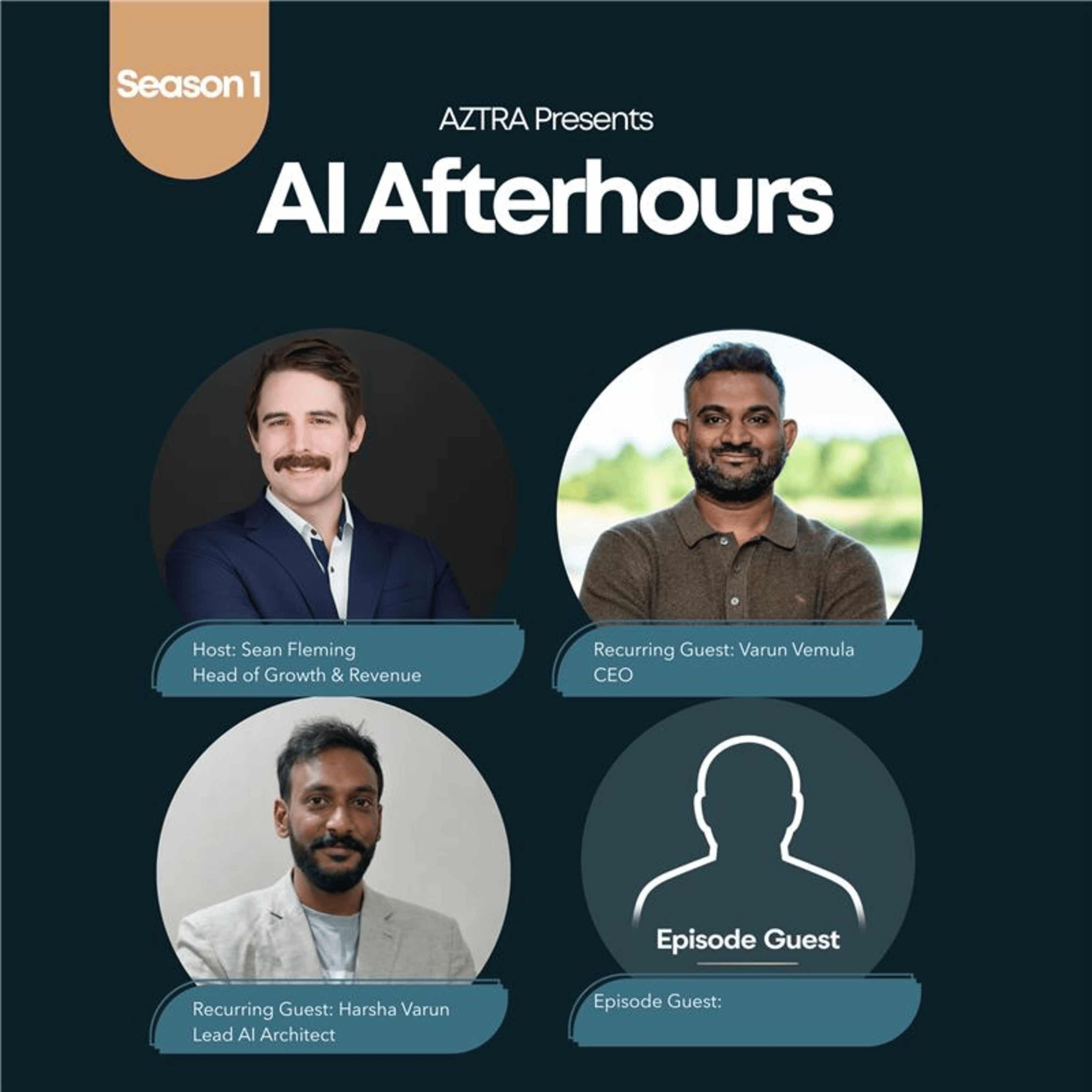
AI Afterhours
by AZTRA
AI Afterhours is AZTRA’s podcast on how organizations cut through noise, identify the signals that matter, and turn them into better decisions across forecasting, operations, automation, and enterprise performance. Season 1, Signals & Noise, creates a consistent narrative across Aurora, Aries, Dovient and Luma through practical conversations on business problems, technical logic, and measurable outcomes. seanpatfleming.substack.com
-
4
AI Afterhours: Optimizing Production & Inventory in Manufacturing
Manufacturing teams don’t struggle with planning because they lack data. They struggle because the moment the plan meets the real world, something always moves.Season 1 of AI Afterhours, Signals & Noise, is about how organizations cut through noise, find the signals that matter, and turn them into better decisions.Episode 5: Optimizing Production & Inventory closes out the manufacturing arc, with host Sean Fleming joined by Shashank Punuru, founder of Dovient, Harsha Varun, Lead AI Architect at AZTRA, and Varun Vemula, CEO of AZTRA, back after stepping away for his executive MBA.Shashank opens by flipping the script. Episode 4: Manufacturing with Dovient focused on maintenance, but he makes the case that maintenance is usually the second thing a plant solves, not the first. A new operation starts clean with process, suppliers, raw materials, and inventory. Maintenance only shows up a year or two later. So production and inventory take the front seat, and the real job becomes planning for surprises, because the plant that runs exactly to plan doesn’t exist. You need a backup plan, and a backup plan for the backup plan.Harsha lays out the systems picture. Planning isn’t one thing, it’s four layers, from long-range capacity down to the shop floor manager changing the schedule on the fly. The base systems run a bounded optimization and stop there. They can’t model the shock that lives outside their scope. His COVID example lands it: when a plant shuts down, no system can answer a question as simple as which other plant can make the same finished good, because every plant names things differently. That intelligence overlay is still missing almost everywhere.Varun reframes the whole tradeoff. It isn’t service levels versus inventory cost. It’s an uncertainty problem. Nobody in the room has agreed how much uncertainty they’re willing to carry. The discipline is the CEO and CFO aligning on one uncertainty budget, then making sure that tolerance carries downstream to the salesperson and the planner. You can’t eliminate uncertainty. You can only minimize it. And anyone selling a 100% accurate forecast is selling fiction.The takeaway from the episode: the plants that win are the ones that get the digitization and the signals right, then stop firefighting and start scaling. Get the foundation in place, and the surprises stop running the business.Episode 6: API Security with Aries is next, moving off the factory floor and into the digital infrastructure that quietly runs behind everything. Different environment, same problem the season keeps circling. Something breaks, nobody notices, and by the time the business finds out, it’s expensive. This is a public episode. If you would like to discuss this with other subscribers or get access to bonus episodes, visit substack.aztra.ai
-
3
AI Afterhours: Manufacturing with Dovient
Manufacturing has not been slow to adopt AI because the industry is behind. On the shop floor, the cost of getting it wrong shows up before anyone can catch it.Season 1 of AI Afterhours, Signals & Noise, is about how organizations cut through noise, find the signals that matter, and turn them into better decisions. In Episode 4, Manufacturing with Dovient, I sat down with Shashank from Dovient and Harsha, who was back after missing Episode 3. Varun was away completing his executive MBA. Get it done, Varun.Shashank opened with the frame that carried the whole conversation. Before AI, the shop floor runs on delayed visibility, static maintenance schedules, and coordination that happens by phone call. Teams react to what already happened. With AI, the same teams can finally act before the failure arrives. Not because the machine got smarter. Because the decision layer now has context.Harsha made the invisible visible. The core problem is not the signal. It is that 80% of what governs the outcome never makes it into any system. It lives in shift logs, maintenance notes, and the memory of the technician who fixed this same machine three years ago and is not on shift tonight. Dovient’s approach is to digitize that unstructured knowledge, build the graph that connects events across time, and let background agents surface the pattern before the failure compounds.Shashank’s closing thought is the one to take with you. Pick the one KPI where static planning is already failing. Start there. Measure it. Then expand.Next up is Episode 5, still with Shashank and the Dovient team. Capacity decisions, lead time management, inventory positioning, and working capital trade-offs.Shashank, the before and after frame you opened with is the clearest version of this problem I have heard explained. Hard to top that one. Harsha, good to have you back.Thank you for tuning in. See you next episode. This is a public episode. If you would like to discuss this with other subscribers or get access to bonus episodes, visit substack.aztra.ai
-
2
AI Afterhours: Demand Forecasting in Retail
Most retailers have a forecasting problem they have been solving the same way since 2010. The data has changed. The signals have multiplied. The planning systems have not caught up. Somewhere underneath the dashboards and the spreadsheets, a 2026 business is still running on 2010 logic.Season 1 of AI Afterhours, Signals & Noise, is about how organizations cut through noise, find the signals that matter, and turn them into better decisions. In Episode 3, Demand Forecasting in Retail, I sat down with Bob and Varun for the final episode in our three-part retail arc. Harsha was out sick this week. Get well soon, Harsha.Bob opened with the frame that carried the whole conversation. The signal-to-noise ratio has flipped. Historical data used to get planners most of the way there. Now it is barely a starting point. He walked us through shifting planners from curation to exception management, and turning the planning team from a cost center into a value driver. Varun took it higher. When the underlying systems do not talk, the planning room becomes a war room where every team is defending a different number. When the data underneath is broken, the AI on top is just polished chaos. Bob’s parting shot is the one to take with you. Stop trying to automate chaos. Fix the chaos first.Next week we pivot to the factory floor with Episode 4, Manufacturing with Dovient. Different pressures. Same core question.Bob, thank you. The bar you set is going to be hard to top.Thank you for tuning in! See you next episode. This is a public episode. If you would like to discuss this with other subscribers or get access to bonus episodes, visit substack.aztra.ai
-
1
AI Afterhours: Margin Protection at Scale
Retail margin does not disappear in one big event. Too many pricing misses. Too many promos built on gut. Too many inventory gaps. Too many decisions made too late.Season 1 of AI Afterhours, Signals & Noise, is about how organizations cut through noise, find the signals that matter, and turn them into better decisions. In Episode 2, Margin Protection at Scale, I sat down with Bob, Harsha, and Varun to get past the theory and into what actually protects margin across a retail network.Bob broke down where margin erosion really starts and which operational levers matter most. Not one big leak. A hundred small ones that compound across the network. Harsha brought the technical side. What has to be true in the data, the systems, and the decisioning layer to spot margin risk early enough to do something about it. Varun closed it at the executive level. The retailers that protect margin well are not the ones making better decisions. They are the ones making them earlier.Next week we stay in retail one more time with Episode 3, Demand Forecasting in Retail. Same category. One layer upstream. Because if the forecast is wrong, everything downstream is bleeding.Thank you for tuning in! See you next week. This is a public episode. If you would like to discuss this with other subscribers or get access to bonus episodes, visit substack.aztra.ai
-
0
AI Afterhours: Retail & CPG
Retail planning is still broken in a very familiar way. Too much historical logic. Not enough live signal. Too much cluster thinking. Not enough operating truth.Season 1 of AI Afterhours, Signals & Noise, is about how organizations cut through noise, find the signals that matter, and turn them into better decisions. In Episode 1, Retail & CPG, I sat down with Bob, Harsha, and Varun to break down why stockouts, overstocks, and missed margin are usually not isolated failures.They are the downstream consequence of weak signals, slow planning cycles, and planning systems that still assume stores behave the same when they do not. Bob made that real from the operator side. Harsha explained why forecast quality depends on better signals, simulation, and planner knowledge that usually never makes it into the system. Varun brought it back to the business. If you are still planning backward, you are probably bleeding margin forward.Next week we get more specific with Episode 2, Margin Protection at Scale. Same category. Same pressure. Closer to the money.Thank you for tuning in! See you next week. This is a public episode. If you would like to discuss this with other subscribers or get access to bonus episodes, visit substack.aztra.ai
-
-1
AI Afterhours: Retail & CPG Preview
A preview of Episode 1 of AI Afterhours featuring Bob Ntuaremba Leyo on why stores are not interchangeable. The same cluster on paper does not mean the same demand in reality. This clip gets into why local signals, hyper-localization, and operating truth matter if you want better planning, fewer stockouts, and less margin bleed. This is a public episode. If you would like to discuss this with other subscribers or get access to bonus episodes, visit substack.aztra.ai
We're indexing this podcast's transcripts for the first time — this can take a minute or two. We'll show results as soon as they're ready.
No matches for "" in this podcast's transcripts.
No topics indexed yet for this podcast.
Loading reviews...
ABOUT THIS SHOW
AI Afterhours is AZTRA’s podcast on how organizations cut through noise, identify the signals that matter, and turn them into better decisions across forecasting, operations, automation, and enterprise performance. Season 1, Signals & Noise, creates a consistent narrative across Aurora, Aries, Dovient and Luma through practical conversations on business problems, technical logic, and measurable outcomes. seanpatfleming.substack.com
HOSTED BY
AZTRA
CATEGORIES
Loading similar podcasts...
Frequently Asked Questions
How many episodes does AI Afterhours have?
AI Afterhours currently has 6 episodes available on PodParley. New episodes are automatically indexed when they're published to the podcast feed.
What is AI Afterhours about?
AI Afterhours is AZTRA’s podcast on how organizations cut through noise, identify the signals that matter, and turn them into better decisions across forecasting, operations, automation, and enterprise performance. Season 1, Signals & Noise, creates a consistent narrative across Aurora, Aries,...
How often does AI Afterhours release new episodes?
AI Afterhours has 6 episodes. Check the episode list to see recent publication dates and frequency.
Where can I listen to AI Afterhours?
You can listen to AI Afterhours on PodParley by clicking any episode. We provide an embedded audio player for direct listening, and you can also subscribe via your preferred podcast app using the RSS feed.
Who hosts AI Afterhours?
AI Afterhours is created and hosted by AZTRA.
URL copied to clipboard!