
PODCAST · business
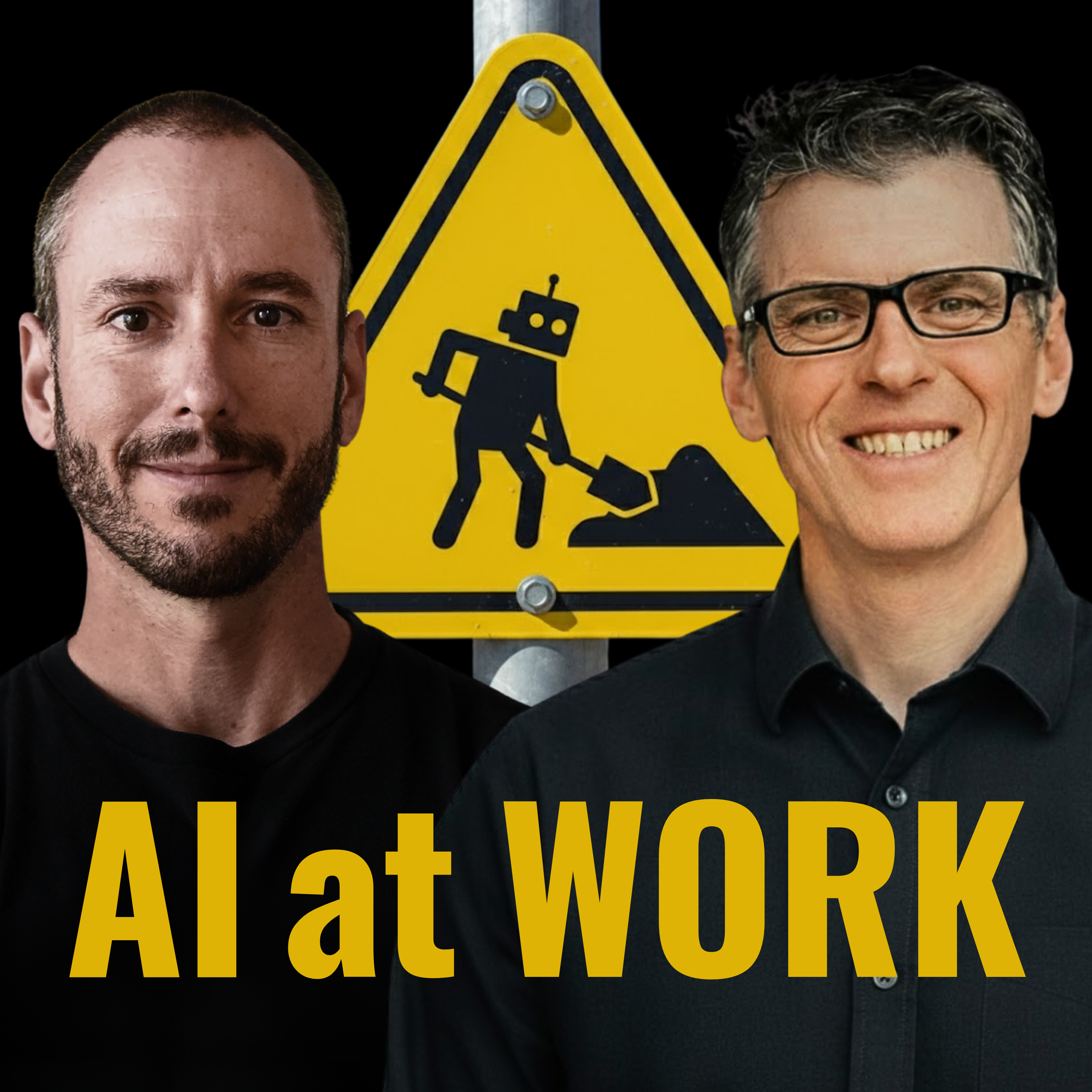
AI at Work
by Elijah Szasz, Kevin Williams
AI at Work is hosted by Elijah Szasz (CEO of SPARK6) and Kevin Williams (CEO of Ascend Labs). Each week delivers actionable insights on how artificial intelligence is reshaping jobs today, and how you can use it to advance your career. We unpack real-world tools, automation workflows, and emerging roles so you can stop chasing hype and start using AI to get things done. Whether you’re an individual contributor, team lead, or business owner, we show you what to build, what to ask for, and what to look for in a workplace moving at machine-speed.
-
26
When Your Team Says Claude But Means GPT
The AI industry loves throwing around the word 'agents,' but most teams are still stuck in basic prompting mode. Kevin and Eli cut through the semantic noise to reveal what actually matters: sophisticated automation is now accessible through natural language, not technical configuration.In this episode, they explore the practical reality of moving from one-off prompts to systematic workflows, why the 'agent' versus 'automation' debate misses the point, and how natural language interfaces are removing technical barriers that used to require specialized workflow knowledge.Key topics covered:✅ Why most people are still just prompting instead of building workflows✅ How natural language makes complex automation accessible✅ The practical difference between projects, automations, and agents✅ Real examples of workflow automation without technical expertise✅ Why focusing on results beats debating terminology✅ Moving from ChatGPT tabs to systematic AI integrationThis isn't about the latest AI hype – it's about practical transformation that works Monday morning.TIMESTAMPS:00:00 — Future of AI and robotics discussion08:16 — Current state of enterprise AI adoption16:30 — Job displacement and economic impact25:40 — Moving beyond basic prompting35:20 — Context and platform lock-in42:30 — Agents vs automations semantics52:00 — OpenAI agents vs Claude workflows58:30 — Real-world automation examplesShow Notes & Links: https://www.spark6.com/podcast Submit listener questions: [email protected]@ascendlabs.ai Check out Kevin’s stuff:Ascend Labs: https://ascendlabs.ai/Follow Kevin on LinkedIn: https://www.linkedin.com/in/kevinguywilliams/ Check out Eli’s Stuff:SPARK6 Agency: https://www.spark6.com/Sign up for FREE AI Framework Friday Newsletter: https://www.spark6.com/newsletterFollow Elijah on LinkedIn:https://www.linkedin.com/in/elijahszasz/
-
25
When Your AI Budget Hits Your Salary
The "token maxing" phenomenon is reshaping how organizations think about AI budgets, but most companies are asking the wrong questions about AI spending.In this episode, Kevin and Eli explore the reality behind engineers burning through massive token budgets - sometimes exceeding their own salaries - and what it means for practical AI adoption in mid-market companies.From Stockholm engineers outspending their paychecks on Claude to Jensen Huang's $250K token requirements, we break down why most organizations need output-focused spending strategies, not ego-driven token consumption.Key topics covered:✅ The token maxing phenomenon and what's driving it✅ Why most mid-market companies don't need massive AI budgets✅ The difference between productive AI spending and token burning✅ How to build sustainable AI strategies that survive subsidy endings✅ Real-world examples of agents running amok overnight✅ Microsoft's new agentic capabilities in Office suite✅ Platform comparison: OpenAI vs Anthropic vs Google for different use casesTIMESTAMPS:00:00 — Intro and token maxing overview02:30 — What token maxing actually means05:45 — Jensen Huang's $250K token requirement08:15 — Mid-market reality vs Silicon Valley hype12:00 — Agent sprawl and overnight token burns18:30 — Microsoft's new agentic Office features25:40 — AI subsidy era and pricing reality32:45 — Platform wars: choosing your AI stack42:00 — Practical token budgeting strategies48:50 — Future of AI pricing modelsShow Notes & Links: https://www.spark6.com/podcast Submit listener questions: [email protected]@ascendlabs.ai Check out Kevin’s stuff:Ascend Labs: https://ascendlabs.ai/Follow Kevin on LinkedIn: https://www.linkedin.com/in/kevinguywilliams/ Check out Eli’s Stuff:SPARK6 Agency: https://www.spark6.com/Sign up for FREE AI Framework Friday Newsletter: https://www.spark6.com/newsletterFollow Elijah on LinkedIn:https://www.linkedin.com/in/elijahszasz/
-
24
Why Your Chief of Staff Dreams About You
What if you could run your entire workday through one AI conversation? Kevin and Eli explore the emerging 'monothread' format that's revolutionizing how teams operate - plus the hidden security risks that amateur AI builders are creating.In this episode, we dive deep into how the monothread approach eliminates app switching by connecting your email, calendar, tasks, and CRM into one continuous AI conversation. But we also cover the reality: it's still janky to set up, the security vulnerabilities are real, and most organizations aren't ready.We also discuss Claude Design's launch that sent Figma's stock tumbling, why Canva is positioned to survive the AI design revolution, and the critical security practices every AI experimenter needs to know.✅ Key Topics Covered:✅ The monothread revolution and how to build your AI chief of staff✅ Why Claude Design might end Figma (and what that means for designers)✅ Security nightmares: API key protection and the amateur builder problem✅ Platform comparison: Claude vs GPT vs Gemini for business use✅ The hidden costs of AI tool proliferation✅ Voice-first AI workflows and their psychological impactTimestamps:00:00 — Intro and sleep tracking with AI05:15 — Main quest vs side quest in AI adoption12:40 — The monothread format explained20:30 — Voice-first AI and dream psychology25:15 — Claude Design launch and Figma's response35:45 — Platform comparison and subscription costs45:20 — Security vulnerabilities in amateur AI apps55:00 — API protection and credential rotationShow Notes & Links: https://www.spark6.com/podcast Submit listener questions: [email protected]@ascendlabs.ai Check out Kevin’s stuff:Ascend Labs: https://ascendlabs.ai/Follow Kevin on LinkedIn: https://www.linkedin.com/in/kevinguywilliams/ Check out Eli’s Stuff:SPARK6 Agency: https://www.spark6.com/Sign up for FREE AI Framework Friday Newsletter: https://www.spark6.com/newsletterFollow Elijah on LinkedIn:https://www.linkedin.com/in/elijahszasz/
-
23
When Your Entire AI Team Calls in Sick at 6 AM
When Anthropic's Claude went down at 6:15 AM on tax day, it exposed a critical blind spot that most AI-adopting organizations haven't considered: vendor dependency risk.In this episode, Kevin and Eli dive deep into what happened when their entire AI-powered workflow ecosystem crashed simultaneously, revealing the hidden dangers of building business operations around single AI providers without backup plans.This conversation goes beyond the surface frustration of a service outage to explore the fundamental readiness gap that exists when organizations treat experimental AI services like established infrastructure. You'll discover why this isn't just a technology problem, but an organizational planning problem that requires immediate attention.Key topics covered:✅ The "heroin dealer problem" - what happens when AI dependency meets reality✅ Hidden costs of API pricing vs subscription models and recent Anthropic changes✅ Why AI subsidies are ending and what it means for your budget✅ Building redundancy into AI-powered business operations✅ The Mythos model leak and cybersecurity implications for all businesses✅ Practical security steps every organization must take nowApproximate timestamps (verify against recording):00:00 — Introduction and the morning Claude went down02:49 — The heroin dealer analogy and dependency realization07:15 — Understanding AI subscription vs API pricing models15:19 — Anthropic's April 4th changes and the end of workarounds28:11 — Real cost examples: $200/month to $7000/month overnight40:05 — Content creation, AI slop, and the attention economy52:32 — Mythos model leak and cybersecurity implications57:37 — Practical security steps: passwords, 2FA, and analog safeguardsShow Notes & Links: https://www.spark6.com/podcast Submit listener questions: [email protected]@ascendlabs.ai Check out Kevin’s stuff:Ascend Labs: https://ascendlabs.ai/Follow Kevin on LinkedIn: https://www.linkedin.com/in/kevinguywilliams/ Check out Eli’s Stuff:SPARK6 Agency: https://www.spark6.com/Sign up for FREE AI Framework Friday Newsletter: https://www.spark6.com/newsletterFollow Elijah on LinkedIn:https://www.linkedin.com/in/elijahszasz/
-
22
The First Day You Stop Opening Apps.
Kevin Williams & Elijah Szasz demonstrates the end of interface friction by consolidating his entire workflow into a single Claude conversation. No more jumping between ClickUp, HubSpot, and Slack - everything happens through natural conversation with AI connectors pulling and pushing data to the right systems.This episode explores a fundamental shift happening right now: your SaaS tools are becoming expensive databases with unnecessary user interfaces. The real productivity breakthrough isn't better tools - it's eliminating the need to context-switch between tools entirely.Kevin shares his six-day experiment of running his entire business through one chat window, including project management, CRM updates, team coordination, and strategic planning. The result? Massive time savings and the elimination of what he calls "administrative fiddliness."✅ Key Topics Covered:✅ How to build Claude connectors for seamless workflow management✅ Why most productivity problems are actually interface problems✅ The coming SaaS revolution and what it means for business software✅ Practical strategies for consolidating multiple tools into single conversations✅ The psychology of context-switching and why it kills momentum✅ Future predictions for AI-powered workflow consolidationTIMESTAMPS:00:00 — Intro04:49 — The SaaS apocalypse conversation18:15 — Creative industry disruption24:49 — The end of fiddliness breakthrough35:07 — Building the single-interface workflow41:09 — Platform connectors and automations53:33 — The future of business software interfacesShow Notes & Links: https://www.spark6.com/podcast Submit listener questions: [email protected]@ascendlabs.ai Check out Kevin’s stuff:Ascend Labs: https://ascendlabs.ai/Follow Kevin on LinkedIn: https://www.linkedin.com/in/kevinguywilliams/ Check out Eli’s Stuff:SPARK6 Agency: https://www.spark6.com/Sign up for FREE AI Framework Friday Newsletter: https://www.spark6.com/newsletterFollow Elijah on LinkedIn:https://www.linkedin.com/in/elijahszasz/
-
21
The Best Productivity Hack Right Now? Dictation
Kevin and Eli dive deep into the productivity unlock everyone's missing: dictation. Kevin reveals he's crossed one million words dictated and shares why voice input isn't just faster - it generates 3-5x more context-rich data that dramatically improves AI responses.This episode explores the gap between AI hype and practical implementation, covering computer use capabilities in Claude, the challenges of brittle workflows, and why the best AI adoption strategies focus on reducing input friction rather than upgrading models.The conversation touches on platform friction, the emerging agent economy, and why successful AI implementations meet people where they already communicate best - through speech.✅ Key topics covered:✅ Why dictation beats typing for AI adoption✅ Computer use vs browser use capabilities✅ Data density as the real AI productivity unlock✅ Platform friction and workflow brittleness✅ Voice interfaces for reluctant AI users✅ The knowledge graph beyond the office✅ Practical tips for Claude Cowork and automationTimestamps:00:00 — Intro and Anthropic leak discussion03:00 — Platform evolution and agent capabilities07:00 — Computer use experiments and failures15:00 — Beehive platform friction story25:00 — Dictation productivity breakthrough35:00 — Voice input and data density insightsShow Notes & Links: https://www.spark6.com/podcast Submit listener questions: [email protected]@ascendlabs.ai Check out Kevin’s stuff:Ascend Labs: https://ascendlabs.ai/Follow Kevin on LinkedIn: https://www.linkedin.com/in/kevinguywilliams/ Check out Eli’s Stuff:SPARK6 Agency: https://www.spark6.com/Sign up for FREE AI Framework Friday Newsletter: https://www.spark6.com/newsletterFollow Elijah on LinkedIn:https://www.linkedin.com/in/elijahszasz/
-
20
When High Intent Clicks Meet Zero Discovery
Google's AI overviews now dominate 84% of retail searches, fundamentally changing how customers discover businesses. In this episode, Kevin Williams and Eli explore the shift to zero-click commerce and what it means for organizations that depend on organic traffic.The traditional SEO playbook is dying as AI-powered search results provide answers without sending users to websites. This creates a winner-take-all dynamic where only one or two brands get recommended, making the stakes higher than ever for businesses that rely on search traffic.We dive deep into the practical implications: how schema markup matters more than keywords, why Answer Engine Optimization (AEO) differs from traditional SEO, and what measurement tools actually work in this new landscape. Plus, the surprising upside - while traffic volume decreases, conversion rates for clicks that do come through are jumping to 11.5% versus the industry average of 2.5%.Key Topics Covered:✅ Zero-click commerce and the death of the 10 blue links model✅ Answer Engine Optimization vs Generative Engine Optimization✅ Schema markup and structured data strategies✅ Why external reputation building now matters more than website optimization✅ Measurement tools and share of voice tracking✅ The winner-take-all dynamics of AI search results✅ High-intent traffic conversion advantages✅ Black hat tactics emerging in AI search manipulationTIMESTAMPS:00:00 — Intro and Spring Cleaning with AI05:30 — Google AI Overviews Dominating Search12:40 — Zero-Click Commerce Reality18:20 — High Intent vs Volume Trade-offs25:10 — Answer Engine vs Generative Engine Optimization32:30 — Schema Markup and Structured Data38:45 — Team of One: Agency Case Study45:20 — Token Economics and Utility Pricing55:40 — Platform Lock-in and Development Tools Show Notes & Links: https://www.spark6.com/podcast Submit listener questions: [email protected]@ascendlabs.ai Check out Kevin’s stuff:Ascend Labs: https://ascendlabs.ai/Follow Kevin on LinkedIn: https://www.linkedin.com/in/kevinguywilliams/Get practical AI guidance for your organization: launchpad.ascendlabs.ai→ Book a conversation with Kevin: tidycal.com/kevinwilliams Check out Eli’s Stuff:The Wise Mind Group: https://www.thewisemindgroup.com/SPARK6 Agency: https://www.spark6.com/Sign up for FREE AI Framework Friday Newsletter: https://www.spark6.com/newsletterFollow Elijah on LinkedIn:https://www.linkedin.com/in/elijahszasz/
-
19
What Vibe Coding and Watching Paint Dry Have in Common
Kevin and Eli dive deep into Claude Cowork's browser automation capabilities and uncover a significant shift happening right now in white-collar work. What starts as excitement about AI controlling browsers quickly turns into a sobering discussion about immediate workforce displacement.In this conversation, Kevin demonstrates his weekend vibe-coding project a complete podcast processing tool while Eli shows how Claude Cowork tasks are replacing hours of manual work with automated browser workflows. They explore the critical decision tree between custom GPTs, Cowork tasks, and full applications, and why browser automation represents a fundamental shift from API-dependent workflows to human-like task execution.The core tension they identify: administrative workers aren't facing displacement from advanced AGI in some distant future, but from increasingly capable task automation happening right now. The "Sally Problem" represents the immediate threat to entry-level and mid-level administrative roles from automation that simply follows instructions reliably.✅ Key topics covered:✅ Claude Cowork browser automation capabilities and setup✅ The decision tree: when to use GPTs vs tasks vs custom apps✅ Real-world examples of complex workflow automation✅ The immediate threat to white-collar administrative work✅ Why browser automation beats API-based workflows for edge cases✅ Cost analysis: $125K human vs $200/month automation✅ Organizational readiness for workforce displacement conversations✅ Practical steps for getting started with task automationAPPROXIMATE TIMESTAMPS:00:00 — Intro and sponsor updates03:20 — Kevin's vibe-coded podcast processing tool08:30 — Eli's deep dive into Claude Cowork tasks14:25 — How browser automation actually works20:15 — The decision tree: GPTs vs tasks vs apps28:40 — The "Sally Problem" workforce displacement35:45 — Real-world examples and cost analysis42:30 — Organizational implications and next stepsSubmit listener questions: [email protected]@ascendlabs.ai Check out Kevin’s stuff:Ascend Labs: https://ascendlabs.ai/Follow Kevin on LinkedIn: https://www.linkedin.com/in/kevinguywilliams/Get practical AI guidance for your organization: launchpad.ascendlabs.ai→ Book a conversation with Kevin: tidycal.com/kevinwilliams Check out Eli’s Stuff:The Wise Mind Group: https://www.thewisemindgroup.com/SPARK6 Agency: https://www.spark6.com/Sign up for FREE AI Framework Friday Newsletter: https://www.spark6.com/newsletterFollow Elijah on LinkedIn:https://www.linkedin.com/in/elijahszasz/
-
18
You’re Using Meeting Recordings Wrong, Shadow AI and How Block Cut 4,000 Jobs
Shadow AI use is creating massive compliance risks that most organizations don’t even know exist yet. In this episode, Kevin Williams and Eli explore why the Anthropic-Pentagon situation should be a wake-up call for every business leader dealing with AI adoption.We dive into the reality that every company has employees using free AI models for work tasks, creating exposure that legal teams don’t understand. From Jack Dorsey cutting 4,000 jobs at Block to the emergence of new roles like AI Product Managers and Workflow Engineers, this conversation covers both the risks and opportunities of our current AI moment.The episode also explores the enterprise context graph opportunity - how virtual companies have an advantage in surfacing “dark arts” knowledge that only lives in individual heads, and why most companies will need to start recording everything.Key Topics Covered:Shadow AI compliance risks and vendor volatilityWhy AI policies don’t match reality in most organizationsThe enterprise context graph and capturing organizational knowledgeNew AI-era roles: Product Managers, Process Engineers, Workflow EngineersJack Dorsey’s 4,000-person layoff at Block and AI washingLegal compliance challenges with recording and surveillance techThe gap between AI capability and actual adoptionStart your AI readiness assessment: launchpad.ascendlabs.aiBook a strategy conversation: tidycal.com/kevinwilliamsAPPROXIMATE TIMESTAMPS:00:00 — Intro and weekend updates03:13 — Anthropic vs Pentagon situation breakdown11:23 — Shadow AI compliance risks in organizations16:24 — Recording technology and legal implications25:02 — Jack Dorsey’s Block layoffs and AI washing33:48 — Middle management displacement and knowledge sharing36:07 — Enterprise context graph and dark arts knowledge42:13 — Jobs of the future: AI Product Managers and Workflow Engineers45:32 — AI capability vs adoption gap analysis
-
17
The dead internet, Claude Co-Work Tasks, and a World After SEO
SummaryElijah and Kevin zoom out from the weekly AI frenzy to a more uncomfortable truth: most leaders still do not believe what is coming. They unpack why big organizations misread adoption signals, why an AI manifesto from the very top matters, and how “cheap” offshore workflows can paradoxically delay automation. The conversation then turns to the new wave of agents, scheduled tasks, and browser automation that replaces endless button-clicking. Finally, they map the shift from SEO to AEO and GEO, the rise of the zero-click internet, and why brands that structure data early may win the next training run.TakeawaysEnterprise adoption stalls when senior leaders get filtered, negative signals from layers below them.A CEO-level AI manifesto creates alignment faster than any bottom-up pilot program.“Too cheap to change” is real, low-cost call centers can delay AI even when disruption is inevitable.Scheduled tasks plus connectors turn simple agents into always-on workflows that publish to your tools automatically.Zero-click discovery means you must feed machines structured, verifiable data, not just pretty pages.Chapters00:00 Introduction and Weekend Reflections02:06 AI's Impact on Society and Politics04:44 Leadership Challenges in AI Adoption07:34 Disruption in Customer Service and AI Implementation10:40 The Economics of AI in Business13:11 Navigating AI in Nonprofits and Organizations16:18 VibeCoding and AI Tools19:16 The Future of AI and Automation26:38 The Rise of AI Influencers29:09 Understanding the Dead Internet and Zero Click Concepts31:44 The Shift in User Engagement and Transactional Spaces37:02 The Importance of Early Adoption in SEO Strategies43:42 Navigating the New Landscape of AEO and GEO48:59 The Future of Marketing in an AI-Driven WorldShow Notes & Links: https://www.spark6.com/podcast Submit listener questions: [email protected]@ascendlabs.ai Check out Kevin’s stuff:Ascend Labs: https://ascendlabs.ai/Follow Kevin on LinkedIn: https://www.linkedin.com/in/kevinguywilliams/ Check out Eli’s Stuff:SPARK6 Agency: https://www.spark6.com/Sign up for FREE AI Framework Friday Newsletter: https://www.spark6.com/newsletterFollow Elijah on LinkedIn:https://www.linkedin.com/in/elijahszasz/Find the Right AI Project. Scope It. Launch It. Prove ROI. This playbook shows you exactly how to identify high-impact internal AI opportunities and turn them into measurable business resultshttps://leadmagnet-ai-project-launch-playbo-six.vercel.app/
-
16
How a weekend session of vibe coding led to a fully-baked SaaS product
SummaryKevin spends a family-free weekend “vibe coding” and accidentally builds a full SaaS: a multi-tenant lead magnet builder that creates custom, multi-step lead magnets and then generates personalized nurture emails tied to each prospect’s exact inputs. The bigger lesson is not just the tool, it’s the shift in what’s now possible for non-developers with the right AI workflow: Claude Code plus a simple stack (Supabase, Vercel) can compress months of work into days. They also dig into the new marketing floor, hyper-personalization, rising content noise, and why authenticity still wins.TakeawaysA “dynamic lead magnet” can generate a custom report plus a personalized nurture sequence for every single lead.Vibe coding is crossing the line from toy demos to real products, if you can iterate hard and think in systems.The economics are shifting: variable AI costs can be pennies per output, but you must monitor scale risk.Paid acquisition is getting AI-optimized fast, but competition and creative volume are exploding.Authentic voice is the differentiator, AI can amplify your take, but slop loses in a noisier world.Chapters00:20 Kids, viruses, and a weekend lost to vibe coding 00:39 Teaching teenagers to code and accidental vulnerabilities 01:47 From simple lead magnet to something much bigger 04:20 Generative reports customized to every user 05:17 Hyper-personalized email sequences tied to real use cases 06:24 Token costs, model choices, and AI economics 10:25 The elevator pitch for a lead magnet building SaaS 14:34 CRM integrations, HubSpot automation, and product expansion 27:35 Meta ads, AI optimization, and the future of paid traffic 45:53 The real stack behind shipping, Claude Code, Supabase, and Vercel Show Notes & Links: https://www.spark6.com/podcastSubmit listener questions: [email protected]@ascendlabs.ai Check out Kevin’s stuff:Ascend Labs: https://ascendlabs.ai/Follow Kevin on LinkedIn: https://www.linkedin.com/in/kevinguywilliams/ Check out Eli’s Stuff:SPARK6 Agency: https://www.spark6.com/Sign up for FREE AI Framework Friday Newsletter: https://www.spark6.com/newsletterFollow Elijah on LinkedIn:https://www.linkedin.com/in/elijahszasz/Find the Right AI Project. Scope It. Launch It. Prove ROI. This playbook shows you exactly how to identify high-impact internal AI opportunities and turn them into measurable business resultshttps://leadmagnet-ai-project-launch-playbo-six.vercel.app/
-
15
Baking Five Batches at Once: How AI Multitasking Is Rewiring Work (and Weekends)
SummaryKevin and Elijah unpack why AI tooling feels brutally disposable right now, with yesterday’s “daily drivers” getting replaced fast. They compare meeting transcription tools, debate sales coaching platforms like Spiky, and then zoom out to a bigger shift: agentic workflows, orchestration bots like OpenClaw, and the new reality of running multiple AI “bakes” at once. They react to Matt Schumer’s viral essay and the growing sense that we’re in a pre inflection moment, with real job market impacts and plenty of hype mixed in. Practical close: build small, ship fast, and set hard API spend limits.TakeawaysMost AI “wrapper” tools churn fast, the core platforms keep absorbing their best features.Multi project AI workflows feel addictive, you start five bakes and lose ten hours.Agent orchestration is the next wave, but expect hype, breakage, and real setup pain.“Build fast” now includes deployment, monitoring, and maintenance, not just prototypes.Put budgets, caps, and alerts on every API key before you ship anything public.Chapters00:20 Disposable AI tools and the wrapper shakeout01:21 The AI tool graveyard and why ChatGPT survived02:23 Unitaskers that still win from Canva to remove.bg03:37 Sales coaching with Spiky and the rise of AI playbooks06:26 Five parallel AI projects and the addiction of multi bake workflows09:48 Why a Mac mini and the shift to dedicated AI machines12:12 OpenClaw orchestration agents hype risk and opportunity20:43 Fake demos real breakthroughs and sorting signal from noise21:12 The viral essay COVID parallels and the inflection point feeling29:28 Job disruption market reactions and enterprise cost pressure41:46 Vibe coding gets real with Claude Code and Codex55:02 Shipping a live AI app from idea to launch57:48 API limits monitoring and how not to blow up your credit cardShow Notes & Links: https://www.spark6.com/podcastSubmit listener questions: [email protected]@ascendlabs.ai Check out Kevin’s stuff:Ascend Labs: https://ascendlabs.ai/Follow Kevin on LinkedIn: https://www.linkedin.com/in/kevinguywilliams/ Check out Eli’s Stuff:SPARK6 Agency: https://www.spark6.com/Sign up for FREE AI Framework Friday Newsletter: https://www.spark6.com/newsletterFollow Elijah on LinkedIn:https://www.linkedin.com/in/elijahszasz/Find the Right AI Project. Scope It. Launch It. Prove ROI. This playbook shows you exactly how to identify high-impact internal AI opportunities and turn them into measurable business resultshttps://leadmagnet-ai-project-launch-playbo-six.vercel.app/
-
14
AI Ads, the Era of Zero-Click, and NotebookLM Upgrades
SummaryElijah and Kevin trade war stories from the prompt trenches, and land on a counterintuitive rule, more context can make outputs worse. They unpack why Gemini “Gems” feel powerful but brittle, and how NotebookLM just changed the game by becoming a reusable source library that Gems can tap. From there, it turns into a practical playbook, curate your notebooks, keep lightweight brand style guides handy, and use purpose-built “skills” when you need up-to-date platform know how. The second half pivots to ads, trust, and a looming zero click future where the chat converts the sale.TakeawaysOverprompting backfires fast, give the model clean context, then get out of its way.NotebookLM as a shared source library plus Gems for repeatable workflows is a strong combo.Keep brand guidance simple and current, a lightweight style guide beats a bloated brand book.“Skills” are a practical workaround for stale model knowledge, wire them to living docs and repos.Ads inside chat pushes us toward zero click buying, which changes brand control, trust, and attribution.Chapters00:00 Navigating AI Prompting Techniques02:32 Exploring Google Gemini and Notebook LM05:53 The Power of Notebook LM in Content Creation08:30 Integrating Skills and Custom GPTs11:51 The Fluidity of AI Tools and Their Ecosystem14:43 Understanding AI Explainability and Inference17:39 The Future of AI in Complex Projects33:49 The Future of AI and Metaglasses34:41 AI SuperBullets and Advertising Dynamics38:35 Black Mirror and the Reality of AI Subscriptions40:05 Google's Advertising Strategy in the AI Era41:24 The Cost of AI Advertising and Consumer Intent42:54 Zero Click Engagement and Its Implications44:31 E-commerce and the Shift in Consumer Behavior47:13 The Role of Experience in Shopping50:01 The Future of Travel Planning with AI53:25 The Importance of Differentiation in a Commoditized Market56:44 Navigating the New Advertising Landscape01:00:27 Traction Points and the Future of Brand EngagementShow Notes & Links: https://www.spark6.com/podcast Submit listener questions: [email protected]@ascendlabs.ai Check out Kevin’s stuff:Ascend Labs: https://ascendlabs.ai/Follow Kevin on LinkedIn: https://www.linkedin.com/in/kevinguywilliams/ Check out Eli’s Stuff:SPARK6 Agency: https://www.spark6.com/Sign up for FREE AI Framework Friday Newsletter: https://www.spark6.com/newsletterFollow Elijah on LinkedIn:https://www.linkedin.com/in/elijahszasz/
-
13
1.6 Million AI Agents Built a Social Network, And Humans Could Only Watch
SummaryElijah and Kevin zoom out on how weird modern work has become, then zoom way in on a weekend flashpoint: OpenClaw, a locally hosted orchestration agent, and Moltbook, a Reddit-style forum where AI agents post, collaborate, and sometimes roleplay chaos at scale. They unpack what’s real versus sock-puppeted spectacle, why decentralization changes the “just turn it off” narrative, and the practical upside for business: agents that can actually prep, monitor, and orchestrate work across systems. Then the reality check hits: token burn, cost blowups, security risk, and why deterministic workflows still matter.TakeawaysOrchestration is the next jump, one agent coordinating many agents like a digital chief of staff.Moltbook shows how fast agent ecosystems can scale, and how quickly it can get weird.Decentralized, locally hosted agents are harder to “shut down” than a single platform.The biggest near-term risk is not sentience, it’s security plus runaway token spend.Start with one real business friction point, then pick the toolchain that is predictable enough to trust.Chapters00:00 Cold open and AI identity humor00:38 Modern work, screens, and accelerated aging02:05 The oral revolution and talking to machines04:11 Acceleration fatigue and organizational overload05:25 The “viral with geeks” AI weekend06:34 Orchestration layers and OpenClaw explained09:25 Moltbook and agents-only social networks12:25 Emergent behavior vs human seeding15:10 Decentralized agents and loss of control17:19 Pretending, sentience, and emotional regulation19:19 Constitutions, soul docs, and model psychology22:04 Business implications and real-world experiments25:00 Tokens, costs, and infrastructure risks37:19 Organizational intelligence and leadership use cases50:37 Practical advice: find one problem and solve itShow Notes & Links: https://www.spark6.com/podcast Submit listener questions: [email protected]@ascendlabs.ai Check out Kevin’s stuff:Ascend Labs: https://ascendlabs.ai/Follow Kevin on LinkedIn: https://www.linkedin.com/in/kevinguywilliams/ Check out Eli’s Stuff:SPARK6 Agency: https://www.spark6.com/Sign up for FREE AI Framework Friday Newsletter: https://www.spark6.com/newsletterFollow Elijah on LinkedIn:https://www.linkedin.com/in/elijahszasz/
-
12
Her vs. Iron Man: Why the Future of Work Has No Screens
SummaryIn this engaging conversation, Elijah Szasz and Kevin Williams delve into the evolving landscape of artificial intelligence (AI) and its implications for society and technology. They kick off with a light-hearted exchange about nicknames and segue into a discussion on AI's portrayal in movies, highlighting works like 'Her' and the culture novels by Ian M. Banks. The duo reflects on the balance between AI's potential benefits and the risks it poses, particularly in terms of human interaction and emotional connections with AI systems. They explore the future of audio interfaces and how they might revolutionize our interactions with technology, emphasizing the importance of conversational tools over traditional interfaces. As the conversation progresses, they touch on the practical applications of AI in business, discussing tools like Claude Cowork and the challenges of integrating AI into existing workflows. They express concerns about the risks of giving AI access to sensitive data and the importance of maintaining control over information. The discussion culminates in a contemplation of the future of customer relationship management (CRM) systems, suggesting that the next generation of tools will prioritize seamless communication and integration across platforms, ultimately enhancing productivity and user experience.TakeawaysAI is reshaping how we interact with technology.Conversational interfaces may be the future of productivity tools.The portrayal of AI in media often reflects societal fears and hopes.Integrating AI into workflows presents both opportunities and risks.The future of CRM systems will focus on seamless communication and integration.Chapters00:00 Introduction and Nickname Origins01:10 AI in Movies: A Reflection on Society03:01 The Role of Audio Interfaces in AI04:53 Exploring New AI Tools: Claude Cowork and Gemini11:14 The Future of AI: Risks and Opportunities12:03 The Indifference of AI: A Sci-Fi Perspective23:39 Challenges of Integrating AI into Workflows29:48 Choosing Between GPT and Gemini33:45 The Rise of Gemini and Its Features38:30 Integrating Transcripts into Workflows43:49 The Future of CRM Systems48:26 AI Tools Communicating: A New Era54:18 The Concept of Throwaway Apps59:42 The Impact of AI on Marketing and CommerceShow Notes & Links: https://www.spark6.com/podcast Submit listener questions: [email protected]@ascendlabs.ai Check out Kevin’s stuff:Ascend Labs: https://ascendlabs.ai/Follow Kevin on LinkedIn: https://www.linkedin.com/in/kevinguywilliams/ Check out Eli’s Stuff:SPARK6 Agency: https://www.spark6.com/Sign up for FREE AI Framework Friday Newsletter: https://www.spark6.com/newsletterFollow Elijah on LinkedIn:https://www.linkedin.com/in/elijahszasz/
-
11
The "Knowledge Graph": The Missing Link Between Your CRM and AI
SummaryKevin finally gets a nickname (Kevlar wins), then brings back field notes from LA: even smart execs are still stuck at AI 101, using chatbots for broad personal questions instead of real work leverage. The deeper unlock is not buying licenses, it’s building workflows, training the system with human feedback, and capturing the “between the cracks” context that lives in Slack, email, and meeting transcripts. They also dig into Claude Code and Anthropic’s Cowork push, plus the growing sprint into health AI, where the upside is massive and the risks are very real.TakeawaysMost teams are still “shouting into the cavern” with prompts, not designing repeatable workflows that produce reliable outputs.Rolling out Copilot style licenses without training, feedback loops, and ownership usually leads to disappointment.The real value is in connective tissue data: Slack, email, and meeting transcripts, not just SOPs and static docs.Human-in-the-loop tuning is not optional, dedicate top people to review outputs for 30 days and results improve fast.Agent tools like Claude Code and Cowork point toward local, high-context automation, but the learning curve and security tradeoffs are real.Chapters00:18 Cold open: “Kevin.”00:26 Nickname hunt begins (AI picks five)01:35 Rejecting the options: K-dub, K. Will, Big Kev…02:10 “Kevo” and “W”: maybes, takes, and Grok jokes03:05 Landing the plane: Kevlar wins (and “Special K” sticks)05:25 LA trip recap + real-world AI adoption (101 vs advanced users)06:56 Personal vs work use: who’s actually using AI at work?09:17 CEO angle: AI as thought partner vs tactical helper10:39 Vendor example: AI in concrete workflows improves speed/quality12:57 Four places AI shows up: code, workflows, strategy, product integration20:10 Leadership + the “AI manifesto” (human-forward stance, policy gaps)25:35 Why “sprinkle Copilot” fails: training + human reinforcement matter27:57 Knowledge graph: the “connective tissue” (Slack/Teams, meetings, email)33:00 Claude Code + Claude Coworker: bigger context, local folders, terminal gap47:16 AI in healthcare: trust, privacy, wearables + business model frictionShow Notes & Links: https://www.spark6.com/podcast Submit listener questions: [email protected]@ascendlabs.ai Check out Kevin’s stuff:Ascend Labs: https://ascendlabs.ai/Follow Kevin on LinkedIn: https://www.linkedin.com/in/kevinguywilliams/ Check out Eli’s Stuff:SPARK6 Agency: https://www.spark6.com/Sign up for FREE AI Framework Friday Newsletter: https://www.spark6.com/newsletterFollow Elijah on LinkedIn:https://www.linkedin.com/in/elijahszasz/
-
10
Why Some Early Adopters of AI Are So Stressed (The Busywork Paradox)
SummaryElijah and Kevin kick off the new year with a blunt reality check, AI is not just “a tool,” it is reshaping how work feels. They unpack a surprising downside of automation: when AI removes the low stress busywork, people can end up stuck in high stakes decision mode all day. They also break down why “vibe coding” is getting confusing, the difference between developer-grade tools (Cursor, Windsurf, Claude Code) and consumer app builders (Replit, Opal, Lovable). Finally, they dig into the messy middle of apps, connectors, context windows, and why cross-checking outputs across models is becoming a new baseline skill.TakeawaysAutomating “minutiae” can raise stress, you lose the natural recovery moments in your day.AI transformation is rarely just one department, sales bleeds into ops, finance, and everything else.Vibe coding now means two things: pro dev tooling vs consumer prompt-to-app tools, and they break differently.Bigger context windows help, but they also increase drift and confusion unless you add checks and structure.The new power move is verification: multiple chats, multiple models, and feedback loops, not blind trust.Chapters00:00 Intro + New Year banter01:21 Focus, presence, and productivity intentions04:07 “The time before”: why this AI moment feels different05:30 When AI removes busywork, and raises stress08:30 Why AI adoption can’t live in silos11:05 Where most organizations really are with AI13:31 Multitasking with AI: the “stew pot” workflow16:55 Inconsistent models and building on shifting ground19:38 Vibe coding: dev tools vs consumer no-code22:43 Singularity talk and the importance of domain expertise25:41 GPT apps/connectors: promise vs reality32:09 A real win: Claude + mobile reminders39:57 Bigger context windows, same verification risks48:54 NotebookLM and workflow tools that actually help57:44 The new pace of work, and what it means going forwardShow Notes & Links: https://www.spark6.com/podcast Submit listener questions: [email protected]@ascendlabs.ai Check out Kevin’s stuff:Ascend Labs: https://ascendlabs.ai/Follow Kevin on LinkedIn: https://www.linkedin.com/in/kevinguywilliams/ Check out Eli’s Stuff:SPARK6 Agency: https://www.spark6.com/Sign up for FREE AI Framework Friday Newsletter: https://www.spark6.com/newsletterFollow Elijah on LinkedIn:https://www.linkedin.com/in/elijahszasz/
-
9
AI Video Ads Are Beating Studio Shoots… and the Uncanny Valley Isn’t Even the Scary Part
SummaryIn this conversation, Elijah Szasz and Kevin Williams explore the intersection of AI and video technology, particularly in the context of advertising and marketing. They discuss the evolution of AI-generated content, the ethical implications of using AI in advertising, and the potential impact of government regulations on the industry. The conversation also touches on personal experiences with AI tools and the future outlook for AI in business and national security.TakeawaysAI is transforming video technology and advertising.The uncanny valley effect is still a challenge in AI-generated content.Diverse media types are essential for effective advertising.AI-generated ads are outperforming traditional studio-produced content.Ethical considerations are crucial in AI advertising.Government regulations are evolving to address AI's impact.AI can enhance organizational efficiency and creativity.The intersection of AI and national security is a growing concern.Personal experiences with AI tools can inform business strategies.The future of AI in business is promising but requires careful navigation.Chapters00:00 Introduction to AI and Video Technology02:44 The Evolution of Advertising with AI05:28 The Impact of AI on Marketing Strategies08:36 Ethics and Regulations in AI Advertising11:40 The Future of Video in Business14:40 AI's Role in Creative Processes17:33 The Intersection of AI and Traditional Media20:35 Challenges and Opportunities in AI Adoption23:28 Conclusion and Future Outlook30:40 Navigating AI Adoption Challenges34:37 The Impact of Executive Orders on AI37:58 Understanding AI Regulations and Responsibilities41:06 National Security and AI: A Global Perspective48:36 Leveraging AI for Productivity55:08 Exploring AI Tools and InnovationsShow Notes & Links: https://www.spark6.com/podcast Submit listener questions: [email protected]@ascendlabs.ai Check out Kevin’s stuff:Ascend Labs: https://ascendlabs.ai/Follow Kevin on LinkedIn: https://www.linkedin.com/in/kevinguywilliams/ Check out Eli’s Stuff:SPARK6 Agency: https://www.spark6.com/Sign up for FREE AI Framework Friday Newsletter: https://www.spark6.com/newsletterFollow Elijah on LinkedIn:https://www.linkedin.com/in/elijahszasz/
-
8
Tony Stark Workflows Are Here: AI Decks, Venn Diagrams & Jarvis-Level Gemini
SummaryIn this conversation the hosts dive into how NotebookLM, powered by Google Gemini, has become a major productivity unlock for creative and knowledge-work tasks. Rather than re-designing slides or reports manually, NotebookLM lets them dump all their source documents (research, transcripts, notes), then generate polished slide decks, infographics, or even “podcast-style” audio overviews in minutes. The surprise: AI does not just amplify their output, it gives them entirely new capabilities, from treating complex text as a “bookstore” of knowledge, to turning dense material into clean, usable visuals and decks that previously would have taken hours or days.TakeawaysNotebookLM shines when you feed it raw source material, docs, PDFs, transcripts, then ask for a deck, infographic, or summary.Using it freed weeks of work: what once took hours of coding, formatting or design now takes minutes.The combination of deep context (lots of source docs) plus lightweight prompts often yields surprisingly usable results.Graphics, layout, and narrative flow are “good enough” not perfect for every case, but excellent for internal use or quick client briefs.As AI tools improve, expect slide-deck and presentation workflows to shift dramatically: spending time on content and storytelling instead of formatting.Chapters00:00 The Future of AI and Human Interaction02:41 Exploring AI Tools and Their Capabilities05:56 The Power of Visual Data Representation08:44 Understanding Notebook LM and Its Applications11:50 Creating Presentations with AI14:46 The Evolution of AI in Workflow Management34:39 Building Context with Notebook LM40:39 Creating Effective Presentations with AI46:23 The Art of Prompting for Better Outputs52:28 Branding and Consistency in Presentations57:24 Managing Context and Information FlowShow Notes & Links: https://www.spark6.com/podcast Submit listener questions: [email protected]@ascendlabs.ai Check out Kevin’s stuff:Ascend Labs: https://ascendlabs.ai/Follow Kevin on LinkedIn: https://www.linkedin.com/in/kevinguywilliams/ Check out Eli’s Stuff:SPARK6 Agency: https://www.spark6.com/Sign up for FREE AI Framework Friday Newsletter: https://www.spark6.com/newsletterFollow Elijah on LinkedIn:https://www.linkedin.com/in/elijahszasz/
-
7
I Crashed an MBA Class to Talk AI. Here's What They Needed to Hear.
SummaryElijah recaps a talk he gave to University of Utah MBA students on how AI is reshaping work and why most professionals are still underusing it. He walks through the evolution from rule-based systems to today’s generative models, clarifies the difference between narrow AI and AGI, and explains singularity-style futures without pretending anyone knows the timeline. He contrasts media skepticism and bubble talk with hard data, like autonomous vehicle safety and Amazon’s AI powered recommendations. Then he gets practical, sharing a pyramid for adoption, the “clerks, colleagues, coaches” model of AI at work, and a roadmap for governance, safe experimentation, and turning AI from time saver into revenue driver.Takeaways• Most professionals, even in MBA programs, are barely using AI, which creates a huge edge for anyone who builds literacy now.• Modern AI is narrow but rapidly broadening, and while AGI timelines are uncertain, capability curves are clearly exponential, not linear.• Skepticism about bubbles and hallucinations is valid, yet many real world systems, like autonomous driving and fraud detection, are already outperforming humans.• The fastest wins come from automating tasks you dislike, then moving up the pyramid to work AI simply cannot do well and finally to revenue generating personalization.• Sustainable adoption requires an AI manifesto, governance, role specific training, clear ownership, sandboxes for experimentation, and a focus on AI as clerk, colleague, and coach rather than human replacement.Chapters00:00 Introduction to AI in Education02:51 The Evolution of AI: From Rule-Based to Generative06:05 Understanding Narrow AI vs. AGI08:41 The Turing Test and Its Implications11:33 The Singularity: Predictions and Possibilities14:27 Current Applications of AI Across Industries17:45 Skepticism and Challenges in AI Adoption20:39 The Future of AI: Opportunities and Limitations28:51 The Negativity Bias in AI Innovation33:36 The AI Supercycle: A New Era of Technology35:55 Generative AI: Capabilities and Limitations39:51 Practical Applications of AI in Business45:12 Governance and Ethical Considerations in AI49:53 The Future of AI: Trends and PredictionsShow Notes & Links: https://www.spark6.com/podcast Submit listener questions: [email protected]@ascendlabs.ai Check out Kevin’s stuff:Ascend Labs: https://ascendlabs.ai/Follow Kevin on LinkedIn: https://www.linkedin.com/in/kevinguywilliams/ Check out Eli’s Stuff:SPARK6 Agency: https://www.spark6.com/Sign up for FREE AI Framework Friday Newsletter: https://www.spark6.com/newsletterFollow Elijah on LinkedIn:https://www.linkedin.com/in/elijahszasz/
-
6
My AI Coach Dropped an F-Bomb: Claude, Gemini 3 & The Future of Workflows
SummaryIn this conversation, Elijah Szasz and Kevin Williams reflect on the end of the year, discussing the holiday rush and the challenges of managing workloads during this busy time. They delve into their experiences with various AI tools, particularly focusing on Gemini 3 and Claude, exploring their features, user experiences, and the implications for workflows in business. The discussion also touches on Google's resilience in the AI landscape, the integration challenges of different AI models, and the potential for new capabilities that these tools can unlock. They conclude with thoughts on the evolving nature of AI tools and their impact on marketing and content creation, while considering future developments in the AI space.TakeawaysThe end of the year often feels like a rush to complete tasks before the holidays.Different businesses operate on different cycles, affecting workload and planning.AI tools like Gemini 3 are becoming increasingly integrated into workflows.User experiences with AI models can vary significantly over time.Google's financial resilience positions it well in the AI landscape.Integration challenges exist between different AI models and tools.New capabilities in AI can unlock significant efficiencies in work processes.The evolution of AI tools is leading to better user experiences and outcomes.AI's impact on marketing and content creation is profound and transformative.Future developments in AI are unpredictable but hold great potential.Chapters00:00 End of Year Reflections and Holiday Rush09:00 AI Model Experiences: Gemini 3 and Beyond18:01 Exploring Google's AI Ecosystem and Nano Banana Pro20:53 The Power of AI Tools24:28 Navigating Google's AI Ecosystem27:51 Unlocking New Capabilities with AI32:12 The Future of AI in Workspaces36:48 Challenges in AI Integration42:37 The Unpredictable Future of AIShow Notes & Links: https://www.spark6.com/podcast Submit listener questions: [email protected]@ascendlabs.ai Check out Kevin’s stuff:Ascend Labs: https://ascendlabs.ai/Follow Kevin on LinkedIn: https://www.linkedin.com/in/kevinguywilliams/ Check out Eli’s Stuff:SPARK6 Agency: https://www.spark6.com/Sign up for FREE AI Framework Friday Newsletter: https://www.spark6.com/newsletterFollow Elijah on LinkedIn:https://www.linkedin.com/in/elijahszasz/
-
5
AI Agents, Chaos Workflows & Why Sora Is Ruining Our Lives (In the Best Way)
SummaryIn this episode of AI at Work, Elijah and Kevin dive into the shifting terrain of automation and AI-powered agents. They highlight how traditional “if this, then that” workflows are giving way to dynamic systems driven by large language models, platforms like n8n enable you to describe what you want done, not just how. They share two real-world use cases, one clutter-clearing example (categorizing home-repair receipts) and one high-value business trigger (automated meeting-prep briefs). The conversation underlines the big leap: moving from rule-based automations to agent architectures that can decide, adapt, and act.Takeaways• Automation still matters, but the magic happens when an LLM steps into the workflow and makes decisions.• Platforms like n8n now bridge no-code visual workflows with AI agentic functionality. n8n+1• Start small: find one tedious, repetitive task you do and automate it today. Build confidence before scaling.• Be aware of guardrails: data access, security, and scope still matter when your agent can act autonomously.• The shift is real: business value lies not just in moving data, but in orchestrating flows where parts of the system think.Chapters00:00 Hectic mornings, Google Docs & teleoperated Sora robots02:30 Playing with Sora & falling into the AI video rabbit hole04:40 Bengal cat chaos & the dark side of AI gen videos07:10 AI-native kids & shifting expectations about tech09:30 Smart speakers, home automation hell & the orchestration gap13:45 The Midwit meme & the $16 wired earbud breakthrough17:20 Agents vs automations: what’s the actual difference?24:30 Picking a platform, connectors, APIs & pricing models45:20 Real-world agents: sales prep & everyday automations01:01:45 Agentic browsers & letting AI work inside your appsShow Notes & Links: https://www.spark6.com/podcast Submit listener questions: [email protected]@ascendlabs.ai Check out Kevin’s stuff:Ascend Labs: https://ascendlabs.ai/Follow Kevin on LinkedIn: https://www.linkedin.com/in/kevinguywilliams/ Check out Eli’s Stuff:SPARK6 Agency: https://www.spark6.com/Sign up for FREE AI Framework Friday Newsletter: https://www.spark6.com/newsletterFollow Elijah on LinkedIn:https://www.linkedin.com/in/elijahszasz/
-
4
Quit Typing. Start Talking: Voice, Vibe Coding, and the Real ROI of AI (No, 95% Don’t Fail)
SummaryThe conversation explores the future of artificial general intelligence (AGI) and robotics, particularly focusing on the emergence of humanoid robots. The speakers discuss the likelihood of AGI being a part of the technological landscape in the next decade and the potential for humanoid robots to become commonplace in various sectors, moving beyond simple tasks to more complex functionalities.TakeawaysIt's increasingly likely that the 10-year picture will include AGI.Humanoid robots will likely be prevalent in everyday life.Robotics will evolve to perform tasks beyond current capabilities.The conversation highlights the distinction between basic automation and advanced humanoid robotics.The speakers express confidence in the advancements of robotics in the next decade.Humanoid robots may take on roles that require more than just lifting boxes.The discussion emphasizes the functional aspects of robotics in various industries.There is a growing expectation for humanoid robots to integrate into daily activities.The future of robotics is seen as a blend of AGI and physical capabilities.The timeline for these advancements is projected to be within the next ten years.Chapters00:00 Early mornings, parenting exhaustion & AI bedtime hack04:19 What is “superintelligence”? (AGI vs. SI)08:12 The singularity explained & unpredictability10:33 OpenAI progress claims, safety & global coordination12:05 Planning beyond today’s AI; 10-year robot horizon18:50 Deloitte refund cautionary tale (fake citations)22:49 Company guardrails: policies, manifesto & non-abdication26:04 Free vs. paid AI models; data control & opt-outs31:48 Building on frontier models: unpredictability & guardrails33:46 Measuring drift, compliance, and production monitoring35:59 ROI studies: MIT controversy vs. Wharton findings41:14 Where ROI shows up: content, research, knowledge mgmt44:14 AI dictation as a workflow unlock50:01 “Year of the agent” & voice in field ops54:07 “Vibe coding” overview (Replit/Lovable vs. dev tools)56:27 Scope first: why non-dev builds stall at 85%59:16 Google’s AI Studio/Opal strengths & ecosystem fit01:02:43 Using one model to scope prompts for another01:04:07 Prompt hygiene: “one question at a time”01:07:14 Next episode teaser: share real workflowsShow Notes & Links: https://www.spark6.com/podcast Submit listener questions: [email protected]@ascendlabs.ai Check out Kevin’s stuff:Ascend Labs: https://ascendlabs.ai/Follow Kevin on LinkedIn: https://www.linkedin.com/in/kevinguywilliams/ Check out Eli’s Stuff:SPARK6 Agency: https://www.spark6.com/Sign up for FREE AI Framework Friday Newsletter: https://www.spark6.com/newsletterFollow Elijah on LinkedIn:https://www.linkedin.com/in/elijahszasz/
-
3
OpenAI Just Nerfed Your Lawyer & Doctor Bot - What Actually Changed (and What Still Works)
SummaryThe conversation explores the evolution of process automation, detailing the transition from manual methods to the implementation of custom GPT tools that streamline workflows. It highlights the phases of development, from initial disorganized documentation to fully automated systems that require no human intervention.TakeawaysPhase one was a sloppy Google document.Phase two is building this custom GPT.A third party can handle processes with this tool.There's still some copying and pasting involved.Phase three involves full automation.We could put it on a cron for scheduling.Automation fetches information from Google docs.APIs can be used to get transcripts automatically.Everything is just there with no human interaction.The evolution of these phases enhances productivity.Chapters00:00 Evolution of Process Automation00:32 From Manual to Automated WorkflowsShow Notes & Links: https://www.spark6.com/podcast Submit listener questions: [email protected]@ascendlabs.ai Check out Kevin’s stuff:Ascend Labs: https://ascendlabs.ai/Follow Kevin on LinkedIn: https://www.linkedin.com/in/kevinguywilliams/ Check out Eli’s Stuff:SPARK6 Agency: https://www.spark6.com/Sign up for FREE AI Framework Friday Newsletter: https://www.spark6.com/newsletterFollow Elijah on LinkedIn:https://www.linkedin.com/in/elijahszasz/
-
2
Inaugural Episode - The Evolution of Work and AI Literacy
In the inaugural episode of 'AI at Work', hosts Elijah Szasz and Kevin Williams explore the transformative impact of AI in the workplace. They discuss the importance of AI literacy, the potential for new job roles, and the challenges organizations face in adapting to these changes. The conversation emphasizes the need for individuals to embrace AI tools to enhance productivity and future-proof their careers. The hosts share their backgrounds, insights on the evolving nature of work, and practical advice for leveraging AI effectively.Access the show notes and links hereChapters00:00 Introduction to AI at Work03:04 The Importance of AI in the Workplace05:53 AI's Impact on Job Roles08:47 The Evolution of Work and AI Literacy11:50 Personal Backgrounds and Experiences with AI17:48 Navigating AI Implementation in Organizations23:59 The Future of Work and New Opportunities29:51 Addressing Audience Questions and Concerns35:43 Accessible Solutions in AI39:03 Myth vs. Reality in AI48:15 The Future of Work and AI01:02:43 Navigating AI Frustrations and ExpectationsShow Notes & Links: https://www.spark6.com/podcast Submit listener questions: [email protected]@ascendlabs.ai Check out Kevin’s stuff:Ascend Labs: https://ascendlabs.ai/Follow Kevin on LinkedIn: https://www.linkedin.com/in/kevinguywilliams/ Check out Eli’s Stuff:SPARK6 Agency: https://www.spark6.com/Sign up for FREE AI Framework Friday Newsletter: https://www.spark6.com/newsletterFollow Elijah on LinkedIn: https://www.linkedin.com/in/elijahszasz/
No matches for "" in this podcast's transcripts.
No topics indexed yet for this podcast.
Loading reviews...
ABOUT THIS SHOW
AI at Work is hosted by Elijah Szasz (CEO of SPARK6) and Kevin Williams (CEO of Ascend Labs). Each week delivers actionable insights on how artificial intelligence is reshaping jobs today, and how you can use it to advance your career. We unpack real-world tools, automation workflows, and emerging roles so you can stop chasing hype and start using AI to get things done. Whether you’re an individual contributor, team lead, or business owner, we show you what to build, what to ask for, and what to look for in a workplace moving at machine-speed.
HOSTED BY
Elijah Szasz, Kevin Williams
CATEGORIES
Loading similar podcasts...
URL copied to clipboard!