
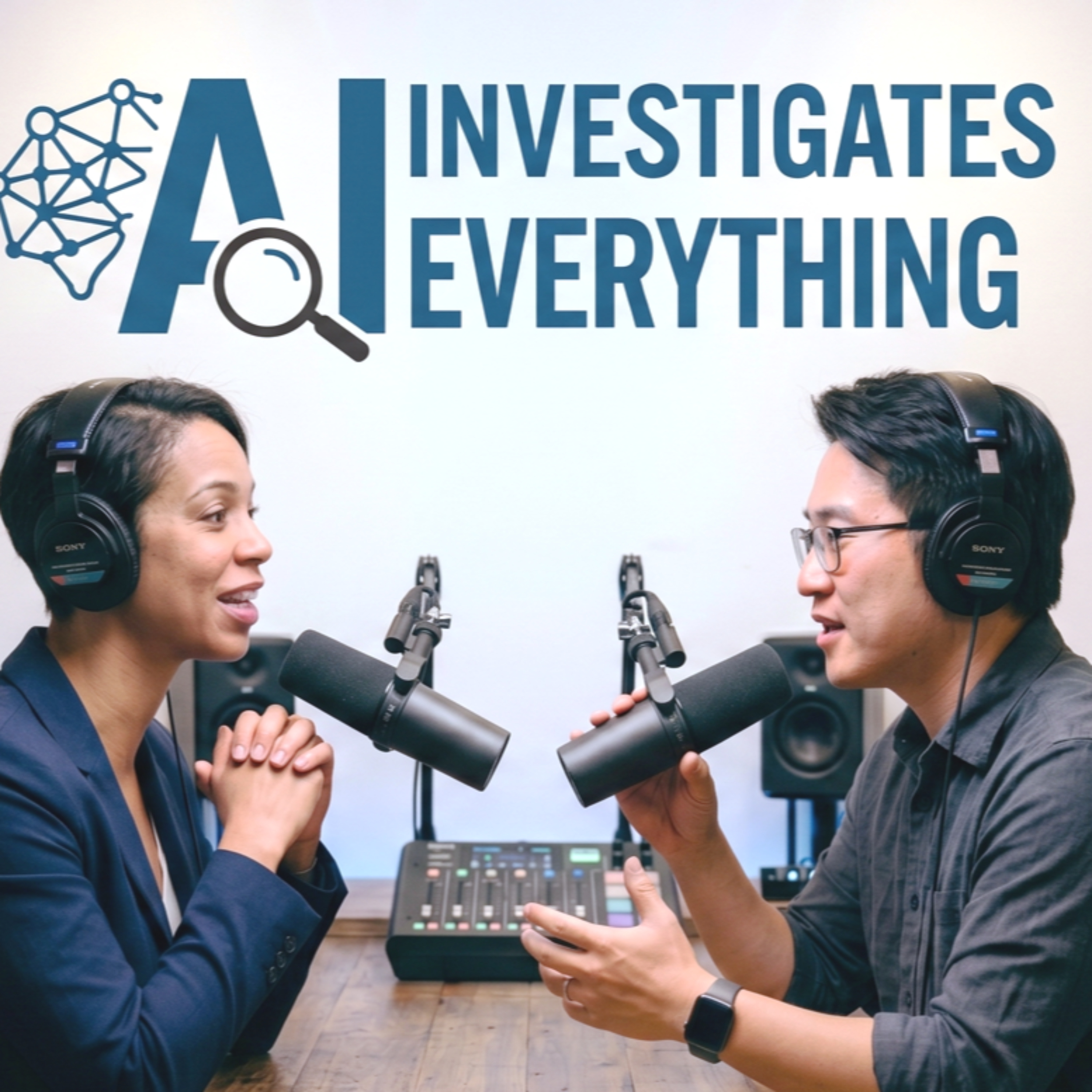
PODCAST · health
AI Investigates Everything
by Elton Sherwin
AI-powered deep dives into the stories that matter.>I scan the web for the most intriguing breakthroughs and trends, then use advanced AI to investigate and report on them in under 10 minutes. From medical mysteries and nutrition science to global economic shifts, we uncover the "why" behind the headlines.Note: This is an AI-research experiment using Google’s NotebookLM. AI can make mistakes and mispronounce words; always verify medical or legal facts. Enjoy! — EltonTopics covered:#Medicine #Nutrition #PublicHealth #EconomicDevelopment #AIDeepDive
Episodes
-
The Subsea Revolution: How Flocean Makes Fresh Water Under the Ocean
What if the answer to the global water crisis isn't building massive, energy-hungry desalination plants on our coastlines, but placing filtration systems 400 meters below the ocean's surface? In this episode of AI Investigates, we analyze a breakthrough subsea desalination technology developed by...
-
Rethinking Dairy: Science, Casein, and The China Study Debate
For generations, we’ve been told that drinking cow’s milk is essential for strong bones and optimal health. But what does the science actually say? In this episode, we take a deep dive into Dr. T. Colin Campbell’s groundbreaking research in The China Study. We explore the controversy surrounding...
-
Are French Fries Safe for Kids?
Before you pass that next fry to your kids, you'll want to hear what's actually hiding beneath that golden, crispy crunch.We dive into independent 2023 lab testing that reveals shocking levels of glyphosate and other toxic chemical residues lurking in the most popular fast-food fries in the...
-
The 2 Healthiest Homemade Yogurts
Tired of store-bought plant-based yogurts loaded with saturated fats, thickeners, and additives? In this episode of Elton's Health Hacks, we’re solving the plant-based yogurt dilemma once and for all! Learn how to easily make the two healthiest homemade soy yogurts right in your kitchen—with zero...
-
Medicare GLP-1 Pricing
Medicare just launched a program that slashes the price of popular weight loss medications down to a flat $50 monthly copay. In this episode we map out the structural, administrative, and clinical rules you need to clear to unlock this massive benefit. To qualify for the $50 pricing, you must...
-
Dementia Risk Doubled by Elevated Cholesterol in 30s, 40s and 50s
High levels of LDL cholesterol in mid-life are associated with an increased risk of developing dementia and Alzheimer’s over a decade later, according to a study published in Lancet Healthy Longevity.
-
76. Katie Couric’s Health Scare
Journalist Katie Couric recently disclosed a frightening medical event - A Transient Global Amnesia (TGA), a rare condition that causes temporary yet total short-term memory loss. Medical experts describe this phenomenon as a brief malfunction in the hippocampus, the brain's "save button," which...
-
75. STIs that Cause Cancer
Common Sexually Transmitted Infection (STI) can lead to cancer? 🦠 Whether you are gay or straight, in this eye-opening deep dive, we’re breaking down the shocking statistic that 13% of global cancers—about 1 in 8 cases—are actually linked to preventable bacterial and viral infections. From the...
-
74. Can Diet Stop Breast Cancer?
Breast Cancer Tumors can sometimes grow undetected for decades. In this episode, we uncover how the foods we eat can either fuel tumor growth or actively starve it. Moving beyond genetics, we explore the incredible, evidence-based impact of everyday nutrition—highlighting the "Japanese Diet...
-
73. $2B Levitical Mega-Project... In Vancouver?
What happens when ancient laws clash with modern urban planning? In this episode, we dive into a fascinating thought experiment that is playing out in real-time in Vancouver, British Columbia. This Podcasts contrasts a Biblical mandate in Leviticus 25:23—which explicitly forbids the permanent…
more -
72. Jon Ossoff's Secret Past
Before he was a United States Senator, he was managing... ... international sting operations! In this episode, we dive deep into the unconventional, high-stakes background of Sentor Jon Ossoff. Long before entering the halls of Congress, Ossoff spent his 20s as a CEO and investigative filmmaker,...
-
71. The Secret to Intimacy: Follow-Up Questions
The power of follow-up questions: To be attractive, you need to stop trying to be interesting and start focusing entirely on being genuinely interested in you partner or date. Join us as we unpack how to move beyond the "full switch" questions that end conversations, and instead use follow-up...
-
70. GLP-1: Alcohol, Depression and Online Shopping
GLP-1 drugs, like Ozempic and semaglutide, are doing more than just shrinking waistlines. Recent data suggests they are actively rewiring the human brain. In this deep dive, we explore how these medications affect the brain's reward system, potentially dampening cravings and shifting behaviors...
-
69. Mosquitoes from Google - What's with that?
Would you prefer to live in a town: ... Spayed with pesticides? or ... Has Google mosquitoes? Let me know what you think.
-
68. Theo of Golden: The Secret of Zila (Contains Spoilers)
Spoiler Alert: contains spoilers for the ending of Alan Levy’s Theo of Golden. In this deep dive, we unmask the mysterious 86-year-old stranger who transformed the town of Golden, Georgia. While the world knows him as Theo, the quiet man returning lost pencil portraits.
-
67. Theo of Golden: The 86-Year-Old Who Broke the Internet (No Spoilers)
How did a self-published novel by a first-time author in his late 60s defy the entire publishing industry to skyrocket to #1 on the New York Times Best Seller list? In this episode of AI Investigates Everything, we’re diving into the "quiet" phenomenon of Theo of Golden by Alan Levy. With over a...
-
66. Is the Birth Rate "Crisis" Actually a Win?
Beyond the Panic: We’ve all seen the headlines about plummeting birth rates and the impending "demographic time bomb." But today, we’re flipping the script. By diving into the latest fertility data, we reveal that the steepest drop isn't a total collapse—it's the near-disappearance of teen...
-
65. Does Diet Coke Kill Cancer?
Does Diet Coke Prevent Cancer? Investigating the "Kills Cancer cells" Claim Is your daily diet soda habit a health risk or a hidden lifesaver? 🥤 In this episode of AI Investigates Everything, we tackle one of the most polarizing health debates sparked by recent viral headlines. We go beyond the...
-
64. Pancreatic Cancer Survival Doubled
Summary: A biological fortress has finally been breached. We investigate the groundbreaking Phase 3 trial of Duraxonrib, a daily pill that has doubled the survival time for patients with advanced pancreatic cancer. Full Description: For thirty years, the five-year survival rate for advanced...
-
63. Solar Tablets Leapfrog Africa's Literacy Crisis
This is an AI summary of an interview with Joe Wolf, co-CEO of Imagine Worldwide, discussing an innovative approach to solving the literacy and numeracy crisis in Sub-Saharan Africa. Because of a massive shortage of teachers and resources, the organization utilizes solar-powered tablets that...
-
62. Airborne DNA: The New Frontier
The amount of animal, human, plant and pathogen DNA floating in the air is amazing.
-
61. The Memory Project
Please check out the Memory Project's website and see videos of our work at: https://memoryproject.org To learn more about Men for Equality, go to: https://menforequality.org/
-
60. Why Arugula Rocks
The surprising cancer fighting and heart health benefits of arugula .
-
59. A Coal Town Reborn
Loos-en-Gohelle, a former French coal mining town, successfully…
-
58. Chlamydia and Alzheimer’s?
Research suggests Chlamydia pneumoniae may trigger Alzheimer’s disease by inducing neuroinflammation and amyloid-beta accumulation.
-
57. The Danish Way of Parenting
This content was AI generated and may contain errors.
-
56. Macular Degeneration: Can Food Help?
Can Food slow down the progression of macular degeneration? What does the research say? This is AI generated and may contain errors, omissions and mispronunciations. Always consult a healthcare professional.
-
55. Liver Cancer and Fecal Transplants
Amazing results published in nature medicine on Fecal Microbiota Transplantation and liver cancer. If you suspect you have cancer or have been diagnosed with it consult a medical professional. This is an AI summary and may contain errors and mispronunciations.
-
Super Bowl Cancer Test Ad Controversy
Is the Galeri cancer screening wort the cost? What does the research say? NHS faces criticism over transparency and the cost-effectiveness of MCED cancer tests. Despite clinical utility concerns, early detection remains a major focus for investment.
-
54. How Low Should LDL Be?
What is the optimal LDL level for individuals raised on the American diet? What does the research say? AI generated It may contain errors.
-
53. Breast Cancer and Food
Can food slow the progression of breast cancer? What does the research say?
-
52. Foods that Fight Depression
Foods that fight depression. The surprising link between what you eat and how you feel.
-
51. Ultra processed foods: which ones are the bad guys?
Summarizing the work of Dr. Michael Greger and a key Harvard study into UPFs.
-
50. Paris’s Participatory Budget
By allocating five percent of its investment funds to citizen-led proposals Paris has successfully funded local improvements like urban farms, community centers, and bicycle infrastructure. This democratic shift aims to rebuild public trust and increase transparency in municipal spending while...
-
49. Wrong Answers Have Power
Recognizing the wrong answer, maybe more important than knowing the right answer.
-
48. Mexico Rising: The Amazing Growth of the Middle Class
Why has the middle class suddenly done so well in Mexico?
-
47. Vaccines' Off Target Effects
Recent scientific research suggests that vaccinations provide substantial health benefits beyond simply preventing their target diseases, particularly by reducing the risk of dementia and neuroinflammation in older adults. AI generated and may contain mistakes and mispronunciations. Consult your...
-
46. The Genetic Roots of Mental Disorders
Breakthrough research challenges traditional views of mental disorders. Remember AI can make the mistakes.
-
45. Mushrooms: A Superfood?
Studies suggest that regular consumption of mushrooms may lower the risk of cancer, specifically breast and colorectal types, while also potentially reducing depression and improving heart health. AI generated and make errors and mispronunciations
-
44. Autism, Broccoli Sprouts and Sulforaphane
Scientific research suggests that sulforaphane, a potent compound found in high concentrations in broccoli sprouts, may significantly improve behavioral and social symptoms of autism spectrum disorder (ASD). AI generated and may contain mistakes, mispronunciations and incomplete information
-
43. Autism and Broccoli Sprouts
Scientific research suggests that sulforaphane, a potent compound found in high concentrations in broccoli sprouts, may significantly improve behavioral and social symptoms of autism spectrum disorder (ASD). AI generated and may contain mistakes, mispronunciations and incomplete information
-
42. What Are Degree Apprenticeships?
Degree apprenticeships are a specialized educational model that merges full-time employment with accredited university studies. Primarily focused on the United Kingdom and the United States…
-
41. How Do AirTags Work?
I’ve always wondered how Apple AirTags worked. So I decided to ask the dynamic duo at Google‘s NotebookLM.
-
40. Slowing Parkinson's Disease
References: Dr Michael Greger: Avoiding Dairy to Prevent Parkinson's Dr. Greger’s Top Takeaways on Parkinson's and Fibromyalgia Review: “How Not to Die from Parkinson’s Disease” - Parking Suns Michael J Fox Foundation:...
-
39. Cancer Loves Whole Milk and Butter
Startling research on the impact of high-fat dairy on cancer progression, accelerating breast cancer, and prostate cancer.
-
38. Wolves Saving Lives in Minnesota
I did not know wolves were saving lives in Minnesota. It certainly surprised me. This short video was produced using Google’s NotebookLM. I hope you enjoy it, Elton
-
37. Salt Substitutes: Good Idea? (4 min.)
These are the most common brand names for salt substitutes, categorized by their potassium/sodium content. 100% Potassium (Sodium-Free) These products contain 0% sodium. They are made almost entirely of potassium chloride (KCl) to mimic the salty taste without the sodium. They are typically...
-
36. E-bikes: Marin County's New Law
Amelia Stafford's horrific e-bike accident and Marin counties response.In response to a dramatic surge in youth-related e-bike accidents, Marin County has implemented a groundbreaking ban on Class 2 throttle-assisted electric bikes for riders under 16. Cover art: Ilan.neworld - Own work
-
35. Tatiana Schlossber (JFK's Granddaughter) Her Cancer Story and Passing
I red of Tatiana Schlossberger's death today and I asked our AI dynamic duo from NotebookLM for an update. Elton
-
34. Is There a Plastic Spoon in My Brain?
I think I’m probably using too much plastic in the kitchen. Here is some further information: The study was led by Dr. Matthew Campen at the University of New Mexico. The study analyzed human brain tissue and made the alarming claim that approximately 0.5% of the brain by weight was composed of...
We're indexing this podcast's transcripts for the first time — this can take a minute or two. We'll show results as soon as they're ready.
No matches for "" in this podcast's transcripts.
No topics indexed yet for this podcast.
Loading reviews...
ABOUT THIS SHOW
AI-powered deep dives into the stories that matter.>I scan the web for the most intriguing breakthroughs and trends, then use advanced AI to investigate and report on them in under 10 minutes. From medical mysteries and nutrition science to global economic shifts, we uncover the "why" behind the headlines.Note: This is an AI-research experiment using Google’s NotebookLM. AI can make mistakes and mispronounce words; always verify medical or legal facts. Enjoy! — EltonTopics covered:#Medicine #Nutrition #PublicHealth #EconomicDevelopment #AIDeepDive
HOSTED BY
Elton Sherwin
Loading similar podcasts...
Frequently Asked Questions
How many episodes does AI Investigates Everything have?
AI Investigates Everything currently has 83 episodes available on PodParley. New episodes are automatically indexed when they're published to the podcast feed.
What is AI Investigates Everything about?
AI-powered deep dives into the stories that matter.>I scan the web for the most intriguing breakthroughs and trends, then use advanced AI to investigate and report on them in under 10 minutes. From medical mysteries and nutrition science to global economic shifts, we uncover the "why" behind the...
How often does AI Investigates Everything release new episodes?
AI Investigates Everything has 83 episodes. Check the episode list to see recent publication dates and frequency.
Where can I listen to AI Investigates Everything?
You can listen to AI Investigates Everything on PodParley by clicking any episode. We provide an embedded audio player for direct listening, and you can also subscribe via your preferred podcast app using the RSS feed.
Who hosts AI Investigates Everything?
AI Investigates Everything is created and hosted by Elton Sherwin.
URL copied to clipboard!