
PODCAST · science
Ashes and Adaptations
by Peyton Paa
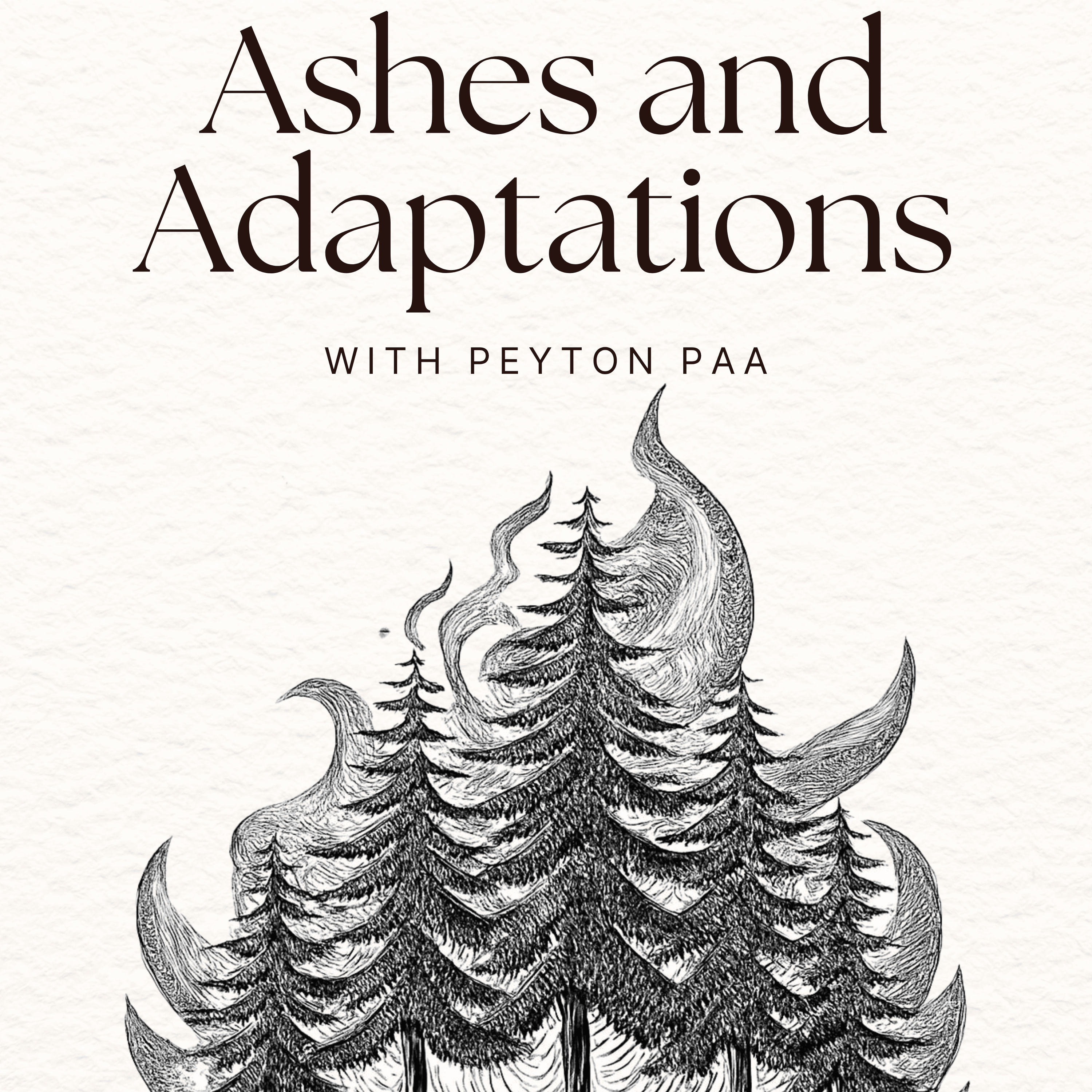
"Ashes and Adaptations" is a five-episode mini-series discussing plant adaptations shaped by fire. The goal of the project was to create an overview of fire as an evolutionary force and explain how climate change is harmful to fire-adapted ecosystems. From trees with flammable oils to cones waiting to open until after a fire, this series discusses a variety of interesting ways plants have evolved with fire. Tune in to learn more!
-
5
From Soil to Canopy: A Discussion with Jamie Woolet and Sarah Hettema on Fire Ecology
Welcome to a very special final episode of Ashes and Adaptations. To wrap up this mini-series, we will be discussing fire ecology with Jamie Woolet and Sarah Hettema. Jamie is a PhD candidate in the Department of Forest and Rangeland Stewardship at Colorado State University. Her research spans from the impact of wildfires on soil composition to how changing fire regimes affect avian communities. Sarah is a spatial analyst at Colorado State University, analyzing the landscape-level impacts of wildfire treatments on Colorado's Front Range. Each offers a unique perspective on the topic of fire adaptations.
-
4
The Phoenix Tree
The eucalyptus is an iconic species across Australia. Join us as we explore what makes them so unique in fire ecology. In this episode of Ashes and Adaptations, we'll be exploring epicormic budding, flammability, and serotiny in the eucalyptus tree. Sources: Nolan, R. H., Bowman, D. M., Clarke, H., Haynes, K., Ooi, M. K., Price, O. F., ... & Bradstock, R. A. (2021). What do the Australian black summer fires signify for the global fire crisis?. Fire, 4(4), 97.Pausas, J. G., & Keeley, J. E. (2017). Epicormic resprouting in fire-prone ecosystems. Trends in Plant Science, 22(12), 1008-1015.Younes, N., Yebra, M., Boer, M. M., Griebel, A., & Nolan, R. H. (2024). A review of leaf-level flammability traits in Eucalypt trees. Fire, 7(6), 183.
-
3
The Waiting Game: The Science of Serotiny
Some species don't simply survive fire, they depend on it. In the third episode of Ashes and Adaptations, we will be discussing serotiny. This remarkable fire adaptation uses heat to trigger seed release. We'll explain what serotiny is, how it works, and why it is beneficial. Sources:Parchman, T. L., Gompert, Z., Mudge, J., Schilkey, F. D., Benkman, C. W., & Buerkle, C. A. (2012). Genome‐wide association genetics of an adaptive trait in lodgepole pine. Molecular ecology, 21(12), 2991-3005.Schoennagel, T., Turner, M. G., & Romme, W. H. (2003). The influence of fire interval and serotiny on postfire lodgepole pine density in Yellowstone National Park. Ecology, 84(11), 2967-2978.
-
2
Layers of Surivival: The Power of Thick Bark
In this episode of Ashes and Adaptations, we're discussing one of the most unassuming yet powerful fire-adapted traits: thick bark. Some trees are built with a natural armor that can protect them from the high temperatures caused by wildfires. We'll explore how fire shapes ecosystems, the science behind bark thickness, variation among species, and limitations regarding thick bark as an adaptationSources:Fire behavior. US Forest Service Research and Development. (n.d.). https://research.fs.usda.gov/psw/fire/behaviorMadrigal, J., Rodríguez de Rivera, Ó., Carrillo, C., Guijarro, M., Hernando, C., Vega, J. A., ... & Espinosa, J. (2023). Empirical Modelling of Stem Cambium Heating Caused by Prescribed Burning in Mediterranean Pine Forest. Fire, 6(11), 430.Rosell, J. A. (2016). Bark thickness across the angiosperms: more than just fire. New Phytologist, 211(1), 90-102.
-
1
Overview of Evolution
Welcome to Ashes and Adaptations! This mini-series will be diving into various plant adaptations that have evolved in response to fire. This first episode explores evolution as a process, how adaptations arise, and corrects common misconceptions.Sources:Adaptation. (n.d.). Retrieved October 3, 2025, from https://evolution.berkeley.edu/evolution-101/mechanisms-the-processes-of-evolution/adaptation/Bilyk, K. T., & DeVries, A. L. (2010). Freezing avoidance of the Antarctic icefishes (Channichthyidae) across thermal gradients in the Southern Ocean. Polar biology, 33(2), 203-213.Raman, V., Wang, M., Avula, B., Lee, J., Manfron, J., & Khan, I. A. (2025). Chemical mimicry in the corpse flower: Floral odor and phytochemical profiles of Amorphophallus titanum (Becc.) Becc. Biochemical Systematics and Ecology, 118, 104920.
We're indexing this podcast's transcripts for the first time — this can take a minute or two. We'll show results as soon as they're ready.
No matches for "" in this podcast's transcripts.
No topics indexed yet for this podcast.
Loading reviews...
ABOUT THIS SHOW
"Ashes and Adaptations" is a five-episode mini-series discussing plant adaptations shaped by fire. The goal of the project was to create an overview of fire as an evolutionary force and explain how climate change is harmful to fire-adapted ecosystems. From trees with flammable oils to cones waiting to open until after a fire, this series discusses a variety of interesting ways plants have evolved with fire. Tune in to learn more!
HOSTED BY
Peyton Paa
CATEGORIES
Loading similar podcasts...
Frequently Asked Questions
How many episodes does Ashes and Adaptations have?
Ashes and Adaptations currently has 5 episodes available on PodParley. New episodes are automatically indexed when they're published to the podcast feed.
What is Ashes and Adaptations about?
"Ashes and Adaptations" is a five-episode mini-series discussing plant adaptations shaped by fire. The goal of the project was to create an overview of fire as an evolutionary force and explain how climate change is harmful to fire-adapted ecosystems. From trees with flammable oils to cones waiting...
How often does Ashes and Adaptations release new episodes?
Ashes and Adaptations has 5 episodes. Check the episode list to see recent publication dates and frequency.
Where can I listen to Ashes and Adaptations?
You can listen to Ashes and Adaptations on PodParley by clicking any episode. We provide an embedded audio player for direct listening, and you can also subscribe via your preferred podcast app using the RSS feed.
Who hosts Ashes and Adaptations?
Ashes and Adaptations is created and hosted by Peyton Paa.
URL copied to clipboard!