
PODCAST · history
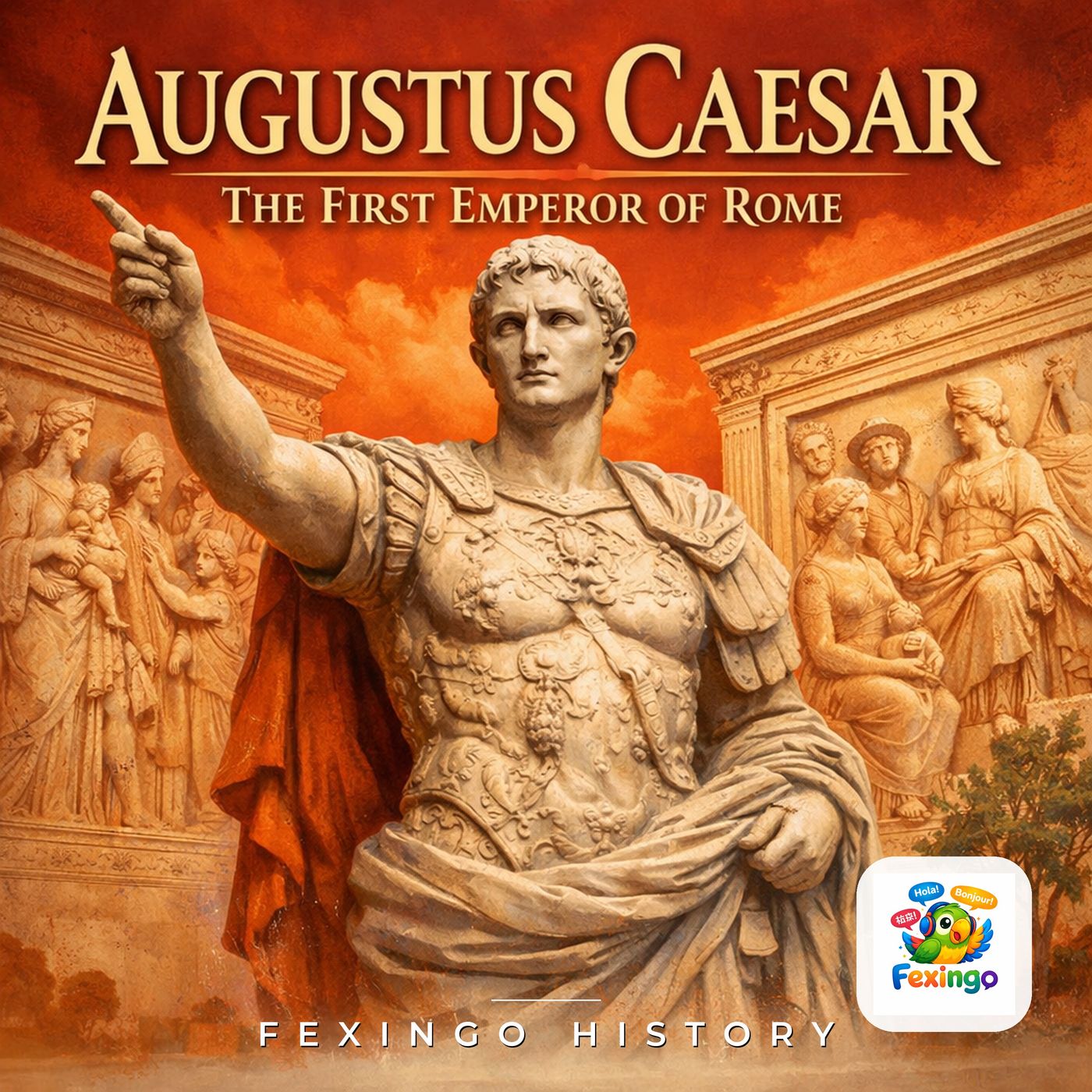
Augustus Caesar: The First Emperor of Rome — Fexingo History
by Fexingo
Augustus Caesar—born Gaius Octavius—transformed a fractured republic into the Roman Empire, setting a template for autocracy that would last centuries. This podcast follows his improbable rise from the chaos of Caesar's assassination through the civil wars against Mark Antony and Cleopatra, culminating in the creation of the Principate. Lucas and Luna explore the artful propaganda of the Res Gestae, the architectural programme that reshaped Rome from brick to marble, and the social engineering of marriage laws meant to revive traditional morality. They dissect the Battle of Actium (31 BCE), the annexation of Egypt, the reforms of the Praetorian Guard, and the bloody purges of political rivals. The show grapples with the paradox of Augustus: a peacemaker who maintained order through military dominance, a restorer of the Republic who dismantled its institutions. Each episode unpacks a facet of his reign—the Ara Pacis reliefs, the development of imperial cult, the frontier wars in Germani
-
34
Augustus and the Praetorian Guard: Rome's Shadow Power
In this episode, Lucas and Luna explore the origins and early years of the Praetorian Guard, the elite unit that began as Augustus's personal bodyguard and evolved into a kingmaker and threat to emperors. They trace its roots to the republican era, when generals like Scipio Africanus and Marius had their own praetorian cohorts, and follow Augustus's formal creation of nine cohorts in 27 BCE, stationed in Rome and Italy under the command of two equestrian prefects. The conversation covers the guard's role in Augustus's security, the Sejanus scandal under Tiberius that revealed its power, and its eventual disbandment by Constantine. Along the way, they touch on the guard's recruitment from Italy, its privileges and pay, and its part in the assassination of Caligula and the Year of the Four Emperors. The episode reveals how a bodyguard meant to protect the princeps became a political force that could make or break emperors, and asks whether Augustus's creation was a necessary safeguard or a fatal flaw in the imperial system. #Augustus #PraetorianGuard #RomanEmpire #Sejanus #Tiberius #Caligula #Rome #ImperialGuard #CastraPraetoria #Equites #RomanHistory #AncientRome #Bodyguard #Kingmaker #YearOfTheFourEmperors #Constantine #History #FexingoHistory Keep every episode free: buymeacoffee.com/fexingo
-
33
Augustus and the Roman Census: Counting Every Citizen
In 28 BCE, Augustus became censor and launched the first of three Roman censuses, a massive operation that would reshape Roman society and politics. This episode follows the meticulous process: the censors' proclamation, the five-year registration period, the oath-swearing at Rome's Forum, and the census tablets that recorded every citizen's name, age, property, and family. We hear how Augustus used the census to purge the Senate, reassign citizens to new tribes and centuries, and build a moral and social hierarchy that reinforced his authority. Along the way, we meet the censors and their staff, the freedmen who served as clerks, and the citizens who traveled from across the empire to Rome. We also examine the dark side: the registration of the poor, the infamia that stripped rights, and the census's role in taxation and military service. For context, we compare Augustus's census with the earlier Republican tradition and the later provincial censuses of Judea, known from the Gospel of Luke. This episode reveals how a simple counting of heads became a tool of imperial governance. #Augustus #RomanCensus #RomanHistory #Censor #RomanRepublic #RomanEmpire #Lustrum #Tribes #Centuries #ForumRomanum #28BCE #8BCE #14CE #ResGestae #RomanCitizenship #Infamia #ProvincialCensus #FexingoHistory Keep every episode free: buymeacoffee.com/fexingo
-
32
Augustus and the Peace of the Gods: The Ara Pacis Revisited
In this episode, Lucas and Luna take a fresh look at the Ara Pacis Augustae, the altar of peace that Augustus built in Rome. They explore its creation after the emperor's return from Spain and Gaul in 13 BC, the Senate's decree, and the intricate reliefs that depict the imperial family, including Augustus himself, Agrippa, and Julia. They discuss how the altar blended Greek and Roman artistic traditions to craft a new visual language for the principate, and how it served as a stage for dynastic messaging and the celebration of the Pax Romana. The episode also examines the altar's rediscovery in the 16th century, its reconstruction under Mussolini in the 20th, and its ongoing legacy as a symbol of Augustan peace and propaganda. Along the way, they consider the challenges of interpreting the altar's iconography, from the mysterious children to the allegorical figures of Tellus and Roma, and reflect on what the altar tells us about Augustus's careful construction of his own image and the ideological foundation of the Roman Empire. #Augustus #AraPacis #RomanEmpire #PaxRomana #RomanArt #RomanHistory #AugustanAge #ImperialRome #RomanReligion #Tellus #Agrippa #Livia #Mussolini #Rome #AncientHistory #HistoryPodcast #FexingoHistory #History Keep every episode free: buymeacoffee.com/fexingo
-
31
Augustus and the Ara Pacis: Rome's Altar of Peace
In this episode, Lucas and Luna explore the Ara Pacis Augustae, the altar of peace that Augustus built to celebrate his return from Gaul and Spain in 13 BCE. They discuss its discovery in the sixteenth century, its reconstruction in the twentieth, and its rich reliefs—from the mythological scenes of Aeneas and Romulus to the imperial family procession. You'll hear about the altar's location on the Campus Martius, its role in Augustan ideology, and the controversies over its interpretation. Lucas explains how the altar blends Greek and Roman styles, how it projects a message of stability after decades of civil war, and why it remains one of the most iconic monuments of Augustan Rome. The conversation also touches on the altar's afterlife, from its burial under the palazzo to Mussolini's reconstruction in 1938. A thoughtful look at how a monument can shape memory and identity. #AraPacis #Augustus #RomanArt #RomanHistory #AltarOfPeace #CampusMartius #ImperialRome #AugustanAge #RomanSculpture #RomanReligion #PaxRomana #RomanArchitecture #Mussolini #Rome #History #FexingoHistory #AncientArt #RomanEmpire Keep every episode free: buymeacoffee.com/fexingo
-
30
Augustus and the Aqua Virgo: Rome's Lifeline
In this episode of Fexingo History, Lucas and Luna explore the Aqua Virgo, the aqueduct that Augustus's right-hand man Agrippa built in 19 BCE—and that still feeds the Trevi Fountain today. They trace its 20-kilometre course from springs near the via Collatina, through the Campus Martius, to the public fountains and baths that defined Augustan Rome. Along the way, they uncover the legend of the young girl who showed Roman engineers the water source, the staggering logistics of moving 100,000 cubic metres of water daily, and the aqueduct's role in Agrippa's broader plan to transform the city. Lucas also explains how the Aqua Virgo survived the fall of Rome while its sister aqueducts crumbled, and why its rediscovery in the Renaissance sparked a new era of fountains. The conversation touches on Frontinus's treatise, the cura aquarum, and the daily life of ordinary Romans who depended on these flowing arteries. A note on listener support keeps the show ad-free. #AquaVirgo #Agrippa #Augustus #RomanAqueducts #TreviFountain #CampusMartius #Frontinus #CuraAquarum #AncientRome #RomanEngineering #RomanWater #FirstCenturyBCE #RomanBaths #RomanFountains #RomanUrbanism #History #FexingoHistory #AncientWorld Keep every episode free: buymeacoffee.com/fexingo
-
29
Augustus and the Art of Poetry: Ovid, Virgil, and the Augustan Age
In this episode, Lucas and Luna explore how Augustus shaped — and was shaped by — the greatest flowering of Latin literature Rome ever saw. They trace Virgil's Aeneid from its commission to its status as Rome's national epic, unpack the dark genius of Ovid's Metamorphoses, and follow Ovid's scandalous exile to Tomis on the Black Sea. Along the way they meet the poet Horace, whose odes celebrated the new regime, and the historian Livy, who gave Rome a usable past. How did Augustus turn writers into instruments of soft power? And what happened when a poet crossed him? With close readings of the Aeneid's opening lines and Ovid's Tristia, the conversation reveals a princeps who understood that controlling the story was as vital as commanding the legions. From the Palatine library to the frozen shores of exile, this episode unpacks the complicated dance between power and poetry. A must for anyone interested in Augustan culture, the birth of the Roman Empire, or the eternal tension between art and authority. #Augustus #Ovid #Virgil #Aeneid #Metamorphoses #Horace #Livy #RomanLiterature #AugustanAge #Exile #Tristia #PalatineLibrary #Tomis #RomanHistory #AncientRome #Poetry #History #FexingoHistory Keep every episode free: buymeacoffee.com/fexingo
-
28
Augustus and the Sybil: Prophecy at the Palatine
In this episode of Fexingo History, Lucas and Luna explore the little-known role of the Sibylline Books in Augustus's rise to power. From the burning of the original texts in 83 BC to their reconstruction and placement in the Temple of Apollo Palatinus, discover how Augustus used prophecy to legitimize his rule and shape Rome's destiny. The conversation covers the legend of the Cumaean Sibyl, the Roman process of consulting the oracles, and how Augustus carefully curated the books to align with his political agenda. With details on the temple's hidden archive, the quindecimviri sacris faciundis, and the Carmen Saeculare, this episode reveals a side of Augustus that is both fascinating and unsettling. Tune in for a fresh perspective on the first emperor's most mysterious tool of propaganda. #SibyllineBooks #Augustus #TempleOfApolloPalatinus #CumaeanSibyl #RomanProphecy #Quindecimviri #CarmenSaeculare #PalatineHill #AncientRome #RomanReligion #AugustanPropaganda #RomanHistory #Oracles #LudiSaeculares #Virgil #Aeneid #History #FexingoHistory Keep every episode free: buymeacoffee.com/fexingo
-
27
Augustus and the Art of Imperial Portraiture
In this episode of Fexingo History, Lucas and Luna explore how Augustus used portraiture to craft his image as Rome's first emperor. From the famous Prima Porta statue to the lesser-known Via Labicana type, they trace the origins of these images back to the Hellenistic rulers of Egypt and Asia Minor, like Alexander the Great and Ptolemy II. They discuss the Greek sculptor Pasiteles, the mysterious 'Prima Porta master', and the use of the Corinthian helmet to evoke Alexander. The conversation also touches on the Capitoline Brutus, the veristic style of the Roman Republic, and Augustus's official portraits in the provinces, including the Augustus of Merida. They consider how these images were distributed across the empire and how local workshops adapted them. The episode ends with a reflection on whether Augustus's portraits were propaganda or a genuine expression of his vision for Rome. #Augustus #RomanPortraiture #PrimaPorta #AlexanderTheGreat #HellenisticArt #Pasiteles #CapitolineBrutus #ViaLabicana #AugustusOfMerida #RomanArt #ImperialCult #RomanEmpire #AugustanAge #ClassicalAntiquity #ArtHistory #History #FexingoHistory #Mediterranean Keep every episode free: buymeacoffee.com/fexingo
-
26
Augustus and the Roman Triumph
In the summer of 29 BCE, Octavian returned to Rome from the East with three days of triumphs, marking the end of the civil wars and the beginning of a new era. But behind the pageantry lay a carefully crafted political message: the triumph was no longer a celebration of a victorious general, but a ritual of imperial unity, with Octavian — soon to be Augustus — casting himself as the restorer of the Republic and the heir of Caesar. In this episode of Fexingo History, Lucas and Luna explore the history of the Roman triumph from its Etruscan roots to its Augustan reinvention. They trace the evolution of the pompa triumphalis, the role of the Senate in voting triumphs, the controversial triumphs of Julius Caesar, and the subtle changes Augustus made to the ceremony itself — including the use of the closed triumphal chariot, the restriction of triumphs to the imperial family, and the eventual replacement of the triumph with the ovatio and the ornamenta triumphalia. We also meet some of the forgotten figures who paid the price for imperial pageantry: the conquered kings and generals who were paraded in chains and often executed at the foot of the Capitoline. And we consider the strange afterlife of the triumph in Roman art, from the reliefs on the Arch of Titus to the paintings of the Renaissance. A story of power, spectacle, and the making of an emperor. #RomanTriumph #Augustus #Octavian #RomanHistory #RomanEmpire #Triumph #Capitoline #Jupiter #pompa #triumphator #Parthia #Pompey #JuliusCaesar #ResGestae #RomanMilitary #FexingoHistory #History #AncientRome Keep every episode free: buymeacoffee.com/fexingo
-
25
Augustus and the Art of the Cameo: The Gemma Augustea
Before the age of Instagram, the Roman emperor Augustus used a tiny carved gemstone called the Gemma Augustea to project his divine authority across the Mediterranean. In this episode, hosts Lucas and Luna explore the origins of the Augustan cameo, from the Hellenistic courts of the Ptolemies to the workshops of Rome's most skilled gem-cutters. They trace how Augustus, who famously called himself the restorer of the Republic, used this luxurious art form to craft an imperial image that was both godlike and relatable. Along the way, they uncover the gem's connections to the goddess Roma, the emperor's triumph over the Germanic tribes, and the subtle political messages hidden in its intricate layers. They also discuss how cameos became one of the most enduring symbols of Roman power, influencing everything from Renaissance medallions to modern corporate logos. With their trademark blend of warmth and erudition, Lucas and Luna make the case that the Gemma Augustea is not just a beautiful object but a key to understanding how Augustus rewrote the rules of Roman politics—and how we still live with those rules today. #GemmaAugustea #Augustus #RomanCameo #ImperialArt #CameoSardonyx #RomanPropaganda #AugustanIdeology #Livia #Tiberius #RomaDea #HellenisticArt #Ptolemies #RomanEmpire #PaxRomana #ArtHistory #History #FexingoHistory #AncientRome Keep every episode free: buymeacoffee.com/fexingo
-
24
Augustus the Godfather: Politics and Family in Rome
In this episode, Lucas and Luna explore how Augustus used family as a political instrument, examining arranged marriages, adoptions, and the marriages of his daughter Julia. They discuss the political calculations behind Julia's marriages to Marcellus, Agrippa, and Tiberius, the scandal of her exile, and the enforced marriages of the moral legislation. They also touch on the role of Livia, the patronage of poets like Virgil and Horace, and the legacy of the Principate's dynastic politics. #Augustus #JulioClaudianDynasty #JuliaTheElder #Livia #Agrippa #Tiberius #Marcellus #RomanMarriage #AdoptionInRome #RomanPolitics #Principate #Dynasty #RomanEmpire #PaxRomana #AncientRome #RomanHistory #FexingoHistory #History Keep every episode free: buymeacoffee.com/fexingo
-
23
Augustus and the Roman Games: Blood, Spectacle, and Crowd Control
For centuries, the Roman games were the great equalizer of the city—a place where the emperor, the senators, and the mob all breathed the same dust and roared at the same spectacle. In this episode of Fexingo History, Lucas and Luna explore how Augustus, the master of image and order, used the arena and the circus to project his authority, divert political energy, and keep the population of a million on his side. They trace the origins of the gladiatorial munus and the chariot races, the rise of the venatio with its exotic beasts, and the engineering marvels from the Circus Maximus to the Colosseum that still astound us today. They delve into the social meaning of the games—how seating was strictly graded by rank, how emperors stage-managed their own appearances, and how the cry of 'panem et circenses' became shorthand for a new kind of politics. And they confront the ethics: did the Romans ever question the bloodshed? What did the games do to the psyche of the city? Along the way, they consider the modern echo of these spectacles—from football stadiums to reality TV—and ask whether we've really moved as far from the arena as we like to think. #RomanGames #Augustus #Gladiators #ChariotRacing #CircusMaximus #Colosseum #Munera #Venatio #PanemEtCircenses #RomanEmpire #Spectacle #CrowdControl #RomanHistory #GladiatorCombat #Ludi #FexingoHistory #History #AncientRome Keep every episode free: buymeacoffee.com/fexingo
-
22
Augustus and the Parthian Standards: A Bloodless Victory
When Augustus boasted he had recovered the Roman standards lost at Carrhae, he wasn't telling the whole story. In this episode, Lucas and Luna dig into the diplomatic sleight of hand that turned a humiliating defeat into a cornerstone of Augustan propaganda. They follow the standards from Crassus's fatal march into Mesopotamia to their return in 20 BCE, negotiated not by force but by a combination of military pressure and imperial anxiety. They unpack who the Parthians really were—a sophisticated Iranian dynasty, not the nomad caricature of Roman sources—and why they returned the eagles so easily. They also look at the showdown with Phraates IV, the rival king Tiridates, and the shadowy envoy who may have brokered the deal. Along the way, they consider what the episode reveals about Augustus's genius for turning accommodation into triumph, and how the story of the standards became a model for later emperors. A surprising story of how diplomacy, not legions, shaped the Pax Romana. #Augustus #Parthia #Carrhae #RomanEmpire #PhraatesIV #Tiridates #Crassus #MarsUltor #Diplomacy #PaxRomana #PrimaPorta #ResGestae #AncientHistory #RomanHistory #ParthianStandards #FexingoHistory #History #Diplomacy Keep every episode free: buymeacoffee.com/fexingo
-
21
Augustus and the Art of Propaganda
In this 200th episode of Fexingo History, hosts Lucas and Luna explore how Augustus used art, architecture, and iconography to craft a new imperial image. From the statues of him as a youthful leader to the Ara Pacis's intricate reliefs, Lucas explains how these images were carefully designed to project peace, piety, and divine favor. The episode tackles the paradox of Augustus's reign: he claimed to restore the Republic while becoming its first emperor. Through stories of the Prima Porta statue, the Gemma Augustea cameo, and the Forum of Augustus, listeners learn how visual messaging became a political tool. Lucas also reveals how later emperors adopted Augustus's tactics, setting a template for imperial power that lasted centuries. This episode is a fresh angle on Augustus, concentrating on the visual language of power rather than military or political events. #Augustus #PrimaPorta #AraPacis #RomanArt #ImperialPropaganda #RomanSculpture #AugustanAge #RomanIconography #AugustusStatue #GemmaAugustea #RomanEmperors #RomanHistory #AncientRome #RomanArtHistory #PropagandaArt #History #FexingoHistory #RomanEmpire Keep every episode free: buymeacoffee.com/fexingo
-
20
Augustus and the Vestals: Rome's Eternal Flame
In 12 BC, Augustus became pontifex maximus, the chief priest of Rome — a role that gave him control over the Vestal Virgins, the six priestesses who guarded the city's sacred hearth. This episode explores how the first emperor fused political power with religious authority, and how the Vestals — women with unique privileges and brutal punishments — became a symbol of Rome's eternity. We trace the order's origins in the regal period, their role in state rituals, and the scandal of 114 BC that shook Rome. Lucas and Luna discuss the Vestals' daily lives, their legal independence, and the grim fate of those who broke their vows. We also look at Augustus's reforms, the burning of the Temple of Vesta in 12 BC, and how the emperor used religion to anchor his new regime. A story of fire, ritual, and the long shadow of tradition. #Augustus #VestalVirgins #RomanReligion #PontifexMaximus #TempleOfVesta #AncientRome #RomanEmpire #RomanWomen #PaxRomana #Livia #JuliaTheElder #RomanHistory #History #FexingoHistory #RomanRitual #Mythology #Romulus #NumaPompilius Keep every episode free: buymeacoffee.com/fexingo
-
19
Augustus and Agrippa: The Right-Hand Man Who Built an Empire
Marcus Vipsanius Agrippa was the architect of Augustus's success—the man who won the naval battles, built the aqueducts, and mapped the empire. This episode of Fexingo History follows the lifelong partnership between the princeps and his loyal friend, from the fields of Philippi to the victory at Actium, through the urban renewal of Rome and the failed Parthian campaign. We explore how Agrippa's practical genius complemented Augustus's political acumen, how he became the emperor's son-in-law and intended successor, and why his early death in 12 BC forced Augustus to reshape his plans for the imperial succession. Along the way, we examine the Pantheon, the Aqua Virgo, the Agrippan map of the world, and the enduring legacy of a man who preferred to be known as the greatest builder of his age, not the greatest general. This is the story of the quiet force behind Rome's first emperor. #Agrippa #Augustus #RomanEmpire #MarcusVipsaniusAgrippa #BattleOfActium #Pantheon #AquaVirgo #PaxRomana #RomanArchitecture #RomanNavy #Succession #CampusMartius #Marcellus #Tiberius #AgrippaPostumus #AncientRome #History #FexingoHistory Keep every episode free: buymeacoffee.com/fexingo
-
18
Augustus the Builder: The Saepta Julia and Public Spaces
In this episode of Fexingo History, Lucas and Luna explore one of Augustus's lesser-known but fascinating projects: the Saepta Julia, a monumental voting enclosure in the Campus Martius. Built to replace the old wooden voting pens, the Saepta was designed by Marcus Vipsanius Agrippa and completed by Augustus. We'll talk about its practical purpose — housing the centuriate assembly's votes — and its symbolic role as a stage for displays of imperial power. From the marble-clad porticoes and the Pantheon's neighbor to the elaborate public entertainments hosted there, we'll see how Augustus turned a functional space into a statement of his new Rome. Along the way, we'll touch on the Aqua Virgo, the Horologium Augusti, and the shifting meaning of public space in the early Empire. So join us as we step inside the Saepta Julia and uncover the secrets of one of Rome's most versatile monuments. #Augustus #RomanArchitecture #SaeptaJulia #CampusMartius #Agrippa #RomanElections #RomanEngineering #PaxRomana #ImperialRome #AncientHistory #RomanForum #AquaVirgo #HorologiumAugusti #Pantheon #RomanEmpire #History #FexingoHistory Keep every episode free: buymeacoffee.com/fexingo
-
17
Augustus and the Sign of the Zodiac: The Capricorn Coin
On August 19, 14 AD, Augustus died at Nola, and his sign was Capricorn — the goat-fish. Why did the first emperor put his horoscope on imperial coins? In this episode, Lucas and Luna explore Augustus's fascination with astrology, his use of Capricorn as a symbol of divine favor and cosmic destiny, and the controversy it stirred among Roman elites. From the Battle of Actium to the Ara Pacis, we trace how Augustus linked his birth to the heavens, how he consulted astrologers like Theogenes of Apollonia, and how the sign appeared on denarii and aurei across the empire. We also look at how astrologers were later banished — including Augustus's own edicts — and how the emperor's private beliefs clashed with public policy. This is the story of how a goat-fish became a symbol of Augustan power. #Augustus #Capricorn #Astrology #RomanCoins #RomanAstrology #Theogenes #Actium #AraPacis #ImperialCult #RomanReligion #Denarius #Aureus #RomanHistory #AncientRome #PaxRomana #History #FexingoHistory #AncientAstrology Keep every episode free: buymeacoffee.com/fexingo
-
16
Augustus and the Temple of Apollo Palatinus: Rome's Sacred Center
When Augustus built his modest house on the Palatine Hill, he did something no Roman had ever done: he attached a temple to his own home. This episode explores the Temple of Apollo Palatinus, inaugurated in 28 BC, and how it fused Augustus's personal piety with his political authority. We walk through the temple's Greek and Roman artistic treasures, the Sibylline Books relocated by Augustus himself, and the grand library that became a hub for poets like Horace and Virgil. We also dig into the temple's role in Augustus's religious reforms, its connection to the Secular Games, and how it subtly positioned Augustus as Apollo's chosen agent on earth. Along the way, we consider the broader Augustan building program, the symbolism of Apollo as a god of order and moderation, and the temple's lasting influence on imperial architecture. Join Lucas and Luna as they unravel the layers of meaning embedded in this sacred space, and reflect on how power in ancient Rome often wore the guise of piety. #Augustus #TempleOfApolloPalatinus #PalatineHill #RomanReligion #SibyllineBooks #AugustanArchitecture #Apollo #RomanHistory #AncientRome #ImperialCult #RomanArt #LudiSaeculares #Horace #Virgil #RomanPoetry #PaxRomana #FexingoHistory #History Keep every episode free: buymeacoffee.com/fexingo
-
15
Augustus and the Nile: Egypt as Rome's Imperial Granary
In this episode, we explore how Augustus turned Egypt into the personal property of the Roman emperor, transforming the ancient land of the pharaohs into the empire's breadbasket. We follow the conquest of Cleopatra's kingdom after Actium, the appointment of the first prefects, and the creation of a unique administrative system that made Egypt the emperor's private domain. We look at the Nile's annual flood, the grain fleets that fed Rome, and the propaganda of a new Golden Age. We meet figures like Cornelius Gallus, the poet-soldier who overstepped his bounds, and Strabo, whose eyewitness account paints a vivid picture of Roman Egypt. We also touch on the legacy of Egypt's wealth in the politics of the early Principate, from Agrippa's visit to the revolt of the Egyptian grain fleet under Claudius. This episode sits within our series on Augustus, filling in a crucial gap in our portrait of the first emperor's world. #Augustus #Egypt #RomanEmpire #Cleopatra #Actium #CorneliusGallus #Prefect #GrainSupply #NileFlood #Alexandria #PaxRomana #Principate #History #FexingoHistory #RomanEgypt #ImperialCult #AugustanAge #AncientWorld Keep every episode free: buymeacoffee.com/fexingo
-
14
Augustus and the Cult of the Emperor
In this episode of Fexingo History, Lucas and Luna explore how Augustus transformed Roman religion into a tool of imperial unity. They discuss the establishment of the imperial cult, from the worship of Roma and Divus Julius to the provincial altars at Lugdunum and the Sebasteion at Aphrodisias. The conversation covers the roles of the Augustales, the significance of the Ara Pacis, and the fusion of Greek and Roman traditions. They also examine the political implications of divinity, including Augustus's careful manipulation of his image as both mortal and divine, and how later emperors built upon his model. Through vivid examples and primary sources, the episode reveals how the imperial cult became the glue of the Roman Empire, shaping religious life, civic identity, and political allegiance for centuries. #Augustus #ImperialCult #RomanReligion #RomaDea #DivusJulius #AraPacis #Lugdunum #Aphrodisias #Augustales #Princeps #PaxRomana #RomanEmpire #AncientHistory #RomanReligion #History #FexingoHistory #Podcast #RomanHistory Keep every episode free: buymeacoffee.com/fexingo
-
13
Augustus and the Roman Roads: The Empire's Arteries
In this episode of Fexingo History, Lucas and Luna explore the vast network of Roman roads built and maintained under Augustus, the first emperor. From the via Appia and via Flaminia to the via Augusta in Hispania and the via Egnatia in the East, these stone-paved arteries moved legions, official dispatches, and trade goods across an empire stretching from the Atlantic to the Euphrates. Discover the practical engineering — the straight alignments, the layered foundations, the milestones (miliaria) that marked every mile — and the political genius behind Augustus's great road-building program, which tied distant provinces closer to Rome, enabled the cursus publicus (the imperial postal system), and projected the image of a ruler who had brought peace and order to the world. Learn about the curatores viarum, the senatorial officials Augustus appointed to oversee the roads, and hear how the via Augusta, built to commemorate the Cantabrian Wars, became the backbone of Roman Spain. This episode also touches on the lesser-known via Agrippa in Gaul and the strategic via Maris in the East, revealing how a web of roads knit together the Pax Romana. #Augustus #RomanRoads #ViaAppia #ViaFlaminia #ViaAugusta #CursusPublicus #RomanEngineering #Miliaria #PaxRomana #RomanEmpire #AncientHistory #RomanInfrastructure #ViaEgnatia #ViaAgrippa #CuratoresViarum #Milestones #HistoryOfRoads #FexingoHistory Keep every episode free: buymeacoffee.com/fexingo
-
12
Augustus and the Roman Arch: Gateways to Empire
In this episode of Fexingo History, Lucas and Luna step through the monumental arches that shaped Rome's imperial landscape. From the triumphal arches of the Republic to Augustus's own arches on the Roman Forum, they explore how these structures were far more than decorative gateways — they were billboards of power, victory, and dynastic ambition. Along the way, they discuss the first known triple arch in Rome, erected by Augustus in 19 BC to commemorate the return of the Parthian standards, and how its design influenced later emperors like Nero and Constantine. They also dig into the practicalities: who paid for these arches, how they were inscribed, and what they meant to everyday Romans. Expect details on the fornix, the Parthian standards, the via Flaminia, and the curious case of the arch of Gaius and Lucius. Plus, a warm thank-you to listeners who support the show via buy me a coffee dot com slash fexingo. #Augustus #RomanArch #TriumphalArch #ParthianStandards #RomanForum #ImperialRome #RomanArchitecture #AncientHistory #FexingoHistory #RomanEngineering #MarsUltor #ViaFlaminia #GaiusAndLucius #Nero #Constantine #RomanInscriptions #History #Podcast Keep every episode free: buymeacoffee.com/fexingo
-
11
Augustus and the Roman Calendar: Time Reborn
After Actium and the chaos of civil war, Augustus didn't just rebuild Rome's walls—he rebuilt time itself. In this episode, Lucas and Luna explore how the first emperor overhauled the Roman calendar, correcting centuries of drift, adding two months, and weaving his own story into the year. They discuss the pre-Julian calendar's flaws, the pontifices' mismanagement, and the meticulous reforms of 8 BC, including leap years and the renaming of Sextilis to Augustus. They also touch on the solar meridian in the Campus Martius, the political power of dating, and how the calendar became a tool of imperial ideology—setting patterns we still follow today. From the Numan calendar to the Julian reform and beyond, they reveal how Augustus made time itself a monument to his reign, a legacy every bit as enduring as marble or bronze. #Augustus #RomanCalendar #JulianCalendar #LeapYear #Sextilis #Pontifices #RomanTimekeeping #ImperialIdeology #PaxRomana #AncientRome #CalendarReform #MarcusVipsaniusAgrippa #Sosigenes #CampusMartius #SolariumAugusti #RomanHistory #History #FexingoHistory Keep every episode free: buymeacoffee.com/fexingo
-
10
The Temple of Mars Ultor and Augustan Revenge
In this episode, Lucas and Luna explore the Temple of Mars Ultor, the centerpiece of Augustus's Forum, and the story of revenge and political renewal that built it. They discuss the vow made before the Battle of Philippi, the Parthian standard recovery in 20 BC, and the temple's role as a stage for imperial spectacle, from the display of the standards to the trials of Julia the Elder. The episode also unpacks how Augustus used architecture to mesh his family's legacy with Rome's destiny, and what the temple's ruins tell us about the Augustan ideological project. #TempleMarsUltor #ForumAugustum #Augustus #Parthia #Philippi #BattleActium #RomanArchitecture #Vow #ImperialCult #RomanEmpire #JuliaTheElder #Trial #PaxRomana #Princeps #AncientRome #History #FexingoHistory #RomanForum Keep every episode free: buymeacoffee.com/fexingo
-
9
Augustus and the Legions: Forging the Imperial Army
How did Augustus transform a sprawling collection of civil war armies into a professional, standing military that would guard the empire for centuries? This episode dives into the nuts and bolts of the Augustan military reforms: the drastic reduction from 50 to 28 legions, the introduction of fixed service terms and regular pay, the creation of the military treasury (aerarium militare), and the establishment of the Praetorian Guard and urban cohorts. We explore the role of the auxilia, the oath of loyalty to the emperor, and the financial and political challenges of demobilizing after Actium. Lucas explains how these reforms solidified Augustus's power, settled veterans on land, and created a career army that would become the backbone of the Pax Romana — but also an enormous drain on the imperial budget. Along the way, we touch on the legions' distribution across the frontiers, the symbolic importance of the eagle standard, and the fate of the soldiers who fought in the Cantabrian Wars. A must for anyone curious about how Rome's military machine was professionalized under the first emperor. #Augustus #RomanArmy #Legions #Auxilia #PraetorianGuard #AerariumMilitare #Actium #PaxRomana #ImperialReforms #RomanHistory #Veterans #CantabrianWars #MilitaryHistory #AncientRome #Octavian #ProfessionalArmy #FexingoHistory #History Keep every episode free: buymeacoffee.com/fexingo
-
8
Augustus and the Marble City: Rome Transformed
In this episode of Augustus Caesar, hosts Lucas and Luna explore how the first emperor transformed Rome from a city of brick to one of marble. They discuss Augustus's ambitious building program — the Forum of Augustus, the Ara Pacis, the Mausoleum, the Theater of Marcellus, the Aqua Virgo aqueduct, the Pantheon, and the restoration of 82 temples. Lucas explains how these projects were not just practical improvements but also political propaganda, designed to project the Pax Romana and the emperor's authority. The conversation touches on the role of Agrippa as the master builder, the symbolic use of Carrara marble, and the lasting impact on urban planning. Along the way, they pause to reflect on listener support that keeps the podcast ad-free. This episode offers a vivid picture of Augustan Rome's physical and ideological landscape. #Augustus #AncientRome #RomanArchitecture #MarbleCity #PaxRomana #Agrippa #ForumOfAugustus #AraPacis #MausoleumOfAugustus #TheaterOfMarcellus #AquaVirgo #Pantheon #ResGestae #CampusMartius #CarraraMarble #ImperialPropaganda #History #FexingoHistory Keep every episode free: buymeacoffee.com/fexingo
-
7
Augustus and the Ludi Saeculares: Rebirth of Rome
In 17 BC, Augustus staged the most spectacular religious festival Rome had ever seen: the Ludi Saeculares, or Secular Games. This episode unpacks how the emperor revived an archaic Etruscan ritual to mark the dawn of a new golden age. We walk through the three-day ceremony on the Campus Martius and Palatine Hill, the secret rites at the Tarentum, and the role of the quindecimviri—the priestly college that guarded the Sibylline Books. Lucas and Luna explore how the Augustan poet Horace was commissioned to write a hymn for the occasion, the Carmen Saeculare, sung by a choir of 27 boys and 27 girls. We hear how the festival honored underworld deities like Dis Pater and Proserpina alongside Apollo and Diana, and how Augustus tied the games to his vision of a revived Rome after decades of civil war. The episode also reveals the logistical feat of organizing such an event, the symbolic use of torches and sacrifices, and how later emperors reused the framework. A deep dive into a single moment that captures the fusion of religion, poetry, and imperial power at the heart of the Augustan settlement. #Augustus #LudiSaeculares #SecularGames #Horace #CarmenSaeculare #17BC #Quindecimviri #Apollo #Diana #DisPater #Proserpina #CampusMartius #RomanReligion #AugustanPropaganda #PaxRomana #RomanHistory #FexingoHistory #History Keep every episode free: buymeacoffee.com/fexingo
-
6
The Varian Disaster: Augustus and the Teutoburg Forest
In 9 AD, the Roman Empire suffered one of its most humiliating defeats: the complete annihilation of three legions in the Teutoburg Forest. This episode explores the events leading up to the ambush, the betrayal of Arminius, and the devastating aftermath for Augustus. We discuss Varus's fatal mistakes, the political fallout in Rome, and how the disaster forced a permanent shift in Roman frontier policy. A story of ambition, deception, and the limits of imperial power, set against the backdrop of Germany's dark forests. #Augustus #TeutoburgForest #VarianDisaster #Arminius #RomanHistory #AncientRome #PubliusQuinctiliusVarus #LegioXVII #LegioXVIII #LegioXIX #Germania #MilitaryHistory #PaxRomana #Empire #Battle #AncientHistory #History #FexingoHistory Keep every episode free: buymeacoffee.com/fexingo
-
5
Augustus and the Res Gestae: The Emperor's Own Account of His Reign
In this episode of Augustus Caesar: The First Emperor of Rome, Lucas and Luna explore the Res Gestae Divi Augusti — the autobiographical inscription that Augustus himself composed to record his achievements for posterity. Discover how this remarkable document, carved on bronze pillars outside his mausoleum and copied across the empire, offers a first-person account of his military conquests, building projects, and distributions to the people. Learn about its survival through a nearly complete copy from the Temple of Rome and Augustus in Ancyra (modern Ankara, Turkey), known as the Monumentum Ancyranum. Lucas explains the structure of the Res Gestae, its key claims, and its role as a tool of imperial propaganda. From the conquest of Egypt to the return of the Parthian standards, the construction of the Forum of Augustus to the staging of gladiatorial shows, this episode unpacks how Augustus shaped his own legacy. The discussion also touches on the significance of the Latin and Greek versions, and what historians can learn from the gaps and silences in the text. #ResGestae #Augustus #RomanHistory #Epigraphy #PaxRomana #Princeps #RomanEmpire #AugustanAge #Ancyra #MonumentumAncyranum #Latin #Greek #RomanInscriptions #PrimarySource #RomanAchievements #AncientRome #History #FexingoHistory Keep every episode free: buymeacoffee.com/fexingo
-
4
Augustus's Moral Laws: Rome's Marriage and Adultery Reforms
Beyond his political and military achievements, Augustus sought to reform Roman morality through a series of laws that regulated marriage, childbirth, and adultery. Known collectively as the leges Iuliae and the later Lex Papia Poppaea, these laws aimed to boost the birth rate among the elite, punish adultery, and restore traditional family values. Lucas and Luna discuss the specifics: the incentives for having three children (ius trium liberorum), the establishment of a permanent court (quaestio perpetua) for adultery cases, the penalties for unmarried men and women, and the ironic hypocrisy when Augustus's own daughter Julia was exiled under the same laws. They explore the social impact, the resistance from the senatorial class, and how these laws fit into Augustus's broader program of moral revival. This episode offers a focused look at how the first emperor tried to legislate virtue—and the mixed results that followed. #Augustus #RomanLaw #LexJulia #LexPapiaPoppaea #iusTriumLiberorum #AdulteryReform #MarriageLaws #RomanMorality #JuliaTheElder #Ovid #RomanWomen #SenatorialClass #AncientRome #ImperialReforms #SocialLegislation #RomanHistory #History #FexingoHistory Keep every episode free: buymeacoffee.com/fexingo
-
3
Augustus and Maecenas: The Patron of the Augustan Age
In this episode of Fexingo History, Lucas and Luna explore the life and influence of Gaius Maecenas, the wealthy equestrian who served as Augustus's unofficial minister of culture. From his Etruscan roots to his role in brokering peace after the battle of Actium, Maecenas was the man who recognized and sponsored the greatest poets of the age: Virgil, Horace, and Propertius. Learn how he commissioned the Georgics and the Aeneid, how he used literature to promote Augustan values, and how his own luxurious lifestyle and eventual fall from grace reflected the contradictions of the new imperial order. Discover why the name 'Maecenas' became a byword for artistic patronage, and how one man's taste helped define an era of Roman history. #Maecenas #Augustus #RomanPatronage #Virgil #Horace #RomanPoetry #Aeneid #Georgics #Equestrian #RomanCulture #AugustanAge #PaxRomana #RomanHistory #AncientRome #FexingoHistory #History #RomanArts #CulturalRevolution Keep every episode free: buymeacoffee.com/fexingo
-
2
Julia the Elder: The Emperor's Daughter
In this episode of Fexingo History, Lucas and Luna delve into the life and tragedy of Julia the Elder, the only daughter of Augustus Caesar. Julia was born into the heart of Roman power in 39 BC, groomed to be the matriarch of a new imperial dynasty. Her marriages—first to her cousin Marcellus, then to Augustus's right-hand man Agrippa, and finally to the future emperor Tiberius—were all arranged to secure the succession. She bore five children, including Gaius and Lucius Caesar, Augustus's intended heirs. But as the dynastic plans unraveled, Julia became embroiled in scandal. In 2 BC, Augustus exiled her to the remote island of Pandateria on charges of adultery, allegedly with Iullus Antonius and others. The episode explores the political motivations behind her downfall, the role of Livia, and the profound personal cost of Augustus's vision for Rome. Through Julia's story, we see the tension between family and empire, and the human lives caught in the machinery of power. This is a tale of ambition, betrayal, and the fragility of imperial dynasties. #JuliaTheElder #AugustusCaesar #RomanEmpire #AncientRome #Livia #Agrippa #Tiberius #Ovid #Pandateria #LexJulia #DomusAugusta #JulioClaudianDynasty #RomanWomen #Exile #Scandal #History #FexingoHistory #PaxRomana Keep every episode free: buymeacoffee.com/fexingo
-
1
Augustus's Final Journey and the Succession of Tiberius
This episode explores the last years of Rome's first emperor, Augustus, and the carefully orchestrated transfer of power to his stepson Tiberius. We trace the deaths of Augustus's intended heirs—Marcellus, Agrippa, Gaius, and Lucius—and the forced adoption of Tiberius in AD 4. The conversation follows Augustus's final journey to Campania with Tiberius, his death at Nola on August 19, AD 14, and the role of Livia. We examine the reading of his will, the elaborate state funeral, and the controversial deification that turned Augustus into a god. The episode also touches on the suppression of Agrippa Postumus, the swift recognition of Tiberius by the Senate and army, and the constitutional adjustments that sealed the Julio-Claudian dynasty. With references to Tacitus, Suetonius, and the Res Gestae, this installment offers a poignant look at the end of an era and the birth of a new order. #Augustus #Tiberius #Livia #RomanEmpire #Succession #RomanHistory #JulioClaudians #Nola #DivusAugustus #ImperialFuneral #RomanSenate #AncientHistory #History #FexingoHistory #AugustanAge #PaxRomana #Princeps #RomanEmperor Keep every episode free: buymeacoffee.com/fexingo
-
0
Augustus and the Urban Cohorts: Policing Rome
In this episode of Augustus Caesar: The First Emperor of Rome, Lucas and Luna explore the creation of Rome's first unified police force: the Urban Cohorts (cohortes urbanae). Established by Augustus in 13 CE, these three elite units under the command of the Praefectus Urbi (city prefect) patrolled Rome's streets, maintained order at public events, and acted as a counterbalance to the increasingly powerful Praetorian Guard. The conversation delves into the cohorts' size, equipment, and daily duties—ranging from fire prevention to crowd control—and highlights their role in the infamous Varian Disaster aftermath and the reign of Tiberius. Listeners will learn about the key figures: the first city prefect, Lucius Calpurnius Piso, and the later prefect Lucius Volusius Saturninus, who served for decades. The episode also touches on the legal framework of the urban cohorts, including their jurisdiction over public order and their relationship with the vigiles and the Praetorians. A nuanced look at how Augustus balanced security, public safety, and imperial control in the heart of his capital. #Augustus #UrbanCohorts #CohortesUrbanae #PraefectusUrbi #LuciusCalpurniusPiso #LuciusVolusiusSaturninus #PraetorianGuard #Vigiles #AncientRome #RomanHistory #PaxRomana #RomanEmpire #PoliceHistory #PublicOrder #Tiberius #VarianDisaster #History #FexingoHistory Keep every episode free: buymeacoffee.com/fexingo
-
-1
Augustus and the Roman Legions' Pay and Pensions
In this episode, Lucas and Luna dive into the financial backbone of Augustus's professional army. How did the first emperor pay his 300,000 legionaries, and what happened when they retired? Learn about the aerarium militare, the military treasury Augustus founded in 6 CE, funded by a 5% inheritance tax and a 1% sales tax. Discover the centurion's salary ladder — from 3,600 sesterces for a centurion to 60,000 for a primus pilus — and how a common legionary's 900 sesterces a year compared to civilian laborers. We explore the donativum, the cash bonus paid from the emperor's personal fortune, and the land grants that caused friction with Italian towns. The episode also covers the financial crisis of 33 CE under Tiberius, when legionary pensions nearly collapsed, and the later reforms of Domitian that raised pay permanently. Finally, we touch on the retirement package: a discharge bonus of 12,000 sesterces or a plot of land, plus exemption from taxes and forced labor. A revealing look at the cold, hard cash that kept the Roman empire running. #Augustus #RomanLegions #AerariumMilitare #LegionaryPay #PaxRomana #Donativum #PrimusPilus #Centurion #InheritanceTax #VeteranPensions #RomanArmy #MilitaryFinance #Tiberius #Domitian #RomanEmpire #AncientHistory #History #FexingoHistory Keep every episode free: buymeacoffee.com/fexingo
-
-2
Augustus and the Secular Games Reborn in 17 BCE
In 17 BCE, Augustus revived the ancient Ludi Saeculares, a centurial festival that had nearly slipped from memory. Lucas and Luna explore the religious vision behind the Secular Games: how Augustus and the quindecimviri sacris faciundis orchestrated three nights of sacrifices to the Moirae, Ilithyiae, and Tellus on the Campus Martius and at the Tarentum. They unpack the Carmen Saeculare composed by Horace, the role of the Sibylline Books, and the political symbolism of the festival as a marker of a new Golden Age. Why did Augustus make the secular games his own, and how did the event's timing and rituals assert the dawn of the Pax Romana? This episode also looks at the Acta of the Secular Games, the stone record that preserves the official schedule, and what the fires, hymns, and theatrical shows reveal about Augustan religion and propaganda. #Augustus #LudiSaeculares #SecularGames #Horace #CampusMartius #Tarentum #Moirae #Ilithyiae #Tellus #CarmenSaeculare #Quindecimviri #SibyllineBooks #PaxRomana #AncientRome #RomanReligion #RomanHistory #History #FexingoHistory Keep every episode free: buymeacoffee.com/fexingo
-
-3
Augustus and the Censorship: Morality Laws and Social Engineering
In 18 BCE, Augustus Caesar, Rome's first emperor, pushed through the Lex Julia de adulteriis coercendis and the Lex Julia de maritandis ordinibus — laws that criminalized adultery, penalized the unmarried, and tried to force the Roman elite to marry and reproduce. Lucas and Luna explore how these moral reforms fit into Augustus's broader project of restoring tradition after civil war, the backlash from the senatorial class, and the ironies of enforcing family values when the emperor's own household was rife with scandal. They discuss the role of the censors, the use of sumptuary laws, the exile of Ovid, and the practical failures of Augustus's attempt to legislate virtue. The conversation also touches on how these laws shaped Roman law for centuries and what modern parallels might look like. A fresh look at the intersection of power, morality, and social control in the early empire. #Augustus #RomanLaw #LexJulia #MoralityLaws #RomanCensors #Adultery #Ovid #SocialEngineering #PaxRomana #RomanEmpire #LexPapiaPoppaea #SumptuaryLaw #JuliaTheElder #RomanWomen #AugustanReforms #AncientHistory #FexingoHistory #History Keep every episode free: buymeacoffee.com/fexingo
-
-4
Augustus and Livia: The Power Couple of Early Rome
This episode explores the political and personal partnership of Augustus and Livia Drusilla, the most influential couple of early imperial Rome. We examine Livia's role as advisor, her public image as the ideal Roman matron, and the controversial marriage that united two powerful families. Through the lens of the Porticus Liviae, the Ara Pacis, and ancient accounts by Tacitus and Cassius Dio, we uncover how Livia navigated the male-dominated world of Roman politics, her involvement in the succession of Tiberius, and the rumours of poisoning that have clouded her legacy. We also discuss the contrast between Livia's public persona as a figure of domestic virtue and her immense behind-the-scenes influence, including her role in the 'first ladies' of Rome. This episode offers a nuanced look at a woman who helped shape the Roman Empire yet remains one of history's most enigmatic figures. #Augustus #Livia #LiviaDrusilla #PorticusLiviae #AraPacis #Tacitus #CassiusDio #RomanEmpire #ImperialWomen #FirstLadyOfRome #Tiberius #JuliaAugusta #RomanHistory #PaxRomana #AugustanAge #History #FexingoHistory #Podcast Keep every episode free: buymeacoffee.com/fexingo
-
-5
Augustus and the Roman Calendar: Reforming Time Itself
In this episode, Lucas and Luna explore how Augustus Caesar reshaped the Roman calendar to consolidate power and project his image as a bringer of order. They cover the pre-Julian calendar's chaos, the introduction of the Julian calendar by Julius Caesar, and Augustus's key reforms: renaming Sextilis to August, adjusting leap years, and adding the Augustan holidays—including the Augustalia—that tied civic and religious life to the princeps. They discuss the role of the pontifices in managing time, the political implications of calendar control, and how Augustus's reforms influenced the Gregorian calendar still used today. The conversation reveals how controlling time itself was a subtle but powerful form of imperial propaganda. #Augustus #RomanCalendar #JulianCalendar #August #Sextilis #Pontifices #Augustalia #Epagomene #PaxRomana #Princeps #CalendarReform #RomanHistory #AncientRome #FexingoHistory #History #Podcast #ImperialPropaganda #Timekeeping Keep every episode free: buymeacoffee.com/fexingo
-
-6
Augustus and the Roman Aqueducts: Water for an Empire
Rome was famous for its aqueducts, but how did the first emperor manage the city's water supply? This episode follows Augustus's reforms of Rome's water system — from the repair of the Aqua Marcia and the construction of the Aqua Virgo (completed by Agrippa in 19 BC) to the creation of the cura aquarum, a permanent water commission. We meet Frontinus, the later water commissioner whose De aquaeductu gives us our best source. We discuss the Lex Quinctia and the fight against water theft, the scale of distribution (public fountains, baths, private connections), and the social implications — who got water, and who didn't. The episode also explores the political symbolism of providing clean water to the people: a concrete sign of the Pax Romana. #Augustus #RomanAqueducts #AquaVirgo #Frontinus #CuraAquarum #LexQuinctia #Rome #PaxRomana #Agrippa #AquaMarcia #RomanEngineering #WaterSupply #AncientRome #FexingoHistory #History #Podcast #ImperialRome #RomanTechnology Keep every episode free: buymeacoffee.com/fexingo
-
-7
Augustus and the Roman Fire Brigades: The Vigiles Urbani
In this episode, Lucas and Luna dive into the creation of Rome's first organized fire brigade, the Vigiles Urbani, established by Augustus in 6 AD. Discover how this paramilitary force of 7,000 men, mostly freedmen, patrolled the streets at night, fought fires with buckets and pumps, and acted as a de facto police force. Learn about their barracks, the role of the praefectus vigilum, and how the system evolved under later emperors. The conversation also touches on the political motives behind the reform, as fires in Rome often sparked unrest and conspiracy. This episode offers a fresh look at how Augustus consolidated power through public services and urban management, a side of his reign often overshadowed by military and political reforms. #Augustus #VigilesUrbani #RomanFireBrigades #AncientRome #RomanHistory #FexingoHistory #RomanEmpire #PraefectusVigilum #UrbanReform #Freedmen #RomanInfrastructure #PaxRomana #Princeps #Subura #CampusMartius #EmperorAugustus #History #Podcast Keep every episode free: buymeacoffee.com/fexingo
-
-8
Augustus and the Praetorian Guard: The Emperor's Double-Edged Sword
In this episode of Fexingo History, Lucas and Luna explore the creation and evolution of the Praetorian Guard under Augustus. After the Battle of Actium, Augustus transformed the ad hoc bodyguard units of Republican generals into a permanent, elite force stationed in Rome. But the Praetorians were always a double-edged sword: they protected the emperor, yet their proximity to power made them a political threat. Lucas explains how Augustus carefully structured the Guard — nine cohorts, each 500 men, commanded by two praefecti praetorio from the equestrian order, not senators — to prevent any single commander from becoming too powerful. He also stationed only three cohorts in the city itself, keeping the others in nearby towns to avoid the appearance of a standing army in Rome. The episode covers the Praetorians' role in imperial ceremonies, their donatives, and the long-term consequences: after Augustus, emperors who lost the Guard's loyalty often lost their lives. Listeners will learn about specific praetorian prefects like Lucius Seius Strabo and his son Sejanus, the Castra Praetoria built by Tiberius, and the fateful precedent set when Augustus centralized armed force at the heart of the empire. #Augustus #PraetorianGuard #RomanEmpire #PraetorianPrefect #CastraPraetoria #Sejanus #LuciusSeiusStrabo #BattleOfActium #EquestrianOrder #ImperialBodyguard #RomanMilitary #PaxRomana #CohortesPraetoriae #Donativum #FexingoHistory #AncientRome #History #Mediterranean Keep every episode free: buymeacoffee.com/fexingo
-
-9
Augustus and the Roman Roads: How the Empire Moved
In this episode of Fexingo History, Lucas and Luna explore Augustus's transformation of the Roman road network, a project as ambitious as any monument. They begin with the Golden Milestone in the Forum, a gilded marker set up by Augustus in 20 BCE that listed distances to every major city, making Rome the literal center of the world. Lucas explains how Augustus revived the neglected roads of the Republic, appointing ex-consuls as curatores viarum to oversee repairs, and personally funding the Via Flaminia from Rome to Ariminum. They discuss the land surveyors called gromatici, the famous milestone at Tongres from the Via Appia, and the concrete innovations like the strato of gravel and basalt slabs that made these roads durable for centuries. The episode also covers the practical consequences: faster troop movements, a postal system, and economic integration. Luna asks about the cost, and Lucas shares that Augustus spent vast sums from his own purse, using it as both infrastructure and propaganda. The conversation touches on the Tabula Peutingeriana, the Romans' only surviving road map, and ends with the irony that these roads, built for empire, later carried barbarian invasions. #Augustus #RomanRoads #ViaAppia #GoldenMilestone #CuratoresViarum #Gromatici #TabulaPeutingeriana #ViaFlaminia #PaxRomana #RomanInfrastructure #RomanPostalSystem #RomanEngineering #Milestones #RomanRepublic #RomanEmpire #MiliariumAureum #History #FexingoHistory Keep every episode free: buymeacoffee.com/fexingo
-
-10
Augustus and the Sign of Taurus: The Emperor's Zodiac
Lucas and Luna explore Augustus Caesar's deep connection to astrology. The first Roman emperor was born under the sign of Libra, but his horoscope was a closely guarded state secret, with astrologers like Thrasyllus advising him on imperial decisions. They discuss the use of horoscopes in Roman politics, the exile of astrologers, the legend of Augustus's own chart, and how the balance of Libra influenced his symbolic representation. This episode unpacks the tension between fate and free will in Augustan propaganda—and how a zodiac sign helped shape an empire. #Augustus #RomanAstrology #Libra #Thrasyllus #Horoscope #JuliusCaesar #ResGestae #PaxRomana #RomanReligion #AstrologyHistory #AncientRome #ImperialCult #Fate #FreeWill #Taurus #Astronomica #Manilius #FexingoHistory Keep every episode free: buymeacoffee.com/fexingo
-
-11
Augustus and the Imperial Cult: Worshiping the Emperor
In this episode, Lucas and Luna explore how Augustus navigated the delicate line between human ruler and divine figure. They discuss the imperial cult's origins, from the cult of Roma et Augustus in the provinces to the refusal of divine honors in Rome itself. Key topics include the temple at Pergamon, the altar at Lugdunum, the role of the provincial council (concilium provinciae), and the appointment of the first flamen Augustalis. The conversation also covers the significance of the deification of Julius Caesar, the controversial cult of the Genius Augusti in Rome, and how Augustus used religion to unify a sprawling empire without openly claiming godhood. Specific details like the festival at Narbo (Colonia Narbo Martius) and the priesthood of the sodales Augustales are examined, showing how Augustus created a civic religion that outlasted him. #Augustus #ImperialCult #RomanReligion #RomaEtAugustus #GeniusAugusti #FlamenAugustalis #SodalesAugustales #Pergamon #Lugdunum #ConciliumProvinciae #Deification #JuliusCaesar #ProvincialPriesthood #PaxRomana #Princeps #RomanEmpire #History #FexingoHistory Keep every episode free: buymeacoffee.com/fexingo
-
-12
Augustus and the Census: Counting Rome's Citizens
In this episode, Lucas and Luna explore Augustus's revival and transformation of the Roman census. After decades of civil war and demographic upheaval, the first emperor sought to count every citizen, assess wealth, and reorder Roman society. We dive into the mechanics of the census: the role of the censors, the registration process in Rome and across Italy, and the famous 'lustrum' purification ceremony. Discover how Augustus used the census not just to tally the population, but to reinforce social hierarchies, promote marriage and childbearing, and project an image of orderly renewal. We discuss the Res Gestae's proud claim of 4,063,000 Roman citizens in AD 14, the challenges of counting a far-flung empire, and the symbolic power of state knowledge. Special attention is given to the Lex Aelia Sentia and Lex Papia Poppaea as census-adjacent laws, and the census's role in shaping Augustan ideology. A natural link to the show's donation segment ties the theme of reckoning and responsibility to listener support. #Augustus #Census #RomanHistory #AncientRome #RomanCensus #ResGestae #Lustrum #Censor #ImperialRome #PaxRomana #Population #RomanCitizenship #LexAeliaSentia #LexPapiaPoppaea #SocialPolicy #Demographics #History #FexingoHistory Keep every episode free: buymeacoffee.com/fexingo
-
-13
Augustus and the Ludi Saeculares: Rome's Secular Games
In 17 BCE, Augustus staged the Ludi Saeculares, the Secular Games — a lavish, multi-day religious festival that marked the end of one saeculum (the longest human lifespan) and the beginning of another. But this was no mere tradition; it was a masterstroke of Augustan propaganda. This episode explores how the princeps used ancient Sibylline prophecies, nocturnal sacrifices to the underworld gods, and unprecedented public spectacles — including chariot races, theatrical performances, and a hymn composed by Horace — to declare that a new golden age had dawned under his rule. We examine the fragmentary Sibylline oracle that authorized the Games, the role of the quindecimviri sacris faciundis in interpreting it, the controversial reinterpretation of the saeculum itself, and the lasting impact of the event on Roman imperial ideology. Lucas and Luna also discuss the famous Carmen Saeculare, performed by a choir of 27 boys and 27 girls, and what the Games reveal about Augustus's blending of religion, politics, and popular entertainment. #LudiSaeculares #SecularGames #Augustus #CarmenSaeculare #Horace #SibyllineOracles #quindecimviri #CampusMartius #Tarentum #DisPater #Proserpina #Apollo #Diana #RomanReligion #AugustanPropaganda #PaxRomana #RomanHistory #FexingoHistory Keep every episode free: buymeacoffee.com/fexingo
-
-14
Augustus and the Ara Pacis: Rome's Altar of Peace
In 13 BCE, the Roman Senate voted to build an altar to Pax, the goddess of peace, to honor Augustus's return from campaigns in Gaul and Spain. The Ara Pacis Augustae, or Altar of Augustan Peace, was consecrated four years later on the Campus Martius. This episode unpacks the altar's intricate reliefs, including the imperial family procession with Augustus, Livia, Agrippa, and the little princes Gaius and Lucius Caesar, alongside Aeneas and Romulus. Lucas and Luna explore how the altar's iconography crafted a visual narrative of peace, piety, and dynastic continuity, drawing on Virgil's Aeneid and Augustus's own Res Gestae. They discuss the mysterious fragment of a child's face, the role of the Senate in commissioning the monument, and how the Ara Pacis survives today as a fragmentary but powerful emblem of Augustan ideology. #Augustus #AraPacis #PaxRomana #RomanArt #AugustanPropaganda #Livia #Agrippa #CampusMartius #RomanReligion #Aeneid #RomanSculpture #ImperialFamily #ResGestae #RomulusAndRemus #RomanHistory #FexingoHistory #History #AncientRome Keep every episode free: buymeacoffee.com/fexingo
-
-15
Augustus and the Temple of Apollo Palatinus: A God Next Door
In 28 BC, Augustus dedicated the Temple of Apollo Palatinus adjacent to his own house on the Palatine Hill, forging an unprecedented bond between the princeps and a patron deity. This episode explores how the temple served as a political and religious statement — a monumental expression of Augustus' piety, his claim to divine favor, and his subtle reshaping of Roman religion. We discuss the temple's architecture, its Greek art collection, the attached libraries, and the Sibylline Books housed within. We also examine how Augustus used the temple as a venue for Senate meetings and foreign embassies, blending the sacred with the political. And we reflect on the temple's legacy as a model for imperial cult spaces across the empire — including its influence on later forums and palaces from Rome to Constantinople. Specific figures include Augustus, Livia, Agrippa, and the poet Horace; specific sites include the Palatine Hill, the Temple of Apollo Palatinus, the Portico of the Danaids, and the libraries; specific concepts include imperial cult, Augustan ideology, and the Sibylline Books. #TempleOfApolloPalatinus #Augustus #PalatineHill #RomanReligion #AugustanIdeology #SibyllineBooks #ImperialCult #Livia #Agrippa #Horace #RomanArchitecture #PorticoOfTheDanaids #ResGestae #PaxRomana #RomanEmpire #AncientRome #History #FexingoHistory Keep every episode free: buymeacoffee.com/fexingo
We're indexing this podcast's transcripts for the first time — this can take a minute or two. We'll show results as soon as they're ready.
No matches for "" in this podcast's transcripts.
No topics indexed yet for this podcast.
Loading reviews...
ABOUT THIS SHOW
Augustus Caesar—born Gaius Octavius—transformed a fractured republic into the Roman Empire, setting a template for autocracy that would last centuries. This podcast follows his improbable rise from the chaos of Caesar's assassination through the civil wars against Mark Antony and Cleopatra, culminating in the creation of the Principate. Lucas and Luna explore the artful propaganda of the Res Gestae, the architectural programme that reshaped Rome from brick to marble, and the social engineering of marriage laws meant to revive traditional morality. They dissect the Battle of Actium (31 BCE), the annexation of Egypt, the reforms of the Praetorian Guard, and the bloody purges of political rivals. The show grapples with the paradox of Augustus: a peacemaker who maintained order through military dominance, a restorer of the Republic who dismantled its institutions. Each episode unpacks a facet of his reign—the Ara Pacis reliefs, the development of imperial cult, the frontier wars in Germani
HOSTED BY
Fexingo
Loading similar podcasts...
Frequently Asked Questions
How many episodes does Augustus Caesar: The First Emperor of Rome — Fexingo History have?
Augustus Caesar: The First Emperor of Rome — Fexingo History currently has 50 episodes available on PodParley. New episodes are automatically indexed when they're published to the podcast feed.
What is Augustus Caesar: The First Emperor of Rome — Fexingo History about?
Augustus Caesar—born Gaius Octavius—transformed a fractured republic into the Roman Empire, setting a template for autocracy that would last centuries. This podcast follows his improbable rise from the chaos of Caesar's assassination through the civil wars against Mark Antony and Cleopatra,...
How often does Augustus Caesar: The First Emperor of Rome — Fexingo History release new episodes?
Augustus Caesar: The First Emperor of Rome — Fexingo History has 50 episodes. Check the episode list to see recent publication dates and frequency.
Where can I listen to Augustus Caesar: The First Emperor of Rome — Fexingo History?
You can listen to Augustus Caesar: The First Emperor of Rome — Fexingo History on PodParley by clicking any episode. We provide an embedded audio player for direct listening, and you can also subscribe via your preferred podcast app using the RSS feed.
Who hosts Augustus Caesar: The First Emperor of Rome — Fexingo History?
Augustus Caesar: The First Emperor of Rome — Fexingo History is created and hosted by Fexingo.
URL copied to clipboard!