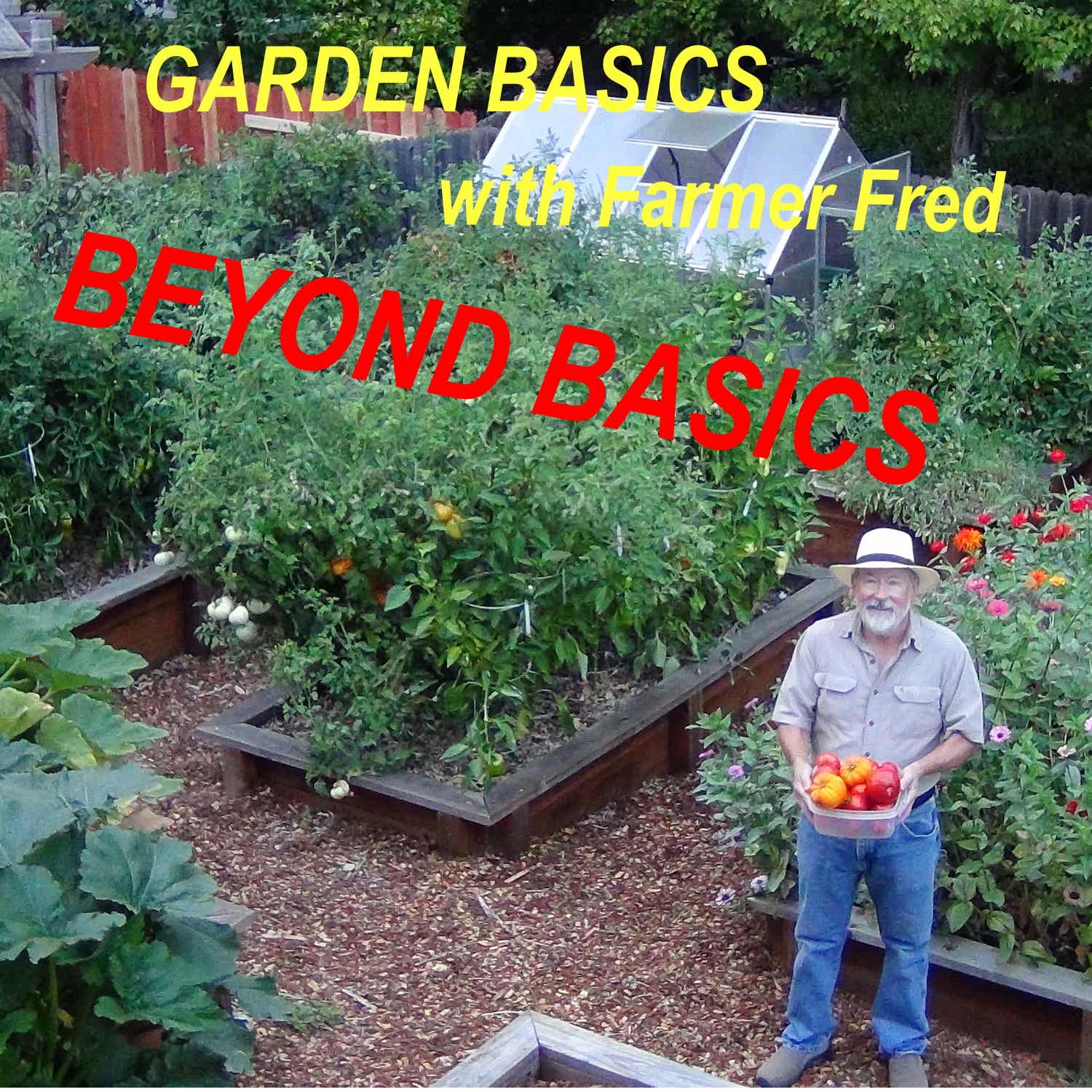
PODCAST · leisure
Beyond the Garden Basics
by Farmer Fred
Picking up where the Garden Basics podcast left off. gardenbasics.substack.com
-
180
More Heat-Beating Garden Tips
You may recall a couple of weeks ago on June 12, the Beyond the Garden Basics podcast featured myself and America’s Favorite retired horticulture professor, Debbie Flower, talking about protecting your outdoor plants in containers from the searing summer heat. That conversation was recorded during a live presentation at the 2023 Harvest Day festivities, put on by the Sacramento County, California Master Gardeners at the Fair Oaks Horticulture Center.Today’s podcast is the rest of that live presentation, where we discuss tips for saving Time Money and Water in the garden. Meanwhile, in this week’s newsletter, we have more advice for dealing with extreme heat in the garden this summer. This is a public episode. If you'd like to discuss this with other subscribers or get access to bonus episodes, visit gardenbasics.substack.com/subscribe
-
179
Controlling Starthistle, Summer's Most Evil Weed*
Today’s newsletter is all about starthistle, and all the ways you can control this summer weed…organically. If you want to read about chemical controls for starthistle, check out this University of California Ag and Natural Resources publication, “Yellow Starthistle”.In today’s podcast (above), America’s Favorite Retired College Horticulture Professor and I talk about the chemical side of weed control products, including all the different formulations of Roundup that are on the market, but they all have very different tasks; some can even sterilize your soil, making your garden unavailable for weeks, months, - or according to Flower - years. We offer tips for using herbicides, as well. We mention a University of Tennessee Institute of Agriculture publication about the different Roundup formulations entitled, “UPDATE ON ROUNDUP-BRANDED HERBICIDES FOR CONSUMERS” that can help you decide.One national database for insecticide/herbicide/miticide labels is the U.S. Environmental Protection Agency’s webpage, “Pesticide Product and Label System.” It’s not the easiest site to navigate, but be persistent. This is a public episode. If you'd like to discuss this with other subscribers or get access to bonus episodes, visit gardenbasics.substack.com/subscribe
-
178
Your Garden vs. Summer Heatwaves
We tackle how to help your garden cope with the late spring and all-summer heat waves coming our way in today’s podcast and newsletter. In the first part of the podcast (above), America’s Favorite Retired College Horticulture Professor, Debbie Flower, and I, concentrate on helping your plants in containers stay cooler in the summer.The second part of today’s podcast features a September 2022 chat with Sacramento County Master Gardener Gail Pothour, who had specific tips for helping your vegetable plants manage the heat. This is a public episode. If you'd like to discuss this with other subscribers or get access to bonus episodes, visit gardenbasics.substack.com/subscribe
-
177
Other Vegetables That Love the Heat
Today’s podcast features Sacramento County Master Gardener and vegetable expert Gail Pothour, extolling the virtues of growing okra in the summer. Gail’s encyclopedic knowledge of this warm weather crop will amaze you. Perhaps it’s her South Carolina heritage that adds to her love of okra. Sometimes disdained for its mucilanginous flavor (aka “slimy”), okra is a plant of many uses, including its leaves and flowers.What? Plant in June or early July? Yes, indeed. Many popular home garden crops - melons, squash, sweet corn, popcorn, and okra - get off to a stronger start when the soil is very warm (70’s-80’s), and the same is true for June-purchased transplants of these vegetables. This is a public episode. If you'd like to discuss this with other subscribers or get access to bonus episodes, visit gardenbasics.substack.com/subscribe
-
176
A Deep Dive Into Citrus Containers
Garden book author and citrus expert Lance Walheim, is a big proponent of growing citrus trees in containers. We discuss his techniques in today’s podcast, along with shameless plugs for his new book, “Citrus: A Gardeners’ & Fruit Lovers’ Guide.”For those of you in a hurry, here are some of the important points we touch on in the podcast:Choose compact citrus varieties for containers — Meyer lemon, kumquat, calamondin, and Bearss limes are ideal; avoid vigorous types like Lisbon lemon or grapefruit, which will quickly outgrow most pots.Upgrade container size gradually When repotting, go up only one size at a time (e.g., sleeve → 10-gallon → 15-gallon → half barrel). Transplanting immediately from the nursery pot to an oversized container can hold excess moisture around the roots and can cause rot.Prioritize drainage above everything else Check that your container has multiple drain holes (at least 4–5 for a half barrel, ½-inch diameter or larger), and drill additional side holes if needed.Raise your container off the ground Set pots on bricks, boards, or a furniture dolly to keep drain holes clear, prevent roots escaping into the native soil, and allow the bottom of the pot to dry properly. If setting pots in catch dishes, don’t let them hold standing water.Use quality commercial potting mix, not backyard soil Garden soil may compact easily, drain poorly, and can introduce pathogens. Consider amending potting mix with perlite, builder’s sand, or pumice for improved aeration, keeping in mind this will cause it to dry out faster.Avoid dark-colored pots in hot climates Black plastic containers in full sun can heat soil to 120–130°F on warm days, killing roots. Use fabric pots, light-colored containers, or nest a dark pot inside a larger one filled with mulch for insulation. Surrounding the citrus pot with other pots can help keep the citrus roots cooler.Fertilize consistently and at a diluted strength Use a liquid or water-soluble citrus fertilizer every two to four weeks. Make sure it contains not just nitrogen but also phosphorus, potassium, and micronutrients like iron, zinc, and manganese.Leach the soil every one to two months Run water slowly through the entire pot multiple times to flush out salt buildup. A white mineral ring around the pot is a sign salts have accumulated.Use a moisture meter to check watering needs Finger-testing the surface is unreliable in root-bound pots; a moisture meter tells you conditions 12 inches down where it matters.Mulch the top of the container A thin layer of bark chips or compost slows moisture loss and protects surface roots. Keep mulch away from the trunk.Transition plants indoors and outdoors gradually Over one to two weeks, move the pot into progressively shadier spots before bringing it inside, and reverse the process in spring. Expect some leaf drop indoors; a bloom cycle usually follows.Treat for pests before moving indoors Apply Neem oil or Spinosad before bringing the tree inside to prevent scale or whiteflies from establishing. Avoid applying oil when temperatures are above 85–90°F.Prune to maintain size and airflow Keep the tree’s center open for air circulation, remove crossing branches, and cut back vigorous shoots. Do major work (including root pruning, if necessary) in winter, the least stressful time.Look for Flying Dragon rootstock if you want a true dwarf This trifoliate orange rootstock keeps trees to 5–6 feet and is well-suited to long-term container growing, though it can be hard to find.Buy only from reputable nurseries Asian citrus psyllid and HLB disease have spread to all major citrus states. Purchasing certified trees (rather than propagating cuttings from friends) is the safest way to avoid bringing home an infestation. This is a public episode. If you'd like to discuss this with other subscribers or get access to bonus episodes, visit gardenbasics.substack.com/subscribe
-
175
Your 7 Favorite Beyond the Garden Basics Newsletter Editions
The Beyond the Garden Basics newsletter and podcast has been around awhile, with over 450 editions since August of 2022. That’s a lot of gardening info!Checking out nearly four years of newsletters and podcasts to learn more about gardening can be a daunting task. So, to help ease the process a bit, here are the seven most clicked-on (and time spent with) editions. This is a public episode. If you'd like to discuss this with other subscribers or get access to bonus episodes, visit gardenbasics.substack.com/subscribe
-
174
The No-Turn, Easy Compost Pile
In case you need a refresher course, here are some points about the benefits of using compost in your garden, according to the UC Master Gardeners of Alameda County:• Improves Soil Structure (Tilth): Lightens heavy clay soils and adds structure to sandy soils.• Saves Water: Increases the water-holding capacity, reducing runoff and water usage.• Feeds Plants & Soil Life: Adds slow-release nutrients and boosts beneficial microorganisms and earthworms.• Balances pH: Helps to buffer and balance soil pH (acidity/alkalinity).• Reduces Needs: Lowers the need for commercial soil conditioners and chemical fertilizers.• Protects Plants: Encourages healthy root structure, helps control erosion, and acts as a mulch to reduce weeds and moderate soil temperature.How to Use Compost (UCANR Recommendations)• As a Soil Amendment: Mix 1–4 inches of compost into the top 6–10 inches of soil before planting.• For New Beds: Apply 3-4 inches of compost and turn into the soil.• As Top Dressing/Mulch: Apply 1-3 inches around established plants, trees, and shrubs (keeping it away from the stems).• For Lawns: Spread a 1/2 inch layer of compost over the lawn in the spring.• When to Apply: Fall is best for improving soil structure, but it can be applied in spring to prepare for planting.• Materials: Composting kitchen and yard waste helps prevent landfill waste and acts as a nutrient-rich fertilizer.For the Snarkies among you who answered, “And compost mulch provides a place for cats to poop.” Hey! Get your head out of the toilet. We covered how to thwart that in a previous newsletter.But if you think composting is a lot of work, what if I told you that you can make compost using just two ingredients, and you don’t have to turn the pile, ever!Now that I have your attention, here’s what Kellie Hallenbeck and Judy McClure had to say in a recent Sacramento County Master Gardener newsletter:“The average person in the U.S. consumes about three cups of coffee per day, with landfills receiving 75% of those spent coffee grounds. Deep in landfills, grounds are robbed of oxygen, so they cannot decompose aerobically like they do in a compost pile or worm bin. Instead, coffee grounds are subject to anaerobic decomposition that can produce large amounts of methane. Methane is a greenhouse gas contributing to global warming, 25 times more potent than carbon dioxide.Composting with coffee grounds is easy if you remember they are high in nitrogen and considered green for compost purposes. Just add a good supply of carbon-rich material, like dried leaves and shredded paper. Too much nitrogen can cause the release of ammonium gas and cause foul odors. At the same time, too little nitrogen will slow down the decomposition process. Follow your routine of food scraps and grass clippings by mixing 1 to 2 volumes of “browns” (dry, woody materials) to 1 volume of “greens” (moist, green materials, filters with grounds). Add water and turn the mixture to add air.” (Or, don’t turn. Read today’s podcast transcript interview further on in this newsletter (or listen to it, above) with Master Gardener and composting expert Susan Muckey to find out the why and how).“In 2022, the Compost team experimented using only coffee grounds as the “greens” and dried leaves as the “browns” to see how the final product compares with traditional methods. Too many coffee grounds were added, resulting in the pile being too wet. The Compost team is trying again with a bin made of a hog/chickenwire ring. The pile was demoed at the March 2026 Open Garden. During you next FOHC visit, stop by the Compost area to check on the process.How can you help to keep coffee grounds from entering the landfill? Take a bag (or 2 or 3) for your home garden during Open Garden Days.Small changes add up over time. Just think: by adding grounds to your compost, you will be reducing waste and protecting our environment, all the while having your coffee too.”A 4’×5’ sheet of 6-inch Concrete Reinforcement Wire (CRW) wrapped end-to-end forms a cylinder roughly 19 inches across and 4 feet tall — plenty of structure to hold a season’s worth of material while letting air reach the pile from every side. The wire ends along the seam can be secured with several zip ties through the opposing squares to lock it shut, so no special tools are needed (and you can pop it open to turn the pile, if necessary).The chicken-wire or 1/2” hardware-cloth liner goes on the inside of the Concrete Reinforcement Wire cylinder so it’s held in place by the pile’s outward pressure rather than fighting it. That fine inner layer keeps loose material from spilling through the big 6-inch openings while still letting the whole bin breathe. Inside, layers of browns (shredded leaves) and greens (coffee grounds) are alternated, a 3 or 5 gallon bucket of each at a time, until the bin is full.The 2-inch perforated pipe runs straight down the center of the bin, poking a few inches above the top of the pile and reaching all the way to the ground. Holes drilled in a staggered pattern along its full length to more easily water the middle of the pile with a garden hose. The holes also let oxygen drift into the middle of the heap — the spot that otherwise goes anaerobic and slows down the composting process. PVC, ABS, or even a length of corrugated drain pipe all work; just drill 1/4’-3/8” holes every couple of inches around the pipe and cap or screen the top so it doesn’t fill with debris.The No-Turn Compost Pile TRANSCRIPTWe Talk with Sacramento County Master Gardener and compost expert Susan Muckey.Farmer Fred:[0:00] Did you know the average person in the United States consumes about three cups of coffee per day?Problem is, landfills are receiving about 75% of those spent coffee grounds. And those coffee grounds are buried deep into landfills, and then the grounds are robbed of oxygen so they can’t decompose. And what happens then, they become anaerobic and poof, they produce large amounts of methane. Methane is a greenhouse gas contributing to global warming, 25 times more potent than carbon dioxide. Did you know you could use those coffee grounds instead of sending it to a landfill? Put it in your compost pile. In fact, you could even make a compost pile using nothing but coffee grounds and leaves. Does that actually work? It just so happens they tested that here at the Fair Oaks Horticulture Center. We’re here at a workday where the Sacramento County Master Gardeners are hard at work, and we’re talking with Composter Supreme Susan Muckey, Master Gardener. And Susan, you did a little experiment back in 2022 on this.Susan Muckey:[1:08] Yes, we did. It was great. We took the tomato cages, which were pretty big tomato cages. They weren’t like the little skinny ones. And then we put chicken wire around them, and we started this in November. And actually, if I were to do this again, I would probably start it as early in the fall as I could, especially as soon as I have enough leaves to fill up a tomato cage. And then the hunt begins. You can go to Starbucks or some of the other places if you don’t drink coffee. And just use, I would say, 50-50 ratio of coffee grounds and leaves. And what happens is by six months, if it rains, and if it doesn’t rain, you’re probably going to have to water it a little bit. But if it rains, you’re going to have incredible compost. The most beautiful I have ever seen.Farmer Fred:[2:02] Let’s talk a little bit about the tomato cages you used. I think we’re standing next to one of them. That was probably a prime candidate for that project. And this is made out of concrete reinforcement wire. And those sheets are usually four by five or thereabouts, maybe four by six, and just formed into a circle. Sometimes they’re secured by zip ties. Sometimes people will bend the prongs together to secure it. But it gets you a tomato cage, six-inch mesh, that’s about five feet tall. and probably two feet wide. So that’s the size you want. And then you would wrap the outside of this with chicken wire.(FREDNOTE: others who have done this recommend putting the chicken wire or hardware cloth on the INSIDE of the tomato cage.)Susan Muckey:[2:40] Yes, because, well, I decided to do a beta test. And when we did it, and this is not in front of an audience, but we did it and we poured the leaves in. And guess what happened? All the leaves fell out. So then we said, oh, well, we probably need to put some chicken wire around it. And I find, too, that shredded leaves probably would work better than the regular leaves. And if you don’t have a leaf shredder, your lawnmower will work just as well.Farmer Fred:[3:13] I use my mulching mower for that. And I also use my weed whacker. And I’ll stick the leaves in the fall into a metal trash can. Remember 32-gallon metal trash cans? Well, they’re still around. And just put my string trimmer into that and cut them up, and it works fine. And in this day and age, you can save those leaves forever if you’ve got a big enough compost sack where you can just keep those leaves in until you need them.Susan Muckey:[3:47] Yesterday, I shredded five bags of leaves from last year and they were fine. The only problem is if you hadn’t shred them in the fall when you collected them, it’s very hard to shred them. They’re like a mass of muck. And so I could just take the top layer because those shredded just fine. But the bottom ones, because I think during the year, what happens is the moisture that’s in the leaves kind of goes down to the bottom, and now you’ve got all this moisture, even though the leaves were dry when I put them in the bag.Farmer Fred:[4:23] “Massive Muck” was the name of my band in high school, in case you didn’t know. The secret to a successful compost pile is a 50-50 mix of what are called greens and browns. Those fallen leaves, they’re browns. And I’m still trying to wrap my head around, how can coffee grounds be green?Susan Muckey:[4:40] Because they’re a source of nitrogen. And actually, once they’ve gone through the process of making coffee and brewing and whatnot, they are no longer extra acidic. Because that’s what people are afraid to use, coffee grounds, because they think they’re too acidic. But once you’ve processed them through the coffee-making process, I use instant coffee, so I don’t have that problem. But anyway, yeah, they will not be acidic.Farmer Fred:[5:08] How do you stack them when you’re adding green, when you’re adding brown? How big is each layer?Susan Muckey:[5:16] Okay, so what we did about a month ago, two months ago, is I did an interactive mini talk with my audience. And after I talked a little bit about compost and the components of compost, we went over to our trusty tomato cage and I had each one of them dump a bucket into it, of alternating leaves with coffee grounds.Farmer Fred:[5:40] Five-gallon bucket?Susan Muckey:[5:41] Well, some of them were five-gallon. I think the coffee ground buckets were smaller, like maybe the three-gallon ones from Lowe’s and Home Depot. And they all, one at a time, did it. And then we had somebody sitting there with the hose watering. It became their compost pile. And then we did a cheer when we finished it.Farmer Fred:[6:01] Now, of course, the secret to a successful compost pile is also air. So do you have to turn that pile?Susan Muckey:[6:08] No. That’s why it’s called a no-turn compost pile. And what happens is the materials you put together, they all start interacting with each other. And pretty soon, within about six months, you’re going to have compost.Farmer Fred:[6:22] Well, probably below what you can see on top. So the compost takes up how much of the bottom of the tomato cage?Susan Muckey:[6:28] Okay. So when we did the original experiment, I kept looking at the tomato cage and it still looked like nothing had happened, only that it had shrunk. It went to about half the size. And I said, okay, well, I’m tired of waiting. So we tipped it over and the outside was still the leaves because we didn’t turn it. But what came out of it was to die for. Even Farmer Fred would die for it.Farmer Fred:[7:00] Having a smart pot compost sack, I know that story well because I fill it with the shredded leaves and you look at the top and you go, nothing’s happening there. But then if you dump it out, all of a sudden there’s all this beautiful brown and black compost.Susan Muckey:[7:15] That’s right. That’s right. That’s exactly right. And I don’t remember because it was several years ago, four years ago, but I don’t remember if there was any worms in there. I can’t really remember if there were, but if there were worms in there, they probably would have aided in the decomposition process.Farmer Fred:[7:32] Now, obviously you’re using, if you’re using a three gallon bucket of coffee grounds, that’s probably more coffee than you’re going to make in a week, making your 10 cups (!) of coffee each day. So a lot of coffee shops will gladly give you a big bag or two. And that happens here at the Fair Oaks Horticulture Center. But is that just for Master Gardeners or anybody who shows up on an Open Garden day?Susan Muckey:[7:53] I think it’s for anybody. And actually, what I’ve done is if you give one of the coffee shops a five-gallon bucket, they’ll fill it for you.Farmer Fred:You just have to have a lid.Susan Muckey:Yeah, it should have a lid or a three-gallon if you can’t carry five gallons. But I find they don’t necessarily want to keep a lot of coffee grounds around. Now Starbucks, I know they’ll bag it up for you, you know if you’re really a true gardener you don’t want like just a little bag of coffee grounds you want a manly size bag of coffee grounds. they’ll say ‘Oh do you want us to put it in little bags?’ and i’ll say ‘No just give me a big bag.’ ‘Can you carry it?’ ‘Yes i can carry it.’Farmer Fred:[8:38] How big is the big bag?Susan Muckey:[8:39] It’s a garbage bag oh okay it’s probably a good 30 pounds.Farmer Fred:[8:44] You can drag it to your car.Susan Muckey:[8:45] No i wouldn’t want to drag it to my car, leaving A trail of coffee grounds.Farmer Fred:[8:51] You know. Well, it’s in a garbage bag.Susan Muckey:[8:53] Yes, it’s in a garbage bag, but as you’re dragging it. And also, you do not want it in your car. You know, coffee grounds all over your car.Farmer Fred:[9:03] How do you get it home?Susan Muckey:[9:05] I do carry it in my car, but it doesn’t have a hole in the bag. All right.Farmer Fred:[9:10] Well, use two garbage bags, one inside the other.Susan Muckey:[9:14] Yes, yes, yes. And I do try to take it out as soon as possible because my husband always says, your car smells like a garden.Farmer Fred:[9:22] Well, that’s putting it politely.Susan Muckey:[9:24] I know. He says, between the compost and all the other stuff you put in here, he doesn’t ride with me very often. Okay.Farmer Fred:[9:31] Well, my car usually smells of chicken manure and things like that. All right. So if you’re working with a converted tomato cage that is like five feet wide by two feet wide, If you went to get enough coffee grounds to fill up, say, half of it, it would probably be, and if it’s a garbage bag full, you’d probably need about two or three of those garbage bags.Susan Muckey:[9:58] Yes, it’s quite a bit. And you have to realize, too, when you put the leaves in, it kind of fills in between the spaces in the leaves. And so you’re going to need more than you think. And it’s better to have more than less. All right.Farmer Fred:[10:11] So think about that. If you never starteded a compost pile and you don’t want to have to turn it, you don’t have to do much to this one, except maybe add water regularly.Susan Muckey:[10:19] Yes. If it doesn’t rain. Yeah.Farmer Fred:[10:21] How often do you wet it?Susan Muckey:[10:23] Well, when we did it, we didn’t do anything to it. You know, when we did it in 2022, it must have rained because we didn’t do anything.Susan Muckey:[10:31] We didn’t turn it. We didn’t do anything. Since we started one about two months ago, what I would probably do is I would put a PVC pipe in the middle of it so that when I watered it, because we don’t know how much it’s going to rain, when you water it, the holes in the PVC pipe would disperse the water throughout a little bit better.Farmer Fred:[10:52] What diameter pipe is this?Susan Muckey:[10:55] I would probably use, well, for us, we use whatever we have. We live on a farm, so we just use whatever we have. But if you have an inch, that’d probably work.Farmer Fred:[11:04] Yeah, inch minimum, I would think, just to be able to stick a hose in it.Susan Muckey:[11:07] Right, right, right, right, right.Farmer Fred:[11:09] And if you’ve got a drill, you’re set.Susan Muckey:[11:11] That’s right. That’s right.Farmer Fred:[11:12] How big were the holes?Susan Muckey:[11:14] I don’t think it matters. I mean, you know, the only problem with PVC pipe is it’s really hard to, especially if you get really hard PVC pipe, I would go with softer stuff that’s not so hard to drill.Farmer Fred:[11:30] Oh, okay. That’s a good point because there are some thick three inch lines you can buy. Oh, yeah.Susan Muckey:[11:35] Yeah. I did a worm tower where, you know, you put a huge drainage pipe in your soil. And man, drilling those holes was terrible. It was very, very hard to do.Farmer Fred:[11:49] Now, I know somebody who did that. They had one next to a tree, and I think he drilled a hole that was about six feet deep and stuck a pipe in and would only water it through that perforated pipe. It seems like that would only water one side of the tree.Susan Muckey:[12:03] Well, this was a worm tower. And the worm tower would mean you would build a worm bin basically inside of this worm tower that you submerge into your raised bed or whatever you’re going to put it. Oh, okay, yeah. Yeah, yeah. So, no, no, it’s not for watering. It’s for raising the little cuties, the little red wigglers.Farmer Fred:[12:27] It sounds like an African keyhole garden.Susan Muckey:[12:29] Pretty much, yeah, yeah. Okay.Farmer Fred:[12:31] All right. We have an article about that. I’ll have a link to it in today’s show notes about that article, where you can learn about submerging something into your yard for the worms.Susan Muckey:[12:43] In fact, I don’t know if we still have it here, but we used to have somebody put in a five-gallon bucket, and they were just throwing all their scraps in there. And I’m not sure if we still have it or not, but we did it for several years.Susan Muckey:[12:55] So anyway, it’s just another way. There’s always a way that suits your style of life.Farmer Fred:[13:02] Okay. Now I have a personal question. I tore out some chard that has turned rather bitter. That happens in May. I’ve got the plants out of the ground. I want to feed the worms, the chard. What’s the best way to chop that up? They’re big leaves.Susan Muckey:[13:21] Clippers.Farmer Fred:[13:21] Oh, thank you.Susan Muckey:[13:24] Actually, my daughter, we, you know, so it’s bitter right now. Because what we do with the chard, with the big leaves, is we cut out the stem, and my daughter sautés it. And then she cuts all the other stuff up and puts a bunch of seasoning in it. It’s delicious.Farmer Fred:[13:39] Can I have your daughter?Susan Muckey:[13:40] Yes, you can. She actually lives in Folsom, too. Farmer Fred:[13:45] Oh, great. Well, I still think I’ll feed the worms the chard.Susan Muckey:[13:47] Oh, they’ll enjoy it. Don’t put any onions in there.Farmer Fred:[13:51] No, no.Susan Muckey:[13:52] Or garlic.Farmer Fred:[13:52] Yeah, it’s just I’m going to have to spend an afternoon with scissors.Susan Muckey:[13:56] Yes, that’s right. All right. Or you could put it in your freezer and that will break it down and then you could feed it to the worms.Farmer Fred:Directly?Susan Muckey:Yes.(FREDNOTE: THAT WAS THE TIP OF THE DAY! TIP OF THE DAY!)Farmer Fred:[14:06] Oh, God bless you. Thank you for that. Okay. I don’t even have to cut the leaves in half? No. No.Susan Muckey:[14:12] Because, you know, when you put like strawberries or something in the freezer, what happens? they turn to mush. Yeah.Farmer Fred:[14:20] That’s all. And you’ve always said, every talk I’ve ever heard you give about vermicomposting is, worms love mush.Susan Muckey:[14:26] Oh, they do. The ickier, the better. If you look in the back of your refrigerator in the bottom drawer, that slime that you’ve accidentally forgotten about, they would go, yum, yum, yum, because they don’t have teeth and they’re going to suck it in to their body. That’s the only way they can access the food that we give them.Farmer Fred:[14:48] How long should I keep the chard in the freezer?Susan Muckey:[14:51] Until it gets frozen.Farmer Fred:[14:53] Well, that’s it. So like a few days? Yes. And it turns to mush that quick?Susan Muckey:[14:57] Of course.Farmer Fred:[14:59] Wow. All right. The stuff you learn when all you came to talk about was coffee grounds and leaves. But that’s how you do it. There’s an easy plan for you: the No-Turn, Easy Compost Pile. And we will have this article in today’s newsletter about how you can have your coffee, keep the grounds and reduce the methane and all the problems we have with climate change, I guess. It’s just basically small changes add up over time. And by adding grounds to your compost, you’ll be reducing waste and protecting our environment and still have your coffee as well. Susan Muckey, Sacramento County Master Gardener, who is always wearing a composting shirt, usually one with a worm on it.Susan Muckey:[15:40] Of course.Farmer Fred:[15:40] Of course. Thank you so much.Susan Muckey:[15:42] You’re welcome.Beyond The Garden Basics is a reader-supported publication. Please become a paid subscriber. Heck, today’s tip about freezing oversized, bitter, bolting leaves of greens before feeding it to your worms is worth the price!Fred Hoffman is also a University of California Cooperative Extension Master Gardener in Sacramento County. And he likes his bikes. This is a public episode. If you'd like to discuss this with other subscribers or get access to bonus episodes, visit gardenbasics.substack.com/subscribe
-
173
Is This the Longest Lasting Cut Flower? Perhaps. But, Beware.
Is there a better-looking, longer lasting, cut flower than the alstroemeria? Is there a more invasive, underground spreading plant than the alstroemeria?Sometimes, to get to heaven, you have to go through a little hell.Also known as the Peruvian Lily, Lily of the Incas, Parrot Lily, Princess Lily, and “How the Heck Did You Get Over to the Other Side of the Garden?”, alstroemerias can easily last two weeks as a cut flower. Longer, if you are conscientious about clean water and floral preservatives (more on that below). This is a public episode. If you'd like to discuss this with other subscribers or get access to bonus episodes, visit gardenbasics.substack.com/subscribe
-
172
Tips For Growing Blackberries
If you’re looking for a superfood to grow, it’s hard to beat blackberries. They can be grown in just about every state in the United States. They’re highly adaptable, and they thrive in USDA zones from 4 all the way up through 10. Here in California, in USDA zone 9, they do quite well. They grow nearly anywhere that has enough sun.Today, we talk with Master Gardener and berry expert Jeff Smoker, who has tips for growing blackberries.Blackberries are considered a superfood.According to North Carolina State University, a superfood is so-called because it has a high ratio of nutrients to calories, and that is a perfect description of a blackberry.According to North Carolina State University, blackberries are low in fat and sodium. They make a very heart-healthy snack. They’re loaded with fiber, 7.6 grams per 100 per cup. Only 62 calories per cup. Carbohydrates, 13 or 14 grams. Less than 7 grams of sugar. Less than 1 gram of fat. And they even has 2 grams of protein. Plus, they are loaded with vitamin C, manganese, vitamin K, vitamin E, potassium. They’re high in antioxidants, which reduce free radicals, combat oxidative stress, and may protect against cancer, heart disease, and cognitive decline. This is a public episode. If you'd like to discuss this with other subscribers or get access to bonus episodes, visit gardenbasics.substack.com/subscribe
-
171
All About Basil
In this episode, we discuss the essentials of basil cultivation, highlighting the basil basics for home gardens. We cover basil soil preparation, planting, timing, and a few of the various flavorful basil varieties such as Sweet, Thai, and cinnamon basil. We include basil care tips such as watering, fertilization, and pest management.Special guest Rose Loveall-Sale from Morningsun Herb Farm shares her knowledge about basil’s cultural significance and culinary uses, as well as sharing her vast knowledge of even more basil varieties. Her audio was taken from her how-to basil video on YouTube , because this week she was busy getting ready for Morningsun Herb Farm’s annual open house day, on Saturday, May 2, an event that features speakers, vendors, crafts, demonstrations, and informational booths (including the Solano County Master Gardeners) at the nursery outside Vacaville, in the San Francisco Bay Area.More links and pictures about basil in today’s podcast transcript!ALL ABOUT BASIL - THE PODCAST TRANSCRIPTFarmer Fred:[0:00] If there’s one herb that practically begs to be grown at home, it has to be basil. The good news? It’s not fussy at all. It just wants what most of us really want. Warm weather, plenty of sunshine, and a good drink of water every now and then. Basil is happiest in fertile, well-drained soil that has lots of organic matter. Most garden soils, though, work just fine. But before you plant anything, it’s always worthwhile doing a quick soil test so you know exactly what you’re working with.Farmer Fred:[0:30] If the soil needs a nutrient boost, work your fertilizer into the top six inches. If you’re going the compost route, spread no more than one inch of well-composted material per 100 square feet. A little goes a long way here. The golden rule with basil is wait until after the last frost before planting. Cold soil is the enemy. If you’re starting from seed, basil germinates best when soil temps are between 75 and 85 degrees Fahrenheit, and you can expect the little sprouts to pop up in about 10 to 14 days. If you’re starting with transplants, we’ll give them about four to six weeks to size up and aim for a mid to late May planting. You want to sow seeds about one eighth of an inch deep. That’s barely covering the seed with perhaps some vermiculite. Cover it lightly and keep the soil consistently moist. Then, once your seedlings emerge, thin them to three to four inches apart. Then gradually work toward a final spacing of about 12 inches.Farmer Fred:[1:32] Hey, and don’t throw away what you thin out. Those little guys can be transplanted elsewhere or even tossed into your dinner salad. One tip worth remembering, basil grown in full sun develops more essential oils, and that means richer, more complex flavor. Shade-grown basil? It just isn’t the same, really. So the age-old question is, well, how much basil should I plant? Over a whole season, plan on 5 to 10 plants per person for fresh use, and maybe another 5 to 10 plants if you want to put some away for storage. That may seem like a lot, but believe me, you will go through it. The Master Gardeners of Sonoma County have suggestions for basil varieties worth trying.Farmer Fred:[2:15] Sweet basil is probably the most popular. It’s a large-leafed Mediterranean variety. It’s the primary culinary basil used in Italian cuisine, and it gets up to about two, two and a half feet tall. Purple or opal basil is similar to sweet basil, but it has dark bronze-purple leaves and pink flowers, and that’s a welcome color contrast in the garden and in dishes, although visually it’s really not very suitable for pesto. A somewhat more tender variety, purple basil grows to about the same height as sweet basil, about two and a half feet. Lemon or lime basil is a smaller plant, about 12 inches tall with white flowers, and a mild citrus aroma paired with many types of food. There’s also Greek or globe basil. That’s even smaller, about 6 to 12 inches tall, with tiny compact leaves, soft stems, and a very spicy character that’s useful in salads. Its compact size makes it a good container plant, too, and its hardiness allows it to thrive in poor conditions. Another one worth trying, cinnamon basil. That’s a spicy variety with a pronounced flavor, and it gets about 18 to 30 inches tall.Farmer Fred:[3:29] Thai basil. That can be recognized by its unusually serrated leaves and a spiciness that sort of resembles licorice. Used in Thai and Indian cooking, it grows about two to three feet tall. There are a few types of perennial basil, but all types for culinary use, those are annual basils. And for even more great basil varieties, watch the YouTube video mentioned on today’s podcast. It features Rose Loveall-Sale of Morningsun Herb Farm in Vacaville talking about a myriad of great-looking and great-tasting basil varieties.Farmer Fred:[4:04] How about watering basil? Well, you got to be careful here. Aim for about an inch and a half of water per week. Consistent watering keeps basil growing strong. If you let it wilt and you notice the plant starts to stress out, that’s going to slow growth and damage the roots. A drip irrigation system works beautifully for basil if you want to set it and mostly forget it. You may need to water, though, more frequently. But again, this warning, high temperatures combined with water stress will trigger the plant to flower and set seed. And when that happens, leaf production stops and the off flavors can develop. So you want to keep your basil plant happy and hydrated. Basil is a bit of a hungry plant, especially when you’re actively harvesting or growing it in a pot. Once it hits the harvestable stage, side dress with a liquid nitrogen fertilizer. About one to two tablespoons per gallon of water every two to three weeks per 10-foot row. One of my favorites is fish emulsion. Container plants appreciate a weekly feeding to help keep them thriving.Farmer Fred:[5:13] Your biggest headache with basil early on are probably going to be weeds. Basil really can’t compete with them when they’re young. So cultivate shallowly around those basil plants because you don’t want to prune out their roots. And consider laying down an organic mulch, like straw, leaf mulch, or even newspaper, to keep weeds at bay until the young plants get established.Farmer Fred:[5:36] For pests, grasshoppers and slugs and snails can chew up the leaves, but a row cover over young plants does a great job of keeping them off until they’re big enough to handle the damage from those pests. On the disease front, watch out for root rot and basal shoot blight. Both are fungal diseases, and the problem there is too much water. Good spacing, too, can help keep your plants about 12 inches apart and avoid overwatering them, and that can go a long way towards preventing any problems. Of course, the fun part of basil growing is harvesting. Once your plant has six to eight leaves, you’re ready to start harvesting. Use a sharp knife or scissors to cut leaf stems, leaving just two to four leaves on the plant. Alternate which plants you harvest from so you always have a steady supply coming in. Does Pinching Off Basil Flowers Make More Leaves Grow?The question arises, though, does pinching off the flowers make more leaves grow? Well, interestingly, according to Utah State’s horticultural extension services, not really. Pinching off flowers doesn’t actually stimulate new foliage. It can even cause flowers to form in the leaf axils, and that will reduce your overall yield. A better strategy is to stagger your planting every other week of the basil plants and keep the plants from getting stressed with proper water and proper light so that they’re less inclined to flower in the first place.Farmer Fred:[7:01] But I got to admit, basil flowers are pretty. And although deadheading any flowers may not help the basil plant redirect its energy to producing leaves, consider planting more basil plants than you plan to eat and let those extra basil plants begin to flower. Oh, the beneficial insects in your garden, especially the bees, will appreciate it. And your eyes and nose will appreciate it, too (and the flowers are edible!).How about for storing your basil? How do you go about it? For fresh basil for use in the kitchen, recut the stems and place them in a jar of water away from direct sunlight on the kitchen counter. Cover with a plastic bag and then for even longer life, refrigerate them for up to 7 to 10 days.Farmer Fred:[7:44] For dried basil, bundle the stems, hang them in a shady, well-ventilated spot, and they’ll be ready in 5 to 10 days. Pack the dried leaves in an airtight jar and they’ll stay good for about a year. You can also freeze basil leaves. They can be frozen, though they do get mushy when they thaw. For best results, freeze whole leaves in ice cube trays with water, or even better, make some pesto and freeze that into cubes. Use frozen basil within three to six months. And finally, let’s talk about the nutrition of basil. Beyond the flavor, basil is genuinely good for you. It’s rich in vitamin E, folate, and antioxidants, while being low in calories, sodium, and carbohydrates. Dried basil is even more concentrated with nutrients. So what’s not to like about this herb? It tastes great, it smells great, and it’s good for you. So plant some basil in May. For more information about even more basil varieties, including how to plant them and cook with them, here’s my friend Rose Loveall-Sale of MorningSun Herb Farm in Vacaville, California.BASIL TIPS FROM MORNINGSUN HERB FARMRose Loveall-Sale:[9:02] There’s only one word that we think of in the herb business in April, basil. This is our favorite herb we grow it all the time. The botanical name, Ocimum basilica. Everyone knows the common basils, But what I’m hoping to do today is to talk to you about some of the other basils that you really need to grow in your garden During my college days a friend of mine cooked a meal for me and he said i’m making you pesto It’s the best thing you’ll ever have.Rose Loveall-Sale:[9:28] I’ve never eaten basil, and I’d never eaten pesto before. But one time, and I was hooked, using this beautiful little Genovese basil. I took it back to my parents, and my father, who was very dramatic, said, if I had a million dollars, I’d spend it all on basil. Well, over the next 25 years, he and my mom ate pesto every week. And in the wintertime, she had to freeze enough for him and take it on vacation, take it camping everywhere. So it’s been a favorite of mine for about 25 years. and now no garden in America is complete without a basil plant. Our most common basil, our Genovese basil, is grown for our pesto making and for fresh use. There’s lots of other kinds of basils though, so I want to talk about those today. First I want to start though a little history of basil because there’s always some funny stories in the herb world. Back in the 17th century it was believed that basil would actually make you go crazy. So people didn’t want to eat basil because they thought it would make them die and go crazy.Rose Loveall-Sale:[10:28] So basil leaves were not used until really the 20th century, except by the Italians and Greeks. Now, of course, it’s used in cuisines all over the world. It’s native to North Africa, to the Mediterranean, and all over Asia, both temperate and tropical climates. Here in California, it’s grown mostly as an annual plant. It really likes warm temperatures, and it does not like cold nighttime temperatures at all. There’s a lot of really fun stories about basil. Basil is considered now the herb of love. So if you have a little pot of basil sitting on your windowsill, that means, in Italy at least, that you’re ready for a suitor.Rose Loveall-Sale:[11:06] So keep that in mind if you’re going to be putting your basil out on a windowsill this spring. It may be calling a new love into your life.Rose Loveall-Sale:[11:19] So what are all the different kinds of basils? Why do we want to grow all these wonderful basils? Besides our beautiful Genovese basil and our Italian large leaf basil, right now in these little pots they look very similar, but they have a little bit different flavor.Rose Loveall-Sale:[11:33] One of them, the Genovese, is a little stronger and the Italian large leaf is a little bit milder. These are both going to get about two feet tall and they’re going to be green plants with white flowers. Genovese basil and Italian large leaf basils are our common standard basils that we grow in our garden. There’s a lot of other basils to grow. We’re going to talk about each of those and what their uses would be. So let’s talk about some of the other basils that you will want to grow in your garden. One of my favorites is called Basil Napolitano. It’s got a huge leaf. Even in a little three-inch pot, the leaves are giant, and in the ground, the leaves are going to get up to four to five inches wide and long. This basil is also used a lot for pesto making. It’s a little bit milder, so if you don’t like the flavor of lots of licorice in your basil, this is a much better basil to use. It’s a little more gentle as far as its sun needs, so sometimes we plant this in a little bit of shade. It’s wonderful to use fresh, so if you’re making a hamburger, and you instead of putting lettuce want to put something more interesting, a couple of leaves of this beautiful basil are really an incredible little addition. Also, if you’re making a grilled cheese sandwich, a little bit of basil on that grilled cheese is wonderful. It’s a lovely plant to grow in the garden too. Rose Loveall-Sale:[12:59] My favorite basil is lemon. And lemon basil is actually a different species. There are 62 different species of basil in the world. We really only grow two or three different species. This is Ocimum basilicum ‘citriadora’. So this is lemon basil, and I wish you could smell this. It’s a bright lemony scent. It’s just wonderful.Rose Loveall-Sale:[13:21] Oh, now this (lemon basil) is a great summertime herb, in particular because I can think of, countless different things to do with this plant. So besides making a pesto, which would be great with fresh fish or chicken, or with some sort of a pasta or maybe even vegetables like zucchini, it makes a great bar drink addition. If you’re making a little gin and tonic, or if you’re muddling up a little something extra for a martini, lemon basil is the thing to use. If you’re a teetotaler, it’s an amazing tea plant. Basil is a member of the mint family, And so like many of the other mints, it has the qualities of being a good digestive. So an after-dinner tea of a little bit of lemon basil would make a wonderful addition after a heavy meal barbecue where you’re trying to settle your stomach. It’s just terrific. Lemon basil sorbet, lemon basil stuffed into chicken, lemon basil ice cream, lemon basil lemonade. It’s just endless possibilities with lemon basil. It’s really an amazing plant. We don’t have to just have green basils though, we can have basils that have amazing colors.Rose Loveall-Sale:[14:30] Two of my favorites are the Red Rubin basil, all purple leaves, very lovely, and a new one for us called Persian basil. These are both Ocimum basilicums, and they’re wonderful additions to the garden. These are both excellent as salad additions. So we always think of basil having to be made into something, but it doesn’t have to be made into anything in particular. As a salad green, it’s terrific. This one here, we started to grow two years ago, the Persian basil. And at first I said, well, it’s pretty, but what else is so interesting about it? And then I tried it. And that’s the fun thing about these basils is to try the leaves before you actually cook with them. It’s amazing. Just a slight citrusy undertone to it, a little bit of clove, a little bit of cinnamon to it. It’s really wonderful. It makes a nice little pesto or added to a salsa. It’s wonderful in salads, super pretty, easy to grow.Rose Loveall-Sale:[15:34] And it gives you just a completely different look to your garden. The purple basils, again like the Red Rubin, are again lovely as a salad addition. They also can be used for a rustic pesto, so you wouldn’t want to over-process this basil. If you take this beautiful purple basil and you just chop it so that it’s still fairly rough in your pesto, you’ll keep that beautiful purple color. If you over-process it so that it’s very smooth, it becomes a bit of a muddy color. The flavor is still good, but it’s not quite as an appealing look to it. So make sure you just leave it very rustic looking. So there’s some lovely choices there with your purple basils. Now maybe you don’t have space for a big basil. All the basils we’ve talked about so far, these basils all get 18 inches, 2 feet tall. They’re pretty darn big. Sometimes you need something that’s a little smaller. And that’s where spicy bush basil comes in.Rose Loveall-Sale:[16:30] These are called piccolino basils, tiny little leaf, very small plant. It only gets 10 to 12 inches tall. This is the one in particular in Italy. They say you put a little bit of this on your windowsill, and that tells your shooters that it’s time to come calling. The great thing about these small basils is they may be small in size, but they’re really big in flavor. So why you grow this, even if you have room for a big basil, it’s the flavor. Super punchy, super strong. This basil will hold up to being... So rather than use the other basils in your sauces, you would use this beautiful little small-leafed basil because even when it’s cooked, even when it’s heated up in pizza or sauces, it maintains that wonderful basil flavor. There’s lots of small-leafed basils. This is called spicy bush basil. I really love it because it just keeps going and going all season long. You can really prune it back and it comes right back. The flavor is really amazing on this basil.Rose Loveall-Sale:[17:33] We do have a whole different class of basils, and these are called Tulsi, or sacred or holy basils. These really have a different purpose for us. It’s a whole different species. It’s called Ocimum tenuriflorum, or sanctum, and these basils are considered sacred for the Hindus. There’s many different varieties of them. We grow several. We grow a beautiful one called Kapoor. Kapoor basil takes on these beautiful greenish leaves, heavy clove flavor. It’s a wonderful medicinal. It’s also a great one to use for cooking if you’re doing Asian cuisine or curries. This one here is called Rama, and this is our most important medicinal basil.Rose Loveall-Sale:[18:17] So I mentioned that basils are good for digestion, but also this particular species of basil, the Ocimum tenuiflorum, this one is also excellent as an adaptogen, meaning this basil you can actually use every day as a tonic in a tea form or a tincture and it helps reduce stress. So we can all use a little bit of this in our life every day. So it’s a great stress reducer. It’s good for bringing our bodies back into balance. Really a wonderful herb. These basils here, those tulsis, the sacred basils, these are used often as a sacred plant that every Hindu family grows at their front door. They have it somewhere in their home. It’s part of their tradition. And so here in the United States, we do grow it for medicinal and we also grow it for cooking as well.Rose Loveall-Sale:[19:07] Also, we have Thai basil. And Thai basil is that classic basil that we use in Thai cuisine.Rose Loveall-Sale:[19:16] Super, super heavy licorice, clove scented, almost a little bit of spiciness to it. Very beautiful to look at. It’s a fairly small basil, and it goes to flower very quickly. So you’re always pinching it back to keep it from flowering too much.Rose Loveall-Sale:[19:33] You’d use this in really heavy cuisines and Thai cuisine.Rose Loveall-Sale:[19:41] All the basils I’ve shown you so far are annual basils that we grow from seed, but there are some amazing new basils out there that you should be growing in your garden. This one is called Pesto Perpetuo. It is so wonderful. Notice that variegated leaf? This is a basil that is a Genovese-style basil, so it’s perfect in your garden. To use for pesto making, but it has one particularly wonderful quality about it. It does not bloom, so you never have to pinch back the blooms on this basil. It’s wonderful in a container. It’s great in a pot. It’s a little more cold hardy, so it can actually take a little more cold temperatures. Usually here in California, it will stay in our gardens until November, and if you live somewhere like Santa Barbara, it will overwinter with no problem. This is a beautiful, beautiful specimen plant to have in a container. It’s lovely. Even if you don’t like basil for cooking, it is a wonderfully pretty plant to grow in the garden. Now, the opposite of that are basils that we actually want to flower in the garden. These kinds of basils are sterile hybrids. It’s my favorite.Rose Loveall-Sale:[20:54] Well, after lemon basil, this is my favorite. This basil is called Wild Magic, and notice it’s blooming. We let this basil bloom on purpose. It gives lots of nectar to honeybees, but it doesn’t produce any seed. So you can let it bloom. It doesn’t produce seed and die like your other annual basils do. It gets about 14 inches tall. It is amazing looking in the garden, just beautiful.Rose Loveall-Sale:[21:23] ‘Wild Magic’ tastes great. It has a wonderful basil flavor, perfect for pesto making, wonderful to cook with. It’s very cold hearty. Here in California, in Northern California, we actually grow this one out in the garden usually until Christmas time or even later. It’s lovely to have in the garden, and it’s a beautiful plant to include even just with your perennial bed. So it will bring in lots of wonderful pollinators. We also like small little basils that will bloom in the garden. This one’s called Red Ball. It’s a gorgeous little specimen plant. It only gets about 12 inches tall, has that great purpley look to it, and a pink flower later on. Again, this one is another sterile specimen, so you can let it bloom. It’ll bring wonderful pollinators into the garden. It doesn’t change the flavor, unlike the other annual basils I showed you earlier, that once they start to bloom, you really have to get rid of those flowers quickly. So again, gorgeous, gorgeous, maybe lining your bed. Instead of annual flowers, why not put in something that’s yummy and helpful to bring in pollinators into your garden? Very pretty specimen plant. One of our most popular ones is a basil called Magic Mountain.Rose Loveall-Sale:[22:43] So this basil (‘Magic Mountain’) looks very familiar to a basil that people are familiar with called African blue. The difference is that African blue tastes like camphor, which is not anyone’s favorite flavor usually, but this one, mild sweet basil flavor for this magic mountain basil. This is about a two-footer. Again, this one will bloom, but it’s sterile, so it never produces seed. We only grow it from cuttings. Isn’t that a lovely specimen plant?Rose Loveall-Sale:[23:12] Finally, we also grow one called Ajaka. This has a big pink flower, and this plant tastes very similar to our Thai basil. So this has a punch to it. This one, spicy, heavy clove. This one you want to use for all your Asian cuisine. It’s really delicious. Lovely in the garden. It can get about two feet tall. Again, it’s going to last until November. It’s a lot more cold hardy. So all of these basils that I’ve just shown you, These are wonderful to have in your garden just to give more color for one thing, to include in their garden that’s going to go into the fall. Some people do bring these indoors and use these indoors during the winter if they have enough light. And you can let them bloom, except for your ‘Pesto Perpetua’, which of course will never bloom. And so that’s its best quality is not having to pinch it back.Rose Loveall-Sale:[24:07] These are wonderful new basil additions that people are just becoming familiar with now and growing in their gardens.How to Plant a BasilRose Loveall-Sale:[24:16] So now you’ve decided you have many more basils to choose from. How are you going to plant those basils? There’s a couple little tricks to planting basils so that you have a long harvest and so that your plants look good throughout the season. So we’re going to talk a little bit about how you’re going to grow your basil under the best conditions possible. So you’ve decided to plant all these different basils in your garden. What can you do to make sure that you have a success growing them? I’m showing you here how to grow basil in a raised bed. Now you can grow basil in a raised bed. There’s a benefit to that because you can raise it up if you have a bad soil, like a really heavy clay soil. It’s also a benefit because it warms the soil a little earlier in the season, so you can actually get root growth a little easier. And of course, it helps because it’s lifted up, so you don’t have to sit down so far. You don’t have to be on your knees to harvest. So if you have a raised bed, you wanna make sure you have soil that’s very usable and good. So here, we use a soil booster.Rose Loveall-Sale:[25:16] And we use a soil that we purchase in that has lots of organic matter, lots of earthworm castings, a little bit of bat guano. It also has some organic slow-release fertilizer. You can see it’s fairly light. It’s not really sandy, but it’s not this heavy clay. So you don’t want to use native soil if you’re in a raised bed. Now, if you’re just growing in the ground, then you would add this kind of a mix at a rate of about 30%. or if it’s a heavy clay, even up to 50%, you would mix into that top foot of soil where you’re going to be planting. This will give you really good drainage because basil doesn’t want to be really in a hard, heavy soil. So it wants very good, rich soil. So there’s a trick to basil also that you don’t really talk about with the rest of the herb. Basil likes water and it likes fertilizer. It’s incredibly different than rosemary or sage or lavender or any of those other herbs that we are so familiar with. So when you plant it, you want to add some fertilizer. I’m going to add some Sure Start. I like to use an organic fertilizer, and we only use organic fertilizers for our culinary plants. This particular one has some microbes in it that I really love to use. You don’t need to use much. We’re going to add in just about a teaspoon.Rose Loveall-Sale:[26:37] And so here we have our four-inch plant. I’m going to take where I’m going to plant it, and you notice I’ve spaced these out. Some of these plants are very close together because they’re small, and some of them, like the Genovese basil, I’ve moved way back because it’s going to be a much larger one. This is the Red Ball basil that we just talked about. It’s a small, short basil. We actually let it bloom. I’m going to mix in that fertilizer, and then I’m going to go ahead, pull it out of its pot.Rose Loveall-Sale:[27:06] The roots are pretty good. They don’t have to be pulled apart. They’re not overly close together here. You don’t need for the plant to be any deeper than the soil it came in, so you want to make sure it’s just even.Rose Loveall-Sale:[27:19] And there you’ve got your first plant in the ground. It’s got a little bit of fertilizer right up against the root system. Later on, and in the case of basal, later on means once a month, we’re going to be adding more fertilizer. You can add a slow-release fertilizer. You could add a liquid fertilizer, such as a fish emulsion, with a little bit of sea kelp in it. Either of these can be used on a monthly basis. If you’re growing in a little container, or you’d be fertilizing with this every two weeks. But in a raised bed or in the ground, once a month is enough. We’re also going to plant so that we can water this in. I’m not gonna water it now, but once I get my bed all planted in, we’re gonna water it heavily. And this is gonna be watered during a hot, sunny day, probably every other day or every third day. If this was planted with lavender and rosemary, we’d be watering once a week at the most. So very different watering techniques. Now if you don’t water and fertilize enough, you end up with a basil that looks something like this. So notice it’s kind of yellow, and this is a cinnamon basil here. Notice it’s actually getting ready to bloom. Right up here you can actually see that little blossom start. So people tend to take that blossom, and they might just pinch it off just like that, And that’s great.How to Keep a Basil Plant Young and SpryRose Loveall-Sale:[28:41] Except that pinching off the basil flower is not going to really reprogram that plant back to being a juvenile. So the idea with basil is you want to keep it young and spry. And that’s why we fertilize and water it a lot. Go ahead and use that for your cooking unless it’s a little bit too bitter. The second these little basils start to put on seeds or flowers, they start to get bitter. You’re going to cut that much off that basil. And then you’re going to fertilize it with either liquid or the slow release, and you’re going to make sure it stays nice and moist. You can see as I pull it out of the pot here, This is a fairly dry plant right here. So when it dries down, it thinks, oh no, I don’t have enough food. Then it really thinks, oh no, I’m gonna die. I better have babies. So that’s why it sets flowers and seeds.Rose Loveall-Sale:[29:27] And in these kinds of basils, your main goal is to stop that from happening. Now remember some of these other basils we grow, like this one here, our Wild Magic. This one’s sterile. So you can let this one bloom. You don’t have to prune it. This one’s actually wonderful to allow it to bloom for pollinators, and it won’t change the flavor at all. If it does start to look a little tired looking though, you would actually just come in and actually pinch off. See if I can actually pinch it here. You would actually pinch off. You’d actually remove that much of the plant.Rose Loveall-Sale:[30:02] Fertilize it, water it, and that way you’ll get a nice full plant again. Very edible. And remember, if you have a culinary herb that you can eat the leaves, you can eat the flowers. So basil flowers are wonderful and you should eat them. So what do they taste like? They’re going to taste like basil, only a little fruitier and a little more rounded. Here’s a few in my hand here. Wonderful to add to a salad or if you’re doing even something simple like deviled eggs to put on top. A nice edible garnish. Very yummy. Kids love it. Super flowery flavor to it. So still basil, but sweet. So after about a month, make sure you come back in. You’re gonna fertilize heavily. You’re gonna add your fertilizer again. And then you’re gonna make sure you’re watering a bed like this about every other day. We have a few basils that we’ve been growing for a while. This is that beautiful ajaca.Rose Loveall-Sale:[30:58] So you can see how once it starts to fill in, it’s a gorgeous plant, not just for cooking, but in the garden as well. So maybe in another month, we’ll come back. Some things will be blooming happily. We’ll add a few tomatoes. And in the end, we’ll have this beautiful garden of basil that we can use for everything from cooking, medicine making. We can use it for crafting. We can use it for edible flowers, even nice bouquets we can use it for. And we can make a nice after-dinner cocktail or glass of tea. Beautiful. I love it. I love basil.Farmer Fred:[31:35] That was Rose Loveall-Sale of Morningsun Herb Farm in Vacaville. If you want more basil information and more info about all the herbs and the videos that Rose grows, visit their website, morningsunherbfarm.com.Beyond The Garden Basics is a reader-supported publication. To receive all the new posts and support my work, consider becoming a paid subscriber.Fred Hoffman is also a University of California Cooperative Extension Master Gardener in Sacramento County. And he likes to ride his bike(s). This is a public episode. If you'd like to discuss this with other subscribers or get access to bonus episodes, visit gardenbasics.substack.com/subscribe
-
170
Growing Sweet Potatoes
Sweet potatoes are one of the most under-appreciated crops you can grow. But it will reward those gardeners who give sweet potatoes what they really need: heat.As you will hear in the podcast with Master Gardener and vegetable expert Gail Pothour, sweet potatoes have some very particular needs. A San Joaquin County (CA) listener wrote in asking how to alleviate the frustration of trying to sprout sweet potato slips from organic potatoes in a cold house in January. That’s the core problem right there — sweet potatoes are tropical plants, closer kin to morning glory than to the white potato, and they simply won’t cooperate without warmth. They’ll sit, sulk, and rot before they ever sprout.The good news is that our region of California is genuinely excellent sweet potato territory. Twenty percent of all commercially grown sweet potatoes in the U.S. come out of Merced County here in California, so conditions here are about as favorable as it gets.Timing is everything. Don’t rush them into the ground — mid-May is about right, once the soil has had a chance to warm up. Plant slips, not seeds — always buy certified disease-free slips from a reputable nursery or mail-order source. More about creating sweet potato slips, from the Santa Clara Master Gardeners* To grow your own slips:* Start in February or March.* Fill a shallow container that has drainage holes with moist potting soil.* Nestle in the sweet potato so it is half covered in the soil. Place in a waterproof tray.* Cover to retain humidity and keep it warm.* Remove covering when sprouts appear in 2–4 weeks.* When sprouts are 6 inches long, clip off 1 inch from potato (to prevent possible disease propagation from the mother potato) and plant directly in pots (or root in water then transplant into pots).The Santa Clara Master Gardeners have a video, as well, about creating your own sweet potato slips.Grow in raised beds or ridged rows, about 12 inches apart with three feet between rows. They need room to sprawl. Soil prep matters too. Work in some compost and a light dose of nitrogen before planting, and aim for something loose and sandy — sweet potatoes hate compacted ground. Water consistently for the first few weeks while the vines establish, then ease off. Once they’re growing vigorously, they don’t need much babying. For fertilizer, lean toward something a bit higher in phosphorus and potassium than nitrogen — a 3-4-4 or a 2-2-2 would be ideal.Harvest runs anywhere from 90 to 140 days after transplanting. Watch for the vines to start yellowing — that’s your signal. Don’t wait too long, though. Cold is the enemy at this stage too: roots can suffer damage if temperatures dip below 50 degrees, even briefly. If frost is coming, get them out of the ground and into boxes in a warm, slightly humid spot right away for curing.More about Sweet Potato Curing and StorageFrom “Growing Sweet Potatoes in the Sacramento Region”:Newly harvested sweet potatoes are not very sweet. They require 1 to 2 months of curing and/or storage before they will develop the sweet, moist taste we expect (part of the starch content turns to sugar). Freshly harvested sweet potatoes can, however, be candied or made into pies. This is a good use for roots that may have been damaged during harvest. Sweet potatoes need to be cured if they are to be stored for long periods. The curing process allows any bruises or blemishes on the thin skin to dry so that rotting in storage is reduced. If the sweet potatoes are not intended for long-term storage, curing is not essential; however, storing freshly-harvested sweet potatoes for several weeks will improve the flavor.After the roots are harvested and thoroughly dry, put them in a warm, humid place (80° to 90°F at 85% relative humidity, if possible), or carefully lay the roots out in a warm, dry, and well-ventilated area for 1 to 2 weeks to cure and until all skin wounds have healed.Commercial sweet potato growers have curing rooms with heaters, humidifiers, and evaporative coolers to maintain proper temperatures and humidity. Providing such curing conditions can be rather daunting for home gardeners, so listed below are some suggestions for curing sweet potatoes at home. Several of these suggestions are courtesy of the Santa Clara County Master Gardeners who conducted a sweet potato trial in 2006. Sweet potatoes need to be handled gently, so be careful when placing the roots into containers (avoid throwing or dropping them) so that they will not become bruised, which will keep them from storing well and can trigger them to start decaying.• Put sweet potato roots in a paper bag with a wet paper towel, close the bag, and cure them in a hot attic for 2 weeks. Then store them in a cool room at 60°F until ready to use.• Place sweet potatoes in a large plastic container with damp towels, keeping the damp towels from touching the sweet potatoes. Place the container in a sunny location for 10 to 14 days, rewetting the towels if they become dry.• Cure the roots in a warm, humid place (about 80°F) for 10 to 14 days. Then wrap each root in newspaper and store at 55° to 60°F, taking care not to injure the roots.• Place roots in a single layer in a container on the floor of a greenhouse where the temperature ranges from 80° to 90°F during the day and no lower than 50°F at night. Let them cure for 10 to 14 days.• Lay roots in a container placed near a furnace vent for warmth. If the temperature near the furnace vent is between 65° and 75°F, the curing period should last 2 to 3 weeks. To maintain high humidity, cover the container with paper or heavy cloth. The roots can also be packed in perforated plastic bags which will keep the humidity high, yet allow excess moisture to escape.• Place a heater in a pantry or small room and adjust the temperature to about 85°F; place a bucket of water in the pantry/room as well. Gently place the sweet potato roots in well-ventilated boxes and place the boxes on a small table or platform above the heater (several boxes can be stacked). A week of curing is sufficient with this method. Caution: be sure the heater is not near flammable items and that safety precautions are taken to avoid overheating of the heater, which can cause a fire. The heater should be placed on a non-flammable surface.STORINGWhen the roots are cured, they can then be stored in a dry, dark, well-ventilated place at 55° to 60°F for several months. Sweet potato roots are very sensitive to chilling injury at temperatures below 50°F, so do not store them at lower temperatures or quality will deteriorate. Symptoms of chilling injury include fungal decay, internal pulp browning, and root shriveling. Storing them in an unheated garage or storage shed may be too cold during the winter months. Try wrapping cured sweet potatoes in newspaper and storing them indoors in a box beneath a bed, in a closet, or in an unheated room where room temperatures are slightly cool. Storing the roots in temperatures warmer than 65°F can cause the roots to sprout. Check stored roots periodically and remove any that begin to decay or show other signs of deterioration.SWEET POTATO VARIETIESVisual comparison of diverse sweet potatoes included in a trial conducted by UC Davis Plant Sciences entitled, Opportunities to Breed Diverse Sweetpotato Varieties for California Organic Production. These materials varied in root yield, size category distribution, color, and other characteristics. Many existing heirloom varieties and landraces, including purple-fleshed varieties, produce low yields and a low proportion of roots in the No. 1 size category, despite being favored for culinary traits, such as flavor and/or visual appearance. Contents of each crate are the harvested roots of a single plot (1.83 m × 0.762 m). Varieties shown are (a) Okinawa Purple; (b) Nancy Hall; (c) Murasaki; (d) L-15-39; (e) Shore Gold; (f) All Purple; (g) Nam Hai; (h) Porto Rico USDA; (i) Viola; (j) Kekori; (k) Seon-Mi; (l) Dingess Purple; (m) Camote Morado; (n) L19-53-P; (o) Beauregard [10]; (p) L-19-18; (q) Molokai; (r) Morado; (s) Carolina Ruby; (t) Diane; (u) Vermillion [13]; (v) Waimanalo; (w) L-19-42; (x) L19-56-P; (y) Red Japanese; (z) L-17-182; (aa) CA O’Henry; (bb) L-19-15; (cc) L-17-189; and (dd) Covington [12].From the Study: Opportunities to Breed Diverse Sweet potato Varieties for California Organic Production.SWEET POTATO VARIETIES TRIALED AT THE FAIR OAKS HORTICULTURE CENTER, 2013Results: A total of slightly over 51 pounds of sweet potatoes were harvested from the five plants. ‘Japanese’ was the winner with 15¼ pounds, followed by 10½ pounds each from ‘Bonita’ and ‘Covington’. ‘O’Henry’ had a yield of 9 pounds, and ‘Diane’ had a yield of 6 pounds. There were a variety of sizes and shapes of sweet potatoes that were harvested, with a 5-pounder from ‘Bonita’ and a 6-pound ‘Japanese’ sweet potato.SWEET POTATOES PODCAST - TRANSCRIPTFarmer Fred:As we are fond of saying on this program, the healthiest food you can eat is the food you grow yourself. And one of the healthiest foods that you can grow in your backyard are sweet potatoes. Sweet potatoes offer great immune system support.One sweet potato can provide over 100% of your daily vitamin A requirement, and that’s essential for immune function, skin health, and eye health. It’s a high fiber food too. Sweet potatoes, a single cup, contain about 6.6 grams of fiber that promotes gut health and provides a feeling of fullness and that helps you manage your weight. It’s an antioxidant powerhouse as well. Sweet potatoes have anti-inflammatory and cancer-preventative properties. It’s a heart healthy crop, too. Sweet potatoes are a solid source of potassium, critical for regulating blood pressure and maintaining optimum heart function.There are some tricks to growing sweet potatoes, though. And that’s what today’s Beyond the Garden Basics podcast is all about. We will be talking with Sacramento County Master Gardener and vegetable expert Gail Pothour, who has tips for planting, growing, harvest, curing and storing sweet potatoes. And it all started as a question from another California-based Master Gardener who wanted to know exactly how to plant a sweet potato.Farmer Fred:The listener writes: “Any experience you might have with sweet potato varieties or tips would be appreciated. It’s been very frustrating with a low success rate. As a San Joaquin Master Gardener in Lodi, I have access to resources to help with these crops. Any experience you might have with varieties or tips would be appreciated. Buying organic sweet potatoes and starting the slip-growing process in January has been frustrating with a low success rate. They are in my house, which isn’t very warm in winter. Well, when it comes to vegetables, we like to bring in our resident vegetable expert, Sacramento County Master Gardener Gail Pothour. And Gail, sweet potatoes, they really like the heat, don’t they?Gail Pothour:Oh, they do, and they’re warm. So you get them in too early and you’ll have problems. So you need to wait, get them in the ground when it’s like mid-May in the Sacramento Valley.Farmer Fred:In one regards, I understand this person’s frustration because at a lot of nurseries, sweet potatoes are available usually in late winter, and that’s not the time to be planting them. It’s a case of having to keep those sweet potatoes someplace cool and dry until the weather warms up.Gail Pothour:Right. Cool and dry, but not too cool because they are sensitive to temperatures below 50 degrees. So if you store them in your garage or in a shed during the winter, that could be too cold for them. One of the best ways to get these slips, and sweet potatoes are grown from slips, not the actual potato, is to get them from a disease-free certified mail-order place or a nursery. Sometimes local nurseries will carry the slips, but not often. Mail order catalogs will have them listed. But one of the main problems is most southern-grown slips cannot be shipped to California because there’s a quarantine for the sweet potato weevil. So it can be difficult to find slips that you can order, but you can also grow them yourself. If you have an organically grown sweet potato that you’ve been able to hold over during the winter, there is a process to grow out the slips yourself.Farmer Fred:Is there a chance of picking up a disease that way, though? Or should you actually buy the sweet potatoes, fresh seed potatoes, fresh every year?Gail Pothour:Well, there is a chance to have diseases that are passed along because the slips are grown vegetatively. You grow them from a slip that comes off of the sweet potato. It is possible to transfer diseases, particularly viruses and things like that. So I think if you’re careful, I mean, we always recommend you get them from a certified mail order, you know, a grower. But if you do it yourself, if you get an organically grown sweet potato at a farmer’s market, and there hasn’t been any kind of a sprout inhibitor put on it, then you can try it yourself. It can be a little bit of a challenge, but it’s kind of like the science experiment we did in high school. You know, there is a way that you can grow them. And we do have one of our Sacramento County Master Gardener publications does have information about growing slips yourself.Farmer Fred:It is. It’s a very handy publication called Growing Sweet Potatoes in the Sacramento Region. And you can do an Internet search for that just by using that phrase, “Growing Sweet Potatoes in the Sacramento Region”. If you add the letters “UCANR” after it, it’ll pop right up. UCANR stands for the University of California Agriculture and Natural Resources. And there’s a lot of great information there. And in the case of this particular person, I think they just started a little too early.Gail Pothour:Oh, I agree. They said that they had started them in January and that’s way too early because at least in our area, in order for the soil to be warm enough and the air temperature to be warm enough, we’ll plant them in the garden in May. So you would start the slips yourself two months before that, so March. So January is a little bit early. And this person also said that their home wasn’t very warm in the winter. And in order to grow out sweet potato slips, they need to be kept quite warm. So the way you would do it is to have small sweet potatoes, put them in a shallow container, cover them a couple of inches with sand or peat moss or some material, sawdust even, keep it moist and warm. So you would ideally put the container on, say, a propagation mat, a heating mat, to keep the medium warm, 75 to 80 degrees. So that’s what they need. If it’s too early and too cold, you won’t have very good success.Farmer Fred:But again, you have the conundrum of sweet potatoes being available at the nursery way too early, I mean, for planting. So you buy them in winter, but hold on to them and don’t start the slips until, like you said, when the weather warms up.Gail Pothour:Right. And unlike the regular potato, the russet, the Irish potato that we normally associate with growing in the ground, you put that potato in the ground and that’s what sprouts. Sweet potatoes, you don’t plant the sweet potato. You do need to get slips growing from that potato, and then you would snap those off and plant the slip in the ground.Farmer Fred:Okay, then what is the process for doing that?Gail Pothour:Well, as I mentioned, you would put the sweet potato in a shallow container, cover it medium, keep it warm. The slips would grow. And when they’re about eight inches long, you just snap those off and then just stick that in the ground. And then roots will form from that slip.Farmer Fred:Sweet potatoes have a large growing area. They can be grown in many areas of California and also around the country, too. They can be grown in many zones, and that would include, if you’re familiar with the National Sunset Zones, zones 26 through 33, and that includes Central and Interior Florida, the Lower Rio Grande Valley, the Gulf Coast, North Florida, the Atlantic Coast to Charleston, the Interior Plains of South Texas, Hill Country of Central Texas, the Interior Plains of the Gulf Coast and Coastal Southeast, the interior plains of the mid-Atlantic states, Chesapeake Bay, southeastern Pennsylvania, southern New Jersey, and the north-central Texas and Oklahoma area eastward, all the way to the Appalachian foothills. So sweet potatoes do have a very wide growing area where you can try this yourself. So what sort of fertilization and watering do sweet potatoes need?Gail Pothour:Well, they need to have a fertile soil. It needs to be pretty sandy and well-draining. They tend to not do real well in, say, a heavy clay soil because when you harvest the sweet potatoes, it can get scarred up and things like that. But as far as fertilization, you don’t want high nitrogen because then you’ll get a lot of foliage and not so much flowering and the little sweet potatoes. So what we like to do at the Fair Oaks Horticulture Center when we grow sweet potatoes is give them a monthly application of something like fish emulsion that’s been diluted. Nothing too high in nitrogen.Farmer Fred:When are sweet potatoes ready to harvest?Gail Pothour:Yeah, many varieties are available after 90 to 140 days. So depending on the variety that you’re growing, you would start checking in the soil around that time. So if you were growing a 100-day variety, after 100 days, kind of, check around and see what size the little sweet potatoes are. But generally, it’s going to be later in the summer, even early fall, because it is a long growing season.Farmer Fred:Will the vines turn yellow first before they’re ready?Gail Pothour:Generally, they will. That’s one of the signs that they’re getting ready to harvest is the sign they’ll start to yellow. So if the vines have not started to naturally turn yellow, but it’s starting to become cold weather - remember I said they’re sensitive to temperatures at 50 degrees or below - then you might want to just harvest them before the cold weather because the cold would really damage the sweet potatoes.Farmer Fred:All right. So pay attention to those nighttime temperatures. And when the forecast starts calling for nighttime temperatures or early morning temperatures to be below 50 degrees, get out your shovel or spading fork and start harvesting.Gail Pothour:Absolutely. Yeah, because they will be damaged. even in just a few hours at below 50 degrees.Farmer Fred:How do you store sweet potatoes?Gail Pothour:Good question. Sweet potatoes do need to be cured before they’re stored. Otherwise, they will decay in storage. And it’s kind of tricky of finding ways to cure sweet potatoes because commercially, the growers do have curing rooms with heaters and humidifiers and evaporative coolers to maintain all the proper temperature and humidity. Well, that isn’t something that home gardeners really have access to. So actually, in the publication that I mentioned earlier about growing sweet potatoes in Sacramento area, there is a list of ways that home gardeners can try to cure the sweet potatoes without having all that fancy equipment. The thing is, you want to keep it warm and humid. So it’s kind of hard, at least in our area, to have warm weather if it’s humid because we don’t have a lot of humidity here. But there are things like storing them in a warm area, a greenhouse or something with a pail of water and covering them with plastic to keep the humidity in. So things like that. But you do need to cure them for several weeks in order for them to store properly. And another way to cure sweet potatoes, as I say, it can be rather daunting to have the right equipment, is that you could set up a heater in a small room or in a pantry and have the temperature about 85 degrees and then have a bucket of water that you would place in that room to kind of keep the humidity up and put the sweet potato roots that you’ve harvested in boxes have them well ventilated So in a single layer and place that box on a table or something above the heater so that you have the warmth and the humidity and that would help with the curing process and it may take a week or so.Gail Pothour:However, just be careful if you’re using a heater around anything that’s flammable that you want to take precautions so that you don’t have the heater get overheated and could cause a fire. After you cure them you’d want to store them in a room that’s about 60 degrees and so you know what’s the coolest place in your house maybe wrap them in newspaper put them in a box under your bed kind of thing or in an unused closet but that’s kind of one of the challenges of growing sweet potatoes is the curing process and then storage process now if you don’t plan on storing the potatoes for very long. You could certainly eat them and that’s fine. But just be aware that newly harvested sweet potatoes aren’t going to be very sweet. They need that curing process or at least a storage time when the carbohydrates turns to sugar. So that makes the sweet potato a little bit more palatable. So you can certainly eat them right after they’re harvested, but they won’t have that real sweet flavor. That’s what we expect.Farmer Fred:Yeah, and I guess storing the roots in rooms that are warmer than 65 degrees could cause those roots to sprout.Gail Pothour:Right. So that’s another problem is if it’s too warm, then they can sprout.Gail Pothour:So it’s finding that optimum about 60 degrees in a dark place in a box under your bed, maybe.Farmer Fred:One thing we haven’t talked about in this discussion of sweet potato tips is, is a sweet potato the same thing as a yam?Gail Pothour:No, it is not. That’s a marketing ploy. Actually, the true yam is from Africa. It’s a completely different family, not related at all to the sweet potato. and they can get huge. They can get three feet long and weigh 30 and 40 pounds. So you don’t find two yams grown here in the U.S. I’ve never actually seen one. It was back in the mid 20th century that farmers in Louisiana decided they wanted to differentiate their orange flesh, sweet potatoes that are a little moister than some of the white ones that are a little drier. They wanted to differentiate them from those drier sweet potatoes. So they started calling them yams. So it was just simply a marketing tour. So in California, I don’t know about other states, but if it’s labeled as a yam, they have to also tell you it’s a sweet potato. So all sweet potatoes are sweet potatoes. There’s no true yam that’s grown here in the U.S. Also, I failed to mention that the leaves on sweet potatoes are edible as well.Farmer Fred:Well, you just did.Gail Pothour:But it’s that the sweet potato leaves can be used like spinach or chard.Farmer Fred:I would like to eat them raw. Can you eat the sweet potato leaves raw?Gail Pothour:So sweet potato leaves can be eaten raw, although they kind of have a slight bitterness, apparently, when they’re raw. When they’re cooked, they become a little more mild and delicate flavored. And I have not actually eaten sweet potato leaves raw myself. But according to one of the websites that I got on Specialty Produce, they were talking about it and said that it’s very similar in taste to spinach. It can be a little bitter when raw. So if you use it in a salad, it’s perfectly edible, but it might impart a little bitter flavor. Cooking it would spell all that out.Farmer Fred:We’ve learned a lot today about growing sweet potatoes. Gail Pothour, Sacramento County Master Gardener, thanks for your help on this.Gail Pothour:My pleasure, Fred.Thank you, paid subscribers, for your support! And thanks to the free subscribers for their growing interest.Fred Hoffman is also a University of California Cooperative Extension Master Gardener in Sacramento County. And he likes to ride his bike(s). This is a public episode. If you'd like to discuss this with other subscribers or get access to bonus episodes, visit gardenbasics.substack.com/subscribe
-
169
Mycorrhizal Activity and Your Plants' Health
Soil mycorrhizae. What is it? If you’ve seen any of the “Avatar” movies, you would know that James Cameron probably has a good grasp of the subject…and you would have a basic understanding of what we are going to talk about today. Without mycorrhizal activity, there would be very little gardening.To return to the “Avatar” comparison, you know how in those movies, if anyone fell ill or was near death or they needed to call in the National Guard, they could stick a tree root in their ear and they’d get healthy or victorious, and then the movie could have a happy ending? To quote the “Avatar” Wiki:In Avatar, tree roots are critical, bioluminescent conduits for Eywa, Pandora's neural network, allowing Na'vi to connect to their deity and ancestors. Key structures include the Tree of Souls and Tree of Voices, featuring complex, willow-like root systems that facilitate tsaheylu (the bond) for communication and data transfer.Can you see mycorrhizae activity? Yes! If you have a microscope: (p.s. “Arbuscular”: Arbuscular mycorrhizal fungi (AMF) are soil fungi (subphylum Glomeromycotina) that form symbiotic relationships with roughly 80% of terrestrial plant species. They colonize plant roots, forming tree-like structures called "arbuscules" inside root cells that act as exchange sites. AMF improve plant uptake of phosphorus, nitrogen, and water, in exchange for plant carbon, increasing plant biomass and stress tolerance.) Aren’t you glad you asked?What about if you turn over the mulch that’s beneath your persimmon tree. Is that white stuff on the bottom of the mulch that’s in contact with the soil…is that mycorrhizae?Short answer: No. Long answer: That white stuff on the bottom of mulch is a decomposing fungi, saprophytic fungi. Saprophytes act as decomposers breaking down dead organic matter, while mycorrhizal fungi form symbiotic partnerships with living plant roots.Falling asleep yet? Here’s Ben Faber, a soil, water, and subtropical crops advisor for the Ventura/Santa Barbara UC Cooperative Extension, with his more astute look at mycorrhizae. This is from his newsletter, “Topics in Subtropics”:Mycorrhizae means fungus (myco) root (rhizae). These root-associated fungi predate the evolution of terrestrial plants, and the partnership with mycorrhizal fungi facilitated the establishment of plants on earth. Mycorrhizae form symbiotic associations with more than 70% of land plants across a broad range of terrestrial ecosystems. Plants supplies mycorrhizae with photo-assimilated carbon in exchange for nutrients and water. This is the definition of a perfect relationship whereby the two sides support each other and have a personal interest at maintaining their counterpart well-being for survival. Once mycorrhizae colonize the host plant, its mycelium can grow over large distances to neighboring plants connecting them together by a common network. This extension of the root network allows plants to acquire water and nutrients (especially nitrogen and phosphorus) far beyond its root zone, rendering plants more resilient to drought and nutrient deficiency. The ability of mycorrhizae to form this underground web also enables the connected plant to communicate with each other through chemical signals and exchange water and nutrients. For example, in forest ecosystems, saplings rely on nutrients and carbon supply from older trees sent through the mycorrhizal network. This underground mycorrhizal web has also great physical properties because they improve the soil structure by forming stable soil aggregates thereby limiting erosion and leaching of nutrients.Today’s podcast features two interviews. The first is with Sacramento County Master Gardener Pat Rosales. We discuss the chances of you buying living mycorrhizae that might be an alleged part of that bag of potting soil you’re coveting. Or even more doubtful, an ingredient in the fertilizer you’re reaching for. Science says: doubtful. Science also says: “You’ve got to be kidding me!”We do discuss ways to create your own soil mycorrhizae, as well as how to keep what mycorrhizae you already have in top shape.The second part of today’s podcast features Alaskan garden writer Jeff Lowenfels, author of the “Teaming with…” series of books about what’s in the soil below your feet, including microbes, fungi, bacteria, and nutrients. Lowenfels, besides talking about fungi, is a fun guy. He talks about his previous career (he’s a self-described “recovering lawyer”), and his short stint as a Congressional candidate, campaigning on the platform of, “don’t rake your leaves!” Joining us in the conversation is America’s Favorite Retired College Horticultural Professor, Debbie Flower, who thoroughly enjoyed geeking out with Jeff.Warning: this podcast runs nearly 90 minutes. You may want to change drivers frequently if you’re listening to it on a car trip, so no one will doze off at the wheel.On the other hand, THIS IS REALLY IMPORTANT STUFF AND IT’S WHY PLANTS GROW.Be advised: this material may appear on the Final.If you’re still reading this, you must be a curious gardener! Free or paid, either is welcome. However, I am praying for the eternal salvation of the souls of the paid subscribers. No pressure.Soil Mycorrhizae TRANSCRIPTFarmer Fred:Today on the Beyond the Garden Basics podcast, we’re talking mycorrhizae. No, don’t go away. Don’t go away. Please. Just listen for a minute or two, would you? Mycorrhizae is the reason you have successful plants. If we didn’t have mycorrhizae, you wouldn’t have a garden. So how can you make more mycorrhizae? Well, you can. You don’t have to buy it. We’ll tell you how. Pat Rosales is with us, Master Gardener in Sacramento County, who wrote an excellent article for the Sacramento Master Gardener newsletter in April, all about packaged mycorrhizae. Now, I think we have to establish something right off the bat. A lot of people think mycorrhizae are critters. But no, Mike and Cora don’t live in your soil. It is a relationship that’s called a mycorrhizal relationship. And it’s because it’s a mycorrhizal relationship is the reason a lot of these fungi, these various funguses, if you will, are called mycorrhizae because they’re involved in a mycorrhizal relationship. It’s basically a two-way street between the roots of your plants and the fungi in your soil taking care of each other, which makes your garden thrive.Farmer Fred:But there are things you could do to it that could destroy it. There are things you may not be even aware of, and you may not even realize you don’t have any mycorrhizae. There are certain conditions where you need to have some mycorrhizal relationships going on where none existed before. And we’ll tell you how.Farmer Fred:It’s mycorrhizae today on the Beyond the Garden Basics podcast. By the way, if you think this is daunting, stick around for part two of today’s podcast, where we talk to Jeff Lowenfels, the author of several books about soil microbes: Teaming with Microbes, Teaming with Fungi, Teaming with Bacteria, Teaming with Nutrients.Well, you get the idea, and Jeff will really give you the lowdown and delve deep into the science of mycorrhizal relationships and why they’re so important in your garden.Pat Rosales, French horn musician and Master Gardener, pleasure to have you with us again to talk mycorrhizae. And a lot of people think that, “okay, I’ve heard about the benefits of mycorrhizal relationships and mycorrhizae now for, oh, most of the 21st century. I guess I’ll go buy me some”. Well, before you do that, let’s talk about exactly what they are and what they do, Pat. What are they? What do they do?Pat Rosales:Well, mycorrhizae are collectively the mycelium of the fungus that lives in our soil. And they develop this, as you said, a very symbiotic relationship with your plants. And so the plants produce a carbohydrate because they photosynthesize from the sun. And they produce this carbohydrate, which they exude at the root tip. The mycorrhizae come along and they live near the root tip. And they use the carbon from the plant as nutrients. In exchange, the mycorrhizae provide nutrients, make nutrients available to the plant that they otherwise wouldn’t be able to use.Farmer Fred:It sounds like a fair exchange to me. One of the big ingredients that the mycorrhizal relationship can provide to the plant is phosphorus. And this is where a lot of gardeners might go askew because if you add your own phosphorus fertilizer, you inhibit the mycorrhizae, the beneficial fungi that are in there. It doesn’t necessarily kill the fungi, but it sidelines it because the plant says, “hey, I’ve got all this fertilizer falling down as a little blue powder. I’ll use that instead. You go play with yourself or something. Just leave us alone.” And the poor mycorrhizae basically just have nothing to do, so they do not thrive.Pat Rosales:And then the plant can’t really use the phosphorus in that form.Farmer Fred:That’s right. Somebody has to change it to something that they can use.Pat Rosales:That’s exactly what the mycorrhizae do. They make the phosphorus available to the plant.Farmer Fred:And that’s soluble phosphorus that we’re talking about. When you apply phosphorus via a fertilizer, that’s usually soluble phosphorus. And that, again, sidelines the mycorrhizae. Mycorrhizae, though, are very good at using insoluble phosphorus and converting that to something that the plant can use. So this is one of the reasons why mycorrhizae are so popular in agriculture. It’s cutting fertilizer costs for agriculture for those who are farming organically or farming sustainably or just want to cut their fertilizer costs by having a thriving soil with mycorrhizal relationships going on. There’s all the phosphorus you need so those ships can just keep circling in the Strait of Hormuz and your plants will just be as happy as ever.Pat Rosales:Absolutely. So there are things that you can do to promote the development of microorganisms in soil. For example, if you grow dill periodically or dig to any depth, what you’re doing is disturbing the soil and destroying the mycelium. So every time you do that, it has to build itself up again from scratch. So that’s detrimental. Another thing you can do is to create pathways so that you’re not compacting the soil because the mycelium, that contain the mycorrhizae, can’t live in a compacted soil. And also avoid chemical fertilizers and herbicides because they both kill mycorrhizae. And something we don’t think about a lot is to have something growing in your garden, even during the off season. For example, you might have one plot where you planted tomatoes and you pulled up the tomatoes and you just want to leave that fallow until the next season. But your mycorrhizae need the nourishment that comes from the roots of plants. And so if the tomatoes are gone, plant something else in its stead, something over the winter that can nourish the mycorrhizae.Farmer Fred:Sure, you can put in cover crops. And you can also, instead of yanking out that tomato plant, just cut it off at the base of the soil and let the roots remain in the soil to help the mycorrhizae thrive during the winter.Pat Rosales:Absolutely.Farmer Fred:So there’s a lot of ways that you can encourage mycorrhizal activity without too much work on your part. Cover crops are a great idea. It works well. Mulch too. If you’re using an organic mulch, be it compost or leaves, you’re also increasing the mycorrhizal activity as those leaves or that compost breaks down and, again, feeds the soil. We should also point out, too, that mycorrhizae aren’t just waiters and waitresses feeding plants. They also help to offer them some protection from certain pests and diseases, like nematodes, for example.Pat Rosales:Yes, actually, mycorrhizae will attack nematodes that are attacking your, for example, your tomato plants.Farmer Fred:There are some circumstances, though, where you may need to add commercial mycorrhizae. And a lot of people don’t think about this, but maybe right now you’re building some new raised beds because you’ve heard about how great it is to have a raised bed in your garden. So you call up the sand and gravel place and order five yards of their gardener’s blend, which in the case around here, it’s usually some river bottom soil, a bit of compost, and probably some sort of forest by-products or something like that.Farmer Fred:The problem is there’s probably no mycorrhizae in there because mycorrhizae only survive where there is plant material. So if there are no plant roots in that mix, chances are there’s no mycorrhizae. In that case, you may need to inoculate the soil with mycorrhizae. Now, the problem with going to the store and buying mycorrhizae is how do you know that stuff in that box or bag is alive? And the fact of the matter is, you don’t know if it’s alive or not, and chances are it’s dead. There have been studies done by scientists with their results published in peer-reviewed scientific journals, for instance, New Phytologist, which is a scientific journal, in volume 246. They talk about the viability of commercial mycorrhizae, and they say mycorrhizal colonization in the commercial products they tested was less than 10% in both the old study of 2004 and the newest study in 2024, indicating that even for viable products, they have low symbiotic potential that is not improving over time. And they’re looking for regulatory enforcement along with the cost of independent product assessments in order so that people know that when they’re buying something, they know that there really is mycorrhizal activity going on in that bag. But chances are, if that bag has been sitting out on a parking lot, it’s probably gone through some rather severe temperature extremes, in which case that mycorrhizal may have gotten, shall we say, fairly cooked. And again, you’re talking about mycorrhizal activity commercially purchased where you have a 10% chance of it being effective.Farmer Fred:Here’s a better idea. If you have an area in your yard where you have plant activity, where you’ve got plants growing. If you don’t have any soil problems, if you don’t have any things like verticillium wilt or fusarium wilt, nematodes, things like that, take some of that soil and put it around your plants that you just planted in that new raised bed because there’s mycorrhizal activity in that soil you bring over. And you can’t just put mycorrhizal activity fungi into a raised bed, a new raised bed, without plant material. Those critters need roots to feed on. So you plant the plants first, then you include the inoculant, the mycorrhizal-laden soil, if you will, from other parts of your yard. And it’ll live happily ever after and keep growing and thriving. And Pat, like you said. All you got to do really is just keep some food there for the mycorrhizal activity. In this case, it would be the roots of the plant and maybe add some compost and maybe add some mulch. But try to avoid rototilling as much as possible.Pat Rosales:Yep. Another thing that we don’t think of very often is an area where perhaps there was a shed and you removed the shed and it had a concrete foundation and you remove that and you think, well, you’re going to put a plant bed in there. There’s not going to be any mycorrhizal activity because it’s been crushed under—the soil has been too compacted. So that would be another instance where you would want to add some, as you said, inoculant from another part of your garden.Farmer Fred:Right. And when we usually talk about rototilling, we usually give you a pass as far as rototilling the first time. If you are dealing with a new situation like what you just described, you can till in some compost and some worm castings into an existing piece of dead soil that didn’t have plants growing in it, to help give it a head start. And then put your plants in right away. This is why it takes years to really get raised beds to function effectively the way you want. It’s a slow process, but it’s worth it. It’s worth the time. And by the way, a lot of people don’t realize that mycorrhizal activity also can help those plants stave off drought.Pat Rosales:That’s good information. Okay. I would like to add that some commercial potting soils will actually advertise that they contain mycorrhizae. And I would really question that if it’s been sitting out on a pallet in the hot sun, like you said, or it’s been driven across country in a 16-wheeler. You know, the heat is going to destroy that mycorrhizae.Farmer Fred:Which goes back to what I always say, “all gardening is local”, and that includes buying soil products too. Try to buy your soil products from somebody local where that trip isn’t so long. There are a lot of good soil manufacturers, if you will, potting soil companies within an easy one-hour, two-hour drive of probably wherever you live that can get it there quicker. And if you want to go one step further, go to your local nursery and say, hey, when are you going to get the next load of potting soil in that claims to have mycorrhizae in it? And if they say, yeah, it’s coming in Friday, well, go there Friday and pick it up. Chances are you have a 10% chance of being successful.Pat Rosales:Fred, let me ask you a question. What do you think of the mycorrhizal in the little foil packets?Farmer Fred:There are a lot of just mycorrhizal products sitting on the shelf inside the nursery. And it’s something like, what did I read? Like a $900 million industry now of mycorrhizal products that are out there. And you’re taking a chance. That’s all. You don’t know. As this study pointed out, there is no way for the consumer to figure out if there are living mycorrhizal activity going on inside that bag you buy or that pouch you buy or whatever you buy.Pat Rosales:So there’s no way to test it, huh?Farmer Fred:Well, there is because they do it commercially. They do have tests. And that’s one thing this study was arguing for is get these test kits out into the people’s hands so that they can test the bag to see if there is mycorrhizal relationships. And that’s not a bad thing for a retailer to do. If they get products that claim to have living mycorrhizal activity going on in them, the retailer should be able to check to make sure that what they’re buying is what they will be selling.There are some ways, though, that you can also create problems. And we should point out, too, that you only need, as Pat pointed out in her article, you only need to encourage the thriving of mycorrhizal activity through proper cultural practices. Pat, you talked about don’t disturb the soil by digging or rototilling and to create those pathways so you avoid compacting the soil. And also, I’m scared when I see these fertilizers that claim to have mycorrhizae in them because, well, it’s like... If they do, they’re either dead or very small in number, and it really depends on the amount of phosphorus in that fertilizer.Pat Rosales:Yep.Farmer Fred:And you have to stop using herbicides and fungicides if you spray it on your soil because a fungicide, I don’t think, can discriminate between good guys and bad guys in the fungus world.Pat Rosales:I think you could think of mycorrhizae as the beneficial insects of the plant world.Farmer Fred:Yeah, there you go. And basically have something growing in your garden year-round to sustain the mycorrhizae during the off-season. Don’t leave a bed bare in the wintertime. Like Pat said, have a cover crop in there. Have at least the old plant roots of whatever you cut out from there remaining in the soil. Add mulch on top. that’ll help feed the soil during the winter and keep encouraging the mycorrhizal activity. And again, you don’t need to add as much phosphorus fertilizer, if any, if you’re trying to encourage mycorrhizal activity. Most soils, if you get a real good soil test done, especially in our area, you will notice that there is a plethora of phosphorus in the soil and you need to get that phosphorus level down to a point where mycorrhizal activity can really start thriving. So go easy on the addition of phosphorus and that means looking at that middle number that you might see on a fertilizer bag. You’ll see three numbers on the bag of any fertilizer. The first is nitrogen, the second is phosphorus, and the third is potassium. You want to make sure that second number, the phosphorus, is non-existent, a zero, or really low. Now for instance, my go-to fertilizer, as you longtime listeners probably know, is fish emulsion, because that has a phosphorus content of one. It’s a 5% nitrogen, 1% phosphorus, 1% potassium. My plants are doing okay.Pat Rosales:I like to use fish meal. It’s a little easier to work with than fish emulsion, but it’s hard to find these days. I go to several different stores before I find it.Farmer Fred:Describe fish meal for us.Pat Rosales:Well, it’s ground up fish product. I imagine it’s the part that doesn’t go into the fish market and its dehydrated and ground up. So it’s got the bones and the guts and the head and everything. And it’s got the nutrient mix that you pretty much described with your fish emulsion, but it’s a powder, not a liquid. And so I can just sprinkle it on top of my bed before I plant. And fish emulsion is, well, it’s smelly and you have to mix it with water and I just don’t like it as much.Farmer Fred:All I have to do is shake the bottle and the cats come running.Pat Rosales:I bet.Farmer Fred:We’ll have a lot of links in the newsletter about what we’ve been talking about today, the studies the authorities who talk about how to increase the mycorrhizal activity in your soil.Pat Rosales:Good, especially Jeff’s book.Farmer Fred:Jeff Lowenfels. We’re going to have that chat on today’s podcast that you can listen to, and you’re going to learn a lot. And if you really want to delve into the subject of mycorrhizal activity, get his book, Teaming with Fungus, or is it Teaming with Fungi? I forget which.Pat Rosales:I’ve got it right in front of me. Teeming with Fungi. Fungi, plural version.Farmer Fred:Okay. Yep. So teaming with fungi, Jeff Lowenfels, it’s a great interview.Pat Rosales knows a lot about a lot of things, including E minor and C sharp and other things in the French horn world. Pat, thank you so much. And thanks for the great article about mycorrhizal activity in the Sacramento County Master Gardener newsletter.Pat Rosales:Okay.Farmer Fred:There. Was that confusing enough for people?Feel free to share this post with others that you want to torment.RESOURCES:• Mycorrhizae | Under the Solano Sun, UCANR Blog. Sept 17, 2019: https://ucanr.edu/blog/under-solano-sun/article/mycorrhizae• Fall 2018 CG final.pdf, “The Marketing 0f Mycorrhizae” by Trish Grenfell, Placer County Master Gardener:https://ucanr.edu/sites/default/files/2025-07/Fall%202018%20CG%20final.pdf• “Soil Health is Big Business But Some Research Show Fungal Products Don’t Work as Promised” - Nebraska Public Media:https://nebraskapublicmedia.org/en/news/news-articles/soil-health-is-big-business-but-some-research-shows-fungal-products-dont-work-as-promised/• “Meta-analysis reveals globally sourced commercial mycorrhizal inoculants fall short”New Phytologist, volume 246:https://nph.onlinelibrary.wiley.com/doi/10.1111/nph.20278• “The Truth About Phosphates and Mycorrhizal Fungi”https://www.lebanonturf.com/education-center/biological-plant-treatments/the-truth-about-phosphates-and-mycorrhizal-fungi“Mycorrhizae: What the Heck Are They, Anyway?” by Linda Chalker-Scott, WSU Science Editorhttps://s3.wp.wsu.edu/uploads/sites/403/2015/03/mycorrhizae.pdfJeff Lowenfels Teaming with Bacteria TRANSCRIPT(originally aired in Garden Basics Ep. 238, Nov. 4, 2022)Farmer FredYou’re probably familiar with Farmer Fred’s 11 Garden Rules. And two of them are, “Everything you know is wrong”; and, “If it works for you, fine, but keep an open mind. And what you’re going to hear in this interview is going to blow your mind. It’s going to change the way you garden for the good. You’re going to save money. Debbie Flower is here as well. Debbie Flower, America’s favorite retired college horticultural professor. And we are talking with author Jeff Lowenfels. Jeff has written many, many books. I remember interviewing him on the old radio show back in, I think it was 2006. It was about one of your first books called “Teaming with Microbes”. More have come since then. In “Teaming with Microbes”, he revealed the fascinating facts around the soil food web, all the tiny organisms that live in the soil and aid a plant’s growth. Then, there was “Teaming with Nutrients,” exploring how those organisms ate and about the uptake of nutrients. “Teaming with Fungus”, where Jeff Lowenfels details the symbiotic relationship between plants and fungi, the most important organism living in the soil. And his latest book is, “Teaming with Bacteria.” And Jeff lives in Alaska. And you’re probably thinking, “oh, so he doesn’t garden?” Oh, no, no, no, he even writes a garden column. He’s had a garden column in the Anchorage newspaper for well over 40 years. Jeff Lowenfels, it’s a pleasure talking to you again, after a 15 year respite or so.Jeff LowenfelsYeah. Wonderful Introduction you did there. I’m wondering who this guy is.Farmer FredOh, but wait, there’s more. You have a fabulous history, but one of my favorite parts about your life is the fact that you are a recovering lawyer.Jeff LowenfelsYes. In fact, when I only had two books, I used to bill myself as, because they were both on soil, “America’s dirtiest lawyer”.Farmer Fredthat’s appropriate.Jeff Lowenfelsthat was my moniker for a little while. But yeah, I’m a lawyer, when you can’t do anything else. That’s what you end up becoming.Farmer FredBut the fact that you had a garden column for over 40 years,Debbie Flowerthe longest running garden column in the United States, correct?Jeff LowenfelsActually it is 47 years now. I’ve been told it’s the longest in the world, from a gardening column perspective, and maybe in terms of consecutive weeks. anyway, it’s a long time. And the reason why I do it is because when you’re not there, my particular newspaper puts your picture in the paper and says, “ this is XYZ columnist who is on vacation, and will return in two weeks”. If you write the column and you’re thinking about it, and you’re a lawyer, you’d begin to think that just sort of advertises “He’s not home”. Yeah, so I I always have a column and it just become a religion. Uh, you know, it’s like, Ty Cobb the baseball player. I I don’t want to miss a week and, and I don’t want anybody robbing my house. I always have the goal not to repeat yourself, which I don’t.Debbie FlowerThat would be tough over 47 years every week.Jeff LowenfelsThere are only so many ways you can tell people to grow tomatoes.Farmer FredA lot of people think, how can you garden in Alaska? But it’s probably not very different than living in a city in the mountains, like maybe Colorado Springs or here in California, in the Sierra, Truckee, California. It has a lot of altitude, and you have a growing season of a couple of months. you can grow anything that the people in the flatlands can grow. It’s just got to be a little quicker. That’s all.Jeff LowenfelsWell, yeah. And actually, it’s not as quick as you think because of our daylight situation. But yeah, one of our favorite phrases of gardeners in Alaska is, “How can you stand the weather Outside? That’s what we call where you live, we call it the Outside. Because we really have a season that starts by Memorial Day weekend. And then of course, we can continue sometimes right on through October 15. That’s a long season.Debbie FlowerWhen I look at this at this gardening calendar, when to plant vegetables in Anchorage, Alaska by garden.org, the dates I see on this gardening calendar look very much like the ones I adhere to when I lived in New York and New Jersey, typically nothing before Mother’s Day, right? And then through the summer, and then frost comes in. It’s over. I’m amazed.Jeff LowenfelsThat’s right. I mean, and there’s been a big change from when Fred and I first talked, it’s an even bigger change from when I got to Anchorage in 1975. We’ve added probably 20, maybe even 30 days on to our growing season. So those who are listening and don’t think that global warming, of course, I don’t have to convince anybody in the Sacramento area that Global warming doesn’t exist, you’re crazy, it does exist. And I’ll give a statistic that people always go nuts about. They used to keep records in Talkeetna, which is a little further north than Anchorage. What a wonderful name, Talkeetna, the town that has a cat as an honorary mayor and has for 20 years. But in any case, they keep records there and they kept those records. I think they started around 1875 or there abouts. And lo and behold, we’ve added well over 100 days to the growing season, that’s amazing. You know, it just smacks you in the face. And of course, we have another saying that gardeners in Alaska like to use that you might not appreciate. And that’s “global warming. It’s our turn now.”Debbie FlowerYeah, yeah.Jeff LowenfelsSo you know what one of my friends grew a couple of years ago, maybe two years ago… okra. It’s the first okra I know to have grown in Anchorage, and probably all of Alaska. It’s very hard to grow okra. Grew okra. I couldn’t believe it. It was just a stunner. It’s always an interesting experience watching our climate change. it’s amazing, just completely different than it was when I first got here. So yes, we all garden. And the reason why we garden is because you go nuts during nine months of winter. And it’s not so much the cold as it is you can’t garden! It’s dark and the ground frozen. I try to convince my readers and anybody who gardens and has a warm season like like we do, in winter you should have lights, period. I mean, it’s just you spent all that time for two and a half months in the vegetable garden. You can be grown vegetables all winter long.Farmer Fredyeah, I would think stores would have plenty of grow light fixtures and little, inside greenhouses.Jeff LowenfelsAbsolutely, absolutely. And of course, cannabis has been legal in Alaska since 1975, in the privacy of your home. And so the grow light business well developed in Alaska. There are two or three good grow stores, and it’s something everybody needs to do everywhere. But in a place like Alaska, Fairbanks just makes tremendous amounts of sense because it is such a long season. Nonetheless, the plants grow exactly the same way. So it’s the same kind of excitement, the same kind of satisfaction as you normally get when you go out and plant out in the garden. I would say there’s one other difference between the Alaskan gardener and maybe the gardeners where you are, and that’s that many people in Alaska have plants that they brought up from the lower 48 states. Those plants are Family, “this isn’t my grandmother’s Christmas cactus” or, “I took this clipping from my grandfather”, and they come up the highway with it in the back of the Volkswagen bus. And you don’t want that to die. So that gets people going in the wintertime. we got to keep those special heirloom plants alive.Debbie FlowerYes, I have several of those in my house that I take from place to place. And around here the local utility was, at least when I was teaching, they wanted us to teach how to grow in basically a metal box, an outdoor truck body or something like that, and have the lights on at night so that they could balance out power usage. Everybody’s using the power during the day, then everybody goes to bed, the power need goes down. And the utility wanted us to teach how to grow at night inside these enclosed environments so that that they could even out their power needs.Farmer FredWow. But are greenhouses, outdoor greenhouses, cost prohibitive in Alaska?Jeff Lowenfelsno. if you’re a serious gardener, everybody has an outdoor greenhouse. whether it’s a little plastic hoop house, or whether it’s a permanent structure. we don’t necessarily use glass, there are a couple of those. But we’ve got the outdoor greenhouse for the tomatoes, because if the temperature drops below 55 degrees at night, you don’t get tomatoes. And tomatoes are the holy grail. Well, they were the holy grail of gardening in Alaska. And so, you know, people just everybody seems to have a little outdoor greenhouse, some bigger than others. And we grow cucumbers and tomatoes, and peppers.Debbie FlowerYou have a lot of white fly control information, then.Jeff LowenfelsWe have a lot of white fly control information. We try not to get white flies. From my perspective, when you have an outdoor greenhouse, the white flies come from the nursery when you buy your plants, even if you have grown it yourself. Okay. Nothing is worse.Debbie FlowerYou’re right.Jeff LowenfelsIt’s a difficult one. And particularly now, since I think we have fewer insects that might take them out. This year, I noticed we don’t have any mosquitoes in Anchorage anymore. Seriously. It was just dumbfounding to me. We have far fewer birds. But we don’t have any mosquitoes.Debbie FlowerAre you drier than you’ve been?Jeff LowenfelsWe had the driest spring and the first half of summer and then we literally had the wettest other half of the summer. So we’ve had both extremes, it is very interesting. We are again, I think the bellwether, so you should be keeping an eye on all this. We know we’re losing insect populations. But to me, it was it’s just dumbfounding the bird population differences. So some will want to be worried about them today.Farmer Fredso would any of this have a bearing on your congressional run that you attempted earlier this year for that open congressional seat?Jeff LowenfelsWell, I really left myself open for that one. And I have to say, it was one of these crazy experiences. For those who don’t know, we had a beloved longtime congressional representative, we only have one, and he died. And so there was a special election. And many of us, probably because of our stupor from COVID isolation, decide, “okay, I could do this job, and I could do a good job at this. I’m going to put my name in there and run for this office.” And then we discovered that there 50 other people running, including Sarah Palin, a guy who had been running against our representative for six months prior to that, who had a massive fortune, and a guy who had run for Senator a couple of years ago, who had $80 million left over from that. Anyway, it was one of these situations where because of the press rules, it’s not like gardening. You know, if a carrot doesn’t come up, another carrot does. You’ve got to be fair. And so there were no debates. How do you debate 51 people? There really weren’t any one to one interviews, because how do you do that? Unless it was public radio, and they had to do all 51.Farmer FredHey, Jeff, you work for a newspaper.Jeff LowenfelsI worked for a newspaper. And thank God the newspaper was gracious enough, I think, to sit back and say, “he’s gonna lose let’s not get rid of his streak.” Frankly, I sort of was the Garden Party candidate. I mean, I’ve got some name recognition. And it’s one of those situations where I was an attorney. I represented native corporations, I did mining law, environmental law, pipeline law, public utility, I did all the things, you know, and more important, I represented clients, which is what a congressional person does. And I dealt with the acts that ended up resulting in the formation of the legal system in which Alaska reacts to the federal government, called the Alaska Native Claims Settlement Act, which was passed in the 70s and 80s, when I was there. And in any case, I had the qualifications. So it was gonna be fun. And then it turned out not to be so fun. I have to say that I had one gardening moment, there was only one event, which allowed 14 of us to appear in front of a group at breakfast. And we each got a minute to say our piece, just one minute. And then they asked us five or six questions. We just got a minute to answer three or four questions. And then they had the panel thing. I’m sitting next to Sarah Palin, who’s a friend of mine, I don’t agree with her politics at all. But I know Sarah. Well, I just had written my column. And in my column, I always have been pointing out not to rake your leaves, because it is a waste of time it’s bad for your yard . It is a terrible thing to do. You know, those leaves decay, then they disappear.. Because I think it’s an it’s an interesting topic of conversation these days. That has to do with the soil food web. But anyway, Sarah is sitting next to me. And she begins, “I’m gonna go to my dad’s house in Wasilla and I’m gonna help him rake leaves”. I couldn’t help it. Because I am a wise guy. So, I just blurted out, “You’re not supposed to rake the leaves!” And of course, everybody knows who I am. I’m Jeff the gardener. I’m not Mr. Lowenfel,s a congressional candidate. And of course, it got a gigantic laugh, embarrassed the hell out of poor Sarah. It was the only little funny thing that happened during the entire campaign.Farmer FredDon’t sell yourself short. You there were like 48 to 50 other candidates, and you finished eighth.Jeff LowenfelsAnd I think I was seventh. Actually.Debbie FlowerWell, one guy dropped out.Farmer FredOne guy dropped out. But it was still worth almost 6000 votes. You made a good representation for yourself. Even though Santa Claus did beat you.Jeff LowenfelsYes, he did. And, you know, I like to moan and groan about the son of a gun. People thought it was funny, you know? And I got to sit back and say, Wait a minute. But I have to say that the woman who won, and she called me after that vote came out. and the first thing out of her mouth was a really clever, cute gardening question. You watch her name is Mary Peltola. And she walks on water. I have never met a politician and I dare say any person, who’s more charismatic than this woman, and more sensible. It’s unbelievable and better yet, for a state like Alaska, to have a native who becomes a leader. So anyway, it was a terrific experience. I’ll never do it again. I thought writing a garden column was hard. I thought writing books about gardening was hard. No. Sitting around, wondering what you’re supposed to do when half the people have COVID, nobody’s answering doors, and there are no debates or public forums, and you’re running for Congress.Farmer FredAll right, let’s move on. Let’s sell some books here. “Teaming with Bacteria is your new book. The follow up to, “Teaming with Microbes” “Teaming with Fungi”, “Teaming with Nutrients”. Is bacteria the missing link in all of this? And according to your book, this is going to be the next hot thing. Are we going to be inoculating every seed we plant from now on?Jeff LowenfelsNot right away, but at some point in time, we’re going to certainly be thinking about it. Let me put this whole thing in context so that people know why I wrote this particular book. When we talked about Teaming with Microbes in 2006, it was an eye opener. it was Dr Elaine Ingham’s science and ability to be able to go out and talk about this stuff, and deal with the ridicule that people threw at her when she said, “Here’s how the system operates.” There’s photosynthetic energy, maybe 30-40% of it is used to produce exudates that drip out of the root system. She called them cookies and cakes, their carbon filled molecules, they attract bacteria and fungi that are in the soil to the rhizosphere, that little area right around the root system. And they’re happy, they need that carbon, because they don’t photosynthesize. Along come nematodes and protozoa and they go, “we’re hungry too”. And so they eat the bacteria and the fungi. And, they do so because they also need carbon, they’re not able to photosynthesize, you and I eat toast because we need carbon. They don’t need it all. And so they poop out the excess. And the excess that gets pooped out, basically is in plant usable form. We learned that from “Teaming with Nutrients,” the second book. The microbes, bacteria and fungi put the charge onto the nutrients so that they can get into the plant. So you have this production in the soil that then migrates to the plant. And then “Teaming with Nutrients” talks about how they get absorbed. And then what happens to them once they’re in there. Lot of studies on mycorrhizal fungi since then, but it was a paragraph in “Teaming with Microbes”. It was revised, I put a whole chapter in. And finally, it came to be that there was enough for an entire book on fungi, and so “Teaming with Fungi” added to the way plants get their nutrients and these mycorrhizal fungi that are in that area are attracted by the plant. It’s not the fungi going into the plant. They go in between plant cells, and they trade water and nutrients, and they they get the exudates. They have a nice symbiotic relationship. They never invade the cell, but they’re there. So everything’s happy and copacetic and then a friend of mine in about 2010 sends me a one word text: Rhizophagy. I had no idea what he was talking about. I looked it up. Rhizo, I know, means roots. Phagy means eat. okay, what the hell was he talking about? it didn’t make any sense. And he wasn’t the kind of guy that I call up on the telephone. lo and behold, there was a discovery in 2010 by an Australian team, led by a woman, with a hyphenated name that I always forget.Debbie FlowerDoctor Paungfoo-Lonhienne.Jeff LowenfelsGod, I wish I could just record that and push a button. And anyway, there was also another woman who I don’t think I gave enough credit to I think her name was Miller. But in any case, this team was funded and the funding ran out. But what they discovered using conical microscopies, special kind of microscope, they discovered that bacteria were all inside meristem roots cells, and they theorize that what was happening was that you were getting the meristem, which are very thin walled cells, very young. That’s where they started. As meristem opened up and let these bacteria in, and sort of ate them. They really weren’t sure exactly what was going on. That was the theory, the funding must have run out. And then it was picked up by a guy at Rutgers University in New Jersey, named Dr. James White. And Dr. James White has done some unbelievable work. Those bacteria that Dr. Elaine’s taught us were attracted to the rhizosphere, some of them are not eaten. And that’s where the rhizophagy story begins.Debbie FlowerYou know what, I read the book, I read the entire book, I loved it. I learned things. it open new worlds to me. And one of the things I really, really loved was, pretend you’re a bacterium. On page 109, it starts. And it’s like the Disney ride of the bacterium from the soil into the plant. What it does in the plant, and then it gets spit right back out. That was just, that was a hoot.Jeff LowenfelsWell, funny. You know, Dr. White, who I wrote Teaming with Microbes, basically with Dr. Elaine Ingham, she’s the guru of the soil foodweb. And this book doesn’t take anything away from her by any means. But I was talking with Dr. White and he loves that particular passage, by the way. But I said, how come everybody doesn’t know about this? Can’t get traction? And so I said I’ll write a book. And that’s, that’s where the book came.Debbie FlowerRutgers, by the way is my alumni.Jeff LowenfelsYeah, if I could go back to school.Debbie FlowerYeah, right. I do it too. So much new stuff.Jeff LowenfelsMaybe they would take a 73 year old who would pay them. But in any case, let’s talk about this rhizophagy.Farmer FredWhat is your consumer definition for Rhizophagy.Jeff LowenfelsOh yeah. Okay, so here’s what happens. Let’s pretend you’re a bacteria. What happens is the bacteria form a slime, everybody knows about bacterial slime. The example, of course, is that’s what’s on your teeth every morning and right now, everybody is licking their teeth. But that bacterial slime contains lots of different kinds of bacteria in the soil and formed right up there on the meristem area. The very tip right right after those slough off cells, they begin to smell popcorn, buttered popcorn, and like anybody else in the world, they go, “I wonder if it’s free.” In fact, it smells like there’s a whole popcorn factory. They’re looking for bacteria and so they move through that bit that’s butyric acid, which is released by the plant and they move through the cell wall into what’s known as the periplasmic space. And they go, “What the hell happened there? Where’s the Popcorn?” while there is no popcorn, but when they move through there, there is a spray of super oxide, which is designed by the plant to strip off the cell wall of the bacteria. The cell wall gets stripped off, the bacteria goes, whoa, I don’t like that at all. And two or three things happen. The first is the bacteria says, I gotta weaken this stuff, or I’m dead. And so they produce nitrite, the nitrate is converted to nitrate. And both the cell wall and the nitrate are then continued through the membrane into the cytoplasm, where there are nutrients, up to 30% of the nutrients come from this nitrogen fixation inside the root. You could stop right there. And it would be eyeball dropping, but it continues. Now you got a bacteria in there that doesn’t have a cell wall. But it’s still alive. It’s called, L class. it doesn’t have a cell wall, and they divide every 20 minutes, it divides. And behold, it divides probably even quicker than 20 minutes, because you don’t have a cell wall in the way anymore. And at the same time is producing this nitrate to be an antioxidant to the superoxide, which, incidentally, the superoxide production to the plant goes, “I gotta make sure it’s not killing me, it’s gonna, it’s going to destroy my soul.” So it causes the plant itself to strengthen its own cell wall, heavy stuff, and it continues on through the life with a plant incidentally, then the circulation takes over. And these L Class, they circulate around the inside of the meristem cell. Now, you probably say, what does this look like? Picture a tofu container, that common white plastic tofu container with the water. And then it’s got the tofu on the inside. So the outside that white container, that’s the cell wall, they then move into that watery area, that’s the periplasmic space. And lo and behold, it cycles, and it goes around. Now, another thing is happening, the bacteria are producing one of their phytohormones. Because a lot of bacteria make phytohormones. This one, ethylene. Ethylene causes the meristem cell to grow to stretch. So you’ve got the nitrite, you’ve got the ethylene, you’ve got the cell wall, this L form circulating, multiplying, and they end up forming quads. They form these quads, sometimes six months, but mostly quads. And they circulate around, producing this ethylene, taking a little bit of carbon from the cell wall. And everything’s happy until they get too many. And they begin to back up against the cell wall. And when they back up against the cell wall, the ethylene stops circulating and instead causes a tube to grow in the meristem cell wall. And bingo, the tube is known to me and you as a root hair.Your stem cell is part of that cell, you know it’s not a separate cell. And it’s very thin walled, which is probably why it allows nutrients in there. But the real reason why it forms is because of this ethylene bacterial backup and engulf the bacteria. A low tidal wave creates a pressure and boom they pop out of the tip of the growing hair, and boom, it closes up and more of them come in and it grows and boom they go on. You can go four or five times you can open up and drop out or throw out or eject the wall-less quads of bacteria, and they in the soil, use the nutrients there to regrow the cell walls. And lo and behold, they multiply and…Debbie Flowerthey say that was fun. I’ll do it again.Jeff LowenfelsRight. and they go back in and they do the same thing again. Unbelievable. So when you don’t have the bacteria, you don’t have the root hairs. Who knew? Not me.Debbie Flowerbut you cited, I Don’t know if there were experiments or, or cases where people did grow plants without the bacteria. And the plants. Lo and behold had no root hairs.Jeff LowenfelsRight. They had no root hairs and their roots themselves were all deformed and grew the wrong way.Debbie FlowerYeah, that was pretty amazing grew in the wrong way.Jeff Lowenfelsthen what was even more amazing when you put the bacteria in, they were back the right way.Debbie FlowerCorrect me if I’m wrong, but my understanding from the book was that directional growth had to do with metals that were brought into the root by the bacteria that helped the plant Orient, to gravity. And without the bacteria bringing those metals in, there wasn’t that ability.Jeff LowenfelsI don’t know if I put that in the book. But it makes sense to me. A lot of sense. It might be.Debbie FlowerThere’s a lot of information in that book. Yes.Jeff LowenfelsI know. I just read it. It came out. September 27. yeah, I had to pick it up and read it. I mean, I literally it’s, and if we can interrupt just for a second, we’re talking bacteria, and people really need to understand bacteria. So let me do this. Google bacteria, a head of needle, head of pin. And you’ll see in the images that were too expensive for me to to buy. But there they are. And so we’re don’t think of one car in a driveway. don’t think of that as a bacterium. Think of the Hartsfield airport in Atlanta. You know, that’s bacteria. You know, they’re everywhere. That’s five second rule. Last week, and if you can find this on Google, it’s well worth getting. Also, Google bacteria and tongue cell.Debbie FlowerOh boy. Do I want to?Jeff Lowenfelsa single tongue cells, from someone’s mouth.Farmer FredThe pictures I’m looking at look like Hostess Twinkies.Debbie FlowerRod shaped bacteria,Jeff Lowenfelsgazillion bacteria on this one cell. I mean, did you start there? And why? And of course in America and everyplace else, we study dinosaurs. Yeah. Because they’re useless. You know, instead of studying bacteria and microbes, which are so important. So one of the problems in the book was I had to, you got a list of which ones do what they’re not, they’re not language that we’re familiar with, just like plant names. If people are not really familiar with them, they’re much more familiar with plant names. And we need to change that system. Stop studying dinosaurs. They’re useless. The oil and gas they produce is useless. We need to study bacteria, fungi, nematodes, protozoa, all that stuff. And we’re at the point now where the databases exist. Our phones will have applications where we can learn a lot of this stuff, but I digress. Look up bacteria. Think about the numbers, the sizes are so incredibly small, they have flagellum because they’re so small, that if they were if they tried to roll in water, they couldn’t get anywhere. The shapes that they create are because of the water. the movement situation. they’re absolutely spectacularly fascinating organisms. But the fact that they enter a plant and create root hairs and repeat doing it, changes the soil food web in a serious way. So yeah, 2006 version, plants were farmers, they threw out the nutrients and you know, the exudates, and they ended up farming what they got. And then they bought that stuff inside. Now we know that they are also ranchers, they’re taking in the sheep, shearing off the wool eating the occasional chop, and then putting the rest out into pasture again, so they can regrow the wool and come back in and have the process repeated. So they’re farmers and their managers. It’s really a very big change. Again, not to take away in any way whatsoever from Dr. Elaine Ingham. But Dr. James White and his students who really have come up with an unbelievable fascinating situation.Farmer Fredwho would have thought.Jeff Lowenfelsit’s only because new kinds of microscopes and the ability to be able to dye test the kinds of bacteria.Debbie FlowerYeah, technology advances. Your books. We’ve said the title “teaming,” but talk about how you spelled that word.Jeff LowenfelsAll right, so I spell the word t e a m, you want a team, with microbes. And the reason why you want to do that is because you want them to do the work. Instead of you. Gardeners like to think that we’re in control. We are not the boss, we do this and do that. And, we only mess things up, basically. So if you team up with a microbes, and listen to them, you will end up with a wonderful yard, not just your garden, there’ll be any indoor plants too. For that matter. The system that works outdoors also works indoors.Farmer FredLet me interrupt here just to remind you, you’re listening to the Garden Basics podcast, the episode entitled “geeking with the hort experts”, Debbie Flower. Jeff Lowenfels, the author of “Teaming with Bacteria” is here, the organic gardeners guide to endophytic bacteria and the Rhizophagy cycle or something like that. Explain Jeff, what endophytic bacteria means.Jeff LowenfelsEndophytic bacteria are bacteria that live in there. Incidentally, endophytic fungi that live at least part of their life inside a plant and they don’t do harm to the plant. So we’ve just described one kind. the rise of algae, bacteria, those are Endophytic bacteria, they spend part of their life inside and then they get they get the rest of their life in the soil. There are other bacteria that get into the plant in slightly a different way. They they sneak in through cracks when roots begin to branch. They come in through stomata, they come in through injury. Not quite as often because, who wants to injure plants? And they get into the plant and they live inside the plant? First of all, why would a bacteria want to live inside a plant and isn’t that basically becau is there’s less competition in there?Farmer FredWell, it’s buttered popcorn in there too.Jeff LowenfelsWell, there certainly is down on the root system. I’m not quite sure there is up in the upper half of the plant. It isn’t only if you have too much of that butyric acid, it begins to smell like your stomach vomit. I know this because when I was in 10th grade, we had a biology teacher who decided he was going to show us osmosis. He went over by the window and he poured a tablespoon of butyric acid. But he slipped and it went into the vent system and they had to close down the school for days. Anyways very strong smelling stuff. a plant only needs to produce teeny little bit so they have bad food sources inside. You know, there’s sugar inside plants, some pretty good stuff in there. And basically there’s no competition and it’s just a nice situation for him. Why would the plant let them in there? that’s that’s more important question. Plants understand that bacteria are usually bad, but there seems to be this dance where they get sprayed, they create a situation inside the plant that strengthens the plants. So plants are able to take a biotic stress like heat, cold, wind and biotic stress , like a pathogen coming in. The other bacteria say No, Get out of here. This is our area. They take out the other pathogen, the plant gets helped by this and, and must recognize this.Debbie FlowerIt’s almost like an exercise.Jeff LowenfelsYeah, it becomes important in many different ways in addition to just to the plant itself. So for example, with regard to tomatoes and cannabis have hairs, any plant has hairs. This was something that in the book was speculated on because the research hadn’t been done yet. You know, root hairs look an awful lot like the the trichomes on cannabis. Is there a connection there and there were certainly bacteria inside there. But now, it’s pretty well understood that there are bacteria inside the trichomes both on tomatoes and in any trichomes these bacteria gets sprayed by a soup with superoxide and other things in the plant cells. And in the case of cannabis, they get sprayed by cannabinoids so they help production of cannabinoids. Whoa.Debbie FlowerSo potentially we could influence what in the case of marijuana what cannabinoids are in the crop by choosing, selecting the bacteria that are in the plant.Jeff LowenfelsExactly. And in fact, that’s already happening, isn’t it? I try not to use the word marijuana. so I try I use cannabis wherever I possibly can.Farmer FredYou could say hemp if you wanted to.Jeff LowenfelsWell, not really, Well, it is THC. hemp. Yeah. Yeah.Debbie FlowerBut we could do that with with tea or a camellia. They tend not to have trichomes, however.Jeff Lowenfelsbut it definitely has bacteria.Debbie FlowerI guess we could influence the flavor of tea by choosing the bacteria that are in the plant. Pretty fascinating stuff.Jeff Lowenfelsit’s so fascinating that in fact, if you went back, if you have 400 year old corn, and and kept not breeding and there are strains, we can go back, it has the same bacteria 400 years later that it did 400 years ago.Debbie FlowerSo if we were to change the bacteria that we allow these plants to have or not have, we could end up killing the plantJeff Lowenfelsprecisely. And we can end up feeding the plants at the same time because you get nitrogen fixation. And so when you buy a Landry strain of cannabis, it is because of the bacteria in that cannabis seed, what happens is the end result of all of the endophytic activity is that these endophytes end up in the seed, they get into the flower zone, again, hark back on the pictures. It is a big resilient bacteria stand up inside that seed they get inside that seed coat, and just inside, and bingo, they’re carried on to the next generation. So if you’re a gardener or farmer, and you’re using coated seeds, you may be killing those guys, you may be replacing them with a fertilizer instead of letting them get into the soil where they’re needed to do the rhyzophagy cycle. Or, you know, if you sterilize that’s a bad thing, you know, and a lot of a lot of cannabis growers do that. A lot of tomato growers like to sterilize their soil and craziness. Gotta let nature do its thing. And now that we know about these, what these bacteria do , bacterium is single, it’s just all the more reason to be organic.Farmer FredYou out in your book, the fact that in the 1800s, there were farmers who were moving soil that they had grown legumes in, into new patches of soil and found that the legumes grew even better.Jeff Lowenfelsright. And so so a lot of people discovered a long time ago, and, sort of Dr. Elaine’s thing, if you find a plant that’s doing incredibly well, you find that orange grove or all the plants are growing gangbusters, you get some of that soil up near the rhizosphere and use it on your plants. You know, that’s the way you do it. And if someday we’ll have a gigantic database, and so on, we sorted Is it the fungal bacterial ratio, etc, etc. But it certainly has something to do with the residence.Debbie FlowerSo does that throw the crop rotation idea out the window that we should rotate our crops to prevent buildup of disease?Jeff LowenfelsYeah, you know, again, I think there’s there is this intersection between disease and practice. And if you’re a farmer, you know, the only thing you’re thinking about as your end result is money. you’re gonna make if you’re fully organic, you generally don’t get these right, but how do you get to be fully organic , without getting them and that’s the big thing. I certainly advise people who grow tomatoes, people grow cannabis, people who do container gardening, unless they know they have a root problem, to use the same soil and not to rototill it. Just put the seed in and let the seed grow, it’ll use a lot of the exudates that are still in the soil, it’ll go down through the roots themselves and use a lot of that organic matter. It’s centered, all the right bacteria in there, all the right fungi are in there. It’s just a beautiful system. And it’s not just the bacteria, I don’t want to give people the wrong idea. There are some endophytic fungi as well that they go through the rhyzophagy cycle. I understand yeast. It’s not the same thing with all these bacteria. It’s really an unbelievable discovery. Yeah, it is 30% of nitrogen. And it’s just one that needs to be told. I remember going to a garden Writers Conference in 1998 or 99, in the Seattle area and I was with Dr. Elaine Ingham. And I introduced her, and of course, we had fights at the garden writers over the years between organic and chemical to the point where literally there was one meeting in New York where I thought this would be the end of this organization, we had such an incredible fight between organic and the other side. and then she got up. and I asked the crowd, before she got up, I said how many people here know what a mycorrhizal fungi is? And we were talking to 750 people, the New York Times on down, not one person raised their hand. But you ask today a garden writer what a mycorrhizal fungi is, they know what mycorrhizal fungi is. And they know what the soil food web is, and they don’t write about using chemicals, unless they’ve been paid. Seems to me by somebody to do that.Farmer Fredyou point out, too, in your book, going back to seeds, the fact that people tend to store their seeds a little too dry, that there should be some moisture associated with it.Jeff Lowenfelsa lot of people take all the oxygen out of the container and keep it quite dry. It’s really the oxygen you got , to make sure that because there’s living bacteria, and those seeds actually breathe. Then standard practice, you know, to put them in a little film canister and freeze them up and get rid of all their stuff. Yeah, that’s crazy.Farmer FredI like your recommendation about spraying your lawn with compost tea made from compost that was heavy on grasses taken from the lawn when you want to garden with endophytes.Jeff LowenfelsWell, yeah, it’s just not the compost tea, because a lot of people will point out that there is a dearth of studies that compost tea is really great. But but if you use compost itself, it’s just made from the same material, it just makes sense.Farmer FredWhich is better compost or worm castings?Jeff Lowenfelsthat’s a very interesting situation, because on some plants, worm castings are better. And for some plants, a thermal compost is better, they have a different bacterial base, each one was different. And I didn’t know that. I mean, I knew I sort of intuitively know once thermal and one goes through the body of the worm, but it’s very interesting that there’s research. if you’re growing strawberries, it may be that one’s better than the other. It is worth doing the experimentation to find out, particularly if you’re a commercial grower. But if you’re trying to grow that pumpkin for the fair, oh, my God, it makes sense to discover what’s best. And we’re getting to the point where there’ll be data, again, published, not databases, but published lists. And I’ve got a couple, we’ve got several listed in the book, there have been a lot a lot of research done, again, because of the use of the words, the bacterial numbers, it’s hard to get the general public’s attention about this stuff. If we can say, the rosy bacteria or the you know, the pink bacteria, you know, then people remember but it doesn’t work that way.Debbie FlowerThere’s a bunch of books designated as the science for gardener series. And you’re involved in that.Jeff LowenfelsI don’t know. Who am I?Debbie Flowerwell. Where did I read about it? I read that it was six books. Three of yours: teaming with nutrients, teaming with fungi, teaming with microbes.Jeff Lowenfelssoon to be teaming with bacteria, I would hope as well.Debbie FlowerI wrote bacteria question mark in my notes, because I didn’t see that that was included.Jeff LowenfelsJust came out two weeks ago. Oh, yeah.Debbie FlowerSo it needs some time to step up.Farmer FredSo are you saying you should get a lawyer? I know one.Jeff LowenfelsI need shows like this, to spread the word and not because not because of me or my writing, but because of the work Dr. White did, along with his students. I didn’t invent any of this stuff, just as I didn’t invent, teaming with microbes either. The scientists deserve Nobel Prizes. This is key stuff. And the reason is because we’re going to see a day when you’re going to be able to go to your nursery or go to your farm supply store, and buy specific bacterium that work and feed your plants. This is where nitrogen is going to be coming from, not from urea, and things that are causing climate problems, they’re going to be coming from bacteria that go into the plant and feed the plant and give the plant what it wants.Farmer FredWe hear a lot about mycorrhizal critters living in bags and boxes that you can buy at the nursery. Can those survive standing or sitting in a parking lot on hot asphalt?Jeff LowenfelsYeah, I think mycorrhizal fungi can. I mean, obviously, they exist in Sacramento, in the middle of a sunny summer where it’s 108 degrees. And so I don’t think you got a problem there. But they have a shelf life. It’s certainly no longer than two years, that’s for sure. They tend to be ubiquitous after a while. I mean, in other words, if you’re using a myriad and you’re out there in your soil, so you would use them like we do in the in Anchorage, we do a lot of transplant stuff. So we want to set up a mycorrhizal situation as early as we can, we roll our seeds in it. But yeah, you gotta make sure you’re getting a good product, not one that’s four years old.Debbie FlowerDo you think they’re able to go into their resting stage or spore stage for fungus?Jeff LowenfelsOh, yeah. Fungi? Yeah. Yeah, my conversations with Dr. Mike Amaranth has indicated that, they’re there. It’s fascinating stuff too. But the bacteria are different because not every bacteria turns into an endospore, which is basically the form you want to have, to be able to have a good shelf life.Debbie FlowerSo they’re a little more fragile.Jeff LowenfelsWell, there’s, there’s one that you have, it’s got to be freeze dried, and you’ve got to get facilities that are able to handle them. But there’s some bacillus that work very well. And you can get, cannabis growers are beginning to use it, asiscorium is another one, there are a few that that are readily available. And you can use and need to experiment with depending on what your crop is. It’s the future that people are looking at. And if you follow, what I would consider to be, you know, some of the evil companies. They’re, beginning to merge to my thoughts. They’re producing and studying and researching bacteria to replace, I think, a lot of the chemicals that they currently sell. And the future definitely is going to be a situation where your wheat field is going to be fed by bacteria, mostly, and not by urea.Debbie FlowerIt’s common. That’s wonderful. That’s what we need.Jeff Lowenfelswe have to have it. I mean, we have 60 some odd years left of soil, seasons left of soil. It is blowing away. All of these agro practices destroy soil structure. And by the way, soil structure starts with bacteria. Bacteria produce that slime, that slime sticks together particles of soil, those particles of soil become bigger aggregates on each other, and you get the fungi that weave them all, all even in the bigger aggregates. And once you destroy that either by rototilling or using a chemical, we end up with bad bad problems. And it’s not fair for big agro to ruin our world, because that’s what’s happening.Farmer FredI love your definition of heirloom tomatoes. You call it a strain of plant adapted to its locale. That’s perfect.Jeff LowenfelsYeah, yeah. And that strain is probably because of the bacteria that you’ve you’ve added to the system.Farmer FredYeah, and so people tried to grow Brandywine heirloom tomatoes in California. You don’t have Pennsylvania soil. It’s not going to work.Jeff LowenfelsAlright, well, it’ll be all right. No, it’s not brand new.Debbie FlowerYou got a tomato.Jeff LowenfelsWell, when you’re in Alaska,Debbie Floweryou get as a surprise.Jeff LowenfelsYeah, actually, you’re right though. Brandywine is one of those ones we always when you start growing tomatoes. You try it the first couple of years, you may get one good one but they’re not like your heirlooms. there’s a reason heirlooms were developed.Farmer Fredall gardening is local. And we found out that all bacteria is local, too.Jeff LowenfelsAgain, not all of it, because you’re transporting it around in those seeds. So when I buy territorial seeds, and they ship them up to Alaska, I’m getting the bacteria that’s on that cosmos. is going to make that customers grow well. So that’s the beauty of being an organic grower or gardener. Your bacteria are being shipped right along with those seeds. You don’t have to roll anything in anything.Debbie FlowerIt doesn’t frighten you that we’re moving bacteria cross country and foreign countries? That that has me a little agitated.Jeff LowenfelsYeah, you know, I mean, I think I think it’s happening anyway, if not by travelers, it’s happening by wind. I mean, these guys are ubiquitous.Farmer FredBy the way, kudos to your editors at the book, because they do a fabulous job of making it very accessible for the common gardener.Debbie FlowerIt’s a great book, I really enjoyed it.Jeff LowenfelsWell, I’ll tell you what I met, there’s a there’s one particular editor at Timber Press. Just, she’s a great editor. And she’s really, really fun to work with. And that’s what you gotta have. Writing a book is just not pleasant, you got to go down into a rabbit hole and spend some time down there. And you when your wife says come up for dinner, and you’re not ready to come up for dinner, you don’t come up for dinner, and she gets mad at you. And you’ve got everything laid out where it needs to be. And then I don’t care if the kid has a hockey game, I’m like, this is a real labor. You don’t make a lot of money on it. But in this particular instance, it’s so important that people understand that the soil food web is what makes life for us. This is a part of the soil food web that needs to be part of it. In fact, I’m telling people now, to start reading with teaming with microbes, then go to teaming with bacteria, then go with teaming with fungi, and then go to teaming with nutrients. Which was written because I was sitting at a restaurant, I think it’s called Pepys or something. it’s an Italian restaurant, chain restaurant. And there was a picture of five ladies eating bowls of spaghetti in front of me. And I kept saying to myself, how do plants get there food? What happened? How do they get the food inside? And I couldn’t figure it out. And so I had to read a book about it. I mean, my God, I gotta keep my eyes closed now.Farmer FredSo it’s your literary poop loop, so to speak.Jeff LowenfelsYeah, exactly. You know, though, the thing is, is I’ve told the 100 people so far, I’m not writing another one.Debbie FlowerYeah, we’ll see if that lasts.Jeff LowenfelsYou know, somebody said to me, Well, what if they discovered viruses are important, and they definitely do stuff. And, I had to cut off the bacteria at a certain point. I just couldn’t get into it. I mean, it was just one of those things, but it got me through COVID.Farmer FredYeah, there you go. All right. teaming with bacteria. Jeff Lowenfels is the author. from Timber Press. check his books out, you can find a link to it in today’s show notes. Here on the garden basics podcast, Debbie Flower had fun today.Debbie FlowerI really did. Yeah, I’ve read, I’ve read teaming with microbes and teaming with bacteria. And I’ve got the other two and I’m gonna read them, fungi and then teaming with nutrients.Jeff LowenfelsYou know, I learned so much from him. I mean, the point of these books is that, I’m not that smart, I had to dumb it down so I can understand it.Debbie FlowerThe amount of research you must have done, it boggles my mind.Jeff LowenfelsI do a lot of research. And I do it anyway. I mean, people, people should learn that Google is, or DuckDuckGo, or wherever you want to use, is your best gardening tool. And so for example, you put in “Lowenfels”. Once a week, my garden columns gonna show up at your front door, you put in rhizophagy. And whenever there’s something new about rhizophagy, you’re gonna get it.Debbie FlowerBut you have to know that what you’re getting is from a reliable source.Jeff LowenfelsWell, that’s right. You’ve got to have some smarts and you’ve got to learn. And that’s something we’re going to teach our kids yeah. But generally with obscure kinds of science like this, hopefully will not be for a long time.Debbie FlowerI’m Rhyzophagy punk. Yeah, yeah.Farmer FredAnd by the way, thank you to the audience for sticking with us if you made it through all of this. God bless you.Jeff LowenfelsSee, you can hardly shut me up.Debbie FlowerWell, and you do one other thing. I’m sure you do lots of other things that are wonderful, but talk about plant a row for the hungry.Jeff LowenfelsYes. Oh, yes. Yeah, that again, that you know, and I’m not proud of the fact why it started but I really, I stiffed a guy. the coldest literally the coldest day Washington DC has ever had. And I was staying at the Willard Hotel on an expense account. and I’ve been there so many times, that when I stood there next to Henry Kissinger, they came up and took my bags, not his.Debbie FlowerOh my gosh.Jeff LowenfelsI mean, there wouldn’t be two candies on your pillow. There would be a box. and a bottle of wine and fruit. And I had my hand around money, and they emphasize, don’t give money to homeless people, We take care of them, do not give them money. And so I said, No to the guy. And I went into a restaurant and I had an expense account meal. Oh my god. I did not sleep well That night. I did not sleep well. When I went home. I was in first class. And I was having a steak and zucchini meal. And I thought, oh my god, you terrible person. And I thought about the zucchini and the joke about it in Sacramento: if your car is unlocked in Sacramento at night, you wake up the next morning, somoeone filled it up with zucchini. So anyway, I wrote a column because I had to submit a column that night as well. And I asked my readers to help my conscience and let’s all donate one row in our gardens to a place called Beans Cafe, which is our food kitchen in Anchorage. And then the garden writers came up and adopted it as a national program and it’s still going on, it is still important. And it’s spread. Oh, it’s so easy to do. And, and since you’re the one growing the food, you’re the one responsible for getting it to somebody that needs it. Nothing slips from the lip to the cup and administrative costs or any of that. It’s kind of wonderful program that can be adapted in so many ways. There’s no ownership to it, it’s just you know, go for it.Debbie Flowerfeed people. That’s wonderful. That’s wonderful.Jeff LowenfelsThe old garden writers is now called Garden communicators, gardencomm and there’s a page now and in fact the directory is there, so if you’re wanting to talk to any people and they have a plant a row deal there, it tells you how to become a plant a row person and some ideas of things that you can be doing. so it’s well worth doing so easy and with this Ukrainian problem, fertilizer problems and just generally we have problems anyway, including 35 million people going to bed hungry at night.Farmer FredPlant a Row for the Hungry. You can find it on the internet. Jeff Lowenfels thank you for spending a lot of time with us, talking about Teaming with Bacteria.Jeff LowenfelsYou’re welcome. And thank you very much for doing that. And I hope Dr. James White becomes a little bit more famous, and Dr. Elaine Ingham does as well. Because the soil food web is it.Debbie FlowerYeah, it’s the basis for life.Thanks for Subscribing and Spreading the Word About the Beyond the Garden Basics with Farmer Fred newsletter, I appreciate your support.And thank you for checking out past episodes of my former podcast, Garden Basics with Farmer Fred. It’s still available wherever you get your podcasts. Sponsorship assistance include Smart Pots and Amazon.Fred Hoffman is also a University of California Cooperative Extension Master Gardener in Sacramento County. And he likes to ride his bike(s). This is a public episode. If you'd like to discuss this with other subscribers or get access to bonus episodes, visit gardenbasics.substack.com/subscribe
-
168
How Safe is Rain Barrel Water? When to Plant Warm Season Vegetables and Flowers.
We talk about water safety and rain barrels with Sacramento County Master Gardener and vegetable expert Gail Pothour who swears up and down on her stack of Ruth Stout gardening books that she would NEVER drink water from a rain barrel…nor would she water her edible plants with it.What’s a gardener to do? This is a public episode. If you'd like to discuss this with other subscribers or get access to bonus episodes, visit gardenbasics.substack.com/subscribe
-
167
The 2026 Tomato Preview Show!
If we sound excited, we are! It’s getting close to tomato planting time! In this week’s podcast and newsletter, Don Shor of Redwood Barn Nursery in Davis, CA and I discuss this year’s unusual weather, emphasizing the importance of proper soil temperature and patience when planting. Don shares insights on different tomato varieties, explaining determinate, indeterminate, and heirloom types, alongside effective watering and mulching techniques for possible drought conditions. We offer tips for new gardeners, encouraging variety and restraint in their tomato-growing journey. This is a public episode. If you'd like to discuss this with other subscribers or get access to bonus episodes, visit gardenbasics.substack.com/subscribe
-
166
Growing Citrus Trees in a Non-Citrus Environment
This is a free preview of a paid episode. To hear more, visit gardenbasics.substack.comFarmer Fred interviews horticulturist and commercial citrus grower Lance Walheim about the history and cultivation of citrus fruits, covering varieties, growing tips, pest challenges, and the joys of homegrown citrus.
-
165
The Preserver's Garden
This is a free preview of a paid episode. To hear more, visit gardenbasics.substack.comIn this podcast episode, I speak with Staci and Jeremy Hill, authors of "The Preserver's Garden," at their 11-acre farm Gooseberry Bridge in the Ozark Mountains. We explore their transition from urban life to sustainable farming, emphasizing self-sufficiency and healthy eating through preserving homegrown food.
-
164
What is Backyard Orchard Culture?
This is a free preview of a paid episode. To hear more, visit gardenbasics.substack.comWhat is Backyard Orchard Culture? According to Dave Wilson Nursery, the goal of Backyard Orchard Culture is the prolonged harvest of tree-ripe fruit from a small space. This means planting close together several fruit varieties that ripen at different times and keeping the trees small by summer pruning.According to today’s podcast guest, Ed Laivo, the backyard garden is not a place for a commercial orchard, where all the fruit and nut trees are planted 20 feet apart and get 20-30 feet tall. For thirty years, Ed has championed the idea that the backyard gardener needs only to grow enough fruit to feed the family, as safely and economically as possible.
-
163
Stock Tank Gardening
This is a free preview of a paid episode. To hear more, visit gardenbasics.substack.comSome passersby or visitors might think you have a yard full of shiny coffins in your front or backyard. OK, using large steel cattle watering troughs as gardening containers might not appeal to those who heed form and design before function. But that staple of rural areas for supplying water to horses, cattle, and sheep is also damn practical for the gardener looking to remain more upright while working with food and flower crops. Opting for watering troughs as large garden containers also helps avoid vexing in-ground soil issues such as perpetually soggy clay soil, rocks, thin soil, as well as soil that might be rife with pests (hello, gophers!) and soil-borne diseases such as verticillium wilt, nematodes, fusarium and more. Besides, you can mute the “coffin comments” by prettying them up…with the right paint.In today’s newsletter podcast, we talk with Sacramento County Master Gardener Gail Pothour about using steel watering troughs as large containers for food and flowers. Not only does she have them in her own yard, she and her fellow Master Gardeners at the vegetable section of the Fair Oaks Horticulture Center in Sacramento County, California are showing visitors their value for growing vegetables, annuals, and perennials.Beyond the paywall in both the podcast and newsletter today, we discuss the benefits and drawbacks of using regular steel and galvanized steel as containers for edible crops. One of the big drawbacks to galvanized steel: the chances of zinc leaching into the soil and into the roots of your plants…and then into you. We will look at the available scientific literature (and there’s not much, really) that discusses the dangers of using a container made from galvanized steel.Also, we will delve into the important topic of how to have easier drainage from containers to avoid standing water. And, from “The Road to Hell is Paved with Good Intentions” Department: what some gardeners do, thinking they are helping the water draining situation, when in reality, they may be creating more problems, causing water to collect in the containers, leading to possible root rot. And, of course, paid subscribers get a transcript of the podcast, corrected by an actual human!Paid subscribers are about to find out if their galvanized stock tanks serving as raised vegetable garden beds are slowly killing them. Don’t be left out!
-
162
All About Grapes
This is a free preview of a paid episode. To hear more, visit gardenbasics.substack.comToday’s podcast here on Beyond the Garden Basics is all about grapes. We have two interviews with two Sacramento County UC Master Gardeners, who specialize in grape selection, planting, trellising, feeding, watering, protecting, and harvesting both wine grapes and table grapes. You’re going to discover the best disease and heat resistant varieties, the best tasting grape varieties, and detailed information about pruning both table grapes and wine grapes.And if ever there was a podcast that screamed for pictures, charts, graphics, and more. It’s this one. To the rescue is the original newsletter that contains this podcast, Beyond the Garden Basics, which you can find with an easy search or just to Substack dot com. In the newsletter, we’ll have more explanations about what we talk about in the podcast, including diagrams explaining the various pruning techniques for grapes, best performing grape varieties, and links to grape growing advice from universities throughout the country.
-
161
First Food Garden? New Garden? We Have Tips.
Please share this with any of your friends or family embarking into the exciting world of backyard gardening, especially starting a food garden!America’s Favorite Retired College Horticultural Professor, Debbie Flower, and I explored these “lessons learned the hard way” (aka “Garden Wisdom”) back in 2022. This is a public episode. If you'd like to discuss this with other subscribers or get access to bonus episodes, visit gardenbasics.substack.com/subscribe
-
160
All About Blueberries
This is a free preview of a paid episode. To hear more, visit gardenbasics.substack.comBlueberries Grow Well in ContainersAt our former residence, the blueberry harvest from our six plants was outstanding; there was plenty for us, as well as the birds (note: add netting). The six southern highbush varieties that we planted there included Sharp Blue, Jubilee, South Moon, Blue Ray, Sunshine Blue and Misty. That was about 10 years ago.
-
159
New Roses for 2026
This is a free preview of a paid episode. To hear more, visit gardenbasics.substack.comIn today’s newsletter podcast, Master Rosarian Debbie Arrington waxes rhapsodic about the new rose varieties that will be at nurseries in 2026. In USDA Zone 9, those roses may already be available locally. If not, they’re usually available from rose catalogs. For paid subscribers, Debbie talks about 12 new rose varieties (it’s 6 varieties for free subscribers). Paid subscribers also have access here to the transcript of the podcast, which features pictures of all the roses as well as links to where you can find them online.After the paywall (in the middle of the transcript, below), there are pictures and chat about 6 more new roses for 2026; and, Debbie has tips for bringing cut roses into the house, preserving their aromatic nature. Plus, tips for what to look for when shopping for roses.Here’s the transcript of our conversation about 2026 roses with Debbie Arrington of the Sacramento Rose Society, along with pictures and links:==========Farmer Fred: I was looking up the term “shovel prune”, trying to find out its origin. If you’re a gardener, you may be familiar with the term shovel prune. It basically means to remove a plant, in a polite way. And the first time I heard it, it was from a rosarian. In fact, the only people I know who use the term shovel prune are rosarians. And so I figured, well, it must have some sort of rose background. But unfortunately, I hit too many dead ends. But I will just assume that shovel pruning is a Rosarian term, because you need to make room for all the new roses that are coming out right now. It’s a great habit to get into. (FREDNOTE: This article is not quite the dead end for a definition for “shovel pruning”… and it’s entertaining!)Rosarians love new roses. They love to try new roses. They love to smell them, as well. And one Rosarian has a nice bully pulpit here in the Sacramento area.Debbie Arrington is a master rosarian with the Sacramento Rose Society. She knows her roses. She and Kathy Morrison publish, every day of the year, the Sacramento Digs Gardening newsletter that’s sent to your email inbox, if you’re a subscriber (it’s free). There’s a lot of good information in that. Even if you don’t live in Sacramento, you could open a free subscription to the Sacramento Digs Gardening newsletter and get all sorts of good gardening information.For instance, in a recent newsletter, she talked about the new roses for 2026. This is similar to what automotive magazines publish for car enthusiasts every fall. Automotive fans love to see the new cars when they come out in the fall. Well, Rosarians are like that in January, which makes January the time for shovel pruning. Because you have to plant something else, something new, perhaps. So we’re going to find out what’s new for 2026. What has got the Rosarians a-flutter?Let’s sell some roses here. Debbie Arrington, have you purchased any of these roses that we’re going to talk about?Debbie Arrington: Not yet, but they are on my list. I have to figure out how much room I have to get some roses in. And you’re right about shovel pruning. It is the pruning of last resort when you’ve done everything you can to that rose and it still isn’t performing. It either has to move or has to go. And that’s how you do it, is you dig it out. As some Rosarians say, the way to make sure a rose has a better season is to just show it the shovel and somehow they’ll wake up and have a lot more growth that year.(FREDNOTE: perhaps a more genteel expression than “shovel pruning” when approaching an offending rose is “shovel ready”.)What happens is that over the years, a rosebush can lose its vitality and just start not performing as well as it should. And by losing its vitality, it atrophies. It gets less juice out to the end of its canes. It stops putting out new canes. And if it doesn’t put out new canes, then it will stop putting out roses. And a rosebush that doesn’t bloom is just a pile of thorns. So it’s time to move on to something else. And fortunately, there are still rose hybridizers and rose breeders and rose nurseries and people that are willing to grow new roses and introduce them. And the roses that we are getting now are brand new roses of 2026. We’re actually go back to 2016 or earlier when these roses were originally bred because it takes about 10 years for a rose to come to market after they first discover that seedling. So these roses have been in the works for a long time, but they all represent trends that have been going for most of this new century.Farmer Fred: What are the common threads on the popular new roses? What are rose growers looking for?Debbie Arrington: It’s like they say, everything old is new again. People want roses that smell like roses. They want roses that look like roses. And they want roses that have all those good traits, but in a very easy care format that doesn’t need spraying. In fact, doesn’t need much care at all. And roses naturally tend to be on the low water use side. You can get by with irrigation twice a month easily here in Sacramento, which is saying something for a water-wise plant. That’s the standard. If you can do that, then it’s drought tolerant. And these roses, the ones that are being introduced now, have very good foliage. It’s very clean, fungal-resistant, disease-resistant, and looking very pretty to frame those beautiful new blooms.Farmer Fred: You pointed out in the newsletter that some now are even self-cleaning blooms, that no deadheading is needed. I find that hard to believe.Debbie Arrington: But it works. And it’s particularly true of what they call the landscape roses and your low-growing ground cover or shrub roses. These plants just put out masses of blooms, hundreds of blooms at once. And to go through and deadhead that would be quite a chore to keep those going. So instead, what happens is the flowers die back to the little stem that holds it onto the end of the cane or where it comes out of the cane. And that just dries out, and then it just falls off. And it never forms any rose hips because of the way these flowers die back. And because they die back that way, it just drops off. And then a new bloom comes out of the next leaf, one down, from where that comes out. And so what ends up happening is these plants stay very short, under one foot tall, and they just keep putting on more and more blooms. So they’re just constantly covered with flowers. And they call them carpet roses because they form like a carpet of blooms along the ground.Farmer Fred: So these landscape or ground cover roses, these carpet roses. This sounds like a rose that would do well in just about any part of the United States.Debbie Arrington: Yes, it would. That’s part of their charm and their sell-ability is that they not only are very clean and easy care, but they’re also cold tolerant and heat tolerant. So they can do both extremes. A lot of these roses are hardy down to under 20 degrees, even colder. And then they also can tolerate temperatures in the 90 or over 100. So you’ve got this wide range of growing conditions and looking beautiful all through spring, summer, into fall.Farmer Fred: So landscape roses are basically the Toyota or the Honda of the rose world. But when new rose introductions come out, it’s like cars. These new roses are the sports cars. They’re the big SUVs. They are roses that stand out. It’s the Hummers of the rose world, if you will, that we’re going to be talking about. I don’t see any landscape roses on this list.Debbie Arrington: No because most of the landscape roses are sold by color and they’re a series of roses like one of the popular ones from Star roses is the Drift series and they form drifts of roses and they’re low growing carpet roses and they’re sold by color so there’s apricot Drift, pink Drift, yellow Drift, white Drift. Each one has a little bit of its own personality, like the apricot Drift, which I have, peach Drift and apricot Drift. The peach Drift has a much more ruffled flower to it, a semi-double, with about 12 petals. And the flower is small, about two inches across. But the plant is covered with just dozens and dozens of these blooms. So it just looks like this whole mound, you know, of roughly peach-like looking blooms, while the apricot one has a little bit more substance to the flower.RUFFLED ROMANCEFarmer Fred: Well, you said the magic word ruffled, and that is one of the roses that is included in the new rose introductions for 2026, Ruffled Romance. And this is a floribunda, and I guess we better define our terms here.Debbie Arrington: Yes, yes. Because there’s lots of rose terminology that tends to confuse people. But we’ll break it down the easy way. Most people, when you think of roses, you think of the roses like you get from the florist. And those are hybrid teas. And a hybrid tea rose, generally they have a formal look to them with a high point in the middle. And they look the way people imagine a dozen red roses to look. That sort of formal look. Floribunda, on the other hand, those are like a bouquet on a stem. Instead of one stem, one flower, you have bunches of flowers together on that one stem. And the name floribunda comes from the Latin for abundance of flowers. So that’s where floribunda comes from. Floribundas also tend to be shorter plants, most of them. And hybrid teas typically will grow bushes that are four and a half to five feet tall, while most floribundas stay under three feet. There are several exceptions to that, but they tend to be lower growing. And because they have a growth structure where the stems are shorter and the leaves are closer together, the distance between nodes where the leaves come out or the blooms come out is much shorter. You can prune floribundas with a hedge clipper.Because anywhere you cut them, it will be okay because there’s not much dieback on the stems. And they will produce lots and lots and lots of flowers. And floribundas also can grow in less space than a full-grown hybrid tea. So because of their shorter structure and less space requirements, they have become very popular with people with smaller gardens. And so floribundas are one of the areas where we’re seeing many more rose introductions, where in past years, oh, most of the new rose introductions that got people excited would be hybrid teas. Now, about half of them are floribundas.Farmer Fred: Well, I bet a lot of people are wondering now, since it’s such a compact plant, I bet it could grow in a container. Would that be true?Debbie Arrington: Oh, yes. They’re wonderful container roses, too.Farmer Fred: And what size container is best for a floribunda?Debbie Arrington: You want to have at least two square feet of space for the roots. Mostly you need space for the roots, more than anything. So I’d say at least a 12-inch pot is about as small as you could go with one of those. I have some in 12-inch containers and, oh, five-gallon pots. They grow well in. But if you put it in like a 10 or even a half wine barrel or something like that, they’ll be very happy forever.Farmer Fred: I would want happy roses, so I’d put them all in barrels. Ruffled Romance is from Jackson and Perkins. And it’s a yellow blend.Debbie Arrington: It’s a yellow blend, and it’s name is Ruffled Romance. It sounds like its name. It’s a very pretty, roughly yellow rose. It’s a golden yellow with little peach and pink accents on the edges of the bloom. It’s very cuppy looking. Instead of having a very pointed bloom, it has a very round, soft look to it. It’s extremely disease resistant and has a nice fragrance. The claim to fame on this is it’s the last rose that was created by the legendary hybridizer, Dr. Keith Zary. And he did hundreds and hundreds of roses, and this is the last one of his to come to market. And it’s being marketed by Jackson and Perkins, so that means it has a very wide footprint across the U.S., since they’re one of the major distributors as well as hybridizers.Farmer Fred: Good-sized flowers.Debbie Arrington: It’s nice flowers, too. They’re about four inches across, which is a good size for a floribunda. And when you consider that you’re having six to eight blooms all together on one stem, it does look like a bouquet on the stem.Farmer Fred: I noticed that a lot of the roses we’ll be talking about claim strong disease resistance. And out here, that’s sort of a secondary concern because of our low humidity. But back east and in the Midwest and down South, yeah, you want good disease resistance.Debbie Arrington: Oh, it’s huge. It’s huge. We’re spoiled in Sacramento in that we have ideal growing conditions for roses. As you said, that low humidity in the summer, that really helps. And also, when we hit 90 degrees, that kills most of the fungal diseases. So we don’t have the black spot and powdery mildew and rust that other parts of the country have. But places like Louisiana and Alabama and Mississippi or any place in the Midwest or on the eastern seaboard that has those high summer humidity, it’s almost impossible to grow nice roses without a lot of spraying because the plant just becomes overwhelmed with these fungal diseases. So the hybridizers have really been focusing on strong disease resistance so you don’t need to spray. Because that’s one of the things that gardeners want to cut out of their gardening is any spraying. Because besides killing the fungal disease, you kill a lot of beneficial insects and other things too. So having that disease resistance is very important.Farmer Fred: All right. So a lot of these will have disease resistance. And by the way, we’ll have pictures of all of these in the newsletter portion of the Beyond the Garden Basics. So if you’re wondering what they’re looking like, take a look at the newsletter, too, while you’re listening to the podcast.SEALED WITH A KISSFarmer Fred: A dark red hybrid tea rose from Jackson and Perkins is on the list for exciting new roses for 2026 called Sealed with a Kiss.Debbie Arrington: And this is the best true dark red rose out of the class of ’26. It is near black. It has that velvety look to it. And it looks like a classic hybrid tea exhibition rose. It’s the type of rose that rose exhibitors like myself gravitate towards because it has what they call presence, particularly on the exhibition table. It’s one of those roses that across the room, you see it and you go, “wow!”. And that’s the kind of rose this is. For people that have other roses in their garden, it has the color of, it’s a little darker than a Mr. Lincoln, but it has a much more formal form to it. Sort of like, Veterans Honor or Olympiad. Those both have very pointy form to them. But it has very, very dark red velvety blooms. And it’s one of those, it has very long stems too. So it puts out nice three foot stems. So it makes a nice cut rose.Farmer Fred: Is there such a thing as a black rose?Debbie Arrington: Not yet.Farmer Fred: All right. So for those of you planning a goth garden party, you may want to just settle for Sealed with a Kiss.Debbie Arrington: Yes, yes. Well, there’s roses that look very, very, very dark red, but they’re not true black. They haven’t reached that yet. They haven’t come up with a true black, and they haven’t come up with a true blue either.FLASH GORDONFarmer Fred: All right. Another floribunda that’s on the list of good roses for 2026. It’s a semi-double floribunda, and Debbie will explain the semi-double to us, Flash Gordon.Debbie Arrington: Flash Gordon has these big, bright pink blooms, and semi-double means it has about 12 to 16 petals. And how they came up with that is a single rose has six to eight petals. And so it looks, oh, It doesn’t look much like a rose. It has a very open look. Roses are, they’re related to apples and plums. So single roses tend to look like an apple blossom. And semi-double looks like, oh, more like a peach blossom, in that it has, you know, 12 to 16 petals instead. And the thing about Flash Gordon is it has really big golden stamens in the middle of the rose with a white eye around it. So it has this sort of flash, this chrome in the garden, where it looks sort of like, you know, look over here, you know, look at me. You know, it has this kind of flashiness that gardeners look for. But it also is something that pollinators look for. Because with those strong, stamens in the middle, it’s very bee-friendly. And it’s one of those roses that will bring a lot of bees into the garden.Farmer Fred: It is a form of a pink bloom, a cerise pink. I’m not sure who cerise pink is, but what is cerise pink?Debbie Arrington: Cerise pink is a certain color. It’s a very bright color. Oh, it’s almost hot pink.Farmer Fred: Okay. I’ll go with that.PENELOPE LIVELYFarmer Fred: You know, when I said that earlier that there weren’t any shrub roses on this list, this next one is. It’s a shrub rose. It’s a medium pink shrub rose called Penelope Lively.Debbie Arrington: Yes. Well, the Austin roses are all classified as shrub roses. And in this group of 12 new introductions that I put together, five of them are from the David Austin Rose Collection. And David Austin Roses, they originally started over in England. Their whole thing is to come up with roses that look like they could have been growing 200 years ago. They are really into Victorian-style roses. They’re great, big, giant cabbage roses. A typical hybrid tea rose has 25 to 40 petals. Most of the Austin roses have over 100 petals. And what happens is you’ve got a really big, fat, cabbage-style rose that’s huge, just huge on the plant, huge in the vase. Now, the thing that the problem with Austin roses that a lot of growers have is that the blooms are so heavy their necks break that if they get any rain on them, because they’re very cuppy style roses, they collect a lot of water inside the blooms,Their little neck breaks right over because it doesn’t have enough substance in the stem to hold on to that big giant bloom. So the Austin folks have been working really hard on creating stronger stems so their beauties stay upright during inclement weather. The reason people gravitate towards Austin Roses besides the beauty of the flowers is because they have very heavy, well-developed fragrance. They are renowned for this perfume that the Austin Roses put out. And part of the reason they have such a heavy perfume is that in roses, fragrance is tied to petals. The fragrance is not inside the stamens. It’s at the base of each petal is where the little fragrance gland is, or the plant structure that would be a gland. It’s where it emits its perfume, its scent. It’s just at the base of the petal. So the more petals you have in a rose, the more likely that rose is to have a strong scent. And so the Austin Roses, with their scores of petals, they have this very heavy fragrance in the garden. And it’s a sort of fragrance that you can smell it across the garden. It’s so strong. And that one bloom in a vase can scent a whole room.Farmer Fred: It is an interesting looking flower. It’s very complicated. It’s like looking at the June Taylor dancers from above.Debbie Arrington: And you were talking about Penelope Lively. And that is a medium pink, a middle pink shrub rose that Austin introduced. It is a name for a writer who’s very popular in England. And the rose was originally introduced in England in 2023. And now they have enough to share with us here in America. And so we’re getting it too. And it has 120 petals per bloom. And the Austin Roses that we get here in the U.S. were grown out in Texas instead of in England. When they originally started marketing Austin Roses to the U.S., they were growing them out in England. And the plants were pretty small and used to really cold weather, and then they’d come over here to sunny California and more than double in size. They just got gigantic. And they found that by growing them out in Texas, they could acclimate them a lot more to conditions that they’d find here in North America, and that they stay about the same size as what they say they’re going to grow instead of becoming crazy big monsters. But Penelope Lively is a classic Austin Rose. And as they say, it will be an instant classic.Farmer Fred: Now, you mentioned Texas as a growing ground. I’m very familiar with all the rose growing grounds in the southern San Joaquin Valley around Bakersfield and Wasco. Are there any other rose growing areas in the United States?Debbie Arrington: Well, the big ones right now are Wasco and in Texas. Wasco is here in California, down near Bakersfield. There used to be a lot of production down in San Diego County, but most of that is now homes or grapes.Farmer Fred: Oh, yeah.Debbie Arrington: Because the same conditions that, grapes like, roses like.Farmer Fred: Nothing in Arizona or Nevada?Debbie Arrington: Oh, yes, there are some. There’s a bunch in Arizona. And in fact, a lot of the landscape roses are coming out of Arizona.Farmer Fred: Okay. I would think so, just because of the sun, the heat, and the low humidity.Debbie Arrington: Oh, yeah. The thing about getting a rose to market is it has to be somewhere for about three years before they dig them up and sell them to the public. So that rose has been around for quite a while.QUEEN OF SWEDENFarmer Fred: All right. Queen of Sweden is next. That too is a David Austin rose, so I would imagine it has a good scent.Debbie Arrington: Yes, it does. And it is a very, very light pink, just a blush of a pink. You know, it’s one of those creamy white with just a little cast of baby pink. It has a heavy myrrh scent and 140 petals per bloom. You know, so it’s a beautiful rose. What’s interesting about it is it is a rose that they had originally introduced in 2004. And then decided to take it back and improve it and give it more stability, stronger stems, and more disease resistance, and then reintroduce it again. And so it’s the same rose, only improved.Farmer Fred: And it has, according to the literature with it, it has a heavy scent of m-y-r-r-h, a biblical spice if there ever was one.Debbie Arrington: Yes. What’s so interesting about it is myrrh is one of the scents that a rose can smell like. Roses can smell like more than 20 different things, including smelling like a rose. So myrrh is one of those different variations of what a rose can smell like. And it’s a heavy, spicy scent, like perfume.LARK ASCENDINGFarmer Fred: Next up is a rose, which to me is music. It’s the Lark Ascending. Which was a work by, I believe, by Ralph Vaughan Williams back in the 1880s or early 1900’s.Debbie Arrington: Yes, it is. A beautiful violin piece. And this rose, it is a lovely light golden color. Again, it has that myrrh scent mixed in with more traditional tea rose scent. What’s interesting about this rose is it puts out these huge flowers, but in big clusters. And the clusters, you know, have 10, 12 blooms on one stem. And so again, it’s a bouquet in a vase and very, very popular already. It’s one that people are talking about.Farmer Fred: But it’s not a floribunda.Debbie Arrington: Oh no, it’s classified as a shrub rose. The thing about the Austin roses is they are all classified as shrub roses because of the breeding history of the roses.Beyond The Garden Basics is a reader-supported publication. To receive the complete podcast/newsletter and support my work, consider becoming a paid subscriber. Thank you!
-
158
How to Protect Your Fruit Trees When a Frost or Freeze is Forecast
This is a free preview of a paid episode. To hear more, visit gardenbasics.substack.comWe are entering the shivering season for the Central Valley, Bay Area and low foothills of California, along with other mild winter states, especially those that grow citrus. Late November through mid-February is the most critical time here for protecting frost-susceptible plants.This is especially true for citrus tree owners, who are anxiously keeping an eye out on the upcoming weather f…
-
157
Onions Can Bring Tears to Your Eyes...
Growing onions can be confusing and try your patience, as listening to the above podcast will demonstrate. As our resident vegetable expert, Master Gardener Gail Pothour, knows first hand, growing green onions is a snap. But bulbing onions? Gail has more or less given up on trying to grow bulbing onions.If you listened to the podcast before you started reading this, it should be pointed out that the bulbing onion trial conducted at the Fair Oaks Horticulture Center more than 10 years ago that Gail mentions had some drawbacks, including starting from seed (which requires a lot of patience and the results can be widely variable), and, they were all started at the same time - in August - and not transplanted into the raised beds until November. That’s three months that it took for those onion seeds to produce seedlings to get to a transplantable size, about the thickness of a pencil. This is a public episode. If you'd like to discuss this with other subscribers or get access to bonus episodes, visit gardenbasics.substack.com/subscribe
-
156
Tool Care Tips for Rainy Days (or Any Day)
This is a free preview of a paid episode. To hear more, visit gardenbasics.substack.comIf you spend good money on good-quality hand pruners that have replaceable parts, they can last for decades IF you take care of them: cleaning, oiling, and sharpening after every use. My Felco #2 hand pruners have been alive, well, and cutting since the 1990’s.So, how do you sharpen the blades of pruning tools? Sacramento County Master Gardener Bill Black offers step by step instructions in today’s newsletter podcast. His tips are available for all subscribers. And, he has a how-to-sharpen video.Also in today’s newsletter podcast (available for paid subscribers), Debbie Flower - America’s Favorite Retired College Horticulture Professor - and I do a deep dive into garden tool care and selection, including the must-have tools that should be part of every gardener’s arsenal for backyard fun.
-
155
January is Seed Starting Time For Many Vegetables (Resending)
(Note: this post was sent early this morning, but only a few people received it. I’m not sure what the problem is at Substack, but I’m sending it again. Hope you get to read and listen to it!)Don’t give up on certain seed varieties that seem to really take their time, germinating and growing indoors. Among the warm season vegetables that are frustratingly slow to germinate are onions, peppers, parsley, basil, and dill. To make the wait even more maddening, it can take 8 to 12 weeks for certain vegetables to grow before they can be transplanted in the garden, including onions, parsley, eggplant and celery. Add to that the seeds of flowering plants that take awhile (8 to 12 weeks, or more) to germinate and grow to a transplantable size: snapdragons, begonias, vinca, lisianthus, strawflower, impatiens, statice, geraniums, petunias, rudbeckia and coleus.No wonder we talk about Seed Starting Tips in early January!In today’s newsletter podcast, America’s Favorite Retired College Horticulture Professor, Debbie Flower, offers five great hints on starting seeds of vegetables and flowers, including peppers:• How soaking pepper seeds in hydrogen peroxide can speed up germination; and, how seeds germinate. • Why seeds don’t need fertilizer.• How to know when to transplant those seedlings into larger containers. • Why seedlings need a light period and a dark period each day.• The importance of air movement and the development of reaction wood* for the young seedlings.Slow-to-germinate pepper seeds can take up to three weeks to show their first set of true leaves. And, several other vegetables, especially some herbs, take weeks to sprout. Among them are celery, parsley, rosemary, asparagus, lavender, artichoke, What you’ll need for successful seed germination and growth, according to Debbie:• Small, clean seed trays or containers with drain holes.• A soilless seed starting mix. (We offer up several homemade recipes, too)• The benefit of soaking pepper seeds for a few minutes in hydrogen peroxide.• Bottom heat via a propagation mat.• Consistent moisture.• Lights, once the seedlings appear.• Air movement.• Transplanting those seedlings into bigger containers once roots pop out of the bottom.Debbie Flower is a horticultural treasure. Just one listen to what she has to say isn’t enough. She is offering up so many great tips for gardeners in our “scenic bypasses”, that it really pays to either listen a couple of times or read the entire transcript (below, for paid subscribers). I am amazed at all I am learning from her; and, I’m listening to what she has to say at least four times (the original interview, two editing sessions, proofing the final) and polishing the transcript. And reading and editing that transcript, although last on the list, reveals more great gardening information that I had missed before.We also discussed the importance of gentle watering of seedling trays, so as not to dislodge the seeds (Debbie’s favorite is the Dramm 1000 shower nozzle). We have different ideas about the best sort of gentle watering equipment to use. A list and links of all the seed starting implements that we discussed, including watering equipment, is here**:Grow lightsDramm Water Breaker nozzlePump Pressure Water SprayerMulti Head hose-end sprayer with Mist settingSeed Starting trays, kitsIndoor GreenhousesOutdoor GreenhousesSeed Starting Mix* The phrase, “reaction wood”, awakens the thirteen year-old boy in me. I wonder how many giggling scientists it took to come up with the explanation of the importance of air movement in the development of reaction wood among young plants. According to this scholarly presentation, the answer would be: 10.** Most, if not all, of those germination product links lead to Amazon, mainly so you can see what they look like and a few details about them. I do not receive any remuneration from Amazon for these mentions or purchases (not allowed by Substack). Buy them from whoever you want. Shop around online or at actual stores. There are probably better prices out there than what the Amazon robots are showing you.Beyond The Garden Basics is a reader-supported publication. To receive complete posts, access to past newsletter editions, and help support my work, consider becoming a paid subscriber.GERMINATION REQUIREMENTS FOR VEGETABLE AND HERB SEEDSSource: Germination Requirements for Annuals and Vegetables (Iowa St. Univ.)(By the way, check out that site for a list of flower seed starting tips!)Germination Temperature (°F) : The ideal air temperature for germination.Light conditions during germination are critical for many annual flowers and vegetables. The seeds of some plant species require light for germination, and others require darkness.L = Require Light for Germination. After sowing these seeds, lightly press them into the germination medium, but do not cover them.D = Require Darkness for Germination. Cover the seed with the germination medium (usually 1/4 to 1/2 inch - precise depth outlined on the seed packet)L-D = Lightly Cover Seed. Do not place these seeds too deep in the soil. Lightly cover the seed, leaving the seeds as close to the soil surface as possible.Days to Germination: The number of days to expect the seed to germinate and emerge.Weeks Sowing to Planting: The number of weeks needed to get seedlings/transplants large enough to plant outside. Use this number to determine when to sow seeds indoors. If you intend to plant outdoors on May 15th, then the sowing date indoors would be the number of weeks listed in this column before May 15th.This planting calendar also can be applied to other USDA Zone 9 areas:TRANSCRIPT FOR TODAY’S INTERVIEW SEGMENTSVegetable Seed Germination Tips / Use Old Seeds? TRANSCRIPTFarmer Fred: Well here it is, the dead of winter. And you know what that means for us here in USDA zone nine. It’s pepper seeds starting time. Yay. It’s spring! It’s spring! We can start pepper seeds!Debbie Flower: I wouldn’t say it’s spring; but yes, we can start pepper seeds.Farmer Fred: Thank you for that. Debbie Flower: is here, our favorite retired college horticultural professor. And why is it necessary to start pepper seeds in January or February?Debbie Flower: They’re slow to germinate.Farmer Fred: Yeah, they’re slow to germinate and slow to get up to a transplantable size.Debbie Flower: Yes, like 12 weeks.Farmer Fred: Here in California, basically, it’s if you want tomato seeds to germinate and grow to a transplantable size, start the seeds near the end of February. They’ll be ready by the end of April. And I know in this day and age of climate change, you’re saying, “No, I’m planting mine the first week of March.”Debbie Flower: Then you got to start sooner. So nine weeks, I would say for tomato seeds.Farmer Fred: Yeah. And anything more than that, it’s going to get root bound. And it’s going to be jungle-like wherever you’re growing them, or terribly skinny. And you don’t want that either.Debbie Flower: Skinny unless you work that stem. Yeah, make it move.Farmer Fred: Well, we’re here to talk peppers, not tomatoes. We’ll talk tomatoes at a future time. Probably a month from now. But let’s talk peppers. I brought out my, as you can see here if you’re looking at the picture on this podcast on your phone, my pepper collection seed packets from last year. And obviously every year you don’t start the whole packet. There’s always some left, right. So these are from last year. They should be good this year.Debbie Flower: Yes. Seeds in general, if they’re kept dry and cool, should last two years, minimum.Farmer Fred: So, my favorites from last year that I grew were some heirloom pepper seeds from Baker Creek Heirloom Seed Company. And they included Blot, Jimmy Nardello, which is one of my favorite Italian style peppers.Debbie Flower: He’s got some friends you know, Jimmy.Farmer Fred: The Ozark Giant, Zulu ,and the one that lasted the longest. One that we harvested the last one two weeks before Christmas. The Nadapeno. With a name like “Nadapeno” you’re thinking well, it does looks like a jalapeno.Debbie Flower: Yeah.Farmer Fred: Nada. Okay, that’s the source of the name.Farmer Fred: It’s this jalapeno-like pepper that has no heat to it. And they’re very small. They’re maybe two inches long. But like I say, they lasted a long time, perfect for salads or stir fry.Debbie Flower: And that picture shows a young boy holding green pepper. No pepper is green forever.Farmer Fred: The Nadapenos did turn purple, in November. So there is that. Some of my other favorites that have done well for me either last year or the year before that include Big Red, which is a sweet pepper. All these by the way are sweet peppers. I’ve given up my hot pepper ways. My body objects.Debbie Flower: Yeah, I understand that.Farmer Fred: The tequila is one of my favorites sweet peppers. It’s a beautiful shiny purple. With just the best aroma of any sweet pepper I’ve ever cut into. The Tequila. It’s an all America selections winner, too. The Gypsy. I plant this every year, I probably have planted Gypsy sweet peppers for 20 or 30 years, because it has outstanding yield year after year after year. It starts off with sort of a pale yellow color, then it gets orange, red, and then very red. And it’s very sweet when ripe. But you can harvest it when it’s that pale yellow color. So it’s one of the earliest to start using from the garden, the Gypsy. The Giant Marconi is one of my other favorites, too, that I plant year after year. It gets fairly large. But like the name would imply, about eight inches long or so. And then of course I got to try something new. What’s it going to be this year, Fred? Well, from Southern Exposure Seed Exchange, I’m ordering something called the Super Shepherd sweet pepper. Okay. Don’t know anything about it. Yep. Gotta try it though. All right. And also be planting an old favorite of mine, it’s a sweet red pepper, the Corno de Toro. Which translated is the horn of the bull. It looks like a bull’s horn.Debbie Flower: Wow. You’ve sold those peppers really well.Farmer Fred: Thank you. And I don’t have to buy any... well, I did buy a few. But most of these seeds are from last year.Debbie Flower: Do you find that the peppers need a little more shading? Maybe just the fruit needs shading, more than a tomato plant?Farmer Fred: Here in California, especially here in the hot Central Valley, the west side of the peppers are developing sunburn. Yes.Debbie Flower: Yes, I’ve noticed that as well.Farmer Fred: And I’m now looking at areas that get some protection from that late afternoon sun. Yeah, but obviously pepper plants do best in full sun. And the definition of full sun is...Debbie Flower: Six to eight hours of unobstructed rays from the sun.Farmer Fred: Alright, six to eight hours. I think I have that in my yard now.Debbie Flower: Yeah, your neighbors removed some trees.Farmer Fred: Yeah, breaks my heart.Debbie Flower: I have friends who plant their peppers close together, maybe closer than it’s recommended on the packet. And this is when they go in the field, not when they’re starting from seeds. So that they shade each other to protect the fruit from that sunburn.Farmer Fred: Yeah, a lot of people make the mistake, especially on tomato plants, of cutting away foliage. And that can lead to sunburn of the tomato fruit.Debbie Flower: That’s in our climate. Now when I learned how to grow tomatoes in New Jersey when I was in college, way back when, they had us prune them to a single stem and tie them to a stake because they said we got earlier fruit set. And I have no proof of that. But that’s what I was told, that they needed to be exposed to the sun to ripen.Farmer Fred: So here are some instructions for starting pepper seeds, which is why you came here today. Because they take a long time to germinate. You got to kind of give them a little boost, a little tingle, a little something. And one of those little somethings is some bottom heat. Yeah. Yeah, very important. And that can be a propagation mat.Debbie Flower: Yes. Before I owned an official propagation mat, the heater for a water bed, basically the same thing.Farmer Fred: Yeah, that would work. At one wholesale nursery I know in the area, when they’re germinating seeds, they have tabletops, where they’re running hot water through pipes that are just below the surface of the table. And that provides just enough ambient heat to warm the soil to coax the seeds out of dormancy.Debbie Flower: Right. And if you’re growing in a greenhouse, the greenhouse does not need to be heated. If you’ve got the bottom heat on, under the plant under the soil.Farmer Fred: I did not know that.Debbie Flower: Yes, there are greenhouses that operate that way. You’re just trying to keep the plant warm, and it’s really just the soil mass.Farmer Fred: But after it germinates then you have to turn on the greenhouse heat, I would think.Debbie Flower: When it gets to a certain size, tall enough that it’s going to be out of that realm of heat that is being produced underneath it. So it depends on your source of heat. With the water, you probably get more heat than with a heating padFarmer Fred: Beyond the cotyledon stage.Debbie Flower: Yeah, probably after four true leaves.Farmer Fred: Cotyledons are not the true leaves. Those are the first two leaves that appear on any dicot .A dicot being a plant with two initial leaves.Debbie Flower: A monocot would only have one cotyledon. Yeah.Farmer Fred: Name an example of a monocot.Debbie Flower: Grasses are a monocot. Bamboo is a monocot. Yucca is a monocot. So is corn.Farmer Fred: Okay, but most of your fruiting vegetables are dicots. So anyway, you wait for true leaves to develop. And then if you do have a greenhouse situation, maybe keep the nighttime temperature at 50?Debbie Flower: At least. That would be a good baseline. 45 to 86 is the range in which all plants will grow. 50 would give you a measure of protection in case something went wrong.Farmer Fred: What sort of starting soil do you use? A seed starting mix?Debbie Flower: A seed starting mix is very a fine non soil mix, so soilless mix, that’s has some kind of organic component. peat moss is used, too. Sterile compost can be used. Coir can be used. they make peat pellets that you can use.Farmer Fred: Have had much luck with those, the peat pellets?Debbie Flower: One year, that’s all I used. And I did have good luck with it. But I don’t love their cost. They’re not cheap, right. And the cheaper ones have a net around them, which is nylon, and then you go back to the garden and you find all these little nylon nets all over the place. But they’re easy. They’re fun to watch, if you’re gardening with kids, and they have had seeds germinate in them, but I prefer to mix my own, which would be some very fine organic material as we discussed, and then something to open it up. The typical mix would include some perlite, perlite comes in different sizes, you want to get horticultural grade perlite, and it’s very lightweight so the seedling can push it out of the way. And then sometimes I use vermiculite which is the mica the rock, mica broken into small pieces and heated so it expands. And then that helps to hold moisture in the media also. I often put it on top of the seeds to make sure that moisture is trapped on the top surface of the soil. When you put on a heating mat, you can be surprised at how quickly it dries out. We often start seeds in very small containers. And so there’s not a lot of media. And then when you put that small container on a heating mat, they dry out surprisingly fast. And this vermiculite on the surface holds a little extra moisture again, it’s just sort of a reassures me that that it’s going to stay moist, even if I forget about it for a little bit too long.Farmer Fred: So on top of the soil mix that you created the seed starting mix, could you just place the seeds and then just top it with that eighth of an inch or so of vermiculite?Debbie Flower: Absolutely. The smaller the seed, the more chance it needs to be exposed to light in order to germinate. And vermiculite is very shiny. And you can even cover the seed completely with that eighth inch of vermiculite and the seed will get enough light that it will germinate. Now if the seed requires darkness, and I’m not aware of any vegetable seeds that require darkness, there’s probably some, but if they require darkness, you would need to bury that seed in order to give it that darkness.Farmer Fred: So I can stop poking my finger into the moist soil mix and dropping a seed in there.Debbie Flower:Right. you do want the seed to snuggle up to the media, kind of like in a fireplace. If you have two logs and they’re on either side of the fireplace, you’re not gonna have a very good fire, you’ll have a better fire when those logs snuggle up to each other. Okay, we’ll have a better germination when that seed snuggles up to that media because it will allow the seed to moisten faster.Farmer Fred: We’re learning a lt today, including how to build a fire. Okay, the soil mix. You can buy the seed starting mix. Yes, you can already mix that’s easy, but there are all sorts of formulas online for seed starting mixes and most of them contain basically what you talked about the three ingredients like peat, or coir, 1/3 of that, 1/3 of perlite. And I use 1/3 of a very fine compost as well.Debbie Flower: Right. You can use compost, you can use peat, perlite, vermiculite, sometimes depends on what you’re starting. With most vegetables, moisture is good for starting. And so doing peat, perlite and compost would be a good choice.Farmer Fred: All right, I’m waiting for the annual Debbie Flower: rant about planting in moist soil.Debbie Flower: The soil, and not everyone agrees with me on this, but the soil should be moist before it’s put into the container. If you’re starting seeds. Number one, the containers need to be extremely clean, no traces of media whatsoever in those containers. If you are concerned you don’t think you got it clean enough, you could run it through a 10% bleach solution. But bleach is quickly disabled by organic matter. Any diseases that you might worry about and in starting seeds, the disease is called damping off. Your primary problem will be carried over from the previous crop in that soil. So you want to make sure that the containers are brand new, or they’re older ones that have been completely cleaned. Then you mix your media or you get it from a bag and put it in a container. I use kitty litter containers, use a bucket, use a wheelbarrow, but the container itself needs to be clean. Again, you don’t want to transmit disease from a previous crop, put the media in there and moisten it just like a wrung out sponge not dripping. If you get it too wet, don’t worry too much, your container must have drain holes so that excess water will eventually drain out. Then put it in the pot and fill the pot to the very top, oh, even over the top, and then you bang it on the bench about three times. And that settles the media. Settles it enough, but not so much that you’ve pushed all the air pore holes out of that media. So the roots will still get oxygen. Then you plant your seed, and you always water after planting. And that helps do that snuggling of the seed against the media.Farmer Fred: If the container you’re using is a peat pot, and a lot of people use peat pots, do you need to soak that peat pot first?Debbie Flower: Yes, I believe typically they come with directions that they do need to be soaked. And often they go inside of a rigid plastic or ceramic pots.Farmer Fred: Really?Debbie Flower: Yeah. Okay. They don’t have to, especially if they have the netting, they don’t have to be.Farmer Fred: but most of your three inch or four inch peat pots look like they’re they’re fairly sturdy. Well, they are they’re dry. But as soon as they get wet, they start to fall apart.Debbie Flower: Yeah, that’s the problem.Farmer Fred: That’s why are peat pots. Right? They’re supposed to fall apart.Debbie Flower: We experimented with cow pots made from cow manure. And there were some other pots that we experimented with in production when I was teaching, and they didn’t hold up long enough for vegetable seedling production. At home, they’d probably work fine. But in a greenhouse situation, where we’re trying to move them around and take them out of the greenhouse for sale. They just didn’t stand up, they started to collapse. So they offer lots of different things for seed starting. There’s even a way to make seed pots out of newspaper, which would work but that newspaper is gonna break down fairly quickly.Farmer Fred: Very quickly. Yes. You mentioned damping off, right, let’s talk about that. It’s a very common disease for people who plant from seed You get your hopes up and overnight, your hopes are dashed.Debbie Flower: It’s literally overnight. And it’s, I believe, it’s a fungal disease, and it travels with water. And it loves the conditions for seed starting, which is warm and moist. One day you have your plants Some people start lots of plants in one container, maybe in a flat, and the plants will look great, and you’ll leave and you’ll come back the next day and a portion of them are laying down right at the soil level. And it’s because the disease has eaten that very fine stem all the way around it. It only likes very fine stems. So it only likes the seedling before it gets true leaves. Once the seedling has gotten true leaves, the stem is too thick for the disease to eat through it. But they lay over and they’re they’re dead. You can’t do anything about it.Farmer Fred: I guess technically a disease might dissolve and not eat. Or how does that work? When I think of eating, I think of insects chopping around it.Debbie Flower: Yeah, well, okay. Whatever method it, consumes the very young stem.Farmer Fred: Is damping off pythium? Or am I just making up a word there?Debbie Flower: No, I don’t think it is. I would have to check.Farmer Fred: I don’t know. I’ll check, too...Debbie Flower: Yeah, it’s a fungus. Rhizoctonia and fusarium. Along with water mold pythium. Oh no, you’re right. So it’s a group of fungi.Farmer Fred: It’s a fungal club. All right. I like to use plastic pots over and over again, three inch plastic pots three inches wide, maybe four inches tall. Mm hmm. And I clean them thoroughly. Thank you. Then I always fear that, “Oh, what if this open package of seeds that I’ve had for a year went bad?” Well, I’ll stick three seeds into each container, hoping one comes up. Of course all three germinate.Debbie Flower: That’s very common.Farmer Fred: But by the time they put out their first true sets of leaves, I will be transplanting each one into its own three inch pot. And that means there’s usually a big tray of pepper plants I’m offering for free out on the front porch every April or so.Debbie Flower: Yes, the seedlings quickly take over space. So be prepared for that.Farmer Fred: Yeah, that’s the beauty of having a greenhouse. This is a good scenic bypass to go on, because what if you don’t have a greenhouse?Debbie Flower: you can start them indoors, there are some aids to germination that you will want for any seedling. One is you want to be near a window, it does help to have light. Plants are amazing. Even house plants know when it’s winter and when it’s not. So it does help to have some stimulation from outdoor light. But you will need stronger light than that. So to get a good strong seedling, you need extra light. It used to be fluorescent lights hanging within inches, literally two, three inches above the plant. Now there are LED lights that can be used for the same thing at home. Those are your options. And the reason you don’t want to use sodium halide or halogen or something like that is they are too hot. They give off too much heat and they would burn the plant. You have to have very strong lights, you have to have the light near the plant. And the amount of heat coming from those other types of lights that might be used in a commercial production situation would not work indoors in your home.Farmer Fred: There are some interesting light structures out there that you could be using to get your seedlings to grow. And we should point out that you only need to turn those lights on when the plant has actually emerged from the ground. And all of a sudden it wants more light. And most of these lighting systems are usually long, narrow tubes. And you wonder, “well, how the heck can that provide enough light?” I guess one of the keys is, it’s only two inches from the top of the plant, right? But they’re usually on flexible hoses if you will, and you can bend it down. And they come in different colors.Debbie Flower: Yes, they do. Lights come in what we call the warm tones, which would be the reds, yellows, orange; and the cool tones, which are the blues. And those two different parts of the spectrum have different jobs in the plant. And so you want two bulbs and you want one cool and one warm. I was looking at a seed catalog the other night and they had structures for starting seeds. It was just a two foot long fluorescent or it could have been LED fixture that holds two bulbs. One warm, one cool, it’s on metal stand and you can raise and lower it. And that’s important to be able to raise and lower it. So the ones Fred was describing we’re on a gooseneck that can move around and the one I saw in the seed catalog would was attached to the side structure, and could be moved up and down, because the plants are going to grow. And you want to keep the bulbs within a couple of inches of the tops of the plants for best growth. That’s one thing you definitely need, is additional light.Farmer Fred: You can find some interesting little mini indoor greenhouses available at some of the big box stores and in the better nurseries that look like a little pup tent that have trays in them, a stand and a light fixture. Mm hmm. And it has like a white cover to it, a white sheet cover to it. And I guess that is for maintaining the heat inside.Debbie Flower: Okay, I haven’t seen those.Farmer Fred: you need to get out and shop around.Debbie Flower: I have trouble understanding the need for the plastic part, the structure part. I assume it’s to increase moisture. But there are problems with getting the moisture too high, then you can start having fungal diseases and your plants can rot. The other thing that I would recommend that you have for seed starting is wind, a fan. So because you want the stem of the plant to be strong, and in order for the stem to be strong, it has to move, it has to develop what’s called, reaction wood. It’s called that whether the plant is woody or not. And you want it to sway back and forth. The experiment was done on plants on a bench by some graduate students, and they had to go into the greenhouse and shake the bench for 10 minutes a day. That’s all it needed. That 10 minutes strengthen the stem. I use an oscillating fan, meaning one that goes back and forth. And I have it on a minimum of a half an hour, so that all the plants that it goes back and forth past will get their own 10 minutes of shaking and that will strengthen the stem of the plant.Farmer Fred: Half hour once a day.Debbie Flower: Half hour once a day. Yeah,Farmer Fred: Also you can find these at just about any nursery or big box store, are seed starting kits that consist of a catch basin if you will, an insert that might have up to 72 cells in it and a high plastic lid.Debbie Flower: The domes are wonderful. Yeah, I use domes. I have a greenhouse but I use domes. The domes have openings on either side and along the top so that you can control airflow. Seedlings do need airflow, you do want them. You don’t want them to get so wet that they just rot in place. Seeds will rot in place if they get too wet. You do want some airflow to get them to germinate and then once they are above ground you take the dome off and start using the wind.Farmer Fred: There are also, and this is important, because one question you have to ask yourself, where’s the water going to go? Yeah, it has to go somewhere. It can’t be sitting in the soil. And usually plant trays are ribbed so that the plant cells are sitting maybe half inch or so above the bottom. That just means you have to be vigilant though about emptying out the bottom of that tray. Right?Debbie Flower: It’s like watering a house plant. You don’t want it to sit in a tray of water,Farmer Fred: And there are some kits you can buy that have everything you need all in one fell swoop, you’ve got the dome, you’ve got the cells, you’ve got the tray and you’ve got the heatmat below. That’s a great way to get started. How long can they stay in those little cells though?Debbie Flower: Well, I’m trying to think from germination, it might be a week or two depends on what you’re growing, depends on how big it is. If it’s a bean seed, you got to get it out of there really fast. You’ll start seeing roots coming out the bottom of the cells, and that’s definitely a time to take them out. They’re small, and when you have to increase your frequency in watering, you know, you’ve got a lot of roots in there. So those are the two clues.Farmer Fred: Okay, you’re right. And that’s the other thing, too, is they may not need water every day, but you should check it every day. Absolutely. And some cells may be more prone to drying out than others.Debbie Flower: Yes. Sometimes the edges dry out first, especially if the dome is older. And I do use them for more than one year and it doesn’t quite fit, or part of it, I tried to always put too many pots on the heat pad. And so some of them are getting more heat than others. And so they’re drying out sooner. So they’re getting sun, if they’re in the greenhouse, some parts of the container, are getting sun, more sun than others, there are a variety of things that will cause different sections to dry out first. So yes, check them and periodically pick up the insert and check for roots coming out the bottom.Farmer Fred: And if you use a plastic dome, make sure that has vents on top that you can open.Debbie Flower: Right. And make sure you do open some of them.Farmer Fred: The question that people who listen to Garden Basics might ask, “why can’t you just go to the nursery and buy the plants?” Well, you could, if you wanted to. But don’t you like something a little different, right? Maybe if you want something that’s heirloom or has a different texture, or look or color, much more available in seed than they are as plants. If you go to a good nursery, and check all the varieties of sweet pepper plants, for example, they might have 10, maybe 15 when there is, in reality, if you look at a seed catalog, there’s pages and pages and pages, of possibilities for you to plant. That’s the next level for gardening is...Debbie Flower: explore.Farmer Fred: Thank you, yes.Debbie Flower: It’s fun, it’s rewarding. If you’ve got kids, they often get a kick out of, “look at that, it just came up!” Especially if they put the seed in the soil. So it can be really a cool thing to watch happen. And once you’ve invested in the seed starting set, they’re under 50 bucks, the whole set with the heating pad and the tray and the cells and the dome, then it can be cheaper, because you get a lot more seeds for what you would pay for a single plant at the nursery. And you can reuse it. If some of your plants didn’t come up or you choose not to grow them. You can take the plant out and reuse some of the media for other uses, not for seed starting, but for other uses.Farmer Fred: The nursery industry, they love for you to come in and buy those six packs or those four packs or those singles in the four inch pots of annuals and vegetables because they’re making twice what they paid for it.Debbie Flower: Yeah, it’s profit. But business deserves to make a profit. But you’re right, it does. They do make money.Farmer Fred: It’s a high profit item for the nursery. Now the problem is, of course, if you’re growing them from seed, you’re gonna have more than you know what to do with.Debbie Flower: Right, so you can make some really good friends. Yes, exactly.Farmer Fred: Do a plant swap.Debbie Flower: There you go. Yeah, yeah, you buy the peppers and someone else buys the tomatoes.Now one thing we didn’t discuss was goosing those little seed peppers. Like we said, they take a long time to germinate. And it can be frustrating. I taught students how to do this stuff and you want them to be successful. You want them to see the baby plant as soon as possible. One thing that we did, I read it somewhere, and we tried it and it did help. And that was to soak the seeds in hydrogen peroxide. Hydrogen peroxide, its chemical makeup is H202. So it’s additional oxygen to water. So it’s got more oxygen, and that for some reason, seems to help the seed germinate. In order for a seed to germinate, it has to absorb moisture. There’s a full sized baby plant in there and a source of food for that baby plant inside the seed. And so that absorbed moisture activates chemicals, which cause the cells to start to expand. The first thing that will come out of a seed is a root. And then after that, the cotyledons, which are the source of food and the full baby plant will expand. But for peppers, it just takes a long time. But soaking them in hydrogen peroxide helps. So then you say, “well, how long?” If you check the references, they vary from seconds to half hour. When we did it when I was teaching, we did it for 10 minutes. I can remember the students walking around, with their little plastic cup of pepper seeds, watching the clock and talking to each other, which is fine. It varies. I’ve also seen it recommended for chili pepper seeds, which are pepper seeds. Same thing. The amount of time varies depending on what reference you look at. But it’s worth a try. You could do an experiment, plant some seeds without soaking, then plant some seeds with soaking. Make sure you put that on the label and then see who comes up first.Farmer Fred: And what is the difference in the studies that you’ve done on this of germination time between and unsoaked pepper seed and soaked pepper seeds?Debbie Flower: Well, I don’t have that in my head immediately, but I want to say one week for soaked pepper seed.Farmer Fred: Wow, that’s quick.Debbie Flower: Yeah, that is quick.Farmer Fred: Yeah, because pepper seeds are notoriously slow. Yeah, don’t give up after two weeks. It could be take a third week.Debbie Flower: Yeah. And these were in a greenhouse with a dome, on bottom heat, tended daily. They were well looked-after seedlings.Farmer Fred: And not fertilized. We should point out that at this point in their life, they don’t need extra fertilization, correct?Debbie Flower: They don’t they have those cotyledons, and that’s specifically to feed the baby plant. Once they’re up out of the ground. It’s a different story. But just to get them to germinate, they’ve got all the food they need. The other thing though to consider is don’t plant them too deeply. They are living off of that cotyledon food. From the time they get wet, until they emerge and get sunlight. If they run out of that cotyledon food before they make it up to the surface and out into the sun, they’re dead. So if you plant the seedling too deep, it will die before it makes it to the surface. It’ll germinate but it’ll die before it makes it to the surface. So we were talking about using vermiculite on the surface and not putting the seed in very deeply. That may be a choice that is beneficial for getting those peppers up.Farmer Fred: And again, the process was place the seeds on top of that moistened soil mix in the container, bang that container once on the table top and then sprinkle on like an eighth of an inch or so of vermiculite.Debbie Flower: And then water very gently. Watering is a skill that I found I had to train the students to do because the tendency is to put the planted tray of seedlings or pot of seedlings right under the faucet and water it, and out of the pot goes this seed, because it is right there on the surface. So you need to use a very gentle flow. We used Dramm brand nozzles, they make some with many many many holes in them, 300 holes, 500 holes, and I had the students turn on the water, stand back feet away from the table where the flat of seedlings or planted seeds were, and turn it upside down so the water went up in the air and then it came down. It’s frustrating because it doesn’t wet the media as fast as they may have liked. They also make fogging nozzles to water seedlings with, they’re even more frustrating because they produce very little water. But you put the media in wet, you’ve put the seed on the wet media, you put the wet vermiculite over the top, you’re just trying to get everything settled with a little bit of water. You do not want the water to be very hard on the surface and wash the seed right out of the container.Farmer Fred: Dramm refers to that utensil as their “water breaker nozzle.”Debbie Flower: Water breaker nozzle. Okay. Yeah, that’s the thing on the end. Yeah.Farmer Fred: Showerhead nozzle, water breaker nozzle. If you just have your typical multi-headed hose end sprayer with various settings, I would do it on mist.Debbie Flower: Yes, there you go. Very good. And that would work.Farmer Fred: the whole idea is not to dislodge the seed. Great.Debbie Flower: All right, just be aware of that when you water.Farmer Fred: Anything else.Debbie Flower: The only other thing I could think of is people will say how long do I leave the lights on when the plant is up out of the ground? It’s anywhere from eight to 12 hours a day.Farmer Fred: Is that all? Would you do it during the day or at night?Debbie Flower: During the day. Plants need night. They do other things at night. During the day, they’re doing photosynthesis and they’re respiring which is the opposite of photosynthesis. Photosynthesis is making food. Respiring (at night) is taking that food, breaking it down to make new cells or fix damage or whatever the plant needs. If they never get nighttime, they can’t do that and they’ll burn themselves out.Farmer Fred: All right. Like you were mentioning, this is the perfect sort of homeschooling type of thing to do with the kids to show them how seeds germinate. But if you want a wide variety of different, cool looking, great tasting vegetables this year get seeds. We’re starting off the season with peppers. Go ahead, buy some seeds and get started. Debbie Flower: , thanks so much for getting us going on the 2022 vegetable garden.Debbie Flower: Always a pleasure. Thanks, Fred.=======================CAN YOU PLANT OLD SEEDS?Farmer Fred: We’re talking to our favorite retired college horticultural Professor, Debbie Flower: . And Debbie, this question comes in and I bet this question is on the minds of a lot of gardeners, both new gardeners and experienced gardeners. Cheryl writes in and says, “I still have half a packet of tomato seeds left from last year. Are they are they still good?” Well, I guess we can go with our standard answer. ‘It depends’, right?Debbie Flower: Right. It depends what we need to know, seeds can last several years. Typically, I maybe will keep them for two years. But the critical thing is how they were stored in that time that you’re saving them, they need to be kept dry and cool. And the smaller the seed, the shorter life it has, the less chance that it’s going to survive for this year. And so, if she wants to check it, to see if it’s going to germinate, the easiest thing to do is take five or 10 seeds. Hold on, I’m gonna sneeze. Okay. Now, of course, it’s not gonna come.Farmer Fred: Well, it will in mid sentence.Debbie Flower: Right. She wants to check her seeds. To find out if they’re going to germinate. The easiest thing to do is to take a paper towel or a coffee filter, but I use a paper towel folded in half, and then open it up again and take 10 seeds because then the math is easy. Typically, there are lots of seeds in a seed packet. So 10 is good. You’re not going to run out of seeds by using 10. But you could do five, the math is just a little harder. Put them in, right in that fold. Separate them by an inch and fold the paper towel back over them. And then roll it up in the other direction like a cigar so that the seeds are all in the fold and they are all at the one end of the cigar and then dampen the whole thing. And then I like to stand it up in a jar or coffee cup, glass something like that and put a plastic bag over the top so it stays moist. And I look at the package how many days until germination, tomatoes probably seven to 14. And so I would check it in a week by taking off the plastic bag taking out the paper towel unrolling the cigar opening the fold and see how many have germinated. That will give you an idea of how many will germinate in the ground. If half of them have germinated. Then I might want to double seed. Put two seeds wherever I would start one and then hopefully I’ll get one to germinate. If none of germinated after seven days I fold the thing back up again. Roll it up like a cigar again, put it in the jar again. cover it with plastic again, leave it another week and check it again. If none germinate then then probably the seeds aren’t very good. I wouldn’t trust them and I would buy new.Farmer Fred: Inquiring minds want to know... Why stand the paper towel up? Why can’t you just lay it flat, that wet paper towel?Debbie Flower: Because it’s easier to see which seeds have roots. If you lay it flat, roots grow towards gravity. And so if you lay it flat, the roots will just grow wide all over the other seeds and it’s difficult to tell from which seed the root has arisen. If you stand it up in the cup, then the roots grow down and when you open it up, you’ll be able to see which ones have germinated and which ones have not.Farmer Fred: There’s some downsides to doing this test in January for tomato seeds. I’ll explain that in a second. But let’s say you’re doing this test in February or March, could you take those seeds that have germinated and then put them in some sort of seed starting mix?Debbie Flower: Yes, you could. And that’s why I mentioned a coffee filter instead of a paper towel. The downside of a paper towel is that it has fibers and the roots can become entwined in the fibers. And so if I did this experiment with a paper towel, I would cut the paper towel around the seed and plant the whole thing, paper towel and all, because the root hairs tend to get into the paper towel, if you do it on a coffee filter, they’re less likely to do that. But coffee filters don’t give you as much space as a paper towel does to do this test.Farmer Fred: And why use a seed starting mix instead of just backyard soil?Debbie Flower: Seeds are small, if we’re growing in a container, backyard soil holds too much water to be in a container, it’s very tight in its texture, and water stays in the soil on the surfaces of all the particles. And if the particles are very close together, which is what I mean by tight, then the water fills all the pores between the soil particles and there’s no place for oxygen. Roots do need oxygen to grow. So a seed starting mix is more open, it actually has bigger particle sizes, or there’s lots of different fields soil. And some of the reason field soil can be tight is because the particle sizes are of all different sizes. And so the little ones fit in between the big ones, the seed starting mix that you purchase is of all one size. And so they’re all big, and so when think of a jar full of golf balls, and how there would be spaces between them. But if you added pennies to the golf ball jar, all the spaces would be filled with pennies. So the golf ball and the pennies is this field soil. The golf ball alone is the seed starting mix. Seeds are small, and the little plants that come out of them and seeds contain a completely formed little plant. The little plants that come out of them aren’t very strong. And so the particle sizes need to be very lightweight, so that the little plant that comes out of the seed can push that particles out of the way. Field soil tends to be heavier, it can have rocks in it. Other kinds of potting material that you would buy in a bag to grow things and in containers can have particle sizes that are too large and baby plants can’t push their way out. And if they can’t push their way out, they can’t get bigger. So we use seed starting mix for those reasons.Farmer Fred: Ah yes, that mysterious big wall of soil that you’ll find at a garden center or big box store: potting mix, planting mix, outdoor mix, container mix, and somewhere there you will find, usually small bags of seed starting mix. I guess that’s fine if you’re only starting a few seeds. But if you’re starting a lot, you may want to economize by perhaps making your own seed starting mix.Debbie Flower: That’s true. That’s very true. And so for that we typically use peat moss, perlite and vermiculite on a one to one to one mix. Meaning if I have one, I’ll use an empty a clean, empty container, maybe a four inch, maybe a gallon depends how much material I’m trying to make. And so one part means one container full of peat moss. Another part means one container full of perlite and another part means one container full of vermiculite then you need to add a little bit of lime to that because peat moss is very acidic. If you don’t want to use peat moss, you could use sand that would be for very well drained things, native California drought tolerant plants, cactus, things that like drought, you could use coir. And apparently it comes in pellets. I have not used the pellets, but the pellets need to be soaked, but they work better than the big blocks that are all compressed because the big blocks have to be soaked before you use them. But coir is coconut fiber, you could use compost or any sort of organic material that is clean and seed free can be used to as the instead of peat moss.Farmer Fred: And if you do use coir the benefit to that is it has more of a neutral pH unlike peat moss, which is very acidic. So you wouldn’t need the lime in that case.Debbie Flower: Yes. And the math to calculate how much lime you need. It’s not easy. Yeah,Farmer Fred: So all of a sudden that bag of seed starting mix looks better and better.Debbie Flower: It sure does.Yeah.Farmer Fred: But it’s amazing. What you can do on a big scale though if you just got in my case I would use peat moss, I would use compost and I would use perlite. Now I know you’re not a big fan of perlite but you have a substitute for the perlite.Debbie Flower: I wouldn’t use the perlite in seed starting because it is lightweight. And I’m not a fan of it because of the amount of dust it creates. It creates dust whenever you’re using it so when you open the bag, there’s a puff of dust in your face and then when you dig into the bag to get some out there’s dust and when you pour it there’s dust and when you mix it with the other stuff, there’s dust. So the number one thing to do when you’re working with perlite is wet it. Open the bag with scissors rather than pulling it apart. The scissors are calmer and cutting the bag you create less dust that way. Take the hose and put it right in the bag and wet the perlite. Then, of course, we all have masks these days. Wearing a mask is a good idea. When I’m potting on up once the seed has germinated and I have a small plant with a roots system then I will switch to pumice. Pumice is created by volcanoes. And it comes in different sizes. You can get small sizes that are no I haven’t found one that’s as small as regular horticultural perlite, I haven’t had trouble with it creating problems because it’s a little bit bigger. So I will use that as the component in in container mix.Farmer Fred: One of the problems with perlite as well is as it goes on in the growing process of that new plant. It tends to float up to the surface.Debbie Flower: Well, it doesn’t float to the surface, but everything else washes away.Farmer Fred: Okay, Everything else goes down.Debbie Flower: Everything else goes down. Yeah.Farmer Fred: All right. And is that just cosmetic though?Debbie Flower: Yes, that is cosmetic.Farmer Fred: And if you don’t want to use perlite, you could use pumice.Debbie Flower: You can replace perlite with sand in seed starting. It needs to be horticultural sand, which is also builders sand, which is washed and sized. Because sand typically comes from places that where saltwater has been my I know, you know, you can drive around the US and find gravel pits and sand pits, mining pits all over the place. But they’re in places where salt water used to be and so the sand is full of salt. And so that salt needs to be washed out. Salt will kill a plant very very quickly. It’s it’s got sodium in it, and too much sodium will quickly kill a plant. So the sandy would use in place of perlite and seed starting mix needs to be washed and sized and builder sand is sufficient for that that that you can get at your big box store.Farmer Fred: You don’t want to start tomato seeds in January because they’re going to be ready to transplant in probably eight weeks. And if you do that in January and think you’re going to transplant in March, you just might be in for a rude surprise if the weather turns cold. So if you want to back-time your tomato seed planting, subtract eight weeks. So if you normally plant in late April, you would want to plant those tomato seeds in late February. So I guess this little test, your seed experiment, would work with just about any vegetable seed, wouldn’t it?Debbie Flower: Yes, I used to do it with my students a whole classroom I kept old seeds, some of them decades old, a bean in particular and Anasazi bean that germinated every year, almost 100% for decades. So some seeds can be kept a long time and some seeds can’t. But yeah, every semester we did I did that test with students. It was to me a very wonderful way of testing your seeds.Farmer Fred: What is the best way to store seeds? I know you said in a cool dry place. Is the refrigerator an option?Debbie Flower: Yes, the refrigerator is an option. And that’s where I keep my seeds. Most of them, not all of them. But just because I’m lazy not because I have any selection of ones that shouldn’t go in the refrigerator. refrigerators are typically around 42 degrees. And that’s okay for all seeds.Farmer Fred: And how would you store them? Could you store them in their original container that you purchase the seeds in?Debbie Flower: I always want to do that because there’s so much great information on that seed packet. And I won’t remember what they are, if I take them out and I collect those little dehydration packets that come in do things. I’m sure you’ve bought a new purse recently, right Fred. And then the bottom of the purse is a packet says do not eat. And it’s typically white with some writing on it and rub it around in your hands. And you can feel that there are round things inside. And that’s for absorbing moisture. And I collect those and I’ll put those in with my seeds to keep them dry, and can put them in a Ziploc bag or a jar is even better.Farmer Fred: And then put them down in like the vegetable or the fruit crisper.Debbie Flower: I don’t put them there but anywhere would work. The fruit crisper sometimes is controlled to be humid. And that’s not what you want. You just want it to be cool and dry. So back in the jar in the back of a shelf or even sometimes have them in the door.Farmer Fred: Is there any danger of losing the life out of those seeds if you store them in the refrigerator if there are apples in the same location?Debbie Flower: Apples give off ethylene gas and ethylene is a ripening hormone. I don’t think it would affect the seed. I would have to, honestly, look into that. But I would want my seed in a jar or in a plastic bag. And that should be enough to keep the ethylene away.Farmer Fred: So before you rush out to buy new seed, maybe gather up those packets that you stored in a cool dry location, test the seeds and you just might have plenty for the upcoming growing season. Once again, we learn a lot with Debbie Flower: . Debbie, thanks for a few minutes of your time.Debbie Flower: Always a pleasure, Fred. Thank you.Fred Hoffman is also a University of California Cooperative Extension Master Gardener in Sacramento County. And he likes to ride his bike(s). This is a public episode. If you'd like to discuss this with other subscribers or get access to bonus episodes, visit gardenbasics.substack.com/subscribe
-
154
January is Seed Starting Time For Many Vegetables
Don’t give up on certain seed varieties that seem to really take their time, germinating and growing indoors. Among the warm season vegetables that are frustratingly slow to germinate are onions, peppers, parsley, basil, and dill. To make the wait even more maddening, it can take 8 to 12 weeks for certain vegetables to grow before they can be transplanted in the garden, including onions, parsley, eggplant and celery. Add to that the seeds of flowering plants that take awhile (8 to 12 weeks, or more) to germinate and grow to a transplantable size: snapdragons, begonias, vinca, lisianthus, strawflower, impatiens, statice, geraniums, petunias, rudbeckia and coleus.No wonder we talk about Seed Starting Tips in early January!In today’s newsletter podcast, America’s Favorite Retired College Horticulture Professor, Debbie Flower, offers five great hints on starting seeds of vegetables and flowers, including peppers:• How soaking pepper seeds in hydrogen peroxide can speed up germination; and, how seeds germinate. • Why seeds don’t need fertilizer.• How to know when to transplant those seedlings into larger containers. • Why seedlings need a light period and a dark period each day.• The importance of air movement and the development of reaction wood* for the young seedlings.Slow-to-germinate pepper seeds can take up to three weeks to show their first set of true leaves. And, several other vegetables, especially some herbs, take weeks to sprout. Among them are celery, parsley, rosemary, asparagus, lavender, artichoke, What you’ll need for successful seed germination and growth, according to Debbie:• Small, clean seed trays or containers with drain holes.• A soilless seed starting mix. (We offer up several homemade recipes, too)• The benefit of soaking pepper seeds for a few minutes in hydrogen peroxide.• Bottom heat via a propagation mat.• Consistent moisture.• Lights, once the seedlings appear.• Air movement.• Transplanting those seedlings into bigger containers once roots pop out of the bottom.Debbie Flower is a horticultural treasure. Just one listen to what she has to say isn’t enough. She is offering up so many great tips for gardeners in our “scenic bypasses”, that it really pays to either listen a couple of times or read the entire transcript (below, for paid subscribers). I am amazed at all I am learning from her; and, I’m listening to what she has to say at least four times (the original interview, two editing sessions, proofing the final) and polishing the transcript. And reading and editing that transcript, although last on the list, reveals more great gardening information that I had missed before.We also discussed the importance of gentle watering of seedling trays, so as not to dislodge the seeds (Debbie’s favorite is the Dramm 1000 shower nozzle). We have different ideas about the best sort of gentle watering equipment to use. A list and links of all the seed starting implements that we discussed, including watering equipment, is here**:Grow lightsDramm Water Breaker nozzlePump Pressure Water SprayerMulti Head hose-end sprayer with Mist settingSeed Starting trays, kitsIndoor GreenhousesOutdoor GreenhousesSeed Starting Mix* The phrase, “reaction wood”, awakens the thirteen year-old boy in me. I wonder how many giggling scientists it took to come up with the explanation of the importance of air movement in the development of reaction wood among young plants. According to this scholarly presentation, the answer would be: 10.** Most, if not all, of those germination product links lead to Amazon, mainly so you can see what they look like and a few details about them. I do not receive any remuneration from Amazon for these mentions or purchases (not allowed by Substack). Buy them from whoever you want. Shop around online or at actual stores. There are probably better prices out there than what the Amazon robots are showing you.Beyond the paywall:• A second podcast interview, also featuring Debbie Flower, who explains how you can tell if those old seeds that you have are worth planting (or not). • A nifty vegetable chart from Iowa State University listing the ideal germination temperature range, the light requirements for newly planted seeds, days to germination, and the number of weeks it takes to go from sowing the seed to outdoor planting for 17 varieties of veggies and herbs.• A transcript of today’s podcast interviews.• And my Vegetable Planting Calendar for Northern and Central California.Beyond The Garden Basics is a reader-supported publication. To receive complete posts, access to past newsletter editions, and help support my work, consider becoming a paid subscriber.GERMINATION REQUIREMENTS FOR VEGETABLE AND HERB SEEDSSource: Germination Requirements for Annuals and Vegetables (Iowa St. Univ.)(By the way, check out that site for a list of flower seed starting tips!)Germination Temperature (°F) : The ideal air temperature for germination.Light conditions during germination are critical for many annual flowers and vegetables. The seeds of some plant species require light for germination, and others require darkness.L = Require Light for Germination. After sowing these seeds, lightly press them into the germination medium, but do not cover them.D = Require Darkness for Germination. Cover the seed with the germination medium (usually 1/4 to 1/2 inch - precise depth outlined on the seed packet)L-D = Lightly Cover Seed. Do not place these seeds too deep in the soil. Lightly cover the seed, leaving the seeds as close to the soil surface as possible.Days to Germination: The number of days to expect the seed to germinate and emerge.Weeks Sowing to Planting: The number of weeks needed to get seedlings/transplants large enough to plant outside. Use this number to determine when to sow seeds indoors. If you intend to plant outdoors on May 15th, then the sowing date indoors would be the number of weeks listed in this column before May 15th.This planting calendar also can be applied to other USDA Zone 9 areas:TRANSCRIPT FOR TODAY’S INTERVIEW SEGMENTSVegetable Seed Germination Tips / Use Old Seeds? TRANSCRIPTFarmer Fred: Well here it is, the dead of winter. And you know what that means for us here in USDA zone nine. It’s pepper seeds starting time. Yay. It’s spring! It’s spring! We can start pepper seeds!Debbie Flower: I wouldn’t say it’s spring; but yes, we can start pepper seeds.Farmer Fred: Thank you for that. Debbie Flower: is here, our favorite retired college horticultural professor. And why is it necessary to start pepper seeds in January or February?Debbie Flower: They’re slow to germinate.Farmer Fred: Yeah, they’re slow to germinate and slow to get up to a transplantable size.Debbie Flower: Yes, like 12 weeks.Farmer Fred: Here in California, basically, it’s if you want tomato seeds to germinate and grow to a transplantable size, start the seeds near the end of February. They’ll be ready by the end of April. And I know in this day and age of climate change, you’re saying, “No, I’m planting mine the first week of March.”Debbie Flower: Then you got to start sooner. So nine weeks, I would say for tomato seeds.Farmer Fred: Yeah. And anything more than that, it’s going to get root bound. And it’s going to be jungle-like wherever you’re growing them, or terribly skinny. And you don’t want that either.Debbie Flower: Skinny unless you work that stem. Yeah, make it move.Farmer Fred: Well, we’re here to talk peppers, not tomatoes. We’ll talk tomatoes at a future time. Probably a month from now. But let’s talk peppers. I brought out my, as you can see here if you’re looking at the picture on this podcast on your phone, my pepper collection seed packets from last year. And obviously every year you don’t start the whole packet. There’s always some left, right. So these are from last year. They should be good this year.Debbie Flower: Yes. Seeds in general, if they’re kept dry and cool, should last two years, minimum.Farmer Fred: So, my favorites from last year that I grew were some heirloom pepper seeds from Baker Creek Heirloom Seed Company. And they included Blot, Jimmy Nardello, which is one of my favorite Italian style peppers.Debbie Flower: He’s got some friends you know, Jimmy.Farmer Fred: The Ozark Giant, Zulu ,and the one that lasted the longest. One that we harvested the last one two weeks before Christmas. The Nadapeno. With a name like “Nadapeno” you’re thinking well, it does looks like a jalapeno.Debbie Flower: Yeah.Farmer Fred: Nada. Okay, that’s the source of the name.Farmer Fred: It’s this jalapeno-like pepper that has no heat to it. And they’re very small. They’re maybe two inches long. But like I say, they lasted a long time, perfect for salads or stir fry.Debbie Flower: And that picture shows a young boy holding green pepper. No pepper is green forever.Farmer Fred: The Nadapenos did turn purple, in November. So there is that. Some of my other favorites that have done well for me either last year or the year before that include Big Red, which is a sweet pepper. All these by the way are sweet peppers. I’ve given up my hot pepper ways. My body objects.Debbie Flower: Yeah, I understand that.Farmer Fred: The tequila is one of my favorites sweet peppers. It’s a beautiful shiny purple. With just the best aroma of any sweet pepper I’ve ever cut into. The Tequila. It’s an all America selections winner, too. The Gypsy. I plant this every year, I probably have planted Gypsy sweet peppers for 20 or 30 years, because it has outstanding yield year after year after year. It starts off with sort of a pale yellow color, then it gets orange, red, and then very red. And it’s very sweet when ripe. But you can harvest it when it’s that pale yellow color. So it’s one of the earliest to start using from the garden, the Gypsy. The Giant Marconi is one of my other favorites, too, that I plant year after year. It gets fairly large. But like the name would imply, about eight inches long or so. And then of course I got to try something new. What’s it going to be this year, Fred? Well, from Southern Exposure Seed Exchange, I’m ordering something called the Super Shepherd sweet pepper. Okay. Don’t know anything about it. Yep. Gotta try it though. All right. And also be planting an old favorite of mine, it’s a sweet red pepper, the Corno de Toro. Which translated is the horn of the bull. It looks like a bull’s horn.Debbie Flower: Wow. You’ve sold those peppers really well.Farmer Fred: Thank you. And I don’t have to buy any... well, I did buy a few. But most of these seeds are from last year.Debbie Flower: Do you find that the peppers need a little more shading? Maybe just the fruit needs shading, more than a tomato plant?Farmer Fred: Here in California, especially here in the hot Central Valley, the west side of the peppers are developing sunburn. Yes.Debbie Flower: Yes, I’ve noticed that as well.Farmer Fred: And I’m now looking at areas that get some protection from that late afternoon sun. Yeah, but obviously pepper plants do best in full sun. And the definition of full sun is...Debbie Flower: Six to eight hours of unobstructed rays from the sun.Farmer Fred: Alright, six to eight hours. I think I have that in my yard now.Debbie Flower: Yeah, your neighbors removed some trees.Farmer Fred: Yeah, breaks my heart.Debbie Flower: I have friends who plant their peppers close together, maybe closer than it’s recommended on the packet. And this is when they go in the field, not when they’re starting from seeds. So that they shade each other to protect the fruit from that sunburn.Farmer Fred: Yeah, a lot of people make the mistake, especially on tomato plants, of cutting away foliage. And that can lead to sunburn of the tomato fruit.Debbie Flower: That’s in our climate. Now when I learned how to grow tomatoes in New Jersey when I was in college, way back when, they had us prune them to a single stem and tie them to a stake because they said we got earlier fruit set. And I have no proof of that. But that’s what I was told, that they needed to be exposed to the sun to ripen.Farmer Fred: So here are some instructions for starting pepper seeds, which is why you came here today. Because they take a long time to germinate. You got to kind of give them a little boost, a little tingle, a little something. And one of those little somethings is some bottom heat. Yeah. Yeah, very important. And that can be a propagation mat.Debbie Flower: Yes. Before I owned an official propagation mat, the heater for a water bed, basically the same thing.Farmer Fred: Yeah, that would work. At one wholesale nursery I know in the area, when they’re germinating seeds, they have tabletops, where they’re running hot water through pipes that are just below the surface of the table. And that provides just enough ambient heat to warm the soil to coax the seeds out of dormancy.Debbie Flower: Right. And if you’re growing in a greenhouse, the greenhouse does not need to be heated. If you’ve got the bottom heat on, under the plant under the soil.Farmer Fred: I did not know that.Debbie Flower: Yes, there are greenhouses that operate that way. You’re just trying to keep the plant warm, and it’s really just the soil mass.Farmer Fred: But after it germinates then you have to turn on the greenhouse heat, I would think.Debbie Flower: When it gets to a certain size, tall enough that it’s going to be out of that realm of heat that is being produced underneath it. So it depends on your source of heat. With the water, you probably get more heat than with a heating padFarmer Fred: Beyond the cotyledon stage.Debbie Flower: Yeah, probably after four true leaves.Farmer Fred: Cotyledons are not the true leaves. Those are the first two leaves that appear on any dicot .A dicot being a plant with two initial leaves.Debbie Flower: A monocot would only have one cotyledon. Yeah.Farmer Fred: Name an example of a monocot.Debbie Flower: Grasses are a monocot. Bamboo is a monocot. Yucca is a monocot. So is corn.Farmer Fred: Okay, but most of your fruiting vegetables are dicots. So anyway, you wait for true leaves to develop. And then if you do have a greenhouse situation, maybe keep the nighttime temperature at 50?Debbie Flower: At least. That would be a good baseline. 45 to 86 is the range in which all plants will grow. 50 would give you a measure of protection in case something went wrong.Farmer Fred: What sort of starting soil do you use? A seed starting mix?Debbie Flower: A seed starting mix is very a fine non soil mix, so soilless mix, that’s has some kind of organic component. peat moss is used, too. Sterile compost can be used. Coir can be used. they make peat pellets that you can use.Farmer Fred: Have had much luck with those, the peat pellets?Debbie Flower: One year, that’s all I used. And I did have good luck with it. But I don’t love their cost. They’re not cheap, right. And the cheaper ones have a net around them, which is nylon, and then you go back to the garden and you find all these little nylon nets all over the place. But they’re easy. They’re fun to watch, if you’re gardening with kids, and they have had seeds germinate in them, but I prefer to mix my own, which would be some very fine organic material as we discussed, and then something to open it up. The typical mix would include some perlite, perlite comes in different sizes, you want to get horticultural grade perlite, and it’s very lightweight so the seedling can push it out of the way. And then sometimes I use vermiculite which is the mica the rock, mica broken into small pieces and heated so it expands. And then that helps to hold moisture in the media also. I often put it on top of the seeds to make sure that moisture is trapped on the top surface of the soil. When you put on a heating mat, you can be surprised at how quickly it dries out. We often start seeds in very small containers. And so there’s not a lot of media. And then when you put that small container on a heating mat, they dry out surprisingly fast. And this vermiculite on the surface holds a little extra moisture again, it’s just sort of a reassures me that that it’s going to stay moist, even if I forget about it for a little bit too long.Farmer Fred: So on top of the soil mix that you created the seed starting mix, could you just place the seeds and then just top it with that eighth of an inch or so of vermiculite?Debbie Flower: Absolutely. The smaller the seed, the more chance it needs to be exposed to light in order to germinate. And vermiculite is very shiny. And you can even cover the seed completely with that eighth inch of vermiculite and the seed will get enough light that it will germinate. Now if the seed requires darkness, and I’m not aware of any vegetable seeds that require darkness, there’s probably some, but if they require darkness, you would need to bury that seed in order to give it that darkness.Farmer Fred: So I can stop poking my finger into the moist soil mix and dropping a seed in there.Debbie Flower:Right. you do want the seed to snuggle up to the media, kind of like in a fireplace. If you have two logs and they’re on either side of the fireplace, you’re not gonna have a very good fire, you’ll have a better fire when those logs snuggle up to each other. Okay, we’ll have a better germination when that seed snuggles up to that media because it will allow the seed to moisten faster.Farmer Fred: We’re learning a lt today, including how to build a fire. Okay, the soil mix. You can buy the seed starting mix. Yes, you can already mix that’s easy, but there are all sorts of formulas online for seed starting mixes and most of them contain basically what you talked about the three ingredients like peat, or coir, 1/3 of that, 1/3 of perlite. And I use 1/3 of a very fine compost as well.Debbie Flower: Right. You can use compost, you can use peat, perlite, vermiculite, sometimes depends on what you’re starting. With most vegetables, moisture is good for starting. And so doing peat, perlite and compost would be a good choice.Farmer Fred: All right, I’m waiting for the annual Debbie Flower: rant about planting in moist soil.Debbie Flower: The soil, and not everyone agrees with me on this, but the soil should be moist before it’s put into the container. If you’re starting seeds. Number one, the containers need to be extremely clean, no traces of media whatsoever in those containers. If you are concerned you don’t think you got it clean enough, you could run it through a 10% bleach solution. But bleach is quickly disabled by organic matter. Any diseases that you might worry about and in starting seeds, the disease is called damping off. Your primary problem will be carried over from the previous crop in that soil. So you want to make sure that the containers are brand new, or they’re older ones that have been completely cleaned. Then you mix your media or you get it from a bag and put it in a container. I use kitty litter containers, use a bucket, use a wheelbarrow, but the container itself needs to be clean. Again, you don’t want to transmit disease from a previous crop, put the media in there and moisten it just like a wrung out sponge not dripping. If you get it too wet, don’t worry too much, your container must have drain holes so that excess water will eventually drain out. Then put it in the pot and fill the pot to the very top, oh, even over the top, and then you bang it on the bench about three times. And that settles the media. Settles it enough, but not so much that you’ve pushed all the air pore holes out of that media. So the roots will still get oxygen. Then you plant your seed, and you always water after planting. And that helps do that snuggling of the seed against the media.Farmer Fred: If the container you’re using is a peat pot, and a lot of people use peat pots, do you need to soak that peat pot first?Debbie Flower: Yes, I believe typically they come with directions that they do need to be soaked. And often they go inside of a rigid plastic or ceramic pots.Farmer Fred: Really?Debbie Flower: Yeah. Okay. They don’t have to, especially if they have the netting, they don’t have to be.Farmer Fred: but most of your three inch or four inch peat pots look like they’re they’re fairly sturdy. Well, they are they’re dry. But as soon as they get wet, they start to fall apart.Debbie Flower: Yeah, that’s the problem.Farmer Fred: That’s why are peat pots. Right? They’re supposed to fall apart.Debbie Flower: We experimented with cow pots made from cow manure. And there were some other pots that we experimented with in production when I was teaching, and they didn’t hold up long enough for vegetable seedling production. At home, they’d probably work fine. But in a greenhouse situation, where we’re trying to move them around and take them out of the greenhouse for sale. They just didn’t stand up, they started to collapse. So they offer lots of different things for seed starting. There’s even a way to make seed pots out of newspaper, which would work but that newspaper is gonna break down fairly quickly.Farmer Fred: Very quickly. Yes. You mentioned damping off, right, let’s talk about that. It’s a very common disease for people who plant from seed You get your hopes up and overnight, your hopes are dashed.Debbie Flower: It’s literally overnight. And it’s, I believe, it’s a fungal disease, and it travels with water. And it loves the conditions for seed starting, which is warm and moist. One day you have your plants Some people start lots of plants in one container, maybe in a flat, and the plants will look great, and you’ll leave and you’ll come back the next day and a portion of them are laying down right at the soil level. And it’s because the disease has eaten that very fine stem all the way around it. It only likes very fine stems. So it only likes the seedling before it gets true leaves. Once the seedling has gotten true leaves, the stem is too thick for the disease to eat through it. But they lay over and they’re they’re dead. You can’t do anything about it.Farmer Fred: I guess technically a disease might dissolve and not eat. Or how does that work? When I think of eating, I think of insects chopping around it.Debbie Flower: Yeah, well, okay. Whatever method it, consumes the very young stem.Farmer Fred: Is damping off pythium? Or am I just making up a word there?Debbie Flower: No, I don’t think it is. I would have to check.Farmer Fred: I don’t know. I’ll check, too...Debbie Flower: Yeah, it’s a fungus. Rhizoctonia and fusarium. Along with water mold pythium. Oh no, you’re right. So it’s a group of fungi.Farmer Fred: It’s a fungal club. All right. I like to use plastic pots over and over again, three inch plastic pots three inches wide, maybe four inches tall. Mm hmm. And I clean them thoroughly. Thank you. Then I always fear that, “Oh, what if this open package of seeds that I’ve had for a year went bad?” Well, I’ll stick three seeds into each container, hoping one comes up. Of course all three germinate.Debbie Flower: That’s very common.Farmer Fred: But by the time they put out their first true sets of leaves, I will be transplanting each one into its own three inch pot. And that means there’s usually a big tray of pepper plants I’m offering for free out on the front porch every April or so.Debbie Flower: Yes, the seedlings quickly take over space. So be prepared for that.Farmer Fred: Yeah, that’s the beauty of having a greenhouse. This is a good scenic bypass to go on, because what if you don’t have a greenhouse?Debbie Flower: you can start them indoors, there are some aids to germination that you will want for any seedling. One is you want to be near a window, it does help to have light. Plants are amazing. Even house plants know when it’s winter and when it’s not. So it does help to have some stimulation from outdoor light. But you will need stronger light than that. So to get a good strong seedling, you need extra light. It used to be fluorescent lights hanging within inches, literally two, three inches above the plant. Now there are LED lights that can be used for the same thing at home. Those are your options. And the reason you don’t want to use sodium halide or halogen or something like that is they are too hot. They give off too much heat and they would burn the plant. You have to have very strong lights, you have to have the light near the plant. And the amount of heat coming from those other types of lights that might be used in a commercial production situation would not work indoors in your home.Farmer Fred: There are some interesting light structures out there that you could be using to get your seedlings to grow. And we should point out that you only need to turn those lights on when the plant has actually emerged from the ground. And all of a sudden it wants more light. And most of these lighting systems are usually long, narrow tubes. And you wonder, “well, how the heck can that provide enough light?” I guess one of the keys is, it’s only two inches from the top of the plant, right? But they’re usually on flexible hoses if you will, and you can bend it down. And they come in different colors.Debbie Flower: Yes, they do. Lights come in what we call the warm tones, which would be the reds, yellows, orange; and the cool tones, which are the blues. And those two different parts of the spectrum have different jobs in the plant. And so you want two bulbs and you want one cool and one warm. I was looking at a seed catalog the other night and they had structures for starting seeds. It was just a two foot long fluorescent or it could have been LED fixture that holds two bulbs. One warm, one cool, it’s on metal stand and you can raise and lower it. And that’s important to be able to raise and lower it. So the ones Fred was describing we’re on a gooseneck that can move around and the one I saw in the seed catalog would was attached to the side structure, and could be moved up and down, because the plants are going to grow. And you want to keep the bulbs within a couple of inches of the tops of the plants for best growth. That’s one thing you definitely need, is additional light.Farmer Fred: You can find some interesting little mini indoor greenhouses available at some of the big box stores and in the better nurseries that look like a little pup tent that have trays in them, a stand and a light fixture. Mm hmm. And it has like a white cover to it, a white sheet cover to it. And I guess that is for maintaining the heat inside.Debbie Flower: Okay, I haven’t seen those.Farmer Fred: you need to get out and shop around.Debbie Flower: I have trouble understanding the need for the plastic part, the structure part. I assume it’s to increase moisture. But there are problems with getting the moisture too high, then you can start having fungal diseases and your plants can rot. The other thing that I would recommend that you have for seed starting is wind, a fan. So because you want the stem of the plant to be strong, and in order for the stem to be strong, it has to move, it has to develop what’s called, reaction wood. It’s called that whether the plant is woody or not. And you want it to sway back and forth. The experiment was done on plants on a bench by some graduate students, and they had to go into the greenhouse and shake the bench for 10 minutes a day. That’s all it needed. That 10 minutes strengthen the stem. I use an oscillating fan, meaning one that goes back and forth. And I have it on a minimum of a half an hour, so that all the plants that it goes back and forth past will get their own 10 minutes of shaking and that will strengthen the stem of the plant.Farmer Fred: Half hour once a day.Debbie Flower: Half hour once a day. Yeah,Farmer Fred: Also you can find these at just about any nursery or big box store, are seed starting kits that consist of a catch basin if you will, an insert that might have up to 72 cells in it and a high plastic lid.Debbie Flower: The domes are wonderful. Yeah, I use domes. I have a greenhouse but I use domes. The domes have openings on either side and along the top so that you can control airflow. Seedlings do need airflow, you do want them. You don’t want them to get so wet that they just rot in place. Seeds will rot in place if they get too wet. You do want some airflow to get them to germinate and then once they are above ground you take the dome off and start using the wind.Farmer Fred: There are also, and this is important, because one question you have to ask yourself, where’s the water going to go? Yeah, it has to go somewhere. It can’t be sitting in the soil. And usually plant trays are ribbed so that the plant cells are sitting maybe half inch or so above the bottom. That just means you have to be vigilant though about emptying out the bottom of that tray. Right?Debbie Flower: It’s like watering a house plant. You don’t want it to sit in a tray of water,Farmer Fred: And there are some kits you can buy that have everything you need all in one fell swoop, you’ve got the dome, you’ve got the cells, you’ve got the tray and you’ve got the heatmat below. That’s a great way to get started. How long can they stay in those little cells though?Debbie Flower: Well, I’m trying to think from germination, it might be a week or two depends on what you’re growing, depends on how big it is. If it’s a bean seed, you got to get it out of there really fast. You’ll start seeing roots coming out the bottom of the cells, and that’s definitely a time to take them out. They’re small, and when you have to increase your frequency in watering, you know, you’ve got a lot of roots in there. So those are the two clues.Farmer Fred: Okay, you’re right. And that’s the other thing, too, is they may not need water every day, but you should check it every day. Absolutely. And some cells may be more prone to drying out than others.Debbie Flower: Yes. Sometimes the edges dry out first, especially if the dome is older. And I do use them for more than one year and it doesn’t quite fit, or part of it, I tried to always put too many pots on the heat pad. And so some of them are getting more heat than others. And so they’re drying out sooner. So they’re getting sun, if they’re in the greenhouse, some parts of the container, are getting sun, more sun than others, there are a variety of things that will cause different sections to dry out first. So yes, check them and periodically pick up the insert and check for roots coming out the bottom.Farmer Fred: And if you use a plastic dome, make sure that has vents on top that you can open.Debbie Flower: Right. And make sure you do open some of them.Farmer Fred: The question that people who listen to Garden Basics might ask, “why can’t you just go to the nursery and buy the plants?” Well, you could, if you wanted to. But don’t you like something a little different, right? Maybe if you want something that’s heirloom or has a different texture, or look or color, much more available in seed than they are as plants. If you go to a good nursery, and check all the varieties of sweet pepper plants, for example, they might have 10, maybe 15 when there is, in reality, if you look at a seed catalog, there’s pages and pages and pages, of possibilities for you to plant. That’s the next level for gardening is...Debbie Flower: explore.Farmer Fred: Thank you, yes.Debbie Flower: It’s fun, it’s rewarding. If you’ve got kids, they often get a kick out of, “look at that, it just came up!” Especially if they put the seed in the soil. So it can be really a cool thing to watch happen. And once you’ve invested in the seed starting set, they’re under 50 bucks, the whole set with the heating pad and the tray and the cells and the dome, then it can be cheaper, because you get a lot more seeds for what you would pay for a single plant at the nursery. And you can reuse it. If some of your plants didn’t come up or you choose not to grow them. You can take the plant out and reuse some of the media for other uses, not for seed starting, but for other uses.Farmer Fred: The nursery industry, they love for you to come in and buy those six packs or those four packs or those singles in the four inch pots of annuals and vegetables because they’re making twice what they paid for it.Debbie Flower: Yeah, it’s profit. But business deserves to make a profit. But you’re right, it does. They do make money.Farmer Fred: It’s a high profit item for the nursery. Now the problem is, of course, if you’re growing them from seed, you’re gonna have more than you know what to do with.Debbie Flower: Right, so you can make some really good friends. Yes, exactly.Farmer Fred: Do a plant swap.Debbie Flower: There you go. Yeah, yeah, you buy the peppers and someone else buys the tomatoes.Now one thing we didn’t discuss was goosing those little seed peppers. Like we said, they take a long time to germinate. And it can be frustrating. I taught students how to do this stuff and you want them to be successful. You want them to see the baby plant as soon as possible. One thing that we did, I read it somewhere, and we tried it and it did help. And that was to soak the seeds in hydrogen peroxide. Hydrogen peroxide, its chemical makeup is H202. So it’s additional oxygen to water. So it’s got more oxygen, and that for some reason, seems to help the seed germinate. In order for a seed to germinate, it has to absorb moisture. There’s a full sized baby plant in there and a source of food for that baby plant inside the seed. And so that absorbed moisture activates chemicals, which cause the cells to start to expand. The first thing that will come out of a seed is a root. And then after that, the cotyledons, which are the source of food and the full baby plant will expand. But for peppers, it just takes a long time. But soaking them in hydrogen peroxide helps. So then you say, “well, how long?” If you check the references, they vary from seconds to half hour. When we did it when I was teaching, we did it for 10 minutes. I can remember the students walking around, with their little plastic cup of pepper seeds, watching the clock and talking to each other, which is fine. It varies. I’ve also seen it recommended for chili pepper seeds, which are pepper seeds. Same thing. The amount of time varies depending on what reference you look at. But it’s worth a try. You could do an experiment, plant some seeds without soaking, then plant some seeds with soaking. Make sure you put that on the label and then see who comes up first.Farmer Fred: And what is the difference in the studies that you’ve done on this of germination time between and unsoaked pepper seed and soaked pepper seeds?Debbie Flower: Well, I don’t have that in my head immediately, but I want to say one week for soaked pepper seed.Farmer Fred: Wow, that’s quick.Debbie Flower: Yeah, that is quick.Farmer Fred: Yeah, because pepper seeds are notoriously slow. Yeah, don’t give up after two weeks. It could be take a third week.Debbie Flower: Yeah. And these were in a greenhouse with a dome, on bottom heat, tended daily. They were well looked-after seedlings.Farmer Fred: And not fertilized. We should point out that at this point in their life, they don’t need extra fertilization, correct?Debbie Flower: They don’t they have those cotyledons, and that’s specifically to feed the baby plant. Once they’re up out of the ground. It’s a different story. But just to get them to germinate, they’ve got all the food they need. The other thing though to consider is don’t plant them too deeply. They are living off of that cotyledon food. From the time they get wet, until they emerge and get sunlight. If they run out of that cotyledon food before they make it up to the surface and out into the sun, they’re dead. So if you plant the seedling too deep, it will die before it makes it to the surface. It’ll germinate but it’ll die before it makes it to the surface. So we were talking about using vermiculite on the surface and not putting the seed in very deeply. That may be a choice that is beneficial for getting those peppers up.Farmer Fred: And again, the process was place the seeds on top of that moistened soil mix in the container, bang that container once on the table top and then sprinkle on like an eighth of an inch or so of vermiculite.Debbie Flower: And then water very gently. Watering is a skill that I found I had to train the students to do because the tendency is to put the planted tray of seedlings or pot of seedlings right under the faucet and water it, and out of the pot goes this seed, because it is right there on the surface. So you need to use a very gentle flow. We used Dramm brand nozzles, they make some with many many many holes in them, 300 holes, 500 holes, and I had the students turn on the water, stand back feet away from the table where the flat of seedlings or planted seeds were, and turn it upside down so the water went up in the air and then it came down. It’s frustrating because it doesn’t wet the media as fast as they may have liked. They also make fogging nozzles to water seedlings with, they’re even more frustrating because they produce very little water. But you put the media in wet, you’ve put the seed on the wet media, you put the wet vermiculite over the top, you’re just trying to get everything settled with a little bit of water. You do not want the water to be very hard on the surface and wash the seed right out of the container.Farmer Fred: Dramm refers to that utensil as their “water breaker nozzle.”Debbie Flower: Water breaker nozzle. Okay. Yeah, that’s the thing on the end. Yeah.Farmer Fred: Showerhead nozzle, water breaker nozzle. If you just have your typical multi-headed hose end sprayer with various settings, I would do it on mist.Debbie Flower: Yes, there you go. Very good. And that would work.Farmer Fred: the whole idea is not to dislodge the seed. Great.Debbie Flower: All right, just be aware of that when you water.Farmer Fred: Anything else.Debbie Flower: The only other thing I could think of is people will say how long do I leave the lights on when the plant is up out of the ground? It’s anywhere from eight to 12 hours a day.Farmer Fred: Is that all? Would you do it during the day or at night?Debbie Flower: During the day. Plants need night. They do other things at night. During the day, they’re doing photosynthesis and they’re respiring which is the opposite of photosynthesis. Photosynthesis is making food. Respiring (at night) is taking that food, breaking it down to make new cells or fix damage or whatever the plant needs. If they never get nighttime, they can’t do that and they’ll burn themselves out.Farmer Fred: All right. Like you were mentioning, this is the perfect sort of homeschooling type of thing to do with the kids to show them how seeds germinate. But if you want a wide variety of different, cool looking, great tasting vegetables this year get seeds. We’re starting off the season with peppers. Go ahead, buy some seeds and get started. Debbie Flower: , thanks so much for getting us going on the 2022 vegetable garden.Debbie Flower: Always a pleasure. Thanks, Fred.=======================CAN YOU PLANT OLD SEEDS?Farmer Fred: We’re talking to our favorite retired college horticultural Professor, Debbie Flower: . And Debbie, this question comes in and I bet this question is on the minds of a lot of gardeners, both new gardeners and experienced gardeners. Cheryl writes in and says, “I still have half a packet of tomato seeds left from last year. Are they are they still good?” Well, I guess we can go with our standard answer. ‘It depends’, right?Debbie Flower: Right. It depends what we need to know, seeds can last several years. Typically, I maybe will keep them for two years. But the critical thing is how they were stored in that time that you’re saving them, they need to be kept dry and cool. And the smaller the seed, the shorter life it has, the less chance that it’s going to survive for this year. And so, if she wants to check it, to see if it’s going to germinate, the easiest thing to do is take five or 10 seeds. Hold on, I’m gonna sneeze. Okay. Now, of course, it’s not gonna come.Farmer Fred: Well, it will in mid sentence.Debbie Flower: Right. She wants to check her seeds. To find out if they’re going to germinate. The easiest thing to do is to take a paper towel or a coffee filter, but I use a paper towel folded in half, and then open it up again and take 10 seeds because then the math is easy. Typically, there are lots of seeds in a seed packet. So 10 is good. You’re not going to run out of seeds by using 10. But you could do five, the math is just a little harder. Put them in, right in that fold. Separate them by an inch and fold the paper towel back over them. And then roll it up in the other direction like a cigar so that the seeds are all in the fold and they are all at the one end of the cigar and then dampen the whole thing. And then I like to stand it up in a jar or coffee cup, glass something like that and put a plastic bag over the top so it stays moist. And I look at the package how many days until germination, tomatoes probably seven to 14. And so I would check it in a week by taking off the plastic bag taking out the paper towel unrolling the cigar opening the fold and see how many have germinated. That will give you an idea of how many will germinate in the ground. If half of them have germinated. Then I might want to double seed. Put two seeds wherever I would start one and then hopefully I’ll get one to germinate. If none of germinated after seven days I fold the thing back up again. Roll it up like a cigar again, put it in the jar again. cover it with plastic again, leave it another week and check it again. If none germinate then then probably the seeds aren’t very good. I wouldn’t trust them and I would buy new.Farmer Fred: Inquiring minds want to know... Why stand the paper towel up? Why can’t you just lay it flat, that wet paper towel?Debbie Flower: Because it’s easier to see which seeds have roots. If you lay it flat, roots grow towards gravity. And so if you lay it flat, the roots will just grow wide all over the other seeds and it’s difficult to tell from which seed the root has arisen. If you stand it up in the cup, then the roots grow down and when you open it up, you’ll be able to see which ones have germinated and which ones have not.Farmer Fred: There’s some downsides to doing this test in January for tomato seeds. I’ll explain that in a second. But let’s say you’re doing this test in February or March, could you take those seeds that have germinated and then put them in some sort of seed starting mix?Debbie Flower: Yes, you could. And that’s why I mentioned a coffee filter instead of a paper towel. The downside of a paper towel is that it has fibers and the roots can become entwined in the fibers. And so if I did this experiment with a paper towel, I would cut the paper towel around the seed and plant the whole thing, paper towel and all, because the root hairs tend to get into the paper towel, if you do it on a coffee filter, they’re less likely to do that. But coffee filters don’t give you as much space as a paper towel does to do this test.Farmer Fred: And why use a seed starting mix instead of just backyard soil?Debbie Flower: Seeds are small, if we’re growing in a container, backyard soil holds too much water to be in a container, it’s very tight in its texture, and water stays in the soil on the surfaces of all the particles. And if the particles are very close together, which is what I mean by tight, then the water fills all the pores between the soil particles and there’s no place for oxygen. Roots do need oxygen to grow. So a seed starting mix is more open, it actually has bigger particle sizes, or there’s lots of different fields soil. And some of the reason field soil can be tight is because the particle sizes are of all different sizes. And so the little ones fit in between the big ones, the seed starting mix that you purchase is of all one size. And so they’re all big, and so when think of a jar full of golf balls, and how there would be spaces between them. But if you added pennies to the golf ball jar, all the spaces would be filled with pennies. So the golf ball and the pennies is this field soil. The golf ball alone is the seed starting mix. Seeds are small, and the little plants that come out of them and seeds contain a completely formed little plant. The little plants that come out of them aren’t very strong. And so the particle sizes need to be very lightweight, so that the little plant that comes out of the seed can push that particles out of the way. Field soil tends to be heavier, it can have rocks in it. Other kinds of potting material that you would buy in a bag to grow things and in containers can have particle sizes that are too large and baby plants can’t push their way out. And if they can’t push their way out, they can’t get bigger. So we use seed starting mix for those reasons.Farmer Fred: Ah yes, that mysterious big wall of soil that you’ll find at a garden center or big box store: potting mix, planting mix, outdoor mix, container mix, and somewhere there you will find, usually small bags of seed starting mix. I guess that’s fine if you’re only starting a few seeds. But if you’re starting a lot, you may want to economize by perhaps making your own seed starting mix.Debbie Flower: That’s true. That’s very true. And so for that we typically use peat moss, perlite and vermiculite on a one to one to one mix. Meaning if I have one, I’ll use an empty a clean, empty container, maybe a four inch, maybe a gallon depends how much material I’m trying to make. And so one part means one container full of peat moss. Another part means one container full of perlite and another part means one container full of vermiculite then you need to add a little bit of lime to that because peat moss is very acidic. If you don’t want to use peat moss, you could use sand that would be for very well drained things, native California drought tolerant plants, cactus, things that like drought, you could use coir. And apparently it comes in pellets. I have not used the pellets, but the pellets need to be soaked, but they work better than the big blocks that are all compressed because the big blocks have to be soaked before you use them. But coir is coconut fiber, you could use compost or any sort of organic material that is clean and seed free can be used to as the instead of peat moss.Farmer Fred: And if you do use coir the benefit to that is it has more of a neutral pH unlike peat moss, which is very acidic. So you wouldn’t need the lime in that case.Debbie Flower: Yes. And the math to calculate how much lime you need. It’s not easy. Yeah,Farmer Fred: So all of a sudden that bag of seed starting mix looks better and better.Debbie Flower: It sure does.Yeah.Farmer Fred: But it’s amazing. What you can do on a big scale though if you just got in my case I would use peat moss, I would use compost and I would use perlite. Now I know you’re not a big fan of perlite but you have a substitute for the perlite.Debbie Flower: I wouldn’t use the perlite in seed starting because it is lightweight. And I’m not a fan of it because of the amount of dust it creates. It creates dust whenever you’re using it so when you open the bag, there’s a puff of dust in your face and then when you dig into the bag to get some out there’s dust and when you pour it there’s dust and when you mix it with the other stuff, there’s dust. So the number one thing to do when you’re working with perlite is wet it. Open the bag with scissors rather than pulling it apart. The scissors are calmer and cutting the bag you create less dust that way. Take the hose and put it right in the bag and wet the perlite. Then, of course, we all have masks these days. Wearing a mask is a good idea. When I’m potting on up once the seed has germinated and I have a small plant with a roots system then I will switch to pumice. Pumice is created by volcanoes. And it comes in different sizes. You can get small sizes that are no I haven’t found one that’s as small as regular horticultural perlite, I haven’t had trouble with it creating problems because it’s a little bit bigger. So I will use that as the component in in container mix.Farmer Fred: One of the problems with perlite as well is as it goes on in the growing process of that new plant. It tends to float up to the surface.Debbie Flower: Well, it doesn’t float to the surface, but everything else washes away.Farmer Fred: Okay, Everything else goes down.Debbie Flower: Everything else goes down. Yeah.Farmer Fred: All right. And is that just cosmetic though?Debbie Flower: Yes, that is cosmetic.Farmer Fred: And if you don’t want to use perlite, you could use pumice.Debbie Flower: You can replace perlite with sand in seed starting. It needs to be horticultural sand, which is also builders sand, which is washed and sized. Because sand typically comes from places that where saltwater has been my I know, you know, you can drive around the US and find gravel pits and sand pits, mining pits all over the place. But they’re in places where salt water used to be and so the sand is full of salt. And so that salt needs to be washed out. Salt will kill a plant very very quickly. It’s it’s got sodium in it, and too much sodium will quickly kill a plant. So the sandy would use in place of perlite and seed starting mix needs to be washed and sized and builder sand is sufficient for that that that you can get at your big box store.Farmer Fred: You don’t want to start tomato seeds in January because they’re going to be ready to transplant in probably eight weeks. And if you do that in January and think you’re going to transplant in March, you just might be in for a rude surprise if the weather turns cold. So if you want to back-time your tomato seed planting, subtract eight weeks. So if you normally plant in late April, you would want to plant those tomato seeds in late February. So I guess this little test, your seed experiment, would work with just about any vegetable seed, wouldn’t it?Debbie Flower: Yes, I used to do it with my students a whole classroom I kept old seeds, some of them decades old, a bean in particular and Anasazi bean that germinated every year, almost 100% for decades. So some seeds can be kept a long time and some seeds can’t. But yeah, every semester we did I did that test with students. It was to me a very wonderful way of testing your seeds.Farmer Fred: What is the best way to store seeds? I know you said in a cool dry place. Is the refrigerator an option?Debbie Flower: Yes, the refrigerator is an option. And that’s where I keep my seeds. Most of them, not all of them. But just because I’m lazy not because I have any selection of ones that shouldn’t go in the refrigerator. refrigerators are typically around 42 degrees. And that’s okay for all seeds.Farmer Fred: And how would you store them? Could you store them in their original container that you purchase the seeds in?Debbie Flower: I always want to do that because there’s so much great information on that seed packet. And I won’t remember what they are, if I take them out and I collect those little dehydration packets that come in do things. I’m sure you’ve bought a new purse recently, right Fred. And then the bottom of the purse is a packet says do not eat. And it’s typically white with some writing on it and rub it around in your hands. And you can feel that there are round things inside. And that’s for absorbing moisture. And I collect those and I’ll put those in with my seeds to keep them dry, and can put them in a Ziploc bag or a jar is even better.Farmer Fred: And then put them down in like the vegetable or the fruit crisper.Debbie Flower: I don’t put them there but anywhere would work. The fruit crisper sometimes is controlled to be humid. And that’s not what you want. You just want it to be cool and dry. So back in the jar in the back of a shelf or even sometimes have them in the door.Farmer Fred: Is there any danger of losing the life out of those seeds if you store them in the refrigerator if there are apples in the same location?Debbie Flower: Apples give off ethylene gas and ethylene is a ripening hormone. I don’t think it would affect the seed. I would have to, honestly, look into that. But I would want my seed in a jar or in a plastic bag. And that should be enough to keep the ethylene away.Farmer Fred: So before you rush out to buy new seed, maybe gather up those packets that you stored in a cool dry location, test the seeds and you just might have plenty for the upcoming growing season. Once again, we learn a lot with Debbie Flower: . Debbie, thanks for a few minutes of your time.Debbie Flower: Always a pleasure, Fred. Thank you.Fred Hoffman is also a University of California Cooperative Extension Master Gardener in Sacramento County. And he likes to ride his bike(s). This is a public episode. If you'd like to discuss this with other subscribers or get access to bonus episodes, visit gardenbasics.substack.com/subscribe
-
153
Winter Garden Cleanup Tips
If you think mulch is beautiful, too, become a subscriber! This is a public episode. If you'd like to discuss this with other subscribers or get access to bonus episodes, visit gardenbasics.substack.com/subscribe
-
152
How to Plant a Fruit Tree
This is a free preview of a paid episode. To hear more, visit gardenbasics.substack.comIt seemed like a simple enough garden question to answer. The writer of the email, Steve, said: “I have never cared for a young peach tree or any other variety so I don’t know what to do since I got it in the ground. Now what?” Steve included a picture of the tree, which you can see here.America’s favorite retired college horticulture professor, Debbie Flower, and I ended up having more questions and comments after closely studying the picture. The end result? An episode mostly dedicated to how to plant a fruit tree to insure success. This was originally recorded for the Garden Basics podcast in July of 2020, thus the reference to a hot summer and the muffled sounds of us talking with mandatory masks on.Paid subscribers get full access to all newsletters and podcasts, and we’re having a holiday sale!TRANSCRIPT Q&A: How to Plant and Care for a Young Fruit TreeFarmer Fred Let’s delve into the mailbag, more mail coming into Fred at farmerfred.com here on the garden basics podcast. And we bring in Debbie Flower, retired horticultural professor at many universities and colleges, and she owns a peach tree too. So this is right up her alley. Steve writes in and says, “I have never cared for a young peach tree or any other variety. So I don’t know what to do now that I got it in the ground and mulched. I was given good info and how to put it in the ground. And I believe I was successful. But now what? The tree came in a typical pot with all its roots and dirt, I’m watching online videos, and it’s left me unsure of what to do and when.” Well, Steve was very kind to send along a picture of his new peach tree that he just planted. It’s a little difficult to say how tall the tree is currently, but it looks like…well, let’s just play, ‘what’s wrong with this picture’, Debbie? What’s wrong with Steve’s picture of his peach tree? I see several issues there.Staking Techniques for Young TreesDebbie FlowerWell, the first thing that jumps out at me is that the stake is taller than the peach tree. We only want to stake a tree, even a newly planted one, if it is unable to stand up on its own. If it is unable to stand up on its own, then we want to tie it. It’s hard to tell, but it looks like it could be tied at two locations. Not sure if that lower one is really there.Farmer FredI think that’s a big branch down there.Debbie Flower Okay. Oh, yes. So we only want to tie it as low as we can, to make it stand up straight. He has it tied nearly at the top of the tree.Farmer Fred That’s a very good point you’re making there is that when you’re staking a tree, you want the tie to be at that point where the tree would actually bend. So what you do, you run your hand up the trunk of the tree and at that point where you can get the tree to stand up, that’s where you would tie the top loop.Debbie Flower Exactly, but he can’t tell if it’s going to fall over because if you look right down at the bottom, it is still attached to the nursery stakes. Nursery stakes are used to get that initial upright growth out of the stem, but it prevents the tree stem, fruit tree or otherwise from moving in the wind and from developing strength. And so you need to take it off . I think of it as trees in bondage. When they’re tied this close to the stake, it’s very useful in the nursery, employees can pick up the tree and move it and throw it in a truck and take it out of the truck and the upright part of the tree stays stable, but it is not what we want for the ultimate life of the tree. We want that trunk to strengthen. In order to do that the trunk has to move in the wind just like we have to use our muscles in order for them to strengthen. That trunk has to move in the wind to strengthen, so take it off of that nursery stake and take it off of the very tall stake and see what happens and it is very likely to fall over, not right onto the soil; if it falls over and hits the soil you dig it out and take it back to the nursery. That means there’s a root problem. Somewhere along the length of that tree, that trunk will curve and the top of the trunk of the tree will bend down toward the earth. And that’s when you do what you said, which is run your hand up from the bottom of the tree and at some point the top of the tree will zing back up in the air. That’s the point at which you want to attach the trunk of the peach tree to the stake. Preferably you have two stakes, one on either side of the trunk and you want them a distance from the trunk of the tree, maybe a foot. The reason for that is you don’t want the tree when it is moving in the wind to rub against those stakes and you don’t want them any taller than you need them to be. So the height of the stake would be just maybe five inches above that, about the height of your hand on that trunk. Maybe it’s three inches, just a few inches above, so that you have room to tie. You’re going to tie the trunk to both stakes at about the same location on the tree trunk to each stake, so it looks like one line across from one stake to the tree and back and then from the other stake to the tree and back. It appears when you look at it to be one line across. Does that makes sense?Farmer Fred Yes, it makes perfect sense. And again, he would want if the tree needed to be staking and that goes back to see if the tree can stand up by itself. But if the tree needs staking you would use two and to his credit, Steve did use green tape that’s like tree tie tape, It’s called. And what we don’t know because we can’t see into the foliage of how he’s tied it to the tree. If it’s a figure eight or wrapped, really tightly around the tree, it shouldn’t be wrapped tightly on the tree, it should be sort of a loose figure eight configuration, right?Debbie Flower Right. And that’s part of using two stakes. Because if it’s loose, then the tree may fall toward the stake. If you have one loosely pulling it toward the stake on the other side, then that corrects that problem.Farmer Fred To Steve’s credit, he’s done a lot of things right here we can see that the tree is located in full sun. It looks like he has mulch underneath the tree but the mulch is not touching the trunk of the tree.Pruning New Deciduous Fruit TreesFarmer FredBut I want to go back even further to when he planted the tree. It looks to be a five or six foot tree. Now if he bought this fruit tree, what they call bare root, which would be before it leafed out, and they used to sell fruit trees basically plunked into sawdust and you would go and you’d pull it out of the sawdust and they’d wrap it up a newspaper for you to take it home. Now even though it’s still called bare root, most fruit trees that are sold are come in pots. So we don’t really know if the tree had leafed out before he bought it or if it was still dormant when he did buy it, but the fact of the matter is, when you get a bare root fruit tree home, one of the first things you need to do is basically cut it off at the knee so you get lower branching, this one doesn’t look like it was cut off at the knee.Debbie Flower Correct. Some people may Saturday here that you cut a fruit tree off at the knee. But that is to keep the fruit bearing branches low to the ground so that you don’t have to stand on a ladder to take care of them. It’s a really wonderful way to grow fruit.Farmer Fred Exactly and and you’re not inhibiting the production of fruit at all. You’d still have plenty of fruit is just going to develop some lower scaffolding to make it easier for you to pick fruit. What’s great about starting with a new tree is it makes it Much easier for keeping that tree at a height that’s manageable. So you never have to get on a ladder. And basically, you stick your hand as far in the air as you can. And you don’t let the tree get any taller than that.Debbie FlowerRight? The height of the tree is is where your hand and the pruning shears when you raise your hand above your head, the highest it goes. That’s how tall you want the plant to be.Farmer FredIf he’s only planted the tree, could he cut it back in half now? Or should he wait until the dormant season? And can you even cut it back one year into its growth?Debbie FlowerPruning to fruit trees can happen during the growing season Yes, but right now we’re in the maybe thick of summer. It’s hot,Farmer FredIt’s hot.Debbie Flower It’s very sunny. We wear sunscreen and hats and things to protect our skin. If we cut that young tree back now, branches would be exposed to the strong sun that have never seen the strong sun before and they will sunburn, and you could lose the tree from that. So I would recommend waiting until it goes dormant.Farmer Fred Now that is a hard thing to do, if you’ve ever done it, you’ve probably done demonstrations of cutting back bare root fruit trees in front of a crowd and it always gets gasps of horror. Whenever you take your pruners and cut a six foot stick back to a two and a half or three foot stick. Yes. And in Steve’s case, he’s going to be cutting off a lot of growth that had leaves and he’s going to feel really bad doing it. But he should.Debbie Flower He should. And what those leaves are doing for that tree right now is feeding the roots. It’s has no flowers or fruit on it that I can see. And so the the food that’s made in those leaves and that’s where plants make their food goes to a couple of places. One is the tips of those branches for new growth. And the other is the roots and a newly planted plant needs food to make roots. All plants need food to make roots. But it’s especially important when the plant is new to the garden, because it only has the roots that were in whatever container you bought it in. And that’s a very small amount and it’s also a very narrow sized root system and can make the plant unstable if the roots just stay in that little tiny area. So he wants the leaves to grow the leaves to make food send them to the roots, the root system to take off and then during dormancy this year. Now here’s the geek in me.Farmer FredAll right, go ahead. We can geek out.Debbie Flower As plants go dormant, deciduous plants - and a peach tree is deciduous - meaning they lose all of their leaves at one time in the year. And that will be in the fall. The plant will re-absorb all the good stuff it can out of those leaves and store it in the trunks and the roots. And so he’s not losing, he’ll lose some some stored food but a lot of that stored food will be absorbed back into the plant and go down into the roots before he takes that stem off. So it’s important to wait until all the leaves have fallen off, so that all that good food the plant has made, has had a chance to get down into the roots and strengthen the plant down there.Farmer Fred So full dormancy would be when all the leaves have fallen from the tree. But before the soil temperature is warm to the point where it starts breaking out new buds, here in the Central Valley of California that could be in February, other parts of the country might be a little later.Debbie Flower Right. And he doesn’t want to do it before then because it will stimulate growth in strange places and which might cause sunburn.Farmer Fred And maybe frost damage to to the new growth.Debbie Flower Yes, so full dormancy, all the leaves are gone. But before it warms up enough for the buds to break and new growth to begin.Farmer Fred Now remember, too, we’re talking about a tree that is only one year old or less. For people who have put in fruit trees that might be three years, five years old, and you didn’t cut it back by half when it was planted, it’s not a good idea to be cutting a tree that is that old, down to the knees. So what you’d want to do is start a process where you’re cutting it back from the top to get it to a height where you can manage it.Debbie Flower Yes, yes. And you never take more than one third of the canopy, one third to one half of the canopy, out of the tree in any one year. You’re going to take a big branch out and then wait another year and take another big branch out until you’ve brought it down to the level you you want it to be.Pruning Fruit Trees: Thinning Cuts vs. Heading CutsFarmer Fred Well this is a good opportunity to explain the difference between thinning and heading. So okay, are you talking about making a thinning cut or a heading cut?Debbie Flower Okay, so thinning is removing the branch from its point of origin, the place where it has grown out from a bigger branch, taking it all the way back. And there’s good ways to do that and bad ways to do that. But regardless of whether you do it well or not, it’s called thinning and it results in the natural shape, the plant will regrow into its natural shape. Heading cuts are used on things like hedges, their random cuts in the middle of the branch, or when we prune something into a geometric shape, a square or a circle, and those cuts come middle of the branch and they result in unnatural regrowth of that branch. A lot of buds below where you took the cut open all at once, and you get a very bushy, dense external growth on the plant. If you have done heading cuts to a shrub, go out and look at it. Pull the outside edge apart and you’ll probably see lots of branches in there but no more leaves. You tend to get a very dense foliage on the outer side. There will be lots of leaves on the outside, and no sun goes through to the inside. So when we’re talking about bringing an old tree back to, it’s a shorter shape, and I did this with an apricot in my yard, you want to do thinning cuts, you want to find the origin of that branch and cut it back to where it’s attached to another branch and then remove that. And that will allow other branches that are in my case below that branch and probably in your tree, they’d be below that branch as well, to grow and be strong. And then wait a year and take another one back to its origin.Farmer FredWell this is an eye opener for me because I always thought that cutting one third of the tree back meant cutting one third of the height back and you’re talking about cutting out one third of the branches.Debbie Flower I choose the branches that are above where I want them to be and cut them back. You can either cut back to their origin or you can cut them back to a place where there is another branch that is one third to one half or more the diameter of the branch to which it is attached. This is hard to do verbally.Farmer Fred Do you want me to put on some tap dance music for you?Debbie Flower Really. So, when we’re cutting the peach tree, the young peach tree back to the knee height, we’re definitely doing a heading cut. Right?Farmer Fred But you’re talking about the old trees, right? Yeah, the older trees when you talk about taking out one third of the growth every year till you get it to the height that you want. Wouldn’t that mostly be heading cuts?Debbie FlowerI don’t do it that way. Okay. All right, all right at the top of the plant, find the branch that’s that’s the tallest. I do this with even shorter plants and run my hand down till I find where it’s attached, or where it has a branch of its own. That is, one third to or greater in diameter, then The branch that I’m removing, and I take it at that point.Farmer Fred All right, so that would be a thinning cut.Debbie Flower Yeah, that is considered a thinning cut because the branch that is remaining, even though it’s attached to the branch I’m removing is big enough to take over as the leader. It has the hormonal strength to remain the leader.Farmer Fred You’re a good tap dancer. All right. All right. So that was a scenic bypass about older trees and how you can bring them back to a height where you don’t have to get on a ladder to be picking fruit or netting the tree. After the Paywall: Irrigating young fruit trees; best practices for planting fruit trees; watch out for counterproductive “ancillary sales techniques” at nurseries.
-
151
2025 Tomato Review Show...And More!
This is a free preview of a paid episode. To hear more, visit gardenbasics.substack.comHoliday Special! For the rest of December 2025, get an annual subscription to the Beyond the Garden Basics newsletter and podcast for 40% off the regular price. Just $30 a year!In this episode, Farmer Fred connects with Don Shor of Redwood Barn Nursery to reflect on the 2025 tomato growing season, sharing their experiences and insights while evaluating the performance of various tomato varieties. Farmer Fred ranks his 2025 tomato season as one of his worst, only second to the scorching summer of 2022, yet he notes that the overall weather conditions this year were quite favorable.Don shares insights from his own experience, noting that several of his trusted varieties, such as Rugby and Bodacious, underperformed this year, likely due to the dry start to the season affecting irrigation practices. They delve into critical topics such as soil moisture levels and root development, emphasizing the importance of watering practices in achieving healthy tomato yields.As the conversation progresses, they discuss the other plants in their gardens, including peppers, onions, edible pumpkin seeds (Pepitas), and cucumbers. Don highlights the successful lemon cucumber, which flourished without issues of mildew, noting the significant yields from this variety. They also explore the common pitfalls of cucumber cultivation and the importance of managing watering strategies to ensure plants remain productive through the growing season.From irrigation practices to soil health and the excitement of trying new varieties, this episode offers an engaging and informative wrap-up of the tomato growing season. Farmer Fred and Don conclude with hopeful notes for the next planting season, reinforcing the lessons learned and anticipating the joys of gardening and fresh produce in the coming year. And as always, a transcript of the podcast is attached for paid subscribers.2025 Tomato Review Show…and More! TRANSCRIPTFarmer Fred:[0:00] So how was your 2025 tomato year? Well, you get to hear my sob story, and you can hear about all the successes from Don Shor of Redwood Barn Nursery in Davis, California, for the next few minutes. And we’ll talk about other plants as well that did well or didn’t do well in the way of peppers and cucumbers. And who knows which way the conversation will go, but we’ll certainly cover tomatoes. I have to rank the 2025 tomato growing season in my own yard as the second worst ever. Don, you may remember the first worst, which was that summer two or three years ago when in September it got up to, what, 115 degrees?Don Shor:[0:40] Yes, two days at 116, two at 110, and three at 106 over here in the Davis area. That was quite epic in September 2022. We’ll talk about that one for a long time to come. Yeah, it did impact yields late in the season, that’s for sure.================CHEF’S CHOICE ORANGE TOMATOFarmer Fred:[0:54] And this year, the weather here in Northern California was excellent. It didn’t get too hot for too long. I’m sure it got over 100, but not by much. And there weren’t extended days of over 100 degrees. It was a very, very nice summer. But I see in my notes here, the first full size tomato I took out of production was on September 27th, the Chef’s Choice Orange Tomato. I harvested 30 ripe tomatoes, but it was the end of production, and I needed the space anyway. But let me tell you about one success, though, and it’s a thing that you told me about to do, and it really works. One of the tomatoes I planted this past year was the Bush Early Girl, that I grew in a container, and I started it (from seed in the greenhouse in early February) and planted it outside on April 6th. And it produced early and often, come June. And by the end of July, it was done for, but it gave me those early tomatoes. And I think that’s a great idea to get an early ripening tomato off to a good start in an area that has warm soil to begin with, like a large container, like a half barrel, and just enjoy your harvest until the big boys come home to roost later on in the summer. But yeah, I’ll give the Bush Early Girl an A for its production. And Chef’s Choice Orange, well, I think that’s going to get an F since it came out in September. Sorry about that.Don Shor:[2:23] It’s not an F. Wait, wait, wait. It gets a C. You took it out after harvesting 30 tomatoes.RUGBY TOMATOFarmer Fred:[2:26] All right. Yeah, I know. Okay, I’ll change that to a C because it did produce some very beautiful Chef’s Choice Orange tomatoes throughout the season. And they were very tasty. And we ended up making some relish with it. So it’s very pretty, too. One of the surprise failures in my yard this year was the Rugby, which up until this year has been doing great. But it went kaput as far as production goes on October the 8th.Don Shor:[2:55] And generally, it’s a good, generally a good late producer for us. I had good results with Rugby, but it was middle of the pack in terms of total yield. Yeah, this was a mediocre year for a lot of people. Obviously, I don’t give everything an F or a C or an A, but there are a lot more lower graded fruit in terms of total yield.BODACIOUS TOMATODon ShorBodacious, for example, which I’ve done very well with for several years, only gave me about 15 or 20 fruit. Yes, they’re wonderful. They’re big, they’re firm. They were for slicing. I went out there, there’s three on there right now. We are recording this in early December. So, okay, I’ll brag about that one a little bit. But overall, in terms of the total yield, it wasn’t spectacular. And I think it goes back to actually how dry things were at the start of the season. We had our last significant rain fall on our side of the valley, first week of March. We had another light storm in April. But when people went out to plant, the soil was actually drier than usual. And all of our conversations with people who are having trouble with their tomatoes, not all of them, but let’s say 98% of them had to do with how they were irrigating. I’m reasonably sure that you know how to irrigate. So I don’t think that was your problem necessarily, but a lot of people use a drip irrigation system, they set it, and they leave it that way. And then we get to ask 20 questions with them. How often are you running it? How long are you running it? And they were not watering deeply enough. And in particular, this year, the tomatoes just never got their roots down in some cases. The soil was dry down further. And ordinarily, when you plant in March, well, you shouldn’t be planting in March. But when you plant April or May, there’s still enough moisture from the winter rains down there. And if you give them a good soaking, get them started, they can tap down and tap into some of that stored moisture. It just wasn’t there this year. So we were having a lot of conversations about plants that weren’t growing vigorously.CHARLIE’S MYSTERY RED DELICIOUS CHERRY TOMATOFarmer Fred:[4:44] This is only the second year where I have not had tomatoes on the Thanksgiving dinner table because I ended the production of the Jetstar and the Dr. Wyche, back on October the 29th. The last full size tomato to go out was Cupid. Plants were cut out. But the one that lasted the longest was a gift seed from our friend Charlie in Brooklyn. It was his mystery red delicious cherry tomato that hung on until mid-November. But for us not to have a tomato on the table on Thanksgiving is a defeat. What really broke my heart, too, is that I did harvest some breaking tomatoes, the ones that are turning yellow after being green for a while. So, you know, they’re going to ripen. And I harvested those in early November and I set them way back in the corner in the kitchen counter, hoping to preserve them until Thanksgiving. But somehow they all managed to get used before Thanksgiving.Don Shor:[5:46] Oh, I see. The problem wasn’t that they spoiled. The problem was that your household residents ate them.Farmer Fred:[5:51] Yes.Don Shor:[5:52] Okay, well, that’s a problem to have, yeah. Well, I just went outside earlier, getting ready to have this conversation with you, and there are six in my garden that are still fruiting. Admittedly, the turkeys and the squirrels are helping themselves to the ones down at the end of the garden.MARZINERA TOMATODon Shor:[6:08] But I’m going to mention one that, boy, I was really impressed with this year, Marzinera. And there’s probably a dozen fruits still on this plant out there. Marzinera is one of the, Heirloom marriage tomatoes, these are where they’re hybridizing two heirloom varieties to get a, well, now it’s a hybrid that hopefully has the characteristics that made each of those heirlooms so desirable. And Marzinera, part of it is San Marzano. Now, San Marzano tomato has its own following, no question. But it’s got some issues. To me, it’s not the most useful tomato. There’s better sauce tomatoes. It’s kind of hollow and skinny and yields well. I mainly stock that one as a retailer just for my old Italian customers. But there’s Marzinera. He’s a bigger fruit, firmer, meaty. It’s a lot more like Roma, but on a plant that is indeterminate and extremely productive. And it was one of my first to produce. My notes through the season show it is good production. And there’s still probably a dozen that the turkeys haven’t gotten at out there that I could harvest right now. So that’s one that I’m watching for next year. I’ve never grown this one before. But these heirloom marriage tomatoes are kind of fascinating me. I did two of them this year. That one in particular did extremely well and is still producing late in the season.Farmer Fred:[7:18] Whenever I think of San Marzano, I immediately think blossom end rot. How did that do?Don Shor:[7:24] Well, that was one of the comments on many of the online resources about Barzinera. I did not have blossom end rot problem with it. I don’t generally get a lot of blossom end rot, and I think that’s partly because I water deeply and relatively infrequently, but nothing ever gets drought stressed in terms of tomato watering on my property. And I did not have that problem, But it has been noted, as I say in the comments, whenever you look this one up on various websites. So I’ve only given it one year. I also have a two-year rule. Am I recommending Marzinera? Not yet, but I’ll definitely be growing it again next year.Farmer Fred:[7:58] I want to point out that the Marzinera, that is a cross between, as you pointed out, the San Marzano and the Cream Sausage tomato, which I’ve also grown in the past and thought it was okay, but it really didn’t stick in my brain for very long.Don Shor:[8:13] San Marzano produces very well for me. I just have never found it as useful as, well, some of these old guys absolutely swear by it. My father loved San Marzano, did very well in coastal San Diego. So it does have a pretty wide range of adaptability.Don Shor:[8:25] But, you know, there’s an interesting book out there called Ten Tomatoes That Changed the World. I don’t know if you’ve seen that one. It came out about five years ago. So he gives a whole history of the San Marzano tomato and the whole region of Italy where it’s almost like French wine. You can only grow it here, and it’s this kind. It was bred for fitting in cans. It was bred to be skinny and for canning and all meat, and that’s what it is. It’s a great cooking tomato. But I get a lot of customers saying, I can’t really do anything else with it. Well, this one is meaty enough and thick enough that you could actually use it for salsa and other purposes. So I don’t know if it’s going to replace San Marzano because those old Italian customers, you know, they know their favorites. But my guess is Marzinera will be one of the heirloom marriage tomatoes that will catch on.GENUWINE TOMATODon Shor:The other one I grew that’s in that category is Genuwine, and it impressed me early. Good early production. It’s a really good flavor. Now, this is a cross between Brandywine and Castelludo Genovese. So you’ve got two really good flavored tomatoes involved there. But when I see Brandywine as one of the parents, I get nervous because I know that one is not particularly heat tolerant with respect to fruit production. But this one did well early, did okay mid-season, and gave a pretty good crop late. So my guess is for this practice that you’re adopting here and there of planting an early producing one that you’re just going to harvest and process and be done with it, Genuwine might be a good one in that category. Again, first year for it, haven’t tried it a second year, so it’s going to be on my list absolutely to try next year. So those are two of the heirloom marriage tomatoes.Farmer Fred:[9:55] I want to know the ones that you can go out to your yard and pick right now in early December.CHAMPION II TOMATODon Shor:[10:02] Champion. Champion won again. Once again, it’s a well-named tomato. Now I’m only growing Champion Two. That’s pretty much all I’m getting from my growers. I haven’t grown Champion side by side with Champion two. What the breeders are doing is breeding in better disease resistance on these new improved versions of Early Girl, Celebrity, Champion. So I’m assuming that the growth, yield, and productivity is all pretty much the same and that all I’m gaining is that disease resistance package with the new ones. Champion two got off to a slow start i didn’t even plant it until the end of june, and it was growing along great and set real heavily August, early September and I was picking very well off of that one in October there’s still some nice looking fruit out there and one of the advantages of Champion this is also a little bit of a drawback from the eating standpoint but it’s got a tougher skin and so my experience is even if we get rain, even if we get let’s say a week of very gloomy weather, such as we just experienced here before the broadcast, the fruit will still hang on there. It won’t just spoil right away. So it’s a good one for late production. Champion is a little more tart flavor. It’s one that definitely benefits from a little extended ripening on the counter. If it’s bright red, it may not actually be fully ripe. That’s something I’ve been mentioning to my customers, and they’ve been finding that three or four days on the counter, it actually gets sweeter and softens up a little bit. So Champion is a good one for your Christmastime harvest.Farmer Fred:[11:26] There are more.Don Shor:[11:28] What’s that?Farmer Fred:[11:28] Aren’t there more? I thought you said you had six that have survived until now.JETSTAR TOMATODon Shor:[11:32] Oh, yes. One that you recommended to me, Jetstar. I have been very impressed with Jetstar and I only grew it for the first time this year. I don’t think it was on my notes from last year. Produced early, stopped mid-summer. I’m used to this with some varieties where it gets hotter and they stop production, but I don’t take them out. I deep watered it and it flushed out some more growth and it gave me some bloom in September and there’s still some fruit on my Jetstar. That’s one that I believe you introduced me to originally a couple of years ago. Where’s that one from? Do you know?Farmer Fred:[12:04] Oh, where did I get that? I’ll look it up (Harris Seeds) while you tell me some more that are going to make me hungry. What else is available in your garden right now?PORK CHOP TOMATODon Shor:[12:13] All right. This is Wild Boar Farms, Brad Gates’ introductions. And one of his that goes way back to his very first product line, probably 25 years ago, was Pork Chop. Pork Chop is his yellow tomato. It’s, in my opinion, one of the best yellow tomatoes on the market. It does soften quickly, so you need to use it pretty much right away. But Pork Chop, every year I grow it, consistent yield, 40 to 50 fruit, good-sized fruit, and it seems to take the heat reasonably well. I know it’s from a few years back when we had a very hot summer. I noted Pork Chop that yielded well for me.RED FURRY BOAR TOMATO, COSMIC BURST TOMATODon Shor:One of the Brad Gates Wild Boar Farms tomatoes that really impressed me this year once again is his Red Furry Boar, which is an old one that goes way back to when he first introduced the product line, also did very well for me. But one of his fairly new ones that impressed me and my staff love the flavor once we figured out when they were right is Cosmic Burst. And I don’t know if you’ve grown this one, but it’s one of these really pretty. He really likes fruit that has stripes and different colors. And honestly, the only issue I’ve had with those is figuring out the first time you grow them when they’re actually ripe. A lot of times they turn color and you can’t tell whether that’s really the full final color. This one is a gorgeous fruit. It’s striped. It’s got gold stripes in it. And it’s got a really interesting, rich, tangy flavor. It’s a two to three ounce fruit. So it’s one of those that’s bigger than a cherry but smaller than an Early Girl, consistent production been very good this year and i’m definitely going to grow it again next year and the description he has is great fruity flavor with a less acidic bite. i agree with that it’s sweet it’s rich it’s you can use it early if you want to but it’s going to be a little more harsh with that flavor some people seem to like that when i took them in fully ripe everybody on the staff is really raved about this one comment does decently in cool weather but does well above average in heat. So that’s a good one for the Valley and did very well for me this year.Farmer Fred:[14:09] And is it still producing?Don Shor:[14:11] It is. I have some out there. I’ll be taking them in.Farmer Fred:[14:14] All right.Don Shor:[14:15] Cosmic Burst is one to watch for.Farmer Fred:[14:17] Besides the ones you just mentioned, you mentioned the Jetstar, and that was from Harris Seeds.Don Shor:[14:24] Yeah. Okay. They’re easy to order from.BADA BING TOMATOFarmer Fred:[14:27] I was talking with Diane Blazek from the All-America Selections winners recently and talking about the 2026 AAS winners. And there is a new tomato on the 2026 list that is described as a cocktail tomato. It is called the Bada Bing. The Bada Bing. So it’s a small tomato, about an inch and a half wide and bright red. And they really like the Bada Bing enough to say that it would be a winner across most of the country.Don Shor:[15:05] Yeah, the All-America series, what’s great about those is you know that they’ve been tested in quite a range of areas. Yeah, Bada Bing here it is. 2026 edible vegetable winner. Unprecedented protection against septoria leaf spot, early blight, and late blight. What’s interesting is tomato varieties are now coming with this complete alphabet soup of disease resistance that’s on the label. I find myself having to explain this to people a lot. And a lot of the things that are on there are not a big concern for listeners here in the Valley. We don’t have a lot of problems with late blight or leaf spot diseases. What we typically are concerned about is verticillium, fusarium, and tolerance for nematodes. But there’s extended breeding now for a lot of these blights, and they do happen. You know, if we have a wet spring, we can get late blight or septoria. But this one, yeah, this looks great. I’ll definitely be adding this to my list for this coming year. Bada-bing. Manageable, 40 inches tall.Farmer Fred:[15:54] Yeah, I like that.Don Shor:[15:56] Does that mean it’s determinate?Farmer Fred:[15:58] No, it’s indeterminate.Don Shor:[16:00] Okay. So it’s a dwarf indeterminate. Got it.Farmer Fred:[16:03] Yeah. How often do you see that?Don Shor:[16:06] Well, let’s see. Well, it’s an increasing category, that’s for sure. The dwarf tomatoes, the miniature tomatoes are really an area of breeding and introduction. There’s a whole lot of new ones out there. I’m just beginning to try them because there’s so many to work from. There was a dwarf Brandywine that came on the market and I grew it. And guess what? It gave me one fruit.Farmer Fred:[16:25] Oh, yeah. By the way, what is the difference between a grape tomato and a cocktail tomato?Don Shor:[16:32] Marketing.Farmer Fred:[16:34] Okay, then what cocktails do you put a tomato in?Don Shor:[16:37] I think that’d be a Bloody Mary. That’s the only one I can think of.Farmer Fred:[16:40] Yeah. But anyway, so it’s a small tomato. It’s, like I said, it’s only about an inch and a half wide.Don Shor:[16:46] Yeah, to me, that’s a cherry tomato. But cherry tomato has a connotation. I have learned people expect them to be tart and juicy. And so if it’s not in that category, they’re sometimes disappointed by them. The cherry tomato, the classic red cherry, and the others like basket packs have been around for years and years, all had a particular pretty high acidity to them. And so that’s the expectation with cherry tomatoes. So it may be that these are sweeter. Maybe that’s the difference, a little lower acidity. Maybe, but again, I suspect it’s mostly marketing. I can see I’m going to have a lot of fun explaining what a dwarf indeterminate is if we bring these in and grow them, but we will do so if we possibly can. Good disease resistance, good garden performance, and unique and reliable, they say here. So why not? Let’s give it a try. I do have great respect for the All-America program. And I know that if they’ve gone to the trouble of putting this in there, it probably grows well pretty much anywhere someone is listening.===================Farmer Fred:Hi, free subscribers to the Beyond the Garden Basics newsletter and podcast. If you want to hear the rest of our chat about tomatoes, as well as peppers, cucumbers, onion, and pumpkins, you need to become a paid subscriber.Don’t forget that paid subscribers also get access to the complete library of newsletter editions, which now number close to 300. And, the full newsletter and podcast features a human-powered transcription of the podcast, which puts those AI generated transcriptions to shame that you’re going to find on some podcast players.Plus, it let’s me know that I’m doing something worthwhile here, that you find of value, even if perhaps it’s only occasionally. The Beyond the Garden Basics podcast comes out twice a week, on Mondays and Fridays. Some are for paid subscribers, some are for everybody. So, thanks for becoming a paid subscriber. Just click on the Subscribe link in the newsletter to keep the good, research-based gardening information coming your way! And when you do, you’ll get the entire podcast and the complete newsletter, including the transcription.And look for the special Holiday offer for free subscribers in the newsletter. For the rest of December 2025, you can get a paid annual subscription to the Beyond the Garden Basics newsletter for 40% off, bring the yearly cost to just $30. Look for that offer in today’s newsletter.Thank you for listening…and reading the Beyond the Garden Basics newsletter and podcast.
-
150
Cut Christmas Tree Care Tips
Thanks for reading Beyond The Garden Basics! This post is public so feel free to share it.Visiting a choose-and-cut Christmas tree farm or any of the corner lots or nurseries filled with already chopped cedars, pines and firs this weekend, in search of the perfect holiday tree? Here are some tips from the Michigan State University Cooperative Extension Departments of Horticulture and Forestry to keep your December living room centerpiece intact through the holidays:• You may cringe at this first tip, but it is one of the most important if you plan to keep the tree in the house for longer than two weeks: Keep the tree in a cool, sheltered location until a few days before Christmas, such as an unheated garage or carport. Otherwise, the warm, dry air of your living room or den can hasten needle drop. Storing it in an environment that more resembles a forest as long as possible will keep the branches more pliable. Take off a half inch to an inch from the base of the tree and keep it in a large bucket of water.• Before bringing the tree indoors, shake it vigorously to dislodge any loose needles or hitchhiking bugs. Check for ants, too.• Before you set up your Christmas tree, make a fresh, straight cut across the base of the tree and place the tree in a stand that holds a gallon of water or more. The end should be re-cut each day before it is placed in the stand. Make a straight cut across the trunk, removing a half inch or more from the bottom.• Cut Christmas trees will absorb a surprising amount of water, particularly during the first week. As a rule, for each inch of stem diameter the tree will need a quart of water per day.• Beware of stands that are too small for the tree. Try to find a tree stand with adequate water-holding capacity for your tree, between one and two gallons. The water capacity listed on a stand’s label or box can be misleading. Usually, they list the capacity of the reservoir when the stand is empty, but you also need to allow for water that will be displaced when the tree trunk is put in the stand.• Keep the tree away from dry, blowing heat. Position the tree away from direct sunlight, fireplaces, heaters, and other heat sources to prevent it from drying out.• Use LED lights. LED lights are cooler to the touch and less likely to dry out the needles.• Turn off the lights when you’re not there. Unplug the lights before you leave the house or go to bed.• Check your tree stand daily to make sure the container has enough water. Refill it often to make sure the water does not fall below the level of the trunk bottom.• What about additives to the water to make the Christmas tree last longer? Based on university studies in Washington and North Carolina, plain water is best. Some home concoctions such as bleach and aspirin cause heavy needle loss and should be avoided. Clean water and plenty of it is the only essential ingredient for success.Tips for a Living Christmas TreeIf chosen wisely and treated correctly, a living Christmas tree can thrive in your yard for generations. The main thing to remember when choosing a living Christmas tree: pick a variety that will flourish in your area.As with everything to do with gardening, all Christmas conifers are localized. Choose one from a reputable local nursery or home center. They will have the best selections for your area. Usually.Among the conifers available at nurseries that will do well outdoors in most areas of USDA Zone 9 after their indoor holiday use:• Italian Stone Pine. A good choice for the interior valleys of USDA Zone 9. Can take heat and drought when established. Has a moderate rate of growth to 60 feet. • Aleppo, Mondell or Afghan Pine. Also called Pinus eldarica or Pinus halepensis. These evergreens can take sun and wind. As an added bonus for those who own acreage, these pines are good for windbreaks and erosion control. Rapid growers, these pines with gray-green needles can get to 30 to 60 feet tall with a 20 to 30 foot spread. They aren’t that thirsty, either; a deep, twice a month watering is all they require during the summer.• Colorado Blue Spruce. Can take sun, shade and cold, but is susceptible to spider mites. Likes most soils, as long as they’re well-drained. This tree with the bluish needles is a slow grower that will eventually get 60 to 80 feet tall with a 40 to 50 foot spread.• Deodar Cedar. A tree that actually prefers clay soil, as long as there’s no standing water. This evergreen can take sun, wind and heat. It’s a rapid grower that will reach 50-80 feet with a 40-foot spread. Aptly known as, “The California Christmas Tree”.• Incense Cedar. Not a true cedar (Calocedrus decurrens), but this California native tree will truly perform well in many USDA 9 yards. Although a slow grower at first, the incense cedar can get 80 feet tall, with a 15 foot spread at the base. It can take hot summers and poor soil, and doesn’t require a lot of water. It’‘s best characteristic: the wonderful aroma on a hot summer day.• Coast Redwood. Give this tree plenty of room in the yard, if you dare. The coast redwood can get 70 feet tall with a spread at the base of 30 feet. It can take our sun, but to thrive needs frequent, deep watering. Better suited to the cooler areas of USDA Zone 9 where there’s more coastal influence (fog, low clouds).Some tips for caring for a living Christmas tree:• Don’t keep it in the house for more than a week.• Keep it away from heating vents, wood stoves and fireplaces.• Water the tree every day while it’s in the house. A good way to insure a slow, thorough watering is to dump a tray or two of ice cubes into its container.• Decorate it with the smaller, cooler, flashing bulbs.• The tree can remain in a large container for a number of years, but you may need a furniture dolly to move it in and out of the house.• Marginal Living Christmas Trees:Given a little care, the dwarf Alberta Spruce can survive as an outdoor living Christmas tree in USDA Zone 9. Give it afternoon shade for best results.Limber Pines (Pinus flexilis), native to mountainous areas, tend to revert to rounded tops as they age. The exception is the “Vanderwolf Pyramid” variety, which keeps its Christmas tree shape.Another one to be wary of is the Grand Fir (Abies grandis). This tree could soon overwhelm a small yard, reaching heights of 200 feet.Other borderline trees that may have trouble here in USDA Zone 9 include the Tempelhof cypress (Chamaecyparis obtusa) and the Blue Point Juniper (doesn’t like too much water or slow draining soil).At the top of Santa’s horticulturally naughty list is the Monterey Pine, which is better for coastal environments; even in its native environment, Monterey pines are in decline due to pine pitch canker. Here in California’s Central valley, the Monterey pine is susceptible to pests and diseases, and sulks in our summer heat. Another Christmas-tree type plant that is widely available is the Norfolk Island Pine. Known as the Hawaiian Christmas Tree, this is best planted outdoors...in Hawaii. In most of the continental U.S., it makes a good house plant year round. When is a Christmas tree not really a tree? When it is a Rosemary plant, an evergreen shrub that’s been pruned into a pyramidal shape. This herb is a great addition to your outdoor garden for its culinary and bee attracting qualities (blooms in the winter and spring), but would require constant shearing to keep it looking like a Christmas tree...uh, bush.Transcript of today’s PodcastCHRISTMAS TREE CARE TIPSFarmer FredSo are you moving the new Christmas tree around? Or do you have one tied to your car right now, while you’re listening? Are you going to put it indoors? Where are you going to put that Christmas tree? And how do you keep a basically dead tree looking green? It just so happens that in a recent article in the Sacramento Digs Gardening newsletter, Debbie Arrington and Kathy Morrison, came up with some ideas on how to keep your Christmas tree looking green. Debbie Arrington is with us. And Debbie, how do you keep your Christmas tree looking healthy, merry and green?Debbie Arrington Think of your Christmas tree like you would any cut flower: it needs water. And the way to get water is to put it in a sturdy stand that can can hold about a quart of water, at least. The taller the tree, the more water it needs. According to the National Christmas Tree Association, you need one quart of water for every inch of trunk diameter. And so make sure that the stand can hold that much. And then check it every day. Because if the trunk dries out, resin starts forming and it blocks the uptake of more water. And the tree will just dry out like a flower would dry out if the vase ran out of water.Farmer Fred What about additives? Do they do any good?Debbie Arrington Apparently, research that the National Christmas Tree Association shared shows that clean water works best. Home remedies, like adding aspirin or bleach or corn syrup or sugar or a can of 7-Up or whatever didn’t make any difference. And in fact, the corn syrup and other stuff attracted bugs.Farmer Fred If you are driving home from the Christmas tree lot right now, with that tree tied to the roof of your car, one thing you need to do before you bring it in the house is to shake it out and get all the bugs off. But also maybe cut off a half inch or an inch off the bottom of the tree to allow some clean uptake from that water.Debbie Arrington Yes, because that resin can block the flow, the uptake of water. It’s already stopping its flow where that tree was sitting in a lot, waiting for somebody to take it home. The National Christmas Tree Association actually says that you should cut off at least one inch to restore the flow and let the water come back up.Farmer Fred And that water monitoring isn’t just an occasional check. That’s something that you have to check every day to make sure that the basin is full.Debbie ArringtonYes, check it every morning. And you’ll be surprised how much water that tree took up.Farmer Fred And that’s one of my big issues with a lot of Christmas tree stands. They aren’t big enough, so they don’t hold enough water. So I would choose a tree stand that could hold probably a gallon (or more) of water.Debbie Arrington Yeah, if you have a full size six foot tree, you probably do need a stand that will hold a gallon of water. And a gallon sounds like a lot. But if you’re looking at a gallon of milk, that’s how big of a reservoir you need on that stand.Farmer Fred Now you’ve got the tree off the car, you’ve cut off part of the bottom of the trunk, about one inch or so, and you’ve got the stand set up. Where is the best place in the house to put a Christmas tree? What should you avoid?Debbie Arrington The best place to put the tree is someplace that will stay cool and away from direct light. Lots of folks like to put their tree in the front window so everybody can see it. But if that window is facing west or south, it’s going to cook the tree. iI prefers having someplace where it is away from direct light and also away from heat. You don’t want it to be anywhere near a heater vent, because that just sucks the moisture right out of the tree. If the tree is in a nice cool corner, it will retain its needles much longer.Farmer FredYeah, that’s the key to keeping the needles on the tree. They haven’t come up with a cure yet on how to keep cats out of Christmas tree ornaments.Debbie Arrington No, that’s why we have a table top tree, and the cat knows that she can’t get up on that table or she’s in a lot of trouble.Farmer Fred And again, I guess the really big point is with the Christmas tree, be it a dead tree or even a living tree, make sure that there is water there.Debbie Arrington Yes. And that’s the thing with living trees. Evergreens don’t like to be indoors. And here you’ve got a big potted spruce or pine, and you’ve love to have it inside at Christmas. But it is not in its natural habitat. And it is desperate for light. Evergreens are all full sun trees. They are not meant to be inside where a tropical plant might live. And so if you do have a living tree, give it as much light as possible, preferably in a sunny window, and make sure it gets watered every day. And then get it outside as soon as possible, because it will be much happier outdoors. But when you return it outdoors, don’t just plunge it into full sun and freezing temperatures, you’ve got to gradually bring it back outside, probably on a covered patio, where it can readjust to outside temperatures and direct sunlight.Farmer FredAnd you make a very good point. Here we’re talking about living Christmas trees that you want to perhaps bring back into the house for the following Christmas. You want to choose a tree variety that is going to like your neighborhood. So choose a variety that is adapted to your climate. And there are some interesting little Christmas trees out there, living Christmas trees that are actually Rosemary plants.Debbie Arrington Yes, your Christmas tree doesn’t have to be an evergreen. It can be some other kind of evergreen, that doesn’t lose its leaves. A rosemary plant doesn’t lose its leaves. It doesn’t have to necessarily be a conifer, I guess would be the proper term. You could have lots of different plants be your Christmas tree. I’ve seen Christmas tree that are really rosemary. And I’ve seen different herbal ones, topiary ones, where they they took a privet or some other type of hedging plant and then cut it into the shape of a Christmas tree. You know, Christmas trees are a decoration. And they are a way of bringing some of the life from outside to the inside, and make us merry and bright. You can be creative. You don’t have to necessarily have a fir as your Christmas tree.Farmer Fred Exactly. Just buy yourself a good pair of pruning shears, because if it is the rosemary or some other sort of hedging plant, it will need consistent pruning to maintain that Christmas tree shape.Debbie Arrington Yes.Farmer Fred So, put a pair of good pruners on your Christmas list. Debbie Arrington, Sacramentao Digs Gardening is their publication. It comes out every day. And if people want to check out Sacramento Digs Gardening, we’ll have a link in the show notes to it. But if you want to do an internet search, how do you do it?Debbie Arrington Look up Sacramento Digs Gardening. And we were formerly on blogspot, but we’re now on Cal local. So look for Sacramento Digs gardening dot California dot local dot com.Farmer Fred There you go. Debbie Arrington. Have Yourself a Merry Little Christmas.Debbie Arrington Thank you very much. Happy Holidays!Beyond The Garden Basics is a reader-supported publication. To receive complete, new posts and support my work, consider becoming a paid subscriber.Beyond The Garden Basics is a reader-supported publication. To receive complete new posts, access to all the previous editions of the newsletter, and help support my work, consider becoming a paid subscriber. Thank You.Fred Hoffman is also a University of California Cooperative Extension Master Gardener in Sacramento County. And he likes his bikes. This is a public episode. If you'd like to discuss this with other subscribers or get access to bonus episodes, visit gardenbasics.substack.com/subscribe
-
149
2026 All America Selections Plant Winners
This is a free preview of a paid episode. To hear more, visit gardenbasics.substack.comIn this week’s podcast, Diane Blazek, Executive Director of All America Selections (AAS), tells us about the upcoming 2026 gardening season’s latest award-winning plants. We highlight standout varieties like the Bada Bing tomato, Treviso basil, Majesty purple pole bean, and RubyBor kale, each recognized for their adaptability and exceptional qualities. Diane also introduces the Butter Lamp winter squash and Sun Globe coreopsis for ornamental gardens, and shares tips on plant care and spacing. Visit aaswinners.com for a complete list of top varieties and inspiration for your 2026 garden!Beyond The Garden Basics is a reader-supported publication. To receive new posts, get access to the entire newsletter library, listen to complete podcasts, and support my work, consider becoming a paid subscriber. Thank you.For those of us who prefer to read instead of listen, here’s the human-corrected transcript of today’s podcast (with pictures):Farmer Fred:[0:00] So by now, you’re probably looking at gardening catalogs, or scrolling online, trying to figure out what are you going to plant in 2026 among vegetables or flowers. One good place to start is with All America Selections to figure out… what are the winners? What are the good ones? All America Selections is an independent nonprofit organization that tests new, never before sold varieties for the home gardener. There’s a whole season of anonymous trialing that goes on by volunteer horticultural professionals, and only the top garden performers are giving the AAS winner award designation for their superior performance. And all the AAS proceeds go into conducting the trials and promoting AAS winners, both old and new. And there’s a lot of old AAS winners. This is an organization that goes back decades. Here to tell us more is Diane Blazek, the executive director of All America Selections. And golly, it’s getting close to 100 years of AAS winners, Diane.Diane Blazek:[1:05] Yes, it is. We were founded in 1932, so it’s not too much longer. We’ll be celebrating our century.Farmer Fred:[1:13] And it has expanded, I guess, to include a lot of other types of winners, like regional winners and gold medal winners.Diane Blazek:[1:21] Yes. So when the organization was founded, everything was grown from seed and it really was just annuals and edibles. So what we’ve done now is not only expanded from seed, but we also include vegetatively propagated annuals and perennials. And we also now have regional winners, as you mentioned. And what that means is if we get an entry in and it has some very specific regional benefits, when we look at the scores, we notice that it didn’t do well all over North America, but it did well in the Southeast or the Northeast or the Southwest. And that’s how we determine regional winners.Farmer Fred:[2:01] And you also have a category called gold medal winners, but there aren’t too many of those, are there?Diane Blazek:[2:08] No, no. There were way back in the beginnings in the 1930s and 40s, because that was considered, it had to be a breeding breakthrough, like just light years ahead of everything else that was being trialed or the comparisons. So we had quite a few in the beginning, and then we went through a lull. There was about 15 years we didn’t have any gold medal winners. And then just recently, we’ve started to have a few more, and we do have two to talk about today. So I will wait until we introduce those. Yes, there are two in this batch of AAS winners.========================BADA BING TOMATOFarmer Fred:[2:44] All right. Well, let’s get started then. Let’s talk about vegetables first. Now, of course, my priority this time of year is looking for interesting tomato varieties to try. I always try a couple of new ones as well as some old proven varieties that usually get repeat performances in my yard. And you do have a tomato in the 2026 vegetable winners list called the Bada Bing.Diane Blazek:[3:13] Yes, the tomato, Bada Bing. So it is a large cherry tomato. So we just put that notation in there in case people look at it and go, well, this is like a cocktail tomato. It’s kind of in between a cherry and a cocktail size. The main thing is it’s disease-resistant, but I don’t want to disregard the taste, the texture, the fact that it’s very, very crack-resistant, nice and juicy like you would expect from a cherry tomato. So we keep calling it the more bang-for-the-buck tomato.Farmer Fred:[3:49] It looks like, because it has an overall height of just 40 inches, with a large container, you could grow the Bada-Bing tomato.Diane Blazek:[3:57] Yes, you could. We did not trial it in containers, but you definitely could. In fact, just this morning, I placed an order for a trade show. I’m going to the summer and we always want to show our new winners. So I went ahead and ordered it in a either a 14 or 16 inch container. So hopefully it will be fine for that size plant.Farmer Fred:[4:19] And I guess if people were saying, well, what tomato variety is it like? I guess it’s pretty close to maybe the Sweet 100.Diane Blazek:[4:27] Exactly. Yeah, that’s one. And then there’s another AAS winner from a couple of years ago called Crockini, and it was compared against those two, the Sweet 100 and the Crockini. All right.Farmer Fred:[4:38] And again, like you pointed out, it has resistance to septoria leaf spot, early blight and late blight. Blight’s a big problem, especially in humid climates.Diane Blazek:[4:49] Exactly. Yeah. And this one did win in the southwest and the southeast, as well as the Great Lakes and Heartland that has a lot of humidity, seeing as how I live there. So we do know that it did perform very well in those regions.Farmer Fred:[5:05] How many days is it to harvest on this one?Diane Blazek:[5:08] That was something else I just went over this morning. From transplant, it would be 65 days. So I’m thinking if you’re sowing straight from seed, probably 80 to 90 days.Farmer Fred:[5:20] Okay. Yeah, usually, the good part about planting tomatoes from seed is they come up fairly quickly, usually within a week to 10 days, unlike pepper seeds. And once they’re up, they start growing fast. So it’s only a few weeks after they’re up and growing that you’d be able to transplant them.Diane Blazek:[5:37] Correct. Yes.Farmer Fred:[5:39] All right. So that again, the Bada Bing tomato. Now it’s not a national winner, but it sure sounds like it would be fairly adaptable across the country.Diane Blazek:[5:49] Exactly. It was four regions. And so, you know, usually when it gets to four regions, it’s very close to being a national winner. So, yeah, this one, you know, I would feel pretty confident in pretty much everywhere. We just know that it did superbly well in those four regions.After the paywall, paid subscribers get more words and pictures about the 2026 All-America Selection plant winners.
-
148
Rain-Draining Strategies for Your Yard and Garden
Today’s Podcast: Debbie Flower and I tackle the problem of a slow draining lawn. There are lots of strategies for improving a soggy lawn!Where does the water go?”That’s a question I frequently ask myself while bicycling throughout the region, staring at rain-soaked suburban yards. This is also a question homeowners should ask themselves before, during, and after the rainy season.One of the best pieces of advice I can offer any new homeowner: before you spend any time and money on landscaping projects or a garden, live with the existing property for a year. This allows you to take monthly pictures of the area where you want a future garden, perennials, shrubs and trees.When we moved to our new home nine years ago, that’s what we did before we embarked on a totally redesigned landscape. Taking a series of pictures on a regular basis on sunny days, especially at different times of the day (9am, 1pm, 5pm), will remind you how much shade your future plants will be dealing with, and you can plant accordingly.A plant labeled for “full sun” will need at least six hours (preferably eight hours) of direct sun a day. “Part Sun/Part Shade” plants, 4-6 hours of sun per day. “Shade” should be reserved for those plants that get little direct sun (less than four hours) and preferably dappled sun, such as protection from an overhanging deciduous tree.However, the more important reason to live with that new yard for a year before embarking on outdoor landscaping projects: figure out where water goes, both after regular irrigation and after rainstorms. In our case, we discovered that few of the yard sprinklers worked fully or accurately, and that a heavy downpour of rain ends up in the garage. And the basement would flood.As a result, the price of our landscape rehab zoomed upward, to include a complete drip irrigation system for both the front yard and backyard, as well as an underground hard pipe drain system to move roof gutter water away from the house and garage to another part of the yard. Home and Garden Pests That Sing in the RainThe other problem with wet weather: some home and garden pests love it when it’s wet; and others will seek refuge in drier quarters, such as in your home.The authors of the University of California Ag and Natural Resources publication, “Pests in the Urban Landscape,” offer some “Wet Weather Do’s and Don’ts” to ward off problems:• Check for snails and slugs. They like it moist and will sing in the rain. Unfortunately, their singing sounds a lot like, “chomp, chomp, chomp.” These garden leaf and flower munchers don’t like it too wet. They may be easily found headed for dry land – sidewalks and driveways – during a deluge. Find them under loose boards, as well. That’s the time for hand-picking or stomping them. Chemical controls for these mollusk family members are ineffective in the rain.• Remove weeds and unwanted plants. When the ground is wet, pulling them out goes much more quickly. Among the winter weeds spreading here right now are oxalis, nutsedge and groundsel. You may have other cool season weedy invaders in your yard.• Dump standing water. This wet winter is already favoring a big mosquito season ahead. Deprive breeding mosquitoes of water-nesting sites such as flowerpot saucers, wheelbarrows, buckets, clogged storm drains, and roof gutters.• Check for ants, cockroaches, and earwigs. These pests may invite themselves into your home when flooding or heavy rains make the outdoors unappealing to them. Seal any cracks or openings in your home. Outdoors, check the perimeter of your home as well as around doors and windows for insect entryways. Weather stripping, door sweeps, and traps placed beneath eave-protected walkways can help keep them outside. Indoors, keep food tightly sealed and the counters clean, especially near electrical outlets that might provide an entryway.• Remove yard mushrooms. Mild temperatures and wet soil are a combination that mushrooms and other fruiting bodies of fungi love. The good news is they are not harmful to your lawn and garden. The bad news? They can be poisonous to children and pets, when consumed. Rake them up.• Don’t apply outdoor fertilizer or pesticides now. Both are easily susceptible to being washed off the soil or plants and into our waterways. Wait for several days of dry weather before applying any sprays, dusts, liquids, or granules.• Avoid pruning plants unless it is to remove broken or damaged branches. Rainfall and open wounds in the winter on plants is a recipe for spreading diseases. Apricots, cherries, and olives should never be pruned during cool, wet, conditions, advises UCANR.• A common site on sidewalks after a rainstorm are worms, struggling to get out of the wet soil and onto dry land. If you have easy draining soil, you may see their mounds in lawns and gardens as they come up temporarily for air. Those mounds are a great fertilizer: worm castings. Just knock them down with your foot or a rake to feed the soil.• Tread lightly through the garden during or just after a rainstorm. Avoid walking, driving, or moving heavy equipment across wet soil. This compacts the soil, removing necessary air pockets, which are vital for healthy trees, shrubs, and other plants.• One other tip: if you have slow draining areas of your yard after a deluge, mark them. Stick a small stake or object on top of those areas to let you know that the area needs drainage help after the rainy season. Avoid planting in consistently wet areas. Consider putting in a drain system to move that water to another part of the yard to make it more habitable for plant life. Or, consider placing a large container or raised bed in that area for a successful garden.PODCAST TRANSCRIPT - LAWN DRAINAGE TIPSFarmer FredWe like to answer your garden questions. Debbie Flower is here, America’s favorite retired college horticultural professor. Evan writes us from San Jose, which is south of San Francisco, a very mild climate that used to be an area of a lot of fruit orchards, way back when. Now it’s the tech hub with million dollar, two bedroom homes. All right. Go figure. Anyway, Evan writes, “I live in San Jose and in my backyard, I have a very small patch of grass that is around 200 square feet. I want to keep this patch because my daughter practices her gymnastics on it. But in the rainy season, it becomes a swampy bog, so I have to fight the moisture for a few months. During that period, I tend to aerate it with my fork quite a bit. Usually I spend 15 minutes aerating it each week to help it dry out and de-compact it. I usually only disturb the top four to six inches of the soil. But I’m starting to worry that I’m doing too much. Is it possible to aerate the lawn too much? Can you recommend any non-destructive ways to fight moisture and compaction? On a small lawn?” My first comment to Evan is, if you’re using a fork, you’re not aerating the soil. You are compacting it.Debbie FlowerYeah, you’re creating holes, but pushing the soil to the side which is causing compaction on either side of that. And maybe creating more of a drainage issue. I assume he’s having success, or he wouldn’t be doing this over and over and over again.Farmer FredWell, he says it’s a fork, but doesn’t give details about the fork.Debbie FlowerI’m picturing a garden fork. Yeah. And that’s just just tines. Yes, aeration should be done with tubes, hollow tubes that take out a chunk of the soil and whatever roots are in it. And they look if you’ve ever seen goose poop, what they take out of the hole when they’re aerated with a hollow tine aerator looks like goose poop.Farmer FredYeah, if you want to aerate, I still like the idea of renting a power aerator because as it picks out those cores of soil, the device also eject them on top of the soil. And you want to be able to do that. I think with a hand aerator, it’s two motions. You punch down, and then when you bring it back up, you have to eject the cores of soil.Debbie FlowerIt’s a lot of work.Farmer FredIt’s a lot of work and Evan, you’re working too hard.Debbie Flower Right. You use a hollow tine aerator of some sort to aerate the soil. Then you want to collect those goose poops, that are about the size of my pinky finger, perhaps three inches long and maybe a quarter to a half an inch across. Then smash them up so that they’re just loose soil and then rake them in over the top. Or rake in some sand. Something that would hold those holes open and allow air and water to move through them.Farmer Fred And I guess you could do that with a spreader of some sort. I know that in a lot of situations where you’re rehabbing a lawn, and you’re dethatching and aerating, that’s the other thing you might consider, too, is dethatching your lawn. But people who have a rhizomatous... is that a word? Thank you. Rhizomatous or stoloniferous lawn... that can tend to build up a lot of dead material below the surface that you don’t ever see, until you bring in a dethatcher. And all of a sudden you’ve got two cubic yards of dead lawn material to dispose of. And that can help drainage quite a bit as well.Debbie Flower So those typical grasses that would have that problem are bluegrass, Bermuda grass, and creeping red fescue.Farmer FredYes, that’s why it’s usually a creeping grass. Exactly.Debbie FlowerYeah, they fill in really well. If you’re a golfer. You would love that because it fills in your divots you make but it’s a harder grass to maintain because of those stems that crawl across the surface and under the surface of the soil.Farmer FredFortunately Evan, it’s only 200 square feet. And maybe you can get through what you’re calling the aeration process in 15 minutes a week. But I have a funny feeling you’re just compacting the soil.Debbie FlowerRight. My first question after reading his question is what’s causing the flooding? Is the lawn in the lowest part of that landscape so that water is flowing to it? Is it clay soil, so it just takes a longer time to drain? We’re getting more storms that are dropping a lot of rain in a short period of time. And clay soil absorbs water very slowly. So is that the problem? Or is it a perched water table, meaning there are soils with two different types of textures on top of each other, which often happens in new housing developments. That’s because they scrape the land clear, then they build the houses and drive heavy equipment all over the property around the house. And then they bring in, without touching that now compacted soil around the house, they bring in some sort of topsoil mix and throw sod on it. And so you’ve got the sod, which is always grown in a very loose soil, and then whatever they brought in, which is typically a very loose soil, and then this very compacted soil beneath it. That would slow down water penetration. So if you can figure out what’s causing the problem, it’s easier to fix it.Farmer FredOne way to do that would be to take out a fairly sizable core of your existing lawn using a flat headed shovel. And make a little square, maybe eight inches by eight inches by eight inches by eight inches, and go down about eight inches, and then bring up that whole block and see what it looks like. Look at the layers. I wouldn’t be surprised that there is this layer of dead stuff right under the green stuff. And then you’re going to have loose soil, and then you’re going to have the compacted soil, and you want to see how deep do the roots go? And if the roots are just going around the top because, who wants to go into compacted soil? Okay, well, that might be the issue right there, right.Debbie FlowerAnd the damp season is the time to do it. Because the soil would be easier to dig in. It’ll stick together better when you pull it out. So if that’s the case, then you’ve got to create some penetration, some breaks some open spaces between the top of the soil, the stems we’re talking about that you would aerate and dethatch to get rid of, and the soil below. So vertical core aeration might fix that as your fork tines only go about four inches deep. So does vertical core aeration, only go four inches deep. If that doesn’t do the job. If your soil layers are deeper than that, the compacted one that you need to break open is deeper than that, then you’re gonna have to dig holes in places and allow the water to drain there.Farmer FredYes, or hardscaping? Yes. Well, there’s that.Debbie FlowerOne other process that may work but it will take years. Golf apparently was invented in Scotland. I am not a golfer. Maybe your wife knows this. But according to my turf professor at UC Davis, Golf was invented in Scotland and the best golf courses were right on the coast. I guess they’re called the moors. I’m not positive about that. But the reason they were so good is that the soil was quite well drained. And sand would blow up from the beaches below and basically the sand top dressed the lawns every year, with just a little bit of sand, and that is healthy for a lawn to top dress. There are reasons to do it. Usually the reasons are to either apply nutrition in the form of a compost or composted manure, and to fill in holes. If you’ve got a lumpy lawn, and you can fill in holes, you can do it every year, you can do it probably twice a year, but you’re only applying a quarter to a half an inch of top dress. And the top dress soil needs to be very close to the soil the grass is already growing in. The texture of the two need to match. So you may have to buy topsoil. At a topsoil place, you can mix it up to 1/3 to one half with sand, horticultural sand, and just spread a layer of quarter to half inch over the whole lawn. The grass will grow up into it, it will root into it. And so over time, you’re going to raise your lawn, the organic component of what you applied is going to break down, but the sand is going to stay there. So you’re gonna raise your lawn maybe a half an inch a year, and you might raise it right up out of that wet spot.Farmer FredI have, I believe in the past, written on the Farmer Fred Rant blog page about rehabbing a lawn that included specific instructions on dethatching and aeration, as well as overseeding. And then covering with that top dress material. You can get some good ideas at the soil place on the machinery that makes it a lot easier, like a bigger roller. Actually, you probably want two rollers. If you’re overseeding, you got one that’s filled with water to get the seeds down into the soil, and then a rolling cage with small holes that you fill with compost and roll it across the lawn. And it does a very good job. And I have seen those at rental places. Hey, a good nursery will lend it to you know, for the day. There you go. Yeah, that’s the way to do it. But Evan, yeah, if you’re doing it every week, for 15 minutes, you’re doing it way too much. You throw out a phrase, Debbie of doing it, maybe twice a year. All right. But again, you’re removing cores. Unfortunately, but I’m glad to say we’re getting away from this scenario, of when people have a garden problem. They go into a nursery and say, “What can I buy to fix this?” We were at a nursery yesterday. Yes. And we saw a product that I would might think that a an employee who didn’t know better or was trying to make a sale might say, “Yeah, we got something we can sell you. It’s a natural soil food for lawns and hard soils it it loosens compacted soil that improves root penetration, mass and grass growth and also helps to stimulate microbial life and it’s only 30 bucks.” And, okay, what’s in it? Well, that’s a darn fine question. And we were looking at that bag yesterday. I don’t think we ever decided what was in it. Or were the ingredients even listed in the back. I should check my notes on that.Debbie FlowerI think it was sulfur and calcium. Yeah. And iron. Yeah, that’s what it was. It was micronutrients. Yeah, grass needs those, but it’s not going to open your soil. The only kind of soil that this product will have any effect on his sodic soil. That is what it’s called. And it’s soil with salt in it. There are places where salt and I’m talking like table salt, but there are other salts as well. But tablesalt has sodium in it, where sodium naturally collects in the soil and binds it, making it tight. Calcium can be applied to such soils. And it binds where the sodium is, and releases the sodium and opens up the soil. And typically you apply calcium with sulfur because calcium will greatly change the pH or the alkalinity and acidity of your soil. Sulfur will prevent that from happening with this application. So there’s only one very limited situation where this product is going to do anything, other than provide nutrients.Farmer FredYou’d be better off spending your money on a fine compost and rolling that over the lawn. Yes.Debbie FlowerAnd I was saying that this process, the top dressing, can be done twice a year. I wouldn’t dethatch and aerate more than once a year. Okay. You want to do the top dressing when the grass is actively growing. I like to topdress in spring when the forsythia shrubs bloom. That’s typically when the soil is warm enough for the spring weed seeds to germinate. And I like to top dress to cover up those baby seedlings so they can’t find the sun and they don’t grow.Debbie FlowerI love horticultural phenology. And that’s what that is. You do garden chores based on what’s in bloom or what’s happening in the garden. And the forsythia bloom usually happens in late winter.Debbie FlowerOr early spring when the soil is just getting warm enough for things to germinate. Or you find you’re mowing the lawn more often.Farmer FredYes, there’s that too. Again, most lawns, and we don’t know what type of lawn Evan has. So it could be a cool season lawn. It could be a warm season lawn. Yes.Debbie FlowerAnd in San Jose, I would guess would be a cool season lawn.Farmer Fredyeah, but you never know. So, Evan, stay off your lawn.Debbie FlowerYeah, don’t walk on it when it’s really wet. That compacts the soil in and of itself.Farmer FredExactly. Now, it should be moist when you do this work, but not so soggy, not too soggy. That would actually compact the soil. Because when you compact the soil, you’re removing air, right? Air is a necessity for root growth.Debbie FlowerYes, it is. Good luck.Farmer FredThere’s a lot I would do in this situation, I think. Perhaps start over. Start over, get some professional equipment. I would first of all, I’d dig out that chunk that eight by eight inch chunk.Debbie FlowerYou got to know what’s going on down there. Yeah, identify the pest, if you will. If you do that send us a picture.Farmer FredYeah, it could be the thatch layer that needs to get removed, if you see a layer of dead stuff below the green stuff before it hits soil. If, on the other hand, when you dig that out and it’s just dripping water, well, then you’ve got a watering issue. That could be the flow from your neighbor’s sprinklers or your own sprinklers. And it just may be as you said, Debbie, just a low lying area. But if it’s supporting a lawn, lawns are amazingly resilient.Debbie FlowerThey are. That’s why people like them. You only have to know one set of instructions to care for a lawn. Yes. Yeah, I suspect there’s layers of soil in there that are impeding water flow. And if it smells, you really got a problem. Yes, it smells like low tide. Or dead fish.Farmer FredYeah, that means your soil is getting way too much water. And so think about where the water is coming from and how much you’re watering. It sounds like maybe you can turn off the sprinklers, if that’s the issue.Debbie FlowerYeah. And maybe your daughter needs a really nice mat or trampoline..Farmer FredYeah, we don’t want to discourage your daughter, Evan, from practicing her gymnastics. But yeah, a mat. That makes sense, a 200 square foot mat. right? Yeah. And you’d save yourself a lot of work, it would be a worthwhile investment, right?Debbie FlowerAnd then, when she’s done, or moved on, you can raise that soil level and have a lawn or whatever you want to grow in that location.Farmer FredOr, you can leave the mat there and sleep out there at night because your wife kicked you out. So there’s always that. All right, so good luck with improving your lawn drainage there, Evan. Thanks for writing in to the Garden Basics podcast, and thank you, Debbie.Debbie FlowerYou’re welcome, Fred.Beyond The Garden Basics is a reader-supported publication. To receive complete, new posts, have access to past newsletters, and support my work, consider becoming a paid subscriber. Thank You.Thanks for Subscribing and Spreading the Word About the Beyond the Basics: The Garden Basics with Farmer Fred newsletter, I appreciate your support.Fred Hoffman is also a University of California Cooperative Extension Master Gardener in Sacramento County. And he likes his bikes. This is a public episode. If you'd like to discuss this with other subscribers or get access to bonus episodes, visit gardenbasics.substack.com/subscribe
-
147
2026 Garden Seed Price Sticker Shock Is Arriving
This is a free preview of a paid episode. To hear more, visit gardenbasics.substack.comIn today’s newsletter podcast, we chat with Renee Shepherd of Renee’s Garden seed company about the worldwide journey of garden seeds, rising seed prices, and seed availability for 2026. We explore factors influencing market changes, including tariffs and supply chain issues.The discussion highlights the logistics of seed packaging and the importance of quality standards. She also differentiate between hybrids, heirlooms, and open-pollinated varieties, along with the complexities of seed saving. As we wrap up, Renee ends on an uplifting note, celebrating the joy of gardening and encouraging listeners to explore the diverse seeds available while enjoying their growing experiences.2026 Seed Prices Go UpThe good news: the 2026 seed catalogs are beginning to arrive! The bad news: you’ll be paying more for garden seeds.Just as the Halloween decorations are packed away at stores on the morning of November 1, the Christmas lights, trees, and wreaths start jamming the aisles. Don’t fret about Thanksgiving, though: there are usually a few shelves dedicated to inflatable front yard turkeys, and an end cap with flour, sugar, pumpkin pie filling, and canned cranberries to honor the Thanksgiving cook.And it seems that garden seed catalogs are arriving sooner than ever, with the first one hitting our mailbox this year in the second week of November.As you’re ogling the colorful, new hybrid seed and plant introductions for 2026 in those catalogs, your hair might turn a bit gray(er) when you glance at the prices for mail order seed packets (plus shipping). Yep, they’re up. So are the prices of the 2026 seed packets on racks at your local nursery and home centers. The discerning gardener will also note that those 2026 packets, although physically the same size as in years past, may contain fewer seeds.That discerning gardener may also need to brush up on their eighth grade math. Those seed packets can be measured in a number of ways, including ounces (rare these days), grams (getting fewer), milligrams (more common), and the most mind-bending of all, fractions of an ounce (1/64th of ounce! really?). Unfortunately, fewer seed varieties are sold by the actual number of seeds in the packet. And, for a good reason: not all seeds of one variety are necessarily the same size or weight. Still, for the backyard gardener, knowing the number of seeds you’re working with seems like a more common sense approach.So, let’s update our garden math book for when you’re comparison shopping:1 ounce = 28 grams1 gram = 1000 milligrams (mg)1/64th of an ounce = 443 mg1/16th of an ounce = 1.7 gramsHow much are prices going up? In the 2024 edition of one garden catalog company, the price for 1/64th of an ounce of Shishito pepper seeds sold for $5.55. In the 2026 catalog, that price - for the same weight - jumped to $6.55, an 18% jump.A flower example: “Golden Yellow” zinnia, in 2024, was $3.75 for 1/32nd of an ounce (that’s 886 mg, for those of you at home keeping score). In 2026, that same zinnia variety is selling for $4.15 for 1/32 of an ounce, about a 10% increase in price.Why, you ask? The cost of everything is up. Add to that, tariffs. Add to that, shipping charges. Who among us have purchased a seed packet of a coveted vegetable or flower variety, and ended up paying more than the packet price in shipping and handling charges? ✋✋✋An understanding of the seed market is necessary, and after you read what’s below, you will quickly come to the conclusion: those seeds you’re taking out of the packet could have originated from any number of countries.One seed company executive, Andrea Tursini, the CEO of High Mowing Organic Seeds, explained the price jump in the 2026 edition of their catalog:“Last spring, when new tariffs were announced by the Trump administration, we shared the confusion and frustration of many consumers and small businesses. We also promised you transparency as we figured out what this meant for our independent seed company. This past summer, we began seeing the first of those tariff charges rolling in, and as a result, you’ll notice some price increases in our 2026 catalog.First, an important note about the global nature of the organic seed industry. At High Mowing, we’ve scoured the world in search of partners who share our values and commitment to organics. These relationships - and the seeds that come from them - allow us to continuously update our collection, offering improved varieties that meet the needs of our growers. These global relationships and not easily replaced.A reminder that tariffs are fees that American companies pay when importing goods; they are not paid by the exporting company. For example, when we buy tomato seeds from the Netherlands, we pay a 15% tariff. When we import broccoli seeds from Switzerland, we pay a 39% tariffs.Tariffs can be hard to track, showing up on carrier bills long after receiving the seed. This has required additional time and attention for us as a company. Which brings up back to our pricing. We did our best to minimize the increases, and in most cases passed on only a percentage of the increased costs to you.”Coming up after the paywall break:• The Top 10 countries that export seeds.• A deeper dive on how seeds get from a farmer - anywhere in the world - to you.• A chart that approximates the number of seeds of various vegetables per gram in a seed packet.• A library with an ongoing seed swap program.• A transcript of our podcast chat with Renee Shepherd, including which seed companies to avoid online; the decrease in diversity of varieties of flowers and vegetables; two ways to preserve your own seeds, for the short term and the long term; and, three mistakes that beginning gardeners make that can be avoided.
-
146
Home Weather Station Setup Tips
Today’s Podcast We interview climate scientist Daniel Swain, who, besides being a University of California Ag and Natural Resources employee at the California Institute for Water Resources, is well known on social media. Swain runs the Weather West website as well as his frequent presentations talking about extreme weather conditions in California and the west on YouTube, Bluesky, and other social media outlets.TIPS FOR SETTING UP A HOME WEATHER STATIONOne common topic when two gardeners meet: the weather. Gardeners are usually grousing about some aspect of whatever is happening with the current weather: the heat vs. their tomatoes; the threat of frost to their citrus or succulent plants; gusty springtime northerly winds drying out the soil prematurely; and let’s not forget comparing plant damage due to a freak hailstorm.Many gardeners are amateur meteorologists, with a yard full of devices that measure the air temperature, the rainfall, the humidity, the wind, and more. According to University of California Ag and Natural Resources climate scientist Daniel Swain, more care is needed as to where you place those weather sensors. After all, that thermometer that’s hanging outside your kitchen window may be reading much warmer than what is happening in your garden.“There are genuine microclimates that can vary over that distance. If the thermometer is attached to your house, it might be warmer,” says Swain, who runs the informative Weather West YouTube page and on other social media outlets. “Presumably if it’s a cold night, you have the heater on inside. Some of that’s going to bleed outside a little bit near your house. If you have it hanging on a wall or an eave somewhere, it is going to exert perhaps a bit of a warming effect. And irrigation can affect the reading. Most people who are farmers or gardeners know that once you put water in the soil, once you put water on the plants, you kind of dampen the range of temperatures that you’re going to experience. By having moisture in some places more than others, you’re also going to actively, in some cases, create a temperature differential that’s different than where you might be measuring at your house or out on the driveway.”Swain says more thought needs to go in to where you place that thermometer sensor for the most accurate readings for the plants of greatest concern.“You’re measuring, technically, the temperature of a small increment of air immediately surrounding that thermometer device,” says Swain. “Imagine two different scenarios, the same parcel of land, the same home, and two thermometers within, five feet of each other. There’s not really a meaningful meteorological difference between the temperature across those five feet under normal circumstances. The numbers should be the same. But imagine that one of those thermometers is just sitting out there in direct sunlight. Maybe you’ve mounted it on a pole above a dirt field or over a concrete or asphalt driveway. That thermometer is going to read some awfully high values in the daytime and potentially some awfully low values in the nighttime. And that’s because you have the sun directly shining on the thermometer, heating the thermometer itself because of the sunlight is landing on the device itself. That thermometer is going to read a very high value. On a hot day, you might even get a value of 120 degrees on that thermometer. But as we define the surface temperature, the temperature at two meter height, so right around the top of my head, since I’m a little over six feet tall, that’s kind of a standard meteorological temperature measurement that’s used not just in science, but also for practical purposes and in agriculture and any number of applied purposes, that temperature is actually supposed to be a shade temperature. What you’re measuring is something different than the number that you’re comparing to everyone else’s numbers. When you go to the National Weather Service website and get a temperature forecast or you look at observations from official weather service certified meteorological stations, the temperatures you’re seeing are taken at the six-foot height in the shade.”Beyond The Garden Basics is a reader-supported publication. Some editions are free, some have a paywall. Your paid subscription helps keep the good gardening information coming your way. Thank You!TRANSCRIPT: Home Weather Station Setup Tips with Daniel SwainFarmer Fred:If you’re a longtime gardener, you just might be a weather nerd. You may want to know what’s happening, especially around your garden area and greenhouse, about many things, such as what’s the high temperature? What’s the low temperature? What about humidity, wind, soil temperature, rainfall, evapotranspiration rate?Plus, there’s chill hours, growing degree days, heat index, UV radiation, and a lot more that can be affecting you and your plants. And your meteorological equipment right now may be as simple as a thermometer hanging outside your kitchen window, which may not be the best idea. We’ll have more about that in a minute. Or it could be as complex as a really nifty weather station that set you back $1,000 or $2,000 that sends a myriad of data to your computer or phone or your in-house monitor. So if you’re considering upgrading your backyard weather equipment, you also need to consider the placement of those various devices in your yard to get more accurate readings about what is really happening in your garden area, especially near your food crops. And you know something else? That upgrade that you’re thinking about with your weather equipment just might be a great move because of the recent cutbacks at the National Weather Service, where personnel and working hours have been slashed, including throughout a very wide swath of California.Today, we’re going to get some answers to those questions from Daniel Swain. If that name sounds familiar, you may know him as the man behind WeatherWest.com. He’s a climate scientist focused on the dynamics and impacts of extreme events, including droughts, floods, storms, and wildfires. Daniel holds joint appointments as a climate scientist within the California Institute for Water Resources, which is part of the University of California Ag and Natural Resources, as well as the Institute of the Environment and Sustainability at UCLA. And he’s a research fellow at the NSF National Center for Atmospheric Research. He’s an alumnus of Davis and Stanford, and he completed postdoctoral work at UCLA. And again, his Weather West blog is excellent reading wherever you might be on social media, especially Twitter, Blue Sky, and YouTube, where he does presentations all the time about upcoming weather events. I’ve been a fan of his for years. Daniel, I’m finally glad to be able to talk to you in person. Welcome to the Garden Basics podcast.Daniel Swain:Yes, thanks for the invitation to be here today. It’s great to be on the show.Farmer Fred:All right. I’d be curious about your own home weather setup. What’s that like?Daniel Swain:[3:30] Ah, yes. I actually am based physically in Boulder, Colorado these days because of that NCAR appointment, despite the primary one with the University of California. So we don’t own a home here. So I’m somewhat limited when I can personally install on this side of the Rocky Mountains. But back in California, back when I was in high school, believe it or not, I installed a weather station on my parents’ home in the North Bay. And that is something that I have maintained over the years on their roof. It’s still there. It still gets maintained. And I’m still trying to use, to the best extent possible, best practices for meteorological station sighting on that one.Farmer Fred:I understand completely. I think when I bought my first large parcel of land, I got myself a Davis Instruments weather station, which was at the time one of the best you could buy. And that let me know a lot of things like wind direction, the high temperature, the low temperature, rainfall amounts, things like that. But it has gotten so much better over the last 20 or 30 years. And the data is much easier to comprehend as well because of either in-house monitors or the data is shot straight to your phone or your computer, it makes it a lot easier. But as they say in the computer world, garbage in, garbage out. So where you put that home station, no matter what kind it is, where you put it in your yard is very important, isn’t it?Daniel Swain:Oh, it’s incredibly important. And this is actually something that I think is not always as obvious for a lot of folks as it might be to some meteorologists, although perhaps not even to all the meteorologists in the world who haven’t worked a lot with actual physical instrumentation. And I think this is because, as you say, exactly where you put these devices and where they are relative to other things that might be in the immediate vicinity can make a huge difference into the numbers of the data you’re actually seeing in front of you. And, as you mentioned, there’s any number of different companies that manufacture weather instrumentation or packages of weather stations.Daniel Swain:For my part, just as was the case with you, the one I installed was indeed, I think it was one of the Davis Vantage Pro stations, sort of the best consumer grade ones that they offered for many years. And it’s still there. It’s still chugging along. It’s been recalibrated a couple times over 20 years at the factory, but it is still the same original hardware from 20 years ago, and it’s still going strong with that careful maintenance. But the bigger issue, I think, is indeed where we put it. And the main reason for this is think about what you’re actually measuring, for example, with something as simple as a thermometer. You’re measuring, technically, the temperature of a small increment of air immediately surrounding that thermometer device, whatever the device is. If it’s an electronic one or an alcohol-based thermometer or a digital one, whatever the particular mechanism is, you’re measuring the immediate environment of that thermometer, right?Daniel Swain:So imagine two different scenarios, the same parcel of land, the same home, two thermometers within, say, five feet of each other. So there’s not really a meaningful meteorological difference between the temperature across those five feet under normal circumstances. So the numbers should be the same. But imagine that one of those thermometers is just sitting out there in direct sunlight.Daniel Swain:You’ve mounted it on a pole above, say, a dirt field or a concrete or asphalt parking lot. That thermometer is going to read some awfully high values in the daytime and potentially some awfully low values in the nighttime. And that’s because, of course, you have the sun when it’s sunny is going to be directly shining on the thermometer, heating the thermometer itself because of the sunlight is actually landing on the device itself. It’s also going to be warmer because you’ve put it in an environment that is itself a bit artificially warmer than it could be. You’ve got your own local heat island effect if you’re near that parking lot or that dirt field because that sun is also heating the ground there more than it would if it were, say, grass or some other surface that weren’t so solar radiation absorptive. So that thermometer is going to read a very high value on a hot day, say, you might even get a value of, 120, 130 degrees on that thermometer. And does that tell you that the ambient air temperature is actually 120, 130 degrees? Well, yes and no, because assuming the thermometer is correct, it is reading correctly the temperature of something in that environment.Daniel Swain:But as we define the surface temperature, for example, whether we’re talking about, the temperature at two meter height, so right around the top of my head, since I’m a little over six feet tall, that’s kind of a standard meteorological temperature measurement that’s used, not just in science, but also for practical purposes and in agriculture and any number of applied purposes. That temperature is actually supposed to be a shade temperature. So the temperature of the air at about six feet off the ground where you don’t have any direct sunlight. So if you’re measuring a temperature, out in your dirt field or near the asphalt parking lot or in direct sun even, even if you’re over grass or something, what you’re measuring is something different than the number that you’re actually comparing to everyone else’s numbers. So when you go to the weather service website and get a temperature forecast or you look at observations from official weather service certified meteorological stations, the temperatures you’re actually seeing are the two meter or the six foot height shade temperature.Daniel Swain:And if you’ve put your thermometer in one of those settings we were just talking about, what you’re measuring is something else entirely. You’re measuring essentially however hot a thermometer gets if you put it in direct sunlight over a very absorptive surface. Likewise, at night, the opposite can happen, where those places get a bit colder than the two-meter temperature, correctly defined, because they tend to radiate a lot of that energy back out to space if it’s a clear sky. And so you’re going to get a colder surface than one that has a little less variability day to night. So you might read a bit too hot or maybe a lot too hot in the daytime and potentially too cold at night. So your range is wider than the actual range of the temperature that we might define officially. And this is just for one specific, simple atmospheric variable, right? We’re just talking about the temperature. Things get even more complicated, and we start talking about things like precipitation or wind, and then things get just really, really complicated. We can dig into the details, but I just wanted to offer just how tricky it can be when we talk even about perhaps the simplest to measure atmospheric variable of temperature. And it’s why, for example, when you look at the temperature on your car thermometer, you know, when you’re out on a hot, sunny day or the bank thermometer, you might see it on the side of the road. Those will read values that might seem kind of patently ridiculous.And the reason is those are often thermometers that are sitting there in the direct sunlight on someone’s rooftop or in the case of your car thermometer, right on the hood of your car. And think about how uncomfortable it would be if you tried to put your hand on the hood of a car on a hot, sunny day in the Central Valley. It’s a lot hotter than the air, I’ll tell you that.Farmer Fred:For gardeners who may have only invested in maybe a remote thermometer that they can read indoors, and those units are widely available even at the big box stores. They sell for $20, $30, $40 or so. A practical application that they’re looking for is, how cold is it under my citrus trees? Do I need to put a frost cloth over them? Do I need to protect them in some way from temperatures? And if all you have is a thermometer, as I use in the example, outside your kitchen window, you’re not getting an accurate temperature of what is happening out where your citrus trees are. So to protect that sensor, that thermometer sensor that is in your yard, would one strategy be to hang it six feet up in a citrus tree?Daniel Swain:Well, I think, the key is it depends on what you’re trying to measure. If you are trying to do, for example, frost or freeze protection, then it really does matter what the temperature is at the level of the plant that you’re trying to protect. And, in the example of a citrus tree, it could be very different. The height of where you’re worried about, frost on the leaves or blossoms or fruit of a tree, as opposed to like a ground crop or even something like vineyards, which are often below head height at their highest point. And you get what’s known as a microclimate, especially in the vertical direction. So I mentioned that going five feet, six feet horizontally probably doesn’t affect things very much most of the time.Daniel Swain:But going five feet vertically actually can make a pretty big difference, particularly at night when you have what’s known as a temperature inversion, when temperatures actually increase with height instead of decreasing as they normally do in the lowest layer of the atmosphere. Sometimes that inversion can be noticeably important even within the first few feet off the surface of the ground. And that can matter if you’re talking about the top of a tomato plant or the top of your grapevines versus the top of a fruit tree or a nut tree or something.Daniel Swain:So you sort of got to measure exactly what you need to know in that case. How high are you actually measuring? Is it under the canopy or is it on the top of the canopy? All of that can matter a lot for something as subtle as making sure you’re not falling below a particular temperature threshold. Might it be good enough if you only need to get within a couple of degrees for your purpose, in any of these locations? That might be fine. But if you really care which side of 32 degrees Fahrenheit that the temperature is at a particular height, you probably got to measure it as close to that height and location as you possibly can because you have these huge variations. In fact, a lot of the frost protection systems that are used in larger scale agricultural settings are really based on the knowledge that you do have these huge variations. Think about when people historically have used things as wild as helicopter downdraft, rotor downwash to sort of mix up the air during freeze events in orchards or fans or windmills that mix the air.Daniel Swain:These aren’t hundreds of thousands of feet tall towers that are doing the mixing. A lot of them are just a few tens of feet tall, and yet mixing the air from 30, 40 feet up to the ground can give you enough of a difference to prevent a freeze in a case where there’s a huge difference between the very cold air right at ground level and the slightly less cold air 10, 20 feet up. So sometimes frost protection is even...Leveraging the fact that these vertical microclimates exist it’s why you see vineyards for example on steep slopes on some of the hills in in any place where you grow wine grapes part of that is because that cold air tends to kind of drain downhill into the the valley below or even the culverts and the rivulets below it doesn’t even need to be a big valley. So even just planting on a slope that’s you know five ten fifteen feet above the lowest point on the land gets you that extra degree or two of insulation. So a long way of saying that you got to measure what you actually want to measure. And if it’s something as sensitive as frost or freeze protection, you got to pinpoint exactly the height and the location where you’re trying to protect against that condition.Farmer Fred:So if I’m a gardener listening to this, it sounds like, well, if I’m really concerned about frost protection for my citrus trees, I’d want to hang that sensor a little bit lower in the tree, maybe only two feet off the ground, but in the shade of the canopy. But at night, that’s not that big of a concern, the shade from the sun. But there sure is a big difference if all you have is a thermometer hanging on the wall of your house outside. And what may be happening 10, 20, 30, 40 feet or more away in your yard where that tree is growing. In my own amateur experimentation with that, I’ve seen as much as a six to an eight degree difference where it’s warmer on that thermometer near the house than it is actually out in the orchard.Daniel Swain:Yeah, absolutely. I mean, I can believe it. Part of that, it’s, as we were talking about, there are genuine microclimates that can vary over that kind of distance. But it’s also because your house, for example, might actually be warmer. Presumably, if it’s a cold night, you have the heater on inside. And so some of that’s going to bleed outside a little bit near your house if you have it hanging on a wall or an eave somewhere. Even a tree, for example, is going to exert perhaps a bit of a warming effect. Because if you have the thermometer under the leaf canopy, for example, that leaf canopy itself is going to be both absorbing and radiating some of its own infrared wavelength energy that is keeping things a little bit warmer than it would be if it were just out in a bare dirt or an asphalt field with nothing above you, going out into the clear, cold winter sky at night with less moisture around too. This is where, whether or not you’ve irrigated. Most people who are farmers or gardeners know that once you put water in the soil, once you put water on the plants, once you irrigate, you kind of dampen the range of temperatures that you’re going to experience. So you have less hot afternoons because more of the sun’s energy is going into evaporating water or water transpiring through the plant’s leaves. But at night, even if you have less transpiration or evaporation, that water is still maintaining some thermal inertia in the tissues of the plant or in the soil because it has retained it from the daytime. And so it takes longer for damp soil, for example, to cool down than dry soil. So by having moisture in some places more than others, you’re also going to actively, in some cases, create a temperature differential that’s different than, you know, where you might be measuring at your house or out on the driveway or something else.Farmer Fred:This is a tip we’ve passed along for years to people who are, who have an orchard or citrus trees or whatever, is basically to test that sensor out in various locations to see where perhaps the coldest temperature might be. What’s nice is there are some inexpensive units that are available that will have multiple sensors that you can hook up to one indoor monitor that can tell you the various temperatures at various points in your yard. And that’s not a bad plan for any gardener before they plant anything is figure out, A, where most of the sun is if you really truly do need full sun, and also where the coldest parts are. So I always advise people, before you plant a garden, live with your house, live with your yard for a year and notice where the sun goes, where the shade goes and where the temperatures go on a month-to-month basis before you do anything.Farmer Fred:I’ve noticed with people who buy, we’ll say, the mid-range weather stations that have temperature, rainfall, and wind, a lot of these units, especially the wind part, is mounted on a rooftop. And I’ve often wondered, well, is that really accurate or not?Daniel Swain:Well, when it comes to wind, you know, the answer is unfortunately often going to be a pretty flat no. It’s not accurate. And there’s a number of reasons for this. One is that, first of all, commercial-grade wind sensors are very finicky. There are different ways you can measure wind. Most familiar is probably the spinning cup anemometer. So all wind gauges are anemometers, by the way. That’s the technical term. But the spinning cup variety, it’s exactly what it sounds like. It’s usually three plastic or metal cups that are sort of rotating along a vertical axis. And the stronger the wind, the faster the cups rotate. They’re sort of like mini ice cream scoops that sort of get caught by the wind and spin faster, the stronger it gets. And that gets converted into a wind speed based on the number of rotations per unit time.The tricky part with these is that they’re highly susceptible to getting dirty or to becoming degraded over time. So anything from spider webs to dust to bird droppings to just good old rust will really affect that kind of sensor. It will really bias its wind speed kind of probably low so you’re estimating winds that are too low relative to real winds and honestly some of the ones, especially the lower to mid-range ones that come straight out of the manufacturers from the warehouse, they already aren’t doing so well. So there is a challenge here where it’s actually pretty difficult to measure wind correctly, even if you’ve sighted the instrumentation correctly, because of the inherent challenges with getting that kind of physical instrument to operate and be fully calibrated correctly. Sometimes at the higher end of the consumer grade, as you get into professional-grade instrumentation, there are other forms of anemometers, of wind gauges, things like sonic anemometers, and those are becoming more common. Those are a little bit more resilient to that particular problem of friction, essentially, with the spinning cups, because there are no moving parts in a sonic anemometer.Essentially, the instrument is actively sending out sound waves between receivers, and it’s measuring the distortion of those sound waves between two relatively nearby points. So there are no moving parts. And if it’s calibrated correctly, that can be a decent option because it’s a little more impervious to things like, you know, you still got to clear the spiderweb off occasionally, but dust isn’t going to affect it as much rust, you know, and there’s no spinning wheel to spinning ball bearing situation that you have to worry about. So that can be, an improved option, although it’s usually more expensive. That’s not what you’re getting on your typical consumer grade station But then there is the problem of sighting. Even the very best professional anemometer is going to be in error if you put it in the wrong place. And the wrong place, as you mentioned, it could be the roof line. Now, a lot of people put anemometers along the roof line because it’s really just the most convenient spot. And I get it. Sometimes you do the best that you can. But the problem with putting it along the roof line is that if you have a gusty wind, for example, and you’re measuring it along the edge of a surface, think about what happens if, you were standing up on the roof on a windy, stormy day, you probably don’t want to stand too close to the edge because you get buffeted by all of these gusts and these eddies, these swirling, turbulent features.Because if you think about it, if the wind is hitting the side of your house, Hopefully it’s not going through your house unless you’re inside of a tornado or something. Instead of going through your house it’s hitting the side of the house and you know the air has mass and it has force and it has to go somewhere so where does it go but it goes up once it hits the side of your house it can’t go down to the ground it can’t go through your house unless you have all the windows open, hopefully not. so it’s going to go up and so now all of a sudden you’ve artificially generated wind in a different direction than the ambient wind. You have upward force of that wind, and as it approaches the edge of your roof, now all of a sudden there’s no barrier anymore, and so it’s going to start to move back in the direction that it wanted to go originally. It’s going to go back horizontally, but now you’re going from an upward wind to a 90-degree change to a horizontal wind again, and that induces rotation or swirls or random turbulent eddies.So what I’m getting at is that if you have an anemometer mounted on the side of your house, whether or not it’s a spinning cup or a sonic anemometer or something else, it’s going to be really measuring all the turbulent eddies that your house produced rather than the ambient wind speed. And so you’re going to be measuring, again, something other than what you actually want to measure. So ideally, what you do if you really want to know what the ambient winds are in a given location is you’d essentially mount your wind gauge, your anemometer, on a stick, on a post somewhere that’s as far from vertical obstacles as you possibly can. So out, ideally, in an open field somewhere, and far enough above the surface that you’re sort of getting away from the surface friction layer. So you want it to be, there’s actually a formula based on the height of the nearby objects or vegetation. You want it to sort of be above that. But in general, you know, we often talk about 2 meter or 10 meter winds. 10 meters is kind of tall. That’s like a 30 plus foot Tower. That is unrealistic for a lot of folks. But ideally, if you can mount it, in an open field or, even in an open lot, there’s less sensitivity than temperature, for example. So it’s a little bit less of a problem if there’s, you know, a paved surface or a dirt surface or water nearby, because you’re not trying to measure the temperature necessarily, you’re trying to measure the wind. And here, what you’re trying to optimize is the radius around the sensor where there’s no tall vertical obstacles that could induce artificial turbulence or either artificially enhance or reduce the ambient wind speed. So here, unlike thermometers where you’re trying to minimize the unwanted solar radiation exposure or the exposure to anomalously damp or heated or artificially cooled areas, here you’re trying to avoid proximity to tall objects that could cause eddies or reduce the speed of that wind. So the challenge is if you have one unit where these sensors are integrated into the same physical object, these can be kind of goals that are in opposition to each other. But ideally, what you might have are sensors that you can physically separate and potentially even put them in different locations, because it might be that optimizing for your most accurate sighting for your wind gauge is different than optimizing for your most accurate sighting for your thermometer, for example.Farmer Fred:And for those gardeners with a nice chunk of land where they can accomplish that, probably their first thing they’ll do is go to Amazon and see what’s available. And there’s a lot of those sonic wind measurement devices available at fairly reasonable prices in the hundreds of dollars, not the thousands of dollars. And that sounds like a much more reliable way to measure the wind other than spinning cups.Daniel Swain:Yeah, it certainly can be. It used to be the case that they were incredibly expensive, as you say, were the very cheapest ones from the thousands. But I think this is another place where technology has the technological curve mass adoption has made them a lot cheaper than they used to be. So they’re still not trivially inexpensive, but they’re also not nearly as financially out of reach as they once were, I think. So if I were, you know, if I were buying a new one right now, I would probably do just that and look for a sonic anemometer because they have, in general, you can imagine fewer moving parts, fewer problems.Farmer Fred:Daniel Swain, thank you so much.Daniel Swain:Thanks again for having me.Thanks for reading Beyond The Garden Basics! This post is public so feel free to share it.Broadcast journalist Fred Hoffman has been talking gardening with the residents of Northern California since 1982 on radio, tv, and podcasts. He is also a University of California Cooperative Extension Master Gardener in Sacramento County. And he has a wet weather bike. This Surly Long Haul Trucker was a gift to myself back in 2012, for surviving quadruple bypass heart surgery. This is a public episode. If you'd like to discuss this with other subscribers or get access to bonus episodes, visit gardenbasics.substack.com/subscribe
-
145
Trees vs Storms, Expanded
This is a free preview of a paid episode. To hear more, visit gardenbasics.substack.comToday’s newsletter podcast features an arborist discussing ways you can spot when your trees may be in danger of falling, especially in a wet, windy winter (recorded as the California drought was ending). Also: Consulting Arborist Michael Santos tells us about online resources for homeowners to get more information about the trees in their yard.More information about what was discussed in the podcast can be found at the University of California Ag and Natural Resources publication, “Inspect Your Landscape Trees for Hazards”.How to (Possibly) Thwart Tree Damage Before a StormDuring or after a particularly violent fall or winter wind/rain/snow storm, TV news crews usually rush to the most photogenic damage during these rare occasions: downed trees, usually leaning against a house or crushing a car.Without the correct care of the trees on your property, winter storms and trees will not get along. Most susceptible are the trees that keep their leaves year round, including broadleaf evergreens, such as eucalyptus and camphor. Add the conifer family to that list: pines, firs, redwoods and cedars. All that mass of greenery acts as a sail in a heavy wind, bending trees at ridiculous angles. Another cause of winter tree failure is crown rot, which despite its name, refers to the deterioration of the root system near the base of the tree. Combine that with a couple of inches of rain onto already saturated soils, and you have tree roots heaving towards the surface, leading to pictures, such as the one above, popping up on the TV news.If this is the view from your window, the day after a major rain and wind storm is not necessarily the best day for the homeowner to tackle the hazardous task of cleaning up the remnants of trees, shrubs and other plants that took a beating. If wind and rain is still in the forecast, the prevalence of slippery conditions and the chance of more falling debris should limit your cleaning chores to dragging broken branches away from the scene of the crime. It is not a good day to be climbing ladders or scrambling into trees while balancing a chain saw. Leave that to the professionals.Signs of Potential Tree FailureArborists offer this good piece of advice for those surveying the fallen aftermath of a major storm: Limb failure is largely a product of poor tree maintenance over time. Take care of your trees, or they may take care of themselves in ways you won’t appreciate. According to the University of California publication, “Inspect Your Landscape Trees for Hazards”, a nice day in autumn (or winter, spring or summer, for that matter) is the time to take an inventory of any possible future tree damage before you, your house or your car becomes the next victim of a falling tree or branch.Leaning Trees: Are your trees not as upright as the result of recent heavy winds? Can you see newly upheaved roots or soil around those trees? Then, immediate action is required: call in a professional, certified, bonded and insured arborist to do an onsite inspection and offer a solution (find one near you at treesaregood.org). Newly leaning trees are an imminent hazard. If you have a tree that has leaned for a number of years, that tree can still be a hazard during wet, windy weather. Taking periodic photographs can help you determine if a greater lean is developing.Multiple Trunked Trees: This co-dominant condition can result in breakage of major tree parts during storms. Usually, these trunks are weakly attached. Inspect the point where the two trunks meet; if you see splitting beginning, call in an arborist.Weakly Attached Branches: Trees with many branches arising from the same point on the trunk are prone to breaking during wind storms. Prune out any split branches. Thin out multiple branches.Hanging or Broken Branches: If you see storm damaged branches hanging from the tree, remove them as soon as possible. This includes removing any completely broken branches that may be resting elsewhere in the tree’s canopy.Cracks in Trunks and Branches: Measure the depth of any cracks with a ruler. If those cracks are more than three inches deep, call in an arborist to determine the best course of action.Dead Branches/Trees: Branches or entire trees that have completely died are very likely to come tumbling down in a storm. Dead branches are most noticeable in the summer when the tree is in full leaf.Cavities and Decay: Large, open pockets where branches meet the trunk, or at the base of the trunk, can mean big trouble. The presence of mushrooms on the bark or on exposed roots may indicate wood decay. Call in an arborist.Beyond The Garden Basics is a reader-supported publication. To receive new posts and support my work, consider becoming a free or paid subscriber.The Arbor Day Foundation website has this guide to proper pruning techniques.Also: Tips for Hiring an Arborist. Beyond the Paywall:• Tree Pruning Advice• The Three-Cut Method for larger branches• Small Trees for Small Yards, Medium-Sized Trees for larger Suburban lots• How to Successfully Plant a Tree• The podcast transcript
-
144
Why There Should be a Chipper Shredder in your Garden
This is a free preview of a paid episode. To hear more, visit gardenbasics.substack.comAre you thinking about buying a rototiller? How about instead purchasing a chipper/shredder? Now, that’s a machine that’s going to make easy work of chopping up your garden clippings including tree limbs. it’s going to make it into the greatest mulch you could possibly own. The latest research shows that rototilling your soil actually damages soil structure and doesn’t do anything good for the soil biology. On the other hand, the end result of using a chipper/shredder is going to provide you with a quality of mulch that we like to call, “gardeners’ gold”.Northern California Organic Gardening Consultant Steve Zien has some rather strong thoughts on this subject. Go back and listen to his comments back in Episode 89 of the Garden Basics podcast, from 2021.Thinking that perhaps his opinions may have mellowed on the chipper-shredder vs rototiller choice over the last four years, I recently asked for his thoughts. Nope. No change. Here’s what he had to say (in bullets):Chipper shredderPros:• Eliminates or dramatically reduces green waste• Helps eliminate the need for a rototiller• Provides material for mulch or compost• When shreddings are applied to soil surface:• Feeds soil biology – resulting in improvements in:• Soil structure (pore space diversity)• Improve movement in soil by water, air, roots, soil biology• Soil water holding capacity (drought resistance)• Nutrient holding capacity• Biological diversity of soil microbes• Greater variety of nutrients, vitamins etc. available to plants• Improves pest resistance• Plant health improves (drought resistance, pest resistance)• Nutrient availability to plants improve• Availability of natural growth hormones, vitamins improves• Nutrient content of vegetables improves• Sequesters carbon – contributes to the reversal of climate change• Weed management benefits• Mulch created by chipper/shredder moderates soil temperatures• Erosion protection (mulch slows the force of falling rain)• Mulch created by chipper/shredder repels some pestsCons:• Expensive• Hard work. And, when done, you then have to apply the mulch to soil surface• Don’t chip diseased materialRototiller:Pros:• Get to smell actinomycetes• Mental connection to past horticultural practices (although no longer recommended)• Creates fine seedbed – but soil quickly becomes compacted making it difficult for sprouts to developCons:• It’s hard work• Expensive• Destroys soil structure• Compacts soil (reducing aeration, drainage, limit root development)• Fine clays quickly fill in pore spaces• Increases runoff – transporting soil, nutrients and pesticides into our waterways• Kills beneficial soil biology• Makes it harder for your plants to grow• Harder to obtain water, nutrients, growth hormones, vitamins• Increases pest susceptibility due in part to:• Reduced crop health• Pest management provided by soil biology• Reduces nutrient content of food crops• Results in the need for additional irrigation, fertilization, pesticides• Mother Nature’s natural rototillers (earthworms) are killed by the blades.• Creates biological imbalance - abundance of bacteria vs. fungi (raises pH)• Loss in biological diversity in the soil• Reduction of soil health (results in reduction of plant health)• Reduces ability of soil to function• Releases greenhouse gasses (CO2) to atmosphere – contributing to global climate change• Reduces organic matter content• Reduces soils water holding capacity – need to irrigate more/more runoff….• Makes plants more susceptible to drought• Reduces food for soil biology• Reduces soil productivity• Reduces soil cover• People feel they need to till every spring because previous tillage created a compacted, dead soil below• Brings up weed seeds so they can germinateObviously, Steve has a bleak future as a salesman at Troy-Bilt.What About Electric Chipper/Shredders?For that, we turn to Debbie Flower, who owns an electric chipper-shredder, the 15 amp Sun Joe. Her review:My chipper is a Sun Joe 15 amp Electric Wood Chipper/Shredder plug-in, model #CJ602E. I have had the pleasure of using it a few times. It is a compact, easy to store machine. The 6” wheels and light weight make it easy to move around the yard.Debbie has a lot more thoughts about her electric chipper shredder, including the downsides of electric. Listen to today’s newsletter podcast to find out more.My thoughts about electric-chipper shredders are closely aligned with Brad Gay’s opinion (paid subscribers will hear his comments in the podcast). Reviewers of this electric chipper shredder say they have issues including the shredding problems mentioned by Debbie, and the overheating problem she mentioned. As Brad said, it’s cheaper to replace a belt on a gas chipper/shredder when the machine gets overwhelmed to the point of freezing up with material jammed in the hopper, than it is to replace a burned out electric motor. And make sure you plug the unit into a 20 amp outlet, not 15, to avoid tripping either the house circuit or the overload circuit on the machine. And as with any outdoor electric-powered garden implement, make sure you have the right gauge extension cord which is determined by the power pull of the unit as well as the length of the extension cord.Reviews of Sun Joe chipper shredders by owners on Amazon also complained about the unit’s inability to chop thin branches, as well as the difficulty to replace the blades, which need to be sharp to do an effective job. Still, most reviewers were very satisfied with this particular Sun Joe 15 amp chipper-shredder. One reviewer did offer a helpful suggestion to avoid clogging situations: “If you feed large branches up to 1” (or more) you really have to hold on to them and only let it take a little at a time, pull it up off the cutter (still inside the safe area) then feed more. One reason it jammed is that when it passes the safety cover it’s still several inches long, which is good safety wise, but it will fall over onto the cutters when you’re no longer holding on to it. That ends up turning that 1” diameter stick into a 1 1/2” + oval. (turn a cylinder on an angle and it’s a long oval) Feed something small along side it and it will keep it vertical. That can help. I learned to just chip smaller stuff.”Below the paywall, here’s what awaits paid subscribers:• Why choosing a chipper-shredder with the right sized flywheel is so important.• Replaceable exit chute screens can give you the size mulch you want.• How to protect yourself when shredding long vines, such as grapevines.• Information on PTO-powered chipper shredders.
-
143
Ants!
This is a free preview of a paid episode. To hear more, visit gardenbasics.substack.comWhen it gets hot, the ants start marching indoors. When it rains, in come the ants. Too cold? The ants know where its nice and cozy: your kitchen, bathroom and pet food bowls. Outdoors, pet food and garbage cans are also ant attractants. Argentine ants, those busy little black ants, are in march formation year round.In years past, we would reach for the spray can and douse those little scavengers. But not anymore. Many of those spray pesticides are only effective with direct contact on the ants. And the stronger sprays, with residual action to thwart the next wave of ants, is potentially harmful to you, your kids, your pets.So, here is what we are doing now: following the recommendations of the UC Davis Integrated Pest Management Project for Ant Control.That includes:• Determine what the ants are attracted to and remove the food source• Vacuum trails, wipe them with soapy water, or spray with window cleaner• Locate entry points and caulk openings or plug with petroleum jelly• Put out bait stations with liquid ant bait or apply gel bait at entry points• Baits take time to work so continue to clean up trails• Indoor sprays are not usually necessary.• Avoid products packaged as granules that contain the active ingredients cyfluthrin or permethrin. Although these products may be mistaken for baits, they are actually contact insecticides that rapidly kill foragers and do not control the colony.Before wiping up (or wiping out) the little critters, follow their trail. Note their entry point into the house. Seal it up. We have found ants entering the house in a variety of small avenues: beneath moulding, cracks in the window frame, behind electrical outlet plates...and one of the ants’ favorite entries: that large holes beneath the sink where the pipes enter the house.According to the UC IPM page on ant control, “If ants can be thoroughly washed away and excluded from an area, an insecticide is probably not necessary. Vacuuming up ant trails or sponging or mopping them with soapy water may be as effective as an insecticide spray in temporarily removing foraging ants in a building because it removes the ant’s scent trail, especially if thorough cleaning is done at the entry points. Some soap products such as window cleaners can kill ants on contact but leave no residual toxicity. Certain plant-based oils are also applied for this purpose, but their odor can be offensive.”Coming Up After the Paywall• Highly effective liquid boric acid products for ant control.• How to control ants in a raised garden bed.• Debbie Flower’s home recipe for ant control• How outdoor ants are ecologically beneficial.
-
142
"How Am I Going to Feed My Family?"
One of my frequent bicycling routes takes me by a local food bank. Over the years as I pedal by in the morning, I’ve seen the line of cars increase while waiting for the 10 am food bank opening. Lines of a half block or more were common during the age of Covid (2021-2022).Lately, the line of cars has not only increased in length, it’s now 2 lanes of traffic stretching down the road waiting for a bag or two of food. Fortunately, the road widens out as it approaches the food bank, and the employees there have adopted the Dutch Brothers Coffee / In-and-Out Hamburger traffic facilitating tactic of walking the lines of cars, and getting the information they need (I’m still trying to figure out what Dutch Brothers is putting in their $6+ coffee drinks that brings in such a large crowd. Is it the sugar?).The number of households living paycheck to paycheck has risen dramatically - up to two-thirds of all households in the U.S. living on the edge - according to one report. There’s more hurt on the way because of recent job losses due to AI, governmental shutdown of services, increased food costs due to tariffs, housing costs, and all the other reasons that you don’t want to be reading about in a gardening column.GARDENERS CAN HELPStill, gardeners can help out their neighbors by donating their excess backyard produce - vegetables and fruit - to a nearby food bank or food pantry. For example, right now in late October, here in USDA Zone 9 (and I know I am not alone in this bounty), there’s a lot of sweet peppers waiting to be harvested - definitely more than we can eat or process into relish. And what are those bright orange orbs staring at me from that tree outside my window? Oh yeah, Fuyu persimmons, also more than we can eat or dehydrate, that will be ready to harvest in a week or two. Definitely, these are the prime mid-Autumn candidates for transporting to the local food bank. Coming up in winter, it will be the cornucopia of citrus - oranges, mandarins, lemons - that will be heading to the food bank, along with fresh greens.Don’t know where you’re nearest food bank is located? Go to AmpleHarvest.org, and find the food banks in your area. It’s quick, easy, and as far as I can tell in my own area, accurate. Your local food bank would probably welcome your donation of healthy, homegrown food (always check first).In this week’s newsletter podcast (above), Gary Oppenheimer, the founder of AmpleHarvest.org, talks about the need for more, fresh, wholesome foods getting into the hands (and mouths) of those who can’t afford to eat healthy, but want to. Give it a listen, or read the transcript, below. Thanks.There’s no paywall on today’s newsletter/podcast episode, because that would be counterproductive to helping get your excess garden harvest to the hungry. Still, thank you for your paid subscription to Beyond the Garden Basics!TRANSCRIPT Interview with Gary Oppenheimer of AmpleHarvest.org (recorded in 2020)Farmer Fred:[0:00] Every day in every corner of the United States, children and adults are worrying about finding enough food to put on the dinner table while thousands of pounds of food are being thrown away from backyard gardens, from small farms. Millions of Americans are unable to get enough fresh food to maintain proper health. The United States has a malnourished population that needs more than processed foods in order to thrive. So many incredible food banks, pantries, and other hunger organizations are working tirelessly to alleviate hunger in our communities, but they consistently lack in donations of fresh produce. Luckily, you can help. By making regular donations of unused fresh produce to your local food pantry, you can be a part of the solution to increase the health of people in your neighborhood. And you can donate food that you grow or food that you buy. It’s easy.Farmer Fred:[0:55] The trick is finding the food pantry nearest you, and you can do that through an incredible site called AmpleHarvest.org. We’re talking with Gary Oppenheimer. He’s with AmpleHarvest.org. He’s the founder. It’s a unique nationwide resource that is eliminating the waste of food, the outcome being a reduction in hunger and malnutrition, along with an improved environment. There’s something like 42 million Americans who grow food in home gardens, community gardens, and their small farmers as well, who could easily donate their excess harvest to one of over 8,600 registered local food pantries spread across all 50 states. And Gary, I want to tell you, first of all, about my experience with your website, ampleharvest.org. There is a page there where you can go and find the food pantry nearest you. And I set a search of 15-mile radius around my house. And up popped, I’m counting, 14 food pantries I never knew existed, including one that is within walking distance. And it’s amazing how easy it could be for people who have an excess of tomatoes or squash or peppers or melons or fruit, where to take it to and how convenient that is. What was your inspiration, Gary, for starting ampleharvest.org?Gary Oppenheimer:[2:17] That’s a great question, actually. There are two things, two pieces of inspiration. One was I grew up hearing, “don’t waste food”. My grandparents always told me, you know, finish what’s on your plate. Kids are starving in Europe. So not wasting food was always inculcated into me. But as an adult and a master gardener, I was growing more food than I can use, and I couldn’t, I didn’t want to go to waste. My wife said, you can’t forget any more of this stuff in the house.Gary Oppenheimer:[2:42] And I struggled to find a place to donate the food to. It turns out I found a battered woman shelter in my town. I’m in Northern New Jersey. But when I had gone on Google to find out where their food pantries, Google said the nearest one was 25 miles away in another city. And I had an epiphany in March of 09. And I realized, wait a minute, this is an information problem. This is not a food problem. People aren’t hungry because America doesn’t have enough food. We actually throw away half the produce, never gets consumed. The problem gardeners across America have always had was miss and missing information. The misinformation was what we were all told at food drives, that you can only donate jars or cans or boxes, but no fresh food. We gardeners took away from that. You can’t donate the extra tomatoes. The missing information was where is a food pantry and what’s a good day of the week and time of day to donate it. When I realized that this was the information problem, I realized the solution was a web-based, an internet-based program that would both educate gardeners about their capacity, that they can indeed donate food.Gary Oppenheimer:[3:50] And to where to donate it near them, and the optimum day of the week and time of day. And that timing is super important because if a food pantry, for argument’s sake, was distributing food to hungry families on Sunday afternoons, the ideal time for you to bring it in is Sunday morning, which means the ideal time for you to harvest is either Sunday morning or Saturday night. So the food would go from your garden to the food pantry to a hungry family in hours, Number one, the food pantry didn’t have to buy refrigeration. And number two, the hungry family was getting food fresher than you and I can buy in a supermarket. It’s truly garden fresh food. And the whole thing came together for me in a one four-hour session on my computer. And seven weeks later, with the help of two volunteers, May 18, 2009, Ample Harvest Road rolled out. And it’s been growing in reach and impact ever since.Farmer Fred:[4:46] We’re going to be using a couple of terms here that people may get confused. I find it confusing as well. Maybe you can explain it. We will be talking about food banks and food pantries. What is the difference?Gary Oppenheimer:[4:57] Well, this is a fun question. All right. For most of America, for all of America, a food bank is a large industrial warehouse type operation, around 200 of them in America. They’re part of the Feeding America Network. These are large warehouses where large amounts of food come in and large amounts of food are then redistributed out to the local programs where hungry families go. So those local programs where hungry families go, there are around 33,500 across America, are usually called a food pantry and in some states a food cupboard or food shelf or food closet. The exception, as far as I know, was Oregon and Washington where those local programs are also called food banks. And you said a little bit ago that I think in Sacramento, they’re also sometimes called food banks. So in the vernacular, in the common language of food banks where a hungry family gets food, but in the real system, there’s a distinction. And the reason I had to create ampleharvest.org was because when the food went from a food drive to a food bank or a food pantry, it took too long. But when it went from a food drive or my garden, for that matter, to a food pantry, it could happen in 15 minutes. So this was an architectural discussion. This is great for a linguistic nerd, but it’s... If people want to use the word food bank, that’s perfectly fine. But I’ll use the word food pantry just to be more correct.Farmer Fred:[6:25] Ampleharvest.org is geared to a wide range of gardeners. You’ve got home gardeners, new gardeners, farmers and food producers, Master Gardeners, and school gardens. And boy, I’m thinking about food waste and all of a sudden, wow, school gardens. I wonder what they’re doing with all that excess food that they’re growing in their little school, especially when it may be happening in the summertime and there isn’t anybody there to harvest it?Gary Oppenheimer:[6:51] School gardens, you’re absolutely right. It’s also camp gardens, by the way. But a school garden, you’ve planted the stuff and then the kids are gone for the summer and who’s harvesting? Or the camp. The camp had a garden and come the end of August or September when kids go back to school, who’s harvesting? So they have the opportunity to also donate the food, by the way, as do other places that don’t think of themselves as gardens. You might have a golf course that has citrus fruits raining down. You might have a public park, for example.Gary Oppenheimer:[7:22] So there’s lots and lots of opportunity for food to be donated from different places. The work we’re doing is to enable as much wholesome, healthy, fresh, locally grown food to get to food pantries as possible, because that not only reduces hunger across America, but it also improves the nation’s health and well-being. The healthier your diet, obviously, the healthier you are. I’ll just give you one number which blew me away when I learned about it. Cisco Systems, the internet company, did an analysis of ampleharvest.org years ago. And it’s online at ampleharvest.org slash study if you want to see it. And their analysis was, if every gardener in America knew that he or she could donate food, surplus food. And if every food pantry in America was on Ample Harvest that were able to receive the food, the nation’s health care costs would drop $58 billion a year.Farmer Fred:[8:20] I always believe that the word pharmacy should be spelled F-A-R-M-A-C-Y because healthy, homegrown, fresh farm food is one of the best ways to get your health back.Gary Oppenheimer:[8:33] Absolutely. And when you think about two of the leading causes of ill health in America are obesity and diabetes, which are both costly in terms of your own well-being and costly in terms of just the medical care involved, those are both diet-impacted diseases. You improve the diet, you reduce those diseases, you have a healthier and, frankly, by extension, a wealthier nation.Farmer Fred:[8:59] One of the categories you have that you’re appealing to is called new gardeners, but there’s a subset of that that we were talking about before the interview called the accidental gardener, and they can also participate with ampleharvest.org.Gary Oppenheimer:[9:13] Yeah, I wrote a blog article about that, the accidental gardener, and people ask, well, what’s an accidental gardener? Either you’re a gardener or you’re not. And I had realized that if you buy a house...Gary Oppenheimer:[9:25] And the house came with a fruit tree that somebody previously planted, apples, oranges, what have you. You may not think of yourself as a gardener if you don’t get your fingers dirty and garden. But the reality is that every year, the tree is raining down on you, all this wonderful food, the apples and the oranges or what have you. And so I describe that person as the accidental gardener. That person, too, has the opportunity to donate the food.Gary Oppenheimer:[9:57] I was named CNN Hero in April 2010. The day I was named CNN Hero, I received an email from somebody in the Southwest who said that the prior year before he’d heard of AmpleHarvest.org, he had thrown away eight 55-gallon drums of citrus fruit because he didn’t know he could donate it. This is a huge opportunity for the country. And the reality is, we haven’t even started tackling that yet. So the $58 billion number was based on the gardeners who know they garden, not the accidental gardeners. So these numbers are going to be subject to change. And I also want to give you one other number subject to change. You started this with saying there are 42 million gardeners in America. That’s pre-COVID. The data we’re now seeing from partners in the industry speaks to 58 millionpeople, and it may well be growing higher as millions more people start their own gardens. And I strongly believe that most of the people who started gardening are going to continue to garden. That means more people gardening and more healthy, fresh food for hungry families on a permanent basis. Look, one thing’s really important. When you grow a garden and have your own garden, you’re growing it for your own enjoyment.Gary Oppenheimer:[11:06] And for your own family. You should be enjoying that food first. The food, however, that you grow that’s in excess of what you can use or preserve or share with friends should never be going to waste. That’s the food that should be donated to a local food pantry. And that’s whether you’re a backyard gardener or maybe you got herbs growing in a kitchen window or in a community garden, it doesn’t really make any difference. And by the way, also the amount of surplus is not terribly important either. Don’t feel bad. I only got five tomatoes to donate. Donate your five tomatoes. It’ll be commingled with all the other people with five tomatoes and 500 pounds of tomatoes at the table. The important thing is that the food is eaten by somebody and nourishes somebody in the community. It’s good for the community.Gary Oppenheimer:[11:50] Frankly, it’s good for the planet because food waste is a contributing factor to climate change. And it’s a wonderful way of people helping their neighbors in need by reaching into their backyards when they can’t afford to reach into their back pocket. Today, we are at work, as you had said, in 50 states, in about 4,200 communities. And today, we’re approaching 9,000 food pantries, which is about a quarter of America’s food pantries, which is great. That means we have three quarters of America’s food pantries yet re-engage and work with and work with those surrounding gardeners. So, we have a lot of work ahead of us and your dollars certainly get us a long way towards succeeding on that.Farmer Fred:[12:28] If you’ve got excess food, you know where to go. Ampleharvest.org will aim you to the food pantry nearest you. Gary Oppenheimer is the founder of Ampleharvest.org. Gary, thanks for a few minutes of your time.Gary Oppenheimer:[12:41] It’s my pleasure. Thank you very, very much.Fred Hoffman is also a University of California Cooperative Extension Master Gardener in Sacramento County. And he’s loved bicycling for a long, long, time. This is a public episode. If you'd like to discuss this with other subscribers or get access to bonus episodes, visit gardenbasics.substack.com/subscribe
-
141
2025 Plant of the Year - Calendulas
This is a free preview of a paid episode. To hear more, visit gardenbasics.substack.comIn the warm winter areas of the country, the calendula is the go-to source of bright garden color on those cold, cloudy, foggy days. In cooler growing zones, the calendula is a blooming staple during the summer. In the podcast (above), we explore the enchanting world of calendulas with Diane Blazek, the executive director of the National Garden Bureau, as we celebrate 2025 as the Year of the Calendula. We discuss their historical significance, medicinal properties, and culinary uses, while clarifying the confusion surrounding their classification as pot marigolds. Diane shares practical gardening tips for successfully growing calendulas, including seed sowing strategies for different climates and the benefits of dense planting for attracting pollinators. We emphasize the ease of growing these flowers, making them ideal for novice gardeners and families. The episode also highlights the best sources for high-quality calendula seeds.According to the National Garden Bureau:* Calendulas need at least 6 hours of daily sunshine to witness its radiant blooms unfurl.* Finding the Perfect Soil: Well-draining soil is key. While Calendula isn’t fussy about soil type, it prefers a slightly acidic to neutral pH. (6 to 7 pH)* Planting for Success: In colder areas of the country (USDA Zones 3-7) sow seeds directly outdoors, in spring, about an inch deep, after the last frost. In the warmer zones (7-10), plant them in early autumn. Space them 12-18 inches apart for ample room to flourish.* The Secret to Continuous Blooms: Regularly remove spent flowers (deadheading) to encourage new growth. This keeps your plant looking tidy and stimulates more blooms.* Natural Pest Control: Calendula is naturally resistant to pests, but keep an eye out for occasional visitors like aphids or caterpillars.* Garden Harmony: Calendulas act as a natural pest deterrent, attracting beneficial insects to your garden because of their easy to reach flower parts.* Harvesting Your Bounty: Pick Calendula flowers when fully open, preferably in the morning for the most concentrated oils. Dry them for later use in teas, salves, or potpourri.* Edible Delight: Surprise your palate! Calendula flowers are edible with a subtle peppery flavor, adding a vibrant touch to salads, soups, and stews.* DIY Potpourri: Dried Calendula blossoms infuse your space with a beautiful fragrance.* Soothing Salves: Calendula’s calming properties make it a popular ingredient in homemade salves.Calendula’s easy to reach flower parts attract pollinators like bees and butterflies, and pest predators such as ladybugs, lacewings, and hoverflies. These insects help control pests like aphids, whiteflies, and caterpillars.By attracting ladybugs, lacewings, and hoverflies, calendula helps control pest populations naturally. Acting like a trap crop, calendulas can attract pests like aphids, which then attract the beneficial predators.Beyond The Garden Basics is a reader-supported publication. To receive complete new posts and podcasts, and have access to the entire catalog of over 200 Beyond the Garden Basics newsletters, consider becoming a paid subscriber.Coming up after the paywall:Calendulas undergo “nyctinasty” every day, a visible change in the plant. We explain what that is in the newsletter and why it is so important for the calendula’s survival.Despite winning competitions internationally, why have there been no calendula winners in All-America Selections trials in its 90+ year history?The popular calendula varieties in California and USDA Zone 9.The popular calendula varieties in the midwest and east.And, the complete transcript of the Calendula podcast, which includes links and videos for more information!
-
140
Grow Better Soil (and Plants) with Worm Castings
This is a free preview of a paid episode. To hear more, visit gardenbasics.substack.comIf you have a worm bin, and are harvesting the worm castings (yes, it’s worm poop), and you’re spreading those castings around your outdoor and indoor plants, you are helping to create some powerful soil, teeming with microbiology, that will supercharge your plants. According to Cal Recycle, the process of vermicomposting, which uses worms to break down organic material such as food scraps, will turn them into a nutrient-rich soil amendment that can nourish your house plants or garden.Some wormy facts:* Worms break food waste into compost faster, over 8-12 weeks. Traditional composting, on the other hand takes 6-9 months.* You can worm compost in your apartment or house, even under your kitchen sink. You can also vermicompost at school or the office.* Worms like to feed on food waste.* Worms break down food scraps efficiently.* Worms eat over half their body weight a day.* Worm manure contains beneficial microbes and nutrients for plants.What will worms eat?Worms eat a variety of organics, such as:* Paper.* Manure.* Fruit.* Vegetable.* Grains.* Coffee Grounds.* Ground Yard Wastes.Do not feed worms:* Meat.* Dairy.* Oily food.* Citrus scraps (toxic to worms).What Do Poop-Happy Worms Need?* Moist, organic bedding as damp as a wrung-out sponge, in a location that has a temperature range of 55-77 degrees F.* Darkness – they are sensitive to light.* Because they have no teeth, add 1 Tbs of grit, such as clean soil, sand, rock dust or oyster flour in bedding to help the worms grind the food.* Clean soil, sand, rock dust, or oyster flour with no foreign organisms.From the Fresno County Master Gardener publication, “About Worm Castings”:Castings contain rich microbiological colonies that help fight soil-borne plant diseases and repel insects.Worm castings are water-soluble allowing plants to quickly and easily absorb essential nutrients and trace minerals. When the manure passes through the worms digestive tract, it forms a coating around the grain which allows for the nutrients to “time release” into the soil. Nutrients are readily available to plant material over a greater length of time and will not burn even the most delicate plants.Analysis of earthworm castings reveals that they are rich in iron, sulfur, calcium, nitrogen, phosphorus and potassium (NPK rating: 5.5.3). They are much richer in nutrients than bulk compost, therefore application rates are much lower. Improved Growth: Extensive University testing has been performed by Ohio State, Cornell University, UC Davis and the Australian SIRO to prove the worth of worm castings. The tests have shown improved flower size, bloom quantity, quality and color. Fruit and vegetable tests have resulted in yield improvements from 57% to over 200% as well as improvement in taste and appearance.Worm Castings Are Great For Your Garden!Nutrient-rich soil: Worm castings, or vermicast, are rich in water-soluble nutrients like nitrogen, phosphorus, and potassium, as well as micronutrients like iron, zinc, and magnesium. These nutrients are in a highly bioavailable form that plants can readily absorb, boosting their growth.* Improved soil structure: Worm castings improve the physical structure of the soil, increasing its ability to retain moisture and improving aeration, which is crucial for root development.* Beneficial microorganisms: The castings contain beneficial bacteria and enzymes that help develop a strong immune system in plants, making them more resistant to pests and diseases.For a deeper dive into the benefits of worm castings, check out this excerpt about vermicomposting in the publication, “Microbes at Work”.After the paywall break:Are commercially bagged earthworm castings as good as homegrown or worm farm-purchased castings? In the podcast (above), America’s Favorite Retired Horticulture Professor, Debbie Flower, and Sacramento-based organic soils expert, Steve Zien, tackle that question (that portion only available to paid subscribers of the Beyond the Garden Basics) .Plus, after the paywall break, a complete transcript of today’s podcast!
-
139
Garlic Planting Time is Here!
This is a free preview of a paid episode. To hear more, visit gardenbasics.substack.comI spent the weekend in a garlic frame of mind. I’ve been working one 4x8’ garden bed, harvesting the pumpkins, removing the vines, reworking the soil with worm castings and compost, and planting the garlic that just arrived last Friday from Territorial Seed Company.By the way, kudos to Territorial for all the information contained about the garlic varieties they sent that’s included on the label, which also has planting instructions. It is a handy label you can save to remind you of what varieties you planted come harvest time next spring, or take pictures of it for your garden diary. (By the way, they didn’t pay me to say that or plug them. I’m just happy with the service and the quality of the garlic that arrived.)I chose this year to plant Susanville and Silver White for their long storage capabilities. In the podcast, you’ll hear me and Debbie Flower discussing our garlic planting tips from October of 2023, mentioning several other varieties. In the newsletter below, even more varieties are mentioned. There’s a lot to choose from! The beauty of being a gardener…growing what you truly enjoy.Beyond The Garden Basics is a reader-supported publication. To receive complete posts, with access to the newsletter archives, and support my work promoting research-based gardening, please consider becoming a paid subscriber.Want to grow garlic?In milder climates (where the ground doesn’t freeze), now is the time to visit your favorite nursery, garden center or garden catalog company to choose the garlic varieties you want. Note I said, “varieties.” Grocery store garlic is primarily one or two varieties. Around here, it is usually California Early or California Late. And these two softneck, Artichoke varieties of garlic do grow well in USDA Zone 9. They take our late spring heat, are very productive, and can be stored (in a cool, dark room, in netted bags) for up to ten months. However, if you want a variety that has a deeper, full-bodied flavor, choose a hardneck variety, such as one of the Rocambole varieties, many of which do well in colder climates, where garlic is best planted two to four weeks before the ground freezes. In the past, I have had good luck with Killarney Red and German Red. Purple Stripe varieties are also quite flavorful, especially when used in baked dishes. Chesnok Red and FerganskiJ are two Purple Stripes that have done well here. Storage life for these varieties is much shorter, usually four to six months. The longest storing varieties – up to a year – are the Silverskins and Creoles, which include two of my favorites: Nootka Rose and Burgundy. Increasing in popularity because of their large size and tangy flavors are the Porcelain garlics, especially “Music”, with cloves as large as a Brazil nut.A well-stocked garden center or independent nursery may have a better supply right now than many garlic catalogs, which sell out of their stock quickly. For more information about garlic – including longer definitions than what is supplied here – check out online garlic company Filaree Farm in Washington State (filareefarm.com). Their site can answer many of your garlic questions. A very good book on the subject is “Growing Great Garlic” by Ron Engeland. A harder to find, out-of-print book, “The Complete Book of Garlic” by Ted Jordan, is a prized ($$$) reference for garlic aficionados (I think, if you shop around, you can find the book a lot cheaper than what it’s selling for on Amazon).University of California Cooperative Extension Master Gardener Advisor Emeritus Michelle Le Strange offers these garlic growing tips:* Below the paywall: A complete transcription of the newsletter podcast, plus:* How to choose and plant a clove a garlic.* How to tell when (and how) to harvest garlic.* Plus: A tasty, slow cooker recipe that uses a lot of garlic!
-
138
Understanding a Soil Report
This is a free preview of a paid episode. To hear more, visit gardenbasics.substack.comFirst of all, if you manage to get through this rather brain-taxing, soil-based, newsletter edition, you deserve a little love. How about 20% off a new paid subscription?Before diving into the deep end of how to read a soil report, check out this Overview on Soil Tests from the Alameda Co. (CA) Master Gardeners. It might help make the rest of this more comprehensible.Getting a soil test done is a great idea for your gardenAccording to the Alameda County (CA) Master Gardeners, a soil test:* Provides detailed information about the nutrient content of the soil, enabling gardeners to apply the correct type and amount of fertilizer.* Knowing the soil’s pH level, which affects nutrient availability, allows gardeners to adjust it to the optimal range for their plants.* Tests can reveal the presence of harmful contaminants like lead or other heavy metals, ensuring the safety of your garden produce.* By applying only the necessary fertilizers and amendments, gardeners can save money and prevent environmental pollution.* Understanding soil health helps in making informed decisions, leading to better plant growth and yield.* If you’ve exhausted your attempts to amend soil with compost, a soil test can provide more detailed information to remedy the problem.However, if you listen to today’s newsletter podcast, you’ll find out that understanding that detailed information can be a problem on its own. Here is a soil test from a commercial, Ag-based soil analysis company, that was submitted by a harried backyard gardener, who wants to know what it all means:Commercial Soil Test Results for a Homeowner’s Garden (2 pages)Even University-conducted homeowner soil tests have a degree of difficulty (but at least they provide links at the end for more information).Soil Test Results for a Backyard Landscape from UMass/Amherst (Pgs 1 & 2)Have your eyes glazed over yet? Listen to today’s podcast at the top of this newsletter with America’s Favorite Retired College Horticulture Professor, Debbie Flower, to help wash the glaze out of your eyes.Coming up after the paywall break:A transcript of today’s podcast, including helpful charts, graphs, and links for more information to help relieve your brain fog regarding soil tests. Plus, a partial list of universities that offer home garden soil testing at reasonable prices.Paid subscribers get access to the entire library of previous Beyond the Garden Basics newsletters and podcasts, of which there are now over 200 editions/And, you’ll get to hear today’s complete podcast!
-
137
What Causes Odd-Looking Vegetables?
This is a free preview of a paid episode. To hear more, visit gardenbasics.substack.comThis journey into the odd and slightly obscene world of misshapen vegetables was inspired by Sacramento County Master Gardener Peter Horton, who wrote this article for the October 2025 Sacramento Co. Master Gardener newsletter.The article made me harken back to the days of the popularity of Richard Nixon lookalike vegetables, odd-shaped tomatoes, peppers, eggplants, and squash that had appendages - that to some - resembled the former President in profile. Eggplants, in particular, seem to favor this aberration, according to Facebook and Google AI:“Commenters who see Nixon in eggplants often cite specific aspects of his facial features that irregularly shaped eggplants can evoke:* Prominent nose: Nixon was known for his prominent, sometimes described as “ski slope,” nose. Certain eggplants can have a rounded, bulbous end that people interpret as a large nose.* Distinctive jowls: Nixon had sagging jowls, particularly later in his career. The shape of some eggplants, with a wider base and some lumps or folds, can be reminiscent of this feature.* Overall shape: A purplish, somewhat lumpy or distorted eggplant can vaguely suggest a human face, and for some, the specific characteristics align with the common caricature of Richard Nixon.This phenomenon is an example of pareidolia, where the human brain perceives familiar patterns, such as faces, in random or ambiguous stimuli.”At the very least, today’s newsletter has introduced you to a new word, “pareidolia”. The term, according to the National Institute of Health, originally implied the observer may be a bit touched in the head:“The term was coined by German psychiatrist Klaus Conrad in 1958 and comes from the Greek words “para” (beside or beyond) and “eidos” (form or shape). He used it to describe the initial stages of schizophrenia, though it is now understood as a normal cognitive function.”Are gardeners a bit touched in the head?If you see two baby chicks kissing in this photo, the only thing that will save you from a life of depravity and isolation is a paid subscription to the Beyond the Garden Basics Newsletter!After the paywall:More deformed vegetables!A transcript of our chat with Gail Pothour, who explains more about locules, and why they happen (hint: IT’S ALL YOUR FAULT). And, she answers the question: are those appendages edible?
-
136
Can Vitamin B1 Help New Garden Transplants?
Beyond The Garden Basics with Farmer Fred is a reader-supported publication. To receive the complete posts, have access to over 200 previous editions, and help keep the good gardening information coming your way, please become a paid subscriber.Early fall is for planting, as we are fond of saying. The days are cooler, and the soil is still warm. Those are ideal conditions for a healthy start of new cool season annuals, perennials, trees, and shrubs.If you’re at the nursery this weekend checking out the latest in plants for your yard, you might just take a stroll down the garden chemical aisle. You may notice, on the shelf, a product of dubious value: Vitamin B-1. A typical label on such a bottle will tout its benefits for transplanting fruit trees, bare rootstock, flowers, vegetables and cuttings.Gardeners, their parents and their grandparents have heard this refrain at nurseries for decades: “Get a bottle of B-1, it will help reduce transplant shock for that new plant you are buying.”The truth, though, is the same as it has been for nearly 90 years: it isn’t the Vitamin B-1 (thiamine hydrochloride) in the bottle that reduces transplant shock.First a definition of “transplant shock” from Purdue University: “Transplant shock is a term that refers to a number of stresses occurring in recently transplanted trees and shrubs. It involves failure of the plant to root well, consequently the plant becomes poorly established in the landscape. New transplants do not have extensive root systems, and they are frequently stressed by lack of sufficient water. Plants suffering from water stress may be more susceptible to injury from other causes such as the weather, insects, or disease. When several stresses are being experienced, the plant may no longer be able to function properly.”And right there you have the answer to effectively reduce transplant shock: water correctly.Thiamine exists in nature, produced for plants via leaves and sunlight. Plants, as well as soil microbes, create their own Vitamin B1. Thiamine is a cofactor (molecule that binds to an enzyme to help/allow it to function) important in the construction and break down of carbohydrates for growth or energy storage/release.In the 1930’s, thiamine was shown to increase root development in plant tissue cultures - in the lab - especially in the dark. But those results couldn’t be replicated consistently in the field.Research at the University of California has shown that the addition of Vitamin B-1 to a plant doesn’t make any difference at all.Garden author Robert Kourik reported on his website: “The sun set on this persistent myth many years ago. Sunset Magazine reported in 1984 of studies which disproved the value of a vitamin B1 drench at transplant. Yet this horticultural “snake oil” still clutters many retail nursery shelves.What does work in that bottle prominently labeled “B-1”: the other ingredients - usually micronutrients or auxins - might make a difference in roots and growth of new plants.Back in the 1940’s, naturally occurring plant growth regulators, known as auxins, were isolated and tested. Auxins were found to stimulate cell elongation in roots and stem tissue. Bingo!Around that time, a commercial product, Transplantone, was developed that contained auxins and thiamine. Later research showed that it was certain auxins, not the thiamine, that encouraged roots.But the die was cast: gardeners got into the habit of getting vitamins for their plants.What does stimulate root growth? A rooting hormone containing auxins such as Indole Butyric Acid, Naphthylacetic acid or Paclobutryzol.Below the paywall: What’s inside a bottle of Superthrive? More information, including a transcript of today’s newsletter podcast, including more myth busting information about pot shards, landscape fabric, wood chips, and why you don’t want to pull out big weeds! Remember: subscribers also have access to the entire back catalog of Beyond the Garden Basics newsletters and podcasts. $5 a month or $50 a year. If you learned something, tip me! Thanks.One surprise that popped up in my research: the much-ridiculed Superthrive contains auxins...as well as, of course, Vitamin B-1. Anyone who has tried to pore through the densely hyperbolic endorsements on a Superthrive label looking for the ingredients, well...good luck.However, I did find the ingredients on a 20 year-old, unused bottle of Superthrive sitting in my greenhouse. Is it the same formulation today? I don’t know. But seeing how they haven’t apparently changed the outside of the bottle much over the years, I have a feeling the insides are still the same.The debate about the benefits of adding thiamine or other additives (including Superthrive) to plants still rage, with proponents citing research supporting their viewpoint.Bottom line: The benefits of root formation contained in a bottle of Vitamin B-1 or any other additive product are the auxins, if any, that are included. Small amounts of nitrogen can also encourage root development. Other fertilizer ingredients that might be contained do not necessarily reduce transplant shock, but may provide other plant benefits. Putting the right plant in the right place, with healthy soil, along with the proper amount of sun, water and fertilizer, is all most gardeners need for success.Today’s Newsletter Podcast Busts More Garden MythsIn today’s newsletter podcast (above), Linda Chalker-Scott tells us: “Vitamin B1 - thiamine - does not reduce transplant shock”, says Chalker-Scott, who is also the author of the book about horticultural myths, “The informed Gardener”.“We tend to think of things in the context of what we do for ourselves, and especially when we take vitamin supplements - and many of us do take Vitamin B1 supplements,” says Chalker-Scott. “And so you just kind of extrapolate that and think, well, it must be good for the plants too. And what people don’t realize is plants make their own thiamine. So they certainly don’t need us to add that. iI’s just an extra cost and waste of resources.”There could be other ingredients, such as small amounts of nitrogen, phosphorus, or potassium in that B1 bottle on the nursery fertilizer shelf that actually may be good for your plants, says Chalker-Scott. “Sometimes there’s also a hormone, usually an auxin, such as IAA, or NAA or something like that. And those actually do have a stimulatory effect on rooting, so that type of rooting hormone or transplant hormone actually does do some good. And so those mixtures of transplant elixirs, if they happen to have a little bit of that hormone, they will have an effect. But it certainly is not the B1 that does it.”Today’s newsletter podcast is an interview with Linda Chalker-Scott who busts quite a few other garden myths, including:• Putting pot shards or other material in the bottom of a potted plant container will improve drainage (it doesn’t).• Using a breathable landscape fabric will keep the weeds out (Nope. Nor does that fabric remain able to move air and water through it for very long).• Arborist wood chips can transfer diseases to your yard (we busted that myth here recently in the “Disease Triangle” edition of the Beyond the Garden Basics newsletter).• Don’t yank out big weeds. Mow them as short as possible instead. Pulling destroys the soil structure.• Adding sand to clay soil improves the drainage. (No. You’re making adobe bricks, unless you’re adding over 50% sand by volume to the total volume of existing soil.)• Replacing native soil with potting mix in a new planting hole makes for a happier perennial, shrub, or tree. (No. It just leads to a pool of water that engulfs the plants’ roots for an extended period of time. (Sad, stinky, dying plant).Give a listen to the podcast above for more details. You can find a transcript available towards the bottom of this newsletter.Meanwhile, back at the B-1 nursery shelf…“Research has shown that the addition of Vitamin B-1 to a plant doesn’t make any difference at all,” echoes Fran Clarke, a University of California lifetime Master Gardener and Community Forester for the Sacramento Tree Foundation. “One test showed that plants given Vitamin B-1 didn’t do as well as plants given just plain water. The benefits to a plant contained in a bottle of Vitamin B-1 are the small amounts of fertilizer that are included. Diluted liquid fertilizer or fish emulsion would accomplish the same task at a fraction of the cost of a bottle of Vitamin B-1.”The addition of thiamine (Vitamin B-1) is unnecessary at transplanting time for another reason: plants, as well as soil microbes and organic mulch, manufacture their own Vitamin B1.How did Vitamin B-1 end up on the garden shelf? Its history goes back generations. In the 1930’s, thiamine was shown to increase root development in plant tissue cultures (in the lab), especially in the dark. That success, though, could not be replicated in the field. Back in the 1940’s, naturally occurring plant growth regulators, known as auxins, were isolated and tested. Auxins were found to stimulate cell elongation in roots and stem tissue.The benefits to a plant contained in a bottle of Vitamin B-1 are the small amounts of auxins, if any, that are included. Small amounts of nitrogen can also encourage root development.Which auxins stimulate root growth? As Chalker-Scott explained, a rooting hormone containing auxins such as Indole Butyric Acid, Naphthylacetic acid, or Paclobutryzol.An organic source of auxins? Seaweed extracts.The best way to lessen transplant shock? Install the right plant (one without a tangled mess of roots) in the right place (non-crowded, sun or shade? dry or wet? protection from winter cold or not?) at the right time (Fall is for planting…but not for summer annuals), using proper planting techniques (dig wider, not deeper).So if you still think B-1 (thiamine) is going to help reduce transplant shock, I can save you a lot of money. Just go to the grocery store, buy some generic brand Vitamin B1 in the pharmacy aisle, and throw a tablet in the soil when you plant. If it will make you feel better…Transcript of today’s Podcast: Garden Myths, with Linda Chalker-Scott of Wash St. U.Farmer Fred : There’s a couple of books that came out about a decade ago that are still sitting on my garden bookshelf and they’re excellent reference books. One is called the “Informed Gardener”, and the other is called “The Informed Gardener Blooms Again”, they both explode a lot of garden myths, and they’re written by Linda Chalker-Scott.Linda Chalker-Scott :Well, thank you, Fred. Glad to be here.Farmer Fred : And Linda Chalker-Scott works for Washington State University. She is a part of their horticulture department there. And as part of the WSU horticulture website she has maintained over the years, a list of so called truths that have damaged both plant and environmental health, things that you would think would be just common sense that you’ve heard for years, so they must be right. Well as the title of a 1970 Firesign Theater album, once proclaimed, Everything You Know Is Wrong. And it’s certainly very true when it comes to horticulture as things change, plant names change, chemicals change, research changes. Well, your book is certainly a compendium of information that is going to make people scratch their heads…Linda Chalker-Scott : or sometimes worse. Yes.Farmer Fred : But just looking through the index as far as the the myths that you tackle, there are several that I have checked marked that people may think, oh, that can’t be true. But it is. And first off, you deal with the myth of drainage material in containers. And for years and years and years, we have heard about when planting in containers put some gravel or some broken up shards of a pot at the bottom to improve drainage. And it always struck me that wouldn’t that actually clog up the drainage holes, but you take it a step further and look at the flow of water involved.Linda Chalker-Scott : You know, and Fred, I used to do the very same thing. In fact, many of these myths, if not all of them are things that I used to do. And this is even when I was getting my PhD in horticulture, so it’s not for lack of knowledge, it’s, it’s just understanding now a lot of a lot of these myths that have just come across as being fact and drainage one is a really interesting one, because intuitively, it just makes sense. You know, to all of us, if you think about water, you know, percolating through soil that all of a sudden when encompasses pebbles or, or pot shards, it’s gonna flow faster. And actually, what happens is that it stops flowing and starts moving horizontally through that same soil that it’s already in and creates this perched water table.Farmer Fred : And that would explain sometimes the white ring you might see around a ceramic pot.Linda Chalker-Scott : Exactly.Farmer Fred : But it’s interesting that it actually inhibits the flow of water through the drainage holes.Linda Chalker-Scott : Yeah, and the reason is because water moves really readily through soil or materials that had about the same particle size and pore size. And once it started to encounter something that A little bit smaller or bigger than it stops. And it’s not until you get a lot of gravitational force behind it, it continues to move downwards.Farmer Fred : And a lot of people complicate matters by having a few if any drain holes and there may be too small and then they put the pot straight on the ground, and that inhibits the outflow even more.Linda Chalker-Scott : Oh yeah,Farmer Fred : so it’s always a good idea to raise your containers off the ground by a quarter inch or a half inch or so on a plant stand or some container legs just to allow some airflow beneath it and also to help keep those holes unpluggedLinda Chalker-Scott : right.Farmer Fred : And so I guess the bottom line would be to whatever you fill the container with be consistent.Unknown Speaker :Exactly. And it makes a little bit tough you know when you get down to those drain holes if you’re using some kind of potting media that is kind of run through the draining holes and what I’ve found is if you just take just a little piece of newspaper or tissue paper, something that’s going to break down pretty quickly and just to temporarily cover that hole. It’ll hold the soil in and then by the time that paper breaks down, you know the soil is not going to be moving through there anymore.Farmer Fred : Another myth that you explode in your book The informed gardener has to do with landscape fabric and and for years and years and years, a lot of us use landscape fabric because oh, it allows air and water to flow through. So just put down this plastic like material and cover it with mulch and you’ll never have any weeds again.Linda Chalker-Scott :Well, and you know, it does have its purposes as a temporary barrier. In fact, I think that using it between rows in your vegetable garden is a great way to keep that area of you know, weed free. But the problem is, is that those holes that are in those fabrics stay clear for about a day and then they start filling up with you know, bits of soil and other materials and then you’re restricting constantly the movement of water and air through that fabric. Plus, it doesn’t stop weeds from growing as you’ve probably seen in older landscapes where there’s been fabric down for a while, you know, dirt starts to settle on top of it. weed seeds blow in and then you have a nice crop of weeds going right on top of your fabric.Farmer Fred : And a lot of times too, you’ll see those weeds and You’re gonna yank them out and you bring up half the landscape fabric with it.Linda Chalker-Scott : That’s right. You have time for a little story. A little story. When we moved into the house we have right now I’d gone out to work a new bed, put some perennials in, it kept on hitting something hard about six inches below the surface of the soil, finally dug it all up. And it was fabric that the previous owners had put down to keep the weeds out. And it was just completely colonized with bind weed and with horse tail, it was just a mess. And so it obviously wasn’t keeping them out at all. But it was really inhibiting water movement, earthworm movement, you know, anything that needs to go up and down in the soil gets really bound up by these fabrics.Farmer Fred : One thing I have noticed in areas where I have put down a landscape fabric and then went to remove it when I removed it. roots from nearby shrubs were close to the surface.Linda Chalker-Scott : Well, yeah, and that’s and that’s partially because they’ll go through, you know, before you have edge seams of fabric coming together, you know, they’ll find those those breaks into go through them. And more damaging is when you do pull those fabric sets and you’re yanking up all those fine feeder roots from your trees and shrubs.Farmer Fred :The option then is what?Linda Chalker-Scott : Well, the option is not to use them in the first place. But if you do have them down and you want to remove them and use something that’s a little bit more root friendly, I would certainly not be removing it in the summer when you’re really going to be having a lot of water stress anyway, and wait till wintertime when trees have gone dormant and you can remove those fabrics and replace them with a different kind of mulch.Farmer Fred : Yeah, and that’s the key isn’t it putting down an organic mulch Exactly. And that can be maybe wood chips or wood your own trees chipped and shredded, sometimes it’s a good idea to invest in a chipper shredder, rather than a roto tiller because with a chipper shredder, you can take those fallen tree limbs or prunings and make a really nice mulch and you’re not importing somebody else’s problems into your yard with their chipped wood.Linda Chalker-Scott : You know I keep on saying that’s what I want for Christmas is my very own Shredder. reason because I would love to be able to use you know the downed limbs and other cuttings and shred them up and use them on my own landscape. Barring that, I do use arborists, wood chips for the very same reason. Although I don’t know where they come from at least they’re local. And it’s keeping them out of landfill and they make a really great organic mulch for landscape.Farmer Fred : Do you let them age before you use them?Linda Chalker-Scott : I personally don’t I’ve never had a problem and sometimes with some of the work that I was doing with students, we didn’t really have the luxury of letting them sit. We had to use them right away. And actually I love I love them because they smell so great when they’re fresh and I really like working with men. A lot of concerns with wood chips in terms of well would they have you know, if you have diseased Woods chipped up, is that going to be a problem? Research has shown that no, we don’t transmit disease from disease wood down through many inches of mulch down to roots. And I I always caution people you know if you’re concerned about pest pathogens now by all means let them sit on site. For a while, and compost, but I’ve seen no damage from anything using fresh chips.Farmer Fred : And being a lazy kind of gardener. I really like your advice when it comes to using wood chips as a mulch as far as you have to take the weeds or get the weeds down before you put the mulch on, obviously, but what I like is you say to prune or mow the perennial weeds at the root crown, because pulling them out destroys the soil structure.Linda Chalker-Scott : Exactly. And you’re just like me, I’m also a lazy gardener and a cheap gardener. So anything I can do to save myself some labor I do. Yeah. And if you wait until things are really starting to go dormant anyway, and then you’re mowing them down they have less of a chance of coming back.Farmer Fred : For years we have heard some rather unsound advice if you have clay soil add sand to improve its texture. But seems to me that’s a recipe for making bricks.Linda Chalker-Scott : That’s exactly right. That’s how you make concrete, isn’t it? Yeah.Farmer Fred : How did that ever start?Linda Chalker-Scott : it’s partially because of what the perfect soil consists of and if you look at a soil triangle, you know the ideal loamy soils are a certain mixture. sand and clay and silt. And that’s what makes a perfect loam. And so if somebody has a landscape that maybe isn’t as perfect, you know, they’re thinking, well, the easiest way to solve that is is to add, you know what they’re missing. But unfortunately, most of us don’t know exactly how much we would need. And the problem is, especially with a clay soil that you have to add about 50% more volume of sand just to get that to more Sandy texture. If you add just, a little bit of sand. It creates some, as you say, Adobe, and so you’d have to just add an awful lot of sand to really change the texture. And then the problem is, is that you know, you’re, you may you may understand the boundaries of your property, but your trees and shrubs roots don’t, and they’ll continue to grow outside your boundary. And if you’ve changed the texture, you know, dramatically from what the surrounding soil is like. You’re going to get to have a problem with water movement, air movement and root movement.Farmer Fred : We see that a lot with people who will dig a hole to plant a tree or a shrub and instead of using their native soil, go out and buy some premium potting soil And throw that in the hole and plant their tree or shrub in that. But as you just pointed out, what happens is the surrounding water will flow into that nice loose soil and it’s like a constantly flooded zone.Linda Chalker-Scott : Exactly, and then and it dries out faster too. So the summer when you’ve got the drier time of year, you’re gonna have that area evaporating water faster and surrounding soil doesn’t so the roots are exposed to constant drought or constant flooding. It’s not a great way to get your plants established.Farmer Fred : In your book, The informed gardener you also tackle an another myth and it’s one that I can’t believe is still around yet people will buy vitamin b1 and you talk to anybody and they’ll describe how they put in a new tree or a shrub or a plan this Oh yeah. And I added vitamin b1 to reduce transplant shock,Linda Chalker-Scott : right? Well, that’s what marketing will do for you and especially when we tend to think of things in the context of what we do for ourselves and, and you know, if we take vitamin supplements many of us do take Vitamin B supplements. And so you just kind of extrapolate that and think, well, it must be good for the plants too. And what people don’t realize is plants make their own. So they certainly don’t need us to add that it’s just an extra cost and waste of resources to add those kinds of fertilizers to plants.Farmer Fred : And it isn’t the vitamin B1 in that bottle that’s probably doing your plant any good. There’s a small amounts of nitrogen, phosphorus, potassium, and perhaps some micronutrients that are the real keys to that.Linda Chalker-Scott : Right. And sometimes there’s also a hormone, usually an auxin that might be IAA, or NAA or something like that. And those actually do have a stimulatory effect on rooting, so that that type of rooting hormone or transport hormone actually does do some good and so those mixtures of transplant elixirs, if they happen to have a little bit of that hormone, they will have an effect but it certainly is not the B1 that does it.Farmer Fred : So if you think thiamine is going to help reduce transplant shock, I can save you a lot of money. Just go to the grocery store, buy some vitamin b1, the generic brand and throw a tablet in them. If you pick up a copy of the informed gardener, you’re going to find all sorts of exploded myths, the myth of wound dressings. We talked about how we didn’t talk about hot weather watering, but briefly it talks about there really is no damage to a plant, if you will water your plant on a hot afternoon is there.Linda Chalker-Scott : As long as you’re not using saltwater, there’s absolutely no damage and you’re just going to reduce the shock to it of being drought stressed. What usually happens is what people do water watering when they see wilt and then of course, those leaves have been fatally wilted, they’re going to develop brown edges and so people tend to blame the watering rather than the lack of water for that brown development. That’s not the water that’s burning the leaves.Farmer Fred : And it’s why I like is a lot of your solutions: Apply mulch.Linda Chalker-Scott : That’s right, I like that. Yep, I did to you know, a decent healthy soil. You’re gonna have decent healthy roots and a decent healthy plant.Farmer Fred : Linda chalker Scott, author of two great books, the informed gardener and the informed gardener blooms again, thanks for a few minutes of your time.Linda Chalker-Scott :Thanks, Fred. I enjoyed it.As you may be aware, the Garden Basics with Farmer Fred podcast, after 412 episodes, has been retired. However, the Beyond The Garden Basics newsletter and podcast with Farmer Fred will continue publication! But the only way it will survive is through your support. Thank you for being a paid subscriber.===============================Thank you for supporting Farmer Fred’s Ride for the Kids, a charity 100-mile bike ride in Sacramento County on Saturday, Oct 4, put on by the Rotary Club and supporting the Crisis Nursery Center of the Sacramento Children’s Home. Mission Accomplished! You helped the Sacramento Children’s Home with your nearly $3,000 in donations. Thank you!Fred Hoffman is a University of California Cooperative Extension Master Gardener in Sacramento County.Thanks for reading - and subscribing - to the Beyond The Garden Basics newsletter. Pass it along to your garden friends. This is a public episode. If you'd like to discuss this with other subscribers or get access to bonus episodes, visit gardenbasics.substack.com/subscribe
-
135
The Disease Triangle
This is a free preview of a paid episode. To hear more, visit gardenbasics.substack.comBack in elementary school in Southern California, there once was a visit from a local firefighter who had Smokey the Bear in tow with him (I felt sorry for whoever was in that outfit. It was a hot day). Because, as Smokey would remind us daily on TV public service announcements, “Remember, Only You Can Prevent Forest Fires.” The purpose was to explain to us fifth graders the fire triangle: that you need three elements to start a fire: fuel, oxygen, and heat. So, douse that campfire with water (to take away the oxygen), and separate the remains (the fuel) from each other (to lessen the heat), and don’t play with matches, kids.Turns out, the same sort of triangle can help you figure out how to control plant diseases in the garden. Debbie Flower, America’s Favorite Retired College Horticulture Professor, calls it “The Disease Triangle”. Debbie says, “If you know this, you can control diseases without chemicals.”She explains that intriguing statement in today’s newsletter podcast, above. For those of you who prefer to use your eyes, here’s the transcript, which includes links to more information about certain statements, and maybe a country song, too:With the closing of the Garden Basics with Farmer Fred podcast, the Beyond The Garden Basics newsletter/podcast is the new flagship publication for good gardening information. To receive new posts and support my work, consider becoming a paid subscriber. And for those who already paid, thank you!
-
134
Grow A Yardful of Phytonutrients
Today’s newsletter and podcast originally appeared here back in September of 2022, and it was one of the most popular posts here in the Beyond the Garden Basics newsletter. Eating healthy food - and the healthiest food you can eat is the food you grow yourself - is a perennial concern. So, for those of you who didn’t hear or read this three years ago - or would like a refresher course - here it is again. Remember, paid subscribers have access to all the previous Beyond the Garden Basics newsletter editions… a very good reason to pony up a few dollars a month for a subscription!Beyond The Garden Basics with Farmer Fred is a reader-supported publication. To receive new posts and support my work, consider becoming paid subscriber.In today’s newsletter podcast, we continue our chat with Dr. Laura Varich, from FreshPhysician.com , a conversation that we began on Episode 228 of the Garden Basics with Farmer Fred podcast. Dr. Varich is a former pediatric radiologist who is now focused on what’s really the cause of so many of the diseases in our society: poor eating habits. Specifically, we are missing a critical element in our diet: phytonutrients. We’re eating too much of colorfully-packaged, highly-processed factory food and not enough fresh from-the-garden (or farmer’s market) colorful food.The result: rampant increases, across all ages, of heart disease, diabetes, high blood pressure, cancer, and other ailments.In both podcasts, she encourages getting out into the yard and growing fresh fruits and vegetables, which is also great exercise. The healthiest food you can eat is the food you grow yourself…and then consume it, fresh. Or, at least, make regular runs to the farmer’s market in your area.What are phytonutrients?Dr. Varich explains that in the podcasts. And, here’s the word from Harvard University:Phytonutrients: Paint your plate with the colors of the rainbowDid you know that adding color to your meals will help you live a longer, healthier life? Colorful fruits and vegetables can paint a beautiful picture of health because they contain phytonutrients, compounds that give plants their rich colors as well as their distinctive tastes and aromas. Phytonutrients also strengthen a plant’s immune system. They protect the plant from threats in their natural environment such as disease and excessive sun.When humans eat plant foods, phytonutrients protect us from chronic diseases. Phytonutrients have potent anti-cancer and anti-heart disease effects. And epidemiological research suggests that food patterns that include fruits and vegetables are associated with a reduced risk of many chronic diseases, including cardiovascular disease, and may be protective against certain types of cancers.The American Cancer Society recommends 2 1/2 cups per day of fruits and vegetables. The most recent US Dietary Guidelines recommend consuming even more: 2 1/2 cups of vegetables and 2 cups of fruit, based on a 2,000-calorie diet.To get started, try to include as many plant-based colors in your meals and snacks as possible. Each color provides various health benefits and no one color is superior to another, which is why a balance of all colors is most important. Getting the most phytonutrients also means eating the colorful skins, the richest sources of the phytonutrients, along with the paler flesh. Try to avoid peeling foods like apples, peaches and eggplant, lest you lose their most concentrated source of beneficial chemicals.Following is a rundown of fruits and vegetables sorted by color, along with the phytonutrients they contain, and which foods you’ll find them in.Red: Rich in the carotenoid lycopene, a potent scavenger of gene-damaging free radicals that seems to protect against prostate cancer as well as heart and lung disease.Found in: strawberries, cranberries, raspberries, tomatoes, cherries, apples, beets, watermelon, red grapes, red peppers, red onions.Orange and yellow: Provide beta cryptothanxin, which supports intracellular communication and may help prevent heart disease.Found in: carrots, sweet potatoes, yellow peppers, oranges, bananas, pineapple, tangerines, mango, pumpkin, apricots, winter squash (butternut, acorn), peaches, cantaloupe, cornGreen: These foods are rich in cancer-blocking chemicals like sulforaphane, isocyanate, and indoles, which inhibit the action of carcinogens (cancer-causing compounds).Found in: spinach, avocados, asparagus, artichokes, broccoli, alfalfa sprouts, kale, cabbage, Brussels sprouts, kiwi fruit, collard greens, green tea, green herbs (mint, rosemary, sage, thyme, and basil)Blue and purple: Have powerful antioxidants called anthocyanins believed to delay cellular aging and help the heart by blocking the formation of blood clots.Found in: blueberries, blackberries, elderberries, Concord grapes, raisins, eggplant, plums, figs, prunes, lavender, purple cabbageWhite and brown: The onion family contains allicin, which has anti-tumor properties. Other foods in this group contain antioxidant flavonoids like quercetin and kaempferol.Found in: onions, cauliflower, garlic, leeks, parsnips, daikon radish, mushroomsReach for the rainbowReaching a total of 4 1/2 cups of colorful fruits and vegetable a day is the goal for a powerful plate. Here are some ways to make it happen:* Servings are not that big. 1/2 cup of chopped raw vegetables or fruit makes one serving. Leafy greens take up more space, so 1 cup chopped counts as a serving. 1/2 cup of dried fruit equals one serving.* Think in twos. Try to eat two servings in the morning, two in the afternoon, and two at night.* Snacks count, too. Feeling hungry between meals? Munch on a piece of fruit or grab some sliced raw vegetables to go.* When shopping, look at your cart. If you find most of your choices are the same one or two colors, swap out a few to increase the colors — and phytonutrients — in your cart.* Dine out colorfully. Start out with a cup of vegetable soup. Choose an arugula or spinach salad and see if they can add extra vegetables. Top off your meal with fresh fruit for dessert and a soothing cup of green tea.* Look local. Farmers markets, co-ops, buying clubs, and community supported farms are usually great sources of fresh produce. Ask a farmer for fresh ideas on how to prepare fruits and vegetables that are new to you.* Frozen produce is okay too! It is best to eat in season, but since seasonal produce may be limited, frozen fruits and vegetables count and are just as nutritious as fresh.Can Plants Reduce Incidents of Serious Covid?In the newsletter podcast, Dr. Varich made an interesting comment, one I had never heard before: in a study published in the British Medical Journal, patients who consumed mainly plants and fish had a 73% chance of not coming down with moderate to severe cases of COVID.Here’s a brief summary of that 2021 study, conducted by John Hopkins University and other institutions:Plant-based diets, pescatarian diets and COVID-19 severity: a population-based case–control study in six countriesAbstractBackground: Several studies have hypothesised that dietary habits may play an important role in COVID-19 infection, severity of symptoms, and duration of illness. However, no previous studies have investigated the association between dietary patterns and COVID-19.Methods: Healthcare workers (HCWs) from six countries (France, Germany, Italy, Spain, UK, USA) with substantial exposure to COVID-19 patients completed a web-based survey from 17 July to 25 September 2020. Participants provided information on demographic characteristics, dietary information, and COVID-19 outcomes. We used multivariable logistic regression models to evaluate the association between self-reported diets and COVID-19 infection, severity, and duration.Results: There were 568 COVID-19 cases and 2316 controls. Among the 568 cases, 138 individuals had moderate-to-severe COVID-19 severity whereas 430 individuals had very mild to mild COVID-19 severity. After adjusting for important confounders, participants who reported following ‘plant-based diets’ and ‘plant-based diets or pescatarian diets’ had 73% (OR 0.27, 95% CI 0.10 to 0.81) and 59% (OR 0.41, 95% CI 0.17 to 0.99) lower odds of moderate-to-severe COVID-19 severity, respectively, compared with participants who did not follow these diets. Compared with participants who reported following ‘plant-based diets’, those who reported following ‘low carbohydrate, high protein diets’ had greater odds of moderate-to-severe COVID-19 (OR 3.86, 95% CI 1.13 to 13.24). No association was observed between self-reported diets and COVID-19 infection or duration.Conclusion In six countries, plant-based diets or pescatarian diets were associated with lower odds of moderate-to-severe COVID-19. These dietary patterns may be considered for protection against severe COVID-19.After the harvest, where do you keep your crops to help preserve their nutrients?Available for free online, from the UC Davis Postharvest Technology department, their “Storing Fresh Fruits and Vegetables for Better Taste” chart.As you may be aware, the Garden Basics with Farmer Fred podcast, after 412 episodes, has been retired. However, the Beyond The Garden Basics newsletter and podcast with Farmer Fred will continue Friday publication! But the only way it will survive is through your support. Please consider becoming a paid subscriber. $5 a month, or $50 a year. Or more, if you feel so inclined. Thank you!Thank you for supporting Farmer Fred’s Ride for the Kids, a charity 100-mile bike ride in Sacramento County on Saturday, Oct 4, put on by the Rotary Club and supporting the Crisis Nursery Center of the Sacramento Children's Home. Wish me luck!Fred Hoffman is a University of California Cooperative Extension Master Gardener in Sacramento County. This is a public episode. If you'd like to discuss this with other subscribers or get access to bonus episodes, visit gardenbasics.substack.com/subscribe
-
133
Feed Your Soil, Cool Season Edition
We are transitioning from the summer gardening season to cool season vegetables and flowers. However, maybe you don’t want to put in cool season crops. A word to the wise: don’t leave your fading summer garden lingering (or drooping) in the garden; doing that invites insect and disease pests to overwinter in that standing debris. In its place, there are some inexpensive and easy things you can do that will not only minimize pest problems for the following year, but also feed your soil and make it even better for next year.In today’s newsletter podcast, soils expert Steve Zien explores how cultivating an environment that nurtures soil biology lays the groundwork for vibrant plants.Among the topics in the podcast:0:05 Goodbye, tomatoes, squash and peppers0:53 Feeding the Living Soil3:56 What’s Missing from the Soil?4:58 Understanding N-P-K6:52 The Importance of pH8:33 Adjusting Soil pH9:25 Benefits of Mulching10:23 Managing Soil Moisture14:01 Fall Planting and Soil CareTips for a Healthier SoilThe University of Minnesota Extension has six tips for a healthier soil:• Get a soil test done to find out what nutrients your garden soil is missing. Some universities offer low-cost soil tests, including U. Mass/Amherst, Colorado State, Texas A&M, and Utah State.• Mix in organic matter. This could include fallen leaves, roots, and general plant litter.• Incorporate compost and worm castings to compacted soil to increase air, water holding capacity, and nutrients for plants.• Protect topsoil with mulch, leaves, or cover crops.• Don’t use chemicals unless there’s no alternative.• If possible, rotate crops.Soil pedologist Steve Zien concurs, saying if people want inexpensive, easy ways to improve their soil during the winter, and they don’t want to grow cool season cover crops, two easy tasks can greatly improve your soiI: cut off your summer crops at the soil level, but leave the root system in place. Then, cover that soil with several inches (six to ten inches) of mowed-over or chopped-up leaves that are beginning to fall from the trees.“Doing that is absolutely wonderful for your garden soil,” says Zien, who is based in Sacramento County. “It regulates the soil temperature, keeping it warmer. The fact that the leaves are ground up makes it easier for the worms that are in your soil to come up and feed, aerating your soil and taking that organic matter down into the soil. So, you will get nutrients moving down into the soil, increasing the nutrient value, and you will get more soil biology. And the more soil biology you have, the more diversity, the more numbers of beneficial microorganisms, the healthier your soil will be and the healthier your crops will be. That increase of beneficial soil biology will naturally combat pest problems.”Zien goes on to say that the root mass remaining in the garden will improve the soil, as well. “The roots will decompose quickly,” says Zien. “The biology will basically reduce them to nothing. And there will be large pore spaces where those roots were. When you irrigate, the water will go down very nicely, which is important, especially if you have a clay soil.”This breaking down process of the roots will happen quicker if you already have healthy soil, teeming with microbes. What can gardeners do to begin that process?“Leaving crop residue and leaf mulch on the soil surface will still be worthwhile,” explains Zien. “The mulch and the underground crop residue protect the soil from nature’s forces of wind and water, reducing erosion and the impact of raindrops on bare soil. When a raindrop hits bare soil it loosens the sand, silt and clay particles. That moves them around in a way that results in the creation of a hard crust that seals off the soil. Topping the soil with crop residue and mulch instead will conserve moisture, reduce the need for irrigation, prevent weed growth and will insulate the root zone from heat and cold, creating a more favorable environment for the development of beneficial soil biology.”Zien warns that part of building healthy soil may require a change in some of your gardening habits.“One must also realize that the good soil organisms are destroyed by synthetic fertilizers and pesticides, therefore their use must be eliminated or at least minimized,” says Zien.“The sooner you adopt these practices, the faster you will create a healthy soil food web with good soil structure and an abundance of organic matter capable of producing the garden and landscape of your dreams.”Beyond The Garden Basics with Farmer Fred is a reader-supported publication. To receive complete posts and support my work, consider becoming a paid subscriber.Here’s the complete transcript of the conversation with soil pedologist Steve Zien in today’s podcast (above):Farmer Fred:[0:00] Well, it’s the change of seasons, kind of, and you might be ripping out your summer vegetable garden. Goodbye, tomatoes, squash and peppers. Hello, broccoli, cauliflower, peas and whatever. But before you add your cool season vegetables to your garden, what about your soil? That would be what my guest would tell you. Steve Zien, pedologist, soil expert. We’ve talked before with Steve, and one of the most popular episodes in the Garden Basics series has been where he’s talked about feeding your soil. And Steve, as people change over to the seasons, to cool season, just like they would change into the spring season in March or April, this time of year, you got to feed the soil because taking out plants and putting in other plants, well, those new plants may be getting off to a weaker start unless you did something to the soil first.Steve Zien:[0:53] Yeah, exactly. And you’ve got to realize a lot of people when they’re thinking about putting things down for the soil, under the soil for feeding the plants, what we really have to realize is that the soil is alive. Teaspoon of soil contains more microscopic organisms than there are people on earth. And it’s these organisms that nurture your plants. They provide water, nutrients, and even pest management. And if you’ve got clay soil, and I suspect a few of your listeners have clay soils, these are the organisms that create soil structure that will open up that clay soil so that water and air and nutrients and roots and everything can move through and function. And they actually glue the sand, silt, and clay particles together and create a diversity of pore spaces so that you have these large pore spaces where air will exist in the soil. Without those large pore spaces, you don’t have any air and people have a lot of problems with their soil. You know, the goal of fertilizing and amending the soil is to create this healthy soil. You want to feed the living soil. We want to get away from the whole idea of feeding the plant. It’s all about creating a favorable environment for the soil biology, because that’s what takes care of your plant.Farmer Fred:[2:16] Now, most gardeners would think, OK, I’m taking out my summer vegetable garden. I know those plants used up a lot of nitrogen. So all I need to do is just add some nitrogen fertilizer and everything will be fine. In reality, if you did that, what would happen?Steve Zien:[2:31] Not much, especially depending upon what kind of fertilizer you use. But what you just talked about, actually, when I was in ag school 3,000 years ago, that’s what we were taught. But they did not realize at that point that the soil was alive and we need to feed the soil. And one of the things that you have to realize is that soil biology eat the most of is organic matter. And so you need to put in organic matter. And you do that not by tilling the soil. Killing the soil destroys the soil structure and actually ends up compacting the soil and kills the soil biology. So you just want to put these things on the soil surface. The best two things that you can put down are worm castings. Those are my favorite, especially if you’ve got clay soils because they contain a lot of different kinds of soil biology. And composting, just put it on top of the soil.And then as you irrigate this time of year, because we still have to irrigate, and then later on in the season when we get rains, the rains and the irrigation will work that organic matter into the soil. Also, by putting that organic matter on the soil surface, worms will come up every single night and feed on that material and go back down in the morning.And they’ll act as Mother Nature’s rototillers. And so they’re going to, you know, that organic material, the compost and the worm castings will eventually disappear because it’s going to be going into the soil, feeding the soil biology. And when you see that gone, time to add more.Farmer Fred:[4:12] What is missing from soil at the end of a growing season?Steve Zien:[4:17] Nitrogen is certainly one of them. And so you do want to add some sort of nitrogen source. Ideally, what I like to try and recommend people do is do a soil test. Ideally, you send your soil off to a lab and you get a full analysis, but that’s more expensive and more complicated than a lot of people want to do. But you can go to your local nursery and they have soil test kits that are relatively accurate, accurate enough for our purposes. And they will test the nitrogen, phosphorus, potash, and the pH. And then you will know whether you need to add more nitrogen, phosphorus, potash, or adjust the pH of your soil.Farmer Fred:[4:59] Let’s explain those terms before we go any further. I always thought our friend Giselle Schoniger of Kellogg Garden Products always put it best when explaining the roles of nitrogen, phosphorus, and potassium. She would say...Steve Zien:[5:12] Yeah, I like her little poem.Farmer Fred:[5:15] Oh, I don’t remember the poem, but for NPK, the three letters, it represents up, down, and all around. All right. Nitrogen gives you leafy green growth. The phosphorus improves the root structure of the plant. Yes.Steve Zien:[5:34] Phosphorus is also, though, important in flower and fruit development.Farmer Fred:[5:38] And then the K, the potassium, is basically for all around vigor and health.Steve Zien:[5:45] Yeah, it helps all of the various functions of the plant operate properly.Farmer Fred:[5:50] And pH is an interesting concept. It’s short for percent hydrogen. And it refers to the acidity or alkalinity of the soil, which I’ve tried to explain to people that for all those soil critters down there that are feeding your plant, These are the tunnels they run through to get to the plants, and the size of that tunnel for them to run through is determined by the pH of the soil.Steve Zien:[6:17] Right. And, you know, the pH where that funnel is widest, where the plants can get the most nutrients available, you know, that works for them, is when the pH is roughly somewhere in the vicinity of like 6.2 or 3, or maybe even 6.4, up to about 7. Which is actually 6.8.Farmer Fred:[6:40] Slightly acid to neutral, basically.Steve Zien:[6:42] Right. And the problem is with most of our soils in this area, because I’ve done lots of soil tests over the years. This area being…Farmer Fred:[6:50] The United States of America?Steve Zien:[6:52] No, in the Sacramento region, most of them. But in the Sacramento region, most of them are above 7.0. Most of them are above 7.2. And so that’s a little alkaline. And that does restrict some of the nutrients, in particular iron. And a lot of people in springtime, their leaves, especially of their acid-loving plants, turn yellow. And so they will go to the local nursery and say, you know, my gardenias or my blueberries, the leaves are turning yellow. And one of the issues is that the pH is just too high and the iron isn’t available. I mean, almost all of the soil tests that I’ve done, again, in this area, there’s plenty of iron in the soil. It’s just not available because the pH is too high. And so what I’ve been trying, I worked with an organization called Our Water, Our World, and we tried to educate the nursery folks on how to minimize the use of pesticides for their clients.And one of the things that people were having problems with is this yellowing of the acid-loving plants due to the high pH. And a lot of times people would just recommend iron. And the nursery folks would just recommend iron. Oh, your plants are deficient in iron. You need to add iron to your soil. And the fact of the matter is there’s plenty of iron in the soil. And so what I tried to convince them to do is buy a pH. Sell them a pH test kit. Let them test the pH of their soil. And then they need to adjust the pH of their soil.Farmer Fred:[8:33] So what do you add to soil to bring down that pH number?Steve Zien:[8:38] Some of the things include soybean meal, which would add nitrogen. Fish hydrolyzate, which is similar to fish emulsion. It’s just manufactured a little different. You actually get more bang for your buck. Compost made with a lot of brown material, earthworm castings, and paper, cardboard, cellulose. You can chop that up and just put it on the soil surface. Again, you’re not mixing this stuff in the soil. You’re just putting it on top.Farmer Fred:[9:09] You know, what you’re describing could also be called mulch as well. So if you put a woody mulch on the surface of your soil year-round, you’re going to have a more balanced soil.Steve Zien:[9:23] Yes.Farmer Fred:[9:24] Talk about that.Steve Zien:[9:25] Well, I mean, a lot of times people get these wood chips. And I really like the wood chips because they have a diversity of particle size. And so the small particles break down and enter the soil very, very quickly and start nourishing the soil biology, which then starts nourishing your plant. And then the bigger pieces last a little longer and will provide the cooling effect in the summertime, the warming effect in the wintertime, and help conserve some moisture in the soil as well.Farmer Fred:[10:00] And in fact, if you keep a four inch layer of a natural mulch like that, and that could be the chip shredded tree parts from your local arborist as well. Right. Yeah. By keeping that mulch on the soil, you are feeding the soil year round, which may mean you don’t have to use as much fertilizer as you may be used to.Steve Zien:[10:22] Exactly. All right.Farmer Fred:[10:23] So, we’ve lowered the pH. Now, for our friends listening where soils are naturally acidic, it’s a low number, and they’re always dealing with, okay, how do we raise the pH to get it more towards neutral? How do you raise the pH?Steve Zien:[10:39] That’s actually much easier. One thing that you can use is wood ash. Normally, for our soils, you don’t want to add wood ash because, like I said, most of our soils, the pH is too high. But you can also, if you’re trying to raise the pH, you can use different forms of lime. Oystershell lime and ground limestone work very, very well. There’s also a material called dolomite lime. And in our area, I generally don’t recommend that because in all the soil tests that I did, most of the soils have very high to excessive amounts of magnesium. And dolomite has not only lime, but it also has magnesium. And so it’s adding more magnesium to a soil that probably has too much already. So you’re better off with the oyster shell lime. And you can get that at any nursery. You can also use compost that has a lot of green materials, aged or compost manures, grass clippings. But make sure to don’t put them down thick or they will mat up.Farmer Fred:[11:40] Dry them out first.Steve Zien:[11:42] Pardon me?Farmer Fred:[11:44] Pardon you? Let them dry out first.Steve Zien:[11:47] Yeah, that’s a good idea. I mean, because it’s the soil biology, again, that helps a lot in the raising of the pH or lowering the pH. It’s the fungi. And what you’re trying to do when you’re trying to lower the pH, you’re trying to feed the fungi because they put out acid materials when they’re doing their thing. And then the bacteria, the excretions from the bacteria will help to raise the pH. And so you’re basically, by adding these various things, trying to get either more bacteria or more fungi active in your soil. It’s all about the soil biology.Farmer Fred:[12:29] Let’s go back to adding ashes to the soil, which can make your soil more alkaline. A couple of words of warning about that, especially if your soil is already near neutral or is already alkaline, is if you’re going to add ash from the wood stove, you would only want to add, I believe, one pound per 100 square feet in order to bring it up gradually.Steve Zien:[12:56] If your pH is, I think before you add any wood ash, you need to test the pH. And you can go to your local nursery and they sell just pH test kits. They’re very inexpensive. And I would say if your pH is 6.7 or above, don’t use wood ash. It makes a great present for your gardening friends that live back east because they have acidic soil.Farmer Fred:[13:21] All right. But now having established that, what about ash from the barbecue?Steve Zien:[13:27] Depending upon what they’re using, if they’re using the briquettes, which most people do, I certainly would not use that.Farmer Fred:[13:33] Because there’s other stuff in there you don’t want to put in the soil.Steve Zien:[13:36] There’s other stuff in there, yeah. I mean, I use mesquite when I barbecue. And if my pH was such that the wood ash would be appropriate, which it is not, I would not mind using that. But because my pH is high enough, I don’t want to raise it anymore. I dispose of the wood ash.Farmer Fred:[13:57] Basically, don’t use charcoal briquette ash in your garden.Steve Zien:[14:00] Definitely not.Farmer Fred:[14:02] All right. Question came in right up your alley and also pertinent to what we’re talking about here. It’s email from Kathy who says, I have a question about my fall planting boxes. Is it OK for them to be resting in an unwatered state? If the beds are empty, should you still be watering them?Steve Zien:[14:20] You know, that kind of depends. I mean, it’s helpful to, you know, keep the soil biology alive and active. What I would do is put down a mulch or my again, my favorite worm castings or compost and then, you know, water occasionally. keep that soil somewhat moist and active. And if you’ve got like a raised bed or a box and you’ve got worms in there, those would probably die. Most of the soil biology would probably go dormant, but it would take them a little while to come back. So if it’s just going to be for a couple of weeks or maybe a month, I would probably keep it moist.Farmer Fred:[14:58] And of course, if you live in an area that gets summer rain, you don’t have to pay attention to what we’re saying. But if you live in an area where it never rains in the summertime or it’s so seldom that people take a holiday when it happens. Basically, it needs to get moistened and fairly thoroughly moistened, too. I don’t think a drip system in a raised bed turned on is going to thoroughly saturate the soil. I think you’d be better off setting up a sprinkler inside of it and thoroughly saturating the soil that way. And if it’s been dry for any length of time, at least a week or so before you plant your cool season crops, man, oh man, put that sprinkler on and let it water and make sure that that water has penetrated the full depth of the bed or at least eight to 12 inches.Steve Zien:[15:47] Yeah, I personally, I think if you’ve got your drip system set up properly, the drip system will work just fine. It’s just you’ve got to make sure to leave it on long enough so that that water, you know, penetrates throughout that entire box.Farmer Fred:[16:02] It depends, as you would know, on the consistency of the soil. If it’s a really loose, friable potting mix straight out of the bag that’s in your raised beds, there’s very little cross motion in that soil. And if you have drip emitters, it’s going to be a very narrow cylinder that descends into the soil. Whereas in a garden bed that’s comprised of sand, silt, and clay, that footprint of water from each emitter is going to be probably twice as wide as what it would be in a raised bed.Steve Zien:[16:36] Yeah, yeah. What you want to do whenever you irrigate. I mean, it’s the only way, in my opinion, to know how to irrigate. When to irrigate, how much to irrigate. which is basically how long and whether if you’re using a drip system whether you’re getting good coverage and that’s to dig into your soil and in in your garden and landscape where you’re dealing with soil i think a soil probe is probably the better tool to utilize in a raised bed they’ve got what’s called a soil sleuth, both of them are available online the soil and basically what you do is you push these things on the ground, you pull them out, and there will be soil in these tools. And you will actually be able to look at them and feel them to find out whether they are moist. And by shoving them in various places, after you’re done irrigating, you will be able to see whether you’re getting good coverage, like we were just talking about throughout that raised bed. And if not, then you’re going to want to, you know, apply it over the top, like you were saying.Farmer Fred:[17:40] The Soil Sleuth is an interesting contraption. It is so simple to look at. It is ingenious in its design. It looks like a red candy cane. It’s got notches along the inside of the long arm. And basically, you just plunge that candy cane into the ground, give it a quarter turn, lift it out, and there are little pockets of soil on each of those notches that you can feel.Steve Zien:[18:10] Yeah, it’s very, very cool, and it works really well in loose soil. If you’re putting it into clay garden soil, it’ll break it.Farmer Fred:[18:20] And for the folks at Soil Sleuth, if you want to send me some money, I wouldn’t mind.Steve Zien:[18:25] I use both. I use both the soil sleuth and the soil probe.Farmer Fred:[18:30] Okay, explain how the soil probe works.Steve Zien:[18:32] A Soil probe basically is a tube and a portion of the side of it is like an open window. And you push that into the ground, give it a little twist and pull it out. And you will see, you know, the whole thing will be, the whole column of soil will be there. and you will be able to see whether the soil is moist at various depths as far down as you pushed it in.And so what I generally tell people is you use the soil probe to make sure before you irrigate that the soil is dry enough where it merits irrigation because one of the biggest problems people have in areas where you have to irrigate a lot in the summertime because they don’t get rain is they irrigate too frequently. And so the soil stays too wet, especially in like the Sacramento area where we get hot, sunny days. The surface of the soil, if you water in the morning, by the time you get home from work, that surface soil, if you don’t have a mulch on, will be bone dry. And people always think, oh, I need to irrigate again. But if you were to use your soil probe, you would find that you go down an eighth of an inch and that soil is probably moist, if not wet. And so it will, by putting it in the ground and pulling it out, it will indicate when the soil is dry enough for married irrigation. Then how much irrigation do you need? I tell people typically water half as long as you normally do. Wait an hour. Give gravity the chance to pull it down as far as it’s going to go. push the soil probe in the ground again, pull it out, and you will see how far down that water has penetrated. And if it’s gone down four inches and the roots of your plants are going down eight inches, you’ve got to double the amount of water. It does require a little bit of math.Farmer Fred:[20:23] We’ve learned a lot again from Steve Zien, pedologist, soil expert. Steve, thanks for your time.Steve Zien:[20:29] You’re welcome. It’s been fun.Farmer Fred’s Ride for the Kids!I’m fundraising on behalf of the 2025 Sac Century Challenge on Saturday, October 4 to raise money for the Sacramento Children’s Home Crisis Nursery, and I could use your support. Here’s the link.On that date, I’ll probably be riding (it arrived!) my new (and probably last) bike, the FRED OTL (a custom Haley titanium bike, NOT an e-bike). “OTL” - in bike race parlance - stands for “Outside Time Limit”…participants who were sent home for being “dead ass last”. I never said I was fast. But I do persevere to the end.The journey of 100 miles throughout the Sacramento area is to help out the Sacramento Children’s Home Crisis Nursery. I’ve ridden 100 miles in one day plenty of times…when I was younger.But at 74, and with a few health setbacks in 2025, I could use some moral support, and the Sacramento Children’s Home Crisis Nursery can use your pledge money.Because of those health setbacks, I’m having to prepare harder for this event. This will be the slowest century I’ve ever done, probably close to 10 hours on the bike. The doctors have not given their OK (yet) for me to do this, but to paraphrase Willie Nelson, “There’s more old bicyclists than there are old doctors, so I guess we should have another ride!”The Sacramento Children’s Home Crisis Nursery is the only program of its kind in Sacramento County and directly prevents child abuse and neglect by supporting families with small children at times of crisis. The nursery allows parents to bring their children ages newborn to five for emergency hourly or overnight care during difficult times, with the goal of keeping families together and reducing the number of children entering foster care. To care for our community’s most vulnerable children, we rely on support from community members like you. By donating, you empower us to provide a safe haven for children throughout the Sacramento area, offering respite to parents during times of crisis, and building a strong support system for the future. Your support helps provide a safe place to stay local kids in need.Again, here’s the link to make a donation to the Sacramento Children’s Home Crisis Nursery.Say “Hi!” if you see me pedaling like crazy out there on Saturday, October 4th!Thanks for reading Beyond The Garden Basics with Farmer Fred! And thanks for being a subscriber, I appreciate it!Fred Hoffman is also a University of California Cooperative Extension Master Gardener in Sacramento County. And he likes to ride his bike(s). Thank you for your paid support! This is a public episode. If you'd like to discuss this with other subscribers or get access to bonus episodes, visit gardenbasics.substack.com/subscribe
-
132
Who's Eating the Tomatoes?
Don from Indiana has a late summer visitor to his tomato plants. He is not pleased:“I flicked 10 of these “bad boys” off one of my tomato plants last night. Ten!I look at this plant every day. I water it every day. I pick and eat tomatoes off it every day. Every day!How did so many appear seemingly overnight?I believe it is a Tobacco Hornworm caterpillar (Manduca sexta).There were actually 11 of them on the plant, but I left the one that had been parasitized. That’s the one with what looks to be little pieces of rice sticking out of its back.I’ve heard you and Debbie Flower talk about this for years, but never witnessed it myself until yesterday.Thanks for the heads up!!”Doug from Sacramento chimes in:"As a first time tomato grower, I have two plants in pots (Patio & Bush Better Boy), and four in the ground (Roma, Sun Gold, Lemon Boy, & Black Krim). Something was eating the young tomatoes in the pots. Upon closer inspection I found three juicy, green caterpillars around the plants. I did some research and they seem to be tomato hornworm (Manduca quinquemaculata) - a common pest and best controlled by hand picking and dumping in soapy water, or allowing the beneficial wasps to do the job.Any other suggestions controlling these tomato eaters?"Doug, one option might be to stick that critter in the envelope that he’s resting on, and mail it to someone you don’t like. However, the envelope may require extra postage. Beyond The Garden Basics with Farmer Fred is a reader-supported publication. To receive new posts and support my work, consider becoming a free or paid subscriber.Either Tobacco or Tomato Hornworms will enjoy your September tomatoes. According to North Carolina St. University:Tomato and tobacco hornworms are closely related species that cause similar damage to the same host plants. Both are equivalent in size and appearance. Tomato hornworms are the larval stage of the fivespotted hawkmoth (Manduca quinquemaculata) and tobacco hornworms are the larval stage of the Carolina sphinx moth (Manduca sexta). Tomato and tobacco hornworms can both be found attacking host plants.Host plants of both species include members of the Solanaceae family such as tomato, pepper, potato, eggplant, along with various nightshade flowering plants. Additionally, tobacco is also targeted by tobacco hornworm.This time of year, many backyard gardeners, in addition to Don and Doug, are glaring at their partially eaten tomato plants, and muttering under their breath, "Just where do these blankety-blank tomato worms come from?" Contrary to a popular urban legend, the larvae of the tomato hornworm do not lurk inside tomato seeds, a diabolical plot between seed growers and chemical manufacturers to increase profits. Nor are the worms drawn by the scent of your tomato plants from deep within your garden soil, emerging forth to wreak havoc.The tomato and tobacco hornworm begin their life cycle as a small, singular, light green egg, about the size of a thick pinhead, laid in late spring and early summer on the underside of a tomato leaf. That egg got there courtesy of a flying culprit, the sphinx moth. Both the tomato hornworm sphinx moth and the tobacco hornworm sphinx moth have similar features: about a four-inch-wide wingspan, gray body, brown wing streaks as well as yellow and white body markings.The egg laid by the sphinx moth hatches within a week, and the emerging hornworm (technically, a caterpillar) begins eating. And eating. And growing. A full-grown hornworm, satiated by its tomato plant diet (supplemented with whatever else is handy, including potatoes, eggplants and peppers) can get up to four inches long.If you miss catching the tomato hornworms, these critters will descend into the soil at the end of the season, wrapping themselves into a cocoon: Disking or rototilling after harvest destroys their pupae in the soil and prevents the adult moths from developing and emerging from the soil the following spring. Again. Hand snipping the tomato worms with scissors or pruners can be a satisfying evening chore. The trick, as seasoned gardeners know, is trying to find the hornworms in the first place. Tracing their black, pellet-shaped excrement from the ground back up the plant usually yields successful results. The best time to find them is in the cool of the morning or evening. Another popular tomato worm hangout: the tender, new growth at the top and sides of tomato plants. If you prefer to douse tomato hornworms in chemicals, use one registered for use on this pest. Soaps and oils might slow them down but won’t kill them. What does work are stomach poisons that contain a bacterial insecticide, such as Bacillus thuringiensis (Bt) or spinosad. They can be applied directly to the offending hornworms. However, this works best while the worms are still small. The bigger ones are more problematic, but there may be help already at work in your yard.Encouraging birds to hang around your property is a good strategy. They enjoy these green treats. Dense, broadleaf evergreen shrubs are a favorite hangout of many birds. (More info to attract birds)Besides birds, the tomato experts at UC Davis point out that there are a lot of garden good guys that can help you battle the hornworms. The UCD Integrated Pest Management website says: “Natural enemies normally keep tomato hornworm populations under control. Hornworm eggs are attacked by Trichogramma parasites (a small wasp); another small wasp, Hyposoter exiguae, attacks the larvae."There are also several general predators to keep hornworm populations under control, including green lacewings, damsel bugs, assassin bugs, big-eyed bugs, minute pirate bugs, soldier beetles, ground beetles, and spiders.Fred Hoffman is also a University of California Cooperative Extension Master Gardener in Sacramento County. And he likes to ride his bike(s). Farmer Fred’s Charity “Ride for the Kids” is coming up Saturday October 4. Thank you for your paid support! This is a public episode. If you'd like to discuss this with other subscribers or get access to bonus episodes, visit gardenbasics.substack.com/subscribe
-
131
More Tips for a Successful Garden
While editing Episode 406 of the Garden Basics with Farmer Fred podcast (out now), I was taking copious notes, about all the great garden tips Don Shor and I discussed in an episode that was ostensibly a chat about growing tomatoes this summer (we both like Cupid, despite its propensity to sprawl). In fact, it was the most notes I have ever taken for any episode. Were you taking notes, too, while listening? If so, I hope you weren’t driving. But I’ll make it easier for you: check out the transcript of today’s episode, especially the more accurate transcripts that you’ll find at our website, gardenbasics.net, or at our podcast uploader, Buzzsprout, and discover your own “Aha!” garden moments.TIP #1: START WITH EVENLY MOIST SOILWe have discussed this several times on the podcast. First, with America’s Favorite Retired College Horticulture Professor, Debbie Flower, when talking about reusing old potting soil for container planting, in Episode 172 in the Garden Basics podcast. Debbie stressed the importance of getting the soil thoroughly moistened before planting:Farmer FredDebbie, it's that time of year or and people are going to go out to get plants, or they're going to get seed. And they may be buying soil. But before they buy soil, they may take a look around their yard and they see all these pots with no plants in them, but they're full of soil. There might be nurseries that might say, "Oh, you don't want to use that. You need to buy our new soil." But that old soil that you have, I guess it really depends what's in it and what it is, and what it needs. Right? And can it be reused?Debbie FlowerYes, I reuse potting soil all the time, I have many instances where I look around and there are pots with dead things in them. As I said to my cousin, I still kill plants, I just know how to do the autopsy. I typically know or have an idea of what killed them as well. I take out the what is left of the plant, there's often a decent root system, I'll bang it around on my potting bench and get off as much of the container media as I can from those roots. And notice I say container media. This is not field soil. I use kitty litter boxes that I bought specifically for the purpose of mixing media. And I dump it in there, mix it up with whatever else I have and reuse it. I very often add a rock component to that reusable media and some new bagged container media. Container media is not soil, it is organic matter. Plus some typically rock components. Peat Moss, coir or compost are usually the organic matter. And then the rock components are perlite, vermiculite, pumice, sand, something like that. And it's often one part of the organic matter to two parts of the sand component. And the reason for that is that over time the organic component breaks down. And as it breaks down, the particles get smaller. And the space between the particles where the air and water hang out in a container gets smaller and the plant starts to suffer. So a plant has died in the container media. It's been in there some period of time and a container, the organic component of that container media has broken down. So the pore spaces, the open spaces between the components of container media have gotten too small, or they've definitely gotten smaller, they may have gotten too small for roots to actively live in there. So I want to fix that. That's one thing I want to fix, is particle size. So I do that by adding some new media from a bag and usually more rock components. Mix them together, get the texture I do very much by feel and I don't have recipes, and then I'll reuse them. I will never reuse media to start seeds in. To start seeds, you want things sterile. You want the pots to be absolutely clean and you want the media to be unused. So I'm not using it for that. But I will move my houseplants up to a bigger size or my seedlings that I started in six packs all the way up to four inch pots, something like that, using this reused media. The other thing that I need to worry about with the media is the salt component. Salt is fertilizer. Fertilizer has to be in the salt form for the plant to be able to take it up. It has to be able to dissolve in water and move to the plants roots and enter the plants roots. And so that's the salt form. And if there's too much of that in there, the pH of the soil will go up, so the soil will be too alkaline. When that happens, then nutrients that are in the soil become unavailable to the plant. The easiest way to do that is just flush the the media with freshwater for several minutes and allow it to come out through the drain holes of the pot. But yes, I absolutely reuse media frequently.Farmer Fred To your last point there. One thing I do is, I get myself a five gallon bucket. And I will take that old container mix and put it in the bucket because usually peat moss is part of that. It is hard to rewet. So I put it in a bucket with no drain holes, I will put that soil mix and then fill the bucket with water and then go do something else. When I come back several hours later, that moisture has basically permeated throughout that entire body of that potting soil. And I then transfer the potting soil to large plastic containers with drain holes and let the whole thing drain. And then I can get in there with my hands and grab the soil and refill whatever pot I was going to do, knowing that it's thoroughly moist.Debbie Flower Yes, potting soil can dry out to beyond rewetting easily. And so you're right. You have to soak it or you can use if you're anxious, you can use warmer water and work with your hands and maybe just a drop, literally just a drop, of dish soap. And you want it to be soap it really would be better to use castile soap or ivory soap, not detergent. But that helps breaks down the surface tension of water and allows it to permeate the particles of the container media more easily. But I always have my soil moist before from top to bottom before I put it in a container.=======================And that brings us to Episode 227 “Understanding Drip Irrigation” and garden author Robert Kourik expanding upon the importance of starting with thoroughly moist raised bed soil, especially with a drip irrigation system. You can hear what he had to say specifically about prepping a raised bed with a drip irrigation system in the podcast excerpt at the top of this page. Or, read this abbreviated transcript of that topic:Robert Kourik Basically, if you turn on the drip on a regular basis, and keep the soil moisture consistent, the roots don't go into any shock. Now we're not talking about wet soil. Some people get carried away and turning the system on too long. We're talking about so moist as you can hardly see the color difference, but the water is there, the moisture is there for the roots, they know it's there. Whereas we may not be able to see it as much in a color difference. But the point being, if you maintain a consistent moisture level, for the whole growing season, things never dampened down or stress out from too much water or stress out from too much drought between cycles. So that's where people say, Oh, I'm going to water every Saturday or twice a month or once a month, well that puts you through these cycles where the soil gets dry enough that the roots aren't happy, then you have some run the system longer to get the soil moist again, and then oftentimes it gets too wet and the roots aren't happy because they're not able to get as much air. So the deal about getting greater yields is to turn the system on on a frequent basis. And this is really hard for people digest because they always heard Oh turn it on and off once a month or once a week or water infrequently but deep. Well, most of the roots are in the top six to 12 inches. So that's that's as deep as I worry about.Farmer Fred You do advise though, before you go to this daily watering regimen that you thoroughly soak the garden, especially if it's a raised bed, make sure that the whole area is saturated. And then you can do that daily spurt, if you will.Robert Kourik Yes. And so that means once you know how to base the irrigation on the weather, you adjust the system to come on every day but you just for tiny amounts of water. It's like a lot of systems I'm doing one to three minutes a day to keep things happening. At the most sometimes you only need 15 minutes a day depends on the amount of water you need to apply. But the point being that this way of approaching it, you can get at least on the average 20% increase in yields. There's a woman in India that did chili peppers, and she is 38% less water but she got a 48% increase in the yields. So it can be quite dramatic.============================And that brings us to the current Garden Basics podcast episode (406) in which Don Shor of Redwood Barn Nursery in Davis, CA advises the same, in the first of several great garden success tips mentioned in the episode:Don Shor:So raised planters have special issues that require some consideration, especially as you adopt your irrigation practices for the season. You put in your drip lines and you turn them on, and you just filled it with the fanciest soil you could buy from that rock yard and you're basically growing things in potting soil. So it is going to probably be necessary the first year, the second year that you have raised planters to water daily. That's just, it's frustrating to have to tell people that. When I say daily, I don't mean three minutes, seven minutes. I mean 35 or 40 minutes each day with a drip system that distributes properly. And I believe you discovered, for example, that a four foot wide bed needed more than four lines going down it.Farmer Fred:Yeah, woe to those who have only one or two lines in a four-foot-wide bed, but I basically space my lateral lines eight inches apart, so it's usually five lines in a four-foot-wide bed.Don:But the conversations I'm having with people about irrigation have been frustrating. Oftentimes, I find myself saying, okay, try this. Go home. You know how to bypass your timer, right? Okay, go out to the knob, turn on the drip system, and let it run all afternoon right now. What? All afternoon? That's overwatering. Well, first of all, that's a term we should just stop using because it doesn't have any specific meaning. Second, you need to get the soil back to field capacity. All right, I've jumped into soil science jargon there, but you need to saturate the soil completely, let it drain out, and then go back to the perhaps lighter irrigation pattern you had been doing. They all forget that the first part of drip irrigation is bringing the soil to field capacity. So sometimes when they bring in a sample of a plant that's showing clear drought stress, I'll say, I just want you to soak the heck out of your whole area. Not just the raised planter, soil around it, the shrubs nearby, the beneficial insects will appreciate it.Don Shor:Just give everything, pretend we're having a three inch rainstorm in the middle of June. Then you can go back to relatively light waterings if you have to do that, but you don't, you didn't bank enough moisture at the beginning of the season. It's really what it comes down to. Those of us with open garden beds, we can deep water because soil just goes as deep as we want. So I can go out there and set a drip line and run for two or three hours and give a really good soaking. And I don't have to do that again for three or four days, sometimes even longer, depending on where you're listening, what your soil is like. But raised planters, you do need to give it a very thorough watering and you have to do it more frequently. So that's the first thing right there. That's the negative part. People aren't watering enough.==========================Tip #2: MODIFY THE RAISED BED SOIL TO RETAIN MORE MOISTUREFarmer Fred: That's why modifying the soil in a raised bed is so important by adding that compost, the worm castings, and the mulch. That mulch does a lot to preserve soil moisture.Don Shor: Yeah. And the other thing I do is I cut plants off, this is just a little trick I learned years ago, rather than pulling them at the end of the season, I'll pull one or two to check the roots. I like to look for nematodes and things like that. But the rest of them get cut off, and I take the top and pile it up. I don't have a formal compost pile, but if I did, it would go into that. Then the roots just disintegrate on site. They break down and make macro pores. They make actual channels that water and nutrients can go down and furthering via. So this is a simple method of building your soil the easy way. Rather than turning it, which we don't think is a great plan, mulch heavily, like you're talking about with leaves and let the roots break down naturally in situ and the plants will benefit in the spring as they explore the newly enriched soil that you created by fall and winter mulch.========================TIP #3: HARVEST TOMATOES EARLY WHEN WEATHER THREATENS (too hot or too cold)Don Shor:That gets into another thing, which is harvesting the fruit, to avoid weather problems and avoid injury from various predators, you know, getting out there and picking them just when they're beginning to ripen rather than letting, trying to let them go fully ripe on the vine. Get into October, November, the nights are getting colder. You're probably better off picking some of those and bringing them in and ripening them on the counter.Also, harvest tomatoes when extended heat waves are forecast, even if the tomatoes are not fully colored. We went into detail about that in the Aug. 25, 2023 newsletter edition, “Tomatoes Not Ripening? Blame the Heat”.===================TIP #4 IMPORTANCE OF MID-SUMMER FERTILIZATION OF PEPPERS, EGGPLANTSDon Shor: You can get really good (autumn) yields here from your vegetable garden if you deep water in August and early September. One thing I would add is a little bit of fertilizer, especially on the peppers, eggplant, cucumbers maybe, but especially peppers and eggplant to keep them going can make a big difference. Whatever you prefer to use, liquid fertilizer, fish emulsion, your favorite granular fertilizer that they sell at the local garden center. Those are all fine. You don't generally need to feed your tomatoes to keep them going. I don't really push nitrogen for tomatoes, but for the peppers and eggplant, and I would say the cucumbers, a light feeding mid-August is actually very beneficial to get that late season crop that we've been talking about.Farmer Fred:A very good tip to end on here in mid-summer in 2025.============================Finally, a bit of info about that picture at the beginning of the newsletter, the Genuwine tomato, a part of a growing trend of hybridizing two different heirloom varieties, also discussed in Ep. 406:Don Shor:Now some of the companies have been hybridizing heirlooms. We want to confuse the public. Hybridizing heirlooms. Now what do we call them? But there are some that I tried this year. These heirloom marriage varieties. And a good example is one called Genuwine. Well, it's producing a lot of fruit for me. It's got 30 or 40 on it right now. It was one of the later ones I planted, end of March. And they're good size. They're beautiful fruit. And it's a cross between Costoluto Genovese and Brandywine.Don Shor:So the Costoluto Genovese part is fine. That's always done very well for me. It's an Italian heirloom and loves the heat. But Brandywine, no, that's one that I don't recommend at all because they generally, let's say I've been skunked by tomato varieties occasionally where I planted a plant and gotten zero or one or two fruit on a vigorous plant. Brandywine's done that to me every time I plant it. It just does not take the heat. So I was a little skeptical, but I figured I'll give this one a try. It has done very well, and it looks like it's going to be a very good producer this year, 2025, with a relatively mild summer. It's looking like a very good possibility. And it looks like a good slicer. It's got great flavor. And so I have good hopes for the Genuwine, one of the heirloom marriage types. Ball Seed Company seems to be the introducer on these, although I don't know if it's their product line. they're the ones that i got the information from so that looks like a good one. And then there's another one called Marzinera, Well, what is Marzinera? Marzinera is a cross between San Marzano, one of the best-known sauce tomatoes in the world, and another variety that I've never heard of, Cream Sausage is the other one.Farmer Fred:Oh, yeah, I've had that. I've actually planted that, yeah.Don Shor:Okay, and it's a firm, I gather, firm, meaty sauce-type tomato. So far, Marzinera is one of my top producers this season. Smaller fruit, Roma style, San Marzano style. The thing about San Marzano is that it's a skinny fruit. It's kind of hollow. It's got a lot of meat, but not a lot of juice. And so it takes a lot of it to make a sauce, but it's got a legendary reputation. I mean, it's been around forever. It's actually a special variety. You can only label your cans “San Marzano” if you're from a particular part of Italy, that kind of thing. This is a more useful fruit to me. It's got more meat to the fruit and it's got really good flavor. So Marzinera looks very promising in this heirloom marriage product line.Farmer Fred:Going back to the Genuwine tomato, since one of its parents is a Costoluto Genovese, one of the problems I've always had with the Costoluto Genovese is it gets soft on the vine very quickly. You have to go out there and squeeze it every day to figure out if it's ripe or not, and then don't leave it out there, but bring it in.Don Shor:And use it right away. It has to go right in the pot. Yeah. So this one looks firmer than that. It looks like it's got more of that Brandywine parentage in that regard. So I'll definitely give you, in a wrap-up program in the end of the fall or in the beginning of next spring, we'll talk about this one. But it looks real promising. It does not seem to have that quick softening characteristic of Costoluto Genovese, but it has the flavor and it has the rich appearance.In all, we probably discussed close to two dozen different tomato varieties in Episode 406 of the Garden Basics podcast. Check it out if you want something new and delicious for 2026. Of course, your weather - and success - may vary. Who was it that keeps saying “All Gardening is Local”?…oh, yeah.Beyond The Garden Basics with Farmer Fred is a reader-supported publication. To receive new posts and support my work, consider becoming a free or paid subscriber.Farmer Fred’s Ride for the Kids!I'm fundraising on behalf of the 2025 Sacramento Century Challenge on Saturday, October 4 to raise money for the Sacramento Children's Home Crisis Nursery, and I could use your support. Here’s the link.The journey of 100 miles along the Sacramento River is to help out the Sacramento Children’s Home Crisis Nursery.I’ve ridden 100 miles in one day plenty of times…when I was younger. But at 74, and with a few health setbacks in 2025, I could use some moral support, and the Sacramento Children’s Home Crisis Nursery can use your pledge money.So, how about it? Maybe pledge 10 cents a mile (that’s $10) along with a hearty, “You go, Fred!” Or a more generous one dollar a mile ($100), to give me the mental endurance for the entire ride, to dodge the pothole-filled levee roads and pedal harder in the ferocious headwinds that makes this ride a real challenge!The Sacramento Children's Home Crisis Nursery is the only program of its kind in Sacramento County and directly prevents child abuse and neglect by supporting families with small children at times of crisis. The nursery allows parents to bring their children ages newborn to five for emergency hourly or overnight care during difficult times, with the goal of keeping families together and reducing the number of children entering foster care. To care for our community's most vulnerable children, we rely on support from community members like you. By donating, you empower us to provide a safe haven for children throughout the Sacramento area, offering respite to parents during times of crisis, and building a strong support system for the future. Your support helps provide a safe place to stay local kids in need.Again, here’s the link to make a donation to the Sacramento Children’s Home Crisis Nursery.Thank you for your support, and say "Hi!" if you see me pedaling like crazy out there on Saturday, October 4th!Fred Hoffman is also a University of California Cooperative Extension Master Gardener in Sacramento County. And he likes to ride his bike(s). Thank you for your paid support! This is a public episode. If you'd like to discuss this with other subscribers or get access to bonus episodes, visit gardenbasics.substack.com/subscribe
We're indexing this podcast's transcripts for the first time — this can take a minute or two. We'll show results as soon as they're ready.
No matches for "" in this podcast's transcripts.
No topics indexed yet for this podcast.
Loading reviews...
Loading similar podcasts...