
PODCAST · business
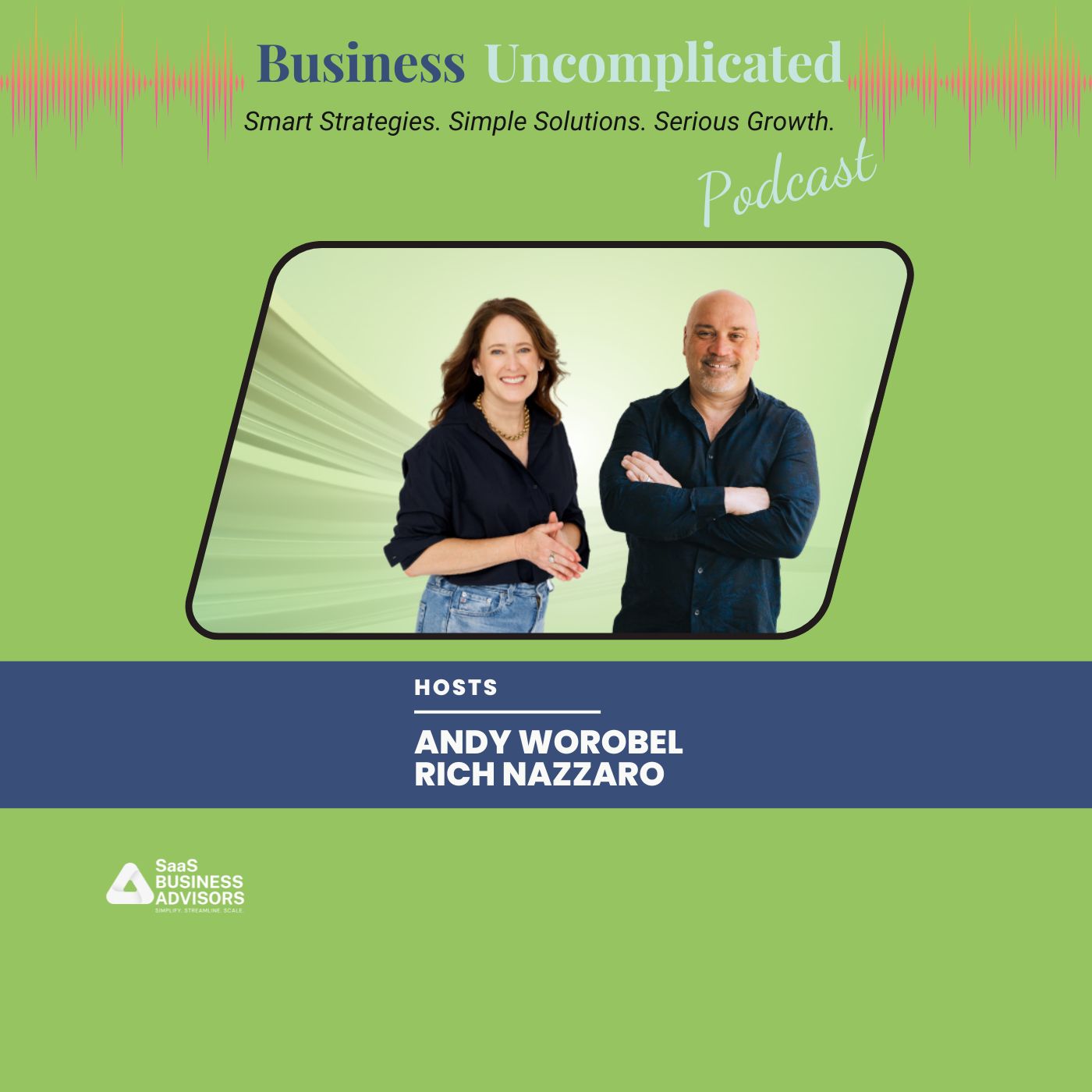
Business Uncomplicated
by Rich Nazzaro & Andy Worobel
Business Uncomplicated is the podcast that bridges the gap between what gets approved in the boardroom and what actually happens when you're implementing digital transformation on the ground.Hosted by Rich Nazzaro and Andrea (Andy) Worobel founders of SaaS Business Advisors, this show is designed for business leaders who are tired of implementations that promise everything and don't always deliver. Drawing from years of experience at industry giants like Dell, Oracle, Accenture, Salesforce, and Eloqua, Rich and Andy bring real-world insights to the complex world of business transformation.
-
25
The Reality of Transformation with Kelly Bianchi
In this episode, Andy and Rich sit down with Kelly Bianchi — serial entrepreneur, operator, and business transformation advisor — whose career has taken her from restaurant owner to auto auction tech pioneer. Kelly sold her company last year after spending 15 years convincing one of the most relationship-driven, change-resistant industries on earth to go digital. She knows firsthand what it takes to move people from "we've always done it this way" to "I can't imagine working any other way." Kelly and the guys dig into what founders understand about transformation that corporate leaders often miss, why the biggest barrier to technology adoption is psychological (not practical), and how the right — or wrong — leader can single-handedly determine whether a rollout succeeds or fails. She also shares the story of Mike: a 30-year veteran who "didn't even use email" — and what happened when someone finally believed in him. Whether you're leading a digital initiative, managing resistant teams, or just trying to figure out how to get people to actually use the tools you've invested in, this conversation is packed with hard-won insight and refreshingly real talk. Connect with Kelly: https://www.linkedin.com/in/kebianchi/ In this episode: Why removing the old process is the only way to make the new one stick How to earn trust with people who feel threatened by change The difference between technology-first and customer-first transformation What AI and institutional knowledge loss mean for the next generation of workers Kelly's two definitions of fear — and why entrepreneurs have to get comfortable with both Chapters (00:00:00) - Shane and Kelly on Reinvention(00:00:36) - Kelly Bianchi on Business Continues to Transform(00:01:35) - Kelly's Journey to the Transformation(00:04:16) - The Auction Industry's Transition to Technology(00:08:09) - Restaurant Entrepreneur: The Technology Theme(00:14:05) - On the Technology of Business(00:21:12) - Have You Fully embraced AI in Your Business?(00:29:05) - Dell Technology's Ability to Scale the Business(00:33:42) - Senators on Technology's Future(00:38:30) - Steve Jobs on Leading With His Finger(00:39:22) - ALIGNING Leadership: The Visionaries(00:43:24) - Do IT Jobs Need to Evolve?(00:47:36) - The Role of the Complainer(00:51:33) - Dads Advice For Their Daughters
-
24
Stop Complicating Your Customer Experience with Raj Rao
After 25+ years of CRM promises, customer success platforms, and enterprise transformation programs, why does the customer experience still fall short? That's the provocative question at the heart of this episode of Business Uncomplicated. Hosts Rich Nazzaro and Andy Worobel welcome Raj Rao — a Salesforce Business Excellence alumnus with deep experience across enterprise transformation, customer journey design, and AI adoption — for a candid conversation about what's really breaking customer experience in most companies. Raj pulls no punches: misaligned C-suite priorities, siloed teams pushing technology before defining outcomes, and a chronic lack of empathy toward both customers and frontline employees are the true culprits. He introduces the idea of "radical collaboration" — small, cross-functional, empowered teams replacing bloated transformation programs — and explains why AI won't save you if your data, governance, and people strategy aren't right first. Whether you're a CX leader, a transformation consultant, or a tech executive trying to make sense of your AI roadmap, this episode is packed with real frameworks, honest lessons from failed programs, and a north star for doing it right. Topics include: the agent experience, voice of the customer, AI pilots, lean governance, and what true C-level alignment actually looks like.Connect with Raj: https://www.linkedin.com/in/mrajrao/ Chapters (00:00:00) - In the Elevator With Raj Rao(00:01:17) - The Special Group at Salesforce(00:03:32) - Why the Customer Experience is so broken(00:08:06) - Where do you think companies are getting it wrong?(00:14:09) - Exploring Radical Collaboration in AI(00:15:23) - Andy Cohen on Governance in the AI World(00:18:14) - Bradley: The Courage to Lead(00:22:45) - Have We Got Time to Be Courageous?(00:24:53) - Courage in AI: Learning the Challenges(00:30:06) - WSJDLive: AI Explodes the Silos(00:32:07) - How does the customer experience change the conversation around transformation?(00:40:03) - Rajput: On the AI Transformation of Business(00:44:15) - The Importance of Collaboration in Enterprise Transformation(00:49:12) - Who do you think at a company should be driving the company's(00:52:00) - Talking To Raj Rao About Digital Transformation(00:52:30) - In the Elevator With Ray and Maria
-
23
Operationalizing AI
Most AI pilots don't fail because the technology doesn't work — they fail because there's no framework to take them beyond the demo. AI Operationalized is the show for business and technology leaders who are done experimenting and ready to embed AI into the way their company actually runs. Hosts Rich Nazzaro and Andy Worobel bring real-world experience from the front lines of enterprise AI transformation, breaking down what it takes to move from pilot to production — and from production to competitive advantage. No hype, no theory. Just the framework, the hard lessons, and the honest conversation about what it actually takes to operationalize AI at scale.Why AI Pilots Fail Lack of defined success criteria and measurable outcomes Democratizing AI without structure or data anchors Poor data quality and data readiness No alignment across leadership and departments The Framework: Design, Deploy, Amplify Strategy and vision before technology Use case identification and prioritization Quick wins vs. strategic investments Change management as a non-negotiable, not an afterthought Data & Governance Data quality as the foundation of AI success Garbage in, garbage out in an AI context Lightweight governance that accelerates rather than blocks Who owns data quality and process accountability Building & Executing Solution architecture and technical debt The role of prompt engineering and team composition Testing and validation at scale AI hallucinations and knowing your source systems Scaling & Operationalizing The AI factory concept Agents and multi-agent architecture Embedding AI into the rhythm of the business The evolving role of IT in an agentic world People & Culture Re-skilling over replacing Breaking down silos Creating a safe space to fail and iterate Elevating grassroots innovation to leadership
-
22
The Talent Architect: Building Teams Without Borders with Jim McCoy
The old model of work had borders — offices, countries, time zones, org charts stacked like filing cabinets. That model is cracking. In this episode of Business Uncomplicated, Rich Nazzaro and Andy Worobel sit down with Jim McCoy, CEO of Atlas HXM, to explore what the future of global work actually looks like when companies can hire talent anywhere in the world. Jim shares how organizations are building borderless teams, the hidden complexity behind global hiring, and why workforce strategy is shifting from location-based hiring to skills-based hiring. They unpack how companies navigate global compliance, cultural differences, remote work policies, and the growing role of AI in workforce management. The conversation also dives into leadership — from scaling global teams and managing cultural nuance to why a little imposter syndrome might actually make you a better leader. If you're building a company, managing distributed teams, or trying to understand where AI and global talent are taking the workforce next, this episode delivers practical insights with a clear view of the road ahead. Topics include: The rise of the borderless workforce How companies hire talent across 160+ countries The role of Employer of Record (EOR) platforms AI’s real impact on HR and workforce planning Skills-based hiring vs traditional job roles Cultural intelligence in global teams Leadership lessons from scaling international organizations Why the future of work may be more global — and more human — than ever Chapters (00:00:00) - Jim McCoy: Is Our Workforce More Borderless?(00:01:28) - Rich Fleming on Becoming CEO of Atlas Group(00:03:46) - An Overview of Atlas Group's Human Experience Management(00:08:20) - How Does Employee Experience Transfer to a Global Company?(00:12:20) - The Challenges of Hiring in a Foreign Market(00:15:02) - EOR Provider Advice for Expats(00:17:00) - The Search for a Global Team(00:23:48) - The Need for Continuous Feedback(00:25:11) - WSJD Live: The Process of Scaling the Organization(00:27:54) - How To Hire When Your Company Is Scaling(00:28:43) - Rising to CEO: The Importance of Imposter Syndrome(00:35:02) - Where is AI impacting HR and Workforce Management?(00:38:55) - What Skills Are Companies Need to Expand?(00:44:10) - WSJD Live: Human in the Loop(00:49:56) - Top Executives: The Value of a Consultant(00:59:57) - WSJD Live: Skills Based Hiring for the 2030(01:03:50) - What's Atlas Look Like in the Next 12 Months?
-
21
S2 E4: Learning in the Age of AI: Adapt, Upskill, or Get Left Behind
SummaryIn this engaging conversation, Cam Brewer shares his journey in the Learning and Development (L&D) space, discussing the evolution of training methods, the impact of AI on learning, and the importance of maintaining a human connection in an increasingly digital world. He emphasizes the need for personalized learning experiences, the role of micro learning, and the common pitfalls organizations face in their training strategies. The discussion also touches on the future of learning, the significance of continuous education, and the challenges of measuring ROI in training initiatives. Camron Brewer Key Learning Studios Takeaways Cam Brewer's journey into L&D began at a young age. The importance of human connection in learning is paramount. AI is transforming the way training is delivered and experienced. Micro learning can be effective but is often overused. Organizations often underestimate the value of instructional design. Continuous learning is essential for employee growth and development. Training should be integrated into the business strategy from the start. Measuring ROI in training remains a challenge for many organizations. The future of learning will involve more personalized experiences. AI tools can enhance training but should not replace human interaction. Chapters 00:00 Introduction to Cam's Journey 02:57 The Evolution of Learning and Development 05:55 AI's Impact on Instructional Design 08:45 Navigating the Human Element in AI 11:47 Training Needs in the Age of AI 14:52 The Future of Learning Plans 17:47 Micro Learning: Pros and Cons 20:49 Common Mistakes in Training Engagement 32:17 Reframing Learning and Technology 35:52 Understanding ROI in Training 39:35 The Human Element in Learning 45:35 AI and the Future of Training 50:55 Rapid Fire Insights Chapters (00:00:00) - Business Uncomplicated: The Future of Learning(00:01:09) - Business Uncomplicated(00:01:43) - Inclusive Design: The Creativity of Learning(00:05:01) - What is the Mission of Your Company?(00:05:46) - In the Elevator With Elon Musk(00:06:39) - Human in the Learning Process(00:07:20) - How to grow your business in the age of AI(00:10:33) - WSJD Live: The Need for Human Talent in the AI Era(00:13:34) - Have Businesses Needed More Training on AI?(00:16:32) - Learning Plan for the Future(00:21:22) - What is Micro Learning?(00:22:51) - Steve Jobs on Experiential Training(00:24:29) - What is the number one mistake people make in training?(00:28:01) - Training and the Budget(00:30:01) - How Much of the Training ROI Conversation Comes Up During the Sales(00:35:21) - How Much Training Should Companies Pay for?(00:38:57) - Teaching With Robots(00:43:26) - AI Training: Biggest Mistake(00:44:12) - What's Your One Prediction about Learning in the Year 2030
-
20
Business Problems Are People Problems in Disguise with Kristy Morgan
In this conversation, Kristy discusses the evolving landscape of leadership, emphasizing the need for leaders to adapt their styles to the unique needs of their team members. She highlights the importance of curiosity, communication, and vulnerability in effective leadership. Kristy also shares insights on the significance of understanding individual motivations and the role of change management in organizational success. The discussion touches on the measurable ROI of leadership training and the broader impact of leadership skills on personal and professional relationships.Contact Kristy at: https://thekristymorgan.com/ https://www.linkedin.com/in/kristy-morgan-pmp/ Takeaways Leaders often confuse being good at their job with being good leaders. Motivating people requires understanding their unique needs. Curiosity is essential for effective leadership. One-on-ones should prioritize employee input. Vulnerability in leadership fosters open communication. Change management is crucial for successful projects. Investing in people leads to long-term success. Effective communication is a two-way process. Asking 'why' helps uncover individual motivations. Leadership skills improve personal relationships as well. Chapters (00:00:00) - What's Wrong With Leadership?(00:01:42) - What's Wrong With Leadership?(00:02:05) - What's Missing in Leadership?(00:05:44) - Exploring the uniqueness of your team(00:07:23) - Leadership Development: Why Are We Talking to Employees?(00:13:43) - How to Coach Leaders on Time With Their Teams(00:20:57) - CIO Network: The Project Management Challenges(00:25:05) - How to Coach People Through Long Term Thinking(00:28:51) - What Makes a Well-Well-Oiled Machine?(00:31:52) - What Made Me Make the Shift(00:36:01) - What Does a Leadership Skills Engagement Look Like?(00:41:06) - What are the most common gaps in leadership?(00:47:27) - The One Thing I Wish I'd Been Told About My Career(00:52:19) - PMI Mile High Symposium and TED Talk(00:55:02) - Senators on the Issues
-
19
AI Is About to Expose Every Dysfunction You've Been Hiding
In this episode of Business Uncomplicated, Rich Nazzaro discusses the importance of breaking down organizational silos and fostering collaboration across departments. He emphasizes the human element in business, the challenges of cross-functional work, and the role of leadership in creating a connected organization. The conversation also explores how AI can serve as a catalyst for change, enhancing data connectivity and improving customer experiences. Rich encourages leaders to rethink their approach to collaboration and data management to drive organizational success.takeaways The human element of business is crucial and often overlooked. Silos exist for accountability but can hinder collaboration. Leadership must actively work to break down silos. AI can expose organizational inefficiencies and data silos. Data should be treated as a shared asset across departments. Cross-functional collaboration is essential for success. Understanding other departments' roles can enhance teamwork. Leaders need to model collaborative behavior. Customer experience should drive organizational strategies. Rethinking leadership development is necessary in the AI era. Chapters (00:00:02) - Business Uncomplicated: The Human Element of Learning(00:01:25) - Building Bridges within the Silo(00:10:19) - Breaking Down the Silo(00:18:11) - Bradley: Building the AI Bridge(00:22:15) - What's the Path Forward for the Customer Experience?(00:25:58) - Looking beyond silos: Connecting Organizations(00:27:12) - Leadership: Breaking Down the Silos
-
18
Up and to the Right: The Four-Box CS Framework for Predictable Growth
In this conversation, Reena Bhatia discusses the importance of a structured framework for customer success, emphasizing the need to balance company goals with customer needs. She introduces the 'Up and to the Right' framework, which helps organizations identify necessary versus unnecessary tasks, and highlights the role of customer feedback in shaping these frameworks. The discussion also touches on the integration of AI in customer success, the significance of health scores, and the operationalization of these frameworks to drive meaningful change within organizations. AI is dominating discussions, but frameworks are essential for success. Customer success should focus on value creation for customers. The journey of customer success begins after the sale is made. Understanding the 'Up and to the Right' framework is crucial. Identifying necessary versus unnecessary tasks can streamline processes. Customer feedback is vital in developing effective frameworks. Balancing company goals with customer needs is a complex challenge. Health scores should reflect the customer's viewpoint, not just internal metrics. AI can enhance customer success but should not replace human interaction. Structured change leads to more effective and less painful transformations. Chapters (00:00:00) - Business Uncomplicated: The 4-Box Framework(00:01:39) - An AI Framework for Business Uncomplicated(00:02:38) - Reena Bhatia on Customer Success(00:05:44) - The 4-quadrant framework(00:11:25) - Separation of Requirement and Unnecessary Tasks(00:14:27) - What's the most surprising thing do you think that comes out of(00:16:34) - How to Balance Company Goal with Customer Success(00:19:49) - Does Customer Success Matter to CEOs?(00:22:40) - Microsoft Customer Success: The 4-Box(00:27:51) - Customer segmentation and its impact on health(00:30:15) - WSJDLive: Digital to Enterprise Segmentation(00:31:48) - What is the Business Process of AI?(00:35:25) - How Do We Elevate the CSM?(00:42:02) - On Operationalizing the Strategic Framework(00:47:23) - How to Build a Six-Point PowerPoint(00:48:34) - What's the First Step towards a Digital Transformation?(00:52:43) - AI Is Bigger Than You Think(00:53:15) - What, what resources out there do you find most valuable right now
-
17
Stop Pitching. Start Connecting: Beth Mastre’s Cold Email Method
Episode Summary Rich Nazzaro sits down with Beth Mastre, a 30-year sales veteran, to discuss why email marketing isn't dead—it's just being done wrong. Beth shares her framework for transforming sales outreach from pitchy, self-centered messages into relationship-building conversations that actually get meetings. Guest Beth Mastre — Sales strategist and creator of an AI-powered email tool that helps sales teams craft effective outreach. With three decades of sales experience, she specializes in teaching teams how to lower barriers and create genuine connections with prospects. Key Takeaways Email isn't for selling—it's for getting meetings. The only metric that matters is whether your outreach results in a conversation. Stop pitching, start teaching. Instead of leading with "here's who we are and what we do," share insights about industry challenges, common mistakes, or questions prospects should be asking. Create FOMO (Fear of Missing Out). Frame your outreach around what prospects don't know rather than what you offer. Make relationship deposits. Every touchpoint should add value to the prospect, not extract it. Sales teams don't have a prospecting problem—they have a fear problem. Fear of rejection, fear of saying the wrong thing, and fear of not hitting quota all contribute to ineffective outreach. The "HVAC Guy" approach: The best salesperson doesn't just quote a price—they walk through your situation, identify problems you didn't know existed, and educate you before ever discussing solutions. Memorable Quotes "People are happy to be unhappy. They have containment around their unhappiness." "Email's not for selling. Your email is about getting a meeting." "You don't have a prospecting problem, you have a fear problem." "Your first meeting is kind of free. If you get the meeting but then you pitched, you might not get your second meeting." The Three Responses Framework When you reach out with insights about industry challenges, you'll get one of three answers: "We didn't know, so we don't have a plan" (easy opportunity) "We know, but don't have a plan" (they need help) "We already have a plan" (rare—ask what else they're working on) Beth's Email Rules Never say "us," "me," "we," "our," or "they"—use "in the industry" or "other organizations" instead Subject lines matter more than you think (her best performer: "requesting discount") Keep it short and focused on one relationship deposit Always end with a simple ask: "When do you have 20 minutes?" AI in Sales: Beth's Perspective AI tools can help, but only when built on solid frameworks. Generic AI-written emails will "burn people so hard and so fast." The key is feeding AI with proven methodology and intellectual property—not just asking it to write cold emails. Chapters (00:00:00) - Business Uncomplicated: Email Is Dead(00:01:33) - Beth Mastry on Business Uncomplicated(00:02:44) - In the Elevator With Beth Mastry(00:04:13) - How to Build a Sales Team with AI(00:04:57) - Are You Ready to Make a Sales Decision?(00:07:18) - How to Sell to a Large Company(00:12:05) - How to Lead with Empathetic Focus(00:17:00) - Onboarding: The 3 Things We Don't Know(00:19:09) - How to Build a Strategic Plan in 2020(00:24:14) - How to Build a Successful Sales Email(00:28:36) - How to Coach Your Clients Through the Talk(00:29:40) - How to Get Your Pitch Heard(00:32:45) - How to Coach People on Authenticity(00:35:53) - How AI is Affecting Sales Communication(00:39:28) - What is the Importance of Frameworks in AI?(00:40:36) - The Inbox: The Framework(00:42:10) - Sales Whisperer: Poor Enabling and Training(00:47:40) - Onboarding With AI: From Onboarding to Sales
-
16
The AI Revolution in Customer Success
In this engaging conversation, industry leaders discuss the transformative impact of AI on customer success. They explore strategic priorities, the importance of data management, and the evolving roles within customer success teams. The discussion emphasizes the need for collaboration across departments and the significance of building trust in customer relationships. As organizations navigate the integration of AI, they highlight the importance of AI literacy and the potential for new roles that blend traditional account management with AI capabilities.Guest: John Durocher: https://www.linkedin.com/in/johndurocher/ Shane Hughes: https://www.linkedin.com/in/shanehughes/ Cesar Sanchez: https://www.linkedin.com/in/thebigc/ Takeaways AI is transforming customer success roles and strategies. Adoption of AI tools is crucial for enhancing productivity. Data management is foundational for effective AI implementation. Customer success must focus on relationship building and trust. Organizational silos hinder effective AI integration. The role of customer success managers is evolving with AI. AI can automate routine tasks but won't replace human interaction. Companies need to prioritize AI literacy across teams. Collaboration between departments is essential for AI success. Future roles in customer success will blend traditional account management with AI capabilities. Chapters (00:00:02) - Business Uncomplicated: AI and the Customer Relationship(00:01:59) - John Durocher, Shane Hughes and Cesar Sanchez(00:05:08) - Customer Service Executives: One Strategic Priority(00:07:56) - Tribble on the Application of AI in CS(00:12:08) - Does the CSM Have a Future?(00:15:58) - Sales and Customer Success: The Future of AI(00:20:48) - Top Executives: More Confusion Within the Organization(00:24:17) - WSJD. AI Acceleration(00:30:28) - CIO Network: How to Integrate AI into your Business(00:35:43) - AI Literacy and Fluency(00:37:28) - COO Network: Do We Need a Chief AI Officer?(00:40:31) - The Need for AI-related Upskilling(00:42:04) - Will AI Replace Human Jobs?(00:45:59) - Will AI Replace Human Interactions?(00:47:26) - December Brings Bold Predictions(00:47:51) - John, what percentage of customer interactions will be AI first by 20(00:49:34) - What CS Role Will Exist in 5 years?(00:51:22) - A.I. in 2028(00:52:17) - milo on EWTN
-
15
Why AI initiatives are Falling Flat and the Biology Lessons that can save them with Steve Wunker
In this episode of Business Uncomplicated, Rich Nazzaro sits down with innovation strategist and author Steve Wunker, Managing Director at New Markets Advisors and author of AI and the Octopus Organization: Building the Super Intelligent Firm. They explore how AI can do far more than automate tasks—it can fundamentally reshape how your organization thinks, decides, and acts. Using the octopus as a metaphor (nine brains, eight tentacles, three hearts), Steve explains what it really means to build a firm that’s fast, adaptive, and intelligent at every node, not just at the top. Together, Rich, Steve, and co-host Andy Worobel dig into why so many AI efforts stall at “pilot theater,” how to move from tools to true transformation, and what this means for leaders, middle managers, and frontline teams.Get your copy of: AI and the Octopus Organization: Building the Superintelligent Firm In this episode, we cover: The Octopus Organization metaphor How nine brains and eight tentacles map to AI-enabled decision-making at the edge of your business. Why most AI initiatives fall flat Pilot overload, narrow thinking, and the trap of sprinkling AI across 17 steps instead of redesigning the process. Transformation vs. technology Why “buying the tool” (Salesforce, AI platforms, etc.) without a clear why leads to shallow change and wasted spend. Starting with the customer, not the model How reimagining growth, customer value, and competitive strategy should precede any AI deployment. Bottom-up autonomy and the new frontline How AI finally makes it possible to devolve authority—with real context, guardrails, and feedback loops. The reinvention of the middle manager Moving from admin and coordination to steward of the model, coach, and day-to-day change manager. Breaking silos without becoming a micromanager How AI-driven transparency can unite marketing, sales, ops, and IT—without turning leadership into “radio-era admirals” meddling in everything. The CIO’s once-in-a-generation moment Why this may be the best time in history for IT to lead organizational transformation—and what that partnership with the business should look like. Energy, infrastructure, and the real constraints on AI Why the current path of hyperscale models is unsustainable and how leaner, purpose-built models may shape the future. Democratizing data and tools From “everyone build a GPT” chaos to intentional productization and access to the right data sources with the right guardrails. Why most companies are terrible at experimentation Zombie projects, poor learning loops, and how to design AI experiments that actually move the needle. If you’re an executive, CIO, or operator trying to move past AI hype and into real, structural change, this conversation gives you both the language and the lenses to start redesigning your organization. Chapters (00:00:00) - Business Uncomplicated: AI and the Octopus Organization(00:01:59) - Steve Wunkur on The AI Origins of Business Uncomplicated(00:02:32) - Disruptive Innovation: Rich Sulzanski(00:05:06) - AI and the Octopus Organization(00:06:44) - The Decoding of the Octopus(00:08:29) - Does AI Need a Transformative Impact?(00:10:56) - Reimagining Growth with AI: The Transformation(00:13:53) - Middle Manager: The End of the Boss(00:14:35) - In the Elevating the Marketing Job(00:15:24) - WSJDLive: Devolving Authority in the AI Era(00:17:17) - Re-Educating the Skills of the Future(00:19:42) - AI and the Breaking of the Silo(00:21:28) - Does AI Change the Middle Manager Role?(00:24:13) - Why are so many AI Projects Failing?(00:26:18) - Projects and the Future of AI(00:27:46) - Energy and the AI Race(00:30:57) - Does Data Decentralization Enhance Business?(00:37:18) - CIO Network: Who Owns the Transformation in a Company?(00:38:44) - Confirmating the Burning Platform for Change(00:42:09) - Steve Jobs on Becoming an Octopus Organization
-
14
Leading Salesforce's Most Ambitious Transformation Yet with Jay Desai
The conversation explores the integration of agentic AI into Salesforce's business operations, focusing on its impact on seller productivity, customer experience, and overall enterprise outcomes. Jay discusses the importance of implementing production-grade systems that go beyond mere demonstrations, highlighting measurable improvements in various business metrics. takeaways Jay is at the forefront of Salesforce's AI initiatives. The focus is on integrating AI into real business operations. Production-grade systems are essential for measurable improvements. AI can significantly enhance seller productivity. Customer experience is transformed through AI integration. Enterprise outcomes can be positively impacted by AI. The conversation emphasizes practical applications of AI. Innovative approaches are necessary to tackle enterprise challenges. Measurable metrics are crucial for assessing AI effectiveness. AI is not just a demo; it's a tool for real business success. Chapters (00:00:00) - Meet Jay Desai(00:02:19) - Interview With Rich Desai(00:02:53) - The Scariest Thing About AI(00:06:22) - What's The Future of Original Content?(00:07:14) - Talking About the Dot-Com(00:07:59) - Is AI Going to Replace Human Work?(00:12:54) - WSJD Live: What's My Role at Salesforce?(00:14:53) - WSJD Live: Starting with SMB and Moving Up(00:16:27) - Agents on the Company's Goals(00:17:45) - How to Build a Real-World Agent with Agentix(00:19:55) - Salesforce: Data is the fuel for AI(00:22:17) - What's the Challenge to Content Management?(00:24:32) - What are the big pillars for anybody's AI or agentic strategy(00:25:08) - WSJD Live: The People Factor in AI(00:29:35) - Salesforce Agents on the Human In the Loop(00:35:01) - What Should Your Agent Be Looking For in AI?(00:41:46) - Informatica Data Cloud: End-to-End Solution(00:43:46) - AI Agents: The Overhyped vs Underhyped(00:45:58) - Williams Sonoma CEO on E-Commerce(00:47:05) - Is AI Driving Salesforce's Transformation?(00:48:38) - Dissecting the Process of Technology(00:49:37) - In the Elevating the AI Challenge(00:50:41) - Punishment
-
13
From Hype to Habit: Building AI That Actually Works with Varun Jain
Varun Jain shares his journey from Wall Street analyst to serial entrepreneur, revealing how he's been solving the same fundamental problem—making complex business processes actually work—for 15 years. Now at ComplyJet, he's tackling the "SOC 2 deal killer problem" where startups lose customers because they can't prove compliance quickly enough. In this conversation, Varun discusses: The evolution of compliance from physical binders to AI-native solutions How ComplyJet reduces SOC 2 compliance from 50-60 hours to 10-15 hours The difference between AI-native and bolt-on AI products Why security and compliance is fundamentally about building trust Practical advice for founders on when to start the compliance journey The future of work and what skills matter in an AI-driven world https://www.linkedin.com/in/varun-jain-stanford/https://www.complyjet.com/ Chapters (00:00:00) - Business Uncomplicated: How to Make Complex Business Processes Work(00:01:24) - Introducing Compliance Gen(00:03:20) - The Process of IT(00:10:42) - How Can We Automate Security & Compliance?(00:13:14) - CIO Network: Hold Up the Security Business(00:14:15) - Security and Compliance for Early Startups vs. Large Companies(00:17:41) - How To Get Ready for SOC2 Compliance in 7 Days?(00:20:13) - WSJDLive: The Security and Compliance Journey(00:22:48) - WSJDLive: What Is an AI-Native Software?(00:28:23) - Human in the Loop at ComplyJet(00:32:15) - What is the Right Skills to Hire for AI-based Teams(00:37:33) - Hiring Tech Pros and Cons(00:39:04) - How to Create Value in Your Company(00:41:03) - How to Tell Your Company's Story(00:43:15) - Top Tech Talk: The Big Hype Around AI
-
12
The Translation Problem: How IT Leaders Bridge Technology and Business Results
In this conversation, Rich Nazzaro, Andy Worobel and Ashley Kanok discuss the evolving role of CIOs and IT leaders in bridging the gap between technology and business needs. They explore the pressures faced by CIOs, the importance of building trust between IT and business, and the shift from IT as a gatekeeper to a strategic partner. The discussion also covers the significance of self-service, governance, and measuring ROI in IT initiatives, as well as the impact of AI on the future of IT leadership and the importance of understanding business processes. 73% of CIOs face pressure to show measurable results. IT must transition from order takers to strategic partners. Building trust is essential for IT-business alignment. Self-service BI empowers business users and reduces IT bottlenecks. CIOs are responsible for business continuity and data security. ROI must be attached to all IT initiatives. Successful digital transformation requires clear success metrics. Understanding business needs is crucial for IT effectiveness. AI should enhance human potential, not replace it. Data quality is foundational for effective IT solutions. Chapters (00:00:00) - What Makes a Great CIO?(00:01:46) - Ashley on the Podcast(00:02:20) - WSJDLive: The tension between the business and IT(00:06:59) - How to Lead the IT Transition(00:09:46) - On the Governance of Self-Service Systems(00:12:21) - CIO Network: Business continuity and the CIO(00:14:44) - CFO Network: On Prioritization and ROI(00:18:35) - What Does a Successful Digital Full-Scale Transformation Look Like?(00:23:15) - IT Lead on AI: Business Processes(00:27:16) - WSJDLive: The Architectural Challenges of AI(00:30:18) - Salesforce CEO: Buy vs. Build AI-based solutions(00:36:37) - WSJDLive: Can AI Save IT Resources?(00:38:29) - How the IT Leader's Role is evolving(00:40:04) - What's the New It for Teams?(00:41:14) - The AI Process: Overhyped?
-
11
The Strategic CIO: Driving Value Creation in the Age of AI and Private Equity
In this conversation, Ryan Worobel discusses the evolving role of the CIO, particularly in the context of private equity and the impact of technology and AI on business operations. He emphasizes the importance of strategic partnerships, business continuity, and the need for CIOs to be integrated into executive discussions. The conversation also touches on the challenges of managing relationships with other executives, the significance of the customer journey, and the role of RevOps in technology. Additionally, they explore the implications of AI on the workforce and the necessity of maintaining a human element in technology implementation. Chapters (00:00:02) - The Denver Broncos Just Lost(00:00:30) - CIO Network: The CIO Conversation(00:02:57) - Ryan Warble on His Couple's(00:04:18) - The CIO Role in Private Equity(00:09:48) - How Has the SaaS Revolution Changed Your Approach to Transformation?(00:11:35) - CIO Network: The Role of the CIO(00:19:45) - CIO Network: The Alliance with the Executive Team(00:21:53) - CIO vs Private Equity: How Do You Report to the Board(00:25:45) - CIO Network: The Role of Revops(00:28:57) - Is AI a Silver Bullet for Business?(00:31:44) - What are people Missing in the AI Transformation?(00:34:44) - The Human in the Loop(00:35:23) - Will the Human Element Survive in the AI Era?(00:39:53) - CIO Network: The CIO's role in tech deals(00:42:13) - CIO Network: The CIO's role in the AI revolution(00:43:39) - CIO Network: Training and Change Management(00:46:32) - Questions for the Presidential Candidate(00:46:55) - Favorite Overhyped Tech Trend(00:49:14) - College and the Future of Jobs
-
10
"The Consultant's View: Inside Out and Outside In"
In this conversation, Cyndi Choung shares her extensive experience in consulting and industry roles, discussing the unique aspects of both environments. The discussion delves into the challenges of business silos, particularly between IT and business, and how AI can play a role in breaking these down. Cyndi emphasizes the importance of leadership in guiding AI adoption and setting a clear vision for its integration into business processes. The conversation also touches on the evolving nature of jobs in an AI-driven world and the critical need for data quality to ensure AI's success. Chapters (00:00:00) - Business Uncomplicated: AI, Leadership, Business Silos(00:01:08) - Cindy Knows Everything About Technology and Business Strategy(00:02:46) - Cindy Chung(00:05:51) - Working in Industry vs. Consulting(00:08:03) - Ex-Consultant on the Other Side(00:11:18) - Questions for Leaders in AI and Leadership(00:12:35) - Business Silos(00:13:37) - The Business vs. the Silo(00:17:43) - On Breaking the Silos(00:22:02) - CIO Network: The AI Silos(00:26:59) - Payroll Executive: AI Is Here to Stay(00:31:01) - Will AI Make More Jobs Vacant?(00:35:56) - How to Coach Your Salesperson(00:36:58) - What Makes a Good Salesperson?(00:38:25) - Leadership: Art vs. Science in the AI Era(00:42:20) - What's the Role of Leaders in AI?(00:45:31) - Does a Leader Need a Strategy?(00:47:19) - The Script is the Foundation of a Movie
-
9
From Layoff to Launch: Transforming Your Career Crisis into Your Greatest Opportunity
Join Rich Nazzaro on Business Uncomplicated as he shares his deeply personal journey from getting laid off during his son's birthday trip in San Francisco to co-founding SaaS Business Advisors. In this powerful episode, Rich reveals the science behind why our brains spiral during career uncertainty and provides a roadmap for turning professional setbacks into transformational opportunities. Discover the three emotional phases everyone goes through after a layoff (fear, imposter syndrome, and support), learn how to rewire your brain using cognitive reappraisal techniques, and explore Rich's "10 Hard-Won Truths" that can help you architect your ideal career. Whether you're currently facing a layoff, considering a career change, or simply feeling stuck, this episode offers practical neuroscience-backed strategies and the emotional support you need to move forward with confidence. Rich candidly discusses the psychological challenges of transitioning from corporate employee to entrepreneur, the power of vulnerability in building authentic professional relationships, and why your timeline for success belongs to you alone. This isn't just another career advice episode—it's a blueprint for transforming crisis into the catalyst for your best chapter yet. Perfect for anyone navigating professional uncertainty, career transitions, or entrepreneurial aspirations. Chapters (00:00:01) - How to Stop Losing Focus on Your Career(00:02:19) - How to Overcome a Crisis in Your Brain(00:06:51) - What Happens to Your Brain After Getting Layoff?(00:11:14) - The End of the Emotional Journey(00:15:13) - In the Elevator of SaaS Business Advisors(00:18:30) - Why Starting a Business Is Harder Than You Think(00:20:41) - The 10 Hard Won Truths(00:24:01) - 4 Rules for Feeling Good About Yourself(00:25:52) - Be Vulnerable, Find Your Tribe(00:27:18) - How to Leverage Your Network(00:30:15) - Give Yourself Permission to Re-think(00:31:25) - 3 Rules for Success in Your Career(00:34:41) - What to Do When You're in Uncertainty?
-
8
Reading the Room's Energy: A Leader's Guide to Productive Conflict
In this conversation, JB Bolton discusses the nature of conflict in organizations, emphasizing the difference between healthy and unhealthy conflict. He highlights the importance of trust, curiosity, and empathy in navigating conflicts effectively. The discussion also covers strategies for leaders to foster a culture of healthy conflict, the role of vulnerability in building trust, and the significance of clarity in communication. Ultimately, the conversation provides valuable insights for leaders looking to manage conflict constructively and improve team dynamics. Takeaways Conflict can be seen as fuel for growth rather than a fire to extinguish. Healthy conflict focuses on ideas, while unhealthy conflict is personal. Curiosity and empathy are essential in addressing conflict. Trust is the foundation for effective conflict resolution. Leaders should preface discussions to create a safe environment. Vulnerability can enhance trust within teams. Clarity in communication helps prevent misunderstandings. Unskilled conflict management can lead to toxic environments. Healthy conflict can improve team performance and morale. Leaders must be proactive in addressing conflict to avoid escalation. Chapters (00:00:00) - In the Elevator With Jb(00:03:05) - Conflict in the Workplace(00:06:31) - Executive Coach and Former C-Level Executive on The Business Coach Podcast(00:08:20) - What's The Biggest Confusion About Conflict in an Organization?(00:12:26) - How to Build a Healthy Conflict(00:14:17) - How to Deal with an Overly Composed Employee(00:15:36) - The Importance of Preface Statements in Team Meetings(00:17:24) - Steve Ballentine on Healthy Conflict vs. Unhealthy Conflict(00:20:52) - The Secret to Healthy Conflict(00:21:45) - What to Do About Healthy Conflict in the Organization(00:27:24) - How to Build Trust in the Company(00:31:15) - In the Elevator With Your Boss(00:34:04) - The 5-Step Process of Leadership(00:38:41) - Managing Conflict: The Unskilled(00:41:16) - How to Manage Conflict in the Organization(00:47:14) - Bolton on Trust(00:48:51) - In the Elevator With Jay-Z(00:50:05) - In the Elevator With Rich Homie(00:52:06) - Steve Jobs on Conflict Resolution(00:55:12) - Six Phases of Leadership Transformation
-
7
Six-Phase Leadership Framework for Transformation Success
In this conversation, Rich Nazzaro and Andy Worobel discuss the critical role of leadership in successful digital transformations. They explore the importance of having a clear vision, aligning leadership, and fostering a culture that supports change. The discussion highlights common pitfalls in transformation efforts, such as unclear objectives, lack of engagement, and the dangers of delegation. They emphasize the need for leaders to be present, ask the right questions, and maintain a focus on the organization's culture to drive successful outcomes. Chapters 00:00 Navigating Life's Transitions02:46 The Importance of Leadership in Digital Transformation05:36 Defining Clear Visions for Transformation08:45 Aligning Leadership for Success11:32 The Role of Leadership in Execution14:44 The Power of Leadership Engagement17:32 Vulnerability and Trust in Leadership20:33 The Importance of Cross-Functional Collaboration23:34 Celebrating Small Wins in Transformation26:34 The Day-to-Day Role of Leadership29:29 Avoiding the Delegation Trap35:57 The Importance of Context in Leadership37:36 Effective Leadership and Team Engagement39:32 Genuine vs. Performative Leadership43:34 Starving Your Transformation: Risks and Realities50:47 Culture vs. Strategy: The Core of Transformation58:34 Key Lessons for Successful Transformation Chapters (00:00:02) - How to Survive a Stressful Summer(00:00:53) - Six Steps to Making a Digital Transformation Successful(00:04:19) - The Disrupting Digital Engagement(00:05:30) - 6 Rules for Clear Vision and Success(00:07:42) - Why We Need AI in our Companies(00:08:38) - Leadership Alignment for Digital Transformations(00:14:56) - The Need for a Transformation(00:17:04) - Leading the Digital Transformation: Accountability Based Trust(00:25:46) - Teaching Leadership: Show Up(00:32:21) - 4 Rules for Delegate Your Way Out of Problems(00:37:18) - In the Elevator With Real Leaders(00:43:28) - The Digital Transformation Imperative(00:43:45) - How to Starch Your Transformation: Will It Kill the Transformation?(00:48:52) - What is the culture of a company?(00:53:57) - In the Elevator With Rich Eisen(00:54:29) - Understanding the culture of a company(00:59:33) - Six Rules for Lead With a Shared Vision(01:02:40) - 5 Life Lessons of a Transformation
-
6
Unlocking the Secrets of Effective Branding with Kelly Morgan
Summary In this episode of Business Uncomplicated, host Rich Nazzaro and co-host Andy Worobel welcome Kelly Morgan, a seasoned creative director, to discuss the intricacies of branding and design. Kelly shares her insights on the importance of strategy in branding, the need for human connection in B2B marketing, and the role of brand guidelines. She emphasizes the emotional connection consumers have with brands and how AI is changing the creative landscape. The conversation also touches on the importance of consistency across all brand touchpoints and the need for brands to evolve over time. Takeaways Kelly emphasizes the importance of understanding the 'why' behind a brand.Strategy is crucial before diving into design elements.Human connection is key in B2B branding.Brand guidelines help maintain consistency across all platforms.AI can enhance creativity but should not replace the human touch.Visuals are processed much faster than text, making design critical.Brands need to evolve to stay relevant in the market.Emotional connections drive consumer loyalty.Effective branding requires collaboration and clarity.Filling the well with inspiration is essential for creativity. Chapters 00:00 Introduction to Design and Creativity04:46 The Philosophy of Client Collaboration06:38 The Importance of Strategy in Branding10:26 Successful Campaigns and Brand Identity13:22 Navigating Brand Strategy Challenges16:05 Understanding Audience and Brand Connection18:34 The Role of Branding Beyond Marketing20:37 Creating Consistency Across Touchpoints22:32 Establishing Brand Guidelines25:10 Essential Elements for Strong Branding26:00 The Impact of AI on Branding27:28 Kelly's Journey into the Creative Field29:01 Finding Inspiration in Creativity31:05 Current Trends in Design and Branding33:26 Practical Advice for Brand Refresh35:57 Conclusion and Resources Chapters (00:00:00) - Business Uncomplicated: The Rock Stars(00:00:20) - Kelly Morgan on Business Uncomplicated(00:03:52) - Meet The Salesforce Creative Director(00:04:30) - In the Elevator With Your Clients(00:05:52) - The Right Brand for Your Business(00:10:12) - How To Build a Brand From the Start(00:12:58) - In the Elevator With Creative Directors(00:15:28) - The Strategic Imperative of Small Business(00:17:49) - The Brand Experience(00:18:21) - Brand Guidelines for non-Sales and Marketing professionals(00:24:52) - What are the Brand Guidelines every company needs?(00:25:51) - How to Inspire Yourself With AI(00:30:51) - Top Brand Executives: The Trends of the Year(00:33:02) - Rebuilding Your Brand: Kelly Kanay
-
5
The Essential Product Mindset with Liz Jensen
Summary In this conversation, Rich Nazzaro, Andy Worobel and Liz Jensen discuss the transformative impact of AI on businesses, emphasizing the importance of understanding the technology and its applications. They explore the product mindset necessary for successful AI implementation, the future of GenAI, and practical advice for those starting their AI journey. The discussion also highlights the significance of prompt engineering and the need for leaders to simplify and scale their operations using AI. Takeaways Understanding different AI software is crucial for business success.AI is not just a buzzword; it's an imperative for companies.The product mindset focuses on solving customer problems effectively.Exploring the 'why' behind projects leads to better outcomes.AI can significantly reduce the time required for tasks.Nolan, the digital coworker, enhances team productivity.GenAI has the potential to revolutionize small businesses.Starting with customer needs is essential for AI implementation.Prompt engineering requires curiosity and context setting.Standardizing on SaaS platforms can streamline operations. Chapters 00:00 Introduction and Background09:00 The Product Mindset in AI14:02 Provoke Solutions and Gen.AI19:00 Real-World Applications of Gen.AI24:11 Leadership in the Age of AI29:07 The Future of Gen.AI and Its Impact34:06 Prompt Engineering and Simplifying Processes38:59 Final Thoughts and Advice Chapters (00:00:00) - How AI Is Shaping Companies(00:02:19) - Interviewing Liz Jensen(00:03:42) - It's All In the Conversation(00:04:06) - Top AI Expert on Forbes Live(00:04:44) - Interview(00:05:54) - In the Elevator With Steve Austin(00:06:53) - How Product Management at Dell Went From Software to Consulting(00:09:01) - What's The Different Approach to Gen-AI?(00:14:14) - What is provoke.ai and how did it grow?(00:15:09) - How to Talk to Clients About GenAI(00:18:42) - How To Approach Gen AI With a Multidimensional Governance(00:21:37) - At the Tech Hackathon(00:22:45) - Leaders of Gen AI: The Challenges(00:25:13) - How to Integrate the Human Side of Technology(00:27:02) - Understanding how the business works with gen AI(00:29:20) - Exploring a Project(00:30:43) - How much are those lessons that you've come across or the work(00:33:23) - Does Genai Do Negative Test Cases?(00:36:01) - Top Executives: Gen AI Is The Future of Business(00:39:05) - What Makes a Prompt Engineer So Great?(00:41:00) - How to Simplify, Streamline and Scale Your Business(00:42:17) - Top Executives on the AI Journey(00:43:43) - The Art of the AI Hackathon(00:48:38) - Talking Business With Liz Hurley
-
4
From Code to Conservation: Ken Chew’s Journey
Summary In this conversation, Rich and Ken Chew explore the evolving landscape of technology and its impact on business. They discuss the importance of understanding the purpose behind technology, the challenges of digital transformation, and the role of leadership in building high-performance teams. Ken shares insights on innovation, AI, and the intersection of technology with conservation efforts, emphasizing the need for practical advice and mentorship in the tech industry. Takeaways Technology is an enabler, not the answer.Understanding business processes is crucial for tech success.Digital transformation often fails due to lack of purpose.Building high-performance teams requires diverse skill sets.Leadership plays a key role in team dynamics.Passion for technology can drive innovation.Mentoring the next generation is essential for growth.Practical advice is needed for tech implementation.AI is reshaping the business landscape.Conservation efforts can benefit from technological advancements. Chapters 00:00 The Human Side of Technology14:04 Career Journey and Evolution in Tech16:47 Challenges in Large Projects19:16 Navigating Compliance and Business Processes21:46 The Importance of Leadership in Tech24:14 Building High-Performance Teams26:35 Avoiding Leadership Mistakes29:21 The Evolution of Technology Solutions31:33 Technology in Personal Life and Innovation34:43 The Maker Mindset: A Family Legacy36:43 Innovating with Drones: From Hobby to Education39:58 Bridging Technology and Conservation44:05 Translating Passion into Corporate Innovation47:36 Mentoring the Next Generation in Tech51:22 The Future of Technology: AI and Beyond53:13 Practical Advice: Start with the Why58:13 Building with Intention: The Journey of Technology59:04 Empowering People Through Technology: A Leader's Perspective Chapters (00:00:00) - Business Uncomplicated: The Challenges of Leadership(00:01:11) - The Future of Technology Is Business Processes(00:03:21) - The Mission of Business(00:04:43) - What's the Point of Digital Transformation?(00:08:17) - Technology's role in the business(00:10:03) - Tech With Purpose in a Hyper-Digital World(00:11:37) - Ken Starr on Business Uncomplicated(00:12:18) - The Human Side of Technology(00:14:26) - WSJD Live: The Technology Industry's Shift(00:17:41) - The Challenges of Large Projects(00:25:03) - How to Build a High-Perform Team(00:28:58) - The Cloud vs. On Premises Architectural Evolution(00:33:38) - Makers: The Future of Science(00:40:14) - Have We Lost the Maker Mindset in Company?(00:47:04) - Ideas for technologists in the future(00:51:33) - What's Exciting About Technology?(00:53:15) - Steve Jobs on Technology and Business Process Transformation(00:54:50) - The driving force behind technology in business and conservation(00:58:13) - Business Uncomplicated: The Purpose of Technology
-
3
Business Uncomplicated: The Journey Begins
In the inaugural episode of Business Uncomplicated, hosts Rich Nazzaro and Andy Worobel introduce their podcast, focusing on the journey of digital transformation in business. They share their backgrounds, experiences, and the mission of SaaS Business Advisors to help organizations achieve business outcomes through effective technology implementation. The conversation delves into the challenges of digital transformation, the importance of communication, and the role of governance in ensuring clarity and success. The hosts express excitement for future episodes featuring industry experts and real-world stories. Takeaways This is our inaugural debut of our podcast.We're excited to share our thoughts and invite industry experts.Digital transformation covers a wide range of topics.The problems businesses face haven't fundamentally changed.Transformation is a team sport that requires collaboration.Communication is key to successful transformation.Governance provides clarity and helps teams understand their roles.We aim to drive value through business outcomes.Understanding the type of transformation is crucial for success.Real-world stories will provide valuable insights for listeners. Chapters 00:00Welcome to Business Uncomplicated 02:39The Journey of Digital Transformation 05:43Rich Nazzaro's Professional Background 11:32Andy Worobel's Marketing Insights 17:45The Evolution of SaaS Business Advisors 20:12Ensuring Project Success Beyond the SOW 23:18Understanding Digital Transformation 26:18The Complexity of Change Management 29:52Measuring ROI in Digital Transformation 32:42 Chapters (00:00:02) - Welcome to Business and Complicated: The First Podcast(00:01:22) - Business Uncomplicated: Digital Transformation Podcast(00:06:19) - Top Executives: The Intersection of Business and Technology(00:11:25) - Having a Mission: Bringing Sales and Marketing together(00:16:46) - The Importance of Consistency(00:19:40) - What Do We Do As SaaS Business Advisors?(00:20:45) - What's the challenge of digital transformation?(00:23:21) - Microsoft's Digital Transformation: Process Enhancements(00:29:53) - 77% of Business Executives Prioritize Digital Transformation(00:30:49) - What type of Transformation are we doing?(00:36:33) - What are you most excited about for the AI Podcast?(00:38:22) - On Governance and Operating Efficiency(00:40:43) - Interviewing Ken Chu
-
2
Business Uncomplicated Launch
Business Uncomplicated is the podcast that bridges the massive gap between what gets approved in the boardroom and what actually happens when you're implementing digital transformation on the ground. Hosted by the founders of SaaS Business Advisors Rich Nazzaro and Andy Worobel, this show is designed for business leaders who are tired of implementations that promise everything and deliver little. Drawing from years of experience at industry giants like Dell, Oracle, Salesforce, Accenture and Eloqua, Rich and Andy bring real-world insights to the complex world of business transformation. What Makes Us Different: We don't shy away from the messy conversations. While others focus on best-case scenarios, we dive deep into the reality of digital transformation - the vendors who overpromise, the SOWs that miss the mark, the change management challenges that derail adoption, and the struggle to track ROI from inception to completion. Who This Is For: CEOs navigating their next digital transformation CIOs connecting strategy to execution Business leaders tired of failed implementations Anyone dealing with the gap between vendor promises and actual results Teams managing life after the vendor moves to "steady state" What You'll Get: Every episode delivers actionable insights you can immediately apply to your business. We feature candid conversations with business leaders who've been in the trenches, sharing practical approaches, hard-earned lessons, and strategic solutions for common transformation pitfalls. Topics We Cover: Digital transformation strategy and execution Vendor selection and management Change management and user adoption ROI measurement and tracking Post-implementation optimization Technology integration challenges Team skill development and capability building Our Philosophy: Business doesn't have to be complicated, but it does have to be real. We believe in honest conversations about what works, what doesn't, and how to rise above the challenges that make digital transformation feel impossible. Whether you're planning your first transformation or your fifth, struggling with adoption rates, or trying to prove ROI to your board, Business Uncomplicated gives you the tools, insights, and strategic perspective you need to succeed. Join the conversation and discover how to make digital transformation truly uncomplicated. Chapters (00:00:00) - Business Uncomplicated: The Right Podcast for You(00:01:03) - Business Uncomplicated: What Makes a Good Transformation
No matches for "" in this podcast's transcripts.
No topics indexed yet for this podcast.
Loading reviews...
ABOUT THIS SHOW
Business Uncomplicated is the podcast that bridges the gap between what gets approved in the boardroom and what actually happens when you're implementing digital transformation on the ground.Hosted by Rich Nazzaro and Andrea (Andy) Worobel founders of SaaS Business Advisors, this show is designed for business leaders who are tired of implementations that promise everything and don't always deliver. Drawing from years of experience at industry giants like Dell, Oracle, Accenture, Salesforce, and Eloqua, Rich and Andy bring real-world insights to the complex world of business transformation.
HOSTED BY
Rich Nazzaro & Andy Worobel
CATEGORIES
Loading similar podcasts...
URL copied to clipboard!