
PODCAST · business
CEO Pajama Time
by Sari Kaganoff
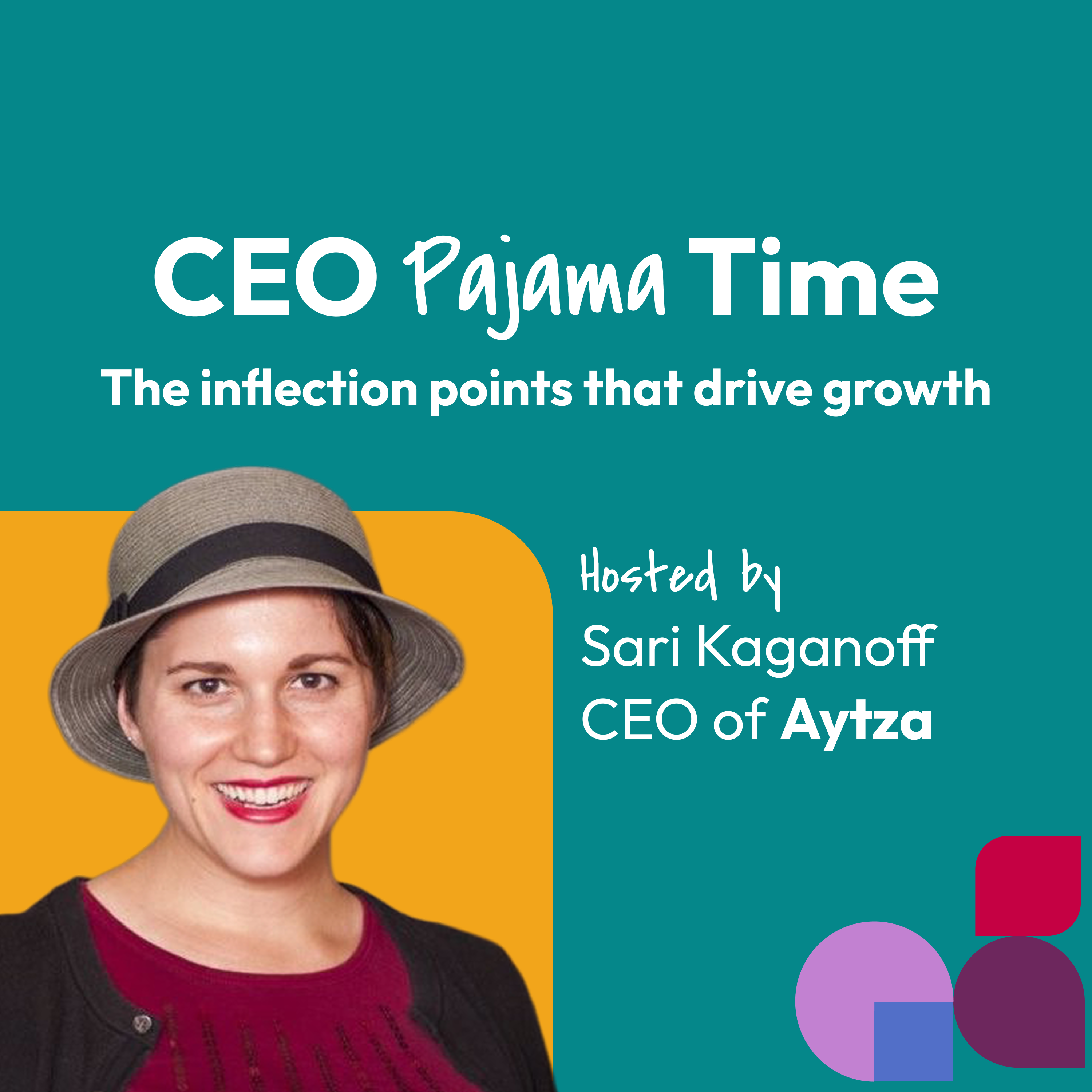
CEO Pajama Time takes you inside the after-hour decisions and toughest strategic choices made by founders as they scale. Hosted by Sari Kaganoff, CEO and Founder of Aytza, these conversations are grounded in real-world experience, navigating the key inflection points every CEO faces.
-
4
The Midnight Pivot That Became Validic
Episode DescriptionMost digital health companies of Validic's vintage have raised $100 million or more. Drew Schiller raised $35 million over 12 years, on purpose.Validic connects data from over 700 wearables, in-home medical devices, and health apps into the healthcare system. Drew started the company in 2010 with his college best friend Ryan, pivoted from corporate wellness into a data infrastructure play, then later expanded into health systems and acquired a logistics business to own the full stack.Drew talks about the midnight conversation with Ryan where they realized they couldn't out-build Fitbit or MyFitnessPal and decided to solve a different burning market need of integrating data into them instead. He also talks about why he devotes a full day every month with his leadership team to talk about nothing but strategy, and how the Validic team rewrote the company's core values in 2018 without him in the room.This one is for founders building infrastructure businesses, navigating pivots, or trying to figure out when slower growth is the right call.About Drew SchillerDrew Schiller is the CEO and co-founder of Validic, the platform that connects data from wearables, in-home medical devices, and health apps into the healthcare system. He started the company in 2010 with his college best friend Ryan, and launched Validic in 2013 after a midnight pivot away from corporate wellness software. Today the platform normalizes data from over 700 sources into a single API used by health systems, health plans, and digital health companies.Presented by Aytza
-
3
Killing Growth to Build a Lasting Company: with Michelle Davey, CEO of Wheel
Michelle Davey built Wheel from a bootstrapped clinician-matching service into the infrastructure behind virtual-first care for some of the largest healthcare enterprises in the country like Amazon Clinic. In this conversation, she gets honest about what that evolution actually looked like. She talks about walking into a board meeting with the investor hockey stick chart and telling them they needed to change course despite it. About pivoting from SMBs to enterprise when every instinct said keep the revenue coming. About acquiring GoodRx's care platform and integrating it in only nine months. About over-hiring in 2021 and the dark days that followed when she had to unwind it. She also talks about her actual pajama time: blocking mornings for reading, then picking back up after the kids go to bed to catch up on what's happening in the market. As Michelle puts it: "A lot of people get into being a founder because it seems glamorous. It is not."In this episode:From Enzyme to Wheel: the three horizons of building virtual-first care infrastructureThe board meeting where she stopped chasing SMB growthAcquiring GoodRx's care platform and building an EMR she said she'd never buildHorizon 3: An AI-native platform powering programs like weight management, menopause, and longevityHer biggest mistake: over-hiring in 2021 and the layoffs that followedHot take: "GLP-1s are going to be more disruptive to healthcare than AI"The signal she's watching: stagnation in large payer market valuesAbout Michelle DaveyMichelle Davey is the CEO and founder of Wheel, the infrastructure platform powering virtual-first care for enterprise healthcare companies. She started the company in 2018 after spending 15 years undiagnosed with an autoimmune condition in rural Texas. That experience drove her into healthcare, but the perverse incentives drove her out and into tech, where she built her career across startups and gig economy marketplaces before finding her way back to telehealth in 2016. Today, Wheel’s AI-native Horizon platform is on track to power 3 to 4 million patient visits this year for enterprises including retailers, pharmaceutical companies, and digital health brands.Presented by Aytza
-
2
Two Acquisitions in 60 Days: What Scaling That Fast Actually Looks Like with Taylor Justice
Taylor Justice spent 13 years building Unite Us from a veteran services startup into the infrastructure connecting healthcare, government, and community organizations across the country. In this conversation, he gets honest about what that actually looked like.He talks about the first thing they built being wrong. The investor who told him healthcare was a mistake, then wrote back a year later to say he was wrong.He also talks about the reality of scaling fast. Tripling headcount. Two acquisitions in 60 days. And what it took to stay the course when everything is moving at once.As Justice puts it: “This sh*t is hard. And you definitely cry sometimes."In this episode:Building for veterans, then pivoting into healthcare before knowing the landscapeThe first product they built (and why it was wrong)Realities of scaling fast: 300 to 900 people, two acquisitions, and trying to stay focused12 years with a co-founder, and what it's like now that he's goneMyth bust: "Stealth mode is the biggest waste of time"Taylor JusticeTaylor Justice is the CEO and co-founder of Unite Us, a software company connecting healthcare, government, and community organizations to coordinate care around health-related non-medical needs like food, housing, and transportation. A former U.S. Army infantry officer, Taylor was medically discharged and built Unite Us out of his own experience navigating the VA system and the gaps he saw for veterans without a network. Thirteen years later, Unite Us operates throughout the United States and has raised over $250 million to transform how human services are delivered.
-
1
Jen Goldsack’s Journey from Olympian to CEO, Declining a 20x Offer to Stay True to the Mission, and Leading Through Cancer
Jen Goldsack has spent six and a half years building the Digital Medicine Society (DiMe) into a trusted voice for healthcare's digital transformation. In this conversation, she shares the inflection points that shaped the organization. And the real story behind them. Like the time a family office offered $4 million if DiMe would pivot to focus only on cancer. She said no. Then sat on the floor crying with her dog, knowing she'd just made everything harder. Or the org structure she championed for two years that wasn't working. And the courage it took to acknowledge it and rebuild. This year, she's been navigating all of it while fighting late-stage colon cancer. She talks about the brutal self-talk that preceded her diagnosis, what being a patient has taught her about the system she's trying to fix, and why the work feels more urgent than ever.In this episode:Turning down $4M to protect DiMe's positioning as "expert generalists"The org structure shortcomings she wishes she'd caught soonerWhat it's like to navigate the healthcare system as a patient after 20 years working in itHot take: Why longevity tech investment is "incredibly gratuitous"The signal she's watching: direct-to-patient pharma pathwaysAbout Jen:Jen Goldsack founded and leads DiMe, a nonprofit working to ensure digital technologies actually improve health, healthcare, and research. Her path to healthcare leadership started unexpectedly. She landed in the field during the 2008 financial crisis after competing in the Beijing Olympics as an elite athlete. Before DiMe, she built experience across two digital health startups (one successful exit), led digital initiatives at a Duke-FDA partnership, and conducted research at Penn. Today she sits on the boards of the Coalition for Health AI and Sage Bionetworks, and contributes to the National Academies' Roundtable on Genomics and Precision Health. She holds three graduate degrees: chemistry from Oxford, history and sociology of medicine from Penn, and an MBA from George Washington. Beyond her professional credentials, Jen is a Pan American Games champion, former world record holder, and World Championship silver medalist.Resources & Links: Digital Medicine Society (DiMe) - https://dimesociety.org/Follow Jen Goldstack - https://www.linkedin.com/in/jgoldsackPresented by Aytzahttps://www.aytza.com/
-
0
The Decisions Behind Huma: The Platform Approach to Healthcare Innovation with Dan Vahdat
How Dan Vahdat Built Huma: The Platform Approach to Healthcare InnovationEnjoy this behind-the-scenes look at how bold vision, stubborn persistence, and platform thinking are revolutionizing healthcare, one disease, one regulation, one market at a time. Dan Vahdat, CEO of Huma, shares the story behind creating a platform that scales across diseases, regulations, and markets without losing sight of the big vision. In this episode:The origin story: From Johns Hopkins lab nerd to healthcare disruptorWhy building a platform beats focusing on single-use casesThe regulatory secret sauce: Configurable software as a medical deviceCommon pitfalls: Do's and don’ts of vision, team-building, and acquisitionsThe future of healthcare workforce with AI: Reinvented doctors and vibing cliniciansPractical advice for founders: Gut feeling, stubbornness, and when to listenWhy AI hype is just noise, even at the biggest tech firmsTimestamps:00:00: Welcome and introducing Dan Vahdat03:30: From disease-specific apps to a scalable platform06:51: Why Dan was driven to start a company10:34: How Dan convinced investors15:28: The risk of chasing one disease versus the platform play20:06: Biggest mistake: Building in uncharted healthcare waters36:49: Hot take: Healthcare workforce will be transformed by AIResources & Links:HumaDan Vahdat Connect with Dan Vahdat:LinkedInTwitterPresented by Aytza.
-
-1
The Decisions That Built Maven with Kate Ryder
Most healthcare startups fail because founders chase every opportunity without knowing what to say no to. Kate Ryder built Maven into the first women's and family health unicorn by doing the opposite.In this conversation, Kate walks through the inflection points that shaped Maven: strong early signals, the decision to wind down Maven Campus when demand did not translate into a sustainable business model, a strategic shift to B2B, and the path to building a virtual care platform that now covers over 28 million lives. She talks about what was actually going through her head when she made those calls, and what she wishes she'd known earlier.We get into how customer signals shaped Maven's direction, the tension between product-market fit and strategic pivots, and why agility matters more than funding in healthcare. Kate also shares the mental model she used to keep investors confident during the moments when scaling felt impossible, and why she focuses on ROI per customer over headcount metrics.This is a conversation about the decisions founders make when no one's watching. If you're navigating a pivot or trying to figure out what to protect and what to let go, Kate's perspective will stay with you. In this episode you will learn about: 00:00- Kate Ryder and Maven's mission02:07 - The evolution of Maven's business model04:35 - Challenges and decisions in the early stages06:10 - The strategic pivot to enterprise clients12:01 - Building trust and resilience in healthcare innovation17:23 - Lessons learned from shutting down the campus health product20:21 - The future of virtual healthcare and Maven's roleResources & Links:Maven Clinic Follow Kate Ryder:TwitterPresented by Aytza.
-
-2
Introduction to CEO Pajama Time with Sari Kaganoff
Welcome to CEO Pajama Time, the podcast that offers a candid look at the behind the scenes decisions and strategic turning points every founder faces. Host Sari Kaganoff, CEO and Founder of Aytza, sits down with healthtech leaders to explore the most difficult choices they made while scaling and the key inflection points that defined their journey.
No matches for "" in this podcast's transcripts.
No topics indexed yet for this podcast.
Loading reviews...
ABOUT THIS SHOW
CEO Pajama Time takes you inside the after-hour decisions and toughest strategic choices made by founders as they scale. Hosted by Sari Kaganoff, CEO and Founder of Aytza, these conversations are grounded in real-world experience, navigating the key inflection points every CEO faces.
HOSTED BY
Sari Kaganoff
CATEGORIES
Loading similar podcasts...
URL copied to clipboard!