
PODCAST · technology
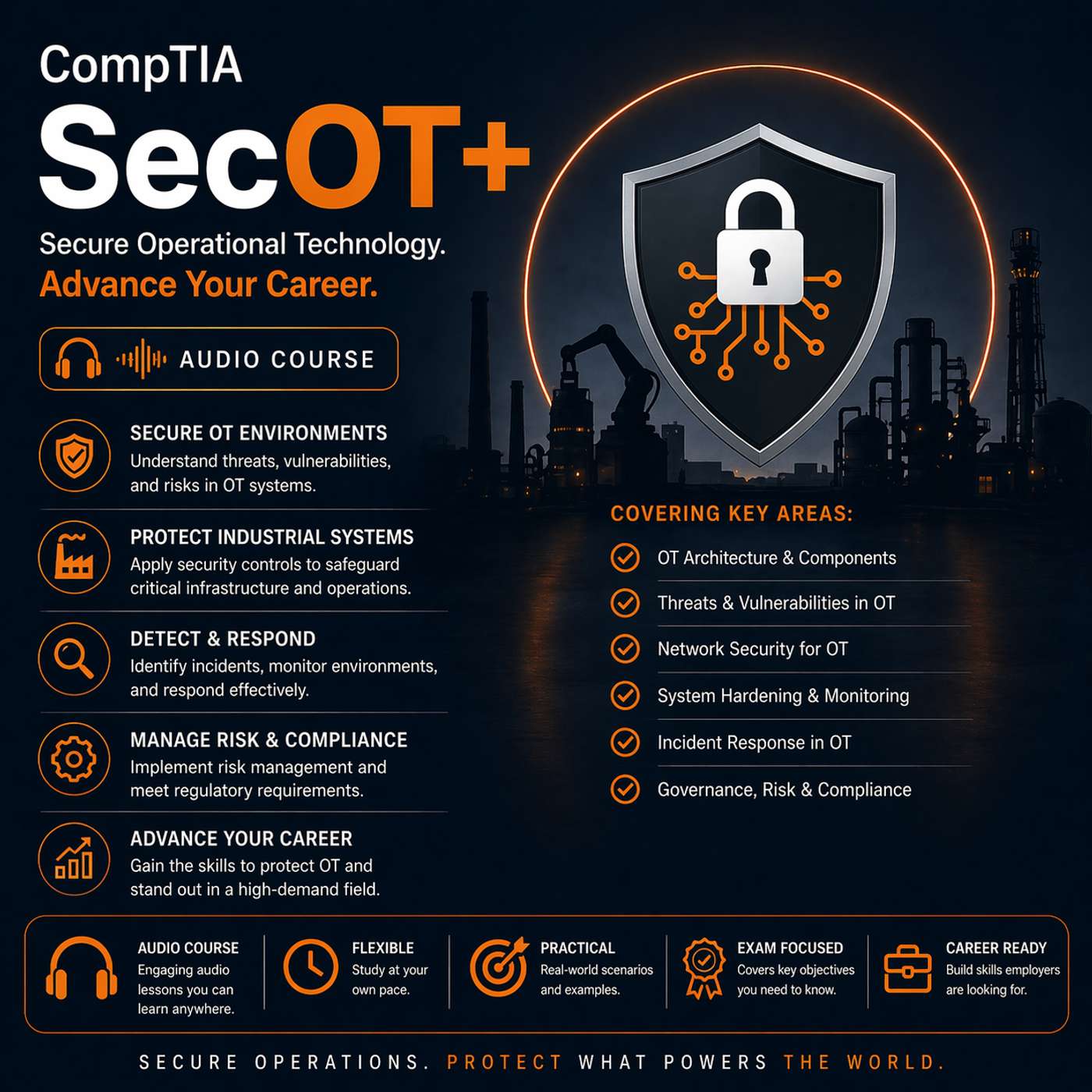
Certified: The CompTIA SecOT+ Audio Course
by Jason Edwards
Certified: The CompTIA SecOT Certification Audio Course is built for security practitioners and aspiring operators who need a practical, audio-first path into day-to-day security work. If you’re early career in cybersecurity, moving from IT into security operations, or stepping into a SOC-adjacent role, this course is designed to meet you where you are. You don’t need a lab rack or a perfect study schedule. You need clear explanations, realistic context, and a steady cadence that fits commutes, workouts, and the hours in between meetings.In Certified: The CompTIA SecOT Certification Audio Course, you’ll learn how modern security operations actually runs: what to monitor, how to interpret signals, and how to respond with calm precision. We’ll cover the flow from detection to triage to containment, with plain-English breakdowns of the tools and concepts you’re expected to understand. Because it’s audio-first, the teaching style is deliberate: short mental models, repeatable decision st
-
89
Episode 88 — Prepare for Incidents: Draft and Update IR Documentation That OT Can Use
This episode teaches how to prepare for incidents by drafting and maintaining IR documentation that OT teams can actually use during real events, where time pressure and safety constraints punish vague plans. You’ll learn what documentation must exist before an incident, including role assignments, contact trees, escalation criteria, safe containment principles, evidence handling procedures, communications templates, and site-specific constraints like maintenance windows and vendor-only change authority. We discuss why OT IR documentation should be practical and localized, with clear language, explicit decision pathways, and references to validated diagrams and inventories, so responders are not forced to invent structure mid-incident. Updating is framed as a continuous improvement loop, using lessons learned from exercises, near misses, vendor changes, and architecture updates to keep documentation aligned with reality instead of letting it drift into irrelevance. The episode also reinforces exam-ready thinking by showing how “prepare” often means building checklists, approvals, and evidence packages that enable safe action, fast coordination, and defensible decisions when the next incident arrives. Produced by BareMetalCyber.com, where you’ll find more cyber audio courses, books, and information to strengthen your educational path. Also, if you want to stay up to date with the latest news, visit DailyCyber.News for a newsletter you can use, and a daily podcast you can commute with.
-
88
Episode 87 — Execute Escalation and Notification: Internal, Government, and Regulator Expectations
This episode explains escalation and notification as disciplined processes that protect safety, preserve credibility, and reduce legal and regulatory risk, because delayed or inconsistent notifications can create consequences that outlast the technical incident. You’ll learn how internal escalation should work across operations, engineering, safety, IT, security leadership, legal, and communications, with clear triggers that avoid both panic escalation and dangerous delays. We cover external notification considerations, including when government coordination may be appropriate, how sector expectations influence timelines, and how regulator expectations tend to focus on accuracy, timeliness, and evidence of control rather than perfect certainty in early hours. The episode emphasizes that notification content must be grounded in what is known, what is unknown, and what actions are being taken, so teams avoid speculative statements that damage trust or create liability. Troubleshooting considerations include handling conflicting reports, ensuring time synchronization and decision logging, and maintaining a single authoritative narrative while technical teams continue investigation and containment under safety constraints. Produced by BareMetalCyber.com, where you’ll find more cyber audio courses, books, and information to strengthen your educational path. Also, if you want to stay up to date with the latest news, visit DailyCyber.News for a newsletter you can use, and a daily podcast you can commute with.
-
87
Episode 86 — Plan Mutual Aid and Retainers: ISACs, Peer Support, and IRR Readiness
This episode teaches how to plan mutual aid and retainers so OT incident response readiness is real, not theoretical, especially when specialized expertise and vendor knowledge may be required quickly. You’ll learn how mutual aid works in practice through sector communities and peer support, and why relationships and pre-defined trust are often more valuable than scrambling for contacts during a crisis. ISAC participation is discussed as a practical channel for timely intelligence, peer lessons learned, and coordinated response support, with an emphasis on how to consume and act on shared information safely in OT environments. Retainers are covered as contractual readiness tools, including defining scope, response timelines, access requirements, evidence handling expectations, and how retained responders coordinate with operations and safety leadership rather than operating like an external IT incident team. IRR readiness is framed as having the right people, contracts, procedures, and approvals in place so help can be activated without delay, while still maintaining governance and safe operational behavior. Produced by BareMetalCyber.com, where you’ll find more cyber audio courses, books, and information to strengthen your educational path. Also, if you want to stay up to date with the latest news, visit DailyCyber.News for a newsletter you can use, and a daily podcast you can commute with.
-
86
Episode 85 — Coordinate IT and OT During Incidents: Nuances, Authority, and Safety Priorities
This episode explains how to coordinate IT and OT during incidents without letting either side accidentally increase risk, a common scenario theme where the “wrong” answer is a technically reasonable IT action applied at the wrong time in OT. You’ll learn why authority and accountability must be explicit, including who can approve isolations, who can change firewall rules, who can touch controller logic, and who owns safety decisions when containment could affect process behavior. We cover the operational nuance that many OT symptoms have both cyber and non-cyber explanations, so coordination must include shared situational awareness, evidence exchange, and agreed investigative steps that do not disrupt deterministic control. Safety priorities are emphasized as the governing constraint, including the need to validate current process state, identify safe states, and coordinate any changes with operators who understand the physical process and its tolerances. You’ll also learn best practices for communication cadence, decision logs, and handoffs, so IT and OT can move quickly while still preserving evidence, maintaining uptime where possible, and preventing parallel “fixes” that conflict. Produced by BareMetalCyber.com, where you’ll find more cyber audio courses, books, and information to strengthen your educational path. Also, if you want to stay up to date with the latest news, visit DailyCyber.News for a newsletter you can use, and a daily podcast you can commute with.
-
85
Episode 84 — Address Overarching OT Incident Considerations: Cyber, Physical, Crisis, and Facilities
This episode teaches the overarching considerations that make OT incident response different, because OT incidents often blend cyber events with physical realities, crisis management demands, and facilities constraints that cannot be ignored. You’ll learn how to assess whether an event is purely cyber, cyber-enabled physical impact, or a physical issue creating cyber symptoms, and why that distinction changes who must be involved and what actions are safe. Crisis considerations are framed around continuity, safety messaging, leadership decision cadence, and the need to coordinate across operations, safety, legal, communications, and external partners without creating conflicting instructions in the field. Facilities considerations include physical access control, room and cabinet security, power and environmental dependencies, and how facility changes during response can either preserve stability or accidentally widen impact. You’ll practice exam-ready reasoning by identifying when to pause technical actions, validate process conditions, coordinate with safety authorities, and document decisions so response remains defensible under scrutiny. Produced by BareMetalCyber.com, where you’ll find more cyber audio courses, books, and information to strengthen your educational path. Also, if you want to stay up to date with the latest news, visit DailyCyber.News for a newsletter you can use, and a daily podcast you can commute with.
-
84
Episode 83 — Describe OT Incident Management Frameworks: PICERL and ICS4ICS With Clear Roles
This episode explains how OT incident management frameworks provide structured response discipline when safety and uptime are at stake, and why SecOT+ scenarios often reward the answer that follows a clear lifecycle with defined roles. You’ll learn PICERL as a practical flow that emphasizes preparation and iterative improvement, then connect it to what teams actually do in OT, such as validating process state before containment, coordinating changes through operations leadership, and preserving evidence without disrupting control. ICS4ICS is covered as a way to align response to industrial realities, including stakeholder coordination, control system constraints, and the need to integrate cyber response with physical and safety management practices. The episode emphasizes role clarity, teaching how to separate decision authority, technical execution, communications, and safety oversight so response actions do not conflict or create additional hazards. You’ll also learn how to apply frameworks during troubleshooting by recognizing which phase you are in, what “good” evidence looks like at that phase, and what the safest next step is when uncertainty is high. Produced by BareMetalCyber.com, where you’ll find more cyber audio courses, books, and information to strengthen your educational path. Also, if you want to stay up to date with the latest news, visit DailyCyber.News for a newsletter you can use, and a daily podcast you can commute with.
-
83
Episode 82 — Apply a Collection Management Framework: What to Collect, How Often, and Why
This episode teaches how to apply a collection management framework so OT security data collection is purposeful, sustainable, and aligned to operational constraints rather than being an endless hunt for “more logs.” You’ll learn how to define collection requirements by starting with decisions you need to support, such as detecting abnormal remote access, validating change control, confirming asset presence, and proving control operation for compliance. We discuss collection sources across OT and supporting IT systems, including jump hosts, authentication platforms, firewalls, engineering workstations, passive network sensors, physical access controls, and process-support systems like historians, while emphasizing that each source must be evaluated for safety impact and data reliability. Frequency is framed as a risk and practicality decision, balancing near-real-time needs for high-risk pathways against periodic validation for slower-moving controls like access reviews and baseline checks. You’ll also learn how to document collection plans with scope, retention, ownership, quality checks, and feedback loops so the program improves over time instead of accumulating unusable data. Produced by BareMetalCyber.com, where you’ll find more cyber audio courses, books, and information to strengthen your educational path. Also, if you want to stay up to date with the latest news, visit DailyCyber.News for a newsletter you can use, and a daily podcast you can commute with.
-
82
Episode 81 — Map Assets to a CMDB: Attributes, Relationships, and Drift Control:
This episode explains how to map OT assets into a CMDB in a way that supports security decisions without forcing IT-centric data models that ignore plant reality. You’ll learn which attributes belong in a CMDB record for OT, including stable identifiers, location context down to cabinets or lines, ownership, vendor support boundaries, criticality, and interface exposure, so the CMDB becomes useful for vulnerability response and incident scoping. We then focus on relationships, such as controller-to-I/O dependencies, HMI-to-controller communications, historian data paths, remote access pathways, and shared services like identity and time synchronization, because many OT failures cascade through relationships, not individual devices. Drift control is treated as the key success factor, covering change triggers, validation cycles, and reconciliation practices that detect “silent” changes introduced by maintenance, contractors, or upgrades. You’ll also learn how to use CMDB outputs during troubleshooting and incidents, such as quickly identifying affected zones, confirming support ownership, and producing defensible evidence for audits and post-incident reviews. Produced by BareMetalCyber.com, where you’ll find more cyber audio courses, books, and information to strengthen your educational path. Also, if you want to stay up to date with the latest news, visit DailyCyber.News for a newsletter you can use, and a daily podcast you can commute with.
-
81
Episode 80 — Maintain Software Inventory and Map to Hardware: Visibility That Enables Decisions
This episode explains why software inventory in OT must be mapped to hardware reality, because risks often live in firmware versions, installed packages, configuration sets, and vendor toolchains that do not show up in a simple device list. You’ll learn what “software inventory” includes in OT contexts, such as operating systems, controller firmware, HMI applications, engineering suites, drivers, and middleware components, and why version visibility is essential for vulnerability response that does not break support agreements. Mapping software to hardware is taught as a dependency practice, connecting what is installed to where it runs, who owns it, what it supports, and what must be coordinated if changes are needed, especially when a single workstation supports multiple lines or sites. We also cover best practices for keeping software inventories current through change triggers, vendor advisories, periodic validation, and evidence capture that supports audits and incident forensics. Troubleshooting considerations focus on avoiding inaccurate assumptions, such as thinking all devices are on the same firmware because a project was “standardized,” and instead using validated records and controlled baselines to make safe, defensible decisions. Produced by BareMetalCyber.com, where you’ll find more cyber audio courses, books, and information to strengthen your educational path. Also, if you want to stay up to date with the latest news, visit DailyCyber.News for a newsletter you can use, and a daily podcast you can commute with.
-
80
Episode 79 — Capture Key Asset Attributes: Identity, Location, Ports, Ownership, Vendor, and Function
This episode teaches which asset attributes matter most for OT security decisions and why capturing the right details prevents wasted effort during audits, patch planning, and incident response. You’ll learn how to establish identity with stable identifiers, including hostnames, serial numbers, MAC addresses, and controller-specific identifiers, while avoiding the trap of treating any single attribute as infallible in isolation. Location is covered as more than a building name, emphasizing cabinet and line context that helps teams perform walkdowns, coordinate access, and understand environmental risks that affect reliability. Ports and interfaces are addressed with a security mindset, including exposed serial, USB, maintenance ports, and network services that define both attack surface and troubleshooting pathways. Ownership, vendor, and function are framed as governance essentials, because the ability to patch, change, or isolate a device depends on who has authority, what support contracts require, and what the device actually does in the process. Produced by BareMetalCyber.com, where you’ll find more cyber audio courses, books, and information to strengthen your educational path. Also, if you want to stay up to date with the latest news, visit DailyCyber.News for a newsletter you can use, and a daily podcast you can commute with.
-
79
Episode 78 — Choose Discovery Methods Carefully: Passive, Active, and Manual Approaches in OT
This episode teaches how to choose asset discovery methods that respect OT safety and reliability constraints, because the wrong discovery approach can disrupt production and destroy trust in the security program. You’ll learn what passive discovery looks like in practice, including observing traffic and device behavior without injecting packets, and why passive methods are often preferred for fragile systems or environments with strict determinism requirements. Active discovery is discussed with clear caution, focusing on what makes it risky in OT, such as scanning side effects, protocol sensitivity, and the possibility of triggering faults or unwanted state changes, even when tools are “standard” in IT. Manual discovery is covered as the necessary complement, including walkdowns, cabinet inspections, configuration reviews, and operator knowledge capture, because not everything meaningful is visible on the network. Troubleshooting considerations show how to build a blended approach, starting with low-risk methods, confirming findings with operations and engineering, and documenting approvals and stop-work triggers so discovery improves visibility without becoming an unplanned outage generator. Produced by BareMetalCyber.com, where you’ll find more cyber audio courses, books, and information to strengthen your educational path. Also, if you want to stay up to date with the latest news, visit DailyCyber.News for a newsletter you can use, and a daily podcast you can commute with.
-
78
Episode 77 — Operationalize Asset Management: Inventory Discovery, Creation, Validation, and Maintenance
This episode explains asset management as a continuous OT security capability, because you cannot govern access, assess risk, or respond confidently if you do not know what exists and what it does. You’ll learn the difference between discovery, which finds candidates, and inventory creation, which establishes a controlled record with identifiers, ownership, and baseline attributes that can be validated. Validation is covered as the discipline of confirming accuracy through walkdowns, engineering review, and cross-checking against network observations, procurement records, and configuration sources, because OT inventories often drift as sites evolve. Maintenance is framed as a process with triggers, such as commissioning, decommissioning, firmware updates, network changes, and vendor work, ensuring the inventory stays current instead of becoming a historical snapshot. The episode also teaches how to use asset management for exam scenarios by linking inventory to segmentation design, monitoring coverage, patch planning, and incident scoping, so decisions are based on known assets and dependencies rather than assumptions. Produced by BareMetalCyber.com, where you’ll find more cyber audio courses, books, and information to strengthen your educational path. Also, if you want to stay up to date with the latest news, visit DailyCyber.News for a newsletter you can use, and a daily podcast you can commute with.
-
77
Episode 76 — Implement Perimeter Controls: Fences, Barriers, and Access Governance for Facilities
This episode teaches facility perimeter controls as the outermost layer of OT defense, because the easiest attack path is often the one that requires no network sophistication at all. You’ll learn how fences and barriers contribute to delay and deterrence, and why perimeter design is about controlling approach routes, limiting concealment, and guiding legitimate entry through monitored points rather than assuming signage will do the job. Access governance is treated as the operational layer that makes the perimeter meaningful, including gate procedures, credential checks, visitor handling, contractor controls, and escalation rules when anomalies appear. We connect perimeter controls to OT outcomes by showing how better facility governance reduces the likelihood of unauthorized cabinet access, rogue device placement, and tampering with exposed infrastructure like remote cabinets and antenna systems. Troubleshooting considerations include responding to perimeter weaknesses such as broken gates, inconsistent guard procedures, and emergency access workarounds that become permanent, and then reinforcing controls with documented procedures, training, and periodic validation that proves the perimeter still matches the facility’s risk profile. Produced by BareMetalCyber.com, where you’ll find more cyber audio courses, books, and information to strengthen your educational path. Also, if you want to stay up to date with the latest news, visit DailyCyber.News for a newsletter you can use, and a daily podcast you can commute with.
-
76
Episode 75 — Use Surveillance and Inspection: Walkdowns, Video, Motion Detection, Spectrum Analysis
This episode explains how surveillance and inspection support OT security by providing reality checks that tools alone cannot deliver, especially in environments where visibility gaps and legacy constraints are common. You’ll learn how walkdowns function as structured validation exercises, confirming asset presence, cabinet condition, port exposure, signage, and physical changes that may not appear in any digital inventory. Video and motion detection are covered as deterrence and investigation aids, emphasizing placement strategy, retention considerations, and how to align monitoring with privacy and operational needs. Spectrum analysis is introduced as a practical method for understanding wireless conditions, identifying interference, detecting rogue transmitters, and validating whether wireless behavior matches expectations, which matters when wireless supports safety or telemetry. Troubleshooting considerations focus on turning observations into defensible actions, such as correlating physical anomalies with configuration drift, documenting findings for change control, and selecting non-disruptive corrective steps that improve security while respecting uptime and safety constraints. Produced by BareMetalCyber.com, where you’ll find more cyber audio courses, books, and information to strengthen your educational path. Also, if you want to stay up to date with the latest news, visit DailyCyber.News for a newsletter you can use, and a daily podcast you can commute with.
-
75
Episode 74 — Secure Rooms, Cabinets, and Cabling: IDFs, MDFs, and Exposure Reduction
This episode teaches how to secure critical spaces and infrastructure elements in OT, because many “cyber” compromises become easy when rooms, cabinets, and cabling are treated as mere facilities concerns. You’ll learn what MDFs and IDFs typically contain, why they represent high-leverage points for segmentation and availability, and how poor access control can enable taps, rogue devices, configuration changes, or physical disruption that looks like mysterious network instability. Cabinets and control panels are addressed as risk concentrators, where exposed ports, default connectors, and accessible I/O modules can allow unauthorized changes or covert persistence. Cabling is covered as both a reliability and security topic, including risks from unprotected runs, mislabeled drops, unmanaged patching, and undocumented cross-connects that defeat architectural intent. You’ll practice selecting practical exposure reduction steps like locked enclosures, controlled keys, tamper evidence, port governance, and walkdown-based validation that confirms what the diagrams claim is actually true. Produced by BareMetalCyber.com, where you’ll find more cyber audio courses, books, and information to strengthen your educational path. Also, if you want to stay up to date with the latest news, visit DailyCyber.News for a newsletter you can use, and a daily podcast you can commute with.
-
74
Episode 73 — Apply Physical Security in OT: Badges, Readers, Biometrics, and Turnstiles
This episode explains physical security controls as part of OT security posture, because physical access frequently equals control access when cabinets, ports, and engineering environments are reachable. You’ll learn how badges, readers, biometrics, and turnstiles function as layers that enforce identity, authorization, and accountability at the facility boundary, and why “everyone knows everyone” is not a control. We connect these mechanisms to OT risk by showing how unauthorized entry can enable laptop connections, removable media introduction, serial access, or direct manipulation of equipment, often with little digital trace if physical controls are weak. You’ll also learn best practices for role-based access, visitor management, escort requirements, and time-based permissions, emphasizing that physical security must match operational rhythms like shift changes and maintenance windows. Troubleshooting considerations cover how physical controls fail in practice, such as tailgating, shared badges, bypassed doors, or reader outages that lead to propped-open entries, and how to respond with policy reinforcement, monitoring, and compensating controls that do not block safe operations. Produced by BareMetalCyber.com, where you’ll find more cyber audio courses, books, and information to strengthen your educational path. Also, if you want to stay up to date with the latest news, visit DailyCyber.News for a newsletter you can use, and a daily podcast you can commute with.
-
73
Episode 72 — Maintain Interoperability and Simplicity: Compatibility Without Expanding Attack Surface
This episode teaches how to maintain interoperability in OT while keeping designs simple enough to operate reliably, because complexity creates hidden dependencies and workarounds that expand attack surface. You’ll learn how interoperability pressures arise from multi-vendor environments, long lifecycles, and the need to share data across engineering, operations, historians, and business systems, and why “just integrate it” can quietly create unsafe trust relationships. We define simplicity as a measurable design quality, including fewer pathways, fewer exceptions, consistent patterns, and clearly documented boundaries that teams can understand and maintain over time. You’ll explore how to evaluate compatibility decisions by checking protocol needs, identity and authorization models, gateway placement, and operational impact, then selecting architectures that minimize new conduits and avoid dual-homed shortcuts. Troubleshooting considerations focus on how to recognize when interoperability has become a security problem, such as uncontrolled data flows, undocumented accounts, inconsistent firewall rules, or brittle middleware dependencies, and how to reduce risk by consolidating pathways and enforcing least privilege without breaking production. Produced by BareMetalCyber.com, where you’ll find more cyber audio courses, books, and information to strengthen your educational path. Also, if you want to stay up to date with the latest news, visit DailyCyber.News for a newsletter you can use, and a daily podcast you can commute with.
-
72
Episode 71 — Build for Performance, Auditability, and Observability: Trust You Can Prove
This episode explains how OT security designs must preserve performance while also producing auditability and observability that can be demonstrated with evidence, because “we think it’s secure” fails the moment an incident or audit demands proof. You’ll learn what performance means in OT beyond bandwidth, including latency sensitivity, jitter tolerance, deterministic traffic expectations, and how poorly planned controls can introduce instability that looks like equipment failure. We then define auditability as the ability to show who did what, when, under what authority, and with what approvals, tying this directly to change control, access reviews, and incident reconstruction. Observability is covered as practical visibility into system state and behavior, such as authentication events, remote sessions, configuration changes, protocol anomalies, and monitoring health, while avoiding disruptive collection methods. You’ll practice selecting controls that deliver trust you can prove, like hardened jump paths, scoped logging, baseline comparisons, and evidence packages that can be produced quickly without improvisation. Produced by BareMetalCyber.com, where you’ll find more cyber audio courses, books, and information to strengthen your educational path. Also, if you want to stay up to date with the latest news, visit DailyCyber.News for a newsletter you can use, and a daily podcast you can commute with.
-
71
Episode 70 — Engineer Compartmentalization and Criticality: Limiting Blast Radius Without Breaking Control
This episode teaches how to engineer compartmentalization in OT so you can limit blast radius while still preserving the control behaviors operations depend on, a balancing act that shows up repeatedly in design and response questions. You’ll learn how to use criticality to decide what belongs in separate zones, what needs tightly controlled conduits, and what systems should never share credentials or management planes because a compromise would spread too easily. We connect compartmentalization to practical patterns like cell and area zoning, dedicated jump hosts per zone, strict one-way data paths where appropriate, and carefully governed remote access that can be disabled without stranding recovery. The episode emphasizes that compartmentalization is not simply “more firewalls,” because poorly designed segmentation can break deterministic traffic, create troubleshooting chaos, and lead teams to implement unsafe workarounds. You’ll practice evaluating a scenario for where the true boundary should be, how to validate that segmentation supports operations, and how to document the design so it is maintainable and auditable over time. Produced by BareMetalCyber.com, where you’ll find more cyber audio courses, books, and information to strengthen your educational path. Also, if you want to stay up to date with the latest news, visit DailyCyber.News for a newsletter you can use, and a daily podcast you can commute with.
-
70
Episode 69 — Design for Operational Resilience: Endurance, Redundancy, High Availability, Recoverability
This episode explains operational resilience as the ability to endure disruption and recover safely, which is a central OT outcome and a frequent thread in SecOT+ scenarios about outages, containment, and restoration. You’ll learn the difference between endurance, redundancy, and high availability, and why each one addresses different failure patterns, from component failures to upstream service outages to deliberate disruption. Recoverability is treated as a discipline, covering backups, golden configurations, tested restoration procedures, and validation steps that prove integrity before returning systems to service. We also connect resilience to security controls by showing how segmentation and least privilege limit blast radius, while monitoring and incident playbooks reduce time to identify and isolate issues without improvisation. Troubleshooting considerations emphasize that resilience designs fail when they are untested, when redundancy shares hidden dependencies, or when recovery requires credentials and services that are down during the incident, and you’ll learn how to design around those realities with independent paths and documented procedures. Produced by BareMetalCyber.com, where you’ll find more cyber audio courses, books, and information to strengthen your educational path. Also, if you want to stay up to date with the latest news, visit DailyCyber.News for a newsletter you can use, and a daily podcast you can commute with.
-
69
Episode 68 — Explain Secure OT Architectural Principles: Least Privilege, Determinism, and Defense in Depth
This episode teaches core OT architectural principles that support both security and reliable control, because SecOT+ questions often reward the answer that preserves deterministic behavior while reducing exposure. You’ll learn how least privilege applies to OT identities, services, and network paths, emphasizing that broad access is not “convenient,” it is a direct multiplier on blast radius when something goes wrong. Determinism is explained as a design goal that influences segmentation, traffic shaping, and monitoring choices, because unpredictable traffic and uncontrolled dependencies make systems harder to operate and easier to disrupt. Defense in depth is framed as layered resilience, combining access governance, segmentation, monitoring, hardening, and recovery capabilities so no single failure becomes catastrophic. The episode also covers common design mistakes such as dual-homed devices, overly permissive conduits, shared admin credentials, and unmanaged remote tools, then teaches how to correct them with architecture patterns that operations can live with long term. You’ll practice applying principles to scenario prompts so you can select design improvements that are both safer and more defensible than one-time technical fixes. Produced by BareMetalCyber.com, where you’ll find more cyber audio courses, books, and information to strengthen your educational path. Also, if you want to stay up to date with the latest news, visit DailyCyber.News for a newsletter you can use, and a daily podcast you can commute with.
-
68
Episode 67 — Turn Telemetry Into Intelligence: Logs, Sessions, and Anomalies That Matter
This episode explains how to turn telemetry into usable intelligence by focusing on signals that matter in OT, where too much noise can be as dangerous as too little visibility. You’ll learn how to think about logs, sessions, and network observations as evidence streams, then apply simple analytic questions like “what is normal here,” “what changed,” and “what could that change enable” to move from data to decisions. We cover the types of telemetry that often provide the most leverage, including remote access session records, authentication events, firewall and jump host logs, engineering workstation activity, and network anomalies in industrial protocols that should normally be predictable. The episode emphasizes that anomalies must be interpreted with operational context, such as maintenance windows, commissioning activities, or process upsets, so you avoid false alarms that erode trust with operations. You’ll also learn best practices for baselining, time synchronization, and correlation, and how to choose safe investigative steps that preserve evidence and reduce risk without touching control logic or disrupting process traffic unnecessarily. Produced by BareMetalCyber.com, where you’ll find more cyber audio courses, books, and information to strengthen your educational path. Also, if you want to stay up to date with the latest news, visit DailyCyber.News for a newsletter you can use, and a daily podcast you can commute with.
-
67
Episode 66 — Operationalize Intel Data Types: IOCs, STIX, YARA, and Where They Fit in OT
This episode teaches how to operationalize intelligence data types without forcing IT-centric workflows into OT environments where telemetry and response options are different. You’ll define indicators of compromise as actionable signals that can be searched for in logs and network data, then learn how to treat IOCs as starting points for investigation rather than proof of infection, especially in environments with limited endpoint visibility. STIX is explained as a structured way to represent intelligence so it can be shared and processed consistently, and you’ll learn what that structure can help with, such as mapping relationships among threats, observables, and mitigations in a way that supports repeatable triage. YARA is introduced as a pattern-matching approach often used for file analysis, and you’ll discuss how and where it can be applied safely in OT contexts, typically on forensic copies or staging systems rather than by scanning fragile production hosts. The episode emphasizes fit and constraints, teaching you to select where each data type belongs, how to validate relevance to your asset inventory, and how to avoid disruptive “hunt everything” actions that risk uptime without improving certainty. Produced by BareMetalCyber.com, where you’ll find more cyber audio courses, books, and information to strengthen your educational path. Also, if you want to stay up to date with the latest news, visit DailyCyber.News for a newsletter you can use, and a daily podcast you can commute with.
-
66
Episode 65 — Identify OT Threat Vectors: Remote Access, Media, Supply Chain, and IT-to-OT Pivoting
This episode focuses on the threat vectors most likely to matter in real OT environments and on the SecOT+ exam, with an emphasis on how attackers actually reach control-adjacent systems. You’ll learn how remote access becomes risky when it is unmanaged, broadly permitted, shared across vendors, or protected by weak authentication, and how to reduce that risk with jump hosts, MFA, tight scoping, and time-bound approvals. Removable media is covered as a practical pathway for both accidental infection and intentional introduction of malicious tooling, especially when engineering workflows rely on portable devices and offline updates. We also break down supply chain vector realities, including compromised updates, vendor credentials, and dependencies on remote services, and why treatment is as much contractual and governance-driven as it is technical. IT-to-OT pivoting is explained in terms of trust boundaries and shared services, showing how identity, monitoring, and management tooling can become bridges, and how to choose controls that prevent pivoting without blocking legitimate operational support. Produced by BareMetalCyber.com, where you’ll find more cyber audio courses, books, and information to strengthen your educational path. Also, if you want to stay up to date with the latest news, visit DailyCyber.News for a newsletter you can use, and a daily podcast you can commute with.
-
65
Episode 64 — Analyze the OT Threat Landscape: Actor Motives, Capabilities, and Physical Consequences
This episode teaches how to analyze the OT threat landscape by connecting actor motives and capabilities to the kinds of consequences OT environments can experience, which helps you choose answers that match realistic risk. You’ll learn how motivations differ across criminal groups, ideological actors, insiders, and nation-state aligned teams, and how those motivations influence targeting decisions such as extortion, disruption, espionage, or shaping strategic pressure. We then connect capability to operational reality, distinguishing opportunistic access and commodity tooling from the deeper capability required to manipulate control logic, maintain stealth, and produce physical outcomes reliably. You’ll practice recognizing scenario clues that indicate intent, such as focus on billing and IT systems for leverage, emphasis on credential harvesting and persistence for long-term access, or evidence of careful process understanding when safety and control behaviors are affected. The episode also reinforces that physical consequences are shaped by interdependencies and safeguards, so you will learn to reason about how segmentation, safety layers, human oversight, and recovery readiness influence whether an attacker can move from access to meaningful impact. Produced by BareMetalCyber.com, where you’ll find more cyber audio courses, books, and information to strengthen your educational path. Also, if you want to stay up to date with the latest news, visit DailyCyber.News for a newsletter you can use, and a daily podcast you can commute with.
-
64
Episode 63 — Learn from Indirect-Impact Events: Colonial Pipeline, SolarWinds, Maersk, AcidRain, CrowdStrike 2024, RTX
This episode explains why indirect-impact events belong in OT security study, because OT outages often originate upstream in IT, suppliers, or shared services even when control networks remain technically untouched. You’ll learn how disruptions like ransomware, widespread IT compromise, supply chain tampering, or platform outages can halt operations through billing systems, scheduling, identity services, remote access tooling, and decision-making paralysis, creating real physical and economic consequences without a single PLC being exploited. We connect these lessons to exam scenarios where the correct answer recognizes dependency and continuity planning, such as designing for degraded operations, maintaining manual procedures, validating backup access methods, and ensuring recovery sequencing protects safety before restoring full connectivity. You’ll also learn how to build practical defensive posture against indirect impact by tightening remote access, reducing shared credential sprawl, validating supplier controls, and monitoring for abnormal enterprise-to-OT access patterns that indicate pivot risk. Troubleshooting considerations include distinguishing “control failure” from “support failure,” so teams avoid risky changes to stable OT systems when the real outage driver is upstream identity, network routing, or vendor platform instability. Produced by BareMetalCyber.com, where you’ll find more cyber audio courses, books, and information to strengthen your educational path. Also, if you want to stay up to date with the latest news, visit DailyCyber.News for a newsletter you can use, and a daily podcast you can commute with.
-
63
Episode 62 — Learn from Direct-Impact OT Events: Stuxnet, TRISIS, BlackEnergy, FrostyGoop, Industroyer
This episode uses major OT incidents as learning instruments, focusing on what made them directly impactful to physical processes and what lessons translate into exam-ready security reasoning. You’ll analyze how these events demonstrate common patterns such as highly tailored targeting, deep understanding of industrial environments, and exploitation of trust relationships that were never designed for adversarial conditions. The goal is not memorizing timelines, but extracting security principles: why segmentation and access governance matter, why monitoring must include industrial protocols and engineering activity, and why safety-related systems deserve separate, rigorous change control. You’ll also learn how to interpret “direct impact” clues in scenarios, such as unexpected process states, safety system interactions, and coordinated actions across multiple components, then select defensive actions that preserve safety and evidence while reducing the attacker’s ability to persist or repeat actions. Troubleshooting considerations include avoiding the trap of assuming every event is “advanced malware,” and instead verifying basic access paths, recent changes, and control integrity first, because many preventable conditions look sophisticated when documentation is weak. Produced by BareMetalCyber.com, where you’ll find more cyber audio courses, books, and information to strengthen your educational path. Also, if you want to stay up to date with the latest news, visit DailyCyber.News for a newsletter you can use, and a daily podcast you can commute with.
-
62
Episode 61 — Apply Threat Intelligence Frameworks: Diamond Model, ATT&CK for ICS, and Kill Chain
This episode teaches how to use structured threat intelligence frameworks to organize thinking and avoid reactive, headline-driven decisions in OT environments. You’ll learn what the Diamond Model is trying to capture by relating adversary, capability, infrastructure, and victim into a repeatable analytic picture, then connect that to how you build and validate hypotheses when evidence is incomplete. We then cover ATT&CK for ICS as a way to categorize adversary behaviors in terms of techniques and tactics, helping you map likely actions to detection opportunities and defensive controls without assuming perfect visibility. The kill chain is presented as a practical narrative tool for understanding stages of compromise, from initial access through execution and impact, and how each stage offers different opportunities for disruption, containment, or recovery planning. You’ll also learn how to apply these frameworks safely in OT by prioritizing relevance, confirming exposure paths, and coordinating with operations before acting, because the correct answer is often a disciplined validation step rather than an immediate technical change. Produced by BareMetalCyber.com, where you’ll find more cyber audio courses, books, and information to strengthen your educational path. Also, if you want to stay up to date with the latest news, visit DailyCyber.News for a newsletter you can use, and a daily podcast you can commute with.
-
61
Episode 60 — Use the Intelligence Life Cycle: Collection, Analysis, Dissemination, and Feedback Loops
This episode explains the intelligence life cycle as a repeatable workflow that turns raw information into decisions, which helps you answer SecOT+ questions about process discipline and operationalization rather than just recognizing terms. You’ll learn the core phases of collection, analysis, dissemination, and feedback, and how each phase must be tailored for OT constraints like limited telemetry, safety approvals for testing, vendor dependencies, and the need to coordinate with operations before acting on intelligence-driven recommendations. We cover collection sources such as vendor advisories, sector reporting, internal logs, network monitoring, incident reports, and peer sharing, then show how analysis should focus on relevance, credibility, impact, and required action, not simply summarizing news. Dissemination is framed as targeted delivery, ensuring that leadership receives risk implications, security teams receive detection and response guidance, and engineering receives actionable control changes that fit change management. Feedback loops are emphasized as the maturity lever, because the life cycle improves only when consumers report what was useful, what was noise, and what outcomes occurred, allowing the program to refine requirements and prove value over time. Produced by BareMetalCyber.com, where you’ll find more cyber audio courses, books, and information to strengthen your educational path. Also, if you want to stay up to date with the latest news, visit DailyCyber.News for a newsletter you can use, and a daily podcast you can commute with.
-
60
Episode 59 — Threat Intelligence Foundations: Intelligence Types and What Each One Delivers
This episode teaches threat intelligence foundations by explaining what different intelligence types deliver, how they are produced, and how to use them in OT without drowning in data that does not improve safety or resilience. You’ll learn the practical differences among strategic, operational, tactical, and technical intelligence, including who each type is for and what decisions it supports, from executive prioritization to SOC triage to engineering controls selection. We cover why OT environments require careful filtering, because many generic feeds focus on IT endpoints and internet exposure while OT risk often hinges on remote access design, vendor pathways, and protocol-specific behaviors. The episode shows how intelligence becomes useful only when tied to assets, exposures, and operational consequences, such as identifying which sites use affected vendors, which remote tools create pivot paths, or which protocol anomalies would matter for detection. Troubleshooting considerations include avoiding overreaction to headlines, validating relevance before changing control systems, and building an intake process that converts intelligence into a small number of actionable tasks with owners, timelines, and evidence expectations. Produced by BareMetalCyber.com, where you’ll find more cyber audio courses, books, and information to strengthen your educational path. Also, if you want to stay up to date with the latest news, visit DailyCyber.News for a newsletter you can use, and a daily podcast you can commute with.
-
59
Episode 58 — Monitor and Disposition Risk: Residuals, Audits, Reporting, Escalations, and Decisions
This episode explains how to monitor and disposition risk after controls are implemented, because residual risk is never zero and the exam often tests whether you can keep decision-making disciplined over time. You’ll learn how to define residual risk in operational terms, including what remains possible despite controls, what conditions would increase exposure, and what indicators suggest that assumptions are no longer valid. We connect this to audits and reporting by showing how to produce evidence that controls operate consistently, how to report exceptions honestly, and how to translate findings into decisions rather than simply filing reports. Escalation is covered as a structured pathway, including what triggers escalation, who must be informed, and what options exist when risk exceeds tolerance but immediate remediation would disrupt operations unsafely. The episode also emphasizes governance behaviors like periodic risk reviews, decision logs, and re-authorization after significant changes, so risk disposition remains intentional and defensible. By the end, you’ll be able to select exam answers that reflect continuous risk ownership and accountable decisions, not one-time assessments that fade into the background. Produced by BareMetalCyber.com, where you’ll find more cyber audio courses, books, and information to strengthen your educational path. Also, if you want to stay up to date with the latest news, visit DailyCyber.News for a newsletter you can use, and a daily podcast you can commute with.
-
58
Episode 57 — Operate a Controls Calendar: Scheduling, Evidence, and Sustainable Compliance
This episode teaches how to operate a controls calendar so OT controls are tested, evidenced, and maintained on a predictable rhythm that supports both compliance and reliability without creating last-minute panic. You’ll learn why a calendar is more than dates on a page, because it defines who performs control checks, what evidence is collected, what systems are affected, and how activities align to maintenance windows and safety approvals. We cover practical examples such as periodic access reviews, backup integrity testing, firewall rule reviews, account recertification, patch coordination checks, incident exercise cadence, and monitoring health verification, emphasizing that each activity needs a clear procedure and a repeatable evidence package. The episode also explains how to handle drift, missed cycles, and changing scope, because OT calendars fail when plants add assets faster than governance updates and evidence processes cannot keep up. Troubleshooting considerations include building escalation rules for overdue controls, designing lightweight evidence capture, and using trend reporting to show whether compliance is sustainable or only achieved through heroics. Produced by BareMetalCyber.com, where you’ll find more cyber audio courses, books, and information to strengthen your educational path. Also, if you want to stay up to date with the latest news, visit DailyCyber.News for a newsletter you can use, and a daily podcast you can commute with.
-
57
Episode 56 — Track Inherited Risk and Maturity Indicators: What You Own Versus What You Inherit
This episode explains inherited risk in OT as the portion of risk you carry because of upstream dependencies and shared services, which is a frequent blind spot when teams assume “we secured our network” but rely on systems they do not fully control. You’ll learn to distinguish what you directly own, such as local segmentation rules and site access governance, from what you inherit, such as enterprise identity providers, upstream monitoring platforms, cloud services, carrier networks, and vendor-managed update channels. We then connect inherited risk to maturity indicators, showing how a program can appear mature locally while still being fragile because inherited controls are untested, undocumented, or outside agreed SLAs. The episode teaches practical tracking methods such as dependency maps, control ownership matrices, and evidence requests that validate inherited controls without starting political fights. Troubleshooting guidance focuses on what to do when inherited controls fail, including escalation paths, compensating controls, and communication practices that keep operations safe while accountability is clarified. By the end, you’ll be able to choose exam answers that reflect shared responsibility, realistic authority, and defensible evidence rather than assuming unlimited control over every dependency. Produced by BareMetalCyber.com, where you’ll find more cyber audio courses, books, and information to strengthen your educational path. Also, if you want to stay up to date with the latest news, visit DailyCyber.News for a newsletter you can use, and a daily podcast you can commute with.
-
56
Episode 55 — Control and Treat OT Risk: Controls Catalogs, Documentation, and Acceptance Criteria
This episode teaches how to control and treat OT risk using controls catalogs, disciplined documentation, and clear acceptance criteria, which is core to making risk decisions auditable and sustainable. You’ll learn how to translate a risk statement into treatment options such as avoidance, mitigation, transfer, or acceptance, then select controls that match operational constraints and safety priorities. We explain what a controls catalog is for in practical terms, including how it supports consistency across sites, reduces decision friction, and makes evidence collection repeatable, while still allowing tailored implementation where equipment and processes differ. Documentation is treated as a working artifact, covering how to record control intent, scope, owner, test method, and required evidence, and why acceptance criteria must be explicit so “good enough” is not decided during a crisis. You’ll also learn how to handle exceptions without losing governance, including compensating controls, expiration dates, and revalidation steps, so risk acceptance is a managed decision rather than an untracked liability. Produced by BareMetalCyber.com, where you’ll find more cyber audio courses, books, and information to strengthen your educational path. Also, if you want to stay up to date with the latest news, visit DailyCyber.News for a newsletter you can use, and a daily podcast you can commute with.
-
55
Episode 54 — Understand OT Pen Tests and Adversarial Emulation: Safety Constraints and Value
This episode explains how penetration testing and adversarial emulation work in OT environments where safety, uptime, and vendor constraints change what “testing” can responsibly mean, a nuance that exam questions often probe. You’ll learn the difference between a traditional pen test focused on vulnerability discovery and exploitation, and adversarial emulation focused on reproducing realistic attacker behaviors to validate detection, response, and segmentation assumptions. We cover the safety constraints that make OT testing different, including the risk of process impact from scanning, protocol fuzzing, credential guessing, or unintended writes, and why many OT programs rely heavily on passive validation, controlled testbeds, and carefully scoped activities with explicit approvals. The episode also teaches how to extract value without chaos by defining objectives, success criteria, safe tooling, and stop-work triggers, along with documentation requirements that produce evidence rather than rumors. Troubleshooting considerations include interpreting findings responsibly, avoiding “scorecard” thinking, and ensuring remediation is operationally realistic, because the goal is improved resilience and safer response, not a dramatic report that cannot be acted on. Produced by BareMetalCyber.com, where you’ll find more cyber audio courses, books, and information to strengthen your educational path. Also, if you want to stay up to date with the latest news, visit DailyCyber.News for a newsletter you can use, and a daily podcast you can commute with.
-
54
Episode 53 — Conduct Architecture Reviews for OT Risk: Data Flows, Trust Boundaries, and Weak Links
This episode teaches how to conduct architecture reviews for OT risk by focusing on data flows, trust boundaries, and weak links that create real-world compromise paths, which aligns closely with SecOT+ objectives around segmentation and defensible design. You’ll learn how to map functional flows such as control commands, telemetry, historian feeds, engineering changes, and remote support sessions, then identify where trust is assumed rather than explicitly enforced. We cover common weak links like shared jump hosts, flat management networks, overly permissive firewall rules, dual-homed devices, unmanaged wireless bridges, and identity dependencies that quietly connect OT to upstream IT services. The episode also explains how architecture reviews should account for operational constraints, including determinism, maintenance windows, vendor support boundaries, and the need to preserve safety functions even during containment actions. You’ll practice translating review findings into actionable recommendations that include ownership, evidence, and rollback planning, so architecture work leads to safer systems rather than diagrams that never change anything. By the end, you’ll be able to interpret exam scenarios that describe “a simple integration” and correctly spot the trust boundary that makes it risky. Produced by BareMetalCyber.com, where you’ll find more cyber audio courses, books, and information to strengthen your educational path. Also, if you want to stay up to date with the latest news, visit DailyCyber.News for a newsletter you can use, and a daily podcast you can commute with.
-
53
Episode 52 — Choose Qualitative Versus Quantitative Risk: When Each Method Actually Helps
This episode explains how to choose qualitative versus quantitative risk methods in OT without turning risk work into either hand-waving or false precision, a balance that the SecOT+ exam often tests through “best next step” decisions. You’ll learn when qualitative methods are the right tool, such as early program stages, limited data environments, and safety-driven decisions where conservative judgment matters more than numeric outputs. We then cover when quantitative approaches can help, such as comparing investment options, modeling downtime costs, or justifying redundancy where business impact can be estimated with credible ranges and documented assumptions. The episode emphasizes that OT data is often incomplete or biased by reporting gaps, vendor opacity, and changing process conditions, so both methods require careful calibration and consistent definitions. You’ll also learn how to present results so stakeholders trust them, including how to communicate uncertainty, avoid mixing scales improperly, and connect ratings back to specific scenarios and controls. The outcome is an exam-ready decision framework for selecting the method that supports action, evidence, and safety rather than generating numbers nobody can defend. Produced by BareMetalCyber.com, where you’ll find more cyber audio courses, books, and information to strengthen your educational path. Also, if you want to stay up to date with the latest news, visit DailyCyber.News for a newsletter you can use, and a daily podcast you can commute with.
-
52
Episode 51 — Use Failure Mode and Criticality Thinking: Safety, Reliability, and Cascading Effects
This episode teaches failure mode and criticality thinking in OT as a practical way to predict how small faults become large incidents, which is essential for SecOT+ questions that revolve around safe prioritization under uncertainty. You’ll learn how to break a system into components, identify plausible failure modes, and connect each failure to effects on safety, reliability, product quality, and recoverability, with special attention to cascading effects across shared power, shared networks, shared credentials, and shared engineering tooling. We also cover how cyber conditions can mimic or trigger classic failure modes, such as integrity loss appearing as sensor drift, availability loss appearing as intermittent comms failures, or unauthorized writes appearing as “mysterious” configuration changes. You’ll practice applying criticality logic to decide what gets protected first, what must be monitored continuously, and what can be deferred to maintenance windows, all while documenting assumptions and evidence. By the end, you’ll be able to choose mitigations that reduce both operational and security risk without creating new hazards through disruptive testing or rushed changes. Produced by BareMetalCyber.com, where you’ll find more cyber audio courses, books, and information to strengthen your educational path. Also, if you want to stay up to date with the latest news, visit DailyCyber.News for a newsletter you can use, and a daily podcast you can commute with.
-
51
Episode 50 — Evaluate Third-Party Risk: Integrators, Remote Support, and Shared Responsibility
This episode teaches how to evaluate third-party risk in OT, because integrators and remote support providers often have the access and authority that determines whether controls are enforceable or merely aspirational. You’ll learn how to identify third-party roles, what systems they touch, what credentials and pathways they use, and what shared responsibility actually means when something fails, including who must detect, who must contain, and who must restore safely. We connect this to exam scenarios where vendor access is necessary but risky, emphasizing controls like dedicated jump hosts, MFA, session recording where appropriate, strict time-bound access, change approvals, and clear evidence requirements after work is performed. The episode also covers governance techniques such as contract language, SLAs for incident support, and periodic access reviews that prevent “temporary” accounts from becoming permanent backdoors. Troubleshooting considerations focus on responding when a third-party event is suspected, including preserving logs, verifying recent sessions, coordinating with legal and procurement, and implementing compensating controls that reduce risk without cutting off critical operational support. Produced by BareMetalCyber.com, where you’ll find more cyber audio courses, books, and information to strengthen your educational path. Also, if you want to stay up to date with the latest news, visit DailyCyber.News for a newsletter you can use, and a daily podcast you can commute with.
-
50
Episode 49 — Assess Supply Chain Risk in OT: Hardware, Software, and Vendor Dependencies
This episode explains how to assess supply chain risk in OT with a focus on dependencies that can affect safety and uptime long before an organization realizes the risk is “cyber.” You’ll learn to evaluate hardware and firmware provenance, software update channels, licensing and activation dependencies, and the operational risk of vendor-only tools and proprietary protocols that can create single points of failure. We discuss realistic threat and failure patterns such as compromised updates, counterfeit components, unsupported end-of-life devices, and vendor outages that can break remote support or patch distribution, and how those issues show up in exam questions as governance and resilience problems. You’ll learn best practices like approved vendor lists, integrity validation for updates, documented bill-of-materials awareness where feasible, and contingency planning for long lead-time replacements. Troubleshooting considerations include what to do when dependencies are poorly documented, such as building a dependency map from procurement records, system configurations, and operational interviews, then prioritizing the most safety- and availability-relevant dependencies for control and monitoring. Produced by BareMetalCyber.com, where you’ll find more cyber audio courses, books, and information to strengthen your educational path. Also, if you want to stay up to date with the latest news, visit DailyCyber.News for a newsletter you can use, and a daily podcast you can commute with.
-
49
Episode 48 — Apply Scenario-Based Risk Methods: Realistic Failure Paths and Meaningful Mitigations
This episode teaches scenario-based risk methods that focus on believable failure paths, because OT risk work is strongest when it mirrors how systems actually fail and how people actually respond under pressure. You’ll learn how to build a scenario from an initiating event, enabling conditions, and a path to impact, then identify where controls can break the chain without relying on perfect detection or perfect behavior. We connect this to exam scenarios where you must choose mitigations that are operationally realistic, such as limiting remote access routes, hardening jump hosts, validating backups, and improving change control discipline rather than proposing disruptive scanning or emergency patching. The episode covers how to define meaningful mitigations by specifying ownership, evidence, maintenance requirements, and how effectiveness will be tested, so mitigations are not just statements like “improve security.” Troubleshooting considerations include avoiding overly broad scenarios that cannot be acted on, missing human factors like shift handoffs, and ignoring safety procedures, and then correcting the scenario by tightening assumptions and validating each step with engineering and operations knowledge. Produced by BareMetalCyber.com, where you’ll find more cyber audio courses, books, and information to strengthen your educational path. Also, if you want to stay up to date with the latest news, visit DailyCyber.News for a newsletter you can use, and a daily podcast you can commute with.
-
48
Episode 47 — Identify OT Threat Surface: Vectors, Exposure, and Threat Actors in Context
This episode explains how to identify the OT threat surface by combining technical exposure with operational context, because OT risk is shaped as much by access pathways and habits as it is by vulnerabilities. You’ll learn to separate vectors, such as remote access, removable media, vendor connections, wireless links, and IT-to-OT pivot paths, from exposure, such as weak authentication, flat networks, unmanaged assets, and poor monitoring. We cover threat actors in a practical way, including opportunistic attackers, financially motivated groups, insiders, and nation-state capabilities, emphasizing that actor selection often depends on sector value, geopolitical interest, and the ease of reaching OT through upstream IT. The episode reinforces exam reasoning by teaching you to start with “how could they get in” and “what could they influence,” then align controls to reduce the most consequential exposure first. Troubleshooting focuses on how organizations miss threat surface elements like shadow remote tools, undocumented modem paths, and temporary contractor networks, and how to find and govern these pathways with inventories, access reviews, and validated network boundaries. Produced by BareMetalCyber.com, where you’ll find more cyber audio courses, books, and information to strengthen your educational path. Also, if you want to stay up to date with the latest news, visit DailyCyber.News for a newsletter you can use, and a daily podcast you can commute with.
-
47
Episode 46 — Scope OT Risk Assessments: Assets, Networks, and Boundaries You Can Defend
This episode teaches how to scope OT risk assessments so the results are defensible, actionable, and aligned to how the plant actually works, which is a common weak spot in both real programs and exam scenarios. You’ll learn how to define scope using operational boundaries like units, cells, lines, sites, and shared services, then map those to network zones, conduits, remote access paths, and vendor touchpoints. We explain why scope must include assumptions and exclusions, because “we didn’t assess that segment” is only acceptable if it is documented, justified, and paired with a plan to address the gap. You’ll practice identifying hidden scope expansion risks, such as shared identity services, shared jump hosts, shared engineering tools, and shared wireless bridges that connect areas people assume are separate. Troubleshooting considerations cover how scoping fails when diagrams are outdated or when stakeholders disagree on boundaries, and how to correct it with walkdowns, traffic observations, and a scoping statement that is reviewed and approved by operations and engineering leadership. Produced by BareMetalCyber.com, where you’ll find more cyber audio courses, books, and information to strengthen your educational path. Also, if you want to stay up to date with the latest news, visit DailyCyber.News for a newsletter you can use, and a daily podcast you can commute with.
-
46
Episode 45 — Model Likelihood and Consequence: Risk Variables That Drive Real Decisions
This episode explains how to model likelihood and consequence in OT without pretending you have perfect data, because good risk decisions come from disciplined reasoning, not false precision. You’ll learn what “likelihood” means when incidents can be rare but impactful, and how to account for exposure, threat capability, existing controls, and operational conditions that make certain failures more plausible. We define consequence in OT terms, including safety impact, environmental harm, production loss, quality degradation, equipment damage, and recovery complexity, then show how consequence can dominate decisions even when likelihood is uncertain. The episode includes exam-relevant guidance on choosing conservative assumptions when safety is involved, documenting uncertainty, and using ranges or ordinal scales when quantitative inputs are weak. Troubleshooting focuses on common modeling errors like double-counting impacts, treating vulnerabilities as threats, or ignoring compensating controls, and how to improve the model by validating assumptions with engineering and operations input and by updating ratings after changes and incidents. Produced by BareMetalCyber.com, where you’ll find more cyber audio courses, books, and information to strengthen your educational path. Also, if you want to stay up to date with the latest news, visit DailyCyber.News for a newsletter you can use, and a daily podcast you can commute with.
-
45
Episode 44 — Explain OT Risk Assessment Frameworks: NIST and ISA/IEC Approaches in Practice
This episode teaches how OT risk assessment frameworks are applied in practice, so you can recognize what a scenario is asking for when it references structured risk work rather than ad hoc judgment. You’ll learn how NIST-style approaches emphasize repeatability, documented controls, and evidence-driven decision paths, while ISA/IEC approaches emphasize zones, conduits, and security levels aligned to industrial architectures and operational needs. We connect both perspectives to the same real objective: identifying risk, selecting controls that fit constraints, and proving that decisions were made deliberately rather than reactively. You’ll practice translating framework language into concrete actions like scoping boundaries, documenting assets and data flows, identifying threats and vulnerabilities, and selecting treatment options with measurable acceptance criteria. Troubleshooting considerations include avoiding framework misuse, such as copying templates without validating reality, forcing IT controls into unsafe environments, or skipping stakeholder input, and learning how to correct course by tying every framework step back to safety, uptime, and defensible evidence. Produced by BareMetalCyber.com, where you’ll find more cyber audio courses, books, and information to strengthen your educational path. Also, if you want to stay up to date with the latest news, visit DailyCyber.News for a newsletter you can use, and a daily podcast you can commute with.
-
44
Episode 43 — Produce OT Documentation That Works: Policies, Processes, Standards, and SOPs
This episode explains how to create OT security documentation that people can actually use under pressure, because unreadable policies and vague procedures fail exactly when incidents and outages happen. You’ll learn the difference between policies that set intent, standards that define requirements, processes that describe repeatable workflows, and SOPs that guide step-by-step execution, then see how each maps to exam expectations around governance and evidence. We cover practical qualities of usable documentation, such as clear ownership, plain language, defined triggers, explicit approvals, and embedded safety considerations like stop-work authority and coordination with operations. You’ll also learn how to document exceptions without losing control, including how to capture rationale, compensating controls, expiration dates, and revalidation steps so exceptions do not become permanent vulnerabilities. Troubleshooting focuses on common failure modes like conflicting documents, outdated diagrams, and procedures that assume tools or access that do not exist, and how to fix them with version control, periodic validation, and short operational feedback loops. Produced by BareMetalCyber.com, where you’ll find more cyber audio courses, books, and information to strengthen your educational path. Also, if you want to stay up to date with the latest news, visit DailyCyber.News for a newsletter you can use, and a daily podcast you can commute with.
-
43
Episode 42 — Determine Asset Criticality: What Fails First, What Hurts Most, and Why
This episode teaches how to determine OT asset criticality using operational reality rather than guesswork, because risk decisions depend on knowing what truly matters first. You’ll learn how to rank assets based on safety impact, production dependency, environmental consequence, recoverability, and the time sensitivity of control functions, so “critical” means something measurable. We connect criticality to exam scenarios where the correct answer prioritizes protective actions for safety instrumented functions, core controllers, and key communications paths before less urgent supporting systems. You’ll also explore practical techniques like dependency mapping, walkdowns, and operator interviews that reveal hidden single points of failure, including shared power, shared networks, shared credentials, and shared engineering workstations. Troubleshooting considerations show how criticality models drift over time as plants expand, vendors change architectures, and exceptions accumulate, and how to keep the model current with periodic reviews and evidence-based updates. Produced by BareMetalCyber.com, where you’ll find more cyber audio courses, books, and information to strengthen your educational path. Also, if you want to stay up to date with the latest news, visit DailyCyber.News for a newsletter you can use, and a daily podcast you can commute with.
-
42
Episode 41 — Build Training and Awareness for OT Teams: Competence Without Chaos
This episode explains how to build OT security training that improves competence without turning daily operations into a compliance exercise that people avoid. You’ll learn how to distinguish awareness from skill, and how to tailor training to roles like operators, engineers, maintenance, and vendors so content matches what each group can actually influence. We connect training design to exam-relevant outcomes such as safe escalation, disciplined remote access, change control behavior, and recognizing when a “quick fix” creates unacceptable operational risk. You’ll also cover delivery methods that work in OT, including short briefings tied to real work cycles, tabletop walk-throughs that reinforce decision pathways, and practical checklists that support safe troubleshooting instead of generic phishing slides. The troubleshooting angle focuses on why training fails, such as unclear ownership, poor relevance, and lack of reinforcement, and how to fix it by tracking completion, validating competence with simple assessments, and adjusting content when incidents reveal gaps. Produced by BareMetalCyber.com, where you’ll find more cyber audio courses, books, and information to strengthen your educational path. Also, if you want to stay up to date with the latest news, visit DailyCyber.News for a newsletter you can use, and a daily podcast you can commute with.
-
41
Episode 40 — Measure OT Security With Purpose: Metrics, Measures, and What They Really Signal
This episode teaches how to measure OT security in a way that supports decisions, because poor metrics create false confidence, misdirect resources, and frustrate operations with reporting that does not reflect reality. You’ll learn the difference between metrics and measures, and why the most useful indicators tie directly to risk reduction, such as improved asset visibility, reduced unmanaged access paths, stronger segmentation enforcement, and faster detection of abnormal control traffic. We explain the traps of vanity metrics, like counting policies or training completions without confirming behavior change, and we show how to design measures that can be validated with evidence and repeated over time. The episode includes practical examples of OT-appropriate measurements, such as coverage of passive monitoring, completion and quality of access reviews, backup integrity test results, mean time to identify and isolate issues, and exception counts with documented approvals. You’ll also learn how to interpret what metrics really signal, including when improvements reflect genuine maturity versus when they reflect tooling changes, scope changes, or data quality shifts that must be explained to maintain trust. Produced by BareMetalCyber.com, where you’ll find more cyber audio courses, books, and information to strengthen your educational path. Also, if you want to stay up to date with the latest news, visit DailyCyber.News for a newsletter you can use, and a daily podcast you can commute with.
-
40
Episode 39 — Use MOUs and SOWs Correctly: Scope, Responsibilities, and Deliverable Discipline
This episode explains how Memoranda of Understanding and Statements of Work support disciplined OT security execution by defining scope and deliverables clearly enough that operations are not surprised midstream. You’ll learn how an MOU typically frames collaboration and shared intent across organizations or internal groups, while an SOW specifies exactly what work will be performed, what artifacts will be produced, what assumptions are in play, and what “done” means. We cover why scope clarity matters in OT, where a “small change” can trigger safety review, require vendor involvement, or affect certification and support status, making vague deliverables a serious operational risk. The episode also addresses common failure modes such as uncontrolled scope creep, missing acceptance criteria, unclear access requirements, and deliverables that cannot be validated in production due to safety constraints. You’ll practice translating a security initiative into SOW language that protects uptime, such as defining passive discovery methods, approved test windows, evidence requirements, rollback planning, and coordination checkpoints with engineering and operations. Produced by BareMetalCyber.com, where you’ll find more cyber audio courses, books, and information to strengthen your educational path. Also, if you want to stay up to date with the latest news, visit DailyCyber.News for a newsletter you can use, and a daily podcast you can commute with.
We're indexing this podcast's transcripts for the first time — this can take a minute or two. We'll show results as soon as they're ready.
No matches for "" in this podcast's transcripts.
No topics indexed yet for this podcast.
Loading reviews...
ABOUT THIS SHOW
Certified: The CompTIA SecOT Certification Audio Course is built for security practitioners and aspiring operators who need a practical, audio-first path into day-to-day security work. If you’re early career in cybersecurity, moving from IT into security operations, or stepping into a SOC-adjacent role, this course is designed to meet you where you are. You don’t need a lab rack or a perfect study schedule. You need clear explanations, realistic context, and a steady cadence that fits commutes, workouts, and the hours in between meetings.In Certified: The CompTIA SecOT Certification Audio Course, you’ll learn how modern security operations actually runs: what to monitor, how to interpret signals, and how to respond with calm precision. We’ll cover the flow from detection to triage to containment, with plain-English breakdowns of the tools and concepts you’re expected to understand. Because it’s audio-first, the teaching style is deliberate: short mental models, repeatable decision st
HOSTED BY
Jason Edwards
CATEGORIES
Loading similar podcasts...
Frequently Asked Questions
How many episodes does Certified: The CompTIA SecOT+ Audio Course have?
Certified: The CompTIA SecOT+ Audio Course currently has 50 episodes available on PodParley. New episodes are automatically indexed when they're published to the podcast feed.
What is Certified: The CompTIA SecOT+ Audio Course about?
Certified: The CompTIA SecOT Certification Audio Course is built for security practitioners and aspiring operators who need a practical, audio-first path into day-to-day security work. If you’re early career in cybersecurity, moving from IT into security operations, or stepping into a SOC-adjacent...
How often does Certified: The CompTIA SecOT+ Audio Course release new episodes?
Certified: The CompTIA SecOT+ Audio Course has 50 episodes. Check the episode list to see recent publication dates and frequency.
Where can I listen to Certified: The CompTIA SecOT+ Audio Course?
You can listen to Certified: The CompTIA SecOT+ Audio Course on PodParley by clicking any episode. We provide an embedded audio player for direct listening, and you can also subscribe via your preferred podcast app using the RSS feed.
Who hosts Certified: The CompTIA SecOT+ Audio Course?
Certified: The CompTIA SecOT+ Audio Course is created and hosted by Jason Edwards.
URL copied to clipboard!