
PODCAST · education
Christ & Hospitality
by Lauren D. Sawyer
The lecture podcast for TCE 542 at The Seattle School of Theology & Psychology
-
9
Episode 9 - Guest Lecture: Social Movements, Reform, & the Church (feat. SueAnn Shiah, MDiv.)
For our season finale, we have the privilege of hearing from recent Princeton Theological School M.Div. grad, SueAnn Shiah, on reformations and crises in the church and what we can learn from those past experiences today. She invites us to reflect on our own relationship with the Church.[00:17] SueAnn Shiah (@sueannshiah www.sueannshiah.com) is a Taiwanese American musician, filmmaker, community organizer, ethnomusicologist, Queer Christian pastor, and public theologian specializing in identity formation, racial justice, gender, and sexuality. She was named one of 12 Christian Women Shaping the Church in 2025 by Sojourners Magazine and contributed a chapter in the Our Bible App’s The Deconstructionists Playbook (2021). In 2020, she joined the leadership team and editorial board of Taiwan’s New Bloom Magazine and became a columnist for News Lens International. She released her debut solo album of reclaimed hymns, “A Liturgy for the Perseverance of the Saints” in June 2018. Her first feature length documentary HuanDao follows her journey of discovery, identity, and belonging in a two week bike trip around Taiwan. [10:04] Reflect: Are there ways that you feel like your moment where you are in your personal faith walk or in the community of faith that you're in, where there are similarities or differences from what we've been talking about to what we're dealing with now?[15:06] Reflect: How do you see those kinds of conflicts playing out with you or with your communities?[16:13] See: Calvin, John, Tony Lane, and Hilary Osborne. The Institutes of Christian Religion. Baker Academic, 2007. [23:34] See: Barth, Karl, and Louise Pettibone Smith. “The Desirability and Possibility of a Universal Reformed Creed.” Essay. In Theology and Church: Shorter Writings 1920-1928, 112–35. Eugene, OR: Wipf & Stock Publishers, 2015. [23:49] This was a document that opposed Nazism in the German church during the rise of Hitler.[26:32] See: “The Heidelberg Catechism: Lord’s Day 1.” Book of confessions: Study edition revised ; part 1 of the Constitution of the Presbyterian Church (U.S.A.). Louisville, KY: Westminster John Knox Press, 2017. [28:30] Read the first question of the Heidelberg Catechism here.[29:53] See: Barth, Karl. The humanity of god. Atlanta: Westminster John Knox Press, 1982. [32:12] Reflect: Where are you finding hope these days?
-
8
Episode 8 - Sexual Harassment in the Church & America
In this penultimate episode, Dr. Sawyer shares her experience at FaithTrust Institute in parallel with the changing views of sexual harassment in the Church and American culture.[07:37] See the chapter, “Sexual Harassment at Century's End," in R. Marie Griffith’s book, Moral Combat: How Sex Divided American Christians and Fractured American Politics.[08:45] This is the EEOC’s current definition of sexual harassment: “It is unlawful to harass a person (an applicant or employee) because of that person's sex. Harassment can include 'sexual harassment' or unwelcome sexual advances, requests for sexual favors, and other verbal or physical harassment of a sexual nature."Harassment does not have to be of a sexual nature, however, and can include offensive remarks about a person's sex. For example, it is illegal to harass a woman by making offensive comments about women in general."Both victim and the harasser can be either a woman or a man, and the victim and harasser can be the same sex."Although the law doesn't prohibit simple teasing, offhand comments, or isolated incidents that are not very serious, harassment is illegal when it is so frequent or severe that it creates a hostile or offensive work environment or when it results in an adverse employment decision (such as the victim being fired or demoted)."The harasser can be the victim's supervisor, a supervisor in another area, a co-worker, or someone who is not an employee of the employer, such as a client or customer.”[11:07] See Seth Dowland’s book, Family Values and the Rise of the Christian Right.[17:20] These stats come from Griffith, 256.[19:41] This extended quote comes from Griffith, 271.[29:12] Access those archives here.[29:22] See the book, published by GRACE: The Child Safeguarding Policy Guide for Churches and Ministries by Basyle Tchividjian and Shira M. Berkovits.[29:52] Learn more about IntoAccount here. [30:25] See Monica Coleman, The Dinah Project: A Handbook for Congregational Responses to Sexual Violence.
-
7
Episode 7 - Queer Inclusion in Protestant Churches (A Complicated History)
In this episode, Dr. Sawyer complicates the narrative that Christianity, especially evangelical Christianity, has never been hospitable to queer folks. Beginning with the 19th century medicalization of sex, she narrates the shift from categorizing sex acts to naming identities, through the 1946 Revised Standard Version, into mid-century mainline ministry and the early roots of queer theology—and then into the evangelical turn across the AIDS era, "love the sinner, hate the sin," "same-sex attraction," and conversion therapy. Along the way we look at the exceptions the standard narrative erases and end where the course always returns: Christ's call to hospitality and why it feels urgent again now.10:05 See the documentary, 1946: The Mistranslation That Shifted Culture.16:55 Tim LaHaye’s The Unhappy Gays: What Everyone Should Know About Homosexuality.18:17 The language of “modernized heterosexism” comes from Michelle Wolkomir’s Do Not Be Deceived: The Sacred and Sexual Struggles of Gay Men and Ex-gay Christian Men. 18:47 Letha Dawson Scanzoni and Virginia Ramey Mollenkott’s Is the Homosexual My Neighbor? Another Christian View.20:33 Isaac B. Sharp’s The Other Evangelicals: A Story of Liberal, Black, Progressive, Feminist, and Gay Christians—and the Movement That Pushed Them Out.
-
6
Episode 6 - The Black Social Gospel
This week we narrow in on the early 20th century, what’s called the Progressive Era in the U.S., to the thinking of Black scholar W.E.B. Du Bois and white pastor and activist Walter Rauschenbusch. For this episode, Dr. Sawyer shares an interview with her colleague Rev. Dr. Julian Cook whose doctoral research spanned these thinkers, in light of what’s called the Social Gospel.[02:03] Read Julian’s bio here.[04:57] Walter Rauschenbusch was a prominent Social Gospel leader. The Social Gospel was a movement in the early 20th century, where Christian leaders (particularly Liberal Christians) recognized that people’s tangible, social needs were as important as their personal salvation. They focused on issues like child labor reform, living wage, factory conditions, and so on.[06:38] I’m showboating here a bit because I was in the middle of writing about this topic for my dissertation![20:57] We are discussing whether or not there was a Black Social Gospel (as defined by scholar Gary Dorrien out of Union Theological Seminary). The Social Gospel leaders, like Rauschenbusch, were not particularly attuned to racial issues at the time. To call someone like Du Bois a social gospeler is a bit of a misnomer! (But read Dorrien’s case here.)25:55 Father Divine was the leader of the International Peace Mission movement. He has been called a cult leader by some, and a social activist by others. See Traci West’s chapter on him in her book Disruptive Christian Ethics or Judith Weisenfeld’s chapter in Devotions and Desires.
-
5
Episode 5 - Modern Christian Thought
Through a rebroadcast of a lecture podcast from another course, this episode introduces major shifts in theology and philosophy (ultimately, epistemology) in the 16th and 17th centuries.[00:10] Here is an infographic of a very broad overview of modernity in terms of theology and philosophy. [01:09] I’m referring to James C. Livingston and Francis Schüssler Fiorenza's Modern Christian Thought, a great text if you want to go deeper on the major philosophical movements as it intersects with Christian theology.[03:33] A little Billie Eilish for your day.[06:26] Aren’t you glad that we’re not reading Descartes this term? ;)[07:37] This story was written by me, inspired by the Barstow chapters you read for this week, back when I had a little more time on my hands. The voice work here is done by my very talented friend, Dr. Amiel Wayne, who is a deep thinker, brilliant pedagogue, and gifted artist (voice and otherwise). [15:11] For this section, I drew on Charles and Rah’s work, a bit of Howard Zinn’s People’s History of the United States, and A People’s History of Christianity (Modern Christianity to 1900) by Amanda Porterfield.[23:54] You do not need to listen to the fullness of this portion of the episode, when I read Descartes’ Meditations on First Philosophy to you. What’s most important about this section is the recognition of Descartes as representing a big shift in thought between the Middle Ages and the authority of the Church and Modernity and the authority of the self.Music from Epidemic Sound.
-
4
Episode 4 - On the Christian-Muslim Encounter & Church Schisms
This episode begins with a discussion of early Christian-Muslim interactions, especially in the “Oriental Church,” or what is the present-day Middle East. Then, Dr. Sawyer continues her conversation with Dr. Friesen on Schisms: first the Great Schism of 1054 which separated the Greek East from the Latin West, then the Reformation, which birthed the Protestant Church from the Roman Catholic Church (in the West).[00:10] See this simple timeline for events covered in this episode. [01:11] The Chalcedonian Definition can be read online here.[01:45] The primary source from this section is Sidney H. Griffith, The Church in the Shadow of the Mosque: Christians and Muslims in the World of Islam (Princeton University Press, 2008).[06:42] This is from an 11th century source, archived by CUNY, but originally published by Franceso Gabriell, Arab Historians of the Crusades (University of California Press, 1969).[10:07] If you remember our definition from class: “Hybridity notes the same blending or merging [that terms like ‘syncretism’ does], but also takes into account dynamics of unequal power in colonial relationships.” (From Sara Parks, Shayna Sheinfeld, and Meredith J.C. Warren, Jewish and Christian Women in the Ancient Mediterranean [Routledge, 2021]). [13:06] I am a little incorrect here. Bishops from the West were a part of the Council of Nicaea (though not in great number). They were less involved in the Council of Chalcedon because they were settled on the understanding of Jesus as two substances, one person (via Tertullian). Language difference likely played a role in settling this debate.[15:21] Phyllis Tickle, The Great Emergence: How Christianity Is Changing and Why[23:10] Again, Audre Lorde: “The master's tools will never dismantle the master's house.”[24:06] This is what Dr. Friesen and I were discussing specifically. [25:07] Pope Francis posed this question regarding gay Catholics. See this article by the BBC.
-
3
Episode 3 - Constantine, Chalcedon, & Clinging to Islands of Sanity
In this week's episode, students will hear a conversation between Dr. Sawyer and Dr. Dwight Friesen about the role of the Church enacting Jesus’ commandment to love your enemies, through “holding the line” and acting as “islands of sanity,” in the midst of the institution’s many failures. The episode ends with a broad overview of the First Council of Nicaea and the Council of Chalcedon (“a tale of two councils”).Note: The audio quality in this episode is a little rough, due to a bad mic setup and a nasty cold![00:15] The Post-Evangelical Collective.[04:54] Please excuse my ambivalence. It is an honor and a privilege to teach this course![06:01] Matthew 5:44.[08:01] He’s referring to Jürgen Habermas here.[15:36] John 18.[16:03] Audre Lorde: “The master's tools will never dismantle the master's house.”[17:18] Margaret Wheatley: Leadership and the New Science[18:54] “Islands of sanity in a world of chaos.”[23:37] Find a simple timeline here. [28:20] Find a simple chart overviewing the Christological Debates here.Music from Epidemic Sound.
-
2
Episode 2 - A Palestinian Jew named Jesus and Hospitality toward Our Jewish Neighbors
In this episode of Christ & Hospitality, Dr. Sawyer walks through the history of the Second Temple Period, the context for Jesus' life and the early church. She ends the episode talking about Jewish-Christian relations in light of hospitality.[01:21] This quote comes from Catherine Keller, God and Power: Counter-Apocalyptic Journeys (Fortress Press, 2005), 115.[02:56] Here is a timeline of the Second Temple Period.[04:14] Here is a map of Palestine from the time of Jesus (created in the 19th century, so don't take it as 100% accurate and unbiased!). Here is a zoomed in version of that map. [22:30] This definition of supersessionism comes from Theopedia.The research for this episode is primarily from Justo González, The Story of Christianity: The Early Church to the Dawn of the Reformation, Vol. 1 (HarperCollins, 2010), 13-30.Music from Epidemic Sound and this rendition of "The Dreidel Song." Cheesy sound effects from Epidemic Sound.
-
1
Episode 1 - The Church is an A**hole
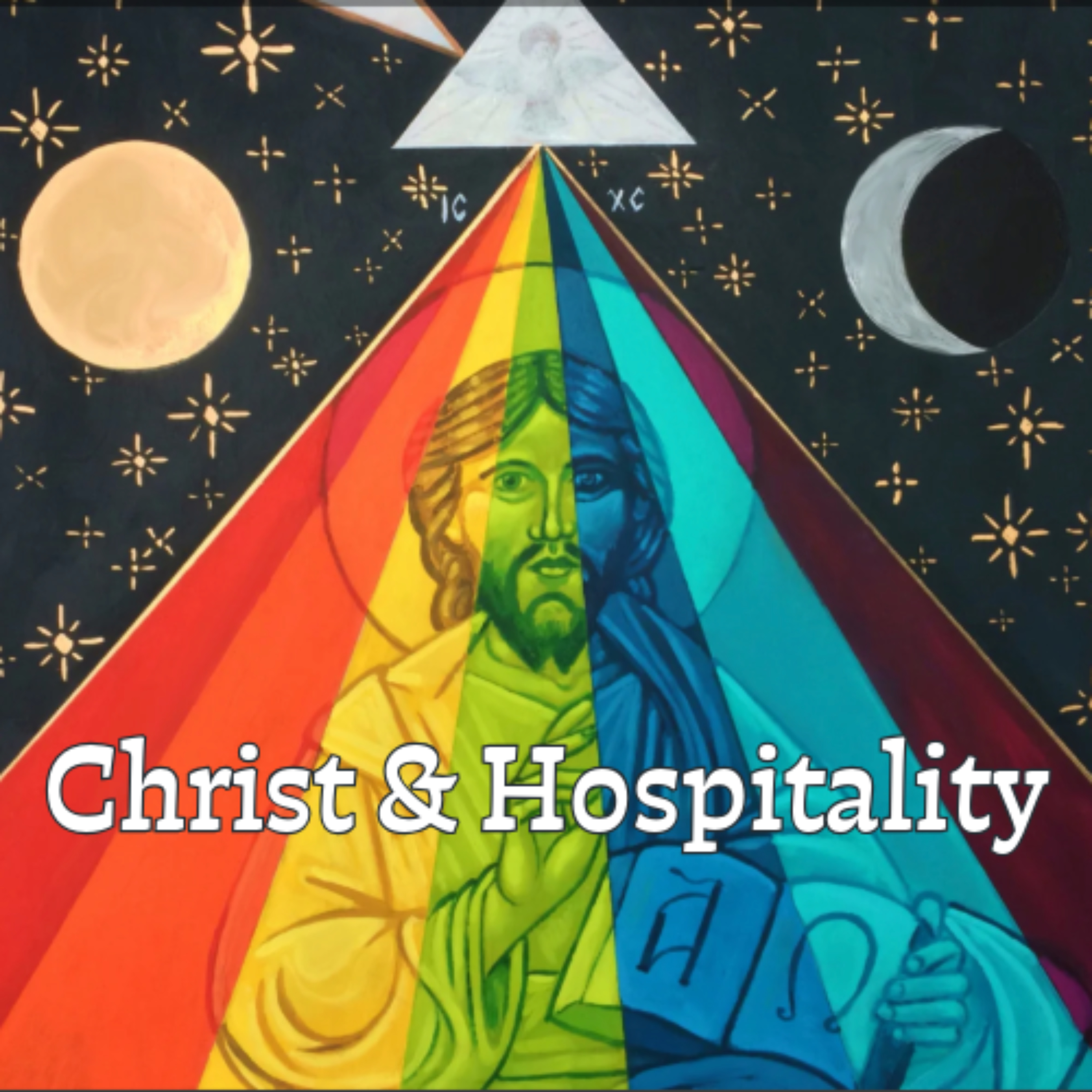
In this season premiere of Christ & Hospitality, Dr. Sawyer shares a bit of her relationship with the Church, to the term hospitality, and her struggle in the creation of this course. Consider it a welcome and foundation for our work ahead.Music is from Epidemic Sound.Cover art is from the iconographer Kelly Latimore.[01:04] That book being The Irresistible Revolution: Living as an Ordinary Radical.[02:59] Isaiah 29:13.[04:07] Amos 5:23-24[04:23] See a version of this note in the syllabus.[05:23] Matthew 26:52.[06:57] Russell, Just Hospitality, p. 116.[09:35] Russell, Just Hospitality, p. 17.[12:05] See Revelation 17:5, Hosea 1, Ephesians 5.
We're indexing this podcast's transcripts for the first time — this can take a minute or two. We'll show results as soon as they're ready.
No matches for "" in this podcast's transcripts.
No topics indexed yet for this podcast.
Loading reviews...
ABOUT THIS SHOW
The lecture podcast for TCE 542 at The Seattle School of Theology & Psychology
HOSTED BY
Lauren D. Sawyer
CATEGORIES
Loading similar podcasts...
Frequently Asked Questions
How many episodes does Christ & Hospitality have?
Christ & Hospitality currently has 9 episodes available on PodParley. New episodes are automatically indexed when they're published to the podcast feed.
What is Christ & Hospitality about?
The lecture podcast for TCE 542 at The Seattle School of Theology & Psychology
How often does Christ & Hospitality release new episodes?
Christ & Hospitality has 9 episodes. Check the episode list to see recent publication dates and frequency.
Where can I listen to Christ & Hospitality?
You can listen to Christ & Hospitality on PodParley by clicking any episode. We provide an embedded audio player for direct listening, and you can also subscribe via your preferred podcast app using the RSS feed.
Who hosts Christ & Hospitality?
Christ & Hospitality is created and hosted by Lauren D. Sawyer.
URL copied to clipboard!