
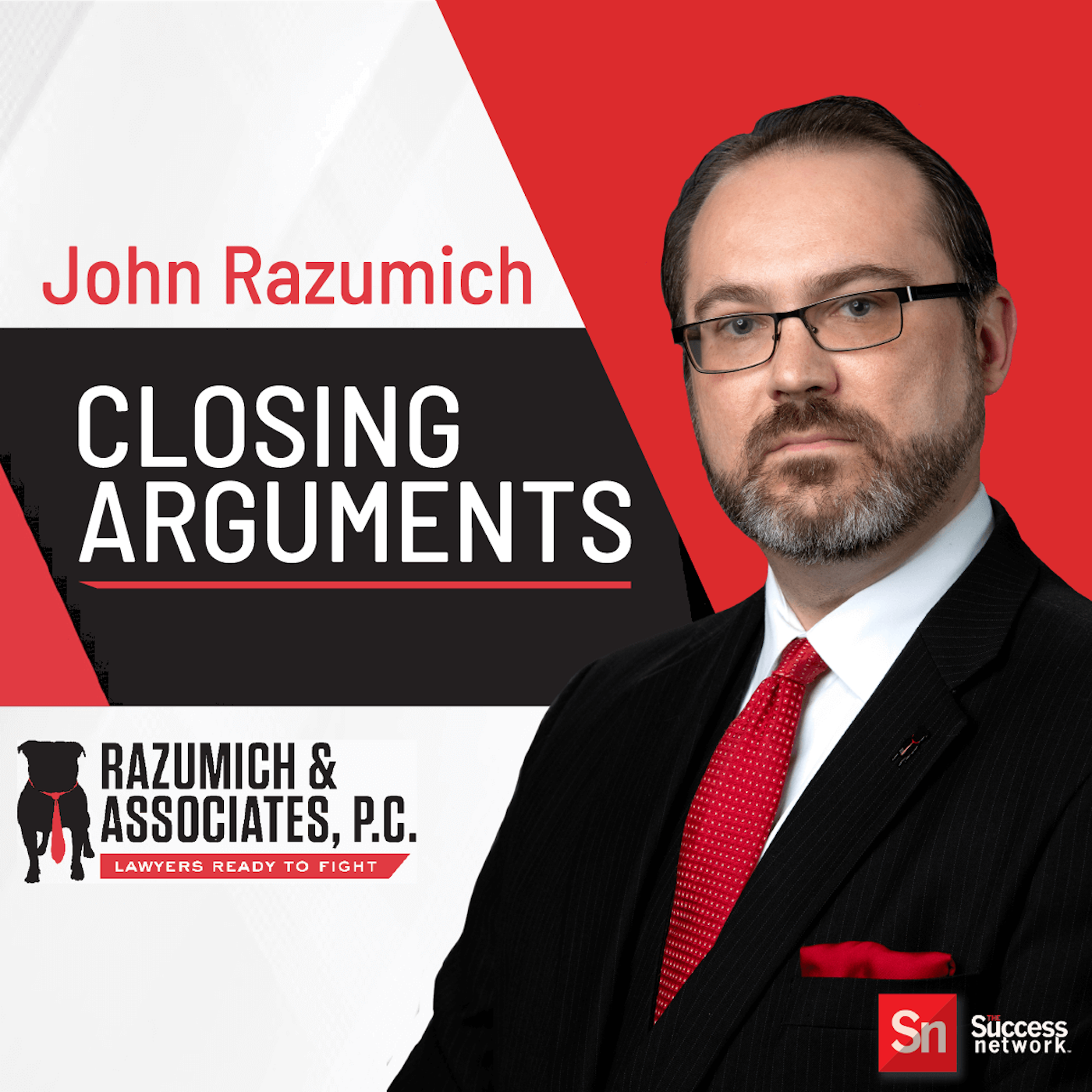
PODCAST · education
Closing Arguments
by John Razumich
Closing Arguments is a long-form legal podcast that explores the law beyond the headlines and the courtroom drama. Hosted by Indianapolis attorney Jack Razumich of Razumich & Associates, the show examines criminal law through real cases, legal history, and the human stories that shape the justice system.Each episode dives deep into complex legal questions — from infamous and unusual lawsuits to landmark criminal cases and Indiana-specific legal issues — offering listeners thoughtful analysis, practical insight, and candid discussion grounded in real-world experience. Rather than soundbites or sensationalism, Closing Arguments focuses on the why, the how, and the consequences behind the law.Whether unpacking bizarre cases like suing the Devil, examining legally haunted houses, or dissecting serious criminal matters that affect lives and communities, Closing Arguments invites listeners to think critically about justice, accountability, and the limits of the legal system.This podcast i
-
25
The Most Difficult Thing About Being a Criminal Defense Attorney
Most people know what a criminal defense attorney does.Few understand what it's actually like to be one.In this episode of Closing Arguments, criminal defense attorney John Razumich takes listeners behind the scenes of a profession that is often misunderstood. From managing unrealistic expectations and delivering difficult news to supporting clients during some of the hardest moments of their lives, John shares the challenges that rarely make headlines.The conversation explores why hiring an attorney isn't about finding someone with "magic powers," but someone who can provide honest guidance, strategic advocacy, and a clear understanding of the legal process. John also discusses the emotional weight that comes with representing people whose futures hang in the balance—and addresses one of the most common questions criminal defense attorneys hear:"How can you defend someone you know is guilty?"If you've ever wondered what life is really like on the other side of the defense table, this episode offers an honest, thoughtful look at the human side of criminal law and the constitutional principles that guide the justice system.Chapters:0:00 – Welcome to Closing Arguments 1:20 – Why Criminal Defense Is Often Misunderstood 3:45 – Managing Client Expectations 10:30 – Why Hiring a Lawyer Isn't "Magic" 16:45 – Having Difficult Conversations with Clients 23:10 – Explaining the Legal Process 29:30 – The Emotional Weight of Criminal Defense 36:40 – Supporting Clients Through Their Hardest Moments 43:20 – "How Can You Defend Someone You Know Is Guilty?" 51:00 – Constitutional Rights and the Role of a Defense Attorney 57:15 – What Criminal Defense Has Taught John About People 1:00:20 – Final Thoughts & Closing Arguments
-
24
The Wrong Person: Why The Evidence Isn't Always What It Seems
Eyewitness testimony. DNA. Fingerprints. Police lineups.Most of us assume these forms of evidence are reliable and objective. After all, we've spent decades watching courtroom dramas where forensic evidence solves every case.But the reality is far more complicated.In this episode of Closing Arguments, criminal defense attorney John Razumich examines one of the most misunderstood aspects of the criminal justice system: why evidence isn't always as conclusive as it appears.John explains how eyewitness testimony can be influenced by stress, memory, and perception, why police lineups must be carefully conducted, and how cross-racial identification has become an important topic in wrongful conviction research. The conversation also explores the so-called "CSI Effect" and why jurors often expect fingerprints, DNA, and other forensic evidence in every criminal case—even though that's rarely how real investigations unfold.If you've ever wondered how someone could be wrongly identified or why the strongest-looking evidence sometimes turns out to be flawed, this episode offers a fascinating look behind the curtain of the criminal justice system.Because sometimes, the biggest challenge isn't finding the evidence—it's understanding what the evidence is actually telling us.Chapters:0:00 – Welcome Back to Closing Arguments1:25 – Why Evidence Isn't Always What It Seems4:10 – The Science Behind Eyewitness Testimony9:05 – How Memory Can Influence Criminal Cases14:30 – Police Lineups and Mistaken Identification20:15 – Cross-Racial Identification Explained27:10 – Wrongful Convictions and What We've Learned32:40 – The "CSI Effect": TV vs. Reality37:45 – Fingerprints, DNA, and Forensic Misconceptions42:15 – What Every Juror Should Understand About Evidence45:20 – Final Thoughts & Closing Arguments
-
23
Mailbag: Criminal Law Questions From The Real World
What makes a great criminal defense attorney? Is it better to hire the local lawyer or the "big city" attorney? Why do two people facing seemingly similar charges receive completely different plea offers? And if prison time is unavoidable, what exactly are you paying a lawyer to do?In this special mailbag edition of Closing Arguments, criminal defense attorney John Razumich answers some of the most common questions he and his team receive from clients, family members, and followers.Drawing from real-world experience across more than 75 Indiana counties, John pulls back the curtain on how criminal cases actually work, why every case is different, and why comparing your situation to someone else's can be misleading.Along the way, he discusses the value of local relationships, the realities of plea negotiations, the role of a defense attorney when the evidence is overwhelming, and one of the most difficult questions clients ask: "Why me?"Whether you're curious about the criminal justice system or want a better understanding of how criminal defense really works, this episode delivers practical insights, honest answers, and a behind-the-scenes look at the realities of practicing law.Chapters:0:00 – Welcome to the Mailbag Episode1:40 – Local Attorney vs. Big-City Attorney5:30 – Does Being Local Really Matter?9:45 – Attorney Relationships, Judges & Courtrooms13:15 – Why Did Someone Else Get a Better Plea Deal?17:45 – The Reality Behind "Similar" Criminal Cases22:00 – Witness Credibility and Plea Negotiations26:15 – If I'm Going to Prison, Why Hire a Lawyer?30:00 – What You're Really Paying a Defense Attorney For32:45 – Should You Hire a Friend as Your Lawyer?34:10 – The "Why Me?" Question Clients Ask37:00 – Focusing on the Future Instead of the Past38:15 – How to Contact Razumich & Associates39:00 – Closing Thoughts & Future Mailbag Questions
-
22
Why Trials Can Feel Like Gambling with Your Life
The right to a jury trial is one of the most fundamental protections in the American legal system.So why do so many defendants choose not to use it?In this episode of Closing Arguments, criminal defense attorney John Razumich examines a difficult and often misunderstood reality: for many people facing criminal charges, going to trial can feel less like exercising a right — and more like taking a risk.We begin with the foundation — the history and purpose of jury trials — and how shifts in the legal system over the past several decades have changed the stakes. From the expansion of law enforcement powers in the 1970s to the rise of statutes like RICO and increasingly aggressive prosecutorial strategies, the modern criminal system has evolved in ways that can dramatically impact a defendant’s decision-making.The episode then turns to real-world examples, including cases where charge stacking, severe sentencing exposure, and evidentiary concerns created enormous pressure to avoid trial altogether. These are not just legal hypotheticals — they are situations where the difference between accepting a plea and going to trial can mean decades of a person’s life.Finally, we ask the broader question: what does this mean for the justice system as a whole? Are these pressures a necessary part of maintaining order, or do they raise concerns about fairness and balance?This episode of Closing Arguments explores the intersection of rights, risk, and reality — and why the decision to go to trial is often far more complicated than it appears.Chapters:0:00 - Introduction2:15 - Busy days at Razumich & Associates3:20 - A brief history of jury trials7:28 - Rising plea agreements and mass incarceration 14:28 - The ever-changing role of the prosecutor23:45 - The case of Patrick Thompson34:12 - The case of Eli Burns43:28 - The state is in the driver's seat50:54 - How to contact Razumich & Associates53:26 - Closing remarks
-
21
Facts, Fear, and Force: A Legal Look at Minneapolis
In this timely and careful episode of Closing Arguments, host and criminal defense attorney Jack Razumich confronts a major legal flashpoint: the fatal shooting of Renée Nicole Good by a federal Immigration and Customs Enforcement (ICE) agent in Minneapolis and the broader questions it raises about self-defense, police authority, and the legal limits on force. We begin by exploring a question that is at once simple and complex: Do police officers have the same self-defense rights as everyone else? What do prosecutorial processes look like in police-involved shootings, and what immunities and challenges come into play when a federal agent uses lethal force? Razumich breaks down the legal concepts and real procedural hurdles that define how these cases unfold — often far differently than public perception. Next, we look directly at what we actually know about the Minneapolis incident — what’s confirmed, what remains unverified, and what Minnesota authorities are legally empowered to do. The fatal shot that killed Good occurred during a federal operation that has ignited protests and heightened scrutiny over law enforcement tactics, prompting calls for independent investigation even as federal agents assert a self-defense justification. We explore how these narratives intersect with legal standards and the realities of prosecuting a federal agent. Finally, we ask the hard questions: Where do we go from here? What legal pathways exist for accountability and public trust when force is used? What lessons should lawyers and laypersons alike take from this case as it continues to unfold?This episode offers a clear, grounded analysis of fear, force, and the law — without speculation, but with all the rigor and perspective you expect from Closing Arguments.Chapters:0:00 - Introduction1:34 - Self-Defense rights among law enforcement6:28 - Prosecuting during a police-involved shooting13:17 - The immunities existing for law enforcement19:04 - The shooting of Renee Good in Minneapolis31:02 - What the State of Minnesota can actually do45:22 - Where do we go from here? 54:10 - Parting thoughts from an attorney57:45 - Closing remarks
-
20
When Self-Defense Becomes Manslaughter or Murder
Self-defense is often described as a fundamental right — but in practice, it is one of the most misunderstood and narrowly defined concepts in criminal law.In this episode of Closing Arguments, Indianapolis attorney Jack Razumich takes a deep dive into the law of self-defense in Indiana, examining how doctrines like Stand Your Ground, Castle Doctrine, and no duty to retreat actually function inside a courtroom — not just in theory, but in real cases with real consequences.The discussion begins by breaking down the legal foundations of self-defense: what the law requires, how “reasonable force” is evaluated, and why a claim of justification does not guarantee immunity from prosecution.From there, the episode analyzes two recent Indiana cases with starkly different outcomes:State of Indiana v. Curt Andersen, arising from a fatal shooting through a door in Whitestown, Indiana, resulting in a manslaughter charge.State of Indiana v. Maclean Murt, stemming from a confrontation at a Fishers bar that led to a murder charge.Why was one case charged as manslaughter and the other as murder? What role did context, perceived threat, proportional force, and decision-making play in each outcome?This episode explores where self-defense ends, where criminal liability begins, and why invoking self-defense is often far more complex — and far riskier — than people realize.Chapters:0:00 - Introduction2:40 - The law of self-defense in Indiana7:54 - "Standing your ground" and the "castle doctrine"15:58 - State of Indiana v. Curt Andersen22:21 - Andersen's argument and claim of self-defense28:47 - The law doesn't recommend warning shots34:41 - The claims made in State of Indiana v. Maclean Murt42:49 - Making critical decisions in a split second 46:05 - Closing remarks
-
19
Suing Satan and Selling Ghosts: When the Law Meets the Supernatural
In this spine-tinged installment of Closing Arguments, we step into the courtroom where logic meets the unexplainable.First up: Gerald Mayo vs. Satan and His Staff — the bizarre 1971 case where one man literally tried to sue the Devil. What drove him to file the lawsuit, and what did the courts have to say about it? More importantly, what does this strange filing reveal about the boundaries of law and belief?Then, we travel to Nyack, New York, home of the only legally haunted house in America. In Stambovsky vs. Ackley, a homebuyer discovered his dream home came with… ghosts. The ruling from this case reshaped how property law deals with psychological stigma — and gave new meaning to the phrase “buyer beware.”From Hell to haunted real estate, this episode of Closing Arguments explores how the justice system handles the strange, the supernatural, and the downright unbelievable.Chapters:0:00 - Introduction2:00 - Sometimes the truth is stranger than fiction3:35 - Can you sue the devil? 8:25 - How deep are Satan's pockets? 14:35 - Why the case was dismissed21:30 - The legally haunted house in America32:06 - Is the house still for sale? 38:05 - Closing remarks
-
18
What I Learned Doing an Entire Year of Jury Trials
After a full year in courtrooms, trying nine jury cases, we’re pulling back the curtain on what really happens when you face the State. In this season premiere, we dig into the lessons learned from victories, defeats, and the unique challenges of sex-related cases.You’ll hear why jury trials are becoming increasingly rare, how juror perception can make or break a case, and why even the most prepared defense isn’t always enough to secure a win. Most importantly, we highlight why having a defense attorney in your corner is the single most critical factor when your future is on the line.If you’ve ever wondered what really goes on behind the courtroom doors—and why it matters to you—this episode will give you a candid, inside look at the realities of modern jury trials.Chapters:0:00 - Introduction1:51 - We're back with an all-new season!4:30 - The difficult nature of defending sex-related jury trials11:00 - The lack of physical evidence creating challenges12:24 - Trials are becoming a thing of the past20:02 - Plea bargains becoming more prevalent 28:33 - The key takeaways 34:38 - Make sure you seek out legal representation! 36:31 - Closing remarks
-
17
Expert Witnesses and How They Influence a Trial
Expert witnesses play a pivotal role in shaping the outcome of trials, often serving as the linchpin between complex evidence and the jury's understanding. But how are these experts chosen? What criteria guide their selection, and how do attorneys ensure they're not just qualified but also compelling in the courtroom?Drawing from decades of experience, John Razumich, of Razumich & Associates, offers invaluable insights into the art of expert witness selection. From identifying the right expertise to assessing credibility and demeanor, every step in the process is carefully orchestrated to bolster the case's strength.Chapters:0:00 - Introduction and overview on the topic of the show1:47 - What is an expert witness? 3:42 - The differences between the Federal and State standard for an expert witness7:29 - Who can be an expert witness within a given case? 10:52 - The idea of "reasonable scientific principles" and a scientific witness20:42 - How an expert witness is 'obtained' by the prosecution or defense30:17 - The difference between an expert witness and a skilled witness33:33 - What can an expert witness actually testify to? 40:30 - How to get in touch with Jack and his team for representation44:03 - Closing remarksConnect with John Razumich:WebsiteFacebookYouTubeLinkedIn
-
16
True Attorney Confessions
In this eye-opening episode of Closing Arguments, join John and Ryan, as they delve into the intricacies of the legal profession, debunking common misconceptions surrounding the role of defense attorneys. Contrary to popular belief, defense attorneys aren't just advocates for the guilty; they serve a critical function in upholding the principles of justice for all.Through riveting anecdotes and insightful analysis, John Razumich offers listeners an insider's perspective on the value that defense attorneys provide to their clients and the broader legal system. From navigating complex legal procedures to safeguarding individuals' rights, defense attorneys play a pivotal role in ensuring fair and equitable treatment under the law.Enjoy!Chapters:0:00 - Introduction and overview on the topic of the day1:43 - The realities of hiring a defense attorney9:31 - How plea agreements work and how a defense attorney navigates them for a client19:28 - The waiting game played by the state22:39 - Is a defense attorney simply helping bad people get away with it? 29:30 - Bail reform and "letting dangerous people back out on the street"35:16 - Just because your friend was not guilty, doesn't mean you will be too40:02 - Why is it so expensive to hire a defense attorney? 47:42 - It's more expensive to not hire an attorney51:00 - The number one job of your defense attorney53:00 - How to get in touch with Jack and his team54:45 - Closing remarksConnect with John Razumich:WebsiteFacebookYouTubeLinkedIn
-
15
The State of Indiana vs. Richard Allen (Part 4) - Analyzing the Original Actions
As we continue our coverage on the State of Indiana vs. Richard Allen case, we take a deeper look into the Original Actions existing within this case. Original Actions themselves are quite rare to experience, but given the wild nature of this case it's no surprise we've experienced them. Join us as Jack and Ryan break down the Original Actions, what they mean, and where this case is ultimately headed!Chapters:0:00 - Introduction and overview on the topic of the day2:40 - What is an Original Action and how it operates4:09 - The limitations within Original Actions and how they are disfavored by the courts7:21 - The two Original Actions filed within the Richard Allen case13:47 - Why The Supreme Court denied the first writ18:50 - The fireworks surrounding the Franks Motion filed in this case26:42 - The Supreme Court granting the second Original Action, in part33:51 - The case has reached a standstill for now41:40 - Our plan for covering this case in the future as new developments arise43:13 - Closing remarksConnect with John Razumich:WebsiteFacebookYouTubeLinkedIn
-
14
The State of Indiana vs. Richard Allen (Part 3) - Will the Defense Prevail?
In this riveting episode of "Closing Arguments," we continue our dive deep into the intricacies of the State of Indiana vs. Richard Allen case, a legal saga that has captivated the nation. Join us as we unravel the layers of this complex case, examining the Allen's confession, shady prison guards, and even the theft of crime scene photos! This case continues to get more twisted each day, leaving our hosts and the audience wondering what type of fireworks will happen next?Enjoy!Chapters:0:00 - Introduction and overview on the episode1:26 - Recapping the high-level details of the Richard Allen case6:01 - Richard Allen's custody arrangements 10:44 - Odinism in the prison system14:36 - How Allen's attorneys handled potential Odinists in the prison system22:31 - Richard Allen's confession and its value to the prosecution29:48 - The fallout of this case and what to be on the lookout for37:46 - The issue of a gag order 46:22 - A tragic suicide enters the picture59:30 - The battle between judge and attorneys1:01:35 - The court has the authority to remove an attorney from a given case1:03:53 - What to expect in our next episode covering this case1:04:28 - Closing remarksConnect with John Razumich:WebsiteFacebookYouTubeLinkedIn
-
13
The State of Indiana vs. Richard Allen (Part 2) - Cracks in the State's Theory
If you thought this case was interesting, you haven't heard anything yet!Welcome back to our multi-part episodic series, where we explore The State of Indiana vs. Richard Allen. This murder case has gained international attention and it continues to get crazier as time goes on. In Part 2, we explore the pieces of evidence that begin creating cracks in the State's theory on how Richard Allen followed through with murder. Enjoy!Timecodes:0:06 - Introduction and overview on the case1:06 - Researching the case for the podcast has been exhausting3:35 - What is a Franks Motion? 6:50 - The Defense attorneys argued that the Sheriff lied to the judge in application for warrant7:50 - The State's public theory of the case12:26 - The search warrant application containing false information15:25 - Time to buckle up your seatbelt!21:20 - The nature of the crime scene wasn't initially revealed30:43 - There was no DNA left at the crime scene34:57 - How Odinism comes into play with this case39:18 - The red flags that begin popping up in the State's theory49:14 - Who ultimately will be Richard Allen's attorney at the end of the day?53:36 - Closing remarksConnect with John Razumich:WebsiteFacebookYouTubeLinkedIn
-
12
The State of Indiana vs. Richard Allen (Part 1)
In this gripping episode of Closing Arguments, we delve deep into a high-profile legal case that shook the heartland of America. Join us as we unravel the intricacies of the "State of Indiana vs. Richard Allen," a trial that captivated the nation and continues to unfold today. Richard Allen, an enigmatic figure at the center of the storm, found himself entangled in a web of allegations that would change his life forever. As the trial unfolds, we explore the evidence, the legal strategies, and the key players involved in this complex and emotionally charged case.Timecodes:0:06 - Introduction and overview on the topic of the show1:04 - Background on State of Indiana vs. Richard Allen4:05 - The landscape and population of Delphi, Indiana6:30 - The chilling video that was taken from the murder10:40 - There are many portions of this case that aren't available to the public16:50 - Richard Allen being charged with two counts of murder21:40 - The case generating international attention and how that impacted the investigation28:01 - The judge recusing themself from this massive case36:00 - Changing the venue of the trial41:02 - The defense goes nuclear!49:26 - New details from this case are becoming available51:18 - Was Richard Allen involved in this murder? 51:57 - Closing remarksConnect with John Razumich:WebsiteFacebookYouTubeLinkedIn
-
11
Closing Arguments - Episode 14 (The Anatomy of a Trial)
On the latest episode of Closing Arguments, we delve deep into the heart of the justice system and explore "The Anatomy of a Trial." In this thought-provoking episode, we take our listeners on an enlightening journey through the intricate process of a courtroom trial.Hosted by John Razumich, this episode sheds light on every phase of a trial, from its inception to its conclusion. We demystify the proceedings and break down the roles of key players, including judges, prosecutors, defense attorneys, witnesses, and jurors, to reveal how they shape the outcome of a case.Timecodes:0:06 - Introduction and overview on the topic of the day1:53 - What happens before a trial ever begins7:30 - How jury selection is conducted and why it's such an important part of a trial16:30 - Diversifying a jury to give multiple perspectives on a given case21:26 - Preliminary instructions at the pre-trial matters hearing29:50 - How evidence and exhibits come into play during a trial35:07 - The various stages at the conclusion of a trial43:00 - Jury deliberations and the reading of the verdict50:01 - How you can get in touch with John and his team for representation51:15 - Closing remarksConnect with John Razumich:WebsiteFacebookYouTubeLinkedIn
-
10
Closing Arguments - Episode 13 (Juvenile Law in Indiana)
Welcome back to Closing Arguments! We're back for an all-new season of the show and we're kicking things off with a deep dive into the juvenile law system in Indiana. Join us as we explore the challenges, triumphs, and ongoing debates surrounding the juvenile justice system, with a particular focus on the Hoosier State.To kick off the episode, we lay the foundation by examining the historical development of Juvenile Law in Indiana. We explore the origins of the system and the intentions behind its establishment. As we uncover the key milestones and influential court cases that shaped Indiana's approach, we also assess the evolution of juvenile justice practices over time.Timecodes:0:06 - Introduction and overview on the topic of the day1:40 - What is Juvenile Law? 3:06 - The brith of a separate law system between an adult and a juvenile5:20 - Where the idea of treating adults and kids differently came from7:58 - The defense of infancy and where it resides within juvenile law11:20 - How juvenile law differs from adult law in the State of Indiana15:52 - Juvenile proceedings have differing rights from adult proceedings20:02 - Can a juvenile be charged as an adult in the State of Indiana25:50 - Being arrested as an adult for a crime that happened when you were a juvenile29:16 - The long-term ramifications of a juvenile convicted of a crime34:50 - How you can get in touch with John and his team36:15 - Closing remarksConnect with John Razumich:WebsiteFacebookYouTubeLinkedIn
-
9
Closing Arguments - Episode 12 (The Insanity Defense)
In the season finale of Closing Arguments, we’re diving into one of the most controversial topics within a courtroom: The Insanity Defense. You’ve seen this defense play out within TV and movies, but how does it really work in the real world? We'll explore every avenue of this affirmative defense, including John's very own experiences with defending a client using the insanity defense! Sit back, relax, and enjoy an exciting season finale!Timecodes:0:06 - Introduction and overview on the topic of the show4:09 - When the insanity defense was first recorded within criminal law7:50 - These cases were primarily surrounding life or death instances12:30 - Where the rules around an insanity defense case stemmed from16:00 - Temporary insanity and how this plays out in a courtroom22:58 - The shifting of burden within an insanity defense27:42 - The current state of insanity pleas within American law today35:14 - When someone should plead insanity within a case38:55 - Who determines insanity? 45:45 - The ripple effect of an acquittal when using an insanity defense48:20 - When can someone be declared sane later in life53:50 - How you can get in touch with Jack's team55:40 - Closing remarksConnect with John Razumich:WebsiteFacebookYouTubeLinkedIn
-
8
Closing Arguments - Episode 11 (What You Need to Know About Juries)
For most people, they're aware of the role a jury plays within a criminal court case. This is likely due to their favorite crime or courtroom drama! However, there's actually a lot of background information that's important for courts to consider when going through jury selection, as well as the power a jury holds within a given case. On the latest installment of Closing Arguments, we're exploring the various items you should know about juries throughout Indiana, as well as the country as a whole. Timecodes: 0:06 - Introduction and overview on the topic of the day1:27 - Jack's team has been busy in courtrooms lately2:15 - Where juries ultimately come from 5:00 - Early English juries and what those looked like9:10 - The Magna Carta and its role on the modern jury system13:13 - A Constitutional Right to a jury17:30 - The various types of juries that exist today25:00 - What is a Coroner's Jury? 28:12 - Civil vs. Criminal juries in Indiana35:00 - How are juries selected in Indiana? 38:20 - Compensation for jurors 41:24 - The power of a jury49:20 - What potential jurors need to know!55:00 - Closing remarksConnect with John Razumich:WebsiteFacebookYouTubeLinkedIn
-
7
Closing Arguments - Episode 10 (Affirmative Defenses in Indiana)
Affirmative defenses and everything in between! That's what we're tackling on the latest installment of Closing Arguments. Join us for another enlightening conversation, where John Razumich shares his personal experiences with the various affirmative defenses in Indiana and the fundamental differences between them. We've got another great episode on tap for you. Enjoy!Timecodes:0:06 - Introduction and overview on the topic of the day1:35 - What is an affirmative defense? 5:50 - There are ten total affirmative defenses in Indiana8:17 - The affirmative defense of Legal Authority11:25 - Self-defense and how this plays out in court15:00 - The affirmative defense of involuntary intoxication20:30 - Insanity defenses26:45 - Mistake of fact37:21 - Abandonment and how this plays out40:40 - Battered spouse syndrome45:25 - The affirmative defense of necessity50:30 - How you can get in touch with Razumich & Associates52:40 - Closing remarksConnect with John Razumich:WebsiteFacebookYouTubeLinkedIn
-
6
Closing Arguments - Episode 9 (Legal Myths That Need to Die)
There are too many legal myths out there, confusing us when it comes to criminal law and its proceedings!On the latest installment of Closing Arguments, we're exploring a variety of different legal myths and setting the record straight once and for all! Listen as John reviews our audience's feedback on the biggest police-related myths, as well as courtroom myths that many believe to be true. This episode is bound to leave you with some clarification on legalities you may have wrongfully thought to be true!Timecodes:0:06 - Introduction and overview on the topic of the day1:45 - Receiving legal myths from our audience to review on today's show2:38 - Do the police have to read me my rights before speaking to me? 5:04 - Do police have to tell me if they are working undercover? 6:50 - Do police have to be honest with me? 10:12 - Do I have to stop and talk to the police? 14:00 - Do I have to consent to a police search? 18:35 - Do I have to get out of the car when I'm told to? 22:31 - Do I have the right to one free phone call when incarcerated? 26:14 - Are you entitled to three plea offers? 28:54 - Are you entitled to three continuances? 32:19 - Do warrants eventually go away? 36:18 - Can alleged victims drop charges? 40:11 - Is it going to cost the state a lot of money to take my case to trial? 43:10 - Are public defenders working for the state and not me?46:56 - Does hiring an attorney make you look guilty? 52:20 - Closing remarksConnect with John Razumich:WebsiteFacebookYouTubeLinkedIn
-
5
Closing Arguments - Episode 8 (A Brief History of the Supreme Court)
Ever since its establishment, the Supreme Court has left a monumental footprint on our lives, hearing some of the biggest legal disputes that have shaped the way we operate as a country and a society. In the latest installment of Closing Arguments, we're going back in time and reviewing a brief history of the Supreme Court. From its development to becoming arguably the most powerful branch of our government today, we'll explore the various cases, as well as justices, that brought the court to what its become today. We've got another informative episode for you today! So sit back, relax, and enjoy this overview on the history of our country's highest legal body. Timecodes:0:06 - Introduction and overview on the topic of the day1:48 - What does the Supreme Court do? 4:54 - The power of the Supreme Court developed over time8:21 - John Jay and the footprint he left on the Supreme Court13:35 - What qualifications did a Supreme Court justice need to have? 19:02 - The Supreme Court's role during the Civil War30:25 - Amendments and the Supreme Court's ruling with segregation38:49 - The Lochner era44:09 - Out of the Lochner Era and into World War II47:30 - The incorporation of the Bill of Rights50:55 - The Civil Rights Era and the Supreme Court's role in this55:27 - Chief Justice Earl Warren's footprint he left on our country1:07:22 - Closing remarksConnect with John Razumich:WebsiteFacebookYouTubeLinkedIn
-
4
Closing Arguments - Episode 7 (The Curious Case of the Hot Dog Man)
In the latest installment of Closing Arguments, we bring you one of the most peculiar case studies that John Razumich has ever been involved in! With stab wounds, a lying prostitute and a wild courtroom trial, this episode is one you aren't going to miss. Regarded as one of the more interesting cases throughout the Indianapolis area, John walks us through the intricate details and explains his vantage point on the case. Sit back, relax, and enjoy this can't-miss episode!Timecodes:0:06 - Introduction and overview on the topic of the day1:35 - Introducing The Curious Case of the Hot Dog Man!5:02 - The crime that plays out in this case9:50 - The investigation begins19:18 - Building the defense around the Hot Dog Man25:50 - Kadrovach begins feeding Jack and his team thoughts on the defense tactics33:50 - The defense's case as they moved towards trial41:49 - Kadrovach paying a prostitute to give false alibi 49:33 - The optics within the trial were not helping Kadrovach 54:09 - The aftermath of the trial1:02:39 - Where is the Hot Dog Man today? 1:05:20 - How to get in touch with John for representation1:06:46 - Closing remarksConnect with John Razumich:WebsiteFacebookYouTubeLinkedIn
-
3
Closing Arguments - Episode 6 (Part 2: United States vs. Shipp)
In the latest installment of Closing Arguments, we revisit the United States vs. Shipp case to conclude the dramatic events that unfolded during the Supreme Court's involvement. After a quick recap of events that led to Ed Johnson being incarcerated for a crime he swore he didn't commit, Jack highlights how the Supreme Court ultimately became involved. And we'll also share how, despite their 'stay of execution' order, Ed Johnson still met his demise. Listen as we bring this fascinating case study comes to a close!Timecodes:0:06 - Introduction and equipment announcements3:32 - Recapping the events that led to Ed Johnson being incarcerated10:16 - Ed Johnson's legal team taking matters into their own hands25:05 - A stay of execution was granted for Ed Johnson33:20 - Justice Harlan enters scene, which was a win for Ed Johnson and his legal team36:01 - The lynching of Ed Johnson at the hand of a mob44:26 - Given the lynching, the Supreme Court charges many with contempt of the court54:00 - Sheriff Shipp returns to Chattanooga and receives a hero's welcome57:30 - Final thoughts and takeaways from this forgotten legal landmark1:03:11 - Closing remarksConnect with John Razumich:WebsiteFacebookYouTubeLinkedIn
-
2
Closing Arguments - Episode 5 (Part 1: United States vs. Shipp)
In the latest installment of Closing Arguments, we're exploring a forgotten legal landmark, which outlines the only original jurisdiction criminal case that was argued before The Supreme Court. Listen, as John takes us through the historic case of United States vs. Shipp and showcases an original example of the press' influence on a criminal trial. This case is packed with interesting variables and courtroom fireworks, so you don't want to miss this one!Sit back, relax, and enjoy part one of our first two-part case study!Timecodes:0:08 - Introduction and overview on the topic of the day2:38 - John joins the show and launches into the background information on United States vs. Shipp8:45 - The assault of Nevada Taylor18:30 - Where Sheriff Shipp comes into play in this case24:23 - The press' impact on this court case33:19 - The trial of Ed Johnson and the fireworks involved in the courtroom42:51 - Ed Johnson is convicted and sentenced to death46:31 - This case ends up in the Supreme Court51:00 - What is still to come in Part Two of this case study53:30 - Closing remarksConnect with John Razumich:WebsiteFacebookYouTubeLinkedIn
-
1
Closing Arguments - Episode 4 (The Law of Self Defense)
In the latest installment of Closing Arguments, John and Ryan explore the law of self defense, which continues to be one of the most controversial topics among criminal law to date. Listen as John shares a complete breakdown on the law of self defense and how it varies across different states. Additionally, John explores how self defense is contested in the courtroom and how the media's coverage of this law has evolved over the years through some key case studies. With self defense being one of the most popular criminal law topics these days, this is an episode packed with beneficial information! Enjoy!Timecodes:0:06 - Overview on the topic of the day2:10 - An update on Razumich & Associates 3:09 - A broad overview on the law of self defense and how it appears in criminal law today5:28 - What affirmative defenses are generally7:47 - How someone can make a claim for self defense15:12 - What self defense looks like within a trial18:41 - How the burden shifts of proving self defense in trial22:41 - Testifying on your own behalf during a self defense claim25:58 - The limitations that exist within self defense claims30:30 - The jury's involvement during a self defense claim trial34:02 - John's viewpoint on self defense and whether it always works or not45:20 - Case studies that are specific to self defense54:20 - How you can get in touch with John and his team 56:09 - Closing remarksConnect with John Razumich:WebsiteFacebookYouTubeLinkedIn
-
0
Closing Arguments - Episode 3 (What Happens After a Conviction?)
A conviction has been reached in court, but what happens next? In the latest installment of Closing Arguments, John and Ryan explore this question and the various strategies at a defendant's disposal to continue the fight. Within this conversation, they explore three key themes that can take place following convictions: The Appeal Process, Post Conviction Relief, and Sentence Modification. Each of these avenues contains its own complexities, but each can be a viable solution for someone convicted in court if they meet particular standards. Just when you think it's over, it may not be! Timecodes:0:06 - Welcome to the show and overview on the topic2:34 - Walkthrough on the appeal process and how someone can start it7:26 - How a case can get to the Supreme Court level12:51 - What happens when an appeal is successful17:10 - Overview on post conviction relief and where it enters the picture20:27 - How many times can PCR be filed in a given case?25:25 - What happens when PCR is successful for a defendant28:48 - Everything that goes into sentence modification 40:10 - Which process that John finds to be the most successful 46:31 - How you can get in touch with Razumich & Associates48:33 - Closing remarks
-
-1
Closing Arguments - Episode 2 (The Miranda Warnings)
In the second installment of Closing Arguments, John and Ryan explore the various facets of the Miranda Warnings, as well as how they have impacted a police officer's interact with civilians overall. Listen as John outlines the monumental court ruling in Miranda vs. Arizona and why the Supreme Court's decision was handed down. Despite their decision receiving some backlash or fallout, their ruling remains intact today and it's something most people are familiar with. Additionally, John outlines how this ruling has altered police interactions altogether. We'll explore the various situations in which the Miranda Warnings are required and how you should interact with a police officer based on various circumstances.Sit back, relax, and enjoy another insightful conversation surrounding concept you thought you knew! Timecodes:0:08 - Welcome to the show and overview on the topic of the day2:30 - Overview on the Miranda Warnings4:33 - The birth of the Miranda Warnings and the monumental court case of Miranda vs. Arizona8:14 - How this case unfolded at the Supreme Court level10:40 - The fallout of the Supreme Court's ruling and what it meant for criminal law moving forward15:00 - Legal developments that came after the Supreme Court's ruling25:00 - Whatever happened to Ernesto Miranda after the court ruling? 27:49 - The involuntary and voluntary interactions with police30:00 - Overview on the custodial interrogation process35:20 - The questions you should ask yourself when interacting with the police44:20 - Don't break the law49:00 - Closing remarksConnect with John Razumich:WebsiteFacebookYouTubeLinkedIn
-
-2
Closing Arguments - Episode 1 (Fast/Speedy Trials and Forfeitures)
In the inaugural episode of Closing Arguments, we introduce you to John Razumich, Attorney at Razumich & Associates, P.C., who serves as an expert in criminal law and a public defender across the state of Indiana. After serving the greater Indiana area for over a decade, John brings a wealth of experience to the table. After describing some of his personal and professional life experiences, John highlights the landscape surrounding fast and speedy trails. Not only has the definition of a fast and speedy trial evolved since its establishment, but there have been landmark court cases to help define this process. Additionally, John will explore the idea of forfeitures and the misconceptions surrounding this topic. So sit back, relax, and we thank you for joining us on our inaugural episode!Timecodes:0:07 - Welcome to the show and introducing John Razumich2:13 - Background information on John and his law background in Indiana 5:04 - The reputation that Razumich & Associates receives across Indiana6:39 - The hot topic of a fast and speedy trial12:26 - Where the OJ Simpson case fell in the realm of fast and speedy trials14:20 - The four-part balancing test applied to fast and speedy trials24:00 - The Speedy Trial Act of 1974 and how it's applied to cases today29:00 - How fast and speedy trials work throughout the state of Indiana34:50 - An independent constitutional analysis and the Barker Test42:15 - The case of Tyson Timbs and its impact on forfeitures55:40 - But wait! There's more!1:02:00 - Closing remarks Connect with John Razumich:WebsiteFacebookYouTubeLinkedIn
We're indexing this podcast's transcripts for the first time — this can take a minute or two. We'll show results as soon as they're ready.
No matches for "" in this podcast's transcripts.
No topics indexed yet for this podcast.
Loading reviews...
ABOUT THIS SHOW
Closing Arguments is a long-form legal podcast that explores the law beyond the headlines and the courtroom drama. Hosted by Indianapolis attorney Jack Razumich of Razumich & Associates, the show examines criminal law through real cases, legal history, and the human stories that shape the justice system.Each episode dives deep into complex legal questions — from infamous and unusual lawsuits to landmark criminal cases and Indiana-specific legal issues — offering listeners thoughtful analysis, practical insight, and candid discussion grounded in real-world experience. Rather than soundbites or sensationalism, Closing Arguments focuses on the why, the how, and the consequences behind the law.Whether unpacking bizarre cases like suing the Devil, examining legally haunted houses, or dissecting serious criminal matters that affect lives and communities, Closing Arguments invites listeners to think critically about justice, accountability, and the limits of the legal system.This podcast i
HOSTED BY
John Razumich
CATEGORIES
Loading similar podcasts...
Frequently Asked Questions
How many episodes does Closing Arguments have?
Closing Arguments currently has 28 episodes available on PodParley. New episodes are automatically indexed when they're published to the podcast feed.
What is Closing Arguments about?
Closing Arguments is a long-form legal podcast that explores the law beyond the headlines and the courtroom drama. Hosted by Indianapolis attorney Jack Razumich of Razumich & Associates, the show examines criminal law through real cases, legal history, and the human stories that shape the justice...
How often does Closing Arguments release new episodes?
Closing Arguments has 28 episodes. Check the episode list to see recent publication dates and frequency.
Where can I listen to Closing Arguments?
You can listen to Closing Arguments on PodParley by clicking any episode. We provide an embedded audio player for direct listening, and you can also subscribe via your preferred podcast app using the RSS feed.
Who hosts Closing Arguments?
Closing Arguments is created and hosted by John Razumich.
URL copied to clipboard!