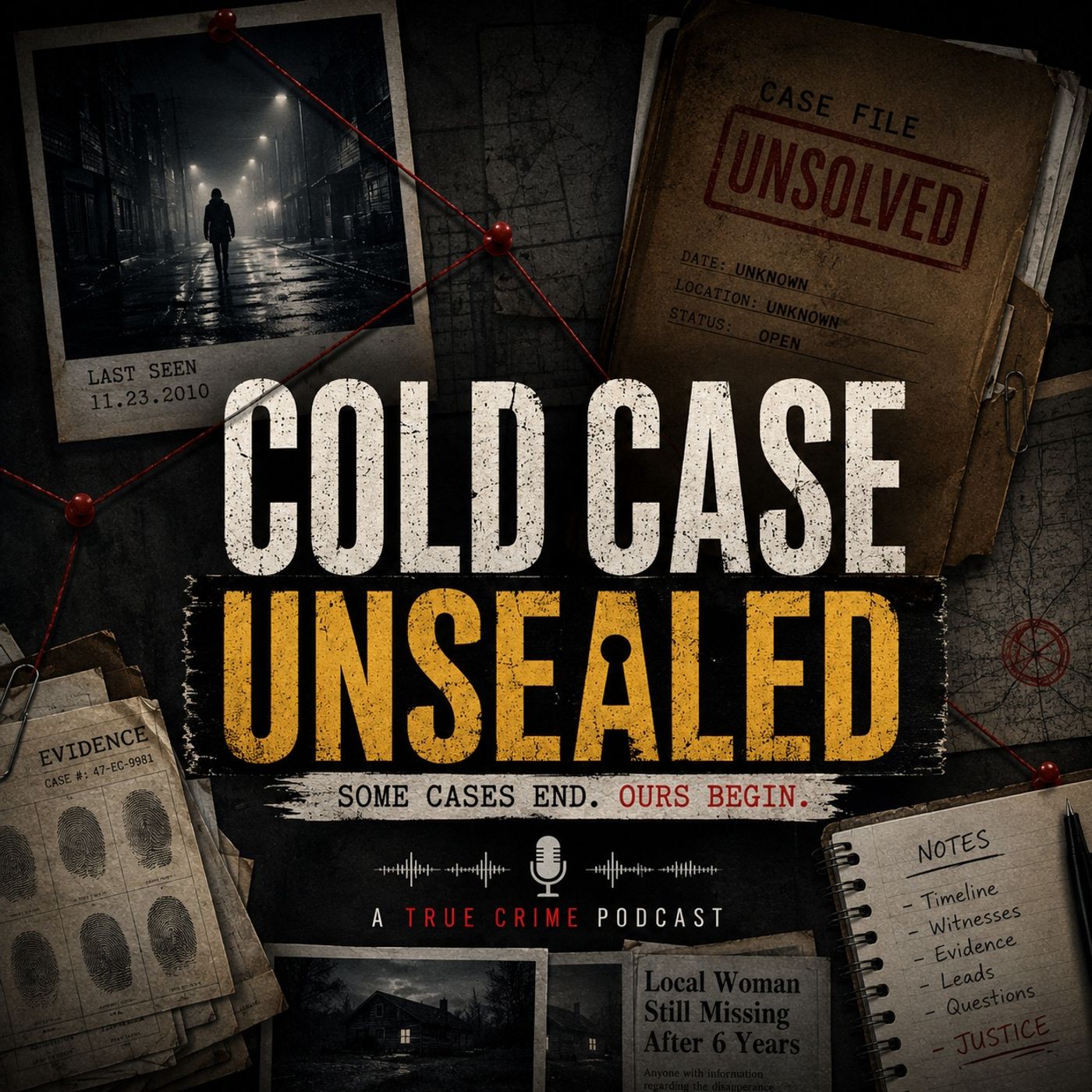
Cold Case Unsealed podcast artwork

PODCAST · true crime

Cold Case Unsealed

Cold Case Unsealed is a gripping true crime podcast that reopens forgotten investigations, unsolved murders, and mysterious disappearances that never received the answers they deserved. Each episode dives deep into cold case files, police reports, witness statements, timelines, and overlooked evidence to uncover the stories buried beneath years of silence. From abandoned leads and vanished suspects to shocking twists and hidden connections, Cold Case Unsealed explores the haunting mysteries that continue to leave families searching for justice. With immersive storytelling, atmospheric narration, and detailed research, the podcast examines the cases that time refused to solve. Some files were closed.These cases were never finished.Disclaimer Cold Case Unsealed is a true crime podcast created for informational, educational, and entertainment purposes. The podcast discusses real criminal cases, investigations, disappearances, and deaths that may

  1. 63

    39-Year-Old Murder Case Solved

    The episode details the long-awaited resolution of the 1980 murder of Kathleen O’Brien Doyle, a young Navy wife killed in Norfolk, Virginia. After nearly four decades, investigators utilized DNA evidence and cross-state collaboration to arrest Dennis Lee Bowman, a former Navy Reservist living in Michigan. The sources describe the brutal nature of the crime and the persistent efforts of Detective Jon Smith, whose work eventually linked Bowman to the killing. Beyond the Doyle case, the investigation led to Bowman's confession regarding the 1989 murder of his adopted daughter, Aundria. This narrative highlights the evolution of forensic science and the profound impact of cold case units on providing closure to families. Ultimately, the episode serves as a testament to investigative tenacity and the power of modern technology in holding violent offenders accountable.This episode includes AI-generated content.

  2. 62

    Man Pleads Guilty in 35-Year-Old Placer County Cold Case

    This source details the 2026 resolution of a harrowing cold case involving the 1991 kidnapping and murder of Cinthia “Cindy” Wanner in Placer County, California. After vanishing from her sister’s home and being held captive for weeks, Wanner was found dead, leaving behind a grieving family and a 35-year mystery. The investigation finally culminated in a guilty plea from James Lawhead Jr., a repeat sex offender who had been living under an alias in Arizona. Authorities utilized modern DNA technology and genetic genealogy to link Lawhead to the crime, ultimately securing a sentence of life without parole. The episode highlights the persistence of law enforcement and the profound impact of scientific advancements in delivering long-awaited justice for victims of violent crime.This episode includes AI-generated content.

  3. 61

    A Sister’s Secret Solves a Cop’s Murder 41 Years Later

    These sources recount two high-profile cold cases where long-held secrets and modern technology finally exposed the truth. The first narrative follows the forty-one-year investigation into the murder of Officer Charles Bernoskie, a case eventually cracked when a relative’s confession and a lone fingerprint on an antifreeze can identified the killers. The second account details the harrowing experience of Jeri Elster, a rape survivor whose quest for justice was initially thwarted by an expired statute of limitations despite a definitive DNA match. Her resilience transformed a personal tragedy into a legislative victory, as she successfully lobbied to change California law regarding forensic evidence. Together, these stories highlight the intersection of persistent detective work, the evolution of forensic science, and the power of victim advocacy in resolving decades-old crimes. Through these examples, the text illustrates how legal loopholes can be closed to ensure that violent offenders are held accountable, regardless of how much time has passed.This episode includes AI-generated content.

  4. 60

    5 Cold Cases Finally Solved With The Most INSANE Twists

    These sources provide detailed accounts of five cold cases that remained a mystery for decades before reaching resolution. The first case describes the 1986 kidnapping of Jessica Gutierrez, where a witness’s description of a "wizard hat" was eventually linked to a cowboy-hat-wearing suspect convicted through fingerprint analysis. Similarly, the 1972 murder of Debbie Randall and the 1987 double homicide of Tanya Van Cuylenborg and Jay Cook were solved through genetic genealogy, a modern forensic technique using public DNA databases to identify relatives of the killers. The 1988 death of Melissa Tremblay also utilized this technology to charge a former prison guard who lived near the crime scene. Finally, the 1966 stabbing of Karen Snider reached a breakthrough in 2024 when a DNA match led to the arrest of a 79-year-old former friend of the family. Together, these narratives highlight how technological advancements and the persistence of investigators can finally deliver justice for victims and their families.This episode includes AI-generated content.

  5. 59

    FBI and ATF Partner with Tribal Authorities to Crack Cold Cases

    The episode details Operation Ballistic Backlog, a collaborative law enforcement initiative involving the FBI, ATF, and the Oglala Sioux Tribe to address violent crime on the Pine Ridge Indian Reservation. By utilizing the National Integrated Ballistic Information Network, officials aim to process hundreds of firearms to generate leads for unsolved homicides and cold cases. This effort is part of a broader federal strategy, Operation Steadfast Promise, which seeks to improve public safety in Indigenous communities through increased forensic resources and personnel. The episode highlights the unique jurisdictional challenges and resource disparities facing tribal lands while emphasizing the importance of federal-tribal partnerships. Ultimately, the initiative focuses on providing justice for victims and their families by integrating modern technology with local tribal knowledge.This episode includes AI-generated content.

  6. 58

    40-year-old Virginia cold case finally cracked after new DNA leads to arrest

    In May 2026, authorities finally solved the 1986 cold case involving the brutal murder of Roberta Walls, a young library employee in Virginia Beach. After four decades of mystery, law enforcement arrested Charles Berry, a former Navy sailor, using modern forensic genealogy and advanced DNA testing. The investigation reveals that the victim was randomly attacked and killed while leaving work, a crime that terrorized the local community for years. This breakthrough was made possible through the Virginia Sexual Assault Kit Initiative, which provided the resources to link long-preserved biological evidence to the suspect. The resolution of this case highlights the unwavering persistence of detectives and the transformative power of genetic technology in achieving justice for grieving families. Ultimately, the report serves as a somber reminder of a life cut short and a testament to the fact that criminal accountability has no expiration date.This episode includes AI-generated content.

  7. 57

    A Murder Went Cold for 37 Years Until DNA Found Her Killer

    The episode details the 1980 murder of Helene Pruszynski, a young journalism intern who was abducted, assaulted, and killed in Colorado. For nearly four decades, the case remained unsolved despite a dedicated group of friends and detectives who refused to let the investigation die. The breakthrough finally arrived through forensic genetic genealogy, which allowed investigators to build a family tree and identify James Curtis Clanton as the primary suspect. By secretly collecting Clanton’s DNA from a discarded beer mug in Florida, authorities confirmed a match to evidence preserved from the original crime scene. After forty years of uncertainty, Clanton was arrested and sentenced to life in prison, bringing a sense of justice to Helene’s loved ones. This overview highlights the intersection of persistent advocacy and modern science in resolving cold cases.This episode includes AI-generated content.

  8. 56

    ‘Crimes committed by a monster’: Man sentenced to life in sexual assault cold case

    This episode recounts the successful resolution of a 1987 cold case involving the brutal sexual assault of two young girls in Exeter, Rhode Island. After nearly four decades of uncertainty, investigators utilized forensic genetic genealogy to identify Frank Thies as the assailant through a match with a distant relative’s DNA. The narrative details how Thies, who was a member of the military at the time of the attack, was eventually apprehended in Indiana following a covert DNA collection operation. During his 2025 trial, emotional testimony from the survivors highlighted the lifelong trauma and family devastation caused by his actions. The proceedings culminated in a double life sentence, a decision the presiding judge emphasized was necessary for a "predator" who had robbed children of their innocence. Ultimately, the source illustrates how modern technology and persistent law enforcement efforts can finally deliver accountability for long-dormant crimes.This episode includes AI-generated content.

  9. 55

    Rodney Alcala: The Dating Game Killer's Trail of Murder

    This episode provides a comprehensive profile of Rodney Alcala, a notorious serial killer whose ability to blend into society earned him the nickname "The Dating Game Killer." The sources detail his predatory methods, highlighting how he utilized his intelligence and photography skills to lure and manipulate dozens of victims across multiple decades. Despite early warnings and repeated arrests, Alcala exploited legal loopholes and lenient sentencing to continue his violent spree until his final capture in 1979. His dark legacy is defined by a massive archive of photographs that suggests a victim count far higher than his official convictions. The narrative ultimately examines the systemic failures that allowed him to remain at large and the ongoing efforts to identify his remaining victims.This episode includes AI-generated content.

  10. 54

    Cold Case Unit Says 1995 Willamette River Killing Solved Through Genetic Genealogy

    The episode details the successful resolution of a thirty-one-year-old homicide investigation involving the death of Joni Marie Grigsby in Oregon. Through the use of investigative genetic genealogy, the Lane County Sheriff’s Office identified Roy C. Gomes as the perpetrator of the 1995 crime. Although the suspect died decades ago in a police confrontation, the discovery offers closure to the victim’s family after years of uncertainty. The narrative highlights the vital role of volunteer cold case units and modern forensic advancements in solving dormant cases. Additionally, it explores the ethical considerations and technical processes behind matching crime scene DNA with public genealogical databases. Ultimately, the source serves as a testament to investigative persistence and the transformative power of DNA technology in the pursuit of justice.This episode includes AI-generated content.

  11. 53

    Shadow in the Valley: The Yosemite Sightseer Murders

    This episode details the brutal 1999 serial murders of four women in and around Yosemite National Park. The narrative begins with the tragic discovery of three sightseers—Carole Sund, Juli Sund, and Silvina Pelosso—who were kidnapped and killed by Cary Stayner, a handyman at a local motel. It explores the intensive investigation that followed, eventually linking Stayner to a fourth victim, naturalist Joie Armstrong, through forensic evidence and his own disturbing confession. The author also examines Stayner's troubled family history, specifically the childhood kidnapping of his brother Steven, and how this trauma may have shaped his violent psychology. Ultimately, the sources provide a comprehensive look at the legal proceedings, the enduring grief of the victims' families, and the lasting impact these crimes had on national park safety and public perception.This episode includes AI-generated content.

  12. 52

    Frederick Police Seek Information in 1989 Cold Case Murder of Tracey Kirkpatrick

    These sources provide a comprehensive overview of the unsolved 1989 murder of Tracey Kirkpatrick, a high-achieving teenager killed while working at a Frederick, Maryland, clothing store. The materials detail the brutal nature of the crime, the discovery of the victim by a security guard, and the mysterious circumstances surrounding the lack of a clear motive or forced entry. Key investigative leads are explored, including a chilling recorded confession from an anonymous caller and the subsequent identification of several persons of interest who were never charged. The episode highlights the evolving role of forensic technology, such as genetic genealogy, which authorities hope will eventually provide a breakthrough. Ultimately, the narrative serves as both a tribute to Kirkpatrick’s life and a persistent plea for public assistance to finally bring justice to her family after nearly four decades.This episode includes AI-generated content.

  13. 51

    Llano County cold case remains likely identified as missing man from 2017

    The episode details a significant breakthrough in a Texas cold case involving skeletal remains found on a remote Llano County ranch in 2018. Through advanced DNA analysis and forensic anthropology, authorities have tentatively identified the deceased as Eric William Wallace, a man who had been missing since 2017. The report examines the scientific methods used to bridge the gap between an anonymous discovery and a named individual, highlighting the role of genetic genealogy and national databases. It further explores Wallace’s multi-state background and the inherent difficulties of conducting investigations within the rugged, sparsely populated Texas Hill Country. Ultimately, the source emphasizes the importance of community input and persistent police work in providing closure to families facing long-term uncertainty. The investigation remains active as detectives seek final confirmation through dental records and solicit new leads regarding Wallace’s final movements.This episode includes AI-generated content.

  14. 50

    The Enduring Mystery of the Doodler Serial Killer

    The episode details the San Francisco Police Department’s ongoing investigation into the Doodler, an unidentified serial killer who targeted gay men during the mid-1970s. This suspect earned his moniker by sketching portraits of his victims in nightlife venues before luring them to isolated coastal areas to be stabbed to death. The sources highlight the historical challenges of the case, noting how the intense societal stigma of the era discouraged survivors and witnesses from testifying. Recently, authorities have renewed their efforts by increasing the financial reward to $250,000 and utilizing modern forensic technology alongside age-progressed sketches. By humanizing the six official victims, the narrative seeks to spark public memory and finally secure justice for a community long haunted by these crimes. The document serves as both a historical record of a transformative time in LGBTQ+ history and an active plea for information to solve these cold cases.This episode includes AI-generated content.

  15. 49

    She was last seen barefoot, wearing a blue nightgown, in July 1970

    The episode examines the unsolved 1970 homicide of Paula Jean Oberbroeckling, an eighteen-year-old from Cedar Rapids, Iowa, who disappeared after leaving her apartment barefoot and in a nightgown. Her bound remains were discovered four months later in a culvert, yet the cause of death was never determined and most physical evidence was later destroyed in a 2008 flood. The sources explore various theories, including a botched illegal abortion, domestic disputes with boyfriends, or a random encounter with a predator. The narrative also highlights systemic failures and societal prejudices regarding race and gender that hindered the original investigation. Through books and cold case reviews, the text emphasizes how Paula’s story remains a haunting symbol of justice delayed and the enduring impact of a life cut short.This episode includes AI-generated content.

  16. 48

    Idaho Murder Victim's Family Launches Foundation to Solve Cold Cases

    Following the 2022 tragedy in Moscow, Idaho, the family of victim Kaylee Goncalves established a nonprofit organization to transform their personal loss into a national resource for justice. This foundation, operating as "Murder Has a Name," focuses on providing financial support for investigative genetic genealogy and advanced DNA testing to resolve stagnant cold cases. By partnering with specialized forensic laboratories, the initiative aims to remove the budgetary obstacles that frequently prevent law enforcement from identifying violent offenders. The episode details how DNA evidence led to the conviction of Kaylee’s killer and how her parents now advocate for other families seeking similar closure. Ultimately, the organization serves as a living legacy for Kaylee, utilizing modern science to ensure that perpetrators of unsolved crimes are held accountable.This episode includes AI-generated content.

  17. 47

    Missing for Nearly 50 Years: Digging Up Cold Cases in Interior Alaska

    The episode examines the pervasive crisis of Missing and Murdered Indigenous Persons within the harsh landscape of Interior Alaska. It specifically highlights the unresolved 1975 disappearance of Ida Rose Jacomet, using her suspicious case to illustrate the systemic and environmental barriers that hinder justice. These obstacles include extreme weather, vast wilderness, and jurisdictional complexities that often cause investigations to stall for decades. Beyond individual stories, the source analyzes statistical disparities affecting Native communities and the critical role of modern forensic technology in reopening cold cases. Ultimately, the narrative serves as both a tribute to the missing and a call for enhanced advocacy and resources to address these long-standing mysteries.This episode includes AI-generated content.

  18. 46

    Unsolved 1983 Double Killing Still Haunts Weatherford

    These documents detail the unsolved 1983 double homicide of two teenagers, Shelly Colliflower and Vincent Tijerina Jr., in Weatherford, Texas. The victims were discovered shot execution-style in a parked car at a local hangout, a tragedy that shattered the security of their small community. Despite numerous investigations involving multiple law enforcement agencies and recent advancements in forensic technology, no one has been charged in the forty years since the crime. The episode explores various theories regarding the motive, ranging from personal jealousy to potential cover-ups, while highlighting the profound grief and frustration of the victims' families. Because official records remain sealed from the public, local advocates and true-crime investigators continue to push for transparency and justice. Ultimately, the sources provide a comprehensive look at how this cold case remains a lingering trauma for a rapidly growing suburban city.This episode includes AI-generated content.

  19. 45

    Gabby Petito's Death Highlights Cold Case Mysteries at National Parks

    This episode examines the tragic homicide of Gabby Petito to highlight the inherent dangers and cold cases found within the United States national park system. While Petito’s high-profile disappearance brought intense media focus to domestic violence and wilderness safety, the sources emphasize that many other unsolved mysteries linger in remote terrains due to jurisdictional complexities and harsh environments. The overview catalogs specific historical disappearances and notorious crimes in locations like Yosemite and the Grand Canyon, contrasting these with the modern "van life" aesthetic. Ultimately, the material serves as a safety guide and a somber reminder of the thousands of individuals who have gone missing in the vast American wilderness. It underscores the need for increased vigilance, better investigative resources, and a deeper public awareness of interpersonal risks during outdoor adventures.This episode includes AI-generated content.

  20. 44

    The Legacy of Adam Walsh: Silence, Failure, and Reform

    This episode explores the 1981 abduction and murder of Adam Walsh, a case that remained officially unsolved for twenty-seven years. It highlights how Sears’ corporate negligence and the Hollywood Police Department’s inexperience led to the loss of critical evidence and the delayed identification of the killer. Though serial killer Otis Toole was ultimately named the culprit in 2008, the source notes lingering debates regarding other suspects like Jeffrey Dahmer. Beyond the tragedy, the narrative details how John and Revé Walsh transformed their grief into a national movement, leading to the creation of the National Center for Missing and Exploited Children. Ultimately, the passage emphasizes that while legal closure was achieved, Adam’s true legacy lies in the legislative reforms and safety protocols that have since saved thousands of children.This episode includes AI-generated content.

  21. 43

    The Girl in the Ditch: Identifying Anita Piteau

    This transcript details the fifty-two-year investigation into the cold case of Anita Piteau, a young woman murdered in Huntington Beach in 1968. For decades, the victim remained an unidentified Jane Doe after her body was discovered in a remote field with no identification. The narrative follows her family’s long search for answers alongside the persistent efforts of detectives who utilized evolving forensic technology. The case was ultimately resolved through genetic genealogy, which allowed investigators to identify Piteau and link her death to a deceased suspect named Johnny Chrisco. This breakthrough provided closure for her relatives, who were finally able to return her remains to Maine for a proper memorial. The story highlights the intersection of science and justice in solving historical crimes.This episode includes AI-generated content.

  22. 42

    The Graveyard on Ocean Parkway

    The episode details the long-term investigation into the Gilgo Beach serial killings, a case that remained unsolved for over a decade after human remains were first discovered on a desolate Long Island parkway. Reporters recount the initial 2010 discovery of the "Gilgo Four," young women whose disappearances eventually exposed a larger graveyard containing ten sets of remains. The narrative emphasizes the dysfunctional police management and early exclusion of the FBI, which many believe stalled progress until a new task force was formed in 2022. Significant focus is placed on Shannon Gilbert, whose missing persons case accidentally led to the bodies, and her mother Mary Gilbert, who became a tireless advocate for the victims before her own tragic death. The breakthrough finally arrived in 2023 with the arrest of Rex Heuermann, a local architect linked to the crimes through advanced DNA analysis of a pizza crust and a long-ignored tip about his vehicle. While the arrest provides some closure, the sources highlight that several victims remain unidentified and many questions about the full extent of the killer's actions persist.This episode includes AI-generated content.

  23. 41

    How DNA Technology Broke Open the Cold Case in Minneapolis Woman's 1993 Murder

    The episode details the 1993 cold case murder of Jeanie Childs and the revolutionary scientific methods used to identify her killer decades later. After the investigation stalled for twenty-six years, authorities utilized forensic genetic genealogy to narrow their search to a Minnesota man named Jerry Westrom. Investigators surreptitiously obtained his DNA from a discarded napkin at a sporting event to confirm a match with evidence found at the original crime scene. This forensic breakthrough, combined with bloody footprint analysis, led to Westrom's first-degree murder conviction in 2022. Beyond the criminal proceedings, the sources emphasize the perseverance of the victim's family and the evolution of technology in providing justice for marginalized individuals. Ultimately, the narrative serves as a case study on how modern genomic tools and persistent police work can resolve the most haunting unsolved crimes.This episode includes AI-generated content.

  24. 40

    The Clues That Reopened America’s Most Chilling Cases

    This episode review from an A&E documentary provides an in-depth look at two notorious criminal investigations involving the Zodiac Killer and Theresa Knorr. The first section outlines the elusive nature of the Zodiac, highlighting his calculated attacks in California, the complex ciphers sent to newspapers, and the eventual failure of DNA and fingerprint evidence to definitively convict prime suspect Arthur Lee Allen. The narrative then shifts to the harrowing case of Theresa Knorr, whose horrific abuse of her children remained hidden for years. Driven by a sense of justice, her youngest daughter, Terry, eventually exposed how her mother murdered two of her own sisters, Susan and Sheila, and discarded their remains. These accounts illustrate the persistence required by detectives and witnesses to solve decades-old cold cases. Collectively, the episode emphasizes how modern forensics and courageous testimony are essential tools in identifying killers and honoring the memory of their victims.This episode includes AI-generated content.

  25. 39

    Man Charged in 2022 Westport Retaliatory Killing

    This episode details the 2026 arrest of Dontaye Montez Carter for the retaliatory homicide of Kenneth Lawson, a case that remained unsolved for four years. Following an alleged armed carjacking in 2022, prosecutors claim Carter used digital tracking and social media to hunt down and execute the young man in Baltimore’s Westport neighborhood. The report highlights the critical role of the city's Cold Case Unit in securing charges through the analysis of surveillance footage and phone data. Beyond the specific crime, the source examines the systemic violence and socioeconomic decline impacting South Baltimore communities. It ultimately frames this incident as a reflection of broader criminal trends, illustrating the transition from personal victimization to vigilante justice within a cycle of urban conflict.This episode includes AI-generated content.

  26. 38

    The Disappearance of Helen Munnings

    This source provides a comprehensive overview of the unsolved disappearance of Helen Munnings, a twenty-year-old mother who vanished from Burnie, Tasmania, in July 2008. The text details the circumstances of her final sightings, specifically her last known interaction with her former partner, Adam Taylor, and the subsequent investigation into her suspected homicide. It explores the tumultuous personal relationships and the challenges Helen faced as a young mother, alongside the extensive search efforts conducted by police across land and sea. Key sections summarize the 2012 coronial inquest, which concluded that she likely died on the day she went missing but could not determine the exact cause of death. Ultimately, the narrative highlights the enduring impact on her family and the ongoing $500,000 reward offered for information that might finally resolve this decades-old cold case.This episode includes AI-generated content.

  27. 37

    Aurora Police Produce Their Own True-Crime Podcast in Hopes of Catching

    The episode details an innovative and controversial move by the Aurora Police Department to solve the 2016 cold-case murder of Chelsea Yasser through a self-produced true-crime podcast titled "The White Whale." By adopting the dramatic storytelling techniques of popular media, law enforcement hopes to generate fresh leads regarding a stabbing death that was partially caught on surveillance video a decade ago. While the initiative seeks to leverage public engagement to find a suspect linked to a specific red minivan, it has sparked significant debate among media ethicists. Critics express concerns regarding the sensationalism of real violence, the potential for bias, and the blurring of lines between official police work and entertainment. Ultimately, the sources examine whether this modern investigative strategy will provide justice for the victim’s family or serve as a cautionary tale for future police outreach.This episode includes AI-generated content.

  28. 36

    San Francisco Offers Reward for 1970s Serial Killer Cold Case

    San Francisco authorities have announced a quarter-million-dollar reward to help resolve a series of unsolved homicides targeting gay men during the mid-1970s. Investigators believe a serial killer lured victims to secluded locations near Ocean Beach, where six men were found dead over a two-year span. While police have identified a local person of interest linked to similar violent incidents from that era, no definitive forensic connection has been established. To broaden the search, the FBI is assisting local detectives by examining whether the suspect may be responsible for national cold cases committed during cross-country travels. This renewed push for information aims to finally identify the perpetrator and provide closure for the families of the victims. Anyone with knowledge regarding these decades-old crimes is encouraged to contact the SFPD homicide unit.This episode includes AI-generated content.

  29. 35

    Slaying suspect in San Diego charged with 3 more murders, including 2 cold cases

    A recent legal development in San Diego involves the prosecution of 74-year-old Dwight William Rhone, who is accused of committing four murders over a thirty-year period. While Rhone was already in custody for a 2023 highway shooting, investigators recently used forensic breakthroughs and property searches to link him to human remains found at his former residence and two additional cold cases dating back to the 1990s. The sources highlight how modern DNA technology and inter-agency cooperation allowed detectives to bridge the gap between historical crimes and recent violence. This case underscores the persistent efforts of law enforcement to seek justice for victims whose deaths remained mysteries for decades. Additionally, the text explores Rhone’s extensive criminal history and the profound emotional impact these long-delayed answers have on the victims' families. Because of the special circumstance of multiple killings, the defendant now faces the possibility of life imprisonment or the death penalty.This episode includes AI-generated content.

  30. 34

    "Silence in the Sand": A Navajo Family's Heartbreaking Search for Answers

    The documentary Silence in the Sand, directed by Chad Brummett, examines the Missing and Murdered Indigenous People (MMIP) crisis through the lens of Ranelle Rose Bennett’s 2021 disappearance from the Navajo Nation. The film illustrates the systemic failures and jurisdictional complexities that hinder tribal investigations, leaving families to conduct their own searches amidst bureaucratic neglect. It highlights a stark media disparity known as "Missing White Woman Syndrome," where Indigenous victims receive significantly less attention than their white counterparts. By blending personal testimony with historical context, the source explores how intergenerational trauma and law enforcement underfunding contribute to this ongoing epidemic. Ultimately, the text serves as an urgent call to action, demanding social and legislative reforms to protect vulnerable Indigenous communities.This episode includes AI-generated content.

  31. 33

    Who Killed Mahogany Davis? A Two Decades Old Cold Case

    This episode examines the unsolved 2002 murder of 21-year-old Mahogany Davis, who was fatally stabbed in her Fairbanks, Alaska, apartment while her young children were present. The narrative details how she managed to confront her attacker and provide a deathbed statement, yet the investigation stalled despite potential links to known local criminals and controversial historical cases. O.Z. Davis, her brother, continues to lead a tireless quest for justice while highlighting the profound trauma and generational loss experienced by their family. The sources analyze investigative shortcomings, the possible involvement of individuals like William Holmes and Jason Wallace, and the role of modern forensics in potentially cracking the cold case. Ultimately, the material serves as a poignant tribute to Davis's life and a call for accountability within the Alaskan justice system.This episode includes AI-generated content.

  32. 32

    Growing DNA databases continue to unlock decades-old cold cases

    Modern forensic genetic genealogy is fundamentally transforming criminal justice by utilizing expansive DNA databases to resolve decades-old cold cases. While traditional systems like CODIS excel at direct matches, the integration of consumer genomics and advanced sequencing allows investigators to build complex family trees from degraded evidence. Landmark successes, such as identifying the Golden State Killer and the Boy in the Box, demonstrate the unprecedented ability to name unidentified victims and suspects. Specialized labs now employ whole-genome sequencing and phenotyping to extract leads from minimal samples that were previously considered unsolvable. However, this rapid technological shift sparks significant ethical debates regarding genetic privacy, informed consent, and the potential for a "genetic dragnet." Ultimately, these tools offer profound closure for families and communities, signaling a new era where time is no longer an absolute barrier to justice.This episode includes AI-generated content.

  33. 31

    Alaska man ID’d as suspect in Geneseo cold case

    In 2026, authorities utilized genetic genealogy to identify skeletal remains found decades ago in Geneseo, Illinois, as 19-year-old Ronald Joe Cole. Investigations revealed that Cole was likely murdered in 1965 by his half-brother, David Arthur LaFever, who had reportedly confessed to the crime before his death in 2007. The sources detail how the DNA Doe Project collaborated with law enforcement to solve this cold case by linking the victim to a missing person report from California. This breakthrough uncovered LaFever’s violent history, which included child exploitation and suspected involvement in multiple other homicides across several states. Ultimately, the episode illustrates how modern forensic science can provide closure for families and restore the identities of long-forgotten victims. While the perpetrator cannot be prosecuted, the findings offer a definitive resolution to a multi-state mystery that lasted sixty years.This episode includes AI-generated content.

  34. 30

    Police Say New DNA Technology Could Help Solve 1994 Cold Case Murder Of 14-Year-Old Girl

    The episode explores the unsolved 1994 homicide of Jenny Lin, a gifted 14-year-old girl who was killed inside her home in Castro Valley, California. It details the original investigation’s challenges, including the lack of a clear motive and the failure of early forensic methods to identify a perpetrator. Despite these setbacks, the narrative highlights a renewed sense of hope driven by modern breakthroughs in DNA technology and genetic genealogy. The sources also honor Jenny's legacy through her family's persistent advocacy and the foundation established in her name. Ultimately, the material serves as both a comprehensive case history and a public appeal for information to finally secure justice.This episode includes AI-generated content.

  35. 29

    "Chelsea Jane Doe" identified by police 26 years later, family calls news "bittersweet"

    In 2000, the brutally dismembered remains of an unidentified teenager were discovered in Chelsea, Massachusetts, leading to the conviction of Eugene McCollom for her murder. Despite the killer’s imprisonment, the victim remained known only as "Chelsea Jane Doe" for twenty-six years. Through the recent application of investigative genetic genealogy, authorities successfully identified the girl as Tiffany Bradley, a sixteen-year-old from Pennsylvania. The sources detail her vibrant life, her likely exploitation through human trafficking, and the persistent forensic efforts that finally allowed her family to find closure. This case highlights the revolutionary impact of DNA technology in restoring dignity to victims of cold cases. Ultimately, the narrative serves as a poignant reminder of the importance of technological persistence and the enduring search for justice.This episode includes AI-generated content.

  36. 28

    NYC launching Missing Persons Day effort to solve cold cases

    New York City’s Office of Chief Medical Examiner has established an annual Missing Persons Day to help families navigate the agonizing uncertainty of long-term disappearances. This initiative serves as a vital bridge between the public and forensic experts, offering relatives a chance to submit DNA samples, medical records, and personal histories to aid in identification efforts. By utilizing groundbreaking tools like genetic genealogy and advanced DNA sequencing, investigators are successfully uncovering answers in cold cases that were once considered unsolvable. Beyond the science, the program provides emotional support and victim advocacy for those experiencing the "ambiguous loss" of a missing loved one. Ultimately, the event underscores a commitment to human dignity, ensuring that even decades-old mysteries receive renewed attention through modern technology. These collaborative efforts demonstrate that the passage of time does not end an investigation, but rather provides new opportunities for closure and reunification.This episode includes AI-generated content.

  37. 27

    The Gilgo Beach Serial Killer - House of Secrets

    The episode examines the extensive investigation into the Gilgo Beach murders, focusing on the criminal profiling techniques used to understand the unidentified offender. It details how the discovery of multiple remains on Long Island revealed a pattern of an organized serial killer who specifically targeted vulnerable individuals within the sex work industry. The source highlights the behavioral traits of the perpetrator, such as a high need for control, geographic familiarity with the disposal sites, and the strategic use of digital technology to find victims. Additionally, it discusses how the 2023 arrest of Rex Heuermann aligned with long-standing psychological profiles while noting that many questions regarding motive and total victim count remain. Ultimately, the episode serves as a case study on how victimology and forensic advancements intersect to solve complex, cold-case homicides.This episode includes AI-generated content.

  38. 26

    19 Shocking Deathbed Confessions That Solved Decades-Old Cold Cases

    The episode highlights how deathbed confessions serve as a powerful tool for resolving long-standing cold cases and providing answers to grieving families. These final admissions, often motivated by remorse or the fear of judgment, have exposed the truth behind decades-old murders, disappearances, and high-profile thefts. While some revelations lead to the discovery of remains or the exoneration of the wrongfully accused, others remain difficult to verify due to a lack of physical evidence. The accounts illustrate a wide range of criminal history, from civil rights injustices to stolen legendary instruments. Ultimately, the source emphasizes that the weight of a secret often becomes unbearable at the end of life, proving that the truth can surface even after a lifetime of silence.This episode includes AI-generated content.

  39. 25

    Troopers release list of more than 100 Alaska unresolved homicides

    The Alaska Department of Public Safety and State Troopers recently published an updated registry detailing 116 unresolved homicides, a significant increase from previous years fueled by Missing and Murdered Indigenous People (MMIP) advocacy. This comprehensive list includes cases dating back to the 1960s, highlighting the systemic challenges of investigating crimes across Alaska’s vast, remote terrain and harsh environment. By providing names and case details, officials aim to increase transparency and solicit new public leads while addressing the disproportionate violence faced by Indigenous communities. The initiative utilizes modern forensic advancements, such as genetic genealogy, to offer hope for closure in long-dormant investigations. Ultimately, the records serve as both a memorial for victims and a strategic tool to overcome the logistical and cultural barriers inherent in the state's criminal justice system.This episode includes AI-generated content.

  40. 24

    How a Fontana Detective Solved a 40-Year-Old Cold Case with a Wingstop Cup

    The episode chronicles the forty-year investigation into the 1980 murder of Michelle “Missy” Jones, an eighteen-year-old from Fontana, California. After the case remained cold for decades, Corporal Kathryn Clark utilized modern forensic strategies and surreptitious DNA collection to identify the killer. By tracking the suspect, Leonard Nash, to Las Vegas, investigators successfully obtained his genetic profile from a discarded Styrofoam Wingstop cup. This critical evidence linked Nash to the crime scene, resulting in his 2025 conviction and a life sentence. The narrative highlights the evolution of forensic science and the persistent dedication required to provide closure for grieving families. This account serves as a testament to how innovative detective work can resolve even the most historic cold cases.This episode includes AI-generated content.

  41. 23

    $50,000 Reward Offered for Information Leading to Conviction in 1990 New Haven Cold Case Murder of John Evers Robinson

    In 1990, the brutal murder of 24-year-old musician John Evers Robinson in a New Haven rehearsal studio left a lasting scar on the local arts community. Decades later, Connecticut officials have increased the reward to $50,000 for information leading to a conviction in this long-unsolved cold case. The provided text highlights the tireless advocacy of Robinson's sister, Jocelyn Jackson, who has spent years keeping her brother's memory alive through podcasts and petitions. Investigators believe the victim likely knew his attackers, citing the fact that the studio door was locked from the inside and the act appeared targeted. By combining modern forensic potential with a significant financial incentive, authorities hope to finally break the silence of witnesses who were previously afraid to speak. This comprehensive overview serves as both a tribute to Robinson’s life and a renewed call for accountability in a case that has remained a mystery for thirty-six years.This episode includes AI-generated content.

  42. 22

    Arrest Made in 2001 Raleigh Sexual Assault Cold Case After 25 Years: Justice Delayed,

    The episode details the 2026 arrest of Reginald Dwayne Taylor for a violent sexual assault and robbery committed in Raleigh nearly twenty-five years prior. On December 1, 2001, a couple was targeted at gunpoint, and the investigation eventually stalled until a DNA match via the CODIS database linked Taylor to the crime. The source describes the suspect's extensive criminal history and the critical role of forensic science in resolving dormant cases. By connecting evidence from Raleigh to a similar incident in Charlotte, law enforcement demonstrated the importance of inter-agency cooperation and evidence preservation. Ultimately, the article reflects on the enduring trauma experienced by survivors and the persistent efforts of the Cold Case Unit to secure long-awaited accountability.This episode includes AI-generated content.

  43. 21

    Who killed Ella Choate? Maine police seek new leads in unsolved 1975 slaying

    The episode details the unsolved 1975 homicide of Ellen Choate, a young educator who disappeared while traveling to Bangor, Maine, to begin a teaching career. Her remains were discovered two years later in a shallow grave in Newport, revealing she had died from a gunshot wound to the head. The narrative examines the significant investigative hurdles of the era, such as the lack of digital forensics and the risks associated with 1970s hitchhiking culture. It also considers potential connections to other local crimes and highlights recent efforts by the Maine State Police to generate new leads through modern technology. Ultimately, the source serves as both a historical record of a cold case and a public appeal for information to finally provide justice for the victim’s family.This episode includes AI-generated content.

  44. 20

    Using New DNA Technology: Southfield Police Arrest Neighbor in 1997 Cold Case

    This episode details the resolution of a 1997 cold case murder involving Deborah Renee Kennedy, who was killed in her Southfield, Michigan, home. After nearly thirty years, investigators utilized modern DNA profiling and enhanced fingerprint technology to identify her former neighbor, Robert Covington, as the primary suspect. The breakthrough originated from biological evidence preserved since the original investigation, specifically skin cells found under the victim's fingernails and a print on a credit card. Following his arrest in Illinois in 2026, Covington was extradited to face murder charges, bringing a long-awaited sense of closure to Kennedy’s family. The narrative emphasizes how advancements in forensic science and the persistence of law enforcement can eventually deliver justice for decades-old crimes. Ultimately, the source serves as a testament to the enduring nature of physical evidence and the evolution of criminal investigation techniques.This episode includes AI-generated content.

  45. 19

    The Lane Bryant Shooting: America's Largest Unsolved Mass Shooting in the 21st Century

    This episode examines the 2008 Lane Bryant mass shooting in Tinley Park, Illinois, which remains the largest unsolved crime of its kind in 21st-century America. It details how a gunman posing as a delivery driver executed five women and wounded a sixth during a botched robbery that lasted less than an hour. The episode honors the diverse lives of the victims—including a store manager, a nurse, and a social worker—while highlighting the heroic 911 call placed during the crisis. Despite an extensive investigation involving thousands of leads, advanced forensic sketches, and a $100,000 reward, the perpetrator has never been identified. The source explores various criminal theories and the ongoing impact on the suburban community as the case nears its twentieth anniversary. Ultimately, it serves as a call for justice, urging anyone with information to help resolve this enduring mystery.This episode includes AI-generated content.

  46. 18

    The Biggest Cold Cases Finally Solved With DNA In The Last Decade

    Recent breakthroughs in forensic genetic genealogy have revolutionized the pursuit of justice, allowing investigators to solve notorious cold cases that were once considered unresolvable. By utilizing public DNA databases and advanced sequencing, authorities have successfully unmasked long-evasive figures like the Golden State Killer and identified nameless victims such as the Boy in the Box. These sources detail how modern science bridges the gap between decades-old evidence and contemporary family trees to provide closure for grieving relatives. While the technology offers a powerful new lens for criminal investigations, it also prompts significant discussions regarding privacy rights and the ethical use of genetic data. Ultimately, the text illustrates a paradigm shift in forensic science, where even the smallest genetic trace can lead to a definitive breakthrough years after a crime occurred. Over the last decade, these advancements have transformed law enforcement strategies and reshaped public expectations for solving historical mysteries.This episode includes AI-generated content.

  47. 17

    Who Killed Mary Ellen Robinson? An Unsolved Homicide, a Quest for Answers

    This episode examines the unresolved 1970 homicide of Mary Ellen Robinson, a promising medical professional who was fatally assaulted on a beach in Galveston, Texas. Despite an initial investigation hampered by limited forensic technology and the eventual loss of physical evidence to natural disasters, the case has been revitalized by the victim's great-niece, Alycia Randazzo. Through recent public records requests and media outreach, Randazzo seeks to honor her relative’s memory while searching for belated justice and closure for her family. The narrative also places the crime within the broader, chilling context of unsolved violence against women in Southeast Texas during that era. Ultimately, the source highlights how modern advocacy and persistence can prevent cold cases from being forgotten by history.This episode includes AI-generated content.

  48. 16

    Clothing Preserved for 40 Years Helps Solve Dallas Cold Case of Woman Murdered in Her Home

    Authorities recently announced that forensic technology and persistent detective work finally resolved the 1986 cold case murder of Ruby Battee. After nearly forty years, DNA analysis performed on preserved clothing successfully linked the crime to Marvin Lee Holloway, an individual already incarcerated for a separate homicide. This breakthrough was made possible by the meticulous storage of biological evidence and the advanced testing capabilities of the University of North Texas Center for Human Identification. The narrative highlights how modern genetic databases like CODIS can bridge the gap between historical crimes and contemporary justice. Ultimately, the resolution of this decades-old case provides overdue accountability and closure for the victim's family.This episode includes AI-generated content.

  49. 15

    The Honolulu Strangler: Hawaii’s First Known Serial Killer and an Enduring Mystery

    The episode details the chilling history of the Honolulu Strangler, a serial killer who terrorized Hawaii during the mid-1980s by murdering five women. The narrative examines the consistent methods used by the perpetrator, who typically abducted vulnerable victims before raping, binding, and strangling them. By exploring the societal context of 1980s Oahu, the source explains how these brutal crimes shattered the island's reputation as a safe paradise. The episode also identifies Howard Andrew Gay as the primary suspect, highlighting the circumstantial evidence and behavioral patterns that linked him to the deaths. Ultimately, the text serves as a comprehensive overview of an enduring cold case that remains a significant part of Hawaii’s criminal history. Efforts to achieve justice continue as modern investigators hope that advancements in DNA technology might one day provide definitive answers.This episode includes AI-generated content.

  50. 14

    The FBI Warned Hawaii Serial Killers Were Coming. Then One Struck.

    This episode explores the dark history of serial violence in Hawaii, focusing primarily on the terrifying spree of the Honolulu Strangler during the mid-1980s. It details how the FBI’s warnings about the islands' vulnerability were realized when five women were murdered near Keehi Lagoon. The narrative examines the investigation into prime suspects, the specific profiles of the victims, and the forensic challenges that have left these cases unsolved for decades. Additionally, the source documents other predators like Eugene Barrett and the unidentified Kauai killer to illustrate a pattern of violence hidden beneath a peaceful facade. By analyzing criminological context and police records, the text highlights the evolution of safety and justice in a region once considered a protected paradise. These accounts serve as a somber reminder that geographic isolation does not provide immunity from modern criminal threats.This episode includes AI-generated content.

Type above to search every episode's transcript for a word or phrase. Matches are scoped to this podcast.

Searching…

We're indexing this podcast's transcripts for the first time — this can take a minute or two. We'll show results as soon as they're ready.

No matches for "" in this podcast's transcripts.

Showing of matches

No topics indexed yet for this podcast.

Loading reviews...

ABOUT THIS SHOW

Cold Case Unsealed is a gripping true crime podcast that reopens forgotten investigations, unsolved murders, and mysterious disappearances that never received the answers they deserved. Each episode dives deep into cold case files, police reports, witness statements, timelines, and overlooked evidence to uncover the stories buried beneath years of silence. From abandoned leads and vanished suspects to shocking twists and hidden connections, Cold Case Unsealed explores the haunting mysteries that continue to leave families searching for justice. With immersive storytelling, atmospheric narration, and detailed research, the podcast examines the cases that time refused to solve. Some files were closed.These cases were never finished.Disclaimer Cold Case Unsealed is a true crime podcast created for informational, educational, and entertainment purposes. The podcast discusses real criminal cases, investigations, disappearances, and deaths that may

HOSTED BY

AC Wilson

CATEGORIES

Frequently Asked Questions

How many episodes does Cold Case Unsealed have?

Cold Case Unsealed currently has 50 episodes available on PodParley. New episodes are automatically indexed when they're published to the podcast feed.

What is Cold Case Unsealed about?

Cold Case Unsealed is a gripping true crime podcast that reopens forgotten investigations, unsolved murders, and mysterious disappearances that never received the answers they deserved. Each episode dives deep into cold case files, police reports, witness statements, timelines, and overlooked...

How often does Cold Case Unsealed release new episodes?

Cold Case Unsealed has 50 episodes. Check the episode list to see recent publication dates and frequency.

Where can I listen to Cold Case Unsealed?

You can listen to Cold Case Unsealed on PodParley by clicking any episode. We provide an embedded audio player for direct listening, and you can also subscribe via your preferred podcast app using the RSS feed.

Who hosts Cold Case Unsealed?

Cold Case Unsealed is created and hosted by AC Wilson.
URL copied to clipboard!