
PODCAST · arts
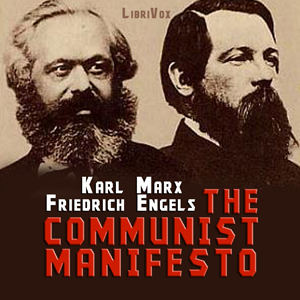
Communist Manifesto (version 2), The by Friedrich Engels (1820 - 1895) and Karl Marx (1818 - 1883)
by LibriVox
The Communist Manifesto was conceived as an outline of the basic beliefs of the Communist movement. The authors believed that the European Powers were universally afraid of the nascent movement, and were condemning as "communist," people or activities that did not actually conform to what the Communists believed. This Manifesto, then, became a manual for their beliefs.In it we find Marx and Engel's rehearsal of the idea that Capital has stolen away the work of the artisan and peasant by building up factories to produce goods cheaply. The efficiency of Capital depends, then, on the wage laborers who staff the factories and how little they will accept in order to have work. This concentrates power and money in a Bourgeois class that profits from the disunity of workers (Proletarians), who only receive a subsistence wage.If workers unite in a class struggle against the bourgeois, using riot and strikes as weapons, they will eventually overthrow the bourgeois and re
-
3
-
2
-
1
No matches for "" in this podcast's transcripts.
No topics indexed yet for this podcast.
Loading reviews...
ABOUT THIS SHOW
The Communist Manifesto was conceived as an outline of the basic beliefs of the Communist movement. The authors believed that the European Powers were universally afraid of the nascent movement, and were condemning as "communist," people or activities that did not actually conform to what the Communists believed. This Manifesto, then, became a manual for their beliefs.In it we find Marx and Engel's rehearsal of the idea that Capital has stolen away the work of the artisan and peasant by building up factories to produce goods cheaply. The efficiency of Capital depends, then, on the wage laborers who staff the factories and how little they will accept in order to have work. This concentrates power and money in a Bourgeois class that profits from the disunity of workers (Proletarians), who only receive a subsistence wage.If workers unite in a class struggle against the bourgeois, using riot and strikes as weapons, they will eventually overthrow the bourgeois and re
HOSTED BY
LibriVox
CATEGORIES
Loading similar podcasts...
URL copied to clipboard!