
PODCAST · business
Complete Paperless Solutions
by Complete Paperless Solutions
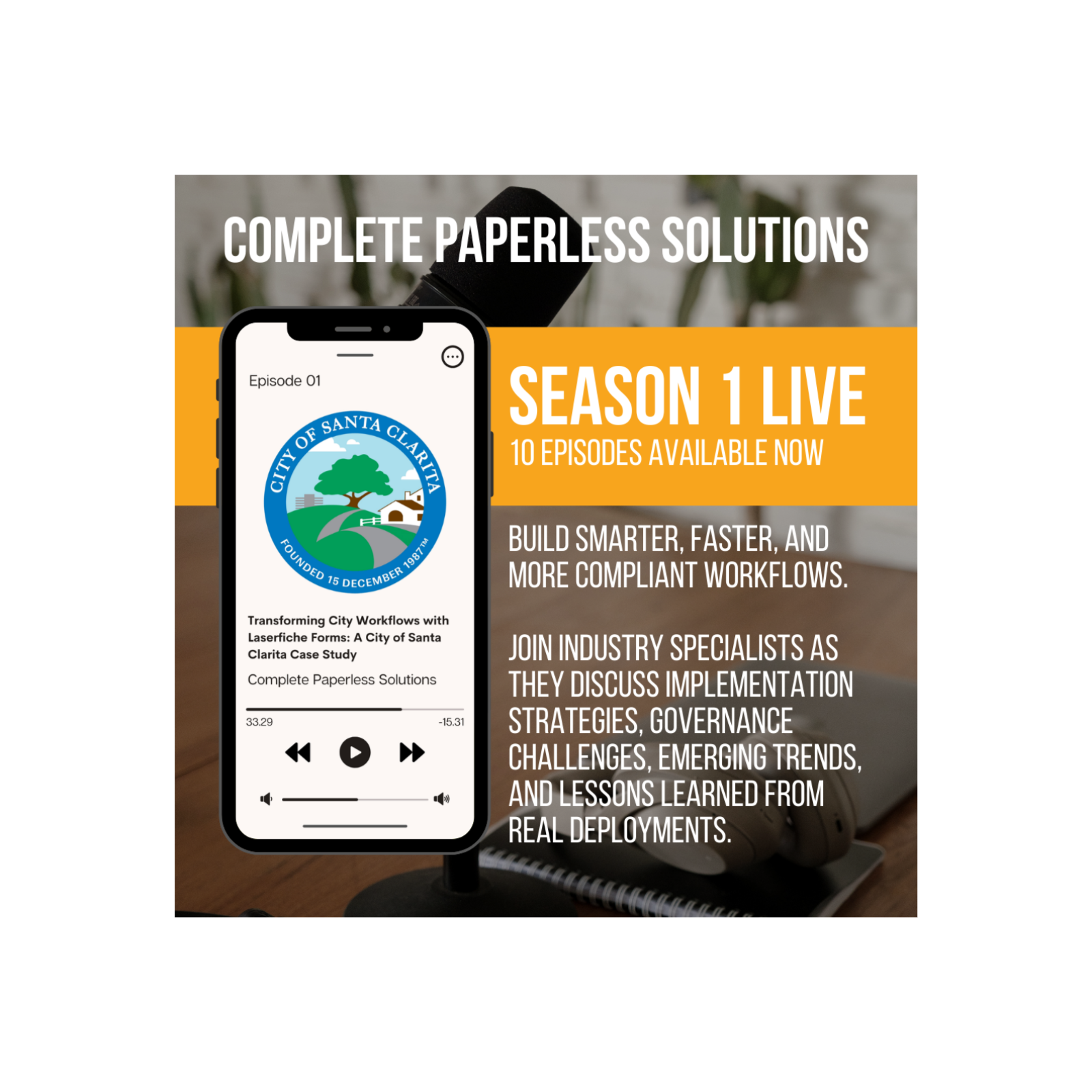
Listen as Complete Paperless Solutions breaks down how to make Laserfiche work for your organization. From automation and process optimization to governance, security, and innovation, we share expert insights, customer success stories, and actionable tips to help you modernize operations and eliminate paper-driven bottlenecks. If you’re looking to transform your digital workflows, this is the show for you.
-
10
Learn More About Laserfiche: Roadmap, Analyst Reviews and Future Capabilities
This presentation provides a comprehensive update on Laserfiche’s strategic roadmap, recent industry accolades, and the integration of next-generation technologies. Key highlights include the announcement of Laserfiche 12, scheduled for late 2024, which focuses on enhancing quality of life for users and reducing deployment complexity. The platform continues to prioritize the "citizen developer" by simplifying process design, allowing business owners to build and adapt workflows without heavy reliance on IT departments.A significant portion of the session centers on Generative AI Innovation, detailing a measured, governance-first approach to productivity. New features such as AI-powered regular expression (Regex) builders are already live, with document summarization and automated classification currently in discovery. These tools aim to eliminate manual bottlenecks in high-volume document environments. Additionally, the presentation clarifies the transition from perpetual licensing to subscription-based models for both self-hosted and cloud environments, ensuring that organizations have flexible paths for growth and migration.Learn more at: https://www.cps247.com/season-1-episode-10
-
9
CPS Best Practices Webinar: Best Practices for Laserfiche Project Communications
This presentation focuses on the critical role of communication and change management within Laserfiche implementation projects. It highlights how technology projects often fail not due to technical limitations, but due to human factors and organizational resistance. By adopting best practices from the worlds of marketing and sociology, project managers can bridge the gap between technical departments and business units to ensure long-term adoption.The discussion emphasizes that project managers spend approximately 80% of their time communicating. Success requires identifying key stakeholders through persona building, creating tailored messaging, and utilizing specialized roles—such as "connectors," "mavens," and "salespeople"—to drive the "tipping point" of organizational change. The presentation also offers practical advice on "implicit communication," where competence is demonstrated through actions like research-as-a-service and rapid prototyping of solutions for common process "pain points.Learn more at: https://www.cps247.com/season-1-episode-9
-
8
To Integrate or Not To Integrate: That is the Question
This session provides an in-depth look at how organizations can bridge the gap between Enterprise Content Management (ECM) and Geographic Information Systems (GIS). By integrating Laserfiche with ArcGIS through the GeoDocs platform, users gain the ability to interact with professional records directly through a map-based interface. This approach moves beyond traditional keyword searches, allowing for spatial queries—such as drawing circles, polygons, or freehand shapes—to retrieve documents associated with specific geographic coordinates or map layers.The demonstration highlights two primary administrative workflows: associating existing Laserfiche records with map locations and importing new files directly into the repository from the map. Key technical features include the use of "polygram" searches to find documents touching specific parcels, the ability to view document previews (PDFs and images) without a direct Laserfiche login, and the mapping of Laserfiche templates to ArcGIS feature IDs. This integration is particularly valuable for public works, engineering, and city planning departments that manage high volumes of location-dependent data.Learn more at: https://www.cps247.com/season-1-episode-8
-
7
Ask The Experts: Laserfiche Workflow
The final segment of the session demonstrates the "last mile" of the contract management lifecycle, emphasizing accountability and seamless integration. Key highlights include the use of Google Maps API within Laserfiche Forms to eliminate data entry errors and the utilization of authenticated electronic signatures, which carry the same weight as physical signatures due to system-level verification. The presentation illustrates how teams can "load balance" contract duties by delegating tasks within the platform, preventing administrative bottlenecks.The session also showcases advanced reporting capabilities, where metadata-driven "Agreements Reports" automatically alert staff to expiring contracts or missing insurance disclosures. By integrating Audit Trail reporting, the system maintains a complete history of every interaction, ensuring full transparency. The webinar concludes with a practical Q&A, reinforcing the "start simple" philosophy for those new to workflow automation—recommending that users begin with basic filing tasks in a test environment before scaling to complex enterprise processes.Learn more at: https://www.cps247.com/season-1-episode-7
-
6
Laserfiche AI
This presentation explores the latest advancements in Laserfiche Cloud, focusing on how artificial intelligence and intelligent automation transform traditional content management into a streamlined, hands-off experience. The session demonstrates the enhanced Web Client interface, which offers improved search efficiencies and a highly customizable metadata display, allowing administrators to design layouts using a canvas-based tool.A significant portion of the discussion centers on Laserfiche AI capabilities, specifically the Smart Chat and Document Summary features. These tools allow users to cross-reference repository content with official Laserfiche educational resources, generate concise document overviews, and query multiple files simultaneously to extract insights.The presentation also distinguishes between two primary automated capture paths:Capture Profiles: Best for standardized documents where data appears in consistent "zones" (e.g., job applications).Smart Fields: Ideal for varied documents (e.g., invoices) where AI identifies key information like vendor names and PO numbers regardless of their location on the page.Finally, the session covers Laserfiche Forms and Workflow, illustrating how these tools work in tandem to automate business processes such as vacation requests. These systems handle everything from initial data collection and email notifications to multi-stage approvals, final archival, and automatic document naming, ensuring full auditability and reducing manual administrative tasks.Learn more at: https://www.cps247.com/season-1-episode-6
-
5
The City of La Quinta - Laser-Focused on Resident Services
This overview explores the City of La Quinta’s successful transition into a "Government as a Service" model, a digital transformation sparked by the economic necessity of the 2008 recession. To maintain high-quality resident services despite a 25% workforce reduction, the city dismantled traditional departmental silos to create "The Hub," a physical and digital one-stop shop for permits, planning, and engineering. Central to this strategy is the implementation of Laserfiche, a "trusted system" that serves as the city's enterprise system of record.By digitizing decades of paper records—including building permits, architectural plans, and engineering archives—the city has empowered its constituents through a 24/7 self-service web portal. This portal features custom search forms that allow users to find records via addresses, project names, or even major commercial tenants. This initiative has significantly increased transparency and efficiency; while formal public records requests doubled during the pandemic, the online portal now handles over 200 search sessions per day, effectively preempting a massive volume of manual administrative work and providing residents with immediate access to information from the comfort of their homes.Learn more at: https://www.cps247.com/season-1-episode-5
-
4
Blazing a Trail Toward Trustworthy Electronic Document Preservation
This presentation provides a comprehensive roadmap for organizations transitioning from paper-heavy environments to legally compliant, trustworthy electronic document preservation systems. It addresses the common misconception of the "paperless office" by highlighting that many organizations remain 70-80% dependent on physical records, a vulnerability exposed by the COVID-19 pandemic.The overview covers the critical legal frameworks—specifically California Government Code 60203 and Code of Regulations 22620—that dictate how electronic copies can officially replace original paper records. Viewers will learn the technical requirements for a "trusted system," including the use of PDF/A formats, WORM (Write Once, Read Many) storage, and the necessity of robust metadata and taxonomy. Beyond technology, the video emphasizes the "human" side of records management: securing executive buy-in, establishing departmental records coordinators, and implementing systematic "baby steps" to ensure long-term organizational compliance and disaster resilience.Learn more at: https://www.cps247.com/season-1-episode-4
-
3
Trusted Systems
In this webinar segment, Restore Vault was demonstrated as a real-time, cloud-based solution for protecting and restoring Laserfiche data. The presenters showed how tens of thousands of files could be restored in minutes directly from the cloud, without consuming local storage, while maintaining exact copies and WORM-compliant immutable storage. The system integrates with Laserfiche workflows to automatically move documents based on retention schedules, allowing secure expiration and disposition of data by authorized users only. Restore Vault’s object storage prevents ransomware attacks, reduces server footprint through virtualization, and ensures compliance with trusted system requirements, while maintaining redundancy across multiple data centers and providing fast, on-demand access.Learn more at: https://www.cps247.com/season-1-episode-3
-
2
Building Trustworthy Systems with Laserfiche: Real-World Insights from Public Sector Leader
The discussion highlights how small and mid-sized cities are implementing Laserfiche as a trusted, scalable records management system by prioritizing simplicity, staff adoption, and public transparency while planning for long-term preservation and disaster resilience. Speakers emphasized starting with minimal required metadata, intuitive filing structures, and OCR-powered search rather than overengineering templates, enabling staff across departments to easily ingest records. Public-facing portals were rolled out incrementally, supported by outreach efforts such as how-to videos, newsletters, and homepage callouts to shift residents toward self-service records access and reduce staff burden. Collaboration—with IT, neighboring cities, and scanning partners like CPS—was repeatedly cited as critical for success, especially as systems integrate with permitting, finance, and other platforms. The conversation also underscored the importance of balancing digital-first strategies with selective physical preservation for historically significant records, maintaining audit trails, and planning for future migrations to ensure records remain accessible decades from now.Learn more at: https://www.cps247.com/season-1-episode-2
-
1
Transforming City Workflows With Laserfiche Forms: A City of Santa Clarity Case Study
The City of Santa Clarita leveraged Laserfiche Forms to modernize and scale enterprise-wide process automation, starting with a high-impact Cal Card form redesign that transformed a complex, error-prone workflow into a modular, user-friendly system using subprocesses, dynamic approvals, and inclusive gateways. The new approach supports parallel multi-approver routing, cleaner finance review, targeted revisions, and automatic record consolidation—while remaining intuitive for staff and adaptable for lower-skill builders. This success catalyzed rapid organizational adoption, positioning Forms as the backbone of the city’s digital service delivery strategy, expanding into HR, finance, travel coordination, and external-facing services. As automation matured, form development evolved beyond digitization into policy shaping, business analysis, and project management, supported by workflow integrations, timers, and data-driven logic. Overall, Forms became the city’s primary engine for scalable automation, operational consistency, and cross-department transformation.Learn more at: https://www.cps247.com/season-1-episode-1
We're indexing this podcast's transcripts for the first time — this can take a minute or two. We'll show results as soon as they're ready.
No matches for "" in this podcast's transcripts.
No topics indexed yet for this podcast.
Loading reviews...
ABOUT THIS SHOW
Listen as Complete Paperless Solutions breaks down how to make Laserfiche work for your organization. From automation and process optimization to governance, security, and innovation, we share expert insights, customer success stories, and actionable tips to help you modernize operations and eliminate paper-driven bottlenecks. If you’re looking to transform your digital workflows, this is the show for you.
HOSTED BY
Complete Paperless Solutions
CATEGORIES
Loading similar podcasts...
Frequently Asked Questions
How many episodes does Complete Paperless Solutions have?
Complete Paperless Solutions currently has 10 episodes available on PodParley. New episodes are automatically indexed when they're published to the podcast feed.
What is Complete Paperless Solutions about?
Listen as Complete Paperless Solutions breaks down how to make Laserfiche work for your organization. From automation and process optimization to governance, security, and innovation, we share expert insights, customer success stories, and actionable tips to help you modernize operations and...
How often does Complete Paperless Solutions release new episodes?
Complete Paperless Solutions has 10 episodes. Check the episode list to see recent publication dates and frequency.
Where can I listen to Complete Paperless Solutions?
You can listen to Complete Paperless Solutions on PodParley by clicking any episode. We provide an embedded audio player for direct listening, and you can also subscribe via your preferred podcast app using the RSS feed.
Who hosts Complete Paperless Solutions?
Complete Paperless Solutions is created and hosted by Complete Paperless Solutions.
URL copied to clipboard!