
PODCAST · arts
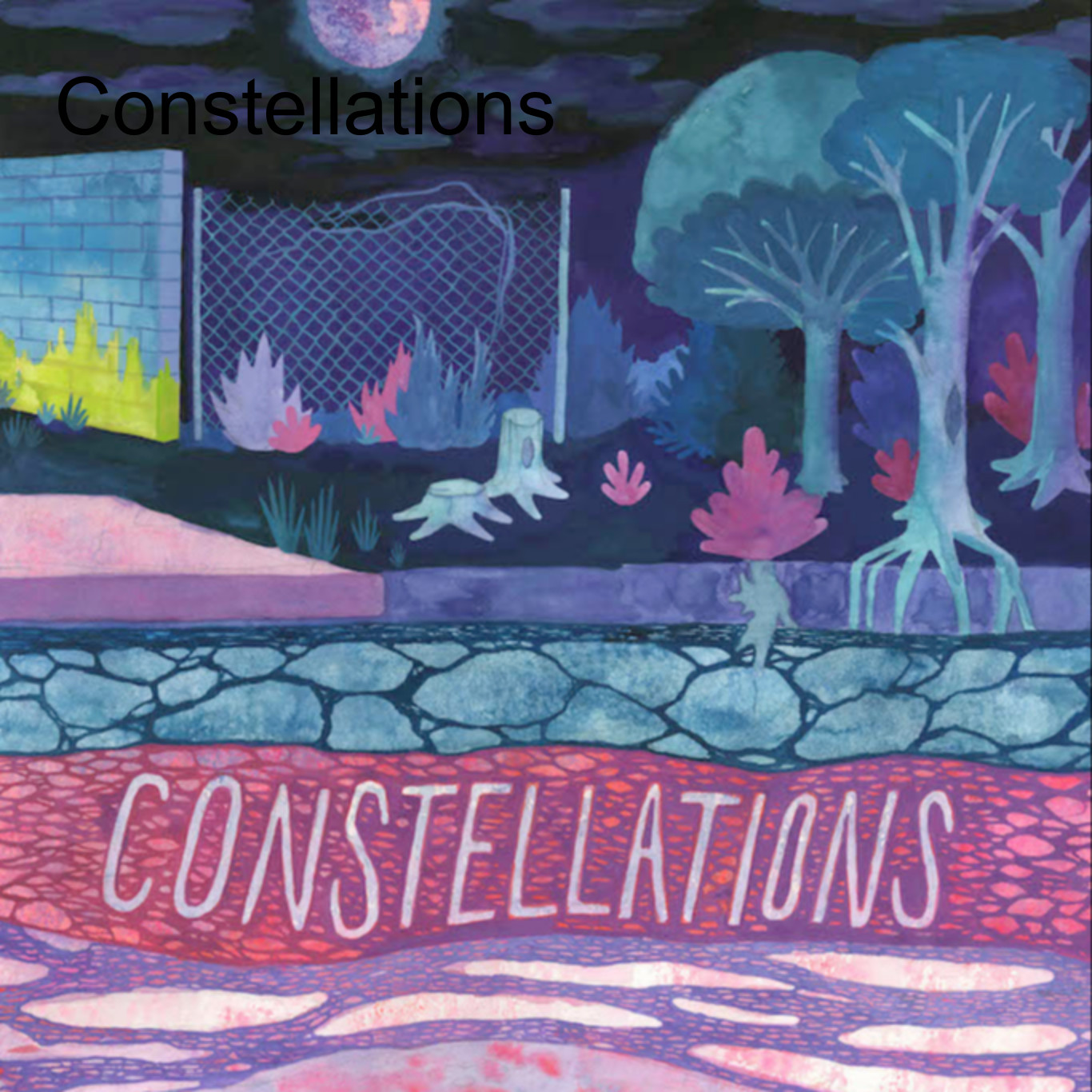
Constellations
by Constellations
We exist in the cosmos of sound art & experimental narrative.
-
74
The Mystery Box
This Mystery Box has been mixed by Ariana Martinez. It’s composed from sounds recorded by: Jess Shane, Miyuki Jokiranta, Anouk Hannan, Mike Williams, Ayesha Barmania, Adair Sheppard and Isaac Arnquist. To hear these sounds in their entirety, click here. *** Constellations is a community of listeners, investigating the world through sound. The mix engineer is MM. The graphics are designed by JS. For more sounds from Constellations, visit out website: https://constellationssounds.org/
-
73
On ”Aural Alterities”: An interview with jamilah malika abu-bakare
This episode of Constellations we speak with artist and writer jamilah malika abu-bakare about Aural Alterities, an online exhibition curated by abu-bakare. Aural Alterities is a collection of works by 8 sound artists, which suggest dimensions and possibilities for working in sound outside of formal or canonical of the medium. All of these artists are Black, Indigenous or POC Chilean. This episode is primarily an interview with abu-bakare, alongside excerpts from the exhibition. We strongly recommend you listen and take in these works in their online format here: auralalterities.com Aural Alterities works: - “sending a message to you” by Adee Roberson - “Speaking into Existence” by Aj McClennon - “Audible Rising” by Allah George - “L2BW2” by jamilah malika abu-bakare - “ALL OF ME” by Jessica Karuhanga - “FIGHT ME” by Kim Ninkuru - “only workers” by RUTMEAT - “Detenidxs Desparecidxs” by Soledad Fatima Muñoz Referenced reading: The Combahee River Collective Statement Art Papers, Interview: David Hammons Undrowned: Black Feminist Lessons from Marine Animals by Alexis Pauline Gumbs Further reading: Aural Alterities “On Listening” page: auralalterities.com/on-listening
-
72
A surprise is coming...
Trick & treat. You know where we've been 😉 Constellations returns with some 🪄😈✨🧨 very soon.
-
71
WARATAH ~lonely artefacts~
Lonely Artefacts is a podcast series about regional Australian museums by Sisters Akousmatica for Constellations. Lonely Artefact #2 takes you to the Waratah Museum in Waratah north west lutruwita-Tasmania. From Sisters Akousmatica: “I visited in 2010 and the museum experience stayed with me, as it was so obviously a labour of love and community service. In fact it was probably the original inspiration for this series.” Sisters Akousmatica pay respect to the Palawa people as the traditional and ongoing custodians of Lutruwita and to elders past, present and future, and acknowledge that sovereignty has never been ceded. https://www.constellationsaudio.com/sounds
-
70
Extraction
Energy usage and sound are two omnipresent components of our daily life. We're constantly trying to weigh our own wants and complications against individual sacrifices and the perceived "difference" our actions can make. And of course, as with much of existence, many things can be true at once. Featuring: "i don't think its my place" by Sophia Steinert-Evoy "Forest to Desert" by Sarah Boothroyd https://www.constellationsaudio.com/sounds
-
69
Semiotic Shift
Language is inextricably linked to land. In this episode, we explore how the shifts in the landscape have impacted language across generations and cultures. Featuring: “Translation (a prayer)” by John Isaiah Edward Hill “During the drought the road is dry” by Bartosz Panek John Isaiah Edward Hill is writing a poem to the generations passed and the generations to come in the Oneida language that’s been threatened by settler colonial violence. In their piece “Translation (a prayer)”, we hear two voices: the English voice which is static and unmoving, and the Oneida voice, which moves in a counter-clockwise motion, representative of traditional Haudenosaunee dance practices. ~ In Poland, drought has wrecked havoc on the landscape. 2019 was the hottest year on record in Poland, and it’s affecting their entire way of life from water, the soil, food and energy prices. These shifts have meant a shift in the language used to describe water, heat and dryness. In Bartosz Panek’s piece “During the drought the road is dry” he explores how old words are being given a new context alongside the changing climate. Transcript for “During the drought the road is dry” is below. [8:49 - 9:00] During the drought the road is dry. [9:10 - 9:15] During the drought the road is dry. [9:20 - 9:25] During the drought the road is dry. [9:34 - 9:34] Can you see the drought? [9:34 - 9:54] So you know... in a place like this it will be seen there... Take a look there, where's upper: dryness has just been appeared. So it’s visible. If the whole area, the grass here, is burned by the sky, it’s obvious there’s the drought. [10:03 - 10:33] Nope! It's not so bad now. In my backyard I have a garden with some vegetables and it was visible You just need to dig your finger into the soil and you know if it’s dry or humid. So when the vegetation started in May and June, there was a kind of crisis. But not now. [11:50 - 11:59] Damn deckchair. The drought exhorted great havoc. Raspberry season is almost over… [14:20 - 14:39] Sasha is treading down a dry road, He can hardly walk, that’s a forebode. The heat is pouring out of the sky, During the drought the road is dry. [24:09 - 24:17] Dry across, dry out, dry over, dry totally…
-
68
Archive
Ft. “American Ghosts” by Erica Huang and “Bob Hope No Hope” by Jenn Stanley. The act of recording has impacted how we perceive and understand time. Recording’s byproduct, whether by sound, video, photo etc, is an artifact of the past, a moment of space and time captured and archived. For this episode of Constellations, we asked two artists, Erica Huang and Jenn Stanley to reflect on how they consider time, its relationship with recorded artifacts and the significance of the archive. We asked them: How might our conception of what an ‘artifact’ is be sonically unraveled?
-
67
Voicing
Voicing was produced and composed by Mara Schwerdtfeger The piece is an interweaving abstract conversation exploring the concept of voice through a series of four sound elements. The deconstructable nature of the piece allows for multiple forms of expression to be heard both as individual voices and together as an active cohesion of sound. We encourage you to visit our website to play with these different voices – voice, viola, environments and sound objects – in your own time. We’ve got each of the separate voices listed there, so you can hear they interact, relate, and reflect back on each other within your own sonic environment. Play with them how you like. constellationsaudio.com/sounds
-
66
Inner Geographies
This episode of constellations we’re mapping ourselves, from the outside in. Relax your need to understand everything and listen to yourself, your body, loosen the need to analyze. Featuring: “Necropolis 2: Cruise Control” by Kamikaze Jones “A Sound Poem” by Axel Kacoutié and “Necropolis 3: Planet of the Gapes” by Kamikaze Jones. Axel writes: “We are wrong to look for uniformity and objectivity. We have all mapped associations to what our subjective experience is like. My experience of the colour red is different from yours. Our brains light up the same way when hearing water but our relationship to its sounds will never be the same. Because of this, I wanted to illustrate how I've mapped mine using abstract terms like solitude, sunbathing, patricide etc. All as an attempt to say, "you don't have to understand, I just want to connect and have you see (listen) how I relate to the world." — “Necropolis 2: Cruise Control” —> This piece is composed from Grindr chats, sex toy Yelp reviews, and hold music from gay phone-sex hotlines. It imagines a queer hauntological underworld mediated by the technologies of yesteryear. “Necropolis 3: Planet of the Gapes” —> This piece is a more meditative, cosmic manifestation of the Queer Necropolis, and is comprised entirely of acoustic instruments played with a vibrating butt plug. Kamikaze writes: “My original intention was to create an immersive sonic environment that was representative of the darker, more infernal channels of the collective queer subconscious. My work as a performance artist and extended technique vocalist over the past year has been focused on explorations of queer madness, and supernatural manifestations of queer erotic identity. My objective was to create a mythological sonic territory that addressed the sublimated ghosts and demons of our shared history. I quickly realized the boundaries of my own subjectivity in the compositional process and, embracing the queer art of failure, realized that the project would undergo a kind of conceptual mitosis, splitting into two separate but distinct companion pieces, each radical interpretations of what a “Queer Necropolis” could sound like. (for more, head to our website) constellationsaudio.com/sounds
-
65
Basic Ingredients
What do eyes sound like? Does a spider’s abdomen sound furry or crunchy? How much sameness do I share with a cardinal? A mouse? Or the mold in the corners of my bathroom?... I should clean my bathroom? In BASIC INGREDIENTS we’re into objects - both seemingly inanimate and living - to reconsider our relationship to the spaces that surround us. Featuring: "Dust Meditation” by Clare Dolan "Fork, Knife, Lid" by Kim Hiorthøy “The Land Owns Us” by Nishant Singh
-
64
Missed Connections
Do you ever feel like you’re not quite getting it? We live in a time of missed connections expressed through misunderstandings, dropped calls and glitches. In this episode of Constellations, sit with us in an attempt to express the inexpressible. Oh, and a duck sound or two. "Echoing Quack" by Natalie Kestecher and Mike Williams "poor connection" by Yardain Amron
-
63
Accumulation Over Time (Parts X,Y,Z)
I want to talk about how the accumulation of things — books or bottles or whatever - is overwhelming on different scales. Overwhelming to the environment, overwhelming to the individual home, or overwhelming to the body. I wanted to make something that was claustrophobic but also could be exhumed and heard in parts like picking through the ruins of an old factory building.
-
62
X Axis: The rationale of a body in pain
X Axis: The rationale of a body in pain -- Think about each layer existing at the same time and bleeding together. Each layer is like a different perspective to a single thing that is too massive to perceive all at once. -- Accumulation Over Time was written, produced, and edited by Adriene Lilly and features the voice of Tiana Tucker with additional help from Tiana Tucker, Olivia Bradley-Skill and Michelle Macklem. Readings from The Body in Pain by Elaine Scarry and Hyperobjects: Philosophy and Ecology After the End of the World by Timothy Morton.
-
61
Y Axis: The hoarding habits of two manhattan heirs
Y Axis: The hoarding habits of two manhattan heirs -- imagine these pieces as parts of a whole. -- Accumulation Over Time was written, produced, and edited by Adriene Lilly and features the voice of Tiana Tucker with additional help from Tiana Tucker, Olivia Bradley-Skill and Michelle Macklem. Readings from The Body in Pain by Elaine Scarry and Hyperobjects: Philosophy and Ecology After the End of the World by Timothy Morton.
-
60
-
59
Accumulation over time [credits]
“There's something to me something about hoarding or accumulating or the need to own things and purchase things and have things in your life. I understand it on a lot of levels and obviously I have stuff and I have more plants than a person should have. But there's something about that impulse. It's the opposite of the impulse I have, which is to shed everything and have nothing. So I say that because, that's like where the tension is for me, right? Because I want to understand … what is this accumulation? Like, why is why is this? How is this? What is this?” [Adriene Lilly] -- Accumulation Over Time was written, produced, and edited by Adriene Lilly and features the voice of Tiana Tucker with additional help from Tiana Tucker, Olivia Bradley-Skill and Michelle Macklem. Readings from The Body in Pain by Elaine Scarry and Hyperobjects: Philosophy and Ecology After the End of the World by Timothy Morton.
-
58
BROOD
BROOD was composed by RUTMEAT. RUTMEAT writes: This work was created by singing with feedback, using effects pedals, playing cymbals with beadwork and some field recordings. April 30th is when I pulled "the sun, it sets on the empire" through my body by using my voice in this way. The words are from a work by Dzawada'enuxw artist, Marianne Nicholson, who has consented to me referencing her 2017 work, The Sun is Setting on the British Empire. I want to talk about the blockades that were in Vancouver this winter in support of Wet'suwet'en hereditary chiefs (law and governance system that is older than what is now known as Canada). I want to talk about ongoing colonial violence, genocide and hope. About Black and Indigenous communities showing up for each other and demanding more than performative allyship from yt and POC settlers. Talk about how resource extraction always brings ripples of violence. I want to talk about how a generation of Indigenous youth called to shut Canada down and then covid struck. I want to talk about labour that is expected of Indigenous femme presenting people to educate those around them. And I will, with my communities. In the words of Ta'kaiya Blaney, "We are the land protecting itself." ~~~~~~~~~~~~~~ This work was supported by constellations' 2019 Indigenous Sound Art Fundraiser.
-
57
-
56
FEEL THE SKY Side B ~ The Burdened Land
For the first episode of Constellations’ 2020 season, we present FEEL THE SKY, a duo of sound works in conversation composed by JAYE KRANZ (Australia) and MYRA AL-RAHIM (USA). Both extend from the same starting point – a recording from 1992 made by a news reporter unfamiliar with field recording, but entranced by a chance encounter with trumpeter swans on an icy lake. Originally recorded on cassette, Constellations digitized the material and commissioned Kranz and Al-Rahim to compose their own landscapes – both real and imagined – in response. Take an interior road trip in “Are We There Yet” (Kranz), a journey across interior ecologies and mountain peaks. Then venture into “The Burdened Land” (Al-Rahim), a sprawling whorl that considers borders from the perspective of migratory bodies that cannot be contained within them. Both works take inspiration from field recordings by HEATHER EVANS on the ancestral and traditional territories of the HAISLA NATION. From the mind of Myra Al-Rahim: When I began developing “The Burdened Land”, I knew I wanted to create an environmentally-conscious piece, though not in the traditional sense of the term. I wanted the work to have a distinct feeling of space and scale. I sought to explore the thematic interconnectedness between the migratory paths of birds and the sprawling supply chains of capital. Heather's original tape appears close to the beginning of my piece and continues throughout Act 1. I imagined she was taking a new journey through the sonic landscape I created for her to explore.
-
55
FEEL THE SKY Side A ~ Are We There Yet?
For the first episode of Constellations’ 2020 season, we present FEEL THE SKY, a duo of sound works in conversation composed by JAYE KRANZ (Australia) and MYRA AL-RAHIM (USA). Both extend from the same starting point – a recording from 1992 made by a news reporter unfamiliar with field recording, but entranced by a chance encounter with trumpeter swans on an icy lake. Originally recorded on cassette, Constellations digitized the material and commissioned Kranz and Al-Rahim to compose their own landscapes – both real and imagined – in response. Take an interior road trip in “Are We There Yet” (Kranz), a journey across interior ecologies and mountain peaks. Then venture into “The Burdened Land” (Al-Rahim), a sprawling whorl that considers borders from the perspective of migratory bodies that cannot be contained within them. Both works take inspiration from field recordings by HEATHER EVANS on the ancestral and traditional territories of the HAISLA NATION. From the mind of Jaye Kranz: “Are We There Yet?” is a strange, recurring road-trip towards home. A home we can never really find or retrieve; while at the same time, being a home we have already found: the one that is already ours. Like a circular roadmap for finding our way there. We hear the same driving tape over and over, but we move through different landscapes, across vast spans of time and place, in a dreamscape where the laws of separation and structure, boundary and contour, do not apply.
-
54
Constellations 2020 is HERE
Hello, Constellations is returning to your feeds with a delicious new season of audio oddities, soul-filled sounds and feed fucking. We can’t wait for you to hear what we’ve been up to. We’re throwing a (n online) party to celebrate our launch, THIS Friday, May 22 at 8:00pm EST / Saturday, May 23 at 10:00am AEST. It’s an intimate listening party and in-conversation with the artists behind our first physical release FEEL THE SKY. Tickets and more info here: https://www.facebook.com/events/836823783469230 And we’re back on your feeds NEXT WEEK, Friday May 29th, so keep an ear out for us then. Constellations~ FEED YOUR EARS
-
53
RESONANT BODIES [the exhibition]
Step inside the world of Resonant Bodies with this special hour-long episode that takes you piece-by-piece through the exhibition. Follow your ears through the ambient sounds of the gallery and stop off at each piece. Read alongside with the piece descriptions below. [00:24-09:02] Aliya Pabani, Singing on the Line Aliya Pabani goes to a vocal coach to look into the extent of her vocal cord damage, and the contours of the voice she has left. Originally constructed as a four-channel audio installation, this piece played back on four speakers fabricated from four balloons. [09:02-19:56] Jon Tjhia, Thing-Like How is a business phone call like a folk song or jazz standard? How much are non-words, and part-words, involved in how we communicate? Is it possible to speak into the void; to use our voices to communicate nothing at all? In Thing-Like, Jon Tjhia has created a suite of 'exercises' – basically analogous to piano études, or studies, for edited sound works. Taking Walter Ong's preoccupations with the 'immersive' and vital nature of oral culture as a point of departure, these pieces tease and critique the heavy burden of speech and its value: as social currency, blunt instrument, monetary resource and point of connection. This collection of short works is composed for speakers – inviting, intrusive, implicating the passer-by; and headphones – individual, interior. Traditional interviews, aimless conversations, paid celebrity dedications, forgotten sing-alongs, free improvisations, custom voice synthesis and chance murmurs become material for a process that is both informal and entirely formal. Speakers’ words are manipulated (‘say that again, but opposite’); license agreements are breached. While Ong argues that thought and expression have been fundamentally reconfigured by the technology of writing; Thing-Like suggests ways in which voice and speech have been reconfigured by the technology of money and how it structures time. [19:56-30:40] Kaija Siirala, Hamina, Finland “Where is the Cloud located on Earth?” Reflecting on the disembodied lexicon of virtual space, Kaija Siirala’s Hamina, Finland situates listeners at an unexpected nexus between digital and physical gathering places: the Hamina sauna. A relic of a retrofitted paper mill, this sauna is an employee perk at the Hamina Google data center in Southern Finland. Uniquely, seawater is channeled here to cool Google’s vast, active server bodies. Simultaneously, human bodies in the neighbouring sauna heat up after a day of work. The piece considers the often-obscured physical consequences of virtual activity by mapping it onto a visceral sauna experience. A watery world emerges through a whispered choir of google search histories, including Siirala’s own Hamina sauna research. Sauna is a central component of Finnish culture and is a lifelong practice Siirala inherited from her family. Her field recordings from these times together — sounds of breath, camaraderie, eruptions of laughter — underscore the piece. When water is tossed onto the rocks atop the stove, the löyly — steam in Finnish — mounts the heat to an intolerable crescendo forcing participants out of the sauna and into the same cold sea cooling the Google servers. Löyly shares the same etymological root as the Finnish word for “spirit”. [30:40-41:17] Cheldon Paterson, Transport Station Forests, rain, traffic — all seem to sound louder in the dark of night. For sighted people, hearing is the center point of attention only when visual input is absent or unclear. Cheldon Paterson’s Transport Station, composed as an audiovisual diptych plays with this tendency through spatial isolation of the audio and visual components of the work, so that they can be experienced both together and apart. In video form, Paterson’s audio comes first, setting up hearing as the primary mode of perceiving one’s environment. Listeners hear field recordings from urban and natural environments that have been twisted and turned on themselves through turntablism and sampling. The second half of the piece is accompanied by video, which employs the kaleidoscope as a visual metaphor for how the transformation of familiar sounds affects the imagination. While the interaction of sight and sound is usually clarifying to the senses, Paterson’s approach refracts memory and imagination, forcing the viewer-listener to succumb to the current of sensual input or become an active participant in meaning-making. [41:17-49:51] Chandra Melting Tallow, Protect Me From My Protector In her critique of romantic love, bell hooks writes, “This illusion, perpetuated by so much romantic lore, stands in the way of our learning how to love. To sustain our fantasy, we substitute romance for love.” In Protect Me From My Protector, Chandra Melting Tallow pierces the fantasy of romance to reveal the sharp, tense and dark edges of harm within intimate partner relationships. Dropping us into the emotional inner world of the artist, this work explores the intensity, confusion, and disorientation of living within the confines of abuse, including the cycles of trauma and cognitive dissonance that occur when one’s protector is simultaneously inflicting harm. The piece extends past personal relationships to confront power relations, particularly between the state as a protectorate and marginalized communities. When these communities are depicted as irrational and hysterical, the state reasserts power to remove their agency. As a result of such abuses of power, the world is heard and experienced differently by marginalized communities, so that music that once signaled romance can be recast as a tool of manipulation. [49:51-57:48] Phoebe Wang, Isn’t it lovely? Stepping inside Isn’t it lovely?, Phoebe Wang asks the audience to leave the known territory and comfort of the white-walled gallery space to become immersed in an isolated environment. Here, sights and sounds of walls, carpets, speech and din create a faux-warmth that is at once invasive and curious. The listener then must subject themselves to the sounds that enter their ears. The fragments of recorded memories that make up Isn’t it lovely? hover over meaning, never landing solidly. As the audio progresses, Wang prompts and engages in a series of conversations that attempt to ask, “why choose to keep going in a world that is not built for you?” In Isn’t it lovely?, Wang constructs a refuge of sorts – yet the systems and histories she seeks to evade or emancipate herself from continue to be felt here, too. ******************************************************* Resonant Bodies began as an exhibition in Toronto Canada. In Toronto, we’re situated within the ‘Dish with One Spoon Territory’ on the ancestral and traditional territories of the Anishnaabe, the Haudenosaunee, the Huron-Wendat First Nations, and the Mississaguas of the Credit First Nations. We acknowledge Canada’s First Peoples as the original inhabitants and storytellers of this land, and we pay respects to their ongoing storytelling traditions. Resonant Bodies was curated and produced by Aliya Pabani, Michelle Macklem and Jess Shane. Audio mixed by Michelle Macklem. Graphics designed by Jess Shane. The artists are: Aliya Pabani, Jon Tjhia, Kaija Siirala, Cheldon Paterson, Chandra Melting Tallow and Phoebe Wang. Resonant Bodies received exhibition support from many generous people and organizations. Thank you to Henry Faber, Jennie Robinson, Mitchell Akiyama, Amita Kirpalani, Braden Labonte, Liam Coo, Matthew Kariatsumari, Frank Green, Evan Cartwright, Robin Luckwaldt, Mitch Trachter, and Yuula Benivolski. Special thanks to the terrific folks at the Toronto Media Arts Centre for partnering with us and making this event possible. Thanks also to community partner Charles Street Video. Resonant Bodies was supported by the Toronto Arts Council and the Ontario Arts Council.
-
52
Phoebe Wang ~ Isn't it lovely?
Stepping inside Isn’t it lovely?, Phoebe Wang asks the audience to leave the known territory and comfort of the white-walled gallery space to become immersed in an isolated environment. Here, sights and sounds of walls, carpets, speech and din create a faux-warmth that is at once invasive and curious. The listener then must subject themselves to the sounds that enter their ears. The fragments of recorded memories that make up Isn’t it lovely? hover over meaning, never landing solidly. As the audio progresses, Wang prompts and engages in a series of conversations that attempt to ask, “why choose to keep going in a world that is not built for you?” In Isn’t it lovely?, Wang constructs a refuge of sorts – yet the systems and histories she seeks to evade or emancipate herself from continue to be felt here, too.
-
51
Chandra Melting Tallow ~ Protect Me From My Protector
In her critique of romantic love, bell hooks writes, “This illusion, perpetuated by so much romantic lore, stands in the way of our learning how to love. To sustain our fantasy, we substitute romance for love.” In Protect Me From My Protector, Chandra Melting Tallow pierces the fantasy of romance to reveal the sharp, tense and dark edges of harm within intimate partner relationships. Dropping us into the emotional inner world of the artist, this work explores the intensity, confusion, and disorientation of living within the confines of abuse, including the cycles of trauma and cognitive dissonance that occur when one’s protector is simultaneously inflicting harm. The piece extends past personal relationships to confront power relations, particularly between the state as a protectorate and marginalized communities. When these communities are depicted as irrational and hysterical, the state reasserts power to remove their agency. As a result of such abuses of power, the world is heard and experienced differently by marginalized communities, so that music that once signaled romance can be recast as a tool of manipulation.
-
50
Cheldon Paterson ~ Transport Station
Forests, rain, traffic — all seem to sound louder in the dark of night. For sighted people, hearing is the center point of attention only when visual input is absent or unclear. Cheldon Paterson’s Transport Station, composed as an audiovisual diptych (though is also released via podcast as audio-only) plays with this tendency through spatial isolation of the audio and visual components of the work, so that they can be experienced both together and apart. In video form, Paterson’s audio comes first, setting up hearing as the primary mode of perceiving one’s environment. Listeners hear field recordings from urban and natural environments that have been twisted and turned on themselves through turntablism and sampling. The second half of the piece is accompanied by video, which employs the kaleidoscope as a visual metaphor for how the transformation of familiar sounds affects the imagination. While the interaction of sight and sound is usually clarifying to the senses, Paterson’s approach refracts memory and imagination, forcing the viewer-listener to succumb to the current of sensual input or become an active participant in meaning-making.
-
49
Kaija Siirala ~ Hamina, Finland
“Where is the Cloud located on Earth?” Reflecting on the disembodied lexicon of virtual space, Kaija Siirala’s Hamina, Finland situates listeners at an unexpected nexus between digital and physical gathering places: the Hamina sauna. A relic of a retrofitted paper mill, this sauna is an employee perk at the Hamina Google data center in Southern Finland. Uniquely, seawater is channeled here to cool Google’s vast, active server bodies. Simultaneously, human bodies in the neighbouring sauna heat up after a day of work. The piece considers the often-obscured physical consequences of virtual activity by mapping it onto a visceral sauna experience. A watery world emerges through a whispered choir of google search histories, including Siirala’s own Hamina sauna research. Sauna is a central component of Finnish culture and is a lifelong practice Siirala inherited from her family. Her field recordings from these times together — sounds of breath, camaraderie, eruptions of laughter — underscore the piece. When water is tossed onto the rocks atop the stove, the löyly — steam in Finnish — mounts the heat to an intolerable crescendo forcing participants out of the sauna and into the same cold sea cooling the Google servers. Löyly shares the same etymological root as the Finnish word for “spirit”. A watery world emerges through a whispered choir of google search histories, including Siirala’s own Hamina sauna research. Sauna is a central component of Finnish culture and is a lifelong practice Siirala inherited from her family. Her field recordings from these times together — sounds of breath, camaraderie, eruptions of laughter — underscore the piece. When water is tossed onto the rocks atop the stove, the löyly — steam in Finnish — mounts the heat to an intolerable crescendo forcing participants out of the sauna and into the same cold sea cooling the Google servers. Löyly shares the same etymological root as the Finnish word for “spirit”.
-
48
Jon Tjhia ~ Thing-Like
In Thing-Like, Jon Tjhia has created a suite of 'exercises' – basically analogous to piano études, or studies, for edited sound works. Taking Walter Ong's preoccupations with the 'immersive' and vital nature of oral culture as a point of departure, these pieces tease and critique the heavy burden of speech and its value: as social currency, blunt instrument, monetary resource and point of connection.
-
47
Aliya Pabani ~ Singing on the Line
“This piece comes out of a desire that I've had for a long time to map out the damage to my vocal cords. As a kid, I used to scream a lot and throw a lot of tantrums and I think that might have caused stress to my vocal cords and that's why I have the voice that I have right now. And although I really like my voice, I can't actually sing very well. I have a really limited range. And so I wanted to speak to a vocal coach and do a vocal lesson to see what my voice could do.” ~Aliya Pabani
-
46
Resonant Bodies {Oct 25 – Dec 2}
Constellations returns on October 25 to Dec 2 with Resonant Bodies – an online exhibition and short season about the interactions between bodies and their environments. It features original works by: Aliya Pabani Chandra Melting Tallow Cheldon Paterson Kaija Siirala Jon Tjhia Phoebe Wang We asked these artists to create works in response to this provocation by Walter Ong: "Sight isolates, sound incorporates. Whereas sight situates the observer outside what [they view], at a distance, sound pours into the hearer."
-
45
hildegard westerkamp - whisper study
“Whisper Study started out as an exercise in exploring basic tape techniques in the studio, using the whispered voice as sound material. It’s based on the sentence "When there is no sound, hearing is most alert", a quote from the Indian mystic Kirphal Singh in Naam or Word. The content of that sentence appealed to me. I thought a lot about it and then decided I was going to whisper that sentence. I ended up with this very quiet recording of my whispered voice. In doing this, I was challenging myself, because whispered sounds in an analog studio create the issue of hiss and added noise.”
-
44
ayaz kamani - point pelee
“What I create through sound design is a false representation of nature, but a constant reminder that it exists, because you're like ‘oh shit this room, no one's going to believe this room if there is no air and room tone.’ So you have to put all this stuff in to sell the room. You're always walking a fine line. While making this piece, I thought a lot about where my urge to recreate this moment at Point Pelee really came from. What evolutionary need does it serve?”
-
43
amy hanley - H:O:M:E
“I explored holding and responding. I explored the possibilities of sound as a facilitator and communicator of memories, embodied and expressed. I explored themes of death, displacement, collective memory, and personal stories. These themes were informed by memories that were shared to an online portal – those stories of place and belonging were gathered by L&NDLESS and were used to create an immersive performance-based installation.”
-
42
sam leeds - that spiraling place
“I’ve been thinking a lot about the intersection of escape and bearing witness. And I keep coming back to that saying, “wherever you go, there you are.” This piece began because I wanted to document my trip to Iceland with one of my close friends. We booked it on whim after a breakup. We spent 10 days driving the country during a wintery March in 2018. It was an escape and a chance to exist outside the routines of home..“
-
41
aidan mcmahon - i/a recording
“This piece is about the tension between experience and the impulse to record it. The two, I believe, are incompatible. What happens when the experience you want to record is another person? How does this interrupt the relationship, or improve it?”
-
40
james t green - emdr
In a medium where the unfurling of an idea is often synthesised and made neatly linear, James T. Green’s piece offers a welcome unending. In perfect tense, “I’ve always felt this need for control”, is a musical refrain with a psychoanalytic spike. The ‘cut ins’ of conversation between James and another person who, from his explainer we learn is his partner, are positioned above a muffled or partially muted version of the motif.
-
39
myra al-rahim - and the sea gave up the dead which were in it
“I started making this piece in the summer of 2017. That year marked 15 years since the US invasion of Iraq. From the piece’s conception, my plan was to create a sonic eulogy commemorating this anniversary; to construct an audioverse where I could reflect on the hubris of the United States and its acolytes. Propelled by ruthless arrogance, bolstered by intelligence that was categorically false, their decision to act preemptively against the non-threat that was Saddam’s Regime, thrust the region into years of destabilization and bloodshed the shock waves of which continue to reverberate to this day.”
-
38
ayesha barmania - quiet contemplations
“I have been really inspired by Ad Reinhardt's 'Abstract Painting' from 1963 which depicts nine very subtle shades of black. At first glance, the viewer sees a flat black canvas. Over time, the viewer notices the subtle tone differences - one is more red, another blue, one slightly green. The viewer wonders: which is the true black? That concept has resonated with me when I contemplate the subtleties in silence.”
-
37
phil smith - the space between stories
“This piece expresses the ongoing search for home and meaning in a time of ecological collapse and the disintegration of old ideas about our place in the world. It’s an expression of conversations I’m having with friends, and of things I’m reading. It's an attempt to make something spiritual and honest in sound! There are no facts or environmental insights in the piece. It's more about the internal flow of feelings and emotions that come from the desire to believe that we might be on the verge of something truly beautiful, despite (and perhaps also owing to) the health of the planet.”
-
36
franco falistoco araya - despojo
“DESPOJO is a sound work which only uses sounds from an old vinyl record — clips and claps. I cut the big sound loop into fragments, creating small samples. Then I limited myself to using few processes — 1 equalizer, 1 reverb, and 1 delay. Anything else I wanted, I had to manually build inside the digital audio workstation.”
-
35
janna graham - to slow down time
“In October, 2014, Atsumi Yoshikubo, a Japanese tourist, was seen walking down the highway outside of Yellowknife with a camera and a shoulder bag. It was the last time she was seen alive. The following summer, a friend of mine, Ryan Silke, discovered her belongings in the bush, not far from town. Rather than delving into how Atsumi died — her death was assumed to be intentional — I began thinking about how we engage in certain processes to slow down time."
-
34
abinadi meza - vein of sky (winter #4)
“Vein of Sky is a collection of pieces made from environmental elements such as air temperature, humidity, light, and the movements of wind. These phenomena were recorded using micro-sensors and translated into sound. The project explores a sonic space or ecology not entirely representational yet not entirely fictional. I think the sonic space of the piece is kind of like a sculptural cast; it is imprinted and formed by real space but it has become something other. Space, air...is so full of material. I wanted to collect some of it.”
-
33
rachel ní chuinn - heavy summer
“Being a mother is a huge change for me. Fán is 9 months old at the moment and sometimes we put her in her high chair and put her up to the piano, and she really enjoys playing and sometimes singing along. I had a recording of Fán playing the piano and singing. I also rediscovered a field recording of a lawn mower in the Botanical Gardens in Dublin that I took a couple years ago which had this compelling drone-like sound.”
-
32
sol rezza - el primer espacio
“The uterus is a spatial experience that all human beings share but do not remember. Within it, we experience the rhythm of our mother’s heart and that of her breathing alongside the rhythm of our own heart. This first rhythm, so close in those 9 months of gestation, will shape how we will perceive the outside world and how our own sense of rhythm in life will develop.”
-
31
israel martínez - mi vida
“I wanted to make a non-linear narrative of a ride ending in a crash. I mean, this is the story, but the "events" are presented differently, going back and forth and connected through acoustic and gestural similarities - composition. I was influenced by literature and films based on this kind of structure. I decided to create a work using car sounds to protest the abuse of the automobile in Mexican cities, and as a criticism of its status as a cult object. “
-
30
paolo pietropaolo - ode to the salish sea
“As the title suggests, my aim was to compose a lyrical tribute to the unique beauty of this coastal region by capturing and recomposing the sounds and languages of the Salish Sea. I also wanted to explore the complexity of the relationship between the indigenous and non-indigenous cultures that call the Salish Sea home.”
-
29
aurélie lierman - iota mikro
“It was my wish to fuse both my passions and professions, radio and composition into one composition. ‘iota mikro’ is Greek for small iota. Iota is the smallest letter in the Greek alphabet, and ‘mikro’ just means small but could also refer to a microphone. And since my real paper birth certificate in Rwanda is actually missing, I created, with iota mikro, my own sonic birth certificate.”
-
28
camilla hannan - it was right there in front of you
“In this piece, I was thinking about how things right in front of you can tell you stuff that for whatever reason you may be oblivious to. You may be distracted by other things or… you can’t or you don’t pay attention. That’s what it’s all about, paying attention.”
-
27
olivia bradley-skill - music to wash dishes By
“I made part of this piece two years ago, kind of as an experiment or a sketch. I recorded myself making sounds in the kitchen, so I made eggs - I turned on the stove, I cracked open the eggs, I fried em up. At the time I was also reading this piece by Zadie Smith, which had an audio component of her reading the piece, and I just needed sound materials and liked her voice and cadences, so I thought it would be interesting to cut her voice up and manipulate it and decontextualize it and see if I could relate it to the kitchen and the idea of cooking as a metaphor for something else, something beyond the piece.”
-
26
dylan gauche - dr faustus begs to come
“I really just want to know what love is, and why it treats me so poorly sometimes. Even though this is far less detailed in its autobiographical elements than some other work I've done and put out into the world, it is by far my most vulnerable piece. I translated this short soliloquy from Faust in November of 2017, with the primary goal of perverting academia. But, while putting a lot of conscious effort into the play of translation, I ended up putting a lot of myself into it. A lot has changed since then, but I do struggle with the same old problems, and I wanted this piece to reflect accurately on many different stages of love.”
-
25
chris connolly - black beach
When we first heard this piece, it was at an earlier stage in its development, at a gathering with a group of Toronto audio aficionados. We both were moved by rawness of the tape. This sort of vulnerable conversation about masculinity was something we'd rarely, if ever, heard before. We love the piece's intimacy, not only in the words spoken but also in its style - the stereo recording, the feeling of being able to drift alongside its narrators as they walk the shoreline. Black Beach is Chris' first foray into audio, and we're so glad to be able to share it here on Constellations.
We're indexing this podcast's transcripts for the first time — this can take a minute or two. We'll show results as soon as they're ready.
No matches for "" in this podcast's transcripts.
Loading reviews...
ABOUT THIS SHOW
We exist in the cosmos of sound art & experimental narrative.
HOSTED BY
Constellations
CATEGORIES
Loading similar podcasts...
Frequently Asked Questions
How many episodes does Constellations have?
Constellations currently has 50 episodes available on PodParley. New episodes are automatically indexed when they're published to the podcast feed.
What is Constellations about?
We exist in the cosmos of sound art & experimental narrative.
How often does Constellations release new episodes?
Constellations has 50 episodes. Check the episode list to see recent publication dates and frequency.
Where can I listen to Constellations?
You can listen to Constellations on PodParley by clicking any episode. We provide an embedded audio player for direct listening, and you can also subscribe via your preferred podcast app using the RSS feed.
Who hosts Constellations?
Constellations is created and hosted by Constellations.
URL copied to clipboard!